Daily reading
Paschal Time
Double · May 10 · Sanctoral
May 10, 2028
From Dom Guéranger’s The Liturgical Year.
A Double leads the weekday; Sts. Gordian and Epimachus are commemorated.Rubrics
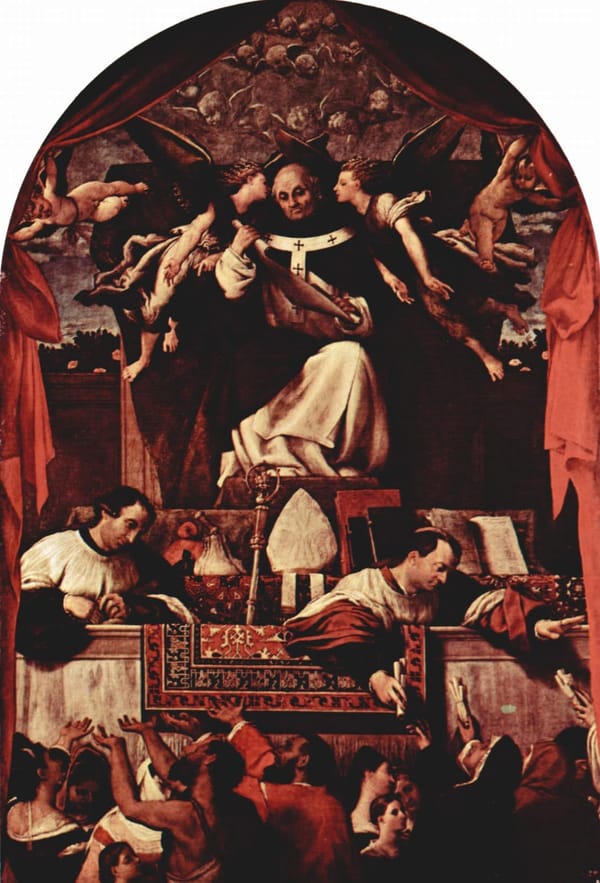 |
May 10: St. Antoninus, Bishop and Confessor
THE Order of St Dominic, which has already presented to our triumphant Jesus Peter the Martyr and Catharine the seraph of Siena, offers him to-day one of the many bishops trained and formed in its admirable school. It was in the fifteenth century, a period when sanctity was rare on the earth, that Antoninus realized in his own person the virtues of the greatest bishops of ancient times. His apostolic zeal, his deeds of charity, his mortified life, are the glory of the Church of Florence, which was confided to his care. Heaven blessed that illustrious city with temporal prosperity on account of its saintly archbishop. Cosmo de Medici was frequently heard to say that Florence owed more to Antoninus than to any other man. The holy prelate was also celebrated for his great learning. He defended the Papacy against the calumnies of certain seditious bishops in the Council of Basle: and, at the General Council of Florence, he eloquently asserted the truth of the Catholic faith, which was assailed by the abettors of the Greek schism. How beautiful is our holy Mother the Church, who produces such children as Antoninus, and has them in readiness to uphold what is true and withstand what is false!
She thus speaks the praises of the Saint of to-day:
Disciple of the great Dominic, inheritor of his burning zeal, protect the holy order which he founded, and of which thou art so bright an ornament. Show that thou still lovest it. Give it increase, and procure for its children the holiness that once worked such loveliness and fruit in the Church. Holy Pontiff, be mindful of the faithful, who implore thine intercession at this period of the year.
Thy eloquent lips announced the Pasch, so many years, to the people of Florence, and urged them to share in the Resurrection of our divine Head. The same Pasch, the immortal Pasch, has shone once more upon us. We are still celebrating it; pray that its fruits may be lasting in us, and that our Risen Jesus, who has given us life, may, by his grace, preserve it in our souls for all eternity.
May 10 (the Same Day): Sts. Gordian and Epimachus, Martyrs
TWO more martyrs ascend from our earth on this day and are admitted to share in Jesus’ glory. Again it is Rome that deputes them to bear her homage to the Conqueror of Death. Gordian was one of the magistrates who were commissioned, under Julian the Apostate, to persecute the Christians. One day, whilst exercising his office, he suddenly descended from the tribunal and took his place among the criminals. He was soon called upon to shed his blood for the faith. His martyrdom, together with that of the illustrious brothers, John and Paul, whose feast we shall keep in June, closes the period of the pagan persecutions in the West. The fact of his being buried in the crypts on the Latin Way awakened the memory of another martyr, whose relics, half consumed by fire, had long before been brought thither from Alexandria. His name was Epimachus; and on this day the two martyrs were inseparably united in the devotion of the faithful. Neither the place nor the period of their combat was the same; but both of them fought for the one cause and won the same victory. The two conquerors are buried in peace in the Eternal City; but he, for whose name they delivered their bodies to death, is mindful of their precious remains. Yet a little while, and he will fulfil, in their regard, the promise he made when he said: I am the Resurrection and the Life. He that believeth in me, although he he dead, shall live.1
Sleep your sleep of peace, O holy martyrs! Rest yet a little time, till your fellow-servants and brethren, who are to be slain even as you, shall be filled up.2 The number has been added to in every century; but the world is now near its end, and its last period is to be rich in martyrdom. When the reign of the man of sin3 begins its course, and the final tempest rages against the bark of holy Church, then, O martyrs of Christ, protect the Christian people, in return for the yearly tribute of honour that it has paid to your venerable names. Pray also for those living during these sad times, whose miseries seem like the distant howling of the storm that is to precede the end of the world. Strengthen our hearts, O holy martyrs! and whatever may be the lot prepared for us by Providence, obtain for us that we may be faithful to him, who would be to us what he has been to you—the Resurrection and the Life.4
Wednesday of the Fourth Week after Easter
THE Son of God is soon to ascend to his Father. He has said to his Apostles: Going, teach all nations: preach the Gospel to every creature. Thus, then, the nations are not to receive the word from the lips of Jesus, but through his ministers. The glory and happiness of being instructed directly by the Man-God were for none but the Israelites, and even for them for only three short years.
The impious may murmur at this, and say, in their pride:’Why should there be men between God and us?' God might justly answer:’And what right have you to expect me to speak to you myself, seeing that you can otherwise be as certain of my word as though you heard it from myself V Was the Son of God to lose his claim to our faith unless he remained on this earth to the end of time? If we reflect on the infinite distance there is between the Creator and creature, we shall detest such a blasphemy. If we receive the testimony of men, the testimony of God is greater:1 and how can we reject it? Can we call that testimony human, which was given by the Apostles, when, in proof of their being sent by God, they showed the power, conferred on them by their divine Master, of working miracles? Of course the pride of reason may rebel; it may protest, and refuse to believe men who speak in God’s name. Did not the very Son of God meet with more unbelievers than believers? And why? Because he affirmed himself to be God, yet showed nothing exteriorly but his human nature. So that there was an act of faith to be made, even when Jesus himself spoke; and pride might rebel, and say:’I will not believe just as it will do when the Apostles speak in his name. The two cases are alike. God demands of us, as long as we are in this world, that we give him our faith; and faith is not possible without humility. God confirms his word by miracles; but man has always the power to resist, and for that very reason faith is a virtue.
If it be asked—why, when God took his Son from this earth, he did not commission his angels to teach us in his name, instead of giving such a sublime office to men, frail and mortal as we ourselves are who receive their teaching—the reason is, that man could not be raised up from the state of degradation into which he had fallen by pride, except by submission and humility; and consequently, it was fitting that the ministry of the divine word should not be entrusted to angels, inasmuch as our pride might have been flattered by our having for our teachers beings so noble and exalted. We believed the serpent when he spoke to us, and we had the pride to think that we might one day become gods: our merciful Creator, in order to save us, has imposed it as a law upon us, that we should yield submission to men, when they speak in his name.
These men, therefore, are to preach the Gospel to every creature; and he that believeth not, shall be condemned. O word of God! thou heavenly seed planted in the field of the Church, how fruitful hast thou not been! Yet one little while, and the harvest will be ripe. Faith will have spread throughout the world; the faithful shall be found in every land. And how came they by the faith? By hearing, answers the great Apostle of the Gentiles.2 They heard the word, and they believed. How honoured above the rest of our senses is our hearing, at least in this present life! Let us listen to St Bernard, speaking on this subject.’One would have thought that the Truth would have entered into our souls by that noblest of our senses, the eye: but no, my soul! that is reserved for the future life, when we shall see face to face. For the present, let the remedy come in by the same door through which crept the malady; let life, and light, and the antidote of truth, come to us in the track previously taken by death and darkness, and the serpent’s poison. Thus the troubled eye will be cured by the ear, and will see, when calm, what she cannot when troubled. The ear was the first door of death; let it be the first to be opened to life. The ear took away our Light; let it now restore our Light; for unless we believe, we shall not understand.3 Hearing, therefore, is the instrument of our merit; sight is to be our reward . . . . Observe, too, how the Holy Ghost follows this order in the spiritual education of the soul: he forms the ear, before he gladdens the eye. He says to her: Hearken, O daughter, and see!4 Forget thine eye for the present: it is thine ear I now ask for. Dost thou wish to see Christ? First hear him; hear what is said of him: that so, when thou dost see him, thou mayest say: As we have heard, so have we seen!5 The brightness is immense; thine eye is weak; and thou canst not bear the splendour. But what thine eye cannot do, thine ear can; . . . only let this ear of thine be fervent, and watchful, and faithful. Faith will give to thine eye the clearness it lost by sin; disobedience shut it, but obedience will open it.”6
To the glory of him who has sent us his word by his ambassadors, and whom we have received as himself, let us recite this ancient sequence of Saint Gall: it expresses the faith of our fathers, and this faith is ours also.
Sequence
Ac Regi Christo Deo
Solvant omnes insularum incolæ,
Quem exspectatum dies jam tenent, et leges ejus
Mentibus captent promptulis.
Quos derelicto populo
Delegit Judæo,
De Abrahæ carne genito,
Quos Abrahæ natos fecit, et cognatos
Suum sanctum per sanguinem.
O Christe,
Consanguinee naturae nostrae, nos fove,
Tuere ab omni incursu inimici, et insidiis.
Quem per carnis edulium
Delusisti hamo tuae majestatis, Fili Dei.
Tu resurgens imperitas,
Non moriturus amplius.
Tu mortalem nostram
Et terream naturam
Resurgens incorruptivam fecisti,
Atque cœlis invexisti.
render thanks to Christ,
our Saviour, King and God,
The Expected One, who is at length come,
and whose Law is now devoutly obeyed by mankind.
He cast off the Jewish people,
who were born
of Abraham according to the flesh;
And he chose, for his own,
them that he made children of Abraham by faith,
them that he had made his brethren by his precious Blood.
O Jesus
who art united to us by the bond of consanguinity! protect us,
And, by thy divine power,
defend us from every attack and snare of the enemy.
Thou, O Son of God! didst show him the Flesh thou hadst assumed,
and he, taking it, was taken by the hook of thy divinity.
Rising again, thou triumphest,
for death shall never more triumph over thee.
By thy Resurrection,
thou gavest incorruptibility
to our mortal and earthly nature,
and didst raise it to heaven.
| Previous Tuesday of the Fourth Week after Easter | Next May 10 (the Same Day): Sts. Gordian and Epimachus, Martyrs |