Daily reading
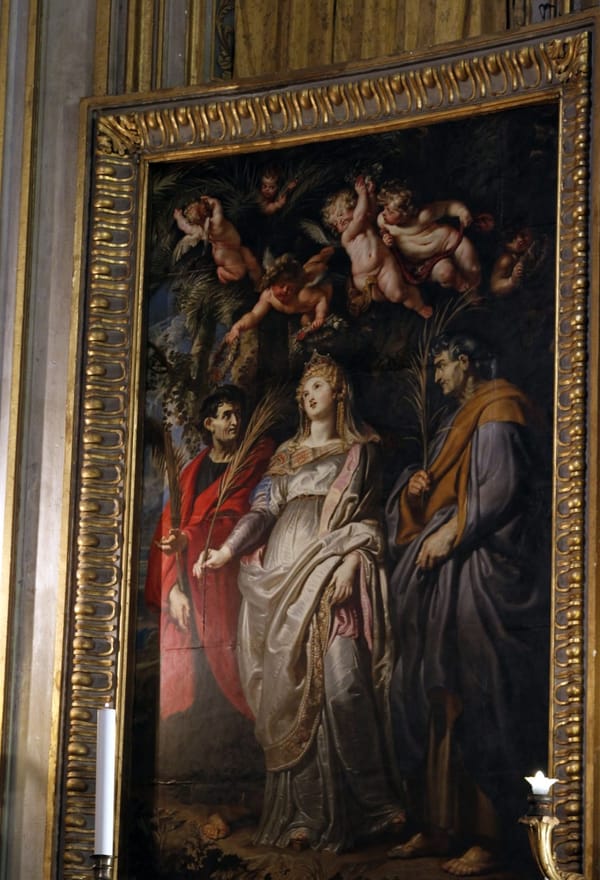
May 12: Sts. Nereus and Achilleus, Martyrs, and St. Flavia Domitilla, Virgin and Martyr
SO far in our Paschal season, the choir of Virgin martyrs has not yet offered to Jesus its crown of roses and lilies. It does so to-day, by presenting to him the noble Flavia Domitilla, the fairest flower of Rome, that was cut down by the sword of martyrdom in the first age of the Christian faith. It was under the persecution of Domitian—during which John the Evangelist was condemned to be burned alive in the cauldron of boiling oil—that Flavia Domitilla was honoured with banishment and death for the sake of our Redeemer, whom she had chosen for her Spouse. She was of the imperial family, being a niece of Flavius Clemens, who adorned the consular dignity by martyrdom. She was one of the Christians belonging to the court of the Emperor Domitian, who show us how rapidly the religion of the poor and humble made its way to the highest classes of Roman life. A few years previous to this, St Paul sent to the Christians of Philippi the greetings of the Christians of Nero's palace.1 There is still extant, not far from Rome, on the Ardeatine Way, the magnificent subterranean cemetery which Flavia Domitilla ordered to be dug on her prædium, and in which were buried the two martyrs, Nereus and Achilleus, whom the Church honours to-day together with the noble virgin who owes her crown to them.
Nereus and Achilleus were in Domitilla’s service.2 Hearing them one day speaking of the merit of virginity, she there and then bade farewell to all worldly pleasures, and aspired to the honour of being the Spouse of Christ. She received the veil of consecrated virgins from the hands of Pope St Clement: Nereus and Achilleus had been baptized by St Peter himself. What glorious reminiscences for one day!
The bodies of these three Saints reposed, for several centuries, in the Basilica, called the Fasciola, on the Appian Way; and we have a Homily which St Gregory the Great preached in this Church on their feast. The holy Pontiff dwelt on the vanity of the earth’s goods; he encouraged his audience to despise them by the example of the three martyrs whose relics lay under the very altar around which they were that day assembled.
These Saints, [said he] before whose tomb we are now standing, trampled with contempt of soul on the world and its flowers. Life was then long, health was uninterrupted, riches were abundant, parents were blessed with many children; and yet, though the world was so flourishing in itself, it had long been a withered thing in their hearts.3
Later on, in the thirteenth century, the Fasciola having been almost reduced to ruins by the disasters that had befallen Rome, the bodies of the three Saints were translated to the Church of St Adrian, in the Forum. There they remained till the close of the sixteenth century, when the great Baronius, who had been raised to the Cardinalate, with the title of Saints Nereus and Achilleus, resolved to repair the Church that was thus entrusted to his care. Through his munificence, the naves were restored; the history of the three martyrs was painted on the walls; the marble pulpit, from which St Gregory preached the Homily, was brought back, and the Homily itself was graven, from beginning to end, on the back; and the Confession was enriched with mosaics and precious marbles, preparatory to its receiving the sacred relics, of which it had been deprived for three hundred years.
Baronius felt that it was high time to put an end to the long exile of the holy martyrs, whose honour was now so specially dear to him. He organized a formal triumph for their return. Christian Rome excels in the art of blending together the forms of classic antiquity and the sentiments inspired by faith. The chariot, bearing a superb canopy, under which lay the relics of the three martyrs, was first led to the Capitol. On reaching the top of the clivus Capitolinus, the eye met two inscriptions, placed parallel with each other. On one were these words: ' To Saint Fla via Domitilla, Virgin and Martyr of Rome, the Capitol, purified from the wicked worship of demons, and restored more perfectly than by Flavius Vespasian and Domitian, Emperors, kinsmen of the Christian Virgin.' On the other: ‘The Senate and People of Rome to Saint Flavia Domitilla, Virgin and Martyr of Rome, who, by allowing herself to be put to death by fire for the faith of Christ, brought greater glory to Rome than did her kinsmen, the Emperors Flavius Vespasian and Domitian, when, at their own expense, they restored the Capitol, that had twice suffered from fire.'
The reliquaries of the martyrs were then placed on an altar that had been erected near the equestrian statue of Marcus Aurelius. After being venerated by the faithful, they were replaced on the chariot, which descended by the opposite side of the Capitol. The procession soon reached the triumphal arch of Septimius Severus, on which were hung these two inscriptions:
To the holy Martyrs Flavia Domitilla, Nereus and Achilleus, the best of citizens, the Senate and People of Rome, for their having honoured the Roman name by their glorious death, and won peace for the Roman commonwealth by shedding their blood.
To Flavia Domitilla, Nereus and Achilleus, the invincible Martyrs of Christ Jesus, the Senate and People of Rome, for their having honoured the City by the noble testimony they bore to the Christian Faith.
Following the Via Sacra, the procession was soon in front of the triumphal arch of Titus, the monument of God’s victory over the deicide nation. On one side were inscribed these words: 'This triumphal arch, formerly dedicated and raised to the Emperor Titus Flavius Vespasian, for having brought the rebellious Judea under the yoke of the Roman people, is now, by the Senate and People of Rome, more auspiciously dedicated and consecrated to Flavia Domitilla, kinswoman of the same Titus, for having, by her death, increased and furthered the Christian Religion.'
On the other side of the arch was the following inscription: ‘To Flavia Domitilla, Virgin and Martyr of Rome, kinswoman of the Emperor Titus Flavius Vespasian, the Senate and People of Rome, for her having, by shedding her blood and laying down her life for the Faith, rendered a more glorious homage to the death of Christ than did the said Titus, when by divine inspiration he destroyed Jerusalem, to avenge that same death.'
Leaving on the left the Coliseum, the hallowed ground whereon so many martyrs had fought the battle of faith, they passed under the triumphal arch of Constantine, which so eloquently speaks of the victory of Christianity, both in Rome and the Empire, and which still bears on it the name of the Gens Flavia, of which the first Christian Emperor was a member. The two following inscriptions were attached to the arch:
To Flavia Domitilla, Nereus and Achilleus, the Senate and People of Rome. On this sacred way, whereon so many Roman Emperors received triumphal honours for having brought various provinces into subjection to the Roman People, these martyrs receive to-day a more glorious triumph, for that they con quered, by a greater courage, the conquerors themselves.
To Flavia Domitilla, the Senate and People of Rome. Twelve Emperors, her kinsmen, conferred honour on the Gens Flavia and on Rome herself by their deeds of fame; but she, by sacrificing all human honours and life itself for Christ's sake, rendered greater service to both family and City than they.
The procession then continued its route along the Appian Way, and at length reached the Basilica. Baronius, assisted by a great number of Cardinals, received the precious relics, and took them with great respect to the Confession of the High Altar. Meanwhile the choir sang this Antiphon of the Pontifical: * Enter, ye Saints of God! for a dwelling hath been prepared for you by the Lord. The faithful people have followed you on your way, that ye may intercede for them with the majesty of the Lord. Alleluia!'
The following is the account of our three martyrs as given in the Liturgy:
How grand was the triumph which Rome gave to you, O holy martyrs, so many centuries after your glorious deaths! How true it is that there is no glory here on earth which can bear comparison with that of the saints! Where are now those twelve Emperors, thy kinsmen, O Domitilla? Who cares for their remains? Who even cherishes their memory? One of them was sur~ named ‘the delight of mankind '; and now how many there are who have never heard of his existence! Another, the last of the twelve, had the glory of proclaiming the victory won by the Cross over the Roman Empire; Christian Rome honours and loves his name; but the homage of religious devotion is not given to him, but to thee, O Domitilla, and to the two martyrs whose names are now associated with thine.
Who does not recognize the power of Jesus' Resurrection in the love and enthusiasm wherewith a whole people welcome your holy relics, O martyrs of the living God? Fifteen hundred years had elapsed; and yet your lifeless remains were greeted with a transport of joy, as though you yourselves were there, and living. It was because we Christians know that Jesus, who is the first-born of the dead,4 has risen from the grave; and that you, like him, are one day to rise in glory. Therefore do the faithful honour by anticipation the immortality which, at a future period, is to be given to your bodies, once slain for Jesus' sake; they already see by faith the future brightness which is to be imparted to your flesh; and thus they proclaim the dignity which the Redemption has given to man, to whom death is now but a transition to true life, and the tomb but a resting-place where the body is consigned, as seed to the earth, to be restored in a hundredfold of richer beauty.
Happy they who, as the prophecy says, have washed their robes and have made them white in the Blood of the Lamb!5 But happier they, says Holy Church, who, after being thus purified, have mingled their own blood with that of the divine Victim! for by so doing they have filled up in their flesh those things that are wanting of the sufferings of Christ.6 Hence, their intercession is powerful, and we should address our prayers to them with love and confidence. Befriend us, then, O holy martyrs Nereus, Achilleus, and Domitilla! Obtain for us an ardent love for our Risen Jesus; perseverance in the new life which he has conferred upon us; detachment from the things of this world, and a determined resolution to trample them beneath our feet, should they become a danger to our eternal salvation. Pray for us, that we may be courageous in resisting our spiritual enemies, ever ready to defend our holy faith, and earnest in our endeavours to gain that kingdom which is to be borne away by violence.7 Be the defenders of the holy Roman Church, which fervently celebrates your memory each year. You, Nereus and Achilleus, were converts of Peter; and thou, Domitilla, wast the spiritual daughter of Clement, Peter's successor; protect the Pontiff who now governs the Church—the Pontiff, in whom Peter still lives—the Pontiff, the successor of Clement. Dispel the storms which are threatening the Cross on the Capitol, and pray for the inhabitants of Rome, that they may be staunch to the faith.
- Phil, iv 22. ↩︎
- The Acts of these two Saints—which were drawn up long after their martyrdom, and on which were formed the Lessons of to-day’s Office—call them “eunuchs”: but it is a mistake of the compiler, who belongs to the fifth or sixth century. The introduction of eunuchs into the Imperial Court, and into the Roman families, is of a later date than the reign of Domitian. ↩︎
- Homil. xxviii in Evang. ↩︎
- Apoc. i 5. ↩︎
- Ibid. vii 14. ↩︎
- Coloss. i 24. ↩︎
- St Matt. xi 12. ↩︎
May 12 (the Same Day): St. Pancras, Martyr
A FOURTH martyr claims our veneration on this twelfth day of May. Like the three others, he culled his palm at Rome. But whilst they died for the faith at the very commencement of the Christian era, Pancras was not called to the glorious combat till the persecution under Diocletian—the last and greatest effort of pagan Rome against the Church. Our young hero was only fourteen years of age; but he was old enough to be a brave martyr, and he has been honoured by a commemoration in Paschal Time. The venerable Church in the Holy City which is dedicated to him, and which gives a title to one of the Cardinals, was built on the site of the cemetery where his body was buried. The following commemoration is made of him in the Matins of this feast:
Divine grace, which called thee to the crown of martyrdom, selected thee, O Pancras, from the distant land of Phrygia, and led thee to the capital of the empire—the centre of every vice and every error of paganism. Thy name, like those of millions of others who were better known to the world, had else been quite forgotten. But now, though thy earthly career was soon ended, the name of Pancras is loved and venerated throughout the whole earth: it is breathed at the altar, in the prayers which accompany the sacrifice of the Lamb. How camest thou, dear youthful martyr, by this celebrity, which will last to the end of the world? It was because, having imitated Jesus' Death by suffering and shedding thy blood for his name, thou hast been made a sharer in the glory of his immortality. In return for the honour we pay thee, deign to aid us by thy protection. Speak of us to Jesus, who is our divine Master, as he was thine. In this vale of our exile, we sing our Alleluia for his Resurrection, which has filled us with hope; obtain for us, by thy prayers, that we may sing Alleluia with thee in heaven, where it will be eternal, and be prompted, not by the gladness of hope, but by the bliss of possession.
Friday of the Fourth Week after Easter
PRAISE be to our Risen Jesus, for his having said to us: He that believeth and is baptized, shall be saved!1 Thanks to his infinite mercy, we believe and have been baptized; we are, therefore, in the path of salvation. It is true that faith will not save us without good works; but, on the other hand, good works without faith cannot merit eternal salvation. With what transport of joy ought we not to give thanks to God, for his having produced in us, by his grace, this unspeakable gift,2 this first pledge of our everlasting happiness! How carefully ought we not to strive to keep it pure, yea and increase it by our fidelity! Faith, like other virtues, has its degrees: we should, therefore, frequently use the prayer addressed to Jesus by his Apostles: Lord! increase our faith!3
We are living in an age when faith is weak amongst the majority even of them that believe; and it is one of the greatest dangers that could befall us in this world. When faith is weak, charity must needs grow cold. Our Saviour one day asked his disciples if they thought that he would find faith upon the earth when he should come to judge mankind.4 Have we not reason to fear that we are fast approaching that awful time, when the want of faith will paralyze men's hearts?
Faith proceeds from our will moved by the Holy Ghost. We believe because we wish to believe; and for this reason it is a happiness to believe. The blind man to whom Jesus restored his sight said to him, when he bade him believe in the Son of God: Who is he, Lord? that I may believe in him.5 These same dispositions ought to animate us, when there is question of our making an act of faith—we should believe, in order that we may know that which, without faith, we could not know: then will God manifest himself to both our mind and heart.
You will meet with Christians who seem to make it their business to keep down the faith of their friends as much as possible. They seem to be jealous of faith getting too much; are ever talking about the rights of reason; and will have it that they who are so ready to believe are guilty of underrating the dignity, range, and divine origin of reason. Let them that are thus accused, answer: ‘We are far from denying the existence of that natural light within us, which is called reason. The teaching of the Church is too express on this point to admit of any doubt; but she also teaches us that this light—even had it retained its primal power, and had not been obscured by original sin—is incapable of discovering, by itself alone, the end for which man was created, and the means whereby that end is to be gained. Faith alone can enable man to attain to such sublime knowledge as this.’
Others, again, maintain that as soon as a Christian comes to the full age of reason, he has a right to suspend the exercise of his faith, in order that he may examine for himself whether it be reasonable or not to continue believing. Such an opinion is most false and has made many an apostate. The Church has ever taught from the days of the Apostles down to our own times, and will so teach to the end of the world, that the child who has received holy baptism has also, and at that same instant, received the gift of infused faith; that he thereby became a member of Christ, and child of his Church; and that if, when he comes to the age of reason, he should be tempted with doubts regarding matters of faith, he receives grace to resist those doubts by faith, and that he would be risking his salvation were he to suspend his faith. This does not imply that the Church forbids him to confirm his faith by study and science; far from it. This is a totally different thing from suspension of one’s faith; it is, according to the admirable saying of the great St Anselm,’faith seeking understanding,’ and, we may add, finding it, for God gives this recompense to faith.
You may probably meet with persons who think it right that there should be found among us a class of men, called free-thinking philosophers, that is to say, men without faith, who hold, with regard to God and creatures, doctrines which are wholly independent of revelation, and who teach a morality that entirely ignores the supernatural element. Is it possible that Catholics can not only countenance and praise such men as these, but even defend them, and be partial towards them?
And what must we say of the sad effects resulting from living with heretics? Most of us could give instances of the dangerous compromises and deplorable concessions made in consequence of much intercourse with those who are not of the faith. The terrible line of demarcation specified by St John, in his second Epistle,6 is being forgotten; the very mention of it is offensive to modern ears. A strong indication of this is to be found in the frequency of mixed marriages, which in a number of cases, though often by imperceptible degrees, result in leading the Catholic party to religious indifference. Let us listen to the energetic language of that illustrious ascetical writer, Father Faber:’The old-fashioned hatred of heresy is becoming scarce. God is not habitually looked at as the sole Truth; and so the existence of heresies no longer appals the mind. It is assumed that God must do nothing painful, and his dominion must not allow itself to take the shape of an inconvenience or a trammel to the liberty of his creatures. If the world has outgrown the idea of exclusiveness, God must follow our lead, and lay it aside as a principle in his dealings with us. What the many want they must have at last. This is the rule and the experience of a constitutional country. Thus discord in religion, and untruth in religion, have come to be less odious and less alarming to men, simply because they are accustomed to them. It requires courage, both moral and mental, to believe the whole of a grand nation in the wrong, or to think that an entire country can go astray. But theology, with a brave simplicity, concludes a whole world under sin, and sees no difficulty in the true Church being able to claim only a moderate share of the population of the earth. The belief in the facility of salvation outside the Church is very agreeable to our domestic loves and to our private friendships. Moreover, if we will hold this, the world will pardon a whole host of other superstitions in us, and will do us the honour of complimenting the religion God gave, as if it were some literary or philosophical production of our own. Is this such a huge gain? Many seem amazingly pleased with it, and pay dear for it quite contentedly. Now it is plain that this belief must lower the value of the Church in our eyes. It must relax our efforts to convert others. It must relax our efforts to convert ourselves. Those who use the system of the Church least will of course esteem it least, and see least in it; and are therefore least fitted to be judges of it. Yet it is just these men who are the most forward and the most generous in surrendering the prerogatives of the Church to the exigencies of modern smoothness and universalism.'7 Another sign of the decay of the spirit of faith, even among many of those who do not neglect their religion, is the disregard for, one might almost say the ignorance of, holy practices recommended by the Church. How many Catholic houses are there, where there is never a drop of Holy Water, or a blessed Candle, or a Palm to be seen? These sacred objects, given to us to be a protection, deserve from us that same reverence and love which our forefathers had when they defended them, even at the risk of their lives, against the Protestants of the sixteenth century. What a jeering look of incredulity is evinced by many amongst us, when mention is made of any miracle that is not found in the Bible! With what an air of contemptuous disbelief they hear or read of anything in connection with the mystic life, such as ecstasies, raptures, or revelations! How uneasy they seem, when the subject of the heroic acts of penance done by the Saints, or of the simplest practices of bodily mortification, happens to come across them! How loudly and pathetically do they not protest against the noble sacrifices which some favoured souls are inspired to make, whereby they break asunder the dearest ties, and shut themselves out of the world, behind the grille of a monastery or convent! The spirit of faith makes a true Catholic appreciate the beauty, the reasonableness, and the sublimity of all these practices and acts; whilst the want of this spirit makes them be condemned as extravagant, unmeaning, and folly.
Faith longs to believe; for believing is its life. It limits not itself to the strict Creed promulgated by the Church. It knows that the Spouse of Christ possesses all truths, though she does not solemnly declare them all, nor under the pain of anathema. Faith forestalls the declaration of a dogma; it believes piously, before believing under obligation. A secret instinct draws it towards this as yet veiled truth; and when the dogma is published by a definition of the supreme Pontiff, then does this same faith rejoice in the triumph of the truth which was revealed from the very commencement of the Church; and its joy is great in proportion to the fidelity wherewith it honoured the truth, when only generous and loyal hearts embraced it.
Glory, then, be to our Risen Jesus, who requited his Mother’s faith, who strengthened that of the disciples and the holy women, and who, as we humbly pray, will mercifully reward ours. Let us offer him our homage, in the words of a sequence from the ancient Missal of Saint Gall.
Sequence
Atque Redemptoris gloriam.
Astutia callidi serpentis,
Sua refecit gratia.
Futurum ut germen
Sancta proferret fœmina;
Nociva exsuperaret capita.
Cernunt saecula.
Novo pollet Maria.
Mire edidit miracula.
Sed statim inter suæ nativitatis primordia.
Per Simeonis verba
Judaica ad se vel corda, vel munera
Attrahens nutu gentilia.
Atque Spiritus Sanctus specie, glorificat.
Docent auctoritate sua.
Dona dedit multa,
Doctrinaeque perplura verba
Ore suo promulgavit saluberrima;
Colaphos, et flagella,
Vestem quoque ludo quæsitam,
Et spineum venit sertum
Ad crucis brachia.
A mortuis resurgens,
Sprevit victoria, ducens secum primitiva
Ad coelos membra,
Et nuper dispersa
Revocans ovilia.
Licet ultima membra simus, spondet dona.
of our Creator and Redeemer!
to them whom he had created aright,
yet who were seduced by the cunning of the crafty serpent.
that a holy Woman would,
one day, bring forth a Fruit,
the baneful head of the old enemy.
these promises that were long forgotten.
put forth a new Flower.
and miracles marked his life,
but immediately after his birth.
and by Simeon’s words,
he drew to himself the heart of the Jew
and the gift of the Gentile.
and by the visible form under which the Holy Ghost appeared.
were appointed to teach others in his name.
abundant gifts of salvation,
and promulgating, with his own lips,
the doctrine of eternal life,
in which he was insulted, spit upon,
buffeted, scourged, vested as a mock-king,
crowned with thorns,
and nailed to a Cross.
he rises triumphant from the grave;
he takes them that belonged to the generations of old,
and leads them with himself to heaven;
he forms into one fold
the scattered sheep.
he promises future gifts, and bids us hope.
| Previous Thursday of the Fourth Week after Easter | Next May 12 (the Same Day): St. Pancras, Martyr |