Daily reading
Paschal Time
Double · May 17 · Sanctoral
May 17, 2028
From Dom Guéranger’s The Liturgical Year.
A Double leads the weekday.Rubric
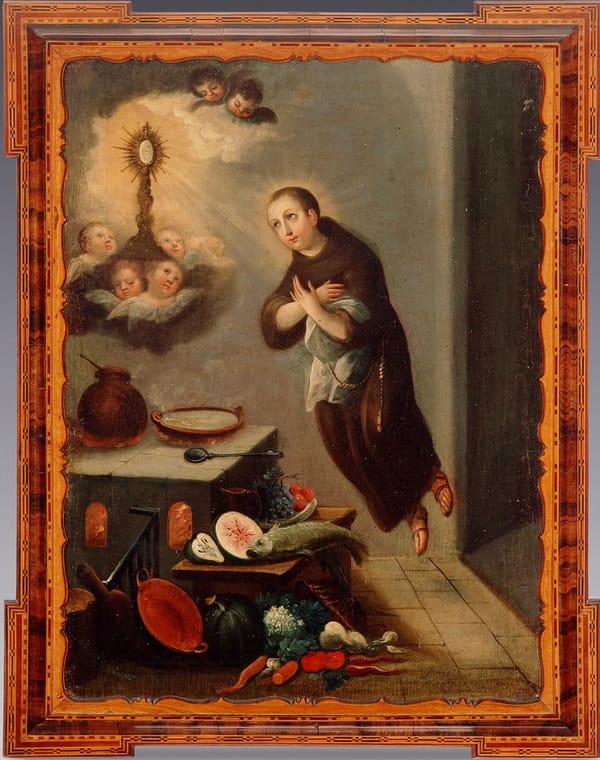 |
May 17: St. Paschal Baylon, Confessor
THE Seraph of Assisi was sure to depute some of his children to pay their court to his Risen Master. The one he sends to-day is the humblest and most obscure of men; another will follow, three days hence, powerful in word and work, and holding a palm in his hands, as a most devoted preacher of the Gospel. Paschal Baylon was a simple peasant. He was a shepherd-boy; and it was in tending his flock that he found the Lord Jesus. He had a great love for contemplation. Forests and fields spoke to him of their great Creator; and, in order that he might be the more closely united with him, he resolved to seek him in the highest paths of perfection. He was ambitious to imitate the humble, poor and suffering life of the Man-God; the Franciscan Cloister offered him the opportunity of satisfying this desire and he flew to it. On that blessed soil, he grew to be one of heaven's choicest plants, and the whole earth has now heard the name of the humble lay-brother of a little convent in Spain. Holy Church brings him before us to-day enraptured in the contemplation of Jesus' Resurrection. He had trod the path of humiliation and the cross; it was but just that he should share in his Master's triumph. It was of him, and of such as he, that this divine Saviour spoke, when he said: Ye are they that have continued with me in my temptations; and I dispose to you, as my Father hath disposed to me, a kingdom; that ye may eat and drink at my table in my kingdom, and may sit upon thrones, judging the twelve tribes of Israel.1
The account given by the Liturgy of the angelic life of this illustrious son of St Francis is as follows:
Heaven opened to receive thee, O Paschal! Even when here below, the fervour of thy contemplation often gave thee a foretaste of the delights of eternal bliss; but now every veil is drawn aside, and thou art face to face with him whom thou didst so ardently desire to possess. Thou hast no further need to unite thyself with him by humiliation and suffering; thou enjoyest his own glory, his own happiness, his own triumph, and he will have thee enjoy it for all eternity. Deign to cast an eye of pity on us, who have not thy eagerness to walk in our Redeemer’s footsteps, and who, as yet, have but the hope of being united to him for eternity. Gain for us courage. Gain for us that love which leads straight to Jesus, which surmounts every obstacle of flesh and blood, and gives to man an admirable resemblance to his divine Model. The pledge of this happy transformation has been given to us by our being permitted to partake of the Paschal Mystery; may it be perfected by our fidelity in keeping close to our divine conqueror and Lord! Though he leave us some time further in this vale of tears, his eye is ever upon us, he longs to see us persevere in our loyalty to him. Yet a little while, and we shall see him! Behold! says he, I come quickly; hold fast that which thou hast. Behold! I stand at the gate and knock. If any man shall hear my voice, and open to me the door, I will come in to him, and will sup with him, and he with me.2 Thus will the Pasch of time be changed into the Pasch of eternity. Pray for us, O Paschal, that like thee, we may hold fast that which, by the grace of our Risen Jesus, we already possess.
Wednesday of the Fifth Week after Easter
WE now come to the fourth sacrament, which may be justly called the sacrament of mercy. Jesus knew the weakness of man. He knew that the great majority of Christians would not persevere in the grace they received at baptism; and that sin would in most cases spoil the beautiful plant which had been watered by the dew of heaven, and which, after growing and flowering, was to be transplanted into the garden of eternal life. Like grass that lies withered on the field, so would be this once fair plant. How could it ever revive, unless he that made it gave it life again? Thanks to his infinite mercy, this is what he has the will to do. Consulting the sinner's salvation rather than his own glory, he prepared, as the holy Fathers express it, a second plank after shipwreck. The first was baptism; but mortal sin came, and the soul was again plunged into the wild abyss. She had fallen once more into the hands of her enemy; she was fettered by chains which it was out of her power to break.
During his mortal life on earth, Jesus, who came not to judge the world, hut to save it,1 declared that these fetters, forged by the sinner’s malice, should be broken by a power which he would one day establish in his Church. Speaking to his Apostles, he told them that whatsoever they should loosen upon earth, should he loosed also in heaven.2 Since making that solemn promise, our Redeemer has offered his sacrifice on the Cross; his infinitely precious Blood has been shed for the superabundant expiation of the sins of the world. He that loved us to such a degree as this could never forget the promise he had made. On the contrary, he was most anxious to keep it, for he knew the fearful dangers to which our salvation is exposed. On the very day of his Resurrection, he appears to his Apostles, and his first words evince his eagerness to fulfil the promise he had previously made. It seems as though his mercy were impatient to break asunder the humiliating and terrible bonds of sin, which held us captives. No sooner has he breathed the Holy Ghost upon his Apostles, than he adds these words: Whose sins ye shall forgive, they are forgiven them.3 Observe here, as the holy Fathers have done, the strength of the words spoken by our Lord: They are forgiven. He says not, ‘they shall be forgiven;’ it is no longer the promise of a gift, but the gift itself. Before the Apostles have exercised the divine power conferred on them by Jesus, every absolution which they and their successors in this sacred ministry shall pronounce, even to the end of time, is already confirmed.
Glory, then, be to our Risen Jesus, who has removed the barriers of his justice, that his mercy might inundate the world! Let mankind unite and sing to him the sublime canticle of David, wherein, foreseeing the wondrous events that were to take place under the New Law, this royal psalmist prophesied the forgiveness of sins, which the Apostles were afterwards to teach us as an Article of our Creed.
Bless the Lord, O my soul! and let all that is within thee bless his holy Name. Who forgiveth all thine iniquities, who healeth all thy diseases, who redeemeth thy life from destruction.
Thy youth shall be renewed like the eagle's. The Lord is compassionate and merciful, long-suffering and plenteous in mercy. He will not always be angry. He hath not dealt with us according to our sins. As far as the east is from the west, so far hath he removed our iniquities from us.As a father hath compassion on his children, so hath the Lord compassion on them that fear him; for he knoweth our frame; he remembereth that we are dust. Man's days are as grass; as the flower of the field, so shall he flourish; for the spirit shall pass in him, and he shall not be, and he shall know his place no more. But the mercy of the Lord is from eternity and unto eternity upon them that fear him. O my soul! bless thou the Lord.4
And yet we, the children of the promise, know even better than David did the greatness of God’s mercy. Jesus was not content with giving us his assurance that if, after having sinned, we have recourse with humble repentance to the divine Majesty, we shall obtain pardon: as the sentence of God’s mercy would thus be without any outward sign, a cruel anxiety would have ever been upon us, leaving us in doubt of our forgiveness. Therefore did this loving Saviour ordain that men should give us pardon, in his name. That we might know that the Son of Man hath power on earth to forgive sins,5 he gave power to his delegates to pronounce over us a sentence of absolution which our very ears might hear, and which would convey to our souls the sweet confidence of pardon.
O ineffable sacrament, by whose means heaven is peopled by countless numbers who else had been lost, and who will for ever sing the mercies of the Lord!6 O irresistible power of the words of absolution, which, deriving their efficacy from the Blood of our Redeemer, take away all our iniquities, and plunge them into the abyss of divine mercy! The eternity of torments due to these iniquities would never have expiated them; and yet these few words of the priest: I absolve thee, have utterly annihilated them.
Such is the sacrament of penance. In return for the humble confession of our sins and the sincere sorrow for having committed them, we receive pardon, and this not once or twice only, but as often as we approach the sacred tribunal; not for this or that kind of sin only, but for every sin whatsoever. It is not to be wondered at that Satan should envy man this gift, and strive to throw such doubts and difficulties in the way as to prevent his profiting by it. What has not heresy said against this sacrament? It began by teaching that it takes from the glory of holy baptism; whereas on the contrary, it honours that first sacrament, by repairing the injuries done to it by sin. Later on, it exacted, as absolutely necessary for the sacraments, such perfect dispositions, that absolution would find the soul already reconciled with God. It was by this dangerous snare of Jansenism that so many were ruined, either by pride or by discouragement. And lastly, it has set up that Protestant dictum:’I confess my sins to God just as though God had not the right to lay down the conditions for pardon.
The sacraments being, as they are, such divine institutions, demand our faith; without faith they are simply impossibilities. Though this be true of all the seven, yet the sacrament of penance is especially welcome to a man of faith, because it so thoroughly humbles human pride. It sends man to ask of his fellow-man what God could have given directly himself. Jesus said to the lepers, whom he wished to cure: Go, show yourselves to the priests!7 Surely he has a right to act in the same manner when there is a question of spiritual leprosy.
Let us, as a homage to our generous Redeemer, offer him this Easter hymn; it is the one used by the Church in her Ferial Matins of Paschal Time.
Hymn
Rerum creator omnium,
Æqualis ante sæcula
Semper Parenti Filius.
Imaginem vultus tui
Tradens Adamo, nobilem
Limo jugasti spiritum.
Fædasset humanum genus,
Tu carne amictus perditam
Formam reformas artifex.
Nunc e sepulchro nasceris,
Tecumque nos a mortuis
Jubes sepultos surgere.
Aqua lavis baptismatis:
Hæc est lavacrum mentium,
Hæc est sepulcrum criminum.
Redemptor affixus cruci,
Nostræ dedisti prodigus
Pretium salutis sanguinem.
Paschale, Jesu, gaudium,
A morte dira criminum
Vitæ renatos libera.
Et Filio, qui a mortuis
Surrexit, ac Paraclito,
In sempiterna saecula.
Creator of all things!
Son co-equal with the Father,
before all ages!
thou gavest to Adam a resemblance to thine own divine Face;
and, to his body formed from slime,
thou joinedst a noble soul.
brought degradation upon mankind,
thou, our Maker, didst clothe thyself with flesh
and reform our lost race.
art now born from the sepulchre,
and biddest us rise with thee
from our death and burial.
who washest thy sheep in the waters of baptism:
it is the laver of our souls,
it is the grave of our sins.
upon the Cross that was due to us;
thou generously gavest us thy Blood,
as the ransom of our salvation.
Paschal joy to our hearts, free us,
who have been regenerated unto life,
from the dread death of sin.
and to the Son who rose
from the dead, and to the Paraclete,
for everlasting ages.
| Previous Tuesday of the Fifth Week after Easter | Next Wednesday of the Fifth Week after Easter |