Daily reading
Paschal Time
Double · May 19 · Sanctoral
May 19, 2028
From Dom Guéranger’s The Liturgical Year.
A Double leads the weekday; St. Pudentiana is commemorated.Rubrics
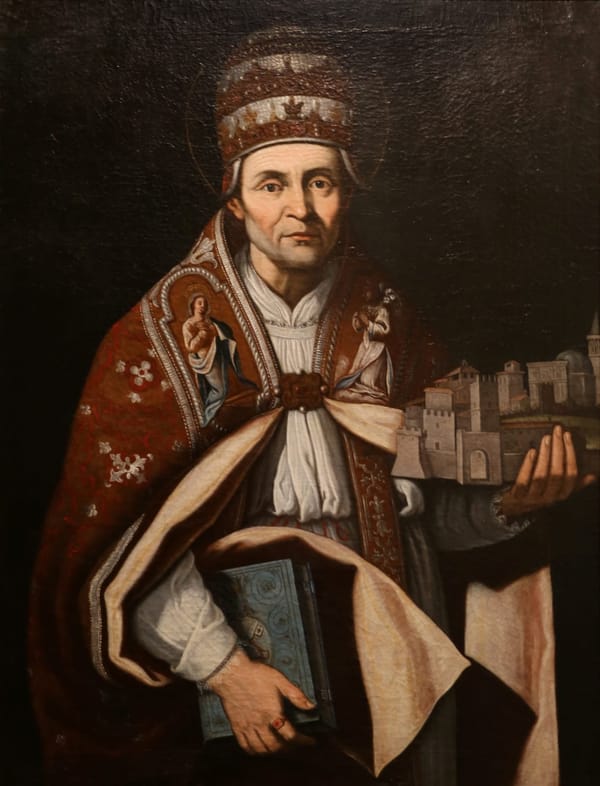 |
May 19: St. Peter Celestine, Pope
OUR Paschal season, which has already given us the admirable Doctor St Leo, brings before us to-day the humble Peter Celestine. He was, like Leo, sovereign pontiff, but no sooner was he throned on the chair of Peter than he left it and returned to solitude. Among the long list of sainted men who compose the venerable series of Roman Pontiffs, our Lord would have one in whose person was to be represented the virtue of humility; that honour was conferred on Peter Celestine. He was dragged from the quiet of his solitude, compelled to ascend the throne of St Peter, and made to hold in his trembling hand the keys of the kingdom of heaven. The holy hermit, whose eyes had been ever fixed on his own weakness, had then to provide for the necessities of the whole Church. In his humility, he judged himself to be unequal to so heavy a responsibility. He resigned the tiara, and begged to be permitted to return to his dear hermitage. His divine Master, Christ, had, in like manner, concealed his glory, first in thirty years of hidden life, and then, later on, under the cloud of his Passion and Sepulchre. The sunshine of the Pasch came; the gloom was dispersed, and the Conqueror of Death arose in all his splendour. He would have his servants share in his triumph and glory; but their share is to be greater or less, according to the measure in which they have, here on earth, imitated his humility. Who, then, could describe the glory which Peter Celestine receives in heaven, as a recompense for the profound humility which made him more eager to be unknown than the most ambitious of men could be for honour and fame? He was great on the pontifical throne, and still greater in his solitude; but his greatness, now that he is in heaven, surpasses all human thought.
Holy Church speaks his praise in these few lines; their simplicity admirably harmonizes with the hermit Pope, whose life they narrate:
Thou didst obtain, O Celestine, the object of thy ambition. Thou wast permitted to descend from the Apostolic Throne, and return to the quiet of that hidden life, which for so many years had been thy delight. Enjoy to thy heart's content the holy charm of being unknown to the world, and the treasures of contemplation in the secret of the face of God.1 But this life of obscurity must have an end; and then the Cross—the Cross which thou hast loved above all earthly possessions—will rise up in brightness before thy cell door, and summon thee to share in the Paschal triumph of him who came down from heaven to teach us this great truth, that he that humbleth himself shall be exalted.2 Thy name, O Celestine, will for ever shine on the list of Roman Pontiffs; thou art one of the links of that glorious chain which unites Holy Church with Jesus, her Founder and her Spouse; but a still greater glory is reserved for thee—the glory of being for ever with this same Risen Jesus. Holy Church, which during the short period of thy holding the keys of Peter, was obedient to thee, has now for centuries paid, and will continue to the end of the world to pay thee the tribute of her devotion, because she recognizes in thee one of God's elect, one of the princes of the heavenly court. And we, O Celestine, we also are invited to ascend where thou art, and contemplate, together with thee, the most beautiful among the children of men,3 the Conqueror of sin and hell. But there is only one path that can lead us thither; it is the path thou didst tread—the path of humility. Pray for us that we may be solidly grounded in this virtue, and desire it with all our hearts; that we may change our miserable self-esteem into an honest self-contempt; that we may despise all human glory, and be courageous, yea, cheerful under humiliation; and that thus having drunk of the torrent, as did our divine Master, we may one day, like him, lift up our heads,4 and cluster round his throne for all eternity.
May 19 (the Same Day): St. Pudentiana, Virgin
THIS same nineteenth of May has another glory attached to it; it is the day on which died the noble virgin Pudentiana. That name carries us back to the very first age of the Christian Church. She was a daughter of a wealthy Roman, called Pudens, a kinsman of the Pudens spoken of by St Paul, in his second Epistle to Timothy.1 She and her sister Praxedes had the honour of being numbered among the earliest members of the Church, and both of them consecrated their virginity to Jesus Christ. Upon their father’s death, the two sisters distributed their fortune to the poor, and devoted their whole time to good works. It was the eve of the persecution under Antoninus. Pudentiana, though scarcely sixteen years of age, was ripe for heaven, and winged her flight to her divine Spouse when the storm was at its height. Her sister survived her many years: we shall commemorate her saintly memory on July 21.
Pudentiana’s house, which in her grandfather’s time had been honoured by St Peter’s presence, was made over by the holy virgin herself to Pope Pius I, and the divine mysteries were celebrated in it. It is now one of the most venerable churches of Rome, and is the Station for the Tuesday of the third week of Lent.
Pudentiana is a tender floweret offered to our Risen Jesus by the Roman Church. Time has diminished nought of the fair lily’s fragrance; and pure as her very name, her memory will live in the hearts of the Christian people even to the end of the world.
The eulogy passed upon her by the holy Liturgy is but a commemoration; and yet says so much, and will say it each year, as long as time itself shall last.
Like the dove of Noe’s Ark, that found not where to rest her feet on the guilty earth, thou didst take thy flight, O Pudentiana, and rest in the bosom of Jesus, thy Spouse. Thus will it be at the end of the world, when the souls of the elect shall have been reunited to their bodies: they will fly like eagles to their King, and will cluster around him as the object of all their desires.2 They will flee from this sinful earth, as thou didst from the abominations of pagan Rome, that was drunk with the blood of the martyrs.3 We celebrate thy departure, dear youthful Saint, with a feeling of hope for our own future deliverance; we honour thy entrance into thy eternal home, and we long to be there, together with thee. Oh! gain for us detachment from all transitory things, intenser love of the new life which came to us with Easter, and indifference as to what concerns that other lower life, which is not that of our Risen Lord. Thou wast a daughter of the holy Church of Rome; pray, then, for thy mother. She is suffering now as she did during the pontificate of Pius I. After having reigned over Christian nations for centuries, she is now abandoned and disowned by the very people that owe all they have to her, and yet are now turning her own blessings against her. Use thine influence, O Pudentiana! assist and protect thine and our dearest mother.
Friday of the Fifth Week after Easter
WE have reverently followed our Redeemer in his institution of the sacramental helps, whereby man is placed and kept in the state of sanctifying grace, from his first entrance into this life to his leaving it for the eternal enjoyment of the beatific vision. We must now speak of that sublime sacrament, which was instituted by Jesus as the source whence mankind is to receive the other sacraments.
This sacrament is Holy Orders, and it is so called because of its being conferred in several distinct degrees upon those who receive it. As in heaven the angels are arranged in different ranks according as they have been endowed with a greater or less degree of light and power, in such wise that they who are higher act upon those that are lower; so it is in the sacrament of Holy Orders; there is order in the several ranks, and the higher act upon the lower by the communication of light and power. It is this that constitutes the hierarchy of the Church. Hierarchy means Sacred Government. It comprises three degrees: the episcopate, priesthood, and diaconate, in which last are included the Orders below it. This is called the hierarchy of Order, to distinguish it from the hierarchy of Jurisdiction. This second, which is entrusted with the government of the Church, is composed of the Pope, of the bishops, and of the inferior clergy to whom the Pope and bishops delegate a part of their power of government. We have already seen how this hierarchy takes its origin from that sovereign act whereby our Lord Jesus, the shepherd of men, gave to Peter the keys of the kingdom of God. The hierarchy of Order is intimately connected with the second, and its object is the sanctification of men by the administration of the treasures of grace confided to its keeping.
As we have already said, Jesus appeared to his Apostles on the day of his Resurrection, and said to them: As the Father hath sent me, I also send you.1 Now the Father sent his Son that he might be the Shepherd of men; and we have heard Jesus bidding Peter to feed his lambs and his sheep. The Father sent his Son that he might be the Teacher of men; and we have seen Jesus entrusting to his Apostles the truths which were to be proposed to us as the object of our faith. But the Father sent the Son that he might also be the High Priest of men; Jesus must, therefore, leave this same priesthood on earth, that it may be continued among us to the end of time. Now what is a priest? He is the mediator between heaven and earth; he reconciles man to his God, by offering a sacrifice that gives infinite honour to God and atones for man's sin; he cleanses the sinner's conscience, and makes him a just man; he, in a word, unites man to his God by the mysteries of which he is the dispenser.
Jesus exercised all these functions of a priest agreeably to the mission given him by the Father; but the Father would have them to be continued, even after his Son should have ascended into heaven. For this it was necessary that Jesus should communicate his priestly character, by a special sacrament, to a few chosen men, just as by baptism he conferred upon all his faithful the dignity of being his members. Here again, it will be the Holy Ghost that will act, in each stage or degree of the sacrament. It was by his divine operation that the Incarnate Word entered into Mary's womb; it is his action that will imprint on the souls of them that are presented the priestly character of this same Jesus our Lord. Hence, after using the words just cited, Jesus breathed on his Apostles, and said to them: Receive ye the Holy Ghost! hereby showing that it is by a special infusion of him who is the Spirit of the Father and the Son, that men are fitted for being sent by the Son, as the Son was sent by the Father.
And yet the Apostles and their successors are to confer this sacrament, not by a breath—that is the prerogative of the Word, the author of life—but by the imposition of hands. It is at the solemn moment of the imposition of the bishop's hands over them who are to be ordained, that the Holy Ghost comes down upon them. Thus will be transmitted the heavenly gift from generation to generation. It will be conferred in its several degrees, according to the will of the hierarch, by and with whom the Holy Ghost acts. So that when Jesus comes on the last day to judge the world, he will find on earth the sacred character which he conferred upon his Apostles when he gave them the Holy Ghost.
Let us attentively and devoutly contemplate the mystic ladder of the hierarchy, established by our Jesus, whereby we might ascend to heaven. At the very summit is the bishop, having in himself the plenitude of Holy Orders and the power to produce other pontiffs, and priests, and deacons. He has the power of offering up the Holy Sacrifice; he holds the keys whereof our Lord speaks, when he says: Whatsoever ye shall bind upon earth, shall be bound also in heaven; and whatsoever ye shall loose upon earth, shall be loosed also in heaven;2 he can administer all the sacraments; the consecration of the Chrism and Holy Oils belongs to his office; he can not only bless, he can also consecrate.
Next comes the priest, who truly looks upon the bishop as his spiritual father, seeing that it was by the imposition of the bishop’s hands that he received the dignity and character of priesthood. The priest, however, does not possess the plenitude of Jesus’ priesthood. His hands, though most holy, have not the power to produce other priests; he blesses, but he does not consecrate;3 he must look to the bishop for holy Chrism, for he himself cannot make it. Notwithstanding this, his dignity is great, for he has power to offer the Holy Sacrifice, and his offering is the same as that of the bishop. He forgives the sins of those whom the bishop has put under his care. The solemn administration of baptism is entrusted to him, when the bishop himself does not perform it: and as to extreme unction, it is essentially a priest’s function.
The next lower order is that of deacon, who is, as the Greek name implies, the servant of the priest. Not having the priesthood, he cannot offer sacrifice, nor remit sins, nor give extreme unction to the dying: but he assists and serves the priest at the Altar, and stands by his side during the solemn moment of consecration. He reads the holy Gospel, from the ambo, to the people. The Blessed Sacrament is entrusted to his care, and, failing a priest, he is allowed to distribute it to the faithful. In similar circumstances, he could solemnly administer baptism. He has also the power of preaching the word of God to the people.
These are the three degrees of the hierarchy of Order. They correspond, as the great St Denis teaches, with the three degrees whereby man attains to union with God: namely, purification, illumination, and perfection. The deacon prepares the catechumen and the sinner, by instructing them in the word of God, which will purify their minds from error, and incite them to the repentance of their sins and to a desire of being freed from them. The priest enlightens these same by the illumination of holy baptism, by the remission of their sins, and by admitting them to partake of the Body and Blood of Christ. The bishop pours out upon them the gifts of the Holy Ghost, and raises them, by their seeing his own supereminent prerogatives, to union with Christ. Such is the sacrament of Holy Orders. It is the essential means established for the salvation of mankind, the channel through which God has ordained that the infinite graces of the Incarnation should flow upon the earth, and the medium whereby is perpetuated among us the presence and action of our Redeemer.
Let us give thanks to our Jesus for this unspeakable blessing. Let us honour the priesthood of the New Law; it is Jesus who inaugurated it in his own person, and who afterwards entrusted it to men, chosen by him for continuing the mission given to him by his Father. The sacraments are the true life of the world; but who are the ministers of these sacraments? The priests of the Church. Let us pray for those who are in Holy Orders; for their responsibilities are great, their dignity is divine, and yet they themselves are but men. They are not a tribe or a caste, as were the priests in the Old Law; but they are taken from every race and family. Finally, a priest, though inferior to the angels by nature, is, by the office he holds, superior to these blessed spirits.
Let us celebrate, to-day, the Resurrection of our eternal High Priest, by this joyous canticle of the ancient Missal of Liége:
Sequence
Quibus e terris
Nuncias gaudia,
Visitans patriam.
Dulci voce dixit: Alleluia.
Pia miracula.
Cecinit voce laudanda.
Volucris vacuas
Redii famulis,
Et novam regnare gratiam.
Christus hodie redemit nos a morte dira.
Ut interimerent pro salute nostra.
Ut nos redimeret morte ab aeterna.
Et frui vita perpetua.
Celebri laude sanctum Pascha.
from what land comest thou,
to the whole world.
more our country?
and sweet voice, saying: ‘Alleluia!
dear prodigies wrought by Christ:
that the Lord hath risen from the tomb.
and joyfully sped my way through the thin air:
servants of God!
and the New Law of grace hath begun its reign.’
‘This day hath Christ delivered us from cruel death.
that they might slay him for the sake of our salvation.
that he might redeem us from eternal death.’
and enjoy never-ending life.
the praise of this holy Pasch.
| Previous Thursday of the Fifth Week after Easter | Next May 19 (the Same Day): St. Pudentiana, Virgin |