Daily reading
Paschal Time
Double of the I Class · Movable from Easter · Temporal
May 25, 2028
From Dom Guéranger’s The Liturgical Year.
A Double of the I Class leads; St. Gregory VII and St. Urban are commemorated.Rubrics

|
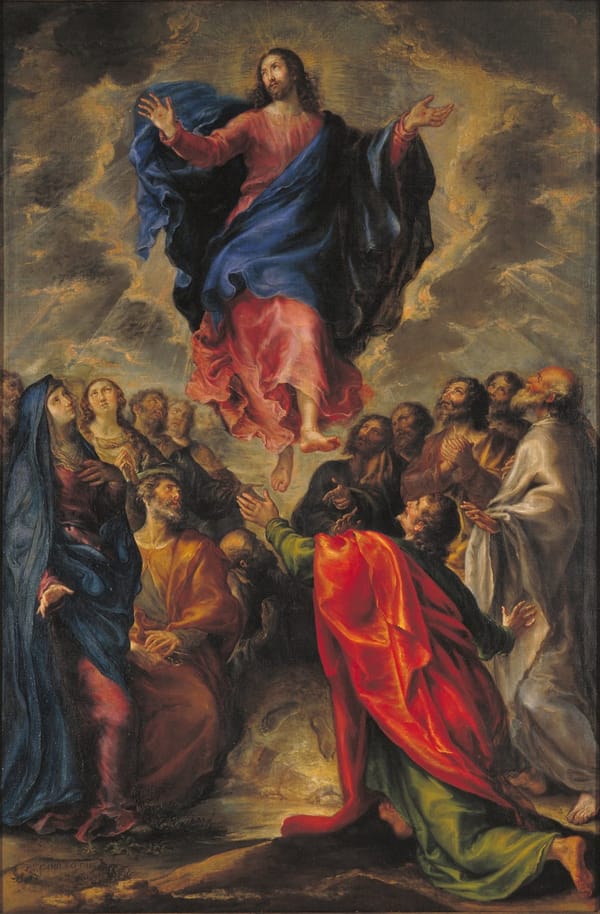
The Ascension of Our Lord
Including descriptions of the following:
The sun of the fortieth day has risen in all his splendour. The earth, which shook with gladness at the birth of our Emmanuel,1 now thrills with a strange emotion. The divine series of the mysteries of the Man-God is about to close. Heaven has caught up the joy of earth. The angelic choirs are preparing to receive their promised King, and their princes stand at the gates, that they may open them when the signal is given of the mighty conqueror’s approach.2 The holy souls, that were liberated from limbo on the morning of the Resurrection, are hovering round Jerusalem, waiting for the happy moment when heaven’s gate, closed by Adam’s sin, shall be thrown open, and they shall enter in company with their Redeemer:—a few hours more, and then to heaven! Meanwhile, our risen Jesus has to visit His disciples and bid them farewell, for they are to be left for some years longer in this vale of tears.
They are in the cenacle, impatiently awaiting His coming. Suddenly He appears in their midst. Of the Mother’s joy, who would dare to speak? As to the disciples and the holy women, they fall down and affectionately adore the Master, who has come to take His leave of them. He deigns to sit down to table with them; He even condescends to eat with them, not, indeed, to give them proof of His Resurrection, for He knows that they have no further doubts of the mystery; but now that He is about to sit at the right hand of the Father, He would give them this endearing mark of familiarity. Oh admirable repast! in which Mary, for the last time in this world, is seated side by side with her Jesus, and in which the Church, (represented by the disciples and the holy women) is honoured by the visible presidency of her Head and Spouse.
What tongue could describe the respect, the recollected mien, the attention of the guests? With what love must they have riveted their eyes on the dear Master! They long to hear Him speak; His parting words will be so treasured! He does not keep them long in suspense: He speaks, but His language is not what they perhaps expected it to be, all affection. He begins by reminding them of the incredulity wherewith they heard of His Resurrection.3 He is going to entrust His apostles with the most sublime mission ever given to man; He would, therefore, prepare them for it by humbling them. A few days hence they are to be the lights of the world; the world must believe what they preach, believe it on their word, believe it without having seen, believe what the apostles alone have seen. It is by faith that man approaches his God: they themselves were once without it, and Jesus would have them now express their sorrow for their former incredulity, and thus base their apostolate on humility.
Then, assuming a tone of authority, such as none but a God could take, He says to them: 'Go ye into the whole world, and preach the Gospel to every creature. He that believeth and is baptized, shall be saved: but he that believeth not, shall be condemned.’4 And how shall they accomplish this mission of preaching the Gospel to the whole world? how shall they persuade men to believe their word? By miracles. ‘And these signs,’ continues Jesus, ‘shall follow them that believe: in My name they shall cast out devils; they shall speak with new tongues; they shall take up serpents; and if they shall drink any deadly thing, it shall not hurt them; they shall lay their hands upon the sick, and they shall recover.’5 He would have miracles to be the foundation of His Church, just as He had made them the argument of His own divine mission. The suspension of the laws of nature proves to us that it is God who speaks; we must receive the word, and humbly believe it.
Here, then, we have men unknown to the world and devoid of every human means, and yet commissioned to conquer the earth and make it acknowledge Jesus as its King! The world ignores their very existence. Tiberius, who sits on the imperial throne, trembling at every shadow of conspiracy, little suspects that there is being prepared an expedition which is to conquer the Roman empire. But these warriors must have their armour, and the armour must be of heaven’s own tempering. Jesus tells them that they are to receive it a few days hence. ‘Stay,’' says He, ‘in the city, till ye be endued with power from on high.’6 But what is this armour? Jesus explains it to them. He reminds them of the Father’s promise, ‘that promise,’ says He, ‘which ye have heard by my mouth; for John, indeed, baptized with water; but ye shall be baptized with the Holy Ghost not many days hence.’7
But the hour of separation is come. Jesus rises: His blessed Mother, and the hundred and twenty persons assembled there, prepare to follow Him. The cenacle is situated on Mount Sion, which is one of the two hills within the walls of Jerusalem. The holy group traverses the city, making for the eastern gate, which opens on the valley of Josaphat. It is the last time that Jesus walks through the faithless city. He is invisible to the eyes of the people who denied. Him, but visible to His disciples, and goes before them, as heretofore the pillar of fire led on the Israelites. How beautiful and imposing a sight! Mary, the disciples, and the holy women accompanying Jesus in His heavenward journey, which is to lead Him to the right hand of His eternal Father! It was commemorated in the middle ages by a solemn procession before the Mass of Ascension day. What happy times were those, when Christians took delight in honouring every action of our Redeemer! They could not be satisfied as we are, with a few vague notions, which can produce nothing but an equally vague devotion.
They reflected on the thoughts which Mary must have had during these last moments of her Son’s presence. They used to ask themselves, which of the two sentiments was uppermost in her maternal heart, —sadness, that she was to see her Jesus no more, or joy, that He was now going to enter into the glory He so infinitely deserved. The answer was soon found: had not Jesus said to His disciples: ‘If ye loved Me, ye would indeed be glad, because I go to the Father.’8 Now, who loved Jesus as Mary did? The Mother’s heart, then, was full of joy at parting with Him. How was she to think of herself, when there was question of the triumph of her Son and her God? Could she that had witnessed the scene of Calvary, do less than desire to see Him glorified, whom she knew to be the sovereign Lord of all things,—Him whom, but a short time ago, she had seen rejected by His people, blasphemed, and dying the most ignominious and cruel of deaths?
The holy group has traversed the valley of Josaphat; it has crossed the brook Cedron, and is moving onwards to Mount Olivet. What recollections would crowd on the mind! This torrent, of which Jesus had drunk on the day of His humiliation, is now the path He takes to triumph and glory. The royal prophet had foretold it.9 On their left, are the garden and the cave, where He suffered His agony and accepted the bitter chalice of His Passion. After having come as far as what St. Luke calls the distance of the journey allowed to the Jews on a Sabbath-day,10 they are close to Bethania, that favoured village, where Jesus used to accept hospitality at the hands of Lazarus and his two sisters. This part of Mount Olivet commands a view of Jerusalem. The sight of its temple and palaces makes the disciples proud of their earthly city: they have forgotten the curse uttered against her; they seem to have forgotten, too, that Jesus has just made them citizens and conquerors of the whole world. They begin to dream of the earthly grandeur of Jerusalem, and, turning to their divine Master, they venture to ask Him this question: ‘Lord, wilt Thou, at this time, restore again the kingdom to Israel?’11
Jesus answers them with a tone of severity: ‘It is not for you to know the times or moments which the Father hath put in His own power.'12 These words do not destroy the hope that Jerusalem is to be restored by the Christian Israel; but, as this is not to happen till the world is drawing towards its end, there is nothing that requires our Saviour’s revealing the secret. What ought to be uppermost in the mind of the disciples, is the conversion of the pagan world, the establishment of the Church. Jesus reminds them of the mission He has just given to them: ‘Ye shall receive', says He, ‘the power of the Holy Ghost coming upon you; and ye shall be witnesses unto me in Jerusalem, and in all Judea, and Samaria, and even to the uttermost part of the earth.'13
According to a tradition, which has been handed down from the earliest ages of Christianity,14 it is midday, the same hour at which He was raised up, when nailed to His cross. Giving His blessed Mother a look of filial affection, and another of fond farewell to the rest of the group that stand around Him, Jesus raises up His hands and blesses them all. While thus blessing them, He is raised up from the ground whereon He stands, and ascends into heaven.15 Their eyes follow Him, until a cloud comes and receives Him out of their sight.16
Yes, Jesus is gone! The earth has lost her Emmanuel!—For four thousand years had He been expected: the patriarchs and prophets had desired His coming with all the fervour of their souls. He came. His love made Him our captive in the chaste womb of the Virgin of Nazareth; it was there He first received our adorations. Nine months after, the blessed Mother offered Him to our joyous love in the stable at Bethlehem. We followed Him into Egypt; we returned with Him; we dwelt with Him at Nazareth. When He began the three years of His public life, we kept close to His steps; we delighted in being near Him, we listened to His preaching and parables, we saw His miracles. The malice of His enemies reached its height; and the time came wherein He was to give us the last and grandest proof of the love that had brought Him from heaven, by dying for us on a cross. We kept near Him as He died, and our souls were purified by the Blood that flowed from His wounds. On the third day, He rose again from His grave, and we stood by exulting in His triumph over death, for that triumph won for us a like resurrection. During the forty days He has deigned to spend with us since His Resurrection, our faith has made us cling to Him: we would fain have kept Him with us for ever,—but the hour is come: He has left us. Yes, our dearest Jesus is gone! Oh happy the souls that He had taken from limbo! They have gone with Him, and, for all eternity, are to enjoy the heaven of His visible presence.
The disciples are still steadfastly looking up towards heaven, when lo! two angels, clad in white robes, appear to them, saying: ‘Ye men of Galilee! why stand ye looking up to heaven? This Jesus, who is taken up from you into heaven, shall so come as ye have seen Him going into heaven!’17 He has ascended, a Saviour; He is to return, a Judge: between these two events is comprised the whole life of the Church on earth. We are therefore living under the reign of Jesus as our Saviour, for He has said: ‘God sent not His Son into the world to judge the world, but that the world might be saved by Him:’18 and to carry out this merciful design He has just been giving to His disciples the mission to go throughout the whole world, and invite men, while yet there is time, to accept the mystery of salvation.
What a task is this He imposes on the apostles! And now that they are to begin their work, He leaves them! They return from Mount Olivet, and Jesus is not with them! And yet, they are not sad; they have Mary to console them; her unselfish generosity is their model, and well do they learn the lesson.
They love Jesus; they rejoice at the thought of His having entered into His rest. ‘They went back into Jerusalem with great joy.’19 These few simple words of the Gospel indicate the spirit of this admirable feast of the Ascension: it is a festival which, notwithstanding its soft tinge of sadness, is, more than any other, expressive of joy and triumph. During its octave, we will endeavour to describe its mystery and magnificence: we would only observe for the present, that this solemnity is the completion of the mysteries of our redemption; that it is one of those which were instituted by the apostles;20 and finally, that it has impressed a character of sacredness on the Thursday of each week, the day already so highly honoured by the institution of the Eucharist.
We have alluded to the procession, whereby our Catholic forefathers used, on this feast, to celebrate the journey of Jesus and His disciples to Mount Olivet. Another custom observed on the Ascension, was the solemn blessing given to bread and to the new fruits: it was commemorative of the farewell repast taken by Jesus in the cenacle. Let us imitate the piety of the ages of faith, when Christians loved to honour the very least of our Saviour’s actions, and, so to speak, make them their own, by thus interweaving the minutest details of His life into their own. What earnest reality of love and adoration was given to our Jesus in those olden times, when His being sovereign Lord and Redeemer was the ruling principle of both individual and social life! Now-a-days, we may follow the principle, as fervently as we please, in the privacy of our own consciences, or, at most, in our own homes; but publicly, and when we are before the world, no! To say nothing of the evil results of this modern limitation of Jesus’ rights as our King, what could be more sacrilegiously unjust to Him who deserves our whole service, everywhere and at all times? The angels said to the apostles: 'This Jesus shall come, as ye have seen Him going into heaven:’ happy we, if, during His absence, we shall have so unreservedly loved and served Him, as to be able to meet Him with confidence when He comes to judge us.
We will not here insert the Office of first Vespers, inasmuch as this festival is fixed for the Thursday; so that its vigil can never fall on a Sunday, and the faithful, consequently, have not the habit of assisting at them. Moreover, with the exception of the versicle and the Magnificat antiphon, the first and second Vespers are exactly alike.
Mass
The Roman missal gives St. Peter’s as the Station for to-day. It was a happy thought to choose this basilica, inasmuch as it possesses the tomb of one of the chief witnesses of Jesus’ Ascension. It is still the stational church; but for now several centuries, the Pope and sacred college of Cardinals repair to the Lateran basilica. It is in this venerable church, dedicated by Constantine to the Saviour of the world, that is closed our yearly series of the mysteries whereby the Son of God wrought our salvation.
In these two magnificent basilicas, as well as in the humblest church of Christendom, the liturgical symbol of the feast is the Paschal Candle. It was first lighted on the night of the Resurrection, and was to remind us, by its forty days’ presence, of the time which Jesus spent among His brethren, after He had risen from the grave. The eyes of the faithful are fixed upon it, and its light seems to be burning more brightly, now that we are about to lose it. Let us bless our holy mother Church, whom the Holy Ghost has taught to instruct us and excite us to devotion by so many admirable symbols. Let us glorify our divine master, who says, speaking of Himself: ‘I am the light of the world.'21
The Introit is the solemn announcement of to-day’s mystery. It is formed of the angels’ words to the apostles: Jesus has ascended into heaven; He is to come down again at the last day.
Introit
Ps. Omnes gentes plaudite manibus: jubilate Deo in voce exsultationis.℣. Gloria Patri. Viri Galilæi.
Ps. Clap your hands, all ye nations: shout unto God, with the voice of joy.℣. Glory. &c. Ye men, &c.
In the Collect, the Church sums up the prayers of her children, and beseeches God to grant them the grace of keeping their hearts fixed on their Redeemer, and of desiring to be united with Him in that home above, which He has gone to prepare for them.
Collect
Epistle
Cap. i.Primum quidem sermonem feci de omnibus, o Theophile, quæ cœpit Jesus facere et docere, usque in diem, qua præcipiens apostolis per Spiritum Sanctum, quos elegit, assumptus est: quibus et praebuit seipsum vivum post passionem suam in multis argumentis, per dies quadraginta apparens eis, et loquens de regno Dei. Et convescens, præcepit eis ab Jerosolymis ne discederent, sed expectarent promissionem Patris, quam audistis (inquit) per os meum: quia Joannes quidem baptizavit aqua, vos autem baptizabimini Spiritu Sancto non post multos hos dies. Igitur qui convenerant interrogabant eum dicentes: Domine, si in tempore hoc restitues regnum Israel? Dixit autem eis: Non est vestrum nosse tempora vel momenta, quæ Pater posuit in sua potestate: sed accipietis virtutem supervenientis Spiritus Sancti in vos, et eritis mihi testes in Jerusalem, et in omni Judæa, et Samaria, et usque ad ultimum terræ. Et cum hæc dixisset, videntibus illis, elevatus est: et nubes suscepit eum ab oculis eorum. Cumque intuerentur in cœlum euntem illum, ecce duo viri adstiterunt juxta illos in vestibus albis, qui et dixerunt: Viri Galilæi, quid statis aspicientes in cœlum? Hic Jesus, qui assumptus est a vobis in cœlum, sic veniet, quemadmodum vidistis eum euntem in cœlum.
Ch. i.The former treatise I made, O Theophilus, of all things which Jesus began to do and to teach, until the day on which, giving commandments by the Holy Ghost to the apostles whom he had chosen, he was taken up. To whom also he showed himself alive after his passion, by many proofs, for forty days appearing to them and speaking of the kingdom of God. And eating together with them, he commanded them, that they should not depart from Jerusalem, but should wait for the promise of the Father, which you have heard (saith he) by my mouth; for John indeed baptized with water, but you shall be baptized with the Holy Ghost not many days hence. They, therefore, who were come together asked him, saying: Lord, wilt thou at this time restore again the kingdom to Israel? But he said to them: It is not for you to know the times or moments which the Father hath put in his own power; but you shall receive the power of the Holy Ghost coming upon you, and you shall be witnesses unto me in Jerusalem, and in all Judæa, and Samaria, and even to the uttermost part of the earth. And when he had said these things, while they looked on, he was raised up; and a cloud received him out of their sight. And while they were beholding him going up to heaven, behold two men stood by them in white garments. Who also said: Ye men of Galilee, why stand you looking up to heaven? This Jesus who is taken from you into heaven, shall so come as you have seen him going into heaven.
This admirable description of our Jesus’ Ascension, brings the mystery so vividly before us, that we almost seem to see the happy group on Mount Olivet. With what affection the disciples gaze upon the divine Master as they see Him rising up towards heaven, and stretching out His hand to bless them! Their eyes, though full of tears, are riveted on the cloud which has come between themselves and Jesus. They are alone on the mount; Jesus’ visible presence is taken from them. How wretched would they not feel in the desert land of their exile, were it not for His supporting grace, and for that holy Spirit who is about to come down and create within them a new being? So then, it is only in heaven that they can ever again see the face of Jesus, who, God as He is, deigned to be their Master for three long happy years, and on the evening of the Last Supper, called them His friends!
Neither are they the only ones who feel this separation. Our earth leaped with joy as the Son of God walked upon it; that joy is now past. It had looked forward, for four thousand years, for the glory of being the dwelling-place of its Creator; that glory is now gone. The nations are in expectation of a Deliverer, and though, with the exception of the people of Judea and Galilee, men are not aware that this Deliverer has come and gone again,—it shall not long be so. They shall hear of His birth, and His life, and His works; they shall hear of His triumphant Ascension, too, for holy Church shall proclaim it in every country of the earth. Eighteen hundred years have elapsed since Ho left this world, and our respectful and loving farewell blends with that which His disciples gave Him when He was mounting up to heaven. Like them, we feel His absence; but like them, we also rejoice in the thought that He is seated at the right hand of His Father, beautiful in His kingly glory. Thou, dear Jesus! hast entered into Thy rest! We adore Thee on Thy throne, we Thy redeemed and the fruit of Thy victory. Bless us! Draw us to Thyself, and grant that Thy last coming may be to us a source of joy rather than of fear!
The two Alleluia-versicles give us the words of the royal psalmist, wherein he celebrates the glorious Ascension of the future Messias, the acclamations of the angels, the loud music of heaven’s trumpets, the gorgeous pageant of the countless fortunate captives of limbo whom the conqueror leads up, as His trophy, to heaven.
Gospel
Cap. xvi.In illo tempore: Recumbentibus undecim discipulis, apparuit illis Jesus, et exprobravit incredulitatem eorum et duritiam cordis: quia iis, qui viderant eum resurrexisse, non crediderunt. Et dixit eis: Euntes in mundum universum, prædicate Evangelium omni creaturæ. Qui crediderit et baptizatusfuerit, salvus erit: qui vero non crediderit, condemnabitur. Signa autem eos, qui crediderint, hæc sequentur: In nomine meo dæmonia ejicient; linguis loquentur novis: serpentes tollent: et si mortiferum quid biberint, non eis nocebit: super ægros manus imponen t, et bene habebunt. Et Dominus quidem Jesus, postquam locutus est eis, assumptus est in cœlum, et sedet a dextris Dei. Illi autem profecti prædicaverunt ubique, Domino cooperante, et sermonem confirmante, sequentibus signis.
Ch. xvi.At that time: Jesus appeared to the eleven as they were at table; and he upbraided them with their incredulity and hardness of heart, because they did not believe them who had seen him after he was risen again. And he said to them: Go ye into the whole world, and preach the Gospel to every creature. He that believeth and is baptized, shall be saved; but he that believeth not shall be condemned. And these signs shall follow them that believe: In my name they shall cast out devils: they shall speak with new tongues: they shall take up serpents: and if they shall drink any deadly thing, it shall not hurt them: they shall lay hands upon the sick, and they shall recover. And the Lord Jesus after he had spoken to them was taken up into heaven, and sitteth on the right hand of God. But they going preached everywhere; the Lord working withal, and confirming the word with signs that followed.
The deacon having sung these words, an acolyte ascends the arabo and extinguishes the Paschal Candle, the sweet symbol of our Jesus’ presence for the forty days after His resurrection. This expressive rite tells us of the widowhood of holy mother Church, and that we, when we would contemplate our beloved Lord, must turn our hearts to heaven, for it is there that He is to be seen. Alas! how short was His stay here below, and how quickly the time passed! How many ages have gone by, and how many must still come over this poor earth of ours, before she can again behold His face!
The Church languishes after Him, in this dreary exile of the vale of tears, taking care of us, the children her Jesus has given her by His holy Spirit. She feels His absence; and, if we are Christians, we shall feel it too. Oh! when will the day come, whereon reunited to our bodies, we shall be taken up in the clouds to meet Christ, and be with our Lord for ever!22 Then, and then only, shall we have attained the end for which we were created.
All the mysteries of the Word Incarnate were to close with His Ascension; all the graces we receive are to end with ours. This world is but a figure that passeth away;23 and we are hastening through it to rejoin our divine Leader. In Him are our life and our happiness; it is vain to seek them elsewhere. Whatever brings us nearer to Jesus, is good; whatever alienates us from Him is evil. The mystery of the Ascension is the last ray of light given to us by our Creator, whereby He shows us the path to our heavenly country. If our heart is seeking its Jesus, and longs to come to Him, it is alive with the true life; if its energies are spent upon created things, and it feels no attraction for its Jesus, it is dead.
Let us, therefore, lift up our eyes, as did the disciples, and follow in desire Him who this day ascends to heaven, and prepares a place there for each of His faithful servants. Sursum corda! Hearts on heaven! It is the parting word of our brethren, who accompany the divine Conqueror in His Ascension; it is the hymn wherewith the angels, coming, down to meet their King, invite us to ascend and fill up the vacant thrones: Sursum corda!
Farewell, dear paschal torch, that hast gladdened us with thy lovely flame! Thou hast sweetly spoken to us of Jesus, our light in the darkness of our pilgrimage; and now thou leavest us, telling us that He is no longer to be seen here below, and that we must follow Him to heaven, if we would again behold Him. Farewell, loved symbol made by the hand of our mother, the Church, that thou mightest speak to our hearts! The impressions excited within us, as we looked upon thee, during this holy season of Easter, shall not be forgotten. Thou wast the herald of our Pasch; thy leaving reminds us that the glad time is drawing to its close.
For the Offertory-antiphon, the Church uses the words of David, as before the Gospel. She is taken up with this one glad thought: the triumph of her Spouse, and the joy it caused in heaven. She would have this joy to be shared in by us who are on earth.
Offertory
Our desires, on this day, should be that we may follow our Jesus to life everlasting, and overcome all the hindrances that we may have to encounter on the way thither. This is what the Church asks of God for us, in the Secret.
Secret
Preface
It is the royal prophet who again speaks in the Communion-anthem. He foretells, a thousand years before the event, that the Emmanuel is to ascend from the east. Mount Olivet, whence our Lord took His departure to His Father’s kingdom, is to the east of Jerusalem.
Communion
The faithful people has just confirmed its union with its divine Head, by receiving the adorable Sacrament; the Church asks of God that this mystery, which contains Jesus within it in an invisible manner, may work in us what it outwardly expresses.
Postcommunion
NOON
A tradition, handed down from the early ages, and confirmed by the revelations of the saints, tells us that the Ascension of our Lord took place at the hour of noon. The Carmelites of St. Teresa’s reform honour this pious tradition by assembling in the choir, at the hour of midday on the Ascension, and spending it in the contemplation of this last of Jesus’ mysteries, following Him, in thought and desire, to the throne of His glory.
Let us also follow Him; but before looking on the bright noon which smiles on His triumph, let us go back in thought to His first coming among us. It was at midnight, in the stable of Bethlehem. That dark and silent hour was an appropriate commencement to the three and thirty years of His life on earth. He had come to accomplish a great mission: year by year and day by day, He laboured in its fulfilment. It was nigh to its fulfilment, when men laid their sacrilegious hands upon Him, and nailed Him to a cross. It was midday, when He was thus raised up in the air; but the eternal Father would not permit the sun to shine on Jesus’ humiliation. Darkness covered the face of the earth; and that day had no noon. Three hours after, the sun reappeared. Three days after, the Crucified rose again from the tomb, and it was at the early dawn of light.
On this day, yea at this very hour, His work is completed. He has redeemed us, by His Blood, from our sins; He has conquered death by His Resurrection to life: had He not a right to choose, for His Ascension, the hour when the sun is pouring forth his warmest and brightest beams? Hail, holy hour of noon, sacred with thy double consecration, which reminds us daily of the mercy and of the triumph of our Emmanuel, of salvation by His cross, and of heaven by His Ascension!
But art not Thou, O Jesus! O Sun of Justice! art not Thou Thyself the noontide of our souls? Where are we to find that fullness of light for which we were created, where that burning of eternal love which alone can satisfy our longing hearts, but in Thee, who camest down upon the earth to dispel our darkness and our cold? It is in this hope that we venture to address Thee in the sublime words of Thy faithful bride Gertrude: ‘O Love, O noontide, whose ardours are so soothing! Thou art the hour of sacred rest; and the unruffled peace I taste in thee is all my delight. O Thou whom my soul loveth, Thou who art my chosen and my elect above all creatures, tell me, show me, where Thou feedest Thy flock, where Thou liest to rest in the midday. My heart kindles with rapture at thought of Thy tranquil rest at noon! Oh that it were given me to come so near to Thee, that I might be not only near Thee, but in Thee! Beneath Thy genial ray, O Sun of justice, the flowers of all the virtues would spring forth from me, who am but dust and ashes. Then would my soul, rendered fruitful by Thee, my Master and my Spouse, bring forth the noble fruit of every perfection. Then should I be led forth from this valley of sorrows, and be admitted to behold Thy face, so long, so wistfully longed for; and then would it be my everlasting happiness to think that Thou hast not disdained, O Thou spotless Mirror, to unite Thyself to a sinner like me!’24
Vespers
The Lord Jesus has disappeared from our earth, but His memory and His promises are treasured in the heart of the Church. She follows in spirit the glorious triumph of her Spouse, a triumph so well deserved by His having accomplished the world’s Redemption. She keenly feels her widowhood; but she awaits, with unshaken confidence, the promised Comforter. The hours of this trying day are passing away, and evening is coming on; she once more assembles her children, and, in the Office of Vespers, commemorates all that has happened in this sublime mystery of the Ascension.
The antiphons of the psalms relate the great event of noon; the tone of sadness that runs through their melody, is in keeping with the feelings excited by the separation.
Psalm Dixit Dominus, page 92.
Psalm Confitebor, page 93.
Psalm Beatus vir, page 94.
Psalm Laudate, pueri, page 95.
Psalm 116
Quoniam confirmata est super nos misericordia ejus: et veritas Domini manet in æternum.
For his mercy is confirmed upon us: and the truth of the Lord remaineth for ever.
Capitulum (Acts of the Apostles , i .)
The hymn was composed by St. Ambrose, and is full of sweetness; it was somewhat changed in the seventeenth century, and in this changed form we now have it.
Hymn*
Jesu, voluptas cordium,
Orbis redempti conditor,
Et casta lux amantium.
Ut nostra ferres crimina,
Mortem subires innocens,
A morte nos ut tolleres?
Vinctis catenas detrahis:
Victor triumpho nobili,
Ad dexteram Patris sedes.
Ut damna nostra sarcias,
Tuique vultus compotes
Dites beato lumine.
Sis meta nostris cordibus,
Sis lacrymarum gaudium,
Sis dulce vitæ præmium.
joy of our hearts,
Creator of the world redeemed,
and chaste light of them that love thee.
to take upon thee our sins?
and suffer death, O innocent victim,
that thou mightest free us from death?
and the chains of them that were bound.
A conqueror, with noblest triumph,
thou now sittest at the right hand of the Father.
to repair our losses.
Oh! give us to see thy Face,
and enrich us with the blessed light.
be thou the object of our heart’s desire;
be thou the joy of our tears,
and the sweet recompense of a life spent for thee!
The Magnificat-anthem is an appeal made to our Jesus, that He would he mindful of His own and His Father’s promise, and not delay to console His bride by sending her the holy Spirit. The Church repeats this antiphon every day, till the arrival of the heavenly Guest.
Antiphon of the Magnificat
During the days of the octave, we will listen to the several Churches of old celebrating, each in its own style, but all with one and the same faith, the Ascension of our Redeemer. Let us give the first place to the Greek Church, which, in her usual pompous style, commemorates the glories of this mystery. It is her hymn for the evening Office.
Hymn (In Assumptione Domini, ad Vesperas)
O Jesus, our Emmanuel! Thy work is done, and this is the day of Thy entering into Thy rest. In the beginning of the world, Thou didst spend six days in harmonizing the varied portions of the creation; after which, Thou enteredst again into Thy rest. When, later on, Thou wouldst repair Thy work, which satan’s malice had deranged, Thy love induced Thee to live among us for three-and-thirty years, during which Thou didst work our redemption, and restoredst us to the holiness and honour whence we had fallen. Whatsoever had been assigned Thee in the eternal decrees of the blessed Trinity, whatsoever had been foretold of Thee by the prophets, all was done, dear Jesus! not an iota of it all was forgotten. Thy triumphant Ascension was the close of the mission Thou hadst so mercifully undertaken. It was Thy second entrance into Thy rest; but, this time, it was with our human nature which Thou hadst assumed, and which was now to receive divine honour. Thou wouldst have companions in Thine Ascension: the souls Thou hadst liberated from limbo; yea, and when about to leave us, Thou saidst this word of consolation to us: ‘I go to prepare a place for you!'25
Confiding O Jesus! in this promise; resolved to follow Thee in all the mysteries achieved by Thee for our sake—in the humility of Thy birth at Bethlehem, in Thy sufferings on Calvary, in the joy of Thy Resurrection—we hope, also, to imitate Thee, when our mortal course is run, in Thy glorious Ascension. Meanwhile, we unite with the holy apostles who rejoiced at Thy triumph, and with the ransomed captives of limbo who entered heaven in Thy company. Watch over us, O divine Shepherd, while we aro in our exile! Tend Thy faithful sheep; let none be lost; lead them all to Thy fold. The mystery of Thine Ascension shows us the object of our existence; it reanimates us to study more attentively, and love more warmly, all Thy other mysteries. Our one ambition, then, our one desire, shall henceforth be our own ascension to heaven and to Thee. It was for this Thou camest into the world: by humbling Thyself to our lowliness, to exalt us to Thine own majesty; and by making Thyself Man, to make man a partaker of Thy Divinity. But until the happy day of our union with Thee, what would become of us without that Power of the Most High whom Thou hast promised to send us, that He may bring us patience during our pilgrimage, fidelity to our absent King, and that solace of a heart exiled from its God, love? Come, then, O holy Spirit! Support our weakness; fix the eye of our souls on the heaven where our King awaits us; and never permit us to set our hearts on a world which, had it every other charm, has not the infinite one of Jesus’ visible presence!
Let us close our feast with this beautiful prayer, taken from the Mozarabic breviary.
Prayer
- Ps. xcv. xcvi. xcvii. ↩︎
- Ps. xxiii. 7. ↩︎
- St. Mark, xvi. 14. ↩︎
- Ibid. 15, 16. ↩︎
- St. Mark, xvi. 17, 18. ↩︎
- St. Luke, xxiv. 49. ↩︎
- Acts, i. 4, 5. ↩︎
- St. John, xiv. 28. ↩︎
- Ps. cix. 7. ↩︎
- Acts, i. 12. ↩︎
- Ibid. 6. ↩︎
- Ibid. 7. ↩︎
- Acts, i. 8. ↩︎
- Constit. Apost. lib. v. cap. xix. ↩︎
- St. Luke, xxiv. 51. ↩︎
- Acts, i. 9. ↩︎
- Acts, i. 10, 11. ↩︎
- St. John, iii. 17. ↩︎
- 1 St. Luke, xxiv. 52. ↩︎
- St. Augustine, Ep. ad Januar. ↩︎
- St. John, viii. 12. ↩︎
- 1 Thess, iv. 16. ↩︎
- 1 Cor. vii. 31. ↩︎
- Exercitia S. Gertrudis, Die V. * In the monastic rite, it is retained in its original form, as written by St. Ambrose. It is preceded by the following responsory: ℟. breve.—Ascendens Christus in altum, * Alleluia, alleluia. Ascendens. ℣. Captivam duxit captivitatem. Alleluia. Gloria Patri, &c. Ascendens. Jesu, nostra redemptio, Amor et desiderium, Deus Creator omnium, Homo in fine temporum. Quæ te vicit dementia, Ut ferres nostra crimina? Crudelem mortem patiens, Ut nos a morte tolieres? Inferni claustra penetrans, Tuos captivos redimens, Victor triumpho nobili, Ad dextram Patris residens. Ipsa te cogat pietas, Ut mala nostra superes Parcendo, et voti compotes, Nos tuo vultu saties. Tu esto nostrum gaudium, Qui es futurus præmium; Sit nostra in te gloria Per cuncta semper sæcula. Amen. ↩︎
- St. John, xiv. 2. ↩︎
May 25: St. Gregory VII, Pope and Confessor
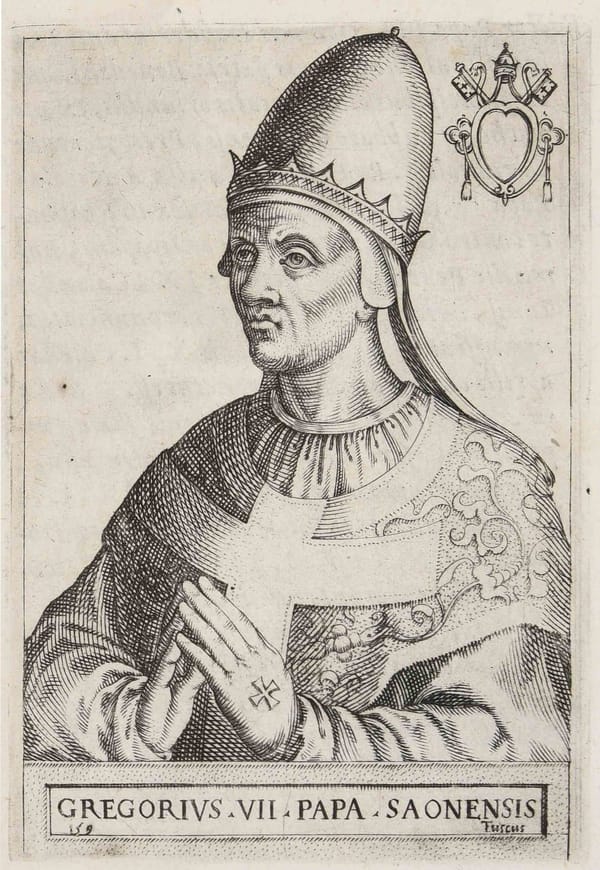 |
OUR Easter Calendar has already given us the two great Popes, Leo the Great and Pius V; it bids us, to-day, pay honour to the glorious memory of Gregory VII. These three names represent the action of the papacy, dating from the period of the persecutions. The mission divinely put upon the successors of St Peter is this: to maintain intact the truths of faith, and to defend the liberty of the Church. St Leo courageously and eloquently asserted the ancient faith, which was called in question by the heretics of those days; St Pius V stemmed the torrent of the so-called Reformation, and delivered Christendom from the yoke of Mahometanism; St Gregory VII came between these two, and saved society from the greatest danger it had so far incurred, and restored the purity of Christian morads by restoring the liberty of the Church.
The end of the tenth and the commencement of the eleventh century was a period that brought upon the Church of Christ one of the severest trials she has ever endured. The two great scourges of persecution and heresy had subsided; they were followed by that of barbarism. The impulse given to civilization by Charlemagne was checked early in the ninth century; the barbarian element had been but suppressed, and broke out again with renewed violence; faith was still vigorous among the people, but of itself it could not triumph over the depravity of morals. The feudal system had produced anarchy throughout the whole of Europe; anarchy created social disorder, and this, in its turn, occasioned the triumph of might and licentiousness over right. Kings and princes were no longer kept in check by the power of the Church; for Rome herself being a prey to factions, unworthy or unfit men were but too frequently raised to the Papal Throne.
The eleventh century came; its years were rapidly advancing; and there seemed no remedy for the disorders it had inherited. Bishoprics had fallen a prey to the secular power, which set them up for sale, and the first requisite for a candidate to a prelacy was that he should be a vassal subservient to the ruler of the nation, ready to supply him with means for prosecuting war. The bishops being thus, for the most part, simoniacal, as St Peter Damian tells us they were, what could be expected from the inferior clergy but scandals? The climax of these miseries was that ignorance increased with each generation, and threatened to obliterate the very notion of duty. There was an end to both Church and society, had it not been for the promise of Christ that he would never abandon his own work.
In order to remedy these evils, in order to dispel all this mist of ignorance, Rome was to be raised from her state of degradation. She needed a holy and energetic Pontiff, whose consciousness of having God on his side would make him heedless of opposition and difficulties; a Pontiff whose reign should be long enough to make his influence felt, and encourage his successors to continue the work of reform. This was the mission of St Gregory VII.
This mission was prepared for by holiness of life; it is always so with those whom God destines to be the instruments of his greatest works. Gregory, or, as he was then called, Hildebrand, left the world, and became a monk of the celebrated monastery of Cluny, in France. It was there, and in the two thousand abbeys which were affiliated with it, that were alone to be found in those days zeal for the liberty of the Church, and the genuine traditions of the monastic life. It was there that for upwards of a hundred years, and under the four great Abbots, Odo, Maiolus, Odilo and Hugh, God had been secretly providing for the regeneration of Christian morals. Yes, we may well say secretly, for no one would have thought that the instruments of the holiest of reforms were to be found in those monasteries, which existed in almost every part of Europe, and had affiliated with Cluny for no other motive than because Cluny was the sanctuary of every monastic virtue. It was to Cluny itself that Hildebrand fled, when he left the world; he felt sure that he would find there a shelter from the scandals that then prevailed.
The illustrious Abbot Hugh was not long in discovering the merits of his new disciple, and the young Italian was made Prior of the great French abbey. A stranger came one day to the gate of the monastery, and sought hospitality. It was Bruno, bishop of Toul, who had been nominated Pope by the Emperor Henry III. Hildebrand could not restrain himself on seeing this new candidate for the Apostolic See—this Pope whom Rome, which alone has the right to choose its own Bishop, had neither chosen nor heard of. He plainly told Bruno that he must not accept the keys of heaven from the hand of an Emperor who was bound in conscience to submit to the canonical election of the holy City. Bruno, who was afterwards St Leo IX, humbly acquiesced in the advice given him by the Prior of Cluny, and both set out for Rome. The elect of the Emperor became the elect of the Roman Church, and Hildebrand prepared to return to Cluny; but the new Pontiff would not hear of his departure, and obliged him to accept the title and duties of Archdeacon of the Roman Church.
This high post would soon have raised him to the Papal Throne, had he wished it; but Hildebrand’s only ambition was to break the fetters that kept the Church from being free, and prepare the reform of Christendom. He used his influence in procuring the election, canonical and independent of imperial favour, of Pontiffs who were willing and determined to exercise their authority for the extirpation of scandals. After St Leo IX came Victor II, Stephen IX, Nicholas II, and Alexander II—all of whom were worthy of their exalted position. But he who had thus been the very soul of the Pontificate under five Popes was at length obliged to accept the Tiara himself. His noble heart was afflicted at the presentiment of the terrible contests that awaited him; but his refusals, his endeavours to evade the heavy burthen of solicitude for all the Churches, were unavailing; and the new Vicar of Christ was made known to the world under the name of Gregory VII. “Gregory” means vigilance; and never did man better realize the name.
He had to contend with brute force personified in a daring and crafty Emperor, whose life was stained with every sort of crime, and who held the Church in his grasp, as a vulture does its prey. In no part of the Empire would a bishop be allowed to hold his see, unless he had received investiture from the Emperor, by the ring and crosier. Such was Henry IV of Germany; and his example encouraged the other Princes of the Empire to infringe on the liberty of canonical elections by the same iniquitous measures. The twofold scandal of simony and incontinence was still frequent among the clergy. Gregory's immediate predecessors had, by courageous zeal, checked the evil; but not one of them had ventured to confront the fomenter of all these abuses, the Emperor himself. The great contest, with its perils and anxieties, was left to Gregory; and history tells us how fearlessly he accepted it.
The first three years of his pontificate were, however, comparatively tranquil. Gregory treated the youthful Emperor with great kindness, out of regard for his father, who had deserved well of the Church. He wrote him several letters, in which he gave him good advice, or affectionately expressed his confidence in the future. Henry did not allow that confidence to last long. Aware that he had to deal with a Pope whom no intimidation could induce to swerve from duty, he thought it prudent to wait a while and watch the course of events. But the restraint was unbearable; the selfimposed check had but swelled the torrent; the enemy of the spiritual power gave full vent to his passion. Bishoprics and abbeys were again sold for the benefit of the imperial revenue. Gregory excommunicated the simoniacal prelates; and Henry, imprudently defying the censures of the Church, persisted in keeping in their posts men who were resolved to follow him in all his crimes. Gregory addressed a solemn warning to the Emperor, enjoining him to withdraw his support from the excommunicated prelates, under penalty of himself incurring the ban of the Church. Henry, who had thrown off the mask, and thought he might afford to despise the Pontiff, was unexpectedly made to tremble for the security of his throne by the revolt of Saxony, in which several of the Electors of the Empire joined. He felt that a rupture with the Church at such a critical time might be fatal. He turned suppliant, besought Gregory to absolve him, and made an abjuration of his past conduct in the presence of two Legates, sent by the Pontiff into Germany. But scarcely had the perjured monarch gained a temporary triumph over the Saxons than he recommenced hostilities with the Church. In an assembly of bishops, worthy of their imperial master, he presumed to pronounce sentence of deposition against Gregory. Shortly afterwards he entered Italy with his army; and this gave to scores of prelates an opportunity for openly declaring rebellion against the Pope, who would not tolerate their scandalous lives.
Then did Gregory, in whose hands were placed those keys which signify the power of loosing and binding in heaven and on earth, pronounce against Henry the terrible sentence which declared him to be deprived of his crown and to have forfeited the allegiance of his subjects. To this the Pontiff added the still heavier anathema; he declared him to be cut off from the communion of the Church. By thus setting himself as a rampart of defence to Christendom, which was threatened on all sides with tyranny and persecution, Gregory drew down upon himself the vengeance of every wicked passion; and even Italy was far from being as loyal to him as he had a right to expect her to be. More than one of the princes of the peninsula sided with Henry; and as to the simoniacal prelates, they looked on him as their defender against the sword of Peter. It seemed as though Gregory would soon not have a spot in Italy whereon he could set his foot in safety; but God, who never abandons his Church, raised up an avenger of his cause. Tuscany, and part of Lombardy, were, at that time, governed by the young and brave countess Matilda. This noble-hearted woman stood up in defence of the Vicar of Christ. She offered her wealth and her army to the Pope, that he might make use of them as he thought best, as long as she lived; and as to her possessions, she willed them to St Peter and his successors.
Matilda, then, became a check to the Emperor's prosperity in crime. Her influence in Italy was still strong enough to procure for the heroic Pontiff a refuge where he could be safe from the Emperor's power. He was enabled by her management to reach Canossa, a strong fortress near Reggio. At the same time, Henry was alarmed by news of a fresh revolt in Saxony, in which more than one feudal lord of the Empire took part, with a view to dethrone the haughty and excommunicated tyrant. Fear again took possession of his mind, and prompted him to recur to perjury. The spiritual power marred his sacrilegious plans; and he flattered himself that by offering a temporary atonement he could soon renew the attack. He went barefooted and unattended to Canossa, garbed as a penitent, shedding hypocrite tears, and suing for pardon. Gregory had compassion on his enemy, and readily yielded to the intercession made for him by Hugh of Cluny and Matilda. He took off the excommunication, and restored Henry to the pale of Holy Church; but thought it would be premature to revoke the sentence whereby he had deprived him of his rights as Emperor. The Pontiff contented himself with announcing his intention of assisting at the Diet which was to be held in Germany; there he would take cognizance of the grievances brought against Henry by the Princes of the Empire, and then decide what was just.
Henry accepted every condition, took his oath on the Gospel, and returned to his army. He felt his hopes rekindle within him at every step he took from the dreaded fortress, within whose walls he had been compelled to sacrifice his pride to his ambition. He reckoned on finding support from the bad passions of others, and to a certain extent his calculation was verified. Such a man was sure to come to a miserable end; but Satan was too deeply interested in his success to refuse him his support.
Meanwhile, Henry met with a rival in Germany: it was Rodolph, duke of Suabia, who, in a Diet of the Electors of the Empire, was proclaimed Henry's successor. Faithful to his principles of justice, Gregory refused, at first, to recognize the newly elected, although his devotedness to the Church and his personal qualifications were such as to make him most worthy of the throne. The Pontiff persisted on hearing both sides, that is, the princes and representatives of the Empire, and Henry himself; this done, he would put an end to the dispute by an equitable judgement. Rodolph strongly urged his claims, and importuned the Pontiff to recognize them; but Gregory, though he loved the duke, courageously refused his demand, assuring him that his cause should be tried at the Diet by which Henry had bound himself, by his oath at Canossa, to stand, though he had good reasons to fear its results. Three years passed on, during which the Pontiff's patience and forbearance were continually and severely tried by Henry's systematic subterfuges, and refusal to give guarantees against his further molesting the Church. At length, after using every means in his power to put an end to the wars that ravaged Italy and Germany, and after Henry had given unmistakable proofs of impenitence and perjury, the Pontiff renewed the excommunication, and in a Council held at Rome, confirmed the sentence whereby he had declared him deposed of his crown. At the same time, Gregory ratified Rodolph’s election, and granted the Apostolic benediction to his adherents.
Henry’s rage was at its height, and his vengeful temper threw off all restraint. Among the Italian prelates who had sided with the tyrant, the foremost in subserviency and ambition was Gilbert, Archbishop of Ravenna, and, of course, there was no bitterer enemy to the holy See. Henry made an anti-pope of this traitor, under the name of Clement III. He had his party; and thus schism was added to the other trials that afflicted the Church. It was one of those terrible periods when, according to the expression of the Apocalypse, it was given unto the Beast to make war with the Saints, and to overcome them.1 The Emperor suddenly became victorious: Rodolph was slain fighting in Germany, and Matilda’s army was defeated in Italy. Henry had then but one wish, and he determined to realize it: to enter Rome, banish Gregory, and set his anti-pope on the Chair of St Peter.
What were the feelings of our Saint in the midst of this deluge of iniquity, from which, however, the Church was to rise purified and free? Let us listen to him, describing them in a letter written to his former Abbot, St Hugh of Cluny: ‘The troubles which have come upon us are such, that even they that are living with us not only cannot endure them, but cannot even bear to look at them. The holy king David said: According to the multitude of my sorrows in my heart, thy consolations have given joy to my soul:2 whereas to us, life is often a burthen, and death a happiness for which we sigh. When Jesus, that loving Consoler, true God and true Man, deigns to stretch out his hand to me, his goodness brings back joy to my afflicted heart; but when he leaves me, immediately my trouble is extreme. Of myself, I am for ever dying; but in so far as he is with me, there are times when I live. When my strength wholly leaves me, I cry out to him, saying with a mournful voice: “If thou hadst put a burthen as heavy as this on Moses or Peter, they would, methinks, have sunk beneath it. What then can be expected of me, who, compared to them, am nothing? Thou hast then, O Lord, but one thing to do: thou thyself, with thine Apostle Peter, must govern the pontificate thou hast imposed on me; else thou wilt find me sink beneath the load, and the pontificate, in my person, be disgraced.” '3
These words of heartfelt grief depict the whole character of the sainted Pontiff. The one great object of his life was the reformation of society by the liberty of the Church. It was nothing but his zeal in such a cause that could have made him face this terrible situation, from which he had nothing to look for in this life but heart-rending vexations. And yet, Gregory was that Father of the Christian world who, from the very commencement of his pontificate, was full of the thought of driving the Mahometans out of Europe, and of delivering the Christians from the yoke of the Saracens. It was the inspiration taken up by his successors, and carried out under the name of the Crusades. In a letter addressed to all the faithful, our Saint thus speaks of the enemy of the Christian name, whom he describes as being at the very gates of Constantinople, committing every kind of outrage and cruelty:
‘If we love God, if we call ourselves Christians, we must grieve over such evils; but we should do more than grieve over them. Our Saviour’s example and the duty of fraternal charity impose upon us the obligation of giving our lives for the deliverance of our fellow-Christians. Know, then, that trusting in the mercy of God and in the might of his arm, we are doing and preparing everything in our power in order to give immediate help to the Christian Empire.’4 He shortly afterwards wrote to Henry, who at that time had not shown his hostile intentions against the Church: ‘My admonition to the Christians of Italy and the countries beyond the Alps has been favourably received. At this moment, fifty thousand men are preparing; and, if they can have me to head the expedition as leader and Pontiff, they are willing to march to battle against the enemies of God, and, with the divine assistance, to go even to our Lord's Sepulchre.’ Thus, despite his advanced age, the noble-minded Pontiff was willing to put himself at the head of the Christian army. ‘There is,’ says he, ‘one thing which urges me to do this: it is the state of the Church of Constantinople, which is separated from us in what regards the dogma of the Holy Ghost, and which must be brought back to union with the Apostolic See. . Almost the whole of Armenia has abandoned the Catholic faith. In a word, the greater portion of the Orientals require to know what is the faith of Peter, on the various questions which are being mooted among them. The time is come for using the grace bestowed, by our merciful Redeemer, on Peter, when he thus spoke to him: I have prayed for thee, Peter, that thy faith may not fail: do thou confirm thy brethren.5 Our Fathers in whose footsteps we would walk, though we be unworthy to be their successors, have more than once visited those countries, that they might confirm the Catholic faith. We, then, also feel urged, if Christ open to us a way, to undertake this expedition for the interests of the faith, and in order to give aid to the Christians.’
With his characteristic good faith, Gregory went so far as to reckon on Henry's protecting the Church during his absence. ‘This design,' says he, in the same letter to the Emperor, ‘requires much counsel and powerful co-operation, in case God permits us to attempt it: I therefore come to you, asking you for this counsel and co-operation, and hope you will grant me them. If, by divine favour, I go, it is to you, after God, that I leave the Roman Church, that you may watch over her as a holy mother, and protect her from insult. Let me know, as soon as may be, what in your prudence, aided by God's counsel, you decide. If I had not greater confidence in you than people suppose, I should not have written this to you; but as you may not fully believe that I have the affection for you that I profess, I appeal to the Holy Spirit who can do all things. I beseech him to make you understand, in his own way, how attached I am to you; and so to guide your soul as to disappoint the desires of the wicked and strengthen the hopes of the good.’6
The interview at Canossa took place in less than three years from the date of the above letter; but at the time he wrote it, Gregory’s hopes for carrying out the expedition were so well grounded, that he acquainted the Countess Matilda with his intention. He wrote to her as follows: ' The matter which engrossed my thoughts, and the desire I have to cross the seas in order to give succour to the Christians, who are being slain as brute beasts by the pagans, makes me seem strange to many people, and fear they think me guilty of a sort of levity. But it costs me nothing to confide it to you, my dearly beloved daughter, whose prudence I esteem more than words could express. After you have perused the letters which I am sending to the countries beyond the Alps, if you have any advice to offer, or, what is better, any aid to give to the cause of God your Creator, exert yourself to the utmost; for if, as men say, it be a grand thing to die for one's country, it is grander and nobler to sacrifice this mortal flesh of ours for Christ, who is Eternal Life. I feel convinced that many soldiers will aid us in this expedition. I have grounds for believing that our Empress (Agnes, the saintly mother of Henry) intends going with us, and would fain take you with her. Your mother (the Countess Beatrice) will remain here in Italy, to protect our common interests; and all things thus arranged, we shall, with Christ's help, be enabled to set out. By coming hither to satisfy her devotion, the Empress, especially if she have you to help her, will doubtless encourage many to join in this enterprise. As for me, honoured with the company of such noble sisters, I will willingly cross the seas, ready to lay down my life for Christ with you, from whom I would not be separated in our eternal country. Send me a speedy answer upon this project, as also regarding your coming to Rome. And may the Almighty God bless you, and give you to advance from virtue to virtue, that thus the common Mother may rejoice in you for many long years to come!’7
The project on which Gregory set his heart with so much earnestness was not a mere scheme suggested by his own greatness of soul; it was a presentiment infused into his mind by God. The troubles he had nearer home, and which he so heroically combated, left him no time for a long expedition; he had to engage with an enemy who was not a Turk, but a Christian. Still, the Crusade so dear to his heart was not far off. Urban II—his second successor, and, like himself, a monk of Cluny—was soon to arouse Christian Europe and give battle to the infidels. But as this subject has led us to mention Matilda's name, we take the opportunity thus afforded us of entering more fully into the character of our great Pontiff. We shall find that this illustrious champion of the Church's liberty, with all his elevation of purpose, and all his untiring zeal in what concerned the interests of Christendom, was as solicitous about the spiritual advancement of a single soul as any director could be. Writing to the Countess Matilda, he says: ' He who fathoms the secrets of the human heart, he alone knows, and knows better than I do myself, how interested I am in what concerns your salvation. I think you understand that I feel myself bound to take care of you for the sake of so many people, in whose interest I have been compelled by charity to deter you, when you were thinking of leaving them in order to provide for the salvation of your own soul. As I have often told you, and will keep on telling you in the words of heaven’s herald, Charity seeketh not her own.8 But as the principal armour wherewith I have provided you in your battle against the prince of this world is the frequent receiving of our Lord’s Body, and a firm confidence in the protection of his blessed Mother, I will now add what St Ambrose says on the subject of holy Communion.’
The Pontiff then gives her two quotations from the writings of this holy Father, to which he also adds others from St Gregory the Great and St John Chrysostom on the blessings we derive from receiving the sacrament of the Eucharist. He then continues: ‘Therefore, my daughter, we should have recourse to this greatest of the sacraments, this greatest of all remedies. I have written all this to you, beloved daughter of blessed Peter, with a view to increase your faith and confidence when you approach to Communion. This is the treasure, and this the gift, more precious than gold and gems, which your soul, out of love for the King of heaven, your Father, expects from me, although you would have received the same in a far better way, and one more worthy of your acceptance, had you applied to some other of God’s ministers. With regard to the Mother of God, to whose care I have confided you, for the past, the present, and the future, until we are permitted to see her in heaven, as we desire—what can I say? How can I say anything worthy of her whom heaven and earth are ever praising, and yet never so much as she deserves? Yes, hold this as a most certain truth: that as she is grander and better and holier than all mothers, so is she more merciful and loving to all sinners who are sorry for their sins. Be, then, determined never to commit sin; prostrate yourself and weep before her, with a contrite and humble heart; and I unhesitatingly promise you this—you will find her more ready to assist you, and more affectionate, than any mother on earth ever was to her child.'9
A Pontiff like this, who amidst all his occupations could devote himself with such paternal zeal to the advancement of one single soul, was sure to be on the watch for men whose piety and learning promised well for the interests of the Church. It is true, there were very few such men in those times; but Gregory would find them out, wheresoever they might be. The great St Anselm, who was living in the peaceful retirement of his monastery at Bec, had not escaped the watchful eye of the Pontiff, who wrote him these touching words amidst the troubles of the year 1079: 'The good odour of your fruits has spread even to us. We give thanks to God, and we embrace you with affection in the love of Christ; for we are well assured of the benefits which the Church of God will derive from your studies and of the succour which, through God’s mercy, she will receive from your prayers, united as they are with those who are of a like spirit. You know, my Brother, of how much avail with God is the prayer of one just man; how much more then must not avail the prayer of many just ones? No, we cannot doubt it; it obtains what it asks. The authority of Truth himself obliges us to believe it. It is he who said: Knock, and it shall be opened to you! Knock with simplicity of heart—ask with simplicity of heart—for those things which are pleasing to him; then shall it be opened to you, then shall you receive; and it is thus that the prayer of the just is graciously heard. We therefore beg of you, Brother, of you and your monks, that you beseech God in assiduous prayer, that he may vouchsafe to deliver from the tyranny of heretics his Church and us, who, though unworthy, are placed over it; and that, dispelling the error which blinds our enemies, he may lead them back to the path of truth.’10
But Gregory’s attention was not confined to persons of such eminence and learning as a Matilda or an Anselm. His quick eye discerned every Christian, how humble soever his station, who had suffered persecution for the cause of Holy Church; he honoured and loved him far more than he would the bravest soldier who fought for earthly glory, and won it at the risk of his life. Let us read the following letter, which he wrote to a poor priest of Milan, named Liprand, who had been cruelly maimed by the simoniacs: ' If we venerate the memory of those Saints who died after their limbs had been severed by the sword; if we celebrate the sufferings of those whom neither the sword nor torture could separate from the faith of Christ; you, who have had your nose and ears cut off for his Name, you deserve still greater praise, for that you have merited a grace which, if it be accompanied by your perseverance, gives you a perfect resemblance to the Saints. Your body is no longer perfect in all its parts; but the interior man, who is renewed from day to day, is now grander than ever. Your outward face is maimed, and therefore disfigured; but the image of God, which consists in the brightness of virtue, has become more graceful by your wounds, and its beauty heightened by the deformity which men have brought on your features. Does not the Church, speaking of herself, say: I am black, O ye daughters of Jerusalem?11 If, then, your interior beauty has not been impaired by these cruel mutilations, neither has your priestly character, which manifests itself rather by the perfection of virtue than by that of the body. Did not the Emperor Constantine show his veneration for a bishop who had had one of his eyes pulled out? was he not seen to kiss the wound? Have we not the examples of the Fathers, and the early history of the Church, telling us that the martyrs were allowed to continue the exercise of the sacred ministry, even after their limbs had been mutilated? You, then, martyr of Christ! must confide in the Lord without reserve. You must congratulate yourself on having made an advance in your priesthood. It was conferred upon you by the holy oil; but now you have sealed it with your own blood. The more your body has lost, the more must you preach what is good, and sow that word which produces a hundredfold. We know that the enemies of holy Church are your enemies and persecutors; fear them not, and tremble not in their presence; for we lovingly hold both yourself and everything that belongs to you under our own protection and that of the Apostolic See. And if you should at any time find it necessary to have recourse to us, we now at once admit your appeal, and will receive you with joy and every mark of honour, when you visit us and this Holy See.’12
Such was Gregory, who preserved the simplicity of the monk amidst all his occupations as Pope; and what engrossing occupations were these, even apart from that fearful contest with tyranny and crime which cost him his life! We have already mentioned his project of the Crusade, which, at a later period, was enough to immortalize the name of Urban II. As to his other labours for the good of religion in every part of Christendom, we may truly say that at no period of the Church's existence did the papacy exercise a wider, more active, or more telling influence, than during the twelve years of his pontificate. By his immense correspondence, he furthered the interests of the Church in Germany, Italy, France, England and Spain; he aided the rising Churches of Denmark, Sweden and Norway; he testified his vigilant and tender solicitude for the welfare of Hungary, Bohemia, Poland, Serbia, yea, even for Russia. Despite the rupture between Rome and Byzantium, the Pontiff withheld not his paternal intervention with a view to remove the schism which kept the Greek Church out of the centre of unity. On the coast of Africa, he, by great vigilance, succeeded in maintaining three bishoprics which had survived the Mussulman invasion. In order to knit the Latin Church into closer unity by greater uniformity in prayer, he abolished the Gothic Liturgy that was used in Spain, and forbade the introduction of the Greek Liturgy into Bohemia. What work was this for one man! And what a martyrdom he had to suffer! Let us resume our history of his trials. He was to save the Church and society; but like his divine Master, he had to drink of the torrent in the way,13 as the condition of his mission being a successful one.
We have seen how its defenders were defeated in battle; how he was menaced by the conqueror, who had once stood trembling in his presence; and how there was set up in opposition an anti-pope, whose side was taken by unworthy prelates. Henry marched on towards Rome, taking with him the false vicar of Christ. He set fire to that part of the City which would expose the Vatican to danger; Gregory sent his blessing to his terrified people, and immediately the fire took the contrary direction and died out. Enthusiasm filled, for a while, the hearts of the Romans, who have so often been ungrateful to their Pontiff, without whom their Rome, with all its glory, sinks into a poor contemptible town. Henry was afraid to consummate the sacrilege. He therefore sent word to the Romans that he only asked one condition; it was that they should induce Gregory to consecrate him Emperor of Germany, and that he would for ever be a devoted son of the Church: as to the ignoble phantom he had set up in opposition to the true Pope, he (Henry) would see that he was soon forgotten, This petition was presented to Gregory by the whole City. The Pontiff made them this reply: ‘Too well do I know the king’s treachery. Let him first make atonement to God and to the Church which he tramples beneath his feet. Then will I absolve him, if penitent, and crown the convert with the imperial diadem.’ The Romans were earnest in their entreaties, but this was the only answer they could elicit from the inflexible guardian of Christian justice. Henry was about to withdraw his troops, when the fickle Romans, bribed by money from Byzantium (for then, as ever, all schisms were in fellowship against the Papacy), abandoned their King and Father, and delivered up the keys of the City to him who enslaved their souls. Gregory was thus obliged to seek refuge in the Castle of Sant’ Angelo, taking with him into that fortress-prison the liberty of Holy Church. Thence, or perhaps a few days previously to his retiring thither, he wrote this admirable letter, in the year 1084. It is addressed to all the faithful, and may be considered as the last Will and Testament of this glorious Pontiff.
‘The kings of the earth and the Princes of the priests have met together against Christ,14 the Son of the Almighty God, and against his Apostle Peter, to the end that they may destroy the Christian religion and propagate the wickedness of heresy in every land. But by the mercy of God they have not been able with all their threats and cruelties and proffers of worldly glory to seduce those that put their confidence in the Lord. Wicked conspirators have raised up their hands against us, for no other reason than because we would not pass over in silence the perils of holy Church, nor tolerate them that blush not to make a slave of the very Spouse of God. In every country the poorest woman is allowed, yea, she is assisted by the law of the land, to choose her own husband; and yet nowadays Holy Church, the Spouse of God and our Mother, is not allowed to be united to her Spouse as the Divine Law commands, and as she herself wishes. It cannot be that we should suffer the children of this Church to be slaves to heretics, adulterers, and tyrants, as though these were their parents. Hence we have had to endure all manner of evil treatment, perils, and unheard-of cruelties, as you will learn from our Legates.
‘You know, Brethren, that it was said to the prophet: Cry from the top of the mountain, cry, cease not! I, then, urged irresistibly, laying human respect aside, and raising my mind above every earthly consideration, I preach the Gospel, I cry out, yea, I cry out unceasingly, and I make known to you that the Christian religion, the true faith which the Son of God, who came down on the earth, taught us by our Fathers, is in danger of being corrupted by the violence of secular power; that it is on the way to destruction, and to the loss of its primitive character, being thus exposed to be scoffed at, not only by Satan, but by Jews, and Turks, and pagans. The very pagans are observers of their laws, though these cannot profit the soul’s salvation, neither have they been guaranteed by miracles, as ours have been, to which our Eternal King has borne testimony; they keep their laws, and believe them. We Christians, intoxicated with the love of the world, and led astray by vain ambition, make every principle of religion and justice give way to covetousness and pride; we seem as though we had neither law nor sense, for we have not the earnestness our Fathers had for our salvation, and for the glory of both the present and future life; we do not make even them the object of our hopes. If there be some still left who fear God, they only care for their own salvation, and the common good seems not to concern them. Where do we now find persons who labour and toil, or expose their lives by fatigue, out of the motive of the fear or love of the Omnipotent God? whereas we see soldiers of this world’s armies braving all manner of dangers for their masters, their friends, and even their subjects! There are thousands of men to be found who face death for the sake of their liege lord; but when the King of heaven, our Redeemer, is in question, so far from being lavish of their lives, Christians dare not even incur the displeasure of a few scoffers. If there be some (and thanks to the mercy of God there are still a few such left among us)—if, we repeat, there be some who, for the love of the Christian Law, dare to resist the wicked to their face, not only are they unsupported by their brethren, but they are accused of imprudence and indiscretion, and are treated as fools.
‘We, therefore, who are bound, by our position, to destroy vice and implant virtue in the hearts of our brethren, we pray and beseech you, in the Lord Jesus who redeemed us, that you would consider within yourselves, and understand why it is that we have to suffer such anguish and tribulation from the enemies of the Christian religion. From the day when, by the Divine will, the Mother-Church, despite my great unworthiness, and (as God is my witness) despite my own wish, placed me on the Apostolic Throne, the one object of all my labours has been that the Spouse of God, our Mistress and Mother, should recover her just rights, in order that she may be free, chaste and Catholic. But such a line of conduct must have caused extreme displeasure to the old enemy; and therefore has he marshalled against us them that are his members, and has stirred up against us a world-wide opposition. Hence it is that there have been used against us, and against the Apostolic See, efforts of a more violent character than any that have ever been attempted since the days of Constantine the Great. But there is nothing surprising in all this: it is but natural that the nearer we approach to the time of Antichrist, the more furious will be the attempts to annihilate the Christian religion.’15
These words vividly describe to us the holy indignation and grief of the great Pontiff, who, at this terrible crisis, stood almost alone against the enemies of God. He was weighed down, he was crushed, by adversity; but conquered, no! From the fortress, within whose walls he had withdrawn the majesty of the Vicar of Christ, he could hear the impious cheers of his people as they followed Henry to the Vatican Basilica, where, at St Peter’s Confession, the mock pope was awaiting his arrival. It was the Palm Sunday of 1085. The sacrilege was committed. On the previous day, Gilbert had dared to ascend the Papal Throne in the Basilica of Saint John Lateran; and on the Sunday, whilst the people held in their hands the palms that glorify the Christ, whose Vicar was Gregory, the anti-pope took the crown of the Christian Empire and put it on the head of the excommunicated Henry. But God was preparing an avenger of his Church. The Pontiff was kept a close prisoner in the fort, and it seemed as though his enemy would soon make him a victim of his rage; when the report suddenly spread through Rome that Robert Guiscard, the valiant Norman chieftain, was marching on towards the City. He had come to fight for the captive Pontiff, and deliver Rome from the tyranny of the Germans. The false Cæsar and his false pope were panic-stricken; they fled, leaving the perjured City to expiate its odious treason in the horrors of a ruthless pillage.
Gregory's heart bled at seeing his people thus treated. It was not in his power to prevent the depredations of the barbarian troops; they had done their work of delivering him from his enemies, but they were not satisfied; they had come to Rome to chastise her, but now they wanted booty, and they were determined to have it. Not only was the Saint powerless to repress these marauders; he was in danger of again falling into Henry's hands, who was meditating a return to Rome, for he made sure that the people's angry humour would secure him a welcome back, and that the Normans would withdraw from the City as soon as it had no more to give them. Gregory therefore, overwhelmed with grief, left the capital; and, shaking off the dust from his feet, he repaired to Monte Cassino, where he sought shelter, and a few hours' repose, with the sons of the great Patriarch St Benedict. The contrast of the peaceful years he spent when a young monk at Cluny, with the storms that had so thickly beset his pontificate, was sure to present itself to his mind. A wanderer and fugitive, and abandoned by all save a few faithful and devoted souls, he was passing through the several stations of his Passion; but his Calvary was not far off, and God was soon to admit him into rest eternal. Before descending the holy mount, he was honoured with the miraculous manifestation which had been witnessed on several previous occasions. Gregory was at the Altar, offering up the Holy Sacrifice; when suddenly a white dove was seen resting on his shoulder, with its beak turned towards his ear, as though it were speaking to him. It was not difficult to recognize, under this expressive symbol, the guidance which the saintly Pontiff received from the Holy Ghost.
It was the early part of the year 1085. Gregory repaired to Salerno, where his troubles and life were to be brought to a close. His bodily strength was gradually failing. He insisted, however, on going through the ceremony of the dedication of the Church of St Matthew the Evangelist, whose body was kept at Salerno He addressed a few words in a feeble voice to the assembled people. He then received the Body and Blood of Christ. Fortified with this lifegiving Viaticum, he returned to the house where he was staying, and threw himself upon the couch, whence he was never to rise again. There he lay, like Jesus on his Cross, robbed of everything, and abandoned by almost the whole world. His last thoughts were for Holy Church. He mentioned to the few Cardinals and Bishops who were with him, three from whom he would recommend his successor to be chosen: Desiderius, Abbot of Monte Cassino, who succeeded him under the title of Victor III; Otho of Chatillon, a monk of Cluny, who was afterwards Urban II, Victor's successor; and the faithful legate, Hugh of Die, whom Gregory had made Archbishop of Lyons.
The bystanders asked the dying Pontiff what were his wishes regarding those whom he had excommunicated. Here again he imitated our Saviour on his Cross—he exercised both mercy and justice. ‘Excepting,’ said he, ‘Henry, and Gilbert the usurper of the Apostolic See, and them that connive at their injustice and impiety, I absolve and bless all those who have faith in my power, as being that of the holy Apostles Peter and Paul.' The thought of the pious and heroic Matilda coming to his mind, he entrusted this devoted daughter of the Roman Church to the care of the courageous Anselm of Lucca; hereby imitating, as the biographer of this holy bishop remarks, our dying Jesus, who consigned Mary to his beloved disciple John. Gregory's last blessing to Matilda drew down upon her thirty years of success and victory.
Though so near his end, Gregory was yet as full of paternal solicitude for the Church as ever he had been. Calling to him, one by one, the faithful few who stood round his couch, he made them promise on oath that they would never acknowledge Henry as Emperor until he had made satisfaction to the Church. Summing up all his energy, he solemnly forbade them to recognize anyone as Pope unless he were elected canonically and in accordance with the rules laid down by the holy Fathers. Then, after a moment of devout recollectedness, he expressed his conformity to the divine Will, which had ordained that his pontificate should be one long martyrdom, and said: ‘I have loved justice and hated iniquity: for which cause, I die in exile!’ One of the bishops who were present, respectfully made him this reply: ‘No, my lord, you cannot die in exile; for, holding the place of Christ and the holy Apostles, you have had given to you the nations for your inheritance, and the utmost parts of the earth for your possession.'Sublime words! but Gregory heard them not: his soul had winged its flight to heaven, and had received a martyr’s immortal crown.
So that Gregory was conquered by death, as Christ himself had been; but as the Master triumphed over death, so too would he have his disciple triumph. Christianity, which had been insulted in so many forms, rose again in all its grandeur. Nay, on the very day that Gregory breathed his last at Salerno, heaven seemed to give a pledge of this Resurrection; for on that day—May 25, 1085—Alphonsus VI entered, with his victorious troops, into the city of Toledo, and there, after four centuries of slavery under the Saracen yoke, he replanted the Cross of Christ.
But the Church had need of someone who would take Gregory’s place in defending her against oppression. The need was supplied. The martyrdom of our saint was like a seed that produced Pontiffs imbued with his spirit. As he had prepared his own predecessors, he also prepared worthy successors. There are few names on the list of the Popes more glorious than those that begin with Victor III, Gregory's immediate successor, and continue to Boniface VIII inclusively, in whom was recommenced the struggle for which our great Pontiff so heroically lived and died. Scarcely had death put an end to his trials in this vale of tears, than victory came to the Church; for her enemies were defeated, her sacred law of celibacy was everywhere re-enforced, and the canonical election of her bishops was secured by the suppression of investitures and simony.
Gregory had been the instrument used by God for the reformation of the Christian world; and although his memory be held in benediction by all true children of the Church, yet his mission was too grand, and too grandly fulfilled, not to draw down upon him the hatred of Satan. The prince of this world,16 then, took his revenge. Gregory was of course detested by heretics; but that could scarcely be called an insult; he must be rendered odious to Catholics; Catholics must be made ashamed of him. The devil succeeded, and it may be beyond his expectations. The Church had passed her judgement; but her judgement, her canonization, had no weight with these cowardly, temporizing, half Catholics; and they persisted in calling the Saint, simply and reproachfully, ‘Gregory VII.’ Governments, styling themselves Catholic, forbade his being honoured as a Saint. There were even bishops who issued Pastorals to the same effect. The most eloquent of French preachers declared his pontificate and conduct to be unchristian. There was a time, and that not so very long ago, when these lines would have exposed the writer to a heavy penalty, as being contrary to the law of the land. The lessons of to-day’s feast, which we give on the next page, were suppressed by the Parliament of Paris in the year 1729; and those who dared to recite them were to be punished by the forfeiture of their property. Thank God! all this is now passed; and the name of St Gregory VII is honoured in every country where the Roman Liturgy is in use. Yes, this glorious name will remain now to the end of the world, on the universal Calendar of Holy Church, as one of the brightest glories of Paschal time. May it produce the same enthusiastic admiration, and bring the same blessings, upon the faithful of these our times, as it did on our Catholic forefathers of the Middle Ages!
We will now read the lessons of to-day’s feast wherein the Church speaks to us of the life and actions of our admirable Pontiff: we will read them with all the greater reverence, because they have been scoffed at by men who knew not what they did.17
The following Responsories, which we select from an Office for his feast, celebrate the struggles and triumphs of the holy Pontiff:
*Thou therefore, my son, if so it please thee, do what thou hast seen me do. ℣. But the king dared not to stretch out his hand, and take the Holy of holies.* Thou therefore, my son, if so it please thee, do what thou hast seen me do.
We unite in one three hymns that celebrate the virtues and services of St Gregory VII:
Hymn
Inclytum Romæ jubar, o Gregori;
Corde qui magno superans procellas,
Littora tangis.
Qui tot et tantos generavit orbi
Filios: nullus simili refulsit
Laude verendus.
Dextra ludentis pueri, dolantem
Dum secus fabrum, Domino regente,
Segmine scribit.
Sol novus mundum radiis serenans:
Pontifex Petri sedeas cathedra,
Arbiter orbis.
Quotquot hostili rabie furentes,
In gregem Christi satagunt nefanda
Tela vibrare.
Spiritu plenus: giadioque verbi
Conteret tetros zabuli minantis
Fortiter astus.
Gestit Henricus, monitis supremi
Patris abscedens, veterum furorum
Flare favillas.
E sacra fulmen jaculatus arce:
Et potestatis tumidos caducae
Despicis ausus.
Sceptra regnantis regimenque transfers,
A fide cives relevans tyranno
Jure negata.
Sub columbina specie, loquentis
Spiritus Sancti documenta sensit,
Actibus implet.
Quæ, patri summo tribuens juvamen,
Inclytae Sedis, studio fideli,
Jura tuetur.
Præsul, et messem manibus profanis
Objici; zelo rapiente, sævit,
Alter Elias.
Libero gressu populi fideles,
Anteit pastor, propriam paratus
Tradere vitam.
Criminum vindex, columenque Romæ,
Inter aerumnas placida, Gregori,
Morte potiris.
Firmus et constans, fidei tenacem,
O Pater, praebes animum: triumphi
Gaudia sumas.
Sis ad aeternam Triadem, precamur:
Cuncta cui dignas resonent per orbem
Saecula laudes.
O Gregory, thou bright ray of Rome’s glory!
With a brave heart thou didst master
the storm and reach the shore.
that has given so many and such noble children to the world
—yes, let it rejoice in this son,
than whom there never lived one worthier of praise.
foretold his future sway;
he wrote it with the fragments that lay beneath a carpenter's feet,
and God guided his hand.
and gladden it with thy beams.
Thy throne, O Pontiff, judge of the world,
is to be the Chair of Peter.
were rushing ’gainst the flock of Christ,
and had their sacrilegious weapons
raised to dart them at his Church.
he has the sword of the Word;
and with its power he will crush the dark plots
wherewith Satan threatens our peace.
heedless of the counsels of the holy Father,
strives to fan the flame
of ancient persecution.
cast against the disobedient prince
the thunderbolt that checked his pride.
What was the haughty daring of mortal power to thee!
thou didst take the royal sceptre and command,
and absolve his subjects
from the fealty forfeited by the tyrant’s crimes.
to receive from the Holy Ghost,
who appeared under the shape of a dove,
the inspirations that guided his acts.
came to the assistance of the Sovereign Pontiff,
and, with faithful zeal,
defended the rights of the Holy See.
and that the harvest was in the hands of worthless men,
Gregory, like another Elias,
was impelled by zeal to holy indignation.
tread the path to their heavenly country,
the shepherd led the way,
ready to give his life for his sheep.
the avenger of crime and the pillar of Rome!
But, after all thy trials,
thy death, O Gregory, was peaceful.
Thy soul, O Father, was firm and true
and unflinching in the faith:
well dost thou deserve a conqueror's triumphant joy.
and intercede for us to the Eternal Three
to whom may every age give worthy praise
throughout the world's wide range.
Our Paschal joy is increased by thy triumph, O Gregory! for in thee we recognize an image of him who by the announcement of his glorious Resurrection, raised the world from its fallen state. Divine Providence had prepared thy pontificate, and made it an era of regeneration for society, which was then oppressed by the tyranny of barbarism. Thy courage was founded on confidence in Jesus' word; and nothing could daunt thee. Thy reign on the Apostolic See was one long combat; and because thou hatedst iniquity and lovedst justice, thou hadst to die an exile. But in thee was fulfilled the prophecy which had been spoken of thy divine Master: If he shall lay down his life for sin, he shall see a long-lived seed.18 A glorious succession of six and thirty Popes continued the work which thy heroism had begun: the Church had regained her liberty, and might was made subservient to right. It was a period of triumph: it passed, war was again declared, and has never. since ceased. Kings and Emperors and Governments have rebelled against the spiritual power; they have thrown off obedience to the Vicar of Christ; they have refused to acknowledge the control of any authority on earth. The people, on their part, have revolted against their Governments, that is, against a power which has ceased to have any visible and sacred connection with God; and this twofold revolt is now hurrying society on to destruction.
This world belongs to Christ, for he is the King of kings, and Lord of lords,19 and to him hath been given all power in heaven and in earth.20 It matters not who they may be that rebel against him—be they kings or be they people, they must inevitably be chastised, just as were the Jewish people who said in their pride: We will not have this Man to reign over us!21 Pray, O Gregory, for this world which thou didst rescue from barbarism, and which is now striving to relapse into degradation. The men of this generation are ever talking of liberty; it is in the name of this pretended liberty that they have unchristianized society; and the only means now left for maintaining order is outward violence and force. Thou didst triumph over brute force by making the laws of right acknowledged and loved; thou gavest the world what it had lost—the liberty of the sons of God, the liberty of doing one’s duty—and it lasted for ages. O come, noble-hearted Pontiff! aid this Europe of ours a second time. Beseech our Lord Jesus Christ to forgive the wickedness of them that have driven him from the world, and scoff at his threat of returning on the day of his triumph and his justice. Yes, pray him to have mercy on the thousands among us who call themselves Christians, and perhaps are so, yet who are led astray by the absurd sophistry of the times, by blind prejudice, by a godless education, by high-sounding and vague words, and who call by the name of progress the system of keeping men as far as possible from the end for which God created them.
From the abode of peace, where thou art now resting after thy labours, look with an eye of affectionate pity on Holy Church, whose path is beset by countless difficulties. Everything conspires against her: remnants of bygone laws that were made in times of persecution; the frenzy of pride, which chafes at everything that favours subordination of rank or authority; and the determination to secularize society by scouting every element of the supernatural. In the midst of this storm of irreligion, the Rock on which thou, O Gregory, didst once hold the place of Peter, is furiously beaten by the waves of persecution. Pray for our holy Father, the Vicar of Christ. Pray that the threatening scourge may be turned aside from Rome. The followers of Satan, as St John prophesies in the Apocalypse, are come upon the breadth of the earth, and have encompassed the camp of the saints, and the beloved City.22 This Holy City was thy Spouse, when thou wast Pontiff here on earth; watch over her now. Disconcert the plots that are laid for her ruin. Rouse the zeal of the children of the Church, that by their courage and generous offerings they may labour for the noblest cause on earth.
Pray, too, for the episcopal Order, of which the Apostolic See is the source. The anointed of the Lord have never had greater need of thine intercession than now, when they have to contend with a world that has openly divorced itself from the laws of God and his Church. May they be endued with strength from on high; courageous in the confession of truth; and zealous in warning the faithful against the errors that are now so rife against faith and morals. The power of the Church in these our days is confined to the sanctuary of the souls of her devoted children; external support is everywhere denied her. The Holy Ghost, whose mission is to maintain the Church of Christ, will indeed assist her even to the consummation of the world; but he does his work by instruments, and these must be men who are detached from the world, men who are not afraid to be unpopular, and men who are resolved at every risk to proclaim the teachings of the Sovereign Pontiff. Great, by the mercy of God, is now the number of pastors of the Church, who are all that he would have them be, who is the Prince of Pastors,23 as St Peter calls him. Pray for all, that all may, like thee, love justice and hate iniquity, love truth and hate error; and fear neither exile, nor persecution, nor death: for the disciple is not above the Master!24
- Apoc. xiii 7. ↩︎
- Ps. xciii 19. ↩︎
- Data Romœ, nonis Maii, Indictione 1 (1078). ↩︎
- Ibid., Kalendis Martii, Indictione 12 (1074). ↩︎
- St Luke xxii 32. ↩︎
- Data Romœ, 7 Idus Decembris, Indictione 13 (1074). ↩︎
- December 16, 1074, Jaffe, Monumenta Gregoriana, p. 532. ↩︎
- 1 Cor. xiii 5. ↩︎
- Data Romæ, 14 Kalendas Martii (1074). ↩︎
- St Anselmus, Epist., lib. ii 31. ↩︎
- Cant. i 4. ↩︎
- 1075, Jaffe, p.533. ↩︎
- Ps. cix 7. ↩︎
- Ps. ii 2. ↩︎
- 1084, Jaffe, p. 572. ↩︎
- St John xii 31. ↩︎
- St Luke xxiii 34. ↩︎
- Isa. liii 10. ↩︎
- 1 Tim. vi 15. ↩︎
- St Matt. xxviii 18. ↩︎
- St Luke xix 14. ↩︎
- Apoc. xx 8. ↩︎
- 1 St Pet. v 4. ↩︎
- St Matt. x 24. ↩︎
May 25 (the Same Day): St. Urban, Pope and Martyr
THIS day is honoured by the triumph of two sainted Popes; and Gregory VII, when he quitted this earth, was introduced into the court of Heaven by one of his predecessors. Urban was a martyr by the shedding of his blood; Gregory was a martyr by the sufferings he had to endure during his whole pontificate. Both fought for the same glorious cause. Urban laid down his life rather than obey an earthly potentate, who bade him degrade himself by adoring an idol; Gregory preferred to endure every temporal suffering rather than allow the Church to be the slave of Cæsar. Both of them adorn the Paschal season with their beautiful palms. Our Risen Jesus said to Peter: Follow me!1—and Peter followed him, even to the cross. Urban and Gregory were Peter’s successors, and like him, they were the devoted disciples of the same divine Master. We honour them both on this day; and, in their triumph, we have a proof of the invincible power which, in every age, the Conqueror of death has communicated to them whom he appointed to bear testimony to the truth of his Resurrection.
The labours and merits of the holy Pope Urban are thus commemorated in the Liturgy:
Holy Pontiff! the joy of this day of thy triumph is enhanced by its being the anniversary of the entrance into heaven of thy illustrious successor Gregory. Thou hadst watched his combats here on earth, and his courage delighted thee, as being equal to that of the martyrs. He, when dying at Salerno, thought of thy martyrdom, and the thought inspired him with energy for his last trial. How admirable is the union that exists between the Church triumphant and militant! How sublime the brotherhood that exists between the Saints! What a joy it is for us to know that we may share in it! Our Risen Jesus invites us to be united with him for all eternity. Each generation is sending him its elect, and they cluster around him, for he is their Head, and they are the members that complete his mystical body. He is the first-born of the dead;2 and he will give us to share in his life, in proportion to our having imitated him in his sufferings and death. Pray, O Urban, that we may become more and more inflamed with the desire of being with him who is the way, the truth, and the life;3 that we may be detached from earthly things, and comport ourselves here below as men who believe themselves to be exiles, absent from the Lord.4
| Previous Rogation Days: Wednesday | Next May 25: St. Gregory VII, Pope and Confessor |