Daily reading
Semidouble · Movable from Easter · Temporal
May 29, 2028
From Dom Guéranger’s The Liturgical Year.
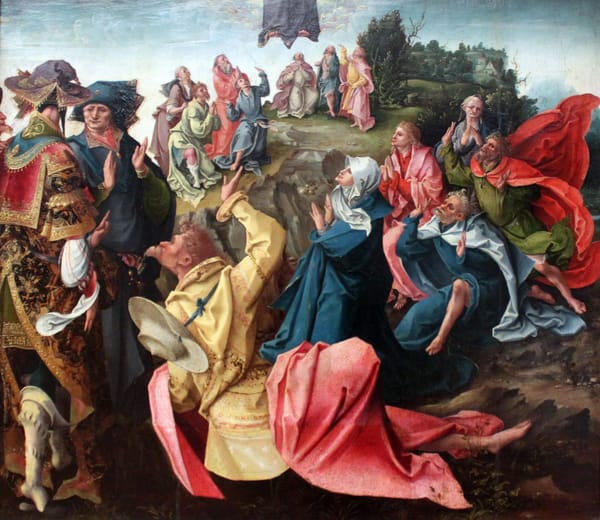
Monday within the Octave of the Ascension
The kingship over men is not the only diadem given to our Emmanuel at His Ascension. The apostle expressly tells us that He is, moreover, ‘the Head of all principality and power.’1 Noble indeed is man; hut nobler far are the glorious choirs of the angelic hierarchy. We have already seen that in the great trial, whereby God tested the love of His angels, many rebelled and were oast into hell; the rest, who were faithful, entered at once into the possession of their sovereign good, and began round the throne of God their ceaseless hymns of adoration, love, and thanksgiving.
But a portion of their happiness was reserved till the fulfilment of one of God’s decrees. Laden as they are with the most magnificent gifts, they await another; it is to be the completion of their joy and glory. God revealed to them, at the first instant of their coming into existence, that He intended to create other beings, of a nature inferior to their own; and that of these beings, who were to be composed of body and soul, there should be one, whom the eternal Word would unite to Himself in unity of Person. It was also revealed to them, that this human Nature, (for whose glory and for God’s, all things were made), was to be the first-born of every creature;2 that all angels and men would have to bend the knee before Him; that after suffering countless humiliations on earth, He would be exalted in heaven; and finally that the time would be, when the whole hierarchy of heaven, the Principalities and Powers, yea, even the Cherubim and Seraphim, would have Him placed over them as their King.
The angels, then, as well as men, looked forward to the coming of Jesus. The angels awaited Him that was to confer upon them their final perfection, give them unity under Himself as their head, and bring them into closer union with God by the union of the divine and created Natures in His own Person. As to us men, we awaited Him as our Redeemer and our mediator: as our Redeemer, because sin had closed heaven against us, and we needed one that would restore us to our inheritance; as our mediator, because it was the eternal decree of God to communicate His own glory to the human race by union with Himself. Whilst, therefore, the just ones on earth, who lived before the Incarnation, were pleasing to God by their faith in this future Redeemer and mediator, the angels in heaven were offering to the divine Majesty the homage of their proffered service of this Man-God, their future King, who, in virtue of the eternal decree, was ever present to the Ancient of days.3
At length the fulness of time came,4 and God, as the apostle expresses it, ‘brought into the world His first-begotten’,5 the prototype of creation. The first to adore the new-born King were not men, but the angels, as the same apostle assures us.6 The royal prophet hed foretold that it would be so.7 And was it not just? These blessed spirits had preceded us in their longings, not indeed for a Redeemer,—for they had never sinned,—but for a mediator, who was to be the link of their closer union with infinite beauty, the object of their eternal delight; in a word, who was to fill up the void there seemed to be even in heaven, by taking the place destined for Him.
Then was accomplished that act of adoration of the Man-God, which was demanded of the angels at the first moment of their creation, and which, according to its being complied with or refused, decided the eternal lot of these noble creatures. With what love did the faithful angels adore Jesus, the Word made Flesh, when they beheld Him in His Mother’s arms at Bethlehem! With what transports of joy did they announce to the shepherds, and to us through them, the glad tidings of the birth of our common King!
As long as He lived upon this earth and submitted to every humiliation and suffering in order to redeem us from sin and make us worthy to become His members, the blessed spirits ceased not to contemplate and adore Him. The Ascension came; and from that day forward, it is on the throne prepared at the Father’s right hand that they behold and adore their Lord and King. At the solemn moment of Jesus’ Ascension, a strange joy was felt in each choir of the heavenly hierarchy, from the burning Seraphim to the Angels who are nearest to our own human nature. The actual possession of a good, whose very expectation had filled them with delight, produced an additional happiness in those already infinitely happy spirits. They fixed their enraptured gaze on Jesus’ beauty, and were lost in astonishment at seeing how Flesh could so reflect the plenitude of grace that dwelt in that human Nature as to outshine their own brightness. And now, by looking on this Nature (which, though inferior to their own, is divinized by its union with the eternal Word), they see into further depths of the uncreated sea of light. Their love is more burning, their zeal is more impetuous, their hymns are more angelic; for, as the Church says of them, the Angels and Archangels, the Powers and Dominations, the Cherubim and Seraphim, praise the majesty of the Father through His Son Jesus Christ: per quem majestatem tuam laudant angeli.
Add to this the joy these heavenly spirits must have experienced at seeing the immense multitude that accompanied Jesus from earth to heaven. These, according to their respective merits, were divided among the various choirs, and placed on thrones left vacant by the fallen angels. Their bodies, are not yet united to their souls; but is not their flesh already glorified in that of Jesus? When the time fixed for the general resurrection comes, the trumpet of the great archangel will be heard,8 and then these happy souls will again put on their ancient vesture, the mortal made immortal. Then will the holy angels, with fraternal enthusiasm, recognize in Adam’s features a likeness of Jesus, and in those of Eve a likeness of Mary, and the resemblance will even be greater than it was when our first parents were innocent and happy in the garden of Eden. Come quickly, O thou glorious day, whereon the bright mystery of the Ascension is to receive its final completion, and the two choirs of angels and men are to be made one in love and praise under the one Head, Christ Jesus!
It is St. Ambrose who is to help us to-day, by the following beautiful hymn, to celebrate the mystery of the triumph of our human nature in Jesus. The hymn is inserted in the breviary of Milan.
Hymn
Sacratus illuxit dies
Quo Christus, mundi spes, Deus,
Conscendit cœlos arduos.
Propriam ad sedem remeans,
Gavisa sunt cœli regna,
Reditu Unigeniti.
Mundi perempto principe,
Patris præsentat vultibus
Victricis carnis gloriam.
Et spem fecit credentibus,
Aperiens paradisum,
Quem protoplastus clauserat.
Quod partus nostræ Virginis,
Post sputa, flagra, post crucem,
Paternæ sedi jungitur.
Nostræ salutis vindici,
Nostrum quod corpus vexerit
Sublimem ad cœli regiam.
Commune manens gaudium,
Illis quod se præsentavit,
Nobis quod se non abstulit.
Christum exspectare nos decet,
Vitaque tali vivere,
Quae possit cœlos scandere.
Qui scandis super sidera,
Cum Patre et sancto Spiritu
In sempiterna saecula.
hath shone upon us: the day whereon Christ our God,
the hope of the world,
ascended to the highest heavens.
returning to his rightful throne,
the kingdom of heaven rejoiced,
for it was the return of the Only-begotten of the Father.
Having defeated the prince of this world,
Jesus presents to his Father the Flesh
that had won the glorious victory.
and opening the gate of heaven,
which our first parent had closed against us,
he inspired believers with hope.
that the Son of our Virgin-Mother,
after being spit upon, and scourged, and crucified,
was placed upon his Father’s throne!
and wrought our salvation,
for that he took our flesh
and made it dwell in the heavenly courts above.
between the angels and us;
they rejoice because he offered himself to their delighted gaze;
we, because he ceased not to be our Brother.
by the practice of virtues of which he has set us the example,
to await our union with Christ,
and so to live as to merit our ascension into heaven.
who ascendest above the stars!
and to the Father, and to the Holy Ghost,
for everlasting ages.
We may use this prayer of the Mozarabic breviary wherewith to close the day.
May 29: St. Mary Magdalen de Pazzi, Virgin
|
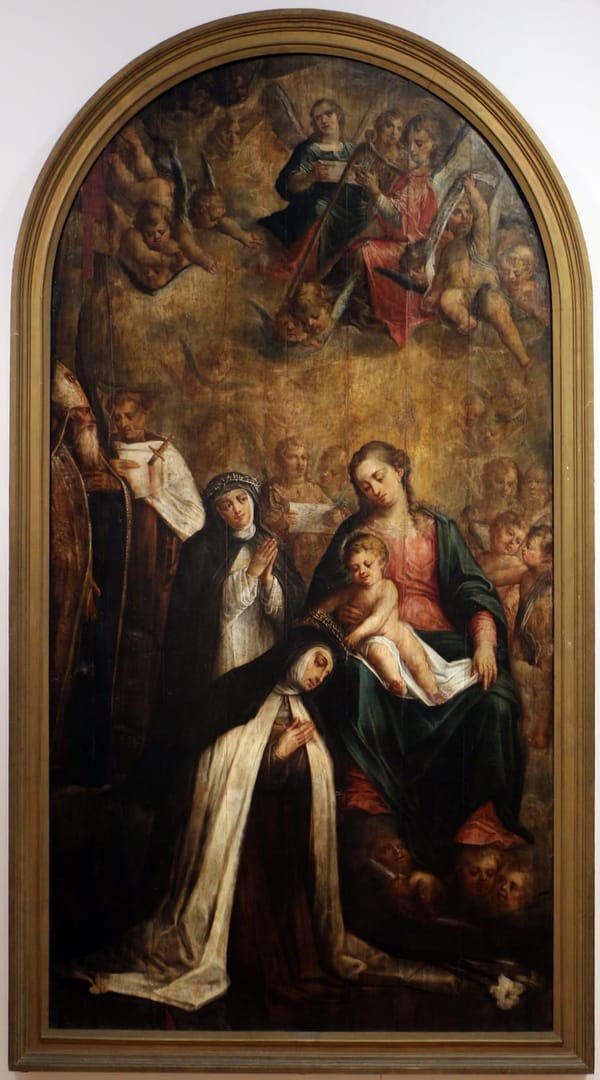
OUR Paschal Calendar gives us three illustrious virgins of beautiful Italy. We have already kept the feast of the valiant Catharine of Siena; in a few days we shall be honouring the memory of Angela dei Merici, surrounded by her school-children; to-day it is the fair lily of Florence, Magdalen de Pazzi, who embalms the whole Church with the fragrance of her name and intercession. She devoted herself to the loving imitation of our crucified Jesus; was it not just that she should have some share in the joy of his Resurrection?
Magdalen de Pazzi was one of the brightest ornaments of the Order of Carmel, by her angelic purity, and by the ardour of her love for God. Like St Philip Neri, she was one of the grandest manifestations of the divine charity that is found in the true Church. Magdalen in her peaceful cloister, and Philip in his active labours for the salvation of souls—both made it their ambition to satisfy that desire expressed by our Jesus when he said: I am come to cast fire on the earth; and what will I, hut that it he kindled?1 The life of this Spouse of Christ was one continued miracle. Her ecstasies and raptures were almost of daily occurrence. The lights given to her regarding the mysteries were extraordinary; and in order to prepare her for those sublime communications, God would have her go through the severest trials of the spiritual life. She triumphed over them all; and her love having found its nourishment in them, she could not be happy without suffering; for nothing else seemed to satisfy the longings of the love that burned within her. At the same time, her heart was filled to overflowing with charity for her neighbour: she would have saved all mankind, and her charity to all, even for their temporal well-being, was something heroic. God blessed Florence on her account; and she so endeared herself to its people by her admirable virtues, that devotion to her, even to this day, which is more than three hundred years since her death, is as fervent as ever it was.
One of the most striking proofs of the divine origin and holiness of the Church is to be found in such privileged souls as Magdalen de Pazzi, on whom we see the mysteries of our salvation acting with such direct influence. God so loved the world as to give it his Only Begotten Son;2 and this Son of God deigns to love some of his creatures with such special affection, and to lavish upon them such extraordinary favours, that all men may have some idea of the love wherewith his Sacred Heart is inflamed for this world, which he redeemed at the price of his Blood. Happy those Christians that appreciate and relish these instances of Jesus' special love! Happy they that can give him thanks for bestowing such grits on some of our fellowcreatures! They have the true light; whereas they that have an unpleasant feeling at hearing of such things, and are angry at the thought that there can be between God and any soul an intimacy of which they are not worthy, prove that there is a great deal of darkness in their faith.
We regret extremely that we have not space for a fuller development of the character and life of our Saint. We therefore proceed at once to the Lessons given in her Office. Even they are too short, and give us but an imperfect idea of this admirable spouse of Christ.
Charitate erga proximum singulariter enituit; nam sæpe noctes ducebat insomnes, vel obeundis sororum ministeriis, vel inserviendo infirmis occupata, quarum aliquando ulcera lambens sanavit. Infidelium et peccatorum perditionem amare deflens, se ad quælibet pro illorum salute tormenta paratam offerebat. Multis ante obitum annis, universis cœli deliciis, quibus copiose affluebat, heroica virtute renuntians, illud frequenter in ore habebat: Pati, non mori. Tandem longa et gravissima infirmitate exhausta, transivit ad Sponsum die vigesima quinta Maji anno millesimo sexcentesimo septimo, expleto anno quadragesimo primo ætatis suæ. Eam multis in vita et post mortem miraculis claram Clemens Nonus sanctarum Virginum numero adscripsit: cujus corpus in præsentem diem incorruptum conservatur.
She was remarkable for her charity towards others. She would frequently sit up the whole night, either doing the work of the sisters, or waiting upon the sick, whose sores she sometimes healed by sucking the wounds. She wept bitterly over the perdition of infidels and sinners, and offered to suffer every sort of torment so that they might be saved. Several years before her death she heroically besought our Lord to take from her the heavenly delights wherewith he favoured her; and was frequently heard saying these words: ‘To suffer; not to die.' At length, worn out by a long and most painful illness, she passed hence to her Spouse, on the twenty-fifth of May, in the year 1607, having completed the forty-first year of her age. Many miracles having been wrought by her merits, both before and after death, she was canonized by Pope Clement the Ninth. Her body is, even to this day, preserved from corruption.
Thy life here below, O Magdalen, resembled that of an angel sent by God to assume our weak and fallen nature and be subject to its laws. Thy soul ceaselessly aspired to a life which was all heavenly, and thy Jesus was ever giving thee that thirst of love which can only be quenched by the waters of life everlasting.3 A heavenly light revealed to thee such admirable mysteries, such treasures of truth and beauty, that thy heart, unequal to the sweetness thus given to it by the Holy Ghost, sought relief in sacrifice and suffering. It seemed to thee as though there was but one way of making God a return for his favours—the annihilation of self.
Seraphic lover of our God! how are we to imitate thee? what is our love, when we compare it to thine? And yet we can imitate thee. The year of the Church's Liturgy was thy very life. Each of its seasons did its work in thee, and brought thee new light and love. The divine Babe of Bethlehem, the bleeding Victim of the Cross, the glorious Conqueror of Death, the Holy Ghost radiant with his seven gifts—each of these great realities enraptured thee; and thy soul, renewed by the annual succession of the mysteries, was transformed into him who, that he might win our hearts, gives these sublime celebrations to his Church. Thy love of souls was great during thy sojourn here; it is more ardent now that thou art in possession of the Sovereign Good; obtain for us, O Magdalen, light to see the riches which enraptured thee, and love to love the treasures which enamoured thee. O riches! O treasures! is it possible that they are ours too?
| Previous Sunday within the Octave of the Ascension | Next May 29: St. Mary Magdalen de Pazzi, Virgin |