Daily reading
Paschal Time
Double · Movable from Easter · Temporal
May 30, 2028
From Dom Guéranger’s The Liturgical Year.
 |
Tuesday within the Octave of the Ascension
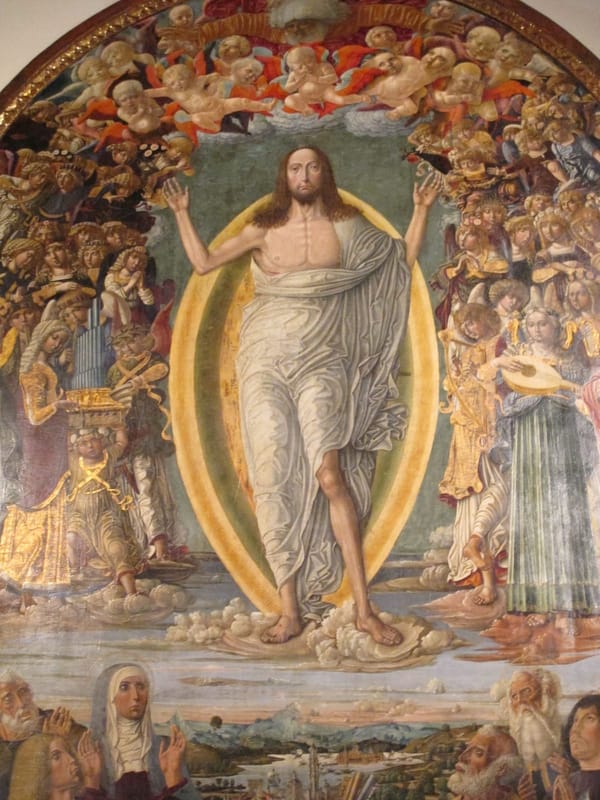
The Lord of glory has ascended into heaven, and, as the apostle says, He has gone thither as our forerunner;1 but how are we to follow Him to this abode of holiness, we whose path is beset with sin, we who are ever needing pardon rather than meriting anything like glory? This brings us to another consequence of the exhaustless mystery of the Ascension; let us give it our closest attention. Jesus has gone to heaven, not only that He may reign as King, but also that He may intercede for us as our High Priest, and, in this quality, obtain for us both the pardon of our sins and the graces we need for following Him to glory. He offered Himself on the cross as a victim of propitiation for our sins; His precious Blood was shed as our superabundant ransom; but the gate of heaven remained shut against us, until He threw it open by His own entrance into that sanctuary, where He was to exercise His eternal office of’Priest according to the order of Melchisedech.’2 By His Ascension into heaven, His priesthood of Calvary was transformed into a priesthood of glory. He entered with the veil of His once passible and mortal Flesh,3 within the veil of His Father’s presence, and there is He our Priest for ever.
How truly is He called Christ, that is,’the Anointed!’ for, no sooner was His divine Person united to the human Nature, than He received a twofold anointing: He was made both King and High Priest. We have already meditated upon His kingship; let us now contemplate His priesthood. He gave proofs of both during His life among us on earth; but it was only by His Ascension that their unclouded splendour was to be declared. Let us, then, follow our Emmanuel, and see Him as our High Priest.
The apostle thus describes the office of a high priest.’He is taken from among men, and is ordained for men in the things that appertain to God that he may offer up gifts and sacrifices for sins’:4 he is appointed their ambassador and mediator with God. Jesus received this office and ministry, and He is fulfilling it in heaven. But, that we may the better appreciate the grand mystery, let us study the figures given of it in the holy Scriptures, and developed by St. Paul in his sublime Epistle; they will give us a precise idea of the grandeur of our Jesus’ pontifical character.
Let us go in thought to the temple of Jerusalem. First of all there is the spacious uncovered court with its porticoes; in the centre stands the altar, whereon are slain the victims of the various sacrifices, and from the altar there radiate a number of conduits, through which flows the blood. We next come to a more sacred portion of the edifice; it is beyond the altar of holocausts, is covered in, and is resplendent with all the riches of the east. Let us respectfully enter, for the place is holy, and it was God Himself who gave to Moses the plan of the various fittings which adorn it with their mysterious and rich beauty: the altar of incense, with its morning and evening cloud of fragrance; the seven-branched candlestick, with its superb lilies and pomegranates; the table of the loaves of proposition, representing the offering made by man to Him who feeds him with the harvests of the earth. And yet it is not here, though the walls are wainscoted with the bright gold of Ophir, that is centred the great majesty of Jehovah. At the extreme end of the temple there is a veil of precious texture, richly embroidered with figures of the Cherubim, and reaching to the ground: it is there, beyond this veil, that the God of Abraham, Isaac, and Jacob, has fixed the abode of His presence; it is there, also, that rests the ark of the covenant, over which two golden Cherubim spread their wings. It is called the Holy of holies, and no one, under pain of death, may draw aside the veil, or look, or enter within the hallowed precinct, where the God of hosts deigns to dwell.
So then, man is banished from the place wherein God dwells; he is unworthy to enter into so holy a presence. He was created that he might see God and be eternally happy with that vision; but, because of sin, he is never to enjoy the sight of God. There is a veil between himself and Him who is his last end; neither can he ever remove that veil. Such is the severe lesson given to us by the symbolism of the ancient temple.
But there is a merciful promise, and it gives a gleam of hope. This veil shall one day be raised up, and man shall enter within: on one condition, however. Let us return to the figurative temple, and we shall learn what this condition is. As we have already noticed, none was allowed to enter the Holy of holies; there was but one exception, and that was in favour of the high priest, who might, once a year, penetrate beyond the veil. Yet even he had certain conditions to observe. If he entered without holding in his hands a vessel containing the blood of two victims, previously immolated by him for his own and the people’s sins, he was to be put to death; if, on the contrary, he faithfully complied with the divine ordinances, he would be protected by the blood he carried in his hands, and might make intercession for himself and all Israel.
How beautiful and impressive are these figures of the first covenant! but how much more so their fulfilment in our Jesus’ Ascension! Even during the period of His voluntary humiliations, He made His power felt in this sacred dwelling of God’s Majesty. His last breath on the cross rent the veil of the Holy of holies, hereby signifying to us that man was soon to recover the right he had lost by sin, the right of admission into God’s presence. We say soon; for Jesus had still to gain the victory over death, by His Resurrection; He had to spend forty days on earth, during which He, our High Priest, would organize the true priesthood that was to be exercised in His Church to the end of time, in union with the priesthood He Himself was to fulfil in heaven.
The fortieth day came, and found all things prepared: the witnesses of the Resurrection had proclaimed the victory of their master; the dogmas of faith had all been revealed; the Church had been formed; the sacraments had been instituted: it was time for our High Priest to enter into the Holy of holies, accompanied by the holy souls of limbo. Let us follow Him with the eye of our faith. As He approached, the veil, that had closed the entrance for four thousand years, was lifted up. Jesus enters. Has He not offered the preparatory sacrifice?—not the figurative sacrifice of the old law, hut the real one of His own Blood P And having reached the throne of the divine Majesty, there to intercede for us His people, He has but to show His eternal Father the wounds He received, and from which flowed the Blood that satisfied every claim of divine justice. He would retain these sacred stigmata of His sacrifice, in order that He might ever present them, as our High Priest, to the Father, and so disarm His anger.’My little children,’ says St. John in his first Epistle, ‘I write these things to you, that ye may not sin; but, if any man do sin, we have an advocate with the Father, Jesus Christ the just.’5 Thus, then, beyond the veil, Jesus treats of our interests with His Father; He gives the merits of His sacrifice their full efficacy; He is the eternal High Priest, whose advocacy is irresistible.
St. John, who was granted a sight of the interior of heaven, gives us a sublime description of this twofold character of our divine Head,—Victim and yet King, sacrificed and yet immortal. He shows us the throne of Jehovah, round which are seated the four-and-twenty ancients, the four symbolical living creatures, and then the seven spirits burning like lamps before it. But the prophet does not finish his description here. He bids us look at the right hand of Him who sits on the throne. There we perceive a Lamb standing and as it were slain: slain and yet standing, for He is radiant with glory and power.6 We should be at a loss to understand the vision, had we not our grand mystery of the Ascension to explain it; but now, all is clear. We recognize in the Lamb, portrayed by the apostle, our Jesus, the Word eternal, who, being consubstantial with the Father, is seated on the same throne with Him. Yet is He also the Lamb; for He assumed to Himself our flesh, in order that He might be sacrificed for us as a victim; and this character of victim is to be for ever upon Him. Oh! see Him there, in all His majesty as Son of God, standing in the attitude of infinite power, yet withal, He will not part with the semblance of the immolated. The sword of sacrifice has left five wounds upon Him, and He would keep them for eternity. Yes, it is identically the same meek Lamb of Calvary, and He is to be for ever consummating in glory the immolation He perfected on the cross.
Such are the stupendous realities seen by the angels within the veil;7 and when our turn comes to pass that veil, we also shall be enraptured with the sight. We are not to be left outside, as were the Jewish people when, once each year, their high priest entered into the Holy of holies. We have the teaching of the apostle:’The fore-runner, Jesus, our High Priest, has entered within the veil for us.’8 For us! Oh what music there is in these two words: for us! He has led the way; we are to follow! Even at the commencement, He would not go alone; He would have the countless legion of the souls of limbo to accompany Him: and ever since then, the procession into heaven has been one of unbroken magnificence. The apostle tells us that we, poor sinners as we are, are already saved by hope;9 and what is our hope, but that we are one day to enter into the Holy of holies? Then shall we blend our glad voices with those of the angels, the four-and- twenty ancients, the myriads of the blessed, in the eternal hymn:’To the Lamb that was slain, power, and divinity, and wisdom, and strength, and glory, and benediction, for ever and ever! Amen.’10
We offer our readers, to-day, the following sequence, composed by the pious Notker, in the ninth century, for the abbey of Saint Gall.
Sequence
Cunctis concedat esse Christianis,
Amatoribus suis.
Mediator nostrae naturae
Ac divinae.
Æthera novus homo
Transvolans.
Stipant, ad Patrem
Reversurum.
Cum lactanti adhuc
Stella tibi serviret
Et angeli?
Rem novam et dulcem
Dedisti, Domine,
Sperandi cœlestia.
Levando super sidereas metas,
Regum Domine.
Tuos replent apostolos,
Quis dedisti cernere
Te cœlos pergere.
In cœlis tibi occurrunt
Novem ordines,
Diu dispersum a lupis,
Gregem unum,
Bone Pastor,
Tu dignare custodire.
who love him, that this day may be
to them a happy one!
thou unitest in thyself the two natures
of God and Man.
thou the new Man,
didst ascend into heaven.
paid the homage of their service to thee,
when thou returnedst to thy Father;
when we remember how,
when thou wast a Babe at thy Mother’s breast,
a star united with the angels in serving thee?
gavest to the inhabitants of earth
a new and sweet sentiment:
the hope of heaven,
—which thou, O King of kings, hadst truly assumed,
—above the highest stars.
the hearts of thine apostles,
whom thou permittedst to see thee
mounting up to heaven!
did the nine choirs of angels go forth
to meet thee as thou enteredst heaven,
the sheep, thy one flock,
that had long been scattered by wolves!
Good shepherd!
vouchsafe to watch over this thy flock!
Prayer
Prayer
May 30: St. Felix I, Pope and Martyr
THE holy Popes of the primitive ages of the Church abound during these last days of our Paschal season. To-day we have Felix I, a martyr of the persecution under Aurelian, in the third century. His Acts have been lost, with the exception of this one detail: that he proclaimed a dogma of the Incarnation, with admirable precision, in a letter addressed to the Church of Alexandria, a passage of which was read with much applause at the two (Ecumenical Councils of Ephesus and Chalcedon.
We also learn from a law he passed for those troubled times of the Church, that this holy Pontiff was zealous in procuring for the martyrs the honour that is due to them. He decreed that the Holy Sacrifice should be offered up on their tombs. The Church still keeps this law in mind by requiring that all altars, whether fixed or portable, must have, amongst the relics that are placed in them, a portion of some belonging to the martyrs. We shall have to speak of this custom in a future volume.
The Liturgy gives us this short notice regarding the holy Pontiff:
Thou, O holy Pontiff, didst imitate thy divine Master in his death, for thou gavest thy life for thy sheep. Like him, too, thou art to rise from thy tomb, and thy happy soul shall be reunited to its body, which suffered death in testimony of the truth thou proclaimedst at Rome. Jesus is the first-born of the dead;* thou didst follow him in his Passion, thou shalt follow him in his Resurrection. Thy body was laid in those venerable vaults, which the piety of early Christians honoured with the appellation of Cemeteries—a word which signifies a place wherein to sleep. Thou, O Felix, wilt awaken on that great day whereon the Pasch is to receive its last and perfect fulfilment: pray that we also may then share with thee in that happy resurrection. Obtain for us that we may be faithful to the graces received in this year's Easter; and prepare us for the visit of the Holy Ghost, who is soon to descend upon us, that he may give stability to the work that has been achieved in our souls by our merciful Saviour.
* Apoc. i 5. ↩︎
June 1 [May 31]: St. Angela de Merici, Virgin
 |
[This feast day, previously kept on May 31, was moved to June 1 when the feast of the Queenship of Mary was established on May 31.-Ed.]
From Dom Guéranger's The Liturgical Year.
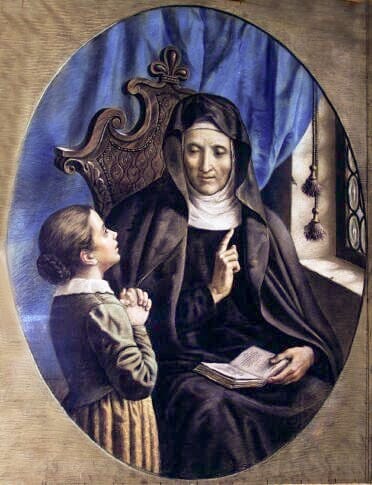
THIS last day of May, which is honoured by the virginal triumph of Aurelia Petronilla, in the first age of the Church, is also fragrant with the lilies that wreathe the brow of Angela de Merici. The sixteenth century, which, a few days back, offered to our Risen Lord the seraphic Magdalen de Pazzi, now presents him with this second fruit of heroic sanctity. Angela realized the whole meaning of her beautiful name. She possessed the purity of the blessed spirits in a mortal body, and she imitated their celestial energy by the vigorous practice of every virtue. This heroine of grace trampled beneath her feet everything that could impede her heavenward march. Gifted at an early age with the highest contemplation, she bravely travelled to Palestine, there to venerate the footsteps of her divine Spouse Jesus. After this, she visited the New Jerusalem, Rome, and offered up her fervent prayers at the Confession of St Peter. She then returned to her life of seclusion, and founded a Religious Order which is, and will be to the end of time, one of the glories and aids of Holy Church.
The thought of the great St Ursula and her virginal legion made a deep impression on Angela’s soul, and she too would form to our Lord an army of valiant women. Ursula confronted the barbarian host; Angela would give battle to the world and to its seductions, which are so dangerous to young girls. God blessed her with victory. As a trophy of her combats, she can point to the countless generations of young people whom her Order has saved during the last three centuries, by giving them a solid Christian education.
The Liturgy thus speaks of the virtues and actions of St Angela:
Thou didst fight the battles of our Lord, O Angela, and thy holy labours merited for thee a glorious rest in the mansions of eternal bliss. An insatiable zeal for the honour of Jesus whom thou hadst chosen as thy Spouse, and an ardent charity for the creatures redeemed by his precious Blood were the characteristics of thy whole life. This love of thy neighbour made thee the mother of a countless progeny; for who can number the young children that have been educated, in sound doctrine and piety, by thy daughters? Thou didst powerfully contribute to the welfare of Christian society, by thus preparing so many for the duties of domestic life; and how many other Congregations, in imitation of thy Ursulines, have taken up the same admirable work, and have brought consolation to the Church, and happiness to the world? The sovereign Pontiff has ordered that thy feast should be kept throughout the whole Church. He declared, in issuing this decree, that he wished to put under thy maternal protection the young girls who are nowadays exposed to such fearful dangers by the enemies of Christ and his Church. They have formed the project of undermining the faith of women, that so their good influence may be destroyed in their families. Disconcert these impious plans, O Angela! Protect thy sex; nourish within it the sentiment of the dignity of Christian woman, and society may still be saved.
We turn to thee, O Spouse of Christ, and ask for fervour in the liturgical year, wherein we are made to follow in the path that was so dear to thee. Thy devotion in following the divine Mysteries which are successively brought before us, led thee to visit the Holy Land. Thou didst long to see Nazareth and Bethlehem, to traverse Galilee and Judea, to give thanks in the Cenacle, to weep on Calvary, and to adore the glorious Sepulchre. Deign to bless our feeble desires and efforts to tread in these same holy paths. We have still to follow thee to Mount Olivet, whence our Redeemer ascended into heaven; we have to return to the Cenacle, which the Holy Ghost is preparing to light up with his divine Fire. Obtain for us, O Angela, that we may follow thee to these hallowed spots, which made thee quit thy country and undertake a long and perilous pilgrimage. Oh! prepare our hearts for the sublime Mysteries which are to crown our Paschal season.
May 30 (the Same Day): St. Ferdinand III, King of Castile and Confessor
DURING the season consecrated to the mystery of our Emmanuel's Birth, we saw standing near his crib the blessed Emperor Charlemagne. Crowned with the imperial diadem, and with a sword in his fearless hand, he seemed to be watching over the Babe, whose first worshippers were shepherds. And now near the glorious Sepulchre, which was first visited by Magdalene and her companions, we perceive a king—Ferdinand the Victorious—wearing a crown, and keeping guard with his valiant sword, the terror of the Saracen.
Catholic Spain is personified in her Ferdinand. His mother Berengaria was sister to Blanche, the mother of St Louis of France. In order to form ‘the Catholic Kingdom,’ there was needed one of our Lord's Apostles, St James the Great; there was needed a formidable trial, the Saracen invasion, which deluged the Peninsula; there was needed a chivalrous resistance, which lasted eight hundred years, and by which Spain regained her glory and her freedom. St Ferdinand is the worthy representative of the brave heroes who drove out the Moors from their fatherland and made her what she is: but he had the virtues of a saint, as well as the courage of a soldier.
His life was one of exploits, and each was a victory. Cordova, the city of the Caliphs, was conquered by this warrior Saint. At once its Alhambra ceased to be a palace of Mahometan effeminacy and crime. Its splendid Mosque was consecrated to the divine service, and afterwards became the Cathedral of the City. The followers of Mahomet had robbed the Church of St James at Compostella of its bells, and had them brought in triumph to Cordova; Ferdinand ordered them to be carried thither again, on the backs of the Moors.
After a siege of sixteen months, Seville also fell into Ferdinand's hands. Its fortifications consisted of a double wall, with a hundred and sixty-six towers. The Christian army was weak in numbers; the Saracens fought with incredible courage, and had the advantages of position and tactics on their part: but the Crescent was to be eclipsed by the Cross. Ferdinand gave the Saracens a month to evacuate the city and territory. Three hundred thousand withdrew to Xeres, and a hundred thousand passed over into Africa. The brave Moorish General, when taking his last look at the city, wept, and said to his officers: ‘None but a Saint could, with such a small force, have made himself master of so strong and well-manned a place.’
We will not enumerate the other victories gained by our Saint. The Moors foresaw that the result would be their total expulsion from the Peninsula. But this was not all that Ferdinand proposed: he even intended to invade Africa, and thus crush the Mussulman power for ever. The noble project was prevented by his death, which took place in the fifty-third year of his age.
He always looked upon himself as the humble instrument of God’s designs, and zealously laboured to accomplish them. Though most austere towards himself, he was a father in his compassion for his people, and was one day heard to say: ‘I am more afraid of the curse of one poor woman, than of all the Saracen armies together.’ He richly endowed the churches which he built in Spain. His devotion to the holy Mother of God was most tender, and he used to call her his Lady: in return, Mary procured him victory in all his battles, and kept away all pestilence and famine from the country during his entire reign, which, as the contemporary chroniclers observe, was an evident miracle, considering the circumstances of the age and period. The life of our Saint was one of happiness and success, whereas the life of that other admirable king, St Louis of France, was one of almost uninterrupted misfortune; as though God would give to the world, in these two Saints, a model of courage in adversity, and an example of humility in prosperity. They form unitedly a complete picture of what human life is, regenerated as it has now been by our Jesus, in whom we adore both the humiliations of the Cross and the glories of the Resurrection. What happy times were those, when God chose kings whereby to teach mankind such sublime lessons!
One feels curious to know how such a man, such a king, as Ferdinand, would take death when it came upon him. When it came, he was in his fifty-fourth year. The time approached for his receiving the Holy Viaticum. As soon as the priest entered the room with the blessed Sacrament, the holy king got out of bed, prostrated himself in adoration, and, humbly putting a cord round his neck, received the Sacred Host. This done, and feeling that he was on the verge of eternity, he ordered his attendants to remove from him every sign of royalty, and called his sons round his bed. Addressing himself to the eldest, who was Alphonsus the Good, he entrusted him with the care of his brothers, and reminded him of the duties he owed to his subjects and soldiers; he then added these words: ‘My son, thou seest what armies, and possessions, and subjects thou hast, more than any other Christian king; make a proper use of these advantages; and as thou hast the power, be good and do good. Thou art now master of the country which the Moors took, in times past, from king Rodriguez. If thou keep the kingdom in the state wherein I now leave it to thee, thou wilt be, as I have been, a good king, which thou wilt not be, if thou allowest any portion of it to be lost.’
As his end drew nigh, the dying king was favoured with an apparition from heaven. He thanked God for granting him that consolation, and then asked for the blessed candle; but before taking it in his hand, he raised up his eyes to heaven, and said: 'Thou, O Lord, hast given me the kingdom, which I should not otherwise have had; thou hast given me more honour and power than I deserved; receive my thanks! I give thee back this kingdom, which I have increased as far as I was able; I also commend my soul into thy hands!' He then asked pardon of the bystanders, begging them to overlook any offence that he might have committed against them. The whole court was present, and, with tears, asked the Saint to forgive them.
The holy king then took the blessed candle into his hands, and raising it up towards heaven, said: ‘Lord Jesus Christ! my Redeemer! naked I came from my mother’s womb, and naked I return to the earth. Lord, receive my soul! and, through the merits of thy most holy Passion, deign to admit it among those of thy servants!’ Having said this, he gave back the candle, and asked the bishops and priests, who were present, to recite the Litanies; which being ended he bade them sing the Te Deum. When the hymn was finished, he bowed down his head, closed his eyes, and calmly expired.
Thus died those men, whose glorious works were the result of their faith, and who looked on themselves as only sent into this world that they might serve Christ and labour to propagate his kingdom. It was to them that Europe owed its highest glory; they made the Gospel its first law, and based its constitution on the Canons of the Church. It is now governed by a very different standard; it is paying dearly for the change, and is drifting rapidly to dissolution and ruin.
The following are the Lessons used in the Office of St Ferdinand:
By delivering thy people from the yoke of the infidel, thou, O Ferdinand, didst imitate our Risen Jesus, who rescued us from death and restored us to the life we had lost. Thy conquests were not like those of this world’s conquerors, who have no other aim than to satisfy their own and their people’s pride. Thy ambition was to deliver thy people from an oppression which had weighed heavily on them for long ages. Thy object was to save them from the danger of apostasy, which they incurred by being under the Moorish yoke. O Champion of Christ! it was for his dear sake that thou didst lay siege to the Saracen cities. His banner was thine; and thy first anxiety was to spread his kingdom. He, in return, blessed thee in all thy battles, and made thee ever victorious.
Thy mission, O Ferdinand, was to form for our God a nation, which has been honoured by Holy Church above all others with the glorious name of the 'Catholic Kingdom.’ Happy Spain, for by her perseverance and courage she broke the Mussulman yoke, that still weighs down the other countries which it made its prey! Happy Spain, for she repelled the invasion of Protestantism, and, by this, preserved the faith, which both saves souls and constitutes a nation’s strongest power! Pray for thy country, O saintly king! False doctrines and treacherous influences are now rife within her, and many of her children have been led astray. Never permit her to injure, by cowardly compromise, that holy faith which has hitherto been her grandest glory and safeguard. Frustrate the secret plots which are working to undermine her Catholicity. Keep up within her her old hatred of heresy, and maintain her in the rank she holds among Catholic nations. Unity in faith and worship may still save her from the abyss into which so many other countries have fallen. O holy king! save once more the land that God entrusted to thy keeping, and which thou didst restore to him with such humble gratitude, when thou wast about to change thine earthly for a heavenly crown. Thou art still her beloved protector; hasten, then, to her aid!
May 30 (the Same Day): St. Joan of Arc, Virgin
WHILE the angelic hosts acclaim the Incarnate Word as he takes possession of his eternal throne, a virgin at the head of the armies of earth re-echoes the praises of heaven. She was a child of the countryside, pious, gentle, and utterly ignorant, especially of the art of war, but Michael the soldier of God trained her with the aid of the Virgin Martyrs Catharine and Margaret, and suddenly, like a challenge thrown to modem naturalism in the broad daylight of history, she made her appearance, at the age of seventeen, as an incomparable warrior. Her victories, her personal influence and strategical genius equal those of the most famous captains of any times. But she surpasses them all in heroism, in her childlike simplicity, virginal purity, and faith in her Lord Jesus, the Son of St Mary, for whom she died—even greater at the stake at Rouen than in the days of her triumph. ‘De par le Roi du ciel’ (‘By order of the King of heaven’) was the motto on her banner. By order of the King of heaven, her sovereign liege, in whose royal service she is day by day, she calls upon cities to return, to their lawful obedience. By order of the King of heaven she intimates to the English that she has been sent to drive them out of France. ‘For,’ as she declared to the Dauphin's representative, 'the kingdom does not appertain to the Dauphin, but to my Lord. But it is the will of my Lord that the Dauphin should be made king and should hold the kingdom in commendam.’ ‘And who is thy Lord?’ asked Baudricourt. ‘My Lord is the King of heaven.’
To Charles she said: ‘I am called Joan the Maid, and through me does the King of heaven give you to understand that you shall be viceregent of the King of heaven who is king of France.' To the Duke of Burgundy, who was then in alliance with the enemy, she said: 'I tell you by order of the King of heaven, that all who make war on the said holy kingdom, make war on the King Jesus, the King of heaven and of all the earth.'
Joan came into the world on the feast of the glorious Epiphany, which manifested the divine Child to the world as the Lord of lords. It was during these days of his Ascension, when he takes his seat at the right hand of his Father, that she began her campaigns in 1428, achieved her greatest triumph in 1429, and closed her warlike career in 1430.
She died May 30, 1431, the eve of the Feast of Corpus Christi—a worthy consummation for a life like hers, a supreme consecration for her cause. As her soul rose from the flames to join Michael and his hosts and the Virgin Martyrs at the court of the immortal King of Ages, she left the Church on earth prostrate before Christ the King, the Ruler of the Nations, who, as it were, holds his royal assizes where he is glorified in the mystery of faith.
The following account of her life is given by the Church:
O King of Glory, who dost to-day ascend above the heights of heaven, thou didst drink of the torrent in the way and therefore dost thou now lift up thy head. Thy ancestor David prophesied it, thine Apostle proclaimed it. Thou didst humble thyself unto death, even the death of the cross, and therefore has God the Father exalted thee on this day, therefore does every knee bow at thy name, in heaven, on earth, and under the earth. It was becoming that the law of the Head should be the law also of all those who were to be called to share his glory. Before all the ages, in the great Counsel of which, as the Church sings on Christmas Day, thou wert the Angel, the conditions of definitive victory and eternal success were thus laid down.
The Gospel tells us that the hour would come for the disciples of Jesus to give testimony and that men would think to serve God by putting them to death. Joan, like Jesus, was questioned, judged and condemned with all the legal forms and imposing ceremonial of orthodoxy. But, O ye enemies of Joan and of France, ye thought yourselves her executioners, and ye were offering her in sacrifice. France was saved, for God accepted the virginal victim. Her passing mission became a permanent patronage, and the deliverer of her country on earth has become her immortal protectress in heaven.
| Previous May 29: St. Mary Magdalen de Pazzi, Virgin | Next May 30: St. Felix I, Pope and Martyr |