Daily reading
Semidouble · Movable from Easter · Temporal
May 31, 2028
From Dom Guéranger’s The Liturgical Year.
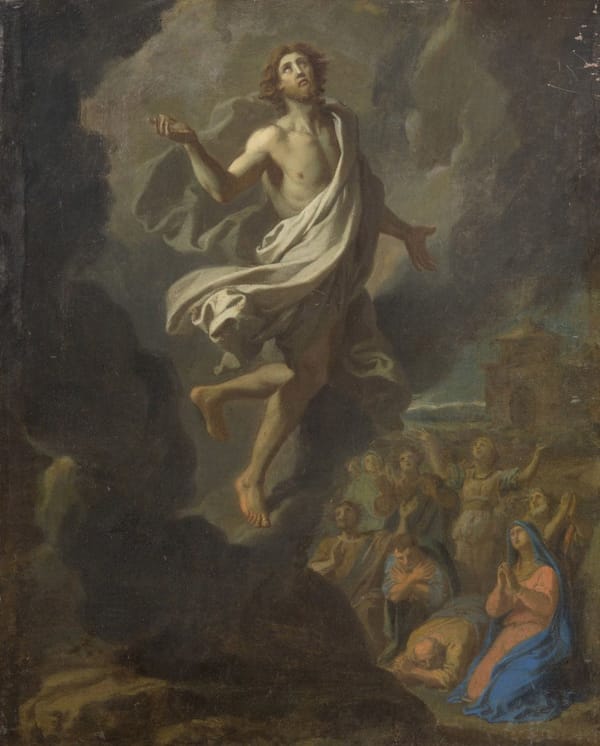
Wednesday within the Octave of the Ascension
Let us now look upon the earth, for our eyes have hitherto been riveted upon the heaven into which our Jesus has entered. Let us see what effects the mystery of the Ascension has produced on this land of our exile. These effects are of the most extraordinary nature. This Jesus, who ascended into heaven unknown to the city of Jerusalem, and whose departure, when it did become known, excited neither regret nor joy among the men of that generation,—now, eighteen hundred years after His departure from us, finds the whole earth celebrating the anniversary of His glorious Ascension. Our age is far from being one of earnest faith; and yet there is not a single country on the face of the globe, where, if there be a church or chapel or even a Catholic home, the feast of Jesus’ Ascension is not being now kept and loved.
He lived for three-and-thirty years on our earth. He, the eternal Son of our God, dwelt among His creatures, and there was only one people that knew it. That one favoured people crucified Him. As to the Gentiles, they would have thought Him beneath their notice. True, this beautiful’light shone in the darkness; but the darkness did not comprehend it; He came unto His own, and His own received Him not.’1 He preached to His chosen people; but His word was that seed which falls on stony ground, and takes no root, or is cast among thorns and is choked; it could with difficulty find a plot of good ground, wherein to bring forth fruit.2 If, thanks to His infinite patience and goodness, He succeeded in keeping a few disciples around Him, their faith was weak and hesitating, and gave way when temptation came.
And yet, ever since the preaching of these same apostles, the name and glory of Jesus are every where; in every language, and in every clime, He is proclaimed the Incarnate Son of God; the most civilized, as well as the most barbarous nations, have submitted to His sweet yoke; in every part of the universe men celebrate His birth in the stable of Bethlehem, His death on the cross whereby He ransomed a guilty world, His resurrection whereby He strengthened the work He came to do, and His Ascension, which gives Him, the Man-God, to sit at the right hand of His Father. The great voice of the Church carries to the uttermost bounds of the earth the mystery of the blessed Trinity, which He came to reveal to mankind. This holy Church, founded by Him, teaches the truths of faith to all nations, and in every nation there are souls who are docile to her teaching.
How was this marvellous change brought about? What has given it stability during these eighteen hundred years? Our Saviour Himself explains it to us, by the words He spoke to His apostles after the last Supper: ‘It is,’ said He,’expedient to you that I go.’3 What means this, but that there is something more advantageous to us than having Him visibly present amongst us? This mortal life is not the time for seeing and contemplating Him, even in His human Nature. To know Him, and relish Him, even in His human Nature, we stand in need of a special gift; it is faith. Now, faith in the mysteries of the Incarnate Word did not begin its reign upon the earth, until He ceased to be visible here below.
Who could tell the triumphant power of faith? St. John gives it a glorious name; he says:’It is the victory which overcometh the world.’4 It subdued the world to our absent King; it subdued the power and pride and superstitions of paganism; it won the homage of the earth for Him who has ascended into heaven, the Son of God and the Son of Mary, Jesus.
St. Leo the Great, the sublime theologian of the mystery of the Incarnation, has treated this point with his characteristic authority and eloquence. Let us listen to his glorious teaching.’Having fulfilled all the mysteries pertaining to the preaching of the Gospel and to the new Covenant, our Lord Jesus Christ ascended into heaven, in the sight of His disciples, on the fortieth day after His Resurrection; hereby withdrawing His corporal presence, for He was to remain at the right hand of His Father until should be filled up the measure of time decreed by God for the multiplication of the children of the Church, and He (Jesus) should again come, and in the same Flesh wherewith He ascended, to judge the living and the dead. Thus, therefore, that which in our Redeemer had hitherto been visible passed into the order of mysteries. And to the end that faith might be grander and surer, teaching took the place of sight; which teaching was to be accepted by the faithful with hearts illumined by heavenly light.
This faith, increased by our Lord’s Ascension, and strengthened by the gift of the Holy Ghost, was proof against every trial; so that neither chains, nor prisons, nor banishment, nor hunger, nor fire, nor wild beasts, nor all the ingenuity of cruelty and persecution, could affright it. For this faith, not only men, but even women, not only beardless boys but even tender maidens, fought unto the shedding of their blood, and this in every country of the world. This faith cast out devils from such as were possessed, cured the sick, and raised the dead to life. The blessed apostles themselves,—who, though they had so often witnessed their Master’s miracles and heard His teachings, turned cowards when they saw Him in His sufferings, and hesitated to believe His Resurrection,—these same, I say, were so changed by His Ascension, that what heretofore had been a subject of fear, then became a subject of joy. And why? Because the whole energy of the soul’s contemplation was raised up to Jesus’ Divinity, now seated at the right hand of His Father; the vigour of the mind’s eye was not dulled by the bodily vision, and they came to the clear view of the mystery, namely, that He neither left the, Father when He descended upon the earth, nor left His disciples when He ascended into heaven.
Never, then, was Jesus so well known, as when He withdrew Himself into the glory of His Father’s majesty, and became more present by His Divinity in proportion as He was distant in His Humanity. Then did faith, made keener, approach to the Son coequal with His Father; she needed not the handling of the bodily substance of her Christ,—that bodily substance, whereby He is less than His Father, The substance of His glorified Body is the same; but our faith was to be of so generous a kind, that we were to go to the coequal Son, not by a corporal feeling, but by a spiritual understanding. Hence, when Mary Magdalene, who represented the Church, threw herself at the feet of the risen Jesus, and would have embraced them, He said to her: Touch Me not, for I am not yet ascended to My Father; as though He would say: I will not that thou come to Me corporally, or that thou know Me by the testimony of thy senses. I have a sublimer recognition in store for thee; I have prepared something far better for thee. When I shall have ascended to My Father, then shalt thou feel Me in a higher and truer way; for thou shalt grasp what thou touchest not, and believe what thou seest not.’5
The departure of our Emmanuel was, therefore, the opening of that reign of faith, which is to prepare us for the eternal vision of the sovereign Good; and this blessed faith, which is our very life, gives us, at the same time, all the light compatible with our mortal existence, for knowing and loving the Word consubstantial with the Father, and for the just appreciation of the mysteries which this Incarnate Word wrought here below in His Humanity. It is now eighteen hundred years since He lived on the earth; and yet we know Him better than His disciples did before His Ascension. Oh! truly it was expedient for us that He should go from us; His visible presence would have checked the generosity of our faith; and it is our faith alone that can bridge over the space which is to be between Himself and us until our ascension comes, and then we shall enter within the veil.
How strangely blind are those who see not the superhuman power of this element of faith, which has not only conquered, but even transformed, the world! Some of them have written long treatises to prove that the Gospels were not written by the evangelists: we pity their ravings. But these great discoverers have another difficulty to get over, and so far they have not attempted to grapple with it; we mean the living Gospel which is the production of the unanimous faith of eighteen centuries, and is the result of the courageous confession of so many millions of martyrs, of the holiness of countless men and women, of the conversion of so many both civilized and uncivilized nations. Assuredly He,—who after having spent a few short years in one little spot of earth, had but to disappear in order to draw men’s hearts to Himself so that the brightest intellects and the purest minds gave Him their faith,—must be what He tells us He is: the eternal Son of God. Glory, then, and thanks to Thee O Jesus! who to console us in Thine absence, hast given us faith, whereby the eye of our soul is purified, the hope of our heart is strengthened, and the divine realities we possess tell upon us in all their power! Preserve within us this precious gift of Thy gratuitous goodness; give it increase; and when our death comes,—that solemn hour which precedes our seeing Thee face to face,—Oh, give us the grand fullness of our dearest faith!
One of the most northern of the Churches, now, alas! a slave to Lutheranism, shall provide us to-day with a hymn in honour of the mystery we are celebrating. It is a sequence taken from the last missal of Abo, in Finland. It was composed in the fourteenth or fifteenth century.
Sequence
Festos choros ducite,
Christo triumphante;
Redit cum victoria,
Capta ducens spolia,
Tuba jubilante.
Hodie dominicum
Germen gloriatur!
Terrae fructus hodie
Super thronos curiæ
Cœli sublimatur.
Moyses, et populum
Trahit ad spectaculum
Stant suspensis vultibus,
Intendentes nubibus
Jesum subducentibus,
Viri Galilaei.
Elisaeo duplex datur
Spiritus et pallium:
Alta Christus dum conscendit,
Servis suis mnas appendit
Gratiarum omnium.
Luctum gerens non inanem,
Crucis usus baculo;
Redit turmis cum duabus,
Angelis et animabus,
Et thesauri sacculo.
Qui de mortis
Victor portis
Introit cum gloria;
Rex virtutum,
Cujus nutum
Et obtutum
Trina tremit regia.
Ad consessus solium,
Donec suppedaneos,
Victos vel spontaneos,
Ponat inimicos.
Fruitur potissimis;
Redit ex novissimis,
Judicans ex intimis
Justos et iniquos.
Veni cum clementia:
Dum sistemur ante thronum
Tua in præsentia:
Fac misericordiam;
In perennem transfer vitam
Ad futuram gloriam.
and sing your festive songs,
for it is the triumph of Christ!
He returns to heaven, leading thither
the trophies he has won; and as he ascends,
the jubilant sound of the trumpet is heard.
that is this day conferred on the Son of God!
The fruit of our earth
is this day exalted
above all the thrones
of the heavenly court.
and people flock to see
the grandeur of the mystery:
stand looking up
to the cloud
that received him
out of their sight.
he gave his twofold
spirit and his mantle to Eliseus:
when Jesus ascended into heaven,
he gave to his servants
the talents of his grace.
enduring sufferings of wondrous avail to us,
and the staff he used was the cross.
He returned to heaven with two troops,
—of angels, and of souls (set free from limbo),
—and laden with treasures.
who, having conquered
the gates of death,
entered heaven with glory.
He is the King of hosts,
at whose bidding
and presence
the triple creation trembles.
to sit with him on his throne,
until he make his enemies
bow down before him,
vanquished by force or love.
he receives supreme honour;
he is to come again upon our earth
to judge the consciences of all,
saints and sinners.
come in thy mercy,
when we are to appear
before thee seated on thy throne.
and give us to ascend
to the endless life
of future glory.
Again the Mozarabic breviary offers us one of its beautiful prayers for this octave.
Prayer
May 31: St. Petronilla
THOUGH the Church makes but a simple commemoration of this illustrious virgin in the office of this day, we will not fail to offer her the homage of our devout veneration. On the twelfth of this month we kept the feast of the noble virgin and martyr, Flavia Domitilla; it is probable that Aurelia Petronilla was also of the imperial family of the Flavii. The early traditions of the Church speak of her as being the spiritual daughter of the Prince of the Apostles; and though she did not, like Domitilla, lay down her life for the faith, yet she offered to Jesus that next richest gift, her virginity. The same venerable authorities tell us also that a Roman Patrician, by name Flaccus, having asked her in marriage, she requested three days for consideration, during which she confidently besought the aid of her divine Spouse. Flaccus presented himself on the third day, but found the palace in mourning, and her family busy in preparing the funeral obsequies of the young virgin, who had taken her flight to heaven, as a dove that is startled by an intruder’s approach.
In the eighth century, the holy Pope Paul I had the body of Petronilla taken from the cemetery of Domitilla, on the Ardeatine Way. Her relics were found in a marble sarcophagus, the lid of which was adorned, at each corner, with a dolphin. The Pope had them enshrined in a little church, which he built near the south side of the Vatican Basilica. This church was destroyed in the sixteenth century, in consequence of the alterations needed for the building of the new Basilica of St Peter; and the relics of St Petronilla were translated to one of its altars on the west side. It was but just that she should await her glorious resurrection under the shadow of the great Apostle who had initiated her in the faith, and prepared her for her eternal nuptials with the Lamb.
Thy triumph, O Petronilla, is one of our Easter joys. We lovingly venerate thy blessed memory. Thou didst disdain the pleasures and honours of the world, and thy virginal name is one of the first on the list of the Church of Rome, which was thy mother. Aid her now by thy prayers. Protect those who seek thine intercession, and teach us how to celebrate, with holy enthusiasm, the solemnities that are soon to gladden us.
| Previous May 30 (the Same Day): St. Joan of Arc, Virgin | Next May 31: St. Petronilla |