Daily reading
Paschal Time
Major vigil · Movable from Easter · Temporal
June 3, 2028
From Dom Guéranger’s The Liturgical Year.

|
Vigil of Pentecost
The dazzling splendour of to-morrow’s solemnity forecasts its beauty on this day of its vigil. The faithful are preparing themselves by fasting to celebrate the glorious mystery. But the Mass of the neophytes, which formerly was said during the night, is now anticipated, as on Easter Eve; so that by to-day’s noon, we shall have already begun the praises of the Holy Ghost. The Office of Vespers, in the afternoon, will solemnly open the grand festival. The reign of the holy Spirit is, therefore, proclaimed by the liturgy of this very day. Let us unite ourselves in spirit with the holy ones, who are awaiting the fulfilment of Jesus’ promise.
Whilst following the mysteries of the past seasons of the liturgical year, we have been frequently told of the action of the Third Person of the blessed Trinity. The lessons read to us, from both the old and the new Testament, have more than once excited our respectful attention towards this divine Spirit, who seemed to be shrouded in mystery, the time for Him to be made manifest not having yet arrived. The workings of God in His creatures do not come all at once; there is a succession in their coining, but come they certainly will. The sacred historian describes how the heavenly Father, acting through His Word, employed six days in arranging, into its several parts, this world which He had created; but he also tells us, though under the veil of a mysterious expression, that the Spirit moved over the waters, which the Son of God was about to divide from the earth.
If, then, the Holy Ghost’s visible reign on our earth was deferred until such time as the Man-God should be enthroned on the Father’s right hand, we must not conclude that this divine Spirit has been inactive. What are the sacred Scriptures, from which the liturgy has selected so many sublime passages for our instruction, but the silent production of Him, who, as the venerable Symbol has it, ‘spoke by the prophets?’1 He gave us the Word, the Wisdom of God, by the Scripture, who gave us, at a later period, this same Word, in the flesh of human nature.
He has never been a moment of all the past ages without working. He prepared the world for the reign of the Incarnate Word; He did so by bringing together the various races of once separate nations, and by keeping up that universal expectation of a Redeemer, which was held alike by the most barbarous and by the most highly civilized. The earth had not as yet heard the name of the Holy. Ghost, but He moved over the universe of mankind, as He moved over the dead mass of water at the beginning of the world.
Meanwhile, the prophets spoke of Him in several of the prophecies wherein they foretold the coming of the Son of God. The Lord thus spoke by the lips of Joel:’I will pour out My Spirit upon all flesh.’2 He said to us through Ezechiel:’I will pour upon you clean water, and you shall be cleansed from all your filthiness, and I will cleanse you from all your idols. And I will give you a new heart, and put a new spirit within you: and I will take away the stony heart out of your flesh, and I will give you a heart of flesh; and I will put My Spirit in the midst of you.’3
But previously to the manifestation of Himself, the Holy Ghost was to effect that of the divine Word. When infinite power called into existence the body and soul of the future Mother of God, it was He that prepared the dwelling for the sovereign Majesty, by sanctifying Mary from the instant of her conception, and taking possession of her as the temple into which the Son of God was soon to enter. When the ever blessed day of the Annunciation came, the archangel declared unto Mary that the Holy Ghost would come upon her, and that the power of the Most High would overshadow her. No sooner did the Virgin consent to the fulfilment of the eternal decree, than the operation of the divine Spirit produced within her the most ineffable of mysteries: the Word was made Flesh, and dwelt among us!
Upon this flower that sprang from the branch of the tree of Jesse, upon this Humanity divinely produced in Mary, there rested complacently the Spirit of the Father and of the Son: He enriched it with His gifts, He fitted it for its glorious and everlasting destiny.4 He that had so filled the Mother with the treasures of His grace, that it seemed to border on infinity, gave incomparably more to her Child. And, as ever, the holy Spirit worked these stupendous wonders silently; for the time of His manifestation had not come. The earth is to catch but a glimpse of Him on the day of Jesus’ baptism, when He will rest with outstretched wings on the head of the well-beloved Son of the Father. The holy Baptist John will understand the glorious vision, as he had felt, when yet unborn, the presence of the blessed fruit in Mary’s womb; but as to the bystanders, they saw but a dove, and the dove revealed not his eternal secrets.
The reign of the Son of God, our Emmanuel, is established upon its predetermined foundations. In Him we have a brother, for He has assumed our weak human nature; a teacher, for He is the Wisdom of the Father, and leads us into all truth; a physician, for He heals all our infirmities; a mediator, for by His sacred Humanity He brings all creation to its Creator. In Him we have our Redeemer, and in His Blood our ransom; for sin had broken the link between God and ourselves, and we needed a divine Redeemer. In Him we have a Head, who is not ashamed of His members, however poor they may be; a King whom we have seen crowned with an everlasting diadem; a Lord, whom the Lord hath made to sit on His right hand.5
But if He rules over this earth for all ages, it is from His throne in heaven that He is to rule, until the angel’s voice is heard proclaiming that ‘time is no more’;6 and then He will return to ‘crush the heads’7 of sinners. Meanwhile, long ages are to flow onwards in their course, and these ages are to be the reign of the Holy Ghost. But as we learn from the evangelist, the Spirit was not given until such time as Jesus was glorified.8 So that our beautiful mystery of the Ascension stands between the two divine reigns on earth: the visible reign of the Son of God, and the visible reign of the Holy Ghost. Nor is it only the prophets who announce the succession of the second to the first; it is our Emmanuel Himself, who, during the days of His mortal life, heralded the approaching reign of the divine Spirit.
We have not forgotten His words: ‘It is expedient for you that I go; for if I go not, the Paraclete will not come to you.’9 Oh! how much the world must have needed this divine guest, of whom the very Son of God made Himself the precursor! And that we might understand how great is the majesty of this new master who is to reign over us, Jesus thus speaks of the awful chastisements which are to befall them that offend Him: ‘Whosoever shall speak a word against the Son of Man, it shall be forgiven him; but he that shall speak against the Holy Ghost, it shall not be forgiven him, neither in this world nor in the world to come.’10 This divine Spirit is not, however, to assume our human nature, as did the Son; neither is He to redeem the world, as did the Son; but He is to come among men with a love so immeasurable, that woe to them who despise it! It is to Him that Jesus intends to confide the Church, His bride, during the long term of her widowhood; to Him will He make over His own work, that He may perpetuate and direct it in all its parts.
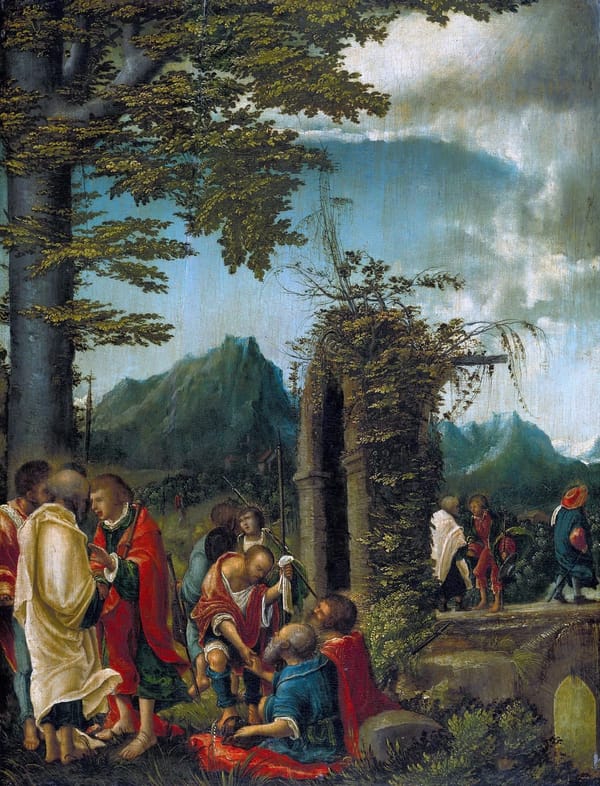
We, then, who are to receive a few hours hence the visit of this Spirit of love, who is to renew the face of the earth,11 must be all attention, as we were at Bethlehem when we were awaiting the birth of our Emmanuel. The Word and the Holy Ghost are coequal in glory and power, and their coming upon the earth proceeds from the one same eternal and merciful decree of the blessed Trinity, who, by this twofold visit, would’make us partakers of the divine nature.’12 We, who were once nothingness, are destined to become, by the operation of the Word and the Spirit, children of the heavenly Father. And if we would know what preparation we should make for the visit of the Paraclete, lot us return in thought to the cenacle, where we left the disciples assembled, persevering with one mind in prayer, and waiting, as their Master had commanded them, for the power of the Most High to descend upon them, and arm them for their future combat.
The first we look for in this sanctuary of recol- lectedness and peace, is Mary, the Mother of Jesus, the master-piece of the Holy Ghost, the Church of the living God, from whom is to be born on the morrow, and by the action of the same divine Spirit, the Church, militant; for this second Eve represents and contains it within herself. Well, indeed, does this incomparable creature now deserve our honour! Have we not seen her glorious share in all the mysteries of the Man-God? And is she not to be the dearest and worthiest object of the Paraclete’s visit? Hail, then, O Mary full of grace! Thou art our mother, and we rejoice in being thy children. The holy Church expresses this joy of ours, when she thus comments the words of David’s canticle: ‘Our dwelling in thee, O holy Mother of God! is as of them that are all rejoicers!’13 In vain wouldst thou decline the honours that await thee on the morrow! Mother Immaculate! Temple of the Holy Ghost! there is no escape, and receive thou must a new visit of the Spirit, for a new work is entrusted to thee: the care of the infant Church for several years to come!
The apostolic college is clustered around the holy Mother; it is such a feast to them to look upon her, for they see the likeness of their Jesus in her face! In the very cenacle where they are now assembled, and in Mary’s presence, an event occurs which is of deep importance. As God, when He formed His Israelite people, chose the twelve sons of Jacob that they might be the fathers of that privileged race, so did Jesus choose twelve men, and they, too, were Israelites, that they might be the foundations of the Church, of which He Himself, and Peter together with and in Him, is the chief corner-stone. The terrible fall of Judas has reduced the number to eleven; the mysterious number is broken, and the Holy Ghost is about to descend upon the college of the apostles. Jesus had not thought proper to fill up the vacanoy before His Ascension into heaven: and yet the number must be completed, before the coming of the Power from on high. The Church surely could not be less perfect than the Synagogue. Who, then, will take Christ’s place in designating the new apostle? Such a right, says St. John Chrysostom, could not belong to any but Peter; but he humbly waived his right, and expressed his wish that there should be an election. The choice fell upon Mathias, who immediately took his place among the apostles, and awaited the promised Comforter.
In the cenacle, and in the blessed Mother’s company, there are also the disciples, less honoured, it is true, than the twelve, yet have they been witnesses of the works and mysteries of the Man-God; they, too, are to share in preaching the good tidings. And finally, Magdalene and the other holy women are there, preparing, as the Master had prescribed, for the visit from on high, which is to tell upon them also. Let us honour this fervent assembly of the hundred and twenty disciples. They are our models. The holy Spirit is to descend first upon them, for they are His first-fruits; but He is to come down upon us also, and it is with a view to prepare us for our Pentecost that the Church imposes on us to-day the obligation of fasting.
Formerly, this vigil was kept like that of Easter. The faithful repaired to the church in the evening, that they might assist at the solemn administration of Baptism. During the night, the Sacrament of regeneration was conferred upon such catechumens as sickness or absence from home had prevented from receiving it on Easter night. Those, also, who had then been thought insufficiently tried or instructed, and had, during the interval, satisfied the conditions required by the Church, now formed part of the group of aspirants to the new birth of the sacred font. Instead of the twelve prophecies, which were read on Easter night while the priests were performing over the catechumens the rites preparatory to Baptism, six only were now read; at least, such was the usual custom, and it would lead us to suppose that the number of those baptized at Pentecost was less than at Easter.
The Paschal Candle was again brought forward during this night of grace, in order to impress the newly baptized with respect and love for the Son of God, who became Man that He might be the light of the world.14 The rites already described and explained for Holy Saturday were repeated on this occasion, and the Sacrifice of the Mass, at which the neophytes assisted, began before the break of day.
In later times, when the charitable custom of conferring Baptism on children immediately after their birth passed into a general law, the Mass of Whitsun-Eve was said early in the morning, as was done in the case of Easter-Eve. The six prophecies, of which we have just spoken, are now read before the celebration of the holy Sacrifice; after which, the baptismal water is solemnly blessed. The Paschal Candle is used at this ceremony, at which the faithful should consider it a duty to assist.
First Vespers are sung in the afternoon. We do not insert them, because Whitsun-Eve can never occur on a Sunday; whereas, for other feasts, for which we have given the first Vespers, the vigil may be a Sunday. Moreover, the first and second Vespers of Whit-Sunday are almost exactly alike.
We will close this day by inserting one of the finest sequences composed by Adam of Saint Victor on the mystery of Pentecost. This great liturgical poet of the western Church has surpassed himself in what he has written on the Holy Ghost; and more than once, during the octave, we will select from his rich store. But the hymn we give to-day is not merely a composition of poetic worth; it is a sublime and fervent prayer to the Paraclete, whom Jesus has promised to send us, and whom we are now expecting. Let us make these sentiments of the devout poet of the twelfth century our own; let us imitate him in his longings for the holy Spirit, who is coming that He may renew the face of the earth, and dwell within us.
Sequence
Genitore Genitoque,
Pariter Paraclite,
Redde linguas eloquentes,
Fac ferventes in te mentes
Flamma tua divite.
Par amborum, et utrique
Compar et consimilis,
Cuncta reples, cuncta foves,
Astra regis, cœlum moves,
Permanens immobilis.
Internarum tenebrarum
Effugas caliginem;
Per te mundi sunt mundati;
Tu peccatum et peccati
Destruis rubiginem.
Et ostendis viam pacis
Et iter justitiæ.
Perversorum corda vitas,
Et bonorum corda ditas
Munere scientiae.
Te praesente nil impurum;
Gloriatur mens jucunda;
Per te laeta,
Per te munda
Gaudet conscientia.
Per te suam sacramenta
Habent efficaciam:
Tu nocivam vim repellis,
Tu confutas et refellis
Hostium nequitiam.
Quando subis, atrae nubis
Effugit obscuritas;
Sacer ignis, pectus uris;
Non comburis, sed a curis
Purgas, quando visitas.
Et sopitas et oblitas
Erudis et excitas.
Foves linguas, formas sonum,
Cor ad bonum facit pronum
A te data charitas.
O solamen miserorum,
Pauperum refugium,
Da contemptum terrenorum:
Ad amorem supernorum
Trahe desiderium.
Habitator et amator
Cordium humilium,
Pelle mala, terge sordes,
Et discordes fac concordes,
Et affer præsidium.
Docuisti, confortasti
Timentes discipulos,
Visitare nos digneris;
Nos, si placet, consoleris
Et credentes populos.
Par potestas est earum,
Et communis deitas:
Tu procedens a duobus
Coæqualis es ambobus:
In nullo disparitas.
Quantus Pater est et qualis;
Servorum humilitas
Deo Patri, Filioque
Redemptori, tibi quoque
Laudes reddat debitas.
who proceedest equally from the Father
and the Son! with thy glowing fire,
give eloquence to our tongues,
and make our hearts fervent
in their love for thee.
equal and coequal with them in essence!
thou fillest and fosterest all things:
and though in thyself immovable,
thou governest the stars,
and givest motion to the heavens.
thou puttest to flight
the gloom of our soul’s darkness.
‘Tis thou that purifiest the pure,
and takest away
sin and its rust.
thou showest us the way of peace
and the path of justice.
Thou shunnest the hearts of perverse sinners;
thou enrichest the hearts of the good
with the gift of knowledge.
when thou art present, there is no impurity.
The soul that possesses thee,
is cheerful:
and her conscience
is joyful and pure.
by thee have the Sacraments
their efficacy:
thou drivest away all evil power:
thou bringest to nought
the wickedness of our enemies.
our hearts are soothed;
when thou enterest, dark clouds are put to flight.
O sacred Fire! when thou visitest us,
thou inflamest our souls; not burning them,
but purging them from the dross of care.
that once were ignorant and drowsy and heedless.
Thou inspirest the tongue,
thou formest its speech;
and the charity thou givest,
makes the heart prompt to all that is good.
O Comforter of the afflicted!
O refuge of the poor!
Give us a contempt for earthly things,
and draw our affections
to the love of what is heavenly.
and guest, and lover
of humble souls!
Drive all evil from us, cleanse our sins,
bring concord where now is discord,
and support us by thy protection.
teach, and strengthen
the timid disciples,
deign to visit us;
vouchsafe to console us
and the faithful throughout the world.
equal the power,
and one the divinity,
of the Three Persons.
Thou proceedest from the Father and the Son,
and art coequal in all things with them.
in all perfections as is the Father,
accept from us thy poor servants
the praise that is due to thee,
equally with the Father
and the Son.
- Qui locutus est per prophetas. (Symbol of Nicœa and Constantinople.) ↩︎
- Joel, ii. 28. ↩︎
- Ezech. xxxvi. 25-27. ↩︎
- Is. ad. 1-3. ↩︎
- Ps. cix. 1. ↩︎
- Apoc. x. 6. ↩︎
- Ps. cix. 6. ↩︎
- St. John, vii. 39. ↩︎
- St. John, xvi. 7. ↩︎
- St. Matth. xii. 32. ↩︎
- Ps. ciii. 30. ↩︎
- 2 St. Peter, i. 4. ↩︎
- The 2nd Nocturn of the Office of the Blessed Virgin; Antiphon to the 86 th Psalm. ↩︎
- St. John, viii. 12. ↩︎
June 3: St. Clotilde, Queen of the Franks
At this season, in which the Office of the time is leading us to consider the early developments of holy Church, eternal Wisdom so arranges, now as ever, that the feasts of the saints should complete the teachings of the movable cycle. The Paraclete, who has but just come down upon us, is to fill the whole earth;1 the Man-God has sent Him expressly to win over the whole earth and to secure all time to His Church. Now, it is by subjecting kingdoms to the faith, that He is to form Christ’s empire;
it is by enabling the Church to assimilate all nations to herself, that He gives growth and continuance to the bride. See, therefore, how at this Season wherein He has but just taken possession of the world anew, His co-operators in this His work of conquest shine out on every side in the heavens of the holy liturgy. But the west above all concurs in forming the magnificent constellation that is mingling its radiant splendour with the fires of Pentecost. Indeed, what could better show the omnipotence of the Spirit of Christ, than the establishment of this Latin Christendom, in these distant lands of the west?
What star is this shining to-day in such silvery beauty on the land of the Franks? The city of Lyons, prepared by the blood of martyrs for this her second glory, sees this new light rise in her midst. Clotilde is a mother; and the cruel sufferings which wrung her heart while she was yet young matured her soul for the grand destinies reserved by God for the privileged children of sorrow. The violent death of her father Chilperic, dethroned by a fratricidal usurper; the sight of her brothers massacred, and of her mother drowned in the Rhone; her long captivity in the Arian court of the murderer who brought heresy with him to the throne of the Burgundians, developed in her the heroism that was to make this niece of Gondebaud become the mother of a whole nation to Christ.
God drew the visible universe out of nothingness, solely to manifest His goodness. In like manner, He has willed that man, coming from His hands without power as yet to recognize his Creator, should recognize, at least, a mother’s tender love, the first sensible ray, as it were, of infinite love. Irresistible is this ray, sublime in its gentleness, exquisite in its purity, giving to the mother a facility, belonging only to her, to complete in the soul of her child the reproduction of the divine ideal that is to be impressed upon him. Now this she does by education. To-day’s feast reveals how much more sublime, more potent, more extensive, is maternity in the order of grace than in that of nature. For when God, coming down amongst us, was pleased, to take Flesh of a daughter of Adam, maternity was raised in her to the extreme limit that separates the endowments of a simple creature from the divine attributes. Thus rising above the heavens, maternity at the same time embraced the world, bringing all mankind together into close union, without distinction of nation or family, in the one filiation of that Virgin-Mother. The new Adam, the perfect model of our race, and our first born,2 willed to have us for His brethren, in all fullness, brethren in Mary as in God.3 The Mother of God was then proclaimed Mother of men on Calvary; from the summit of the cross, the Man-God replaced upon the brow of Mary that diadem of Eve, broken beneath the fatal tree. Constituted sole Mother of the living by this noble investiture,4 our Lady once again participated in the privileges of the Father who is in heaven. Not only was she Mother by nature, as He is Father, of His Son; but, just as all paternity flows down from the eternal Father, and borrows thence supereminent dignity; so from that moment, all maternity was nought but an outflow of Mary’s in the truest sense; a delegation of her love, and a communication of her august privilege whereby she brings forth men unto God, whose sons they are to be.
Good reason, therefore, have Christian mothers to glory in their maternity, for in that does their greatness consist; through Mary, their dignity has increased to a degree that nature could never have dreamed of. But at the same time, under the aegis of Mary, not less real is the maternity of holy virgins, not only in God’s eyes, but often manifested to their own: the wife, too, prepared by a special call from God and by suffering, is sometimes, like Clotilde, endowed with a fecundity of a spiritual order, a thousand times more prolific than that of earth. Happy the fruits of this supernatural maternity, which under the favour of Mary is fraught with so much greatness! Happy the nations on whom the divine munificence has bestowed a mother!
History tells us how the founders of empires have ever had the terrible prerogative of impressing upon nations the distinctive character, disastrous or beneficial, which, through length of ages, continues to be theirs. How often does that want of counterpoise to the preponderance of power, make itself only too evident in the impetus given rather to destroy than to build up! And wherefore? Because ancient empires never had a mother; for this noble title cannot be applied to those heroines who have transmitted their names to posterity merely for having rivalled the ambition and pomp of conquerors. To Christian times it was reserved to behold introduced into a people’s life this element of maternity, more salutary, more efficacious in its humble gentleness, than that which springs from the talents or vices, from the power or genius, of their first princes.
Time was needed to subdue the savage instincts of the warriors of Clovis, and to fit his sword to the noble destiny that awaited it in the hand of a Charlemagne, or of a St. Louis. With good reason has it been said that the honour of this labour is due to the bishops and the monks. But to be more accurate and to prove a deeper insight into the ways of divine Providence, it would have been well, perhaps, to pass less lightly over woman’s part in the work of conversion and of education, which made the Frankish nation become the eldest son of the Church. Clotilde it was who led the Franks to the baptistery of Rheims, and presented to Remigius the proud Sicambrian, transformed far less by the exhortations of the holy bishop than by the force of prayer, the prayer of that strong woman elected by God to bear away this rich spoil from the camp of hell. What manly energy, what devotedness to God, are displayed in every measure taken by this noble daughter of the Burgundians’ dethroned king! Beneath the suspicious eye of the usurper, the murderer of her family, she awaits, in the silence of prayer and in the exercise of charity, heaven’s appointed hour. When at last the moment comes, taking counsel of none save the Holy Ghost and her own heart, how nobly does she dart forward to conquer unto Christ her betrothed, though yet a stranger to her, out-doing in valour, in this instance, all the warriors of her escort! Strength and beauty were indeed her covering,5 her adornment on her bridal day; and the heart of Clovis soon learnt that the conquests reserved to his bride far out-stripped in importance the booty he had hitherto seized by force of arms. Clotilde, on the other hand, found her work already prepared on the banks of the Seine. For fifty years, St. Genevieve had been busy defending Paris against the pagan hordes, and only awaiting the Baptism of the king of the Franks in order to open to him the city gates.
Still, when on that Christmas night Clotilde gave birth to the eldest son of holy Church in Mary’s name, the great work was far from being completed; this new-born people had yet, by the slow process of a laborious education to be fashioned into the most Christian nation. This chosen one of God and of our Lady does not fall short of the maternal task. But still what anguish of heart to be endured, what tears yet to be shed over these her sons, whose inborn violence seems simply indomitable, and the very exuberance of whose rich nature yields them up to the fury of passions, urging them blindly on to crimes the most atrocious! Her grand-children, inveigled from her side and caught in the perfidious trap laid for them by their faithless uncles, are massacred. Fratricidal wars carry devastation over the whole of that territory of ancient Gaul, purged by her from paganism and heresy. Finally another pang, but one of a more glorious kind, seems given as a compensation for the bitterness of intestine strife. Her cherished daughter, Clotilde the younger, dies, worn out by ill usage endured for her faith at the hand of her Arian husband. Surely all this must have shown clearly enough to the queen of the Franks, that if she was chosen by heaven to be their mother, she was to have all the pangs as well as the honour that title involves. Thus does Christ ever deal with His own, when they have earned His confidence. Clotilde well understood this: already a widow and deprived by death of the aid of Genevieve likewise, she had long ago retired to Tours, near to the sepulchre of the Thaumaturgus of the Gauls. There, in the secret of prayer and in the heroism of her childhood’s faith, did she continue, aided by St. Martin, the preparation of this new people for its mighty destinies.
An immense work was this, and one for which no single life-time could suffice! But though Clotilde was not to witness the desired transformation accomplished, her life was not to close until she had pressed to her heart, at Tours, her illustrious daughter-in-law, Radegonde; and having by this last embrace invested her with her own sublime maternity, she sends her to Poitiers, there to continue, at the tomb of St. Hilary, this great work of intercession. Then, when at length Radegonde herself, having ended her task of suffering and love, must likewise quit this earth, Bathilde will presently come forward to consummate the work, in that remarkable seventh century, when ‘the Frank, at last ready for his mission, is betrothed to holy Church, and dubbed a knight of God.’6
Clotilde, Radegonde, Bathilde, all three of them mothers of France, bear a striking resemblance to one another. All three are prepared, from the early dawn of life, to the devotedness their grand mission would require, by the like trials, captivity, slavery, and massacre or loss of their own relatives: all three bring to the throne nought but a dauntless love of Christ, the King, and a desire of seeing Him rule the people; all three set aside the queenly diadem as soon as may be, in order to be able, prostrate before God in retirement and penitence, to attain more surely the one object of their maternal and royal ambition. Heiresses of Abraham, in very deed, they found in his faith7 the fecundity which made them mothers of those countless multitudes, which the soil watered by their tears produced for heaven. Even in these weakened times of ours, there is still a goodly throng ever passing from the land of the Franks to their true home yonder, there to join the happy bands of the combatants of better days. At the sight of this ever increasing group of sons joyously pressing round their thrones, the hearts of Clotilde, Radegonde, and Bathilde, overflowing with love, give utterance in one united cry, to this word of the Prophet: ‘Who hath begotten these? I was barren and brought not forth, led away, and captive: and who hath brought up these? I was destitute and alone: and these where were they?’ Then the Lord answering, saith: ‘As I live, thou shalt be clothed with all these as with an ornament, and as a bride thou shalt put them about thee. For thy deserts, and thy desolate places, and the land of thy destruction shall now be too narrow by reason of the inhabitants. The children of thy barrenness shall still say in thine ear: the place is too strait for me, make me room to dwell in. And kings shall be thy nursing fathers, and queens thy nurses. And thou shalt know that I am the Lord, for they shall not be confounded that wait for Him.’8
But it is time to listen to the liturgical account of Saint Clotilde’s life.
Great is thy glory on earth and in heaven, O Clotilde, mother of nations! Not only hast thou given to holy Church that people of France, surnamed the most Christian; but our own England and Spain also claim their descent from thee (in the pedigree of faith) by Bertha and Ingonda, thy noble granddaughters. Ingonda, more fortunate than thy daughter Clotilde, succeeded, by the help of Saint Leander of Seville, in bringing back to the true faith her husband Hermenegilde, and even leading him to the crown of martyrdom. Bertha, queen of our own fair Kent, welcomed Augustine to our Saxon shores, and through her influence was our royal Ethelbert brought from the darkness of paganism even unto Baptism and the aureola of sanctity: realizing thus that word of the apostle, that the unbelieving husband is sanctified by the believing wife.9 Since those early days, in how many other parts of Europe, and on how many other more distant shores, have the sons of thine own nation, that nation of which thou wast mother, propagated that light of faith which they received of thee: whether brandishing the sword in defence of the Church’s right to teach freely and everywhere the word of truth; or whether, becoming themselves missioners and apostles, carrying that same truth to infidel nations, far beyond reach of any possible protection, and at the expense of their sweat and of their blood. Happy thou, to be the first in bringing forth unto Christ, the King, a nation pure from every stain of heresy and vowed to holy Church from the first moment of its new birth! Rightly indeed the church of Sainte-Marie at Rheims was the one selected on that Christmas day of the year 496, for this birth unto God of the Frankish nation; wherein our Lady, in a proportionate measure, gave thee to share her own motherhood of our race.
There especially lies our motive of confidence as we turn to thee, O Clotilde, in our intercessory prayer this day. Alas! how many of thy sons are far from being what they should be towards such a mother! But when our Lady gave thee a share in her own maternal rights, she necessarily communicated to thee also her own tender compassion for beguiled children deaf to their mother’s voice. Take pity on these unfortunate sons, led so very far astray by strange doctrines.10 The Christian monarchy founded by thee is no more. Thou didst build it upon the recognized rights of God in His Christ and in the Vicar of His Christ. Princes with shortsighted views of self-interest, traitors to the mission they had received to maintain thy work, imagined they were performing marvels, when they allowed maxims to be spread in thy France, proclaiming the independence of civil power in respect of that of holy Church; and now by a just retribution, society has proclaimed its independence of princes! But at the same time, the infatuated populace has really no other idea than that of being its own sovereign; and intoxicated by this false liberty which it dreams of having acquired, it goes so far as to contemn even the supreme dominion of the Creator Himself. The rights of man have usurped the rights of God, as the basis of social contract; a new-fangled Gospel, which France, with misguided proselytism, is fain to carry over the whole world in place of the true Gospel so loved of yore!
In that unhappy country poisoned by a lying philosophy, such is the excess of delirium, that many who deplore the apostasy of the mass of the population, and wish to remain themselves Christians, imagine they can do so whilst at the same time maintaining the destructive principle of liberalism, the very essence of revolution. Let Christ have heaven and souls, say they, but let man have earth, together with full right of governing it as he chooses, and of thinking as suits him best. While they fall on their adoring knees before the Divinity of our Lord Jesus Christ in the sanctuary of their own conscience, they search the Scriptures, and are too blind to see there expressed how the Man-God is and must be King of the whole earth. In learned theses they inform us that they have probed the very depths of history, and find therein nothing that can contradict their arguments. If indeed they must admit that the government of a Clovis, or a Charlemagne, or a St. Louis does not correspond in everything with their political axioms, we must, they say, make allowances for those primitive ages: a nation cannot be expected to come in a day to the perfect age attained at last by the law of progress! Alas! have pity, O dear mother of France, on the ravings of these poor sons of thine! Arouse once more, in that noble land, the faith of the Franks! Oh! may the God of Clotilde, the Lord of hosts, the King of nations, show Himself once more, leading on thy sons to victory, in the name that won for Clovis the field of Tolbiac: Jesus Christ!
| Previous June 2: Sts. Marcellinus, Peter, and Erasmus, Martyrs | Next June 3: St. Clotilde, Queen of the Franks |