Daily reading
After Pentecost
Double · Movable from Easter · Temporal
June 22, 2028
From Dom Guéranger’s The Liturgical Year.

|
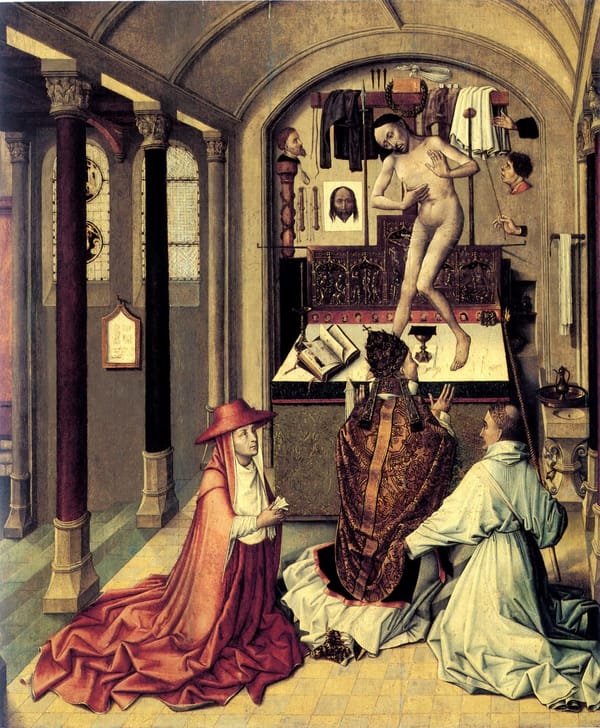
Thursday, the Octave of Corpus Christi
The bright octave, consecrated to the glory of the blessed Sacrament, closes to-day; and although we began the subject three days before the feast itself, we have been able to do little more than slightly touch upon the sublime subject proposed for our consideration and love by the Church. The Memorial left us by our Lord of all His wondrous mercies1 far exceeds the measure of our poor thoughts, and the capabilities of human language; such is the extremity of the infinite love, which God bears to His own2 creatures, that no possibility of ours could make it a return such as it deserves.
Eternal Wisdom was, even from His Father’s bosom, betrothed to human nature. He came down into this world, which sin had marred, and there He found man, who had become the slave of sin;3 He assumed the nature of man: He was thus able to make a Sacrifice, which gives infinite glory and full satisfaction to God, and He perfected His union with His creature, by means of that divine banquet, at which, as food and drink, He Himself is served; for He is the divine Victim4 immolated on the cross and at our altars.
O man! O child of Adam, that wast formed of earthy slime,5 what art thou, that thou shouldst be remembered in the court of heaven?6 Thou desired one of the everlasting hills7—for we may apply this name even to thee—what hast thou done, that thou shouldst thus be glorified?8 Yet doubt it not, thou hast had all these favours. ‘Let not my few weak words stagger thee,’ cries out St. Cyril, the brave defender at Ephesus of the sacred nuptials, of which the Eucharist is what the fathers call the glorious extension, ‘heed not my unworthiness, but listen to the voice, respect the authority, of them that have gone before us, and have preached these truths. They were not men of the common sort, they were not men undeserving of notice, who went about, like hired criers, to proclaim these things on the highroads; no, they were such men as the great Solomon, who was sent as the herald of the King of kings; he sat on his high throne, and proclaimed the mysteries of the Most High; he was clad in scarlet robes, and wore a diadem on his brow, and he was the one to publish the mandate of the God who makes and unmakes kings.’9
Christians! ye people of kings,10 who are to have crowns and thrones yonder in heaven,11 it is to you this Solomon speaks. Your dignity is great. Listen to this herald of God; learn whence comes your greatness, and live up to it. ‘Hearken, ye kings, and understand! Give ear, ye kings! To you are these my words. If ye love your thrones and your sceptres, love wisdom, that ye may reign for ever. I preferred this wisdom before kingdoms and thrones; I loved her above all treasures, and health, and beauty, and chose to have her instead of light. What this wisdom is, and what her origin, I will declare, and I will not hide from you the mysteries of God; but will seek wisdom out from the beginning of her birth, and bring the knowledge of her to light, and will not pass over the truth. I have learned her without guile, and I communicate her to you without envy. Receive, therefore, instruction by my words, and it shall be profitable unto you.’12 Would to God, that we had been able to tell the wonderful mystery we have been celebrating! Divine Wisdom Himself has been pressing us, during all these days, to study the excellencies of that sacred Bread, which yields delights to the kings, His guests.13 The Church has kept close to the throne of her Jesus, that cloud in which He dwells out of love for us.14 She is full of love for Him; He has given her unity by the Sacrament of union; and she, like a strong compact city, summons her tribes of Israel,15 the holy nation, the people of the redeemed, the chosen race of the priests and kings,16 to come together again on this octave-day, that they may testify their faith, and sing their love, and be grateful for the peace which the holy Eucharist secures to them, and for the abundance of grace and blessing it gives to these her children.17 These days of universal joy and festivity around the holy Host were revealed by the Holy Ghost to the son of Sirach; and the vision made him exclaim: ‘Wisdom shall praise her own self, and shall be honoured in God, and shall glory in the midst of her people, and shall open her mouth in the churches of the Most High, and shall glorify herself in the sight of His power. And in the midst of her own people, she shall be exalted, and shall be admired in the holy assembly. And in the multitude of the elect, she shall have praise, and among the blessed (of the Father) she shall be blessed.’18
‘Blessed the man,’ continues the inspired writer, still speaking in the future, ‘that shall dwell in wisdom! Blessed the man that considereth her ways in his heart, and hath understanding in her secrets, who goeth after her as one that traceth, and prepareth for her snares of love;19 who looketh in at her windows, and hearkeneth at her door! Blessed is he that lodgeth near her house, and, fastening a pin in her walls, shall set up his tent nigh unto her, where good things shall rest in his lodging for ever. He shall set his children under her shelter, and shall lodge under her branches. He shall be protected under her covering from the heat, and shall rest in her glory.’20
O house of God, house of the feasting of kings,21 filled with the fragrance of sweetest incense!22 Better is one day in thy precincts, than a thousand elsewhere. It is a joy to my soul to think of days spent there!23 The poor bird that once was lonely, and sat moaning on a roof that could never give her rest,24 here, in the house of God, finds all she wants. The turtle-dove, having found at the altar of her Lord a nest for her young ones,25 has no further solicitude. In the secret of that little cloud, far from the conflicts and disturbances of the world, and where there is no contradiction of tongues—there, from early dawn, eternal Wisdom is pouring out upon souls the multitude of His light and sweetness;26 there, each of the Church’s hours, choirs will be singing psalms and canticles of praise and joy around the tabernacle,27 wherein resides the Lamb who, though slain, is ever living,28 beautiful on His throne of love, the Hod of gods in our Sion.29
Truly, He abides among us; our earth has received the mystery of the marriage-feast, of the divine espousals with human nature, and she ever possesses the Lord her Hod dwelling with her in the Eucharist. O thou gladness of morning!30 O heavenly wine that bringest forth virgins!31 O happy moments, wherein the beauty of Jesus, whose full vision is the joy of the angels, gives itself under the sacramental veil to our souls, you leave behind you something more than a joyous recollection. The altar of Sacrifice, and the house of the great Banquet, both continue as the throne ever occupied by our King; they are the earthly abode of that Wisdom, who, though He is seated at the right hand of the Father in the brightness of the saints,32 and is loved by the Lord of all things,33 yet has not changed towards us poor children of men; He still delights to be with us, and keep up His loved union with us; and, as He tells us He did at the beginning, so He still loves this world of ours, and, to use His own word, He still plays with it.34 On the throne of His tabernacle, He, beautiful Wisdom, receives the adorations of them that rule this world, for it is from Him they have their crowns and sceptres; and when they have wisdom, it is from Him they have it, and they asked Him for it on bended knees.35 On that same throne He hears and grants the prayer of those little ones, little by humility and simplicity of heart, whom He so sweetly presses to go to Him;36 they are attracted to Him by His divine loveliness and riches;37 and they go to Him, that He may teach them how to love Him and fill their treasures to the brim.38
Glory be to the Lamb, whose Sacrifice has given us this wonderful Presence in the blessed Sacrament I To Him be power, and divinity, and wisdom, and strength, and honour, and glory, and benediction, for ever and ever!39 By His lovely light40 let us, as a close to this day and the octave, respectfully contemplate what this ineffable permanence is, which thus secures to us in its fullness, to the end of time, the great mystery of faith.
How different is the divine Lamb of the true Passover, from that ancient one of the Jewish people, which we now so well understand!41 In prescribing the rites to be observed in the sacrifice of the figurative Paschal Lamb, which was to be eaten but once a year, Moses laid down this strict injunction: ‘Neither shall there remain anything of it until morning’;42 nothing was to be left, all was to be consumed! Let us listen, now, to an apostle of the new Law: it is Andrew, brother of Peter; he is speaking to a Roman proconsul, and, through him, to all the Gentiles: ‘Every day, I offer up to the almighty God, who is one and true, not the flesh of oxen, nor the blood of goats, but the spotless Lamb, upon the altar; of whose Flesh the whole multitude of the people eat; and the Lamb that is sacrificed, remains whole and living.’43
‘How can that be?’ asks the proconsul. ‘Become a disciple and thou shalt learn,' replies Andrew. But that could not be: the representative of the pagan world was officially appointed to persecute the crucified Jesus in His members; and as to the sublime dogma he had just heard, and which was the very basis of the religion proscribed by the State, he had but one way of dealing with it and its preacher: laugh at it, and hang Andrew on the cross. The apostle thus sealed his testimony by his death, leaving to the Holy Ghost, who had inspired him with the words he had spoken,44 the future victory which that teaching was to win. His brother-apostles, who had been his fellow-guests at the last Supper, also laid down their lives for Jesus and His doctrine; and, by that sacrifice of themselves, they made themselves food to the same dear Lord. So did Andrew. He followed the counsel of the Wise Man: ‘When thou shalt sit to eat with a prince, consider diligently what is set before thy face, and lay this to thy heart, and know that it behoveth thee to give a like feasting to the prince.’45 Having, therefore, been fed with Jesus’ cross in the banquet of His Body at the last Supper, as St. Augustine expresses it,46 Andrew made a right noble return.
And so was it with the other martyrs, who came after him: the joy they showed, in the midst of their tortures, kept up the proof of the power that exists in the precious Wine and heavenly Bread, which can thus gladden man’s heart and make it brave.47 The time would come, when the demonstration of the mystery of faith, so sublimely expressed by the apostle St. Andrew, would convince the world; not indeed by the force of argument, or by the clever sequel of learned deductions, but by the world itself becoming transformed from paganism to Christianity. That transformation was an impossibility, as far as the world’s own misery and power were concerned; and yet it was an undeniable fact; and it was the result of an irresistible influence: the influence of the divine leaven, which, in the language of the Gospel, was put into the whole measure of flour at the last Supper. From south to north, from east to west, everywhere throughout the globe, the children of the Church now sing these words, which are but St. Andrew’s expression that has triumphed over the world, won its faith, and is set to rhythm and music: ‘Christ’s Flesh is food, and His Blood is drink; yet is He whole under each Species. He is not cut by the receiver, nor broken, nor divided: He is taken whole. He is received by one, He is received by a thousand; the one receives as much as all; nor is He consumed, who is received And when the Sacrament is broken, waver not, but remember that there is as much under each fragment as is hidden under the whole. Of the substance there is no division; it is but the sign that is broken; and He who is the Signified, is not thereby diminished, either as to state or stature.’48
The Church’s doctrine is this: that ‘under each Species, and under each part of each Species, there is contained, truly, really, and substantially, the Body and the Blood, together with the Soul and Divinity of our Lord Jesus Christ, and therefore the whole Christ.’49 Of themselves, it is true, the words of Consecration in the Sacrifice do but produce what they signify; and therefore, exclusively and isolatedly, under the twofold Species, produce the Body and the Blood; but our risen Lord, who liveth now for ever, remains indivisible. As the apostle teaches us, Christ, rising again from the dead, dieth now no more; for, in that He died to sin (that is, because of our sin), He died once; but in that He liveth, He liveth unto God.50 Therefore, wheresoever, in virtue of the words of consecration, there is the most holy Body, or the Blood of our Redeemer, there also, by an essential and necessary concomitance, is the whole entire sacred Humanity, united with the Word.
And here, for the sake of greater precision, we are going to adopt the scholastic phraseology. And firstly, the change of bread into the Body, and of wine into the Blood, is one of substance into substance; but in this miraculous change, very appropriately, on that account, called trans-substantiation, the accidents or modes of the two terms of the change are in no way altered or destroyed. So that, being deprived of their natural subject, or support, the species, or appearances of bread and wine are immediately sustained by God’s omnipotence, and they produce and receive the same impressions as they would do if they were joined to their own proper substances. They are the sacramental sign; and although they do not inform the Body of Christ, that is, do not give It their own qualities or properties, yet they determine and maintain Its presence, so long as these species are not essentially modified. As regards the Body of our Lord—which, in Its own true substance, is substituted for the substance alone of bread and wine—It is withdrawn, by the sacred formula, from those mysterious laws of extension, which are so far from being thoroughly understood by human science; It is whole under the whole species, and whole under each sensible portion of the species; and, in this, It resembles spiritual substances, such as, for instance, the soul of man, which is whole in his whole body, and whole in each member of the same. Such, then, is the mystery of the sacramental state: whilst present to us under the dimensions of the Host, and not beyond them, by reason of His substance being independent of our known laws of extension, Christ our Lord abides in Himself precisely what He is in heaven. As St. Thomas of Aquin expresses it: ‘The Body of Christ, in the Sacrament, retains all Its accidents, as a necessary consequence; and Its several parts are just as they are in His sacred Body, although they are not subject to the conditions of external space.’51
The very notion of Sacrifice required this passive appearance; in the same way that the idea of a banquet, in which He is received, determined what was to be the peculiar nature of the sacramental elements selected by our divine Lord. Of course, when we behold the sacred Host, we must banish every such thought as bondage, or actual suffering, or laborious virtues, on the part of the divine Guest who dwells under the sacred Species: under this external passiveness or apparent death, there abound life, and love, and the beauty of the Lamb, who has vanquished death, and who is the immortal King of ages.
He resides under the white Host, with all His power and brightness, the most beautiful of the children of men;52 He has all those admirable proportions, and all the perfect finish of those divine members, which were formed from the flesh of the most beautiful of the daughters of Adam, and the purest of virgins. Let us venerate, with all the respect we are capable of, those feet, which were watered by the tears of the repentant Magdalene, and dried with her hair,53 and embalmed with the sweetest ointment, beforehand, as Jesus emphasised her act, when He praised it;54 those feet of our merciful Redeemer, more beautiful than the feet of them who bring us the tidings of His having come among us;55 they are bright, beyond the brightness of fine brass when in a burning furnaoe.56 Let us send our reverential kisses, beyond the veil, to those hands, which are spotless, and consecrated for the office of High Priest;57 those hands, which worked at the wood in Joseph’s shop; those hands, which scattered blessings and miracles throughout the land of Israel; they are there, under that Host, just as the bride of the Canticle saw and described them, bright as gold, formed to the model of perfection, and full of something extremely precious, which she called hyacinths,58 and which perhaps signify those wounds of which the prophet speaks, saying, ‘horns are in His hands, and there is His strength hid.’59 Would that we might look beneath the little cloud which hides from us that divine head, the admiration of the angels; that face, once disfigured, and buffeted, and covered all over with reproaches, out of love for us,60 but now resplendent as the sun when he shineth in his power!61 O mouth of our Jesus, thou instrument of the Word, whose voice is as the sound of many waters,62 and whose breathing is death to the wicked!63 O lips, which our Scriptures tell us, are as lilies dropping choice myrrh!64 And you, O eyes, which shed tears over Lazarus,65 and now are lighting up with your brightness66 the abode of the saints! Oh! that we might see all, see Thee Thyself, Jesus, beneath the mystery and the veil! But no! the mystery and the veil may not be removed; and surer are we, than if our eyes were the witnesses, that Thou, O Beloved of our hearts, art behind our wall, looking at us through the lattices;67 and this is enough to make us adore Thee. Verily the sweetest test to which Thou couldst put our love, was that we should have faith in this mystery of the adorable Sacrament!
O precious Blood, thou price of our ransom, shed profusely on this earth, but now again within the sacred veins of Jesus! thou art now, as during His years here below, diffusing thy life-giving qualities to His divine members, under the action of that sacred Heart, which we are so solemnly to honour to-morrow! Most holy Soul of Jesus, present in the Sacrament as form substantial68 of that most perfect Body, which, through thee, is the ever-living Body of the Man-God, thou possessest within thee all the treasures of eternal Wisdom.69 Thou hadst the office intrusted to thee, of putting into a varied and sensible language the ineffable beauty of that Wisdom of the Father, who was taken with love for the children of men, and desired, by a manifestation which they could understand, to secure their love to Himself! Every word, every step, of Jesus, every mystery of His public or hidden life, was a gradual revelation, to us men, of that divine brightness. Truly, as we have it in the Gospel, this Wisdom, like the grace that was within Him, advanced in His manifestation to the creatures, whose love He had come down from heaven to win.70 When, at length, He had achieved all His work—given us His teachings, and examples, and mysteries, those marvellous manifestations of His own infinite perfections—He gave them perpetuity, that so all ages to come might possess them and benefit by them; He fixed them, so to say, in the Sacrament of love, that abiding source of grace and light to men, that living Memorial, wherein divine love is ever ready to bestow upon us the graces of the wonderful works He has wrought by His Incarnation. ‘The Flesh, the Blood of Christ, is the Word made manifest,’ says St. Basil; ‘it is Wisdom made visible by the Incarnation and by all that mystery of His life in the flesh, whereby He unfolds to us all moral perfection, and all the beautiful, both natural and divine. It is that which is the food of our soul, and which is preparing her, even in this world, for the contemplation of the divine realities.’71
The solemn Exposition, during which the blessed Sacrament has been receiving our most fervent homage of adoration and love, is concluded, as it began, with a procession. As soon as the Vespers are over (and they are the same as those of the feast, page 273), the deacon takes the monstrance from the throne, and gives it to the priest. The sacred Host is once more carried outside the church, with the same holy ceremonies, and chants, and joyous worship of the faithful. Again It has all nature doing homage to the Creator; It sanctifies every place through which It is carried; drives away the hostile power which, as the apostle tells us, seeks to infest this air;72 blesses our streets and our country lanes, and imparts to our fields a pledge of rich harvest. It is then brought back to the church, not to leave the hallowed precincts again, save for the sake of the dying, to strengthen them for their last long journey, or for the sick, that It may be administered to them, since they are not able to go to their Lord. The Benediction is then given to the adoring assembly, and the sacred Host is replaced in the tabernacle.
Whilst these sentiments of faith and love are so active within us, let us give them expression, by the beautiful hymn, Adoro te devote: it was composed by the Angelic Doctor, St. Thomas of Aquin; and it is hard to say which of the two predominates in these verses, the theological science of the saint, or his humble and glowing love.
But when the tabernacle-door closes upon Jesus in His holy Sacrament, our hearts will still continue with Him. This octave always brings with it such an increase of light regarding the great Mystery! It has been so, this year. More than ever, for the future, will we love and reverence the Banquet which is, and produces, all that we have been considering during these days: we know so much better now, than formerly, the perfections of eternal Wisdom, who has given Himself to us in the Eucharist; we will let Him guide us into all grace and truth.
Rhythmus S. Thomæ
Quæ sub his figuris vere latitas:
Tibi se cor meum totum subjicit,
Quia te contemplans totum deficit.
Sed auditu solo tuto creditur.
Credo quidquid dixit Dei Filius,
Nil hoc verbo veritatis verius.
At hic latet simul et humanitas;
Ambo tamen credens atque confitens,
Peto quod petivit latro pœnitens.
Deum tamen meum te confiteor.
Fac me tibi semper magis credere,
In te spem habere, te diligere.
Panis vivus, vitam præstans homini:
Præsta meæ menti de te vivere,
Et te illi semper dulce sapere.
Me immundum munda tuo sanguine,
Cujus una stilla salvum facere
Totum mundum quit ab omni scelere.
Oro fiat illud quod tam sitio:
Ut te revelata cernens facie
Visu sim beatus tuæ gloriæ.
who truly liest concealed under these forms:
to thee my whole heart subjects itself,
because it finds itself quite lost in contemplating thee.
but the hearing alone may be safely believed.
I believe whatsoever the Son of God has spoken;
nothing is more true than this word of truth.
but here the humanity also lies hid:
but I believe and confess them both,
and ask for what the penitent thief asked.
yet do I confess thee to be my God.
Oh! grant that I may ever believe in thee, more and more,
and put my hope in thee, and love thee.
O living Bread, that givest life to man!
Grant that my soul may ever live on thee,
and may ever relish thy sweetness.
cleanse me, an unclean sinner, with thy Blood,
one drop whereof
could save the whole world from all its guilt.
I beseech thee, let that be done,
for which I do so thirst: that I may see thine unveiled face,
and be happy in the vision of thy glory.
The devout Ratpert, monk of St. Gall, friend of Notker, and, like him, a writer of liturgical compositions, shall provide us with an appropriate conclusion to this our octave of Corpus Christi, in the following devout hymn, which he composed for the faithful of the ninth century.
Ad Eucharistiam Sumendam
Corporis immensi, Sanguinis atque tui.
Tu licet indignis propitiare tuis:
Prosit ut invictis appropiare sacris.
Purificans corpus, cor pariterque pius.
Interea terris dans medicamen opis.
Summeque pascentes protege Pastor oves.
Consolidans dono nos sine fine tuo.
Tu pietate tua, Rex, rege castra tua.
Spiritus atque potens, trinus et unus apex.
honouring the gifts bestowed upon us of the adorable Body and Blood.
have mercy on us thy servants, though unworthy ones.
that our approaching these triumphant sacred Mysteries may be to our profit.
the holy angel who will lovingly cleanse both our body and soul.
giving us meanwhile, here on earth, the restoring power.
O best of shepherds, protect us thy sheep, now feeding on it!
for ever strengthen us by the gift
do thou in thy mercy, O King, rule thine own soldiers!
and the all-powerful Spirit, the perfect Three and One giver of the gifts.
- Ps. cx. 4. ↩︎
- St. John xiii. 1. ↩︎
- Heb. ii. 14, 15. ↩︎
- Prov. ix. 2. ↩︎
- Gen. ii. 7. ↩︎
- Ps. viii. 5. ↩︎
- Gen. xlix. 26. ↩︎
- Job vii. 17. ↩︎
- Hom. div. x in Myst. cœn. ↩︎
- St. Matt. xxv. 34. ↩︎
- Apoc. v. 9, 10. ↩︎
- Wisd. vi. vii. passim. ↩︎
- Gen. xlix. 20. Cf. ant. 3 Laud. in die festi. ↩︎
- Ecclus. xxiv. 7. ↩︎
- Ps. cxxi. 3, 4. ↩︎
- 1 St. Pet. ii.9. ↩︎
- Ps. cxxi. 4-8. ↩︎
- Ecclus. xxiv. 1-4. ↩︎
- Juxta græc. ↩︎
- Ecclus. xiv. 22-27. ↩︎
- Ps. xli. 5. ↩︎
- Ecclus. xxiv. 20, 21. ↩︎
- Ps. lxxxiii. 2, 11. ↩︎
- Ps. ci. 8. ↩︎
- Ibid. lxxxiii. 4. ↩︎
- Ibid. xxx. 20, 21. ↩︎
- Ibid. xxvi. 6. ↩︎
- Apoc. v. 6. ↩︎
- Ps. lxxxiii. 8. ↩︎
- Ps. xxix. 6. ↩︎
- Zach. ix. 17. ↩︎
- Ps. cix. 3. ↩︎
- Wisd. viii. 3. ↩︎
- Prov. viii. 31. ↩︎
- Ibid. 14-16. ↩︎
- Prov. ix. 4; St. Mark x. 14. ↩︎
- Ecclus, xxiv. 26. ↩︎
- Prov. viii. 21. ↩︎
- Apoc. v. xii. ↩︎
- Ibid. xxi. 23. ↩︎
- Paschal Time, vol. 1. ↩︎
- Exod. xii. 10. ↩︎
- Pass. S. Andr. ap. Lipom. ↩︎
- St. Matt. x. 20. ↩︎
- Prov. xxiii. 1, 2. juxta græc. ↩︎
- In Ps. c. ↩︎
- Ps. ciii. 15. ↩︎
- Sequen. Lauda Sion. ↩︎
- Conc. Trid. Sess. xiii. can. 1, 3. ↩︎
- Rom. vi. 9, 10. ↩︎
- P. 3. Q,. lxxvi. a, 4; Sent. lib. 4. dist. 10, art. 2. ↩︎
- Ps. xliv. 3. ↩︎
- St. Luke vii. 37, 38. ↩︎
- St. Mark xiv. 8. ↩︎
- Is. lii. 7. ↩︎
- Apoc. i. 15. ↩︎
- Lev. xxi. 10. ↩︎
- Cant. v. 14. ↩︎
- Hab. iii. 4. ↩︎
- Lam. iii. 30. ↩︎
- Apoc. i. 16. ↩︎
- Ibid. 15. ↩︎
- Is. xi. 4. ↩︎
- Cant. v. 13. ↩︎
- St. John xi. 35. ↩︎
- Apoc. i. 14. ↩︎
- Cant. ii. 9. ↩︎
- Concil. Vienn. ↩︎
- Col. ii. 3. ↩︎
- St. Luke ii. 52. ↩︎
- Epist. viii. ↩︎
- Eph. ii. 2; vi. 12. ↩︎
June 22: St. Alban, Proto-Martyr of England
LET the heavens rejoice, let the Island of Saints exult, and let all the universe shout with her a song of victory; for now indeed has earth been everywhere empurpled with the blood of testimony. Alban, Proto-Martyr of fruitful Britain,1 seals to-day the conquest of the far West. Already, doubtless, even from the earliest days, Albion had yielded abundant flowers beneath the footsteps of the Spouse, whose giant stride2 had reached even unto her. Later on Eleutherius and Lucius had added the fresh charm of other plants to this new garden, wherein, far away from sterile Juda, the Man-God could forget the haughty disdain of the daughter of Sion. Jesus loves, indeed, flower-beds exhaling the fragrance of confession and of praise;3 but still flowers of peace may not alone form the diadem of this powerful Son of the God of armies.4 The beauty he received from his Mother was enhanced by the blood shed by him in the great battle, and to obtain favour in his eyes, the bride too is called upon to mingle her own brilliant purple with the glistening whiteness of his lilies.
Glory, then, to our Proto-Martyr! Glory to him by whom Albion, fully arrayed for the nuptials of the Lamb, advances side by side with the most illustrious Churches, and takes her seat with them at the banquet of the strong!5 From the heights of heaven, the glorious choir of apostles and the white-robed army of martyrs are thrilling with joy, as in the brightest days of the three hundred years' struggle, prolonged, perchance, on purpose to give ancient Britain a chance of sharing in their triumph. Persecution was nearing its close; and even from British soil, the last to be touched by the tidal wave of martyrs’ blood, would deliverance come. On June 22, 303, Alban, our new Stephen, died, breathing a prayer for his murderers, beside the banks of a tributary of the Thames: on July 25, 306, Constantine, having just escaped the snares of Galerius, was proclaimed at York, and he started thence to unfurl the standard of salvation to the whole world.
Later on, to the victorious combats of the cross succeeded heresy’s contesting struggle to wrest from God nations already won to his Christ in holy Baptism. Whilst the East was going astray in misconceptions of the Incarnate Word, the West was carping at doctrines concerning free will and grace, a fatal stumbling-block which would be thrown in again at a more distant epoch.
Pelagius, the heretic here in question, was condemned by the Church, and the stone of error hurled against her gave but a passing shock.
The tomb of Alban was the curbing point of hell’s efforts at that time, and here ended the final troubles caused by the Pelagian attack. St Lupus of Troyes and St Germanus of Auxerre, sent from the Continent to maintain the cause of grace, ascribed to our British martyr the whole honour of their victory, whereby peace was given to the Western Church. To show that this second defeat of hell’s power was indeed the completion of that which a century previously had ended the era of blood, these two holy bishops respectfully opened the glorious tomb, and united to the remains of our noble Alban some relics of the apostles and martyrs, the fruit of whose triumph had just been definitively sealed.
For a thousand years were the depths of the abyss closed:6 years of power, years of honour for Alban, venerated alike by each successive race that lived on our British shore. The Anglo-Saxons outstripped the Britons in the magnificence of the structure they raised on the site of the church formerly built over the martyr’s tomb in the first era of his victory; the Danes even considered his holy body to be their noblest conquest; and under the Normans, the abbey founded by Offa of Mercia beheld popes and kings concert together in raising its prerogatives and glory to the highest pitch. No monastic church on this side of the Channel would compare with St Alban's in its privileges;7 and just as Alban is counted England's first martyr, so was the abbot of his monastery held first in dignity among all abbots of this realm.8
For a thousand years Alban too reigned with Christ.9 At last came the epoch when the depths of the abyss were to be let loose for a little time, and Satan, unchained, would once again seduce nations. Vanquished formerly by the saints, power was now given him to make war with them, and to overcome them in his turn.10 The disciple is not above his Master:11 like his Lord, Alban too was rejected by his own. Hated without cause, he beheld the illustrious monastery destroyed, that had been Albion's pride in the palmy days of her history; and scarce was even the venerable church itself saved, wherein God's athlete had so long reposed, shedding benefits around far and near. But, after all, what could he do now, in a profaned sanctuary, in which strange rites had banished those of our forefathers, and condemned the faith for which martyrs had bled and died? So Alban was ignominiously expelled, and his ashes scattered to the winds.
The eulogy (unfortunately very meagre) dedicated by England, still faithful to her Proto-Martyr, sums up in the following lines the combat of this hero of the Lord:
‘I was a stranger, and you took me in,’ will our Lord say to his elect, on the great judgement day;12 and to the inquiries of the elect as to the meaning of this word of his, our Lord will explain that whatsoever they did to the least of their brethren, they did it unto him. But thou, O Alban, knowest all this beforehand; that last hour, in which both the good and the wicked will hearken to their eternal doom, will reveal to the world, on this point, only what thou didst experience in thy very first steps along the path of salvation. By harbouring within thy yet pagan house this unknown fugitive, thou deemedst that thou wast but yielding to the instincts of a heart naturally generous and faithful to the laws of hospitality! But, far other than thou believedst was this stranger that came knocking at thy door; for ere he left thee, it was manifest that Christ himself had become thy guest. Full soon did he invite thee, in return, to come and dwell in his own home, and the triumphant gate of martyrdom presently opened unto thee his heavenly palace.
The way to God, traced in thy blood, lies opened wide in this great island of ours. Long did the foe seem unable to cast his snares here: and thy fellowcitizens of earth were to be seen flocking in crowds along this blessed pathway. Yea, nations thou didst never know came in their turn also, esteeming it an honour to forget, as it were, diversity of origin and rights of conquest, when united in thy name, O Alban, they paid homage to thee, glorious Proto-Martyr of this land. Thus wast thou both the stem of this supernatural efflorescence which made ours to be the Island of Saints, and the link of national unity in the divers phases of our history. Thou didst gather together the sons of St Benedict around the couch whereon thou wast reposing while awaiting the day of resurrection; thou didst assemble them in that splendid temple dedicated to thee by a grateful people; thou didst invite them to the ministry of divine praise, whereby celebrating past benefits and daily blessings, they might also merit for thy fatherland a continuation of heaven's favours. Grand indeed were those ages, wherein God by his saints thus ruled the world; and sadly misguided are those who think to serve the cause of the Lord and of nations, by suppressing the homage of foregoing generations to these their illustrious protectors.
Since thou wast treated, O Alban, like to thy divine Master, the King of saints, like him also remember not the injuries we have inflicted on thee. Rather, O thou our Proto-Martyr, exult in the triumph of all the other warriors who swell the ranks of the sacred phalanx, placed under thy command in our eternal home. If for a while the era of martyrs seems once again to be closed, consider those of thy children whose constancy has survived so many rough assaults; bless those families in which has ever been kept alive the faith of the olden times; a noble-hearted race are they, whose forefathers exposed themselves like thee, even unto death, in harbouring priests. Uphold the new sons of the cloister in maintaining at a high standard those monastic traditions handed to them even in the very midst of the tempest; multiply, everywhere, labourers called in to repair our ruins.
The voice of the Lord is heard once more in Albion. The holy virtue of hospitality which was, in thy case, the beginning of salvation, has proved to her also, in these our own days, an occasion for her return to the ancestral faith, just as though God willed that, in this instance likewise, her history should be linked with thine. Like thee, she hath received priests from beyond the seas, driven to her coasts from the storm of persecution; like thee, hath she not even already heard that word of divine approval: 'I was a stranger, and you took me in? May she then go the whole length in her imitation of thee, her protector and father, by following the heavenly invitation to the last, so as to conclude with the ancient writer of the acts of thy martyrdom: 'The known truth shall be our island's joy; great shall be our gladness when the fetters of falsehood are broken. For my part, without further delay, I will go to Rome, I will there cast off mine error, there merit reconciliation and pardon of my faults; yea, this very book I hold in my hands, I will present to the revision of them that dwell in that city, so that should aught unseemly be written therein, the Lord Jesus Christ may vouchsafe to correct it by their means, he who reigneth God for ever and ever. Amen.’13
- Venant. Fortun. De Virginit. 155. ↩︎
- Ps. xviii 6. ↩︎
- Cant. vi 1. ↩︎
- Ps. xliv 4. ↩︎
- Apoc. xix 7. ↩︎
- Apoc. xx 3. ↩︎
- Matth. Paris, edit. 1684, p. 1020. ↩︎
- Ex regest. Honor. III, Privileg. de Omnibus libertat. S Albani. ↩︎
- Apoc. xx. 4. ↩︎
- Ibid. xiii 7. ↩︎
- St John xv 18-25. ↩︎
- St Matt. xxv 35. ↩︎
- Acta Ss Albani, Amphibali et Sociorum, DXC Anglice scripta, v 46, Bolland., Junii iv, p. 159. ↩︎
June 22 (the Same Day): St. Paulinus, Bishop and Confessor
WHILE we were celebrating the infancy of our divine Lord, Felix of Nola rejoiced our hearts with the sight of his sanctity at once so triumphant and yet so humble, revealing under humblest aspects the potency of our Emmanuel. Illumined by the fires of Pentecost, Paulinus now comes before us from that very same town of Nola, doing honour by his glory to him whose happy conquest he was. For indeed the sublime path whereby he was to ascend to heaven was not at first opened before him; and Felix it was who, at a somewhat tardy hour, cast into his soul the first seeds of salvation.
Paulinus, heir to an immense fortune, and at twentyfive years of age already Prefect of Rome, senator, and consul, was far from supposing that there could be a career more honourable for himself or more profitable to the world, than that in which he was thus engaged by the traditions of his illustrious family. Verily, to the eyes of worldly men, no lot in life could be conceived better cast, surrounded as he was by noble connections, buoyed up by the well deserved esteem of great and little, and finding repose in the culture of letters which had already from his earliest youth rendered him the very pride of brilliant Aquitaine, where at Bordeaux he first saw the light. Alas! in our days how many are undeservedly set up as models of a laborious and useful life!
The day came, however, when these lowly careers, which heretofore seemed so brimful of work and prospect, now offered to Paulinus but the spectacle of men ‘tossed to and fro in the midst of days of emptiness, and having for their life’s toil naught but the weaving of the spider-web of vain works.’1 What then had happened? It was this: once, when in the Campania, which was subject to his government, Paulinus happened to come to the hallowed tomb of St Felix, that humble priest heretofore proscribed by this very Rome, whose power was symbolized by the terrible fasces borne at that moment in front of him; suddenly floods of new light inundated his soul; Rome and her power became dark as night before this apparition 'of the grand rights of the awful God.’2 With his whole heart this scion of many an ancient race, that had brought the world to subjection, now pledged his faith to God; Christ, revealing himself in the light of Felix, had won his love.3 He had long enough sought and run in vain; at last he had found 'that naught is of greater worth than to believe in Jesus Christ.’4
A man of so noble a soul as Paulinus carried this new principle, that had taken the place of every other, to its utmost limit. Jesus said: 'If thou wilt be perfect, go, sell what thou hast and give to the poor: and then come and follow me.’5 Paulinus did not hesitate: not for a moment would he neglect what was best to prefer what was least;6 up to this, perfect in his worldly career, could he now endure not to be so for his God? He renounced his vast possessions, styled even kingdoms;7 the various nations of the empire, before which were displayed his incalculable riches, were astounded at the new commerce: Paulinus sold all, in order to purchase the cross and follow his God.8 For he was well aware that the abandonment of earthly goods is but the entrance to the lists, and not the race itself; the athlete does not become victor by the mere fact of casting off his garments; but he strips himself solely with the view of beginning combat; nor has the swimmer already breasted the flood, because he stands prepared and stripped on the water's brink.9
In holy impetuosity, Paulinus rather cut, than unknotted, the cable that moored his bark to land.10 Christ is his steersman:11 and with the applause of his noble wife Therasia (henceforth his sister and imitator), he sailed to the secure port of the monastic life, thinking only of saving his soul.12 One thought alone held him in suspense: ought he to retire to Jerusalem where so many memories invite a disciple of Christ? Jerome, whom he consulted, answered with all the frankness of strong friendship: ‘For clerks, towns: for monks, solitude. It would be utter folly to quit the world in order to live in the midst of a crowd greater than before. If you wish to be what you are called, a monk, that is to say, “alone,” what are you doing in towns, which surely are not the habitation for solitaries, but for the multitude? Each kind of life has its models. Ours has Paul and Anthony, Hilarion and Macarius; our guides are Elias, Eliseus, and all those sons of the prophets, who dwelt in country places and in solitudes, pitching their tents near Jordan's banks.’13
Paulinus followed the counsels of the solitary of Bethlehem. Preferring his title of monk to abiding even in the holy city, and seeking the ‘small field’ of which Jerome had spoken, he chose a spot in the territory of Nola, outside the town, near to the glorious tomb where light had beamed upon him. Until his dying day, Felix took the place, here below, of home, of honours, of fortune, of relatives. In his sanctuary he grew, changing, by virtue of the divine seed of the Word within him, his terrestrial form, and receiving in his new being celestial wings, the one object of his ambition, which might lift him up towards God.14 The world might no longer count on him, either to enhance her feasts or be the recipient of her appointments; absorbed in voluntary penance and humiliation, the former consul was nothing henceforth but the last of the servants of Christ and the guardian of a tomb.15
Great was the joy of the saints in heaven and of holy men on earth, at the news of such a spectacle of total renunciation given to the world. No less great was the indignant astonishment of the scandalized16 politicians, of the prudent according to this world, of a host of men to whom the Gospel is tolerable only when its maxims do not jar with the short-sighted prejudices of their wisdom. ‘What will the great say?’ wrote St Ambrose. ‘The scion of such a family, of such a race, one so gifted, so eloquent, to quit the senate! to cut off the succession of such an ancestral line! It is quite intolerable! Yet look at these very men, when their own whims are at stake; they then see nothing extraordinary in inflicting on themselves transformations the most ridiculous; but if a Christian anxious about perfection dares to change his costume, he is cried down at once with indignation!’17
Paulinus, unmoved, withstood all these attacks, and knew well that his example was not likely to be followed by many. He was aware how God manifests in the few what might become profitable to the many, if they would but accept it, and thus is divine Providence justified.18 Even as the traveller does not turn aside from his road by reason of a few barking dogs, so those who enter on the narrow path of the Lord should despise the remarks of the worldly and profane; rejoicing rather that they are displeasing to those to whom even God is likewise displeasing. Scripture suffices to show us what to think of them and of ourselves. So far his own words.19
Resolute in his silence and in his determination to leave the dead to bury their dead,20 the heart of our saint deemed it needful to make one exception, urged by delicacy of feeling, in favour of his former master, Ausonius. Paulinus had remained the favourite pupil of this famous rhetorician, in whose school, at that period, even emperors were formed. Ausonius had always been to him as a friend and a father; and the old poet's soul, transpierced with grief at the departure of this son of his love, was now pouring itself out in wails and complaints, enough to rend the heart of Paulinus. Paulinus wished to try to elevate this soul so dear to him, above the senseless form of that mould, those mythological vanities, in which his life was still cast. He therefore chose to justify his recent step in a poem, the exquisite gracefulness of which was calculated to delight Ausonius and to win him over to taste the depth of that Christian sense whereby his former pupil was inspired with a poetry so new to a time-honoured disciple of Apollo and the Muses.
He thus addresses him:
Father, wherefore art thou fain to win me back to the worship of the Muses? Another power now pervades my soul, a God greater than old Apollo. The true, the good have I found at the very source of Goodness and Truth, even in God, beheld in his Christ. Exchanging his Divinity for our human nature, in a sublime commerce, at once Man and God, he, the master of virtues, transforms our being and replaces former pleasures by delights wholly chaste. By means of faith in a future life, he subdues within us the vain agitations of the present life. Even these riches which we seem to contemn, he does not reject as either impure or worthless; but, merely teaching us how to love them in a better way, He leads us to commit them to the care of God, who, in return, promises yet more. Call not stupid him who devotes himself to a merchandise the most advantageous and by far the most secure. And what of filial piety? Can it be wanting in a Christian? Could I possibly fail to pay it thee, O father, unto whom I owe everything, science, honours, renown; to thee, who by thy care hast prepared me for Christ by cultivating his gifts? Yea, verily, Christ is about to reward thee for this fruit nurtured by thy sap: reject not this his praise of thee, disown not the waters that have welled out from thy fountain. Thy tenderness is hurt at my withdrawing to a distance; but prithee, forgive one whom thou lovest, if he do but that which is expedient. I have vowed my heart to God, I have believed in Christ; on the faith of the divine counsels, I have with the goods of time bought an eternal recompense. Father, I cannot believe that thou shouldst tax me with folly for this. Such errors as these inspire me with no repentance, I rather rejoice to be held a fool by those who follow another path; it suffices me that the eternal King accounts me wise. All that is of man is short, frail, perishable, and without Christ, but dust and shadow; whether he approve or condemn, the judgement is worth no more than the judge; he dieth, and his judgement fadeth away with himself. When at the supreme moment all is laid bare, tardy then will lamentation be, and of small avail the excuse of him who till then has cringed before the vain outcries of men’s tongues, and has not dreaded the wrathful vengeance of the divine Judge. For my part, I believe; and fear is my goad; I would not that the last day catch me asleep in darkness, or so laden as that I may not fly up on lightest wing to meet my King in mid-heaven. Wherefore, cutting short all hesitation, all ties, all pleasures of earth, I would fain be ready for any event. Alive still, I have nevertheless done with life’s cares; I have confided to God my goods for ages to come, in order to be able, with tranquil heart, to await grim death. If thou approve, congratulate a friend rich in high hope; if not, suffer that I look to Jesus Christ alone for approbation.21
Nothing better than such language as this could give an idea of what our fathers were of the olden time, with their simplicity replete at once with grace and force, and that logic of faith, which, resting on the word of God, had need of nothing else for reaching heroism at one bound. Indeed one may ask, where else could be found anything capable of deducing itself more naturally than the resolutions disclosed to us by Paulinus? What sound practical sense, in all the true and grand signification of the word, does this staunch Roman maintain in his holiness! Here is easily recognized St Augustine’s lovable correspondent, who, having been interrogated by the great Doctor on his opinion touching certain doubtful points of the future life, thus replied so charmingly: 'Thou dost condescend to ask my opinion regarding the occupation of the blessed after the resurrection of the flesh. But if thou didst only know how I disquiet myself far more about this present life, about what I am in it, about what I can do in it! Be thou rather my master and my physician; teach me to do the will of God, to walk in thy footsteps, following Christ; would that, first of all, I may come to die, like thee, this evangelical death which precedes and secures the other.’22 Our saint, however, who was bent on nothing but imitating and learning, soon appeared as one of the most brilliant luminaries of holy Church. The humble retreat where he thought to hide himself became the resort of illustrious patricians and their ladies, the centre of attraction for all the choicest souls of that century. From places the most distant and the widest apart, Ambrose, Augustine, Jerome, Martin, together with their disciples, raised their voice in one concert of praise —we were going to say unanimous, were it not that, for the greater sanctification of his servant, God permitted one painful exception at the commencement. Certain members of the Roman clergy, moved (in a sense other than was fitting) by the marks of veneration lavished on this monk, had striven, and not without success, to circumvent, under specious pretexts, the supreme Pontiff himself; and Pope Siricius therefore was brought so far as to be almost on the point of separating Paulinus from his communion.23 But the meekness and longanimity of the servant of God were not slow in bringing Siricius back to himself, from the error into which his surroundings had led him: envy at last had to turn its teeth elsewhere.
Space does not permit us to descant longer on this noble career. We must allow the Nocturn Lesson, short as it is, to complete these pages. In conclusion, let us recollect that the liturgy is greatly indebted to St Paulinus for the precious details contained in his letters and poems, chiefly as regards Christian architecture and the symbolism of its various parts, the cultus of images, the honour due to saints and to their sacred relics. A tradition, but one which unfortunately is not sufficiently established to exclude all doubt, attributes to him the first liturgical use of bells. It is said that, by enlarging the dimensions of the ancient small bell, he transformed it into this noble instrument so well fitted to become the voice of the Church herself, and to which Campania and Nola have therefore bequeathed their names —i.e., nolœ, campanœ, both Latin designations of church bells.
Thy goods are now all restored to thee, O thou who didst believe the word of the Lord! At the very time so many others vainly sought to retain their treasure, thine was already in safety. Ah! what lamentations reached thine ears, amidst the frightful crumbling down of that mighty empire, of which thou hadst been so noble and powerful a magistrate! Thy colleagues in honour, as well as thine equals in wealth, were guilty, it is true, of no fault in not imitating thy voluntary renunciation; but when the terrific hour came, wherein nobility was but a more sure title to greater woe, wherein riches brought naught to their possessors save despair and torture, to how many then, even in a worldly sense, did thy prudence appear the best! Thou hadst said to thyself that the kingdom of heaven suffereth violence, and that the violent bear it away:24 but could that violence thou hadst imposed on thyself by breaking, for the sake of better bonds, thy fetters here below be compared to that which more than one of thy former detractors had himself now to endure, and that without profit either for this life or the next? Thus does it often happen, even beyond these sad periods in which the universe seems delivered up to wreck and ruin. The privations demanded by God of those that are his fall short of the sufferings frequently imposed by the world on its votaries.
Ill indeed did it beseem such men as Albinus or Symmachus to stigmatize as cowardly desertion thy retiring into solitude at Christ’s call, seeing that they themselves drew down upon Rome this deluge of wrath by their obstinate attachment to expiring paganism! If the empire could have been saved, it would have been saved by thy imitators, such as Pammachius, Aper, and others, who, few as they were, made thee cry out: 'O Rome, naught wouldst thou have to fear of the threats uttered against thee in the Apocalypse, if all thy senators understood, as these do, the duty of their charge.’25 What a counterpoise would have been presented to divine vengeance, if that spectacle had been less rare, such as thou hast described it in one of thy finest poems!26 It was the morrow of the dread invasion of Radagaisus; ancient Rome now expiring was invoking more vainly than ever her senseless gods; but from Nola there arose to the Most High the voice of praise, powerful as the living psaltery, by whose harmonious notes its accents were borne to heaven. Noble indeed was this instrument, the ten strings of which were named, on the one side, Æmilius, Paulinus, Apronianus, Pinianus, Asterius; on the other, Albina, Therasia, Avita, Melania, Eunomia: all clear and bright, either following in the footsteps of Cecilia and Valerian, or vowed to God from infancy; all alike in virtue, though unlike in sex, and forming but one choir, at the tomb of Felix, singing sacred hymns. In their suite, and in union with them, was a numerous train of illustrious persons and virgins, all chanting alike to the same Lord, appeasing his ire against a cursed land, and at least retarding his wrathful blow.27 Ten just men could have saved Sodom; but more than ten were needed for this ‘Babylon drunk with the blood of martyrs,’ for this ‘mother of the fornications and the abominations of the earth.’28 None the less have ye gained your reward, and even beyond yourselves your labour has been fruitful. Faith can never be sterile; since the days of Abraham,29 faith has ever been the great element of fecundity for the whole world. If Rome's degenerate sons refused to understand, in the fourth century, the lesson that was being read to them by the heirs of the noblest families of the empire, if they could not or would not see where alone salvation was to be found, by your faith, O illustrious companions of Paulinus, there is bom unto heaven a new race, doing honour to a new Rome, and far outdoing in mighty deeds the old patricians! Like thee, O Paulinus, ‘contemplating in light divine the primitive ages and then those that followed, we must admire the depths of the Creator's work, and this mysterious lineage prepared for the Romans of bygone days during the night of ages.’30
Glory, then, to thee, who didst not turn a deaf ear to the Gospel;31 and strong in faith, didst conquer the prince of this world. Restore to the present age, so like thine own in its utter ruin, that frank love of truth, that simplicity of faith, which in the fourth and fifth centuries saved the baptized world from shipwreck. There is not less light now than there was then; nay, rather, light has been increased by reason of the incessant labours of the doctors of the Church and the further definitions of Pontiffs. The fact is, that truth, though always equally powerful for the saving of man,32 delivers none but those who live by faith; and hence it is that dogma, though more and more fully defined, does not in these days raise men's minds to a higher standard. Dogma must not remain a dead letter; Jesus Christ did not transmit it to his Church in the form of a speculative theory; nor, when the Church expounds it to her children, does she aim merely at charming the ears of her hearers by beauty of style or amplitude of development. God's word is a seed;33 it is cast on the ground, not to be hidden there, but to germinate there, to grow up there, to tower above all other growths there,34 because its right as well as its might is to appropriate to itself the whole sap of the earth that has received it; so far even as to transform this same soil itself, so that it may yield all that God expects thereof. At least, O Paulinus, may this divine seed produce its full effect in all those who give thee their admiration and offer thee their prayers! Without diminishing the truths of Scripture, without pretending to interpret, according to the whims of earthly fancies, the words of our Lord, thou didst take to the letter everything that should be so taken; and therefore thou art now a saint. Oh! may every word of God be thus also uncompromisingly accepted by us; may each word be the ruling principle of our thoughts and of our actions!
On this day which ushers in the Vigil of the Nativity of St John the Baptist, we can but recall thine own tender devotion to the friend of the Bridegroom. The place thou holdest in the cycle makes thee the herald of God's precursor on earth. Prepare, then, our souls to hail the apparition of this brilliant star; may we, like thee, be warmed by his rays so as to celebrate with enthusiasm the great things thou hast already sung of him.35
- Paulin. Epist. xxxvi 3, ad Amandum. ↩︎
- Poema xxii, ad Jovium, v. 83-85. ↩︎
- Poem. xxi natalit. xiii, v. 365-374. ↩︎
- Ibid. ultimum, v. 1-3. ↩︎
- St Matt. xix 21. ↩︎
- Epist. xxxv ad Delphinum. ↩︎
- Auson. Ep. xxiii ad Paulin., v. 116. ↩︎
- Poem. xxi natal, xiii, v. 426. ↩︎
- Epist. xxiv 7, ad Severum. ↩︎
- Hieron. Epist. liii 10, ad Paulin. ↩︎
- Poem. ultim., v. 158. ↩︎
- Epist. xvi 8, ad Jovium. ↩︎
- Hieron. Ep. lviii. 4-5, ad Paulin. ↩︎
- Poem, xv natal. iv, v. 15-20. ↩︎
- Poem. xii natal. i, v. 31-38. ↩︎
- 1 Cor. i 23. ↩︎
- Ambr. Epist. lviii 3, ad Sabinum. ↩︎
- Paulin. Epist. xxxviii 7, ad Aprum. ↩︎
- Epist. i 2, 6, ad Severum. ↩︎
- St Matt. viii 22. ↩︎
- Poema x, ad Ausonium, passim. ↩︎
- Epist. xlv 4, ad Augustinum. ↩︎
- Ibid. v 13, 14, ad Severum. ↩︎
- St Matt. xi 12. ↩︎
- Epist. xiii 15, ad Pammachium. ↩︎
- Poema xxi natal. xiii, v. 60-99, 203-343. ↩︎
- Prima chori Albina est, compar et Hærasia,
Jungitur hoc germana jugo, ut sit tertia princeps
Agminis, hymnisonis mater Avita choris
……………………………..
Has procerum numerosa cohors, et concolor uno
Vellere virgineæ sequitur sacra turba catervæ. ↩︎ - Apoc. xvii 5, 6. ↩︎
- Rom. iv 16-21. ↩︎
- Poema xxi natal. xiii, v. 227-240. ↩︎
- Epist. v 6, ad Severum. ↩︎
- St John viii 32. ↩︎
- St Luke viii 11. ↩︎
- St Mark iv 22. ↩︎
- Poema vi, de S Joanne Baptista. ↩︎
| Previous June 21: St. Aloysius Gonzaga, Confessor | Next June 22: St. Alban, Proto-Martyr of England |