Daily reading
After Pentecost
Simple · Movable from Easter · Temporal
August 13, 2028
From Dom Guéranger’s The Liturgical Year.

|
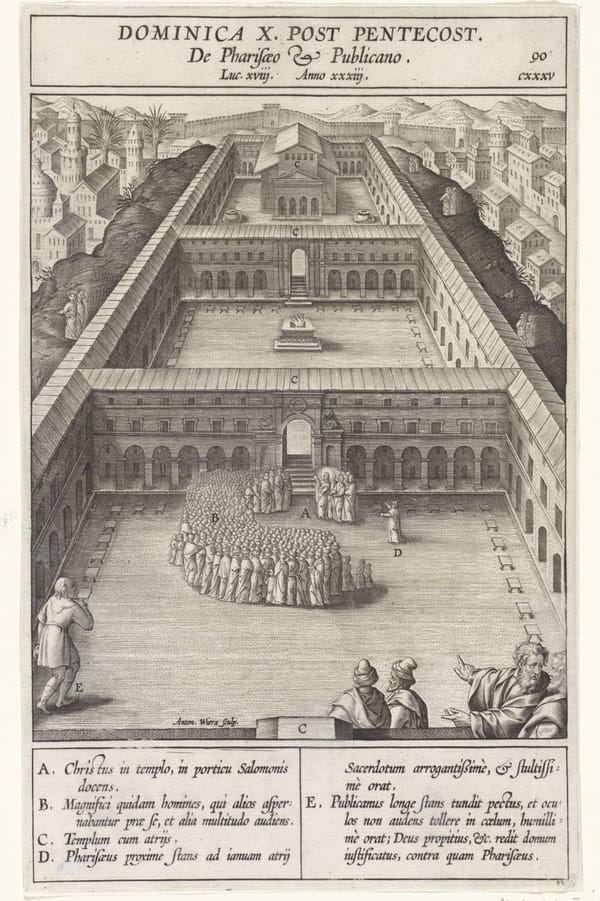
The Tenth Sunday after Pentecost
The destruction of Jerusalem has closed that portion of the prophetic Scriptures which was based on the institutions and history of the figurative period. The altar of the true God, built by Solomon on the summit of Moriah, was the authentic evidence of the true religion, to those who were then living under the Law of expectation. Even after the promulgation of the new Testament, the continued existence of that altar (the only one heretofore recognized by the Most High as His own1) was some sort of an excuse for such of the Jews as clung obstinately to the old order of things. That excuse was taken away when the temple was so destroyed as that not a stone was left on a stone; and the blindest partisans of the Mosaic system were compelled to acknowledge the total abrogation of a religion which was reduced by God Himself to the impossibility of ever offering the sacrifices essential to its existence.
The considerateness wherewith the Church had, so far, treated the Synagogue would henceforward be unmeaning. As the beautiful queen and bride, she was now at full liberty to show herself to all nations, subdue their wild instincts by the power of the Spirit, unify them in Christ Jesus, and put them by faith into the substantial, though not visible,2 possession of those eternal realities which had been foreshadowed by the Law of types and figures.
The new sacrifice, which is no other than that of the cross and of eternity, is now, more than ever, evidently the one sole centre, where her life is fixed in God with Christ her Spouse,3 and from which she derives her energy in labouring for the conversion and sanctification of all future generations of men. The Church, now more than ever fruitful, is more than ever receiving of that life of union which is the cause of her admirable fecundity.
We cannot, therefore, be surprised, that the sacred liturgy, which is the outward expression of the bride's inner life, will now more than ever reflect this closeness of her union with God. In the fifteen weeks we have still to spend of this Time after Pentecost, there is no such thing as gradation, no connexion, in the Proper of the Sundays' Masses. Even in the Lessons of the night-Office, dating from August, the historic Books have been replaced by those which are called the Sapiential; and these, in due time, will be followed by the Books of Job, Tobias, Judith and Esther. Here again there is no connexion, further than that of sanctity in precept or in example. So far, we have found more or less of oneness of idea between the Lessons of the Office and the Proper of the Mass; but, beginning with this tenth Sunday, these are independent of each other.
Henceforward, therefore, we must limit our commentary to the Proper of each Sunday's Mass; and in doing this, we shall be respectfully taking the teachings which the holy Spirit, 'who divideth as He willeth,'4 gives us, unitedly with the Church, in each portion of each Sunday's liturgy. Each Epistle and Gospel, especially; and then, each Introit and Collect, each Gradual and Offertory, each Secret, Communion and Postcommunion, will be a precious and exquisitely varied instruction. We shall see all this in the Epistle of this tenth Sunday.
The fall of Jerusalem—that great event, which told men how the prophecies were going to be gloriously fulfilled, now that the Jewish opposition was so completely removed—is one more solemn proclamation of the reign of the Holy Ghost throughout the entire earth; for, as we said of Him at the grand Pentecost solemnity, 'He hath filled the whole world.’5 We have much to learn from the tone our holy mother the Church puts in the liturgy of these remaining fifteen Pentecostal Sundays. In the admirable teachings she is now going to give to her children, there is no logical arrangement or sequel. She is as intent as ever on leading souls to holiness and perfection : yet it is not by following a method of any sort, but by applying to us the united power of the divine sacrifice and the word of the Scripture, to which she sweetly adds her own; and the holy Spirit of Love breathes upon it all, where He willeth, and when He willeth.6
This Sunday is, in some years, the second of the dominical series which opened with the feast of Saint Laurence, and took its name of Post Sancti Laurentii from the solemnity of the great deaconmartyr. It is also sometimes called the Sunday of humility, or of the pharisee and publican, because of the Gospel of the day. The Greeks count it as the tenth of Saint Matthew, and they read on it the episode of the lunatic, which is given in the seventeenth chapter of that Evangelist.
Mass
The humble and suppliant confidence which the Church reposes in the help given her by her Jesus will ever preserve her from those terrible humiliations wherewith were punished the persecuting jealousy and pride of the Synagogue. She exhorts her children to imitate her when they are in trouble; like her, they must let their prayers and supplications be ever sounding in God's ear.
Introit
Ever deeply impressed by the remembrance of the fearful, though most just, chastisements of the Jewish people, the Church reminds God that the marvels of His pardon and mercy are still stronger manifestations of His omnipotence; she, therefore, in her Collect, prays for an abundant effusion of this mercy upon the Christian people who are here assembled. But what grandeur, what sublimity —especially in the times immediately following Jerusalem’s ruin—there is in the Church’s attitude, when, in reply to the account given her by her Spouse of the severest justice ever shown by His eternal Father, she, bride and mother, has confidence and courage enough to begin with such words as these : Deus, qui omnipotentiam tuam parcendo maxime et miserando manifestas!
Collect
The other Collects, as on page 120.
Epistle
1 Cap. xii.Fratres : Scitis quoniam cum Gentes essetis, ad simulacra muta prout ducebamini euntes. Ideo notum vobis facio, quod nemo in Spiritu Dei loquens, dicit anathema Jesu. Et nemo potest dicere, Dominus Jesus, nisi in Spiritu sancto. Divisiones vero gratiarum sunt, idem autem Spiritus. Et divisiones ministrationum sunt, idem autem Dominus. Et divisiones operationum sunt, idem vero Deus, qui operatur omnia in omnibus. Unicuique autem datur manifestatio Spiritus ad utilitatem. Alii quidem per Spiritum datur senno sapientiæ : alii autem serino scientiæ secundumeumdem Spiritum : alteri fides in eodem Spiritu : alii gratia sanitatum in uno Spiritu : alii operatio virtutum, alii prophetia, alii discretio spirituum, alii genera linguarum, alii interpretatio sermonum. Hæc autem omnia operatur unus atque idem Spiritus, dividens singulis prout vult.
1 Ch. xii.Brethren : You know that when you were heathens, you went to dumb idols, according as you were led. Wherefore I give you to understand, that no man, speaking by the Spirit of God, saith anathema to Jesus. And no man can say the Lord Jesus, but by the Holy Ghost. Now there are diversities of graces, but the same Spirit. And there are diversities of ministries, but the same Lord. And there are diversities of operations but the same God who worketh all in all. And the manifestation of the Spirit is given to every man unto profit. To one, indeed, by the Spirit, is given the word of wisdom; and to another, the word of knowledge, according to the same Spirit; to another, faith in the same Spirit; to another, the grace of healing in ono Spirit; to another, the working of miracles; to another, prophecy; to another, the discerning of spirits; to another, divers kinds of tongues; to another, interpretation of speeches. But all these things one and the same Spirit worketh, dividing to every one according as he will.
The Synagogue has been rejected, has been cast out; and the Church is thereby declared the exclusive heir of the promises.7 She is now sole depositary of God’s gifts; and she leads her children to St. Paul, that he may put before them the principles which should guide them in the appreciation and use of those gifts. In our Epistle he is speaking of those absolutely gratuitous favours which, at the first commencement of the Church, were, more or less, enjoyed by every Christian assembly. Since then they are imparted to a few privileged souls, which, generally speaking, though not necessarily, are being guided in the extraordinary paths of mystic theology. If, in the immense majority of God's faithful servants, we do not meet with these infused graces of prophecy, of supernatural knowledge, of the gift of tongues, or of miracles properly so called, yet the lives of the saints are always the common patrimony of the children of the Church; and therefore we should not neglect to provide ourselves with the lights needed for understanding and profiting by a reading so important and so interesting. In this season of the liturgical year—which is so specially devoted to the celebration of the mysteries of divine union—it is very necessary to have certain clear ideas, without which we should be in danger of confounding in this higher Christian life the interior perfection of the soul and her real holiness with those exterior, and intermittent, and varied phenomena which are but the gratuitous radiations of the Spirit of love.
These are the motives which induced the Church to select, for to-day, this passage from the Epistle of St. Paul to the Corinthians. If we would fully enter into her design, we must not limit our attention to the few lines we have just been reading; the end of the chapter from which they are taken, as likewise the two subsequent chapters, are all one and the same piece of teaching, and must not be separated one from the other.8 In this important passage, besides the summary of the principles which are unchangeable, we have, also, an instructive account of what the Church’s assemblies were in those early times, when the omnipotence of the holy Spirit everywhere opened and made to flow in abundance the double spring of miracles and holiness.
The rapid conquest of the world, which from the very commencement was to give evidence to the catholicity of the Church, required a large effusion of power from on high; and, in order that the promulgation of the new Testament might be made authoritatively among men, it was necessary that God should give it all possible solemnity and authenticity. This He did, by accompanying it with signs and wonders, of which He alone could be the author. Hence, in those early days, the Holy Ghost took not possession of a soul by Baptism, without giving an external sign of His presence in that new Christian—without, that is, one of those manifestations which the apostle here enumerates. Thus the Witness of the Word9 fulfilled the twofold mission He had received : Ho sanctified in truth the faithful of Christ,10 and He convinced of sin the world which would not receive the word of the heralds of the Gospel.11
St. Paul12 mentions three proofs which were held out to the world as a sure guarantee of the divinity of Christ : these were, His Resurrection from the grave, the holiness of those who became His disciples, and, thirdly, the innumerable miracles which accompanied the preaching of the apostles, and the conversion of the Gentiles. As to the first of these proofs, we shall have it proposed to our consideration next Sunday. Let us pass to the second. The law given to the world by Jesus of Nazareth was abundantly proved to be of divine origin, by the admirable change of this earth, of which, when He was born in it for our salvation, we might say in the language of the Scripture, ‘all flesh had corrupted its way.’13 For men that knew how to use their reasoning powers, no demonstration could be plainer or more cogent than this, which showed that, from the sinks of corruption, there were everywhere coming forth harvests worthy of heaven, and that men who had degraded themselves to the level of the brute by the indulgence of their evil passions were now changed into angels of earth by their saintly morals and heavenly aspirations. To change the 'odour of death' into the 'good odour of Christ’14—that is, to livs as did the Christians—was it not to reveal God to men by showing that the very life of God was lived by men in human flesh?'15
But, for men who seem incapable of reasoning, who cannot see beyond the present, nor raise themabove the senses, who have become brutalized, who see in virtue, which scorns to share in their debaucheries, merely something to stare at and blaspheme,16 the holy Spirit had prepared a demonstration which was tangible and visible, and which all could take in, viz. : that exuberance of supernatural gifts, which were actively at work in every place where there was a Church. The gift of tongues, which had given such power to the preaching of the apostles on the day of Pentecost,17 was multiplied with such frequency, when men came near the baptismal font, that the beholders were astonished, or, as the full force of the sacred text gives it, they were stupefied;18 it continued to be the sign, the wonder, whose influence on the unbeliever, after first exciting his surprise, went on gradually inclining both his thoughts and his heart towards the word of faith.19 But the work of his conversion received a still greater impulse, when he was introduced into the assembly of the men of his own neighbourhood, whom hitherto he had known only in the simple intercourse of every-day life. He then found them transformed into prophets, who could see into the most hidden recesses of his unbelieving soul; all were his convincers, all were his judges; how was he to resist? He fell prostrate on the ground, he adored God, he could not but acknowledge that the Lord was indeed in such an assembly.20
The Corinthians to whom St. Paul wrote that Epistle were rich in these spiritual favours; nothing of this kind of grace was wanting to them; and the apostle gave thanks to God for having so abundantly endowed them, because thereby a strong testimony was given to the Christian religion.21 But it would be a great mistake, if, from this profusion bestowed upon them by the holy Spirit, we should conclude that the Corinthians were perfect. Jealousies, vanity, obstinacy, and other miseries, earned for them the name of carnal, and made the apostle tell them that he was compelled to treat them as children, incapable of receiving anything like sublime teaching.22 These privileged receivers of gratuitous graces pointed out very clearly, therefore, the difference between the importance the Christian should attach to these exceptionally great, but perhaps to the possessor's own soul unproductive, favours, and the value he should set on justifying and sanctifying grace which makes the soul pleasing to God.
This second—the regularly appointed result of the Sacraments, which were instituted by our Lord’s munificence for the use of all men—this sanctifying grace is the necessary basis of salvation; it is, also, the one sole measure of future glory, for its development and increase depend on the merit of each individual possessor. Gratuitous grace, on the contrary, is irregular and spontaneous both in its origin and its effects, and is quite independent of the dispositions or merits of the recipient. Like the authority given to one over the souls of others, like those several ministries mentioned in our Epistle, this gratuitous grace has for its aim, not so much the advantage of him who receives it as the advantage of his fellow-men; and this aim is realized, independently of the virtue, or the imperfection, of the one whom God has selected as His instrument. So that miracles and prophecy do not necessarily presuppose a certain amount of holiness in the thaumaturgus or the prophet. We have a proof of it in our Corinthians, and a still stronger one in Balaam and Judas. God, who had His own designs, which were not to be frustrated by their faults or sins, left them in possession of His own gifts, just as He does the priest, who may, perhaps, be anything but what he should be, and who, nevertheless, validly makes use of faculties and powers more divine than any of those others. We have it from our divine Master Himself : 'Many,' says He, 'will say to Me on that day ' [of judgment], "Lord! Lord! have we not prophesied in Thy name, and in Thy name cast out devils, and done many wonderful works in Thy name?” And then will I profess unto them, never knew you. Depart from Me, ye that work iniquity!"'23
In these days, when such manifestations of supernatural power are no longer needed for the promulgation of the Gospel, and are, therefore, less frequent—it is generally the case that, when they are found in a Christian, they are an indication of a real and sanctifying union existing between him and the Spirit of love. That holy Spirit, who raises such a Christian above the ordinary paths, takes pleasure in His own divine work, and wishes it to attract the attention either of all the faithful, or at least of some privileged souls, who, being moved by these extraordinary signs, give thanks to God for the favours He has bestowed on that soul. And yet, even in such a case, it would be a mistake to measure the holiness of that favoured soul by the number or greatness of such exterior gifts. The development of charity by the exercise of the several virtues is the only thing that makes men saints. Divine union— whether it be that degree of it which is attainable by all, or those grand heights of mystic theology which are reached by a few privileged ones—does not in any way depend on those brilliant phenomena. These, when they are bestowed upon a servant of God, are not generally deferred till he has reached perfection in divine love; though it is love alone that will give him, if he be faithful, the perfection of true holiness.
The practical conclusion we are to draw from all this is what the apostle makes the summary of his teaching on this subject : Have a great esteem for all these gifts; look on them as the work of the Holy Ghost, who thereby bestows manifold degrees of adornment on the whole body of the Church; do not despise any of these; but, when you see or hear of any of them, count those as the most precious which produce most edification in the Church and in souls.
Let us above all hearken to what St. Paul adds : ‘I have a way to show unto you more excellent than all these! If I should speak with the tongues of men and of angels; if I should have prophecy, and should know all mysteries, and all knowledge; if I should have all faith, so that I could remove mountains; if I have not charity, I am nothing, it profits me nothing. Prophecies will be made void, tongues will cease, knowledge will be destroyed and be replaced by the beatific vision; but charity will never fail, will never cease; of all things, charity is the greatest!’24
In the Gradual, the Church once more speaks of the confidence which, as bride, she puts in her Lord’s help; encouraged by the love she bears Him, and which keeps her in the paths of equity, she does not fear His judgments. The Alleluiaverse extols the Spouse's glory in Sion; but, this time, and henceforth, it is always the true Sion, the new Jerusalem, that is spoken of.
Gradual
Gospel
Cap. xviii.In illo tempore : Dixit Jesus ad quosdam, qui in se confidebant tamquam justi, et aspernabantur ceteros, parabolam istam : Duo homines ascenderunt in templum ut orarent: Unus pharisæus, et alter publicanus. Pharisæus stans, hæc apud se orabat; Deus, gratias ago tibi, quia non sum sicut ceteri hominum : raptores, injusti, adulteri, velut etiam bio publicanus. Je. juno bis in sabbato : decimas do omnium, quæ possideo. Et pnblicanus a longe stans, nolebat nec oculos ad cœlum levare : sed perçutiebat pectus suum, dicens : Deus, propitios esto mihi peccatori. Dico vobis : Descendit hic justifìcatus in domum suam ab illo : quis omnis qui se exaltat, humiliabitur : et qui se humiliat, exaltabitur.
Ch. xviii.At that time : Jesus spake this parable to some who trusted in themselves as just, and despised others. Two men went up into the temple to pray : the one a pharisee, and the other & publican. The pharisee standing, prayed thus with himself : O God, I give thee thanks that I am not as the rest of men, extortioners, unjust, adulterers, as also is this publican. I fast twice in the week : I give tithes of all that I possess. And the publican standing afar off would not so much as lift up his eyes towards heaven : but struck his breast, saying : O God, be merciful to me a sinner. I say to you, this man went down to his house justified rather than the other, because every one that exalteth himself, shall be humbled; and hethathumbleth himself, shall be exalted.
Commenting on this passage of St. Luke, Venerable Bede25 thus explains the mystery : 'The pharisee is the Jewish people, who boasts of the merits he has acquired to himself by observing the precepts of the law; the publican is the Gentile, who, being far off from God, confesses his sins. The pharisee, by reason of his pride, has to depart in humiliation; the publican by lamenting his miseries, merits to draw nigh to God—that is, to be exalted. It is of these two people, and of every man who is proud or humble, that it is written : The heart of a man is exalted before destruction, and it is humbled before he be glorified.’26
In the whole Gospel, then, there was no teaching more appropriate than this, as a sequel to the history of Jerusalem's fall. The children of the Church, who, in her early years, saw her humbled in Sion and persecuted by the insulting arrogance of the Synagogue, now quite understand that word of the Wise Man : 'Better is it to be humbled with the meek, than to divide spoils with the proud!'27 According to another Proverb, the tongue of the Jew—that tongue which abused the publican and ran down the poor Gentile—has become, in his mouth, as 'a rod of pride,'28 a rod which, in time, struck himself, by bringing on his own destruction. But, whilst adoring the justice of God's vengeance and giving praise to His mercy, the Gentiles must take care not to go into the path wherein was lost the unhappy people whose place they now occupy. Israel's offence, says St. Paul, has brought about the salvation of the Gentiles; but, his pride would be also their ruin; and whereas Israel is assured, by prophecy, of a return to God's favour when the end of the world shall be approaching,29 there is no such promise of a second call of mercy to the Gentiles, should they ever apostatize after their baptism. If, at present, the power of eternal Wisdom enables the Gentiles to produce fruits of glory and honour,30 let them never forget how once they were vile, barren trees : then, humility—which alone can keep them right, as formerly it alone drew upon them the eye of God,' mercy—will be an easy duty; and, at the same time, they will understand the regard they should always entertain for the people of Israel, in spite of all his sins.
While the original defect of their birth made the Gentiles as wild olive-trees, producing nothing but worthless fruits, the good, the genuine, the natural olive-tree, through whose branches flowed the sap of grace, was growing and flourishing, sucking sanctification into its branches from the holy root of the patriarchs, blessed of God.31 We must remember that this tree of salvation is ever the same. Some of its branches fell off, it is true, and others were substituted; but this accession of the Gentiles, who were permitted by grace to graft their branches into the holy stock, effected no change, either in the stock or in its root. The God of the Gentiles is not another, but the same, as the God of Isaac and Jacob; the heavenly olive-tree is one, and only one, and its roots rest in Abraham's bosom : it is from the faith of this the just man par excellence,32 from the blessing, promised to him33 and to his divine Bud,34 and to be imparted to all the nations of the earth, that flows the life-giving and rich sap, which will transform the Gentile world in all future ages. When, therefore, Christian nations are boasting of their origin and descent, let them not forget the one which is above all the rest. The founders of earthly empires are not, in God's way of counting, the true fathers of the people of those empires : in the order of supernatural, that is of our best, interest, Abraham the Hebrew,35 he that went forth from Chaldea at the call of God,36 is, by the fecundity of his faith, the truest father of nations.37
Now we can understand those words of the apostle : 'Boast not, O thou wild olive-tree, that, contrary to nature, wast ingrafted into the good olive-tree, boast not against the original branches. But if thou art tempted to boast, remember, thou bearest not the root, but the root beareth thee. Therefore, be not high-minded, but fear.'38
Humility, which produces within us this salutary fear, is the virtue that makes man know his right place, with regard both to God and to his fellow-men. It rests on the deep-rooted conviction, put into our hearts by grace, that God is everything, and that we, by nature, are nothingness, nay, less than nothingness, because we have degraded ourselves by sin. Reason is able, of herself alone, to convince anyone, who takes the trouble to reflect, of the nothingness of a creature; but such conviction, if it remain a mere theoretical conclusion, is not humility : it is a conviction which forces itself on the devil in hell, whose vexation at such a truth is the chief source of his rage. As faith, which reveals to us what God is in the supernatural order, does not come from mere reason, nor remain confined to the intellect alone, so neither does humility, which teaches us what we ourselves are: that it may be true, real virtue, it must derive its light from above, and, in the holy Spirit, must move our will also. At the same time that this holy Spirit fills our souls with the knowledge of their littleness and misery, He also sweetly leads them to the acceptance and love of this truth, which reason, if left entirely to herself, would be tempted to look on as a disagreeable thought.
When this holy Spirit of truth,39 this divine witness of hearts,40 takes possession of a soul, what an incomparably stronger light is there in the humility which He imparts, than in that which mere human reason forces on a man! We are bewildered at seeing to what lengths this sentiment of their own misery led the saints; it made them deem themselves inferior to every one; it drove them to act and speak in a way which, in our flippant judgment, outstepped the bounds of both truth and justice! But the Holy Ghost, who guided and ruled them, passed a very different judgment; and it is precisely because of His being the Spirit of all truth and all justice—in other words, because of His being the sanctifying Spirit—that, as He willed to raise them to extraordinary holiness, He gave them an extraordinary clearsightedness, both as to what they themselves were, and as to what God is. Satan, the spirit of wickedness, makes his slaves act just the opposite to the divine way. The way he makes them take, is the one he took for himself, from the very beginning; which our Lord thus expresses : ‘He tood not in the truth;41 he aimed at being like unto the Most High.'42 This pride of his succeeded in fixing him, for all eternity, in the hell of absurdity and lie. Therefore, humility is truth; and, as the same Jesus says: 'The truth shall make you free,'43 by liberating us from the tyranny of the father of lies;44 and then, having made us free, it makes us holy; it sanctifies us,45 by uniting us to God, who is living and substantial truth.
The nearer the stars are to the sun, the greater is the light they receive from him, although they seem to dwindle and disappear, overpowered by his splendour; whereas their light appears brighter and more their own, in proportion as they are farther from him. So man, as he approaches nigher to the infinite All, receives a marvellous increase of life and light; while he gradually loses both his life of self, and the artificial light that accompanied it.
There are men who, like satan, have done all in their power to throw themselves out of the orbit of the divine sun. Bather than acknowledge that they owe all they have to the most high God, they would sink back again into nothingness, if they could. To the heavenly treasures which the common Father opens out to all who own themselves to be His children, they prefer the pleasure of keeping to natural good things; for then, so they say, they owe what they get to their own cleverness and exertions. They are foolish men, not to understand that, do what they please, they owe everything they have to this their forgotten God.46 They are weak, sickly minds, mistaking these vapours of conceit in which their disordered brain finds delight for principles of which they may be proud. Their high-mindedness is but ignominy; their independence leads but to slavery; for, though they refuse to have God as their Father, they must of necessity have Him as their Master; and thus, not being His children, they must be His slaves. As slaves, they keep to the vile food, which they themselves preferred to the pure delights wherewith Wisdom inebriates them that follow her. As slaves, they have acquired the right to the scourge and the fetter. They chose to be satisfied with what they had, and would have neither the throne that was prepared for them,47 nor the nuptial robe;48 let them, if they will, prefer their prison, and there deck themselves in the finery which moths will soon be making their food! But, during these short years of theirs, they are branding their bodies with a deeper slavery than ever red-hot iron stamped on vilest bondsman. All this happens because, with all the empty philosophy which was their boast, they would not listen to the Christian teaching that real greatness consists in the truth, and that humility alone leads to it.
Not only does man not unman himself by humbling himself—for he thereby is but believing himself to be what he really is—but, according to the Gospel expression, the degree of that voluntary abasement is the measure of his exaltation in God's sight. The Holy Ghost is beyond measure liberal in bestowing His gifts on one, who is sure to refer all the glory of them to the divine Giver. It is to the little that the Lord of heaven and earth makes revelations, which He hides from the proudly wise and prudent.49 Or, rather, the truly wise are these same little ones, who understand and have experienced the mysteries of God's infinite love, and who have been invited to the banquet of divine Wisdom. They are nothing in their own eyes; and yet it is in them that, among all the children of men, the Son of God finds His delights.50 This is what the disciples could not understand when, after the words of our Lord, which are given in to-day's Gospel, they insisted, as St. Luke tells us, on keeping back the little ones who wanted to come near Him. But Jesus insisted on their being brought to Him, saying very much the same as He had already said in the old Testament pages : ‘Suffer little children to come to Me; forbid them not, for of such is the kingdom of God. Amen I say to you : whosoever shall not receive the kingdom of God as a child shall not enter into it.'51
In heaven the humility of the saints is far greater than it was while they were here on earth, because they now see the realities, which then they could only faintly perceive. Their happiness, yonder above, is to be gazing on and adoring that altitude of God, of which they will never have an adequate knowledge, and the more they look up at that infinite perfection, the deeper do they plunge into their own original nothingness. Let us get these great truths well into us, and we shall have no difficulty in understanding how it was that the greatest saints were the humblest creatures here below, and how the same beautiful fact is still one great charm of heaven. It must be so, for the light of the elect is in proportion to their glory. What, then, must all this exquisite truth be, when we apply it to the great Mother of God? The nearest to the throne of her divine Son, she is precisely what she was at Nazareth;52 that is, she is the humblest of all creatures, because she is the most enlightened of all, and therefore understands, better than even the Seraphim and Cherubim, the greatness of God and the nothingness of creatures.
It is humility which inspires the Church with the confidence she expresses in the following Offertory-anthem. The more this virtue enables a man to feel bis own weakness, the more, likewise, does it show him the power of God, who is ever ready to help them that call upon Him.
Offertory
The Mass is at once the highest worship which can be given to the divine Majesty, and the sovereign remedy of our miseries. The Secret tells us this.
Secret
The other Secrets, as on page 130.
The Communion-anthem sings the praise of this oblation, which is all pure and full of most perfect justice; it has replaced, on the altar of God, the victims prescribed by the Mosaic law.
Communion
The august Sacrament is ever repairing the losses we sustain through our many miseries; and yet this would not be of much profit to us, unless the divine benignity were to be continually bestowing on us those actual graces, which preserve and increase the treasures of the soul. We cannot get on without this special aid; let us ask for it, in the Postcommunion.
Postcommunion
The other Postcommunions, as on page 131.
Vespers
The psalms, capitulum, hymn, and versicle as above, pages 71-81.
Antiphon of the Magnificat
- Deut. xii.13, 14. ↩︎
- Heb. xi.1. ↩︎
- Col. iii. 3 ↩︎
- 1 Cor. xii.11. ↩︎
- Wisd. i 7. ↩︎
- St. John iii 8. ↩︎
- Gal. iv. 30. ↩︎
- 11 Cor. xii., xiii., xiv. ↩︎
- St. John XV. 26. ↩︎
- Ibid. xvii. 17. ↩︎
- Ibid. xvi. 8-11; 1 Cor. xiv. 22, 24, 25. ↩︎
- Rom. i. 4. ↩︎
- Gen. vi. 12. ↩︎
- 2 Cor. ii. 14-16. ↩︎
- Ibid. iv. 10, 11. ↩︎
- 1 St. Pet. iv. 4. ↩︎
- Acts ii. 6-11 ↩︎
- Ibid. x. 44-48. ↩︎
- 1 Cor. xiv. 22. ↩︎
- Ibid. 24, 25. ↩︎
- Ibid. i. 4-7. ↩︎
- Ibid. iii. 1-3. ↩︎
- St. Matt. vii. 22, 23. ↩︎
- 1 Cor. xii., xiii., xiv. ↩︎
- ℣. Bed., In Luc., v. ↩︎
- Prov. xviii.12. ↩︎
- Prov. xvi. 19. ↩︎
- Ibid. xiv. 3. ↩︎
- Rom. xi. 25-27. ↩︎
- Ecclus. xxiv. 23. ↩︎
- Rom. xi. 16-24. ↩︎
- Ibid. iv.11-18. ↩︎
- Gen. xii. 3. ↩︎
- Ibid. xxii: 18. ↩︎
- Ibid. xiv. 13. ↩︎
- Ibid. xii. 1-4. ↩︎
- Ibid. xvii. 4-7. ↩︎
- Rom. xi. 18, 20, 24. ↩︎
- St. John xiv. 17. ↩︎
- Wisd. i. 6. ↩︎
- St. John viii. 44. ↩︎
- Isa. xiv. 14. ↩︎
- St. John viii. 32. ↩︎
- Ibid. 44. ↩︎
- Ibid. xvii. 17. ↩︎
- Cor. iv. 7. ↩︎
- Wisd. vi. 22. ↩︎
- Ecclus. vi. 32. ↩︎
- St. Luke X. 21. ↩︎
- Prov. viii. 31. ↩︎
- St. Luke xviii. 15-17. ↩︎
- St. Luke i. 48. ↩︎
August 13: St. Radegonde, Queen of France
NEVER was such a booty won as that obtained by the sons of Clovis in their expedition against Thuringia towards the year 530. Receive this blessing from the spoils of the enemy1 might they well say on presenting to the Franks the orphan brought from the court of the fratricide prince whom they had just chastised. God seemed in haste to ripen the soul of Radegonde. After the tragic death of her relatives followed the ruin of her country. So vivid was the impression made in the child's heart that long afterwards the recollection awakened in the queen and the saint a sorrow and a homesickness which nought but the love of Christ could overcome. ‘I have seen the plain strewn with dead and palaces burnt to the ground; I have seen women, with eyes dry from very horror, mourning over fallen Thuringia; I alone have survived to weep over them all.'2
The licentiousness of the Frankish kings was as unbridled as that of her own ancestors; yet in their land the little captive found Christianity, which she had not hitherto known. The faith was a healing balm to this wounded soul. Baptism, in giving her to God, sanctified, without crushing, her high-spirited nature. Thirsting for Christ, she wished to be martyred for Him; she sought Him on the cross of self-renunciation; she found Him in His poor suffering members; looking on the face of a leper, she would see in it the disfigured countenance of her Saviour, and thence rise to the ardent contemplation of the triumphant Spouse, whose glorious face illumines the abode of the saints.
What a loathing, therefore, did she feel when, offering her royal honours, the destroyer of her own country sought to share with God the possession of a heart that heaven alone could comfort or gladden! First flight, then the refusal to comply with the manners of a court where everything was repulsive to her desires and recollections, her eagerness to break, on the very first opportunity, a bond which violence alone had contracted, prove that the trial had no other effect, as her Life says, but to bend her soul more and more to the sole object of her love.3
Meanwhile, near the tomb of St. Martin, another queen, Clotilde, the mother of the most Christian kingdom, was about to die. Unfortunate are those times when the men after God’s own heart, at their departure from earth, leave no one to take their place; as the Psalmist cried out in a just consternation: Save me, O Lord, for there is now no saint!4 For though the elect pray for us in heaven, they can no longer fill up those things that are wanting of the sufferings of Christ, in their flesh, for His body, which is the Church.5 The work begun at the Baptistery of Rheims was not yet completed; the Gospel, though reigning by faith over the Frankish nation, had not yet subdued its manners. Christ, who loved the Franks, heard the last prayer of the mother he had given them, and refused her not the consolation of knowing that she should have a successor. Radegonde was set free, just in time to prevent an interruption in the laborious .work of forming the Church’s eldest daughter; and she took up in solitude the struggle with God, by prayer and expiation, begun by the widow of Clovis.
In the joy of having cast off an odious yoke, forgiveness was an easy thing to her great soul;6 in her monastery at Poitiers she showed an unfailing devotedness for the kings whose company she had fled. The fortune of France was bound up with theirs; France the cradleland of her supernatural life, where the Man-God had revealed Himself to her heart, and which she therefore loved with part of the love reserved for her heavenly country. The peace and prosperity of her spiritual fatherland occupied her thoughts day and night. If any quarrel arose among the princes, say the contemporary accounts, she trembled from head to foot at the very thought of the country’s danger. She wrote, according to their different dispositions, to each of the kings, imploring them to consider the welfare of the nation; she interested the chief vassals in her endeavours to prevent war. She imposed on her community assiduous watchings, exhorting them with tears to pray without ceasing; as to herself, the tortures she inflicted on herself for this end are inexpressible.7
The only victory, then, that Radegonde desired was peace among the princes of the earth; when she had gained this by her struggle with the King of heaven, her joy in the service of the Lord was redoubled, and the tenderness she felt for her devoted helpers, the nuns of Sainte-Croix, could scarcely find utterance: 'You, the daughters of my choice,' she would say, 'my eyes, my life, my sweet repose, so live with me in this world, that we may meet again in the happiness of the next.’ And they responded to her love. 'By the God of heaven it is true that everything in her reflected the splendour of her soul.’ Such was the spontaneous and graceful cry of her daughter Baudonivia; and it was echoed by the graver voice of the historian-bishop, Gregory of Tours, who declared that the supernatural beauty of the saint remained even in death;8 it was a brightness from heaven, which purified while it attracted hearts, which caused the Italian Venantius Fortunatus to cease his wanderings,9 made him a saint and a Pontiff, and inspired him with his most beautiful poems.
The light of God could not but be reflected in her, who, turning towards Him by uninterrupted contemplation, redoubled her desires as the end of her exile approached. Neither the relics of the saints which she had so sought after as speaking to her of her true home, nor her dearest treasure, the Cross of her Lord, was enough for her; she would fain have drawn the Lord Himself from His throne, to dwell visibly on earth. She only interrupted her sighs to excite in others the same longings. She exhorted her daughters not to neglect the knowledge of divine things; and explained to them with profound science and motherly love the difficulties of the Scriptures. As she increased the holy readings of the community for the same end, she would say: 'If you do not understand, ask; why do you fear to seek the light of your souls?' And she would insist: 'Reap, reap the wheat of the Lord; for, I tell you truly, you will not have long to do it: reap, for the time draws near when you will wish to recall the days that are now given you, and your regrets will not be able to bring them back.’ And the loving chronicler to whom we owe these sweet intimate details continues: 'In our idleness we listen coolly to the announcement; but that time has come all too soon. Now is realized in us the prophecy which says: I will send forth a famine into thy land: not a famine of bread, nor a thirst of water, but of hearing the Word of the Lord.10 For though we still read her conferences, that voice which never ceased is now silent; those lips, ever ready with wise advice and sweet words, are closed. O most good God, what an expression, what features, what manners Thou hadst given her! No, no one could describe it. The remembrance is anguish! That teaching, that gracefulness, that face, that mien, that science, that piety, that goodness, that sweetness, where are we to seek them now V Such touching sorrow does honour to both mother and daughters; but it could not keep back the former from her reward. On the morning of the Ides of August 587, while Sainte-Croix was filled with lamentations, an angel was heard saying to others on high: ‘Leave her yet longer, for the tears of her daughters have ascended to God.’ But those who were bearing Radegonde away replied: ' It is too late, she is already in Paradise.’11
Let us read the liturgical account, which will complete what we have said:
Thine exile is over, eternal possession has taken the place of desire; all heaven is illumined with the brightness of the precious stone that has come to enrich the diadem of the Spouse. O Radegonde, the Wisdom who is now rewarding thy toils led thee by admirable ways. Thy inheritance, become to thee as a lion in the wood spreading death around thee, thy captivity far from thy native land; what was all this but love’s way of drawing thee from the dens of the lions, from the mountains of the leopards, where idolatry had led thee in childhood? Thou hadst to suffer in a foreign land, but the light from above shone into thy soul, and gave it strength. A powerful king tried in vain to make thee share his throne; thou wert a queen but for Christ, who in His goodness made thee a mother to that kingdom of France which belongs to Him more than to any prince. For His sake thou didst love that land become thine by the right of the Bride who shares the sceptre of her Spouse; for His sake, that nation, whose glorious destiny thou didst predict, received unstintedly all thy labours, thy unspeakable mortifications, thy prayers and thy tears.
O thou who art ever queen of France, as Christ is ever its King, bring back to Him the hearts of its people, for in their blind error they have laid aside their glory, and their sword is no longer wielded for God. Protect, above all, the city of Poitiers, which honours thee with a special cultus together with its great St. Hilary. Bless thy daughters of Sainte-Croix, who, ever faithful to thy great traditions, prove the power of that fruitful stem, which through so many centuries and such devastations has never ceased to produce both flowers and fruit. Teach us to seek our Lord, and to find Him in His holy Sacrament, in the relics of His saints, in His suffering members on earth; and may all Christians learn from thee how to love.
- 1 Kings xxx. 26. ↩︎
- De excidio Thuringiæ, 1, v. 5-36, Fortunatus ex persona Radegundis. ↩︎
- Baudonivia, Vita Radegundis, 2. ↩︎
- Ps. xi. 2. ↩︎
- Col. i. 24. ↩︎
- Baudonivia, 7. ↩︎
- Baudonivia, 11. ↩︎
- Greg. Turon. De gloria confessorum, cvi. ↩︎
- Fortunat. Miscellanea, viii, 1, 11, etc. ↩︎
- Amos viii. 11. ↩︎
- Baudonivia. ↩︎
August 13 (the Same Day): Sts. Hippolytus and Cassian, Martyrs
Not far from the sepulchre of St. Laurence, on the opposite side of the Tiburtian Way, lies the tomb of St. Hippolytus, one of the sanctuaries most dear to the Christians in the days of triumph. Prudentius has described the magnificence of the crypt, and the immense concourse attracted to it each year on the Ides of August. Who was this saint? Of what rank and manner of life? What facts of his history are there to be told, beyond that of his having given his blood for Christ? All these questions have in modem times become the subject of numerous and learned works. He was a martyr, and that is nobility enough to make him glorious in our eyes. Let us honour him, then, and together with him another soldier of Christ, Cassian of Imola, whom the Church offers to our homage at the same time. Hippolytus was dragged by wild horses over rocks and briars till his body was ail torn: Cassian, who was a schoolmaster, was delivered by the judge to the children he had taught, and died of the thousands of wounds inflicted by their styles. The prince of Christian poets has sung of him as of Hippolytus, describing his combat and his tomb.
| Previous August 12: St. Clare, Virgin | Next August 13: St. Radegonde, Queen of France |