Daily reading
After Pentecost
Simple · Movable from Easter · Temporal
October 1, 2028
From Dom Guéranger’s The Liturgical Year.
The Sunday leads; St. Remigius, Apostle of the Franks is commemorated.Rubrics

|
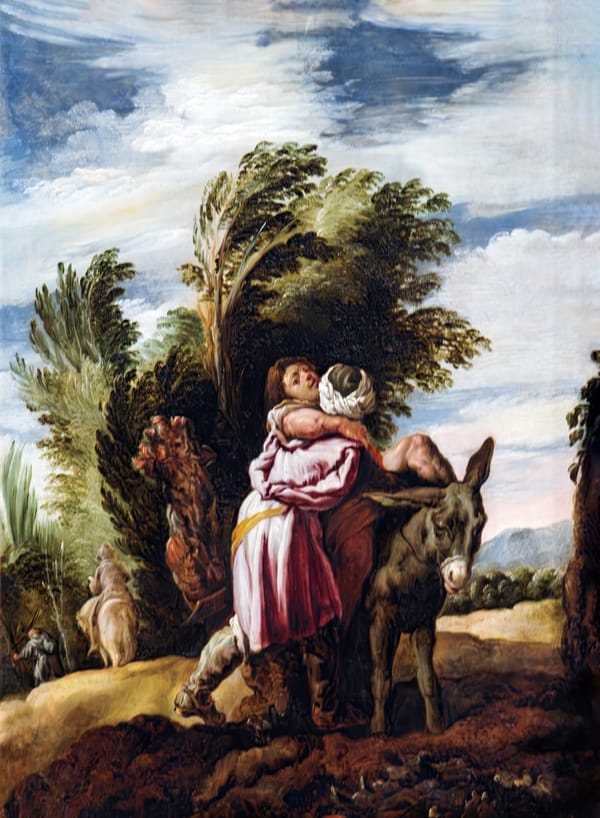
The Seventeenth Sunday after Pentecost
The Gospel, which is now assigned to the Mass of the seventeenth Sunday, has given it the name of the Sunday of the love of God, dating, that is, from the time when the Gospel of the cure of the dropsy and of the invitation to the wedding-feast was anticipated by eight days. Previously even to that change, and from the very first, there used to be read, on this seventeenth Sunday, another passage from the new Testament, which is no longer found in this series of Sundays: it was the Gospel which mentions the difficulty regarding the resurrection of the dead, which the Sadducees proposed to our Lord.1
Mass
The judgments of God are always just, whether it be, in His justice, humbling the proud, or, in His mercy, exalting the humble. This day last week we saw this sovereign disposer of all things, allotting to each his place at the divine banquet. Let us recall to mind the behaviour of the guests, and the respective treatment shown to the humble and the proud. Adoring these judgments of our Lord, let us sing our Introit; and, as far as regards ourselves, let us throw ourselves entirely upon His mercy.
Introit
The most hateful of all the obstacles which divine love has to encounter upon earth is the jealousy of satan, who endeavours, by an impious usurpation, to rob God of the possession of our souls—souls, that is, which were created by and for Him alone. Let us unite with holy Church in praying, in the Collect, for the supernatural assistance we require for avoiding the foul contact of the hideous serpent.
Collect
The other Collects, as on page 120.
Epistle
Cap. iv.Fratres, Obsecro vos ego vinctus in Domino, ut digne ambuletis vocatione, qua vocati estis, cum omni humilitate, et mansuetudine, cum patientia, supportantes invicem in charitate, solliciti servare unitatem spiritus in vinculo pacis. Unum corpus, et unus Spiritus, sicut vocati estis in una spe vocationis vestræ. Unus Dominus, una fides, unum baptisma. Unus Deus et Pater omnium, qui est super omnes, et per omnia, et in omnibus nobis. Qui est benedictus in sæcula sæculorum. Amen.
Ch. iv.Brethren: I, a prisoner in the Lord, beseech you that you walk worthy of the vocation in which you are called, with all humility and mildness, with patience, supporting one another in charity. Careful to keep the unity of the Spirit in the bond of peace. One body and one spirit; as you are called in one hope of your calling. One Lord, one faith, one baptism, one God, and Father of all, who is above all, and through all, and in us all, who is blessed for ever and ever. Amen.
The Church, by thus giving these words from St. Paul’s Epistle to the Ephesians, again takes up the subject so dear to her, viz., the dignity of her children. She beseeches them to correspond, in a becoming manner, to their high vocation. This vocation, this call, which God gives us is, as we have been so often told, the call, or invitation, made to the human family to come to the sacred nuptials of divine union; it is the vocation given to us to reign in heaven with the Word, who has made Himself our Spouse, and our Head.2 The Gospel read to us last week was formerly the one appointed for this present Sunday, and was thus brought into close connexion with our Epistle. These words of St. Paul to the Ephesians are an admirable commentary on that Gospel, and it, in turn, throws light on the apostle’s words about the vocation. ‘When thou art invited to a wedding (cum vocatus fueris) sit down in the lowest place!’ These were our Lord’s words to us last Sunday; and now we have the apostle saying to us : Walk worthy of the vocation in which you are called, yes, walk in that vocation with all humility!
Let us now attentively hearken to our apostle, telling us what we must do, in order to prove ourselves worthy of the high honour offered to us by the Son of God. We must practise, among other virtues, these three—humility, mildness, and patience. These are the means for gaining the end that is so generously proposed to us. And what is this end? It is the unity of that immense body, which the Son of God makes His own, by the mystic nuptials He vouchsafes to celebrate with our human nature. This Man-God asks one condition from those whom He calls, whom He invites, to become, through the Church, His bride, bone of His bones and flesh of His flesh.3 This one condition is, that they maintain such harmony among them, that it will make one body and one spirit of them all, in the bond of peace. ‘Bond most glorious!’ cries out St. John Chrysostom—‘bond most admirable, which unites us all with one another, and then, thus united, unites us with God.’4 The strength of this bond is the strength of the holy Spirit Himself, who is all holiness and love; for it is that holy Spirit who forms these spiritual and divine ties; He it is who, with the countless multitude of the baptized, does the work which the soul does in the human body— that is, gives it life, and unites all the members into oneness of person. It is by the Holy Ghost that young and old, poor and rich, men and women, distinct as all these are in other respects, are made one, fused, so to say, in the fire which eternally burns in the blessed Trinity. But, in order that the flame of infinite love may thus draw into its embrace our regenerated humanity, we must get rid of selfish rivalries, and grudges, and dissensions, which, so long as they exist among us, prove us to be carnal,5 and, therefore, to be unfit material either for the divine flame to touch, or for the union which that flame produces. According to the beautiful comparison of St. John
Chrysostom,6 when the fire lays hold of various species of wood which have been thrown into it, if it find the fuel properly dry, it makes one burning pile of all the several woods; but, if they are damp and wet, it cannot act on them separately, nor reduce the whole to one common blaze. So is it in the spiritual order; the unhealthy humidity of the passions neutralizes the action of the sanctifying Spirit; and union, which is both the means and the end of love, becomes an impossibility.
Let us, therefore, bind ourselves to our brethren by that blessed link of charity, which, if it fetters at all, fetters only our bad tempers; but, in all other respects, it dilates our hearts, by the very fact of its giving free scope to the Holy Ghost to lead them safely to the realization of that one hope of our common vocation and calling, which is to unite us to God by love. Of course, charity, even with the saints, is, so long as they are on this earth, a laborious virtue; because, even with the best, grace seldom restores to a perfect equilibrium the faculties of man, which were put out of order by original sin. From this it follows that the weaknesses of human nature will sometimes show themselves, either by excess or by deficiency; and when these weaknesses do appear, not only the saint himself is humbled by their getting the better of him, but, as he is well aware, those who live with him have to practise kindness and patience towards him. God permits all this, in order to increase the merit of us all, and make us long more and more for heaven. For it is there alone that we shall find ourselves, not only totally, but without any effort, in perfect harmony with our fellow-men; and this because of the perfect peaceful submissiveness of our entire being under the absolute sway of the thrice holy God, who will then be all in all.7 In that happy land God Himself will wipe away the tears of His elect, for their miseries will all be gone; and their miseries will be gone because their whole being will be renovated, because united with Him, who is its infinite source.8 The eternal Son of God, having then conquered in each member of His mystical body the hostile powers and death itself,9 will appear, in the fullness of the mystery of His Incarnation, as the true Head of humanity, sanctified, restored,10 and developed in Him. He will rejoice at seeing how, by the workings of the sanctifying Spirit, there has been wrought the destined degree of perfection in each of the several parts of that marvellous body,11 which He vouchsafed to aggregate to Himself by the bond of love; and all this in order that He might Himself eternally celebrate, in concert with all creation, the glory of the ever adorable Trinity. How will the sweetest music of earth be then surpassed! How will our most perfect choirs seem to us then to have been almost like the noise of children singing out of tune, compared with the concord and harmony of that eternal song! Let us make ourselves ready for that heavenly concert. Let us put our voices in order, by now attuning our hearts to that plenitude of love, which, alas! is not often enjoyed here below, but which we should ever be trying to realize, by patiently supporting the faults of our brethren and ourselves, as the Epistle so earnestly impresses upon us.
In the ecstasy of her delight at hearing these few sounds of heaven’s music brought to her by such a singer as her apostle, our mother the Church seems to feel herself carried away far beyond time, and boldly joins a short song of her own to that of Jesus and His apostle; for by way of a conclusion to the text of our Epistle, she adds an ardent expression of praise, which is not in the original; and thus she forms a kind of doxology to the inspired words of her apostolic cantor.
We now know the priceless gifts brought to our earth by the Man-God.12 Thanks to the prodigies of power and love achieved by the divine Word and the sanctifying Spirit, the soul of the just man is a little heaven on earth. Let us sing in our Gradual and Alleluia the happiness of the Christian people, chosen by God for His own inheritance.
Gradual
Gospel
Cap. xxii.In illo tempore : Accesserunt ad Jesum Pharisæi, et interrogavit eum unus ex eis legis doctor, tentans eum : Magister, quod est mandatum magnum in lege? Ait illi Jesus : Diliges Dominum Deum tuum ex toto corde tuo, et in tota anima tua, et in tota mente tua. Hoc est maximum, et primum mandatum. Secundum autem simile est huic : Diliges proximum tuum sicut teipsum. In his duobus mandatis universa lex pendet, et prophetæ. Congregatia autem Pharisæis, interrogavit eos Jesus, dicens : Quid vobis videtur de Christo? cujus filius est? Dicunt ei : David. Ait illis: Quomodo ergo David in spiritu vocat eum Dominum, dicens : Dixit Dominus Domino meo : Sede a dextris meis, donec ponam inimicos tuos scabellum pedum tuorum? Si ergo David vocat eum Dominum, quomodo filius ejus est? Et nemo poterat ei responded verbum; neque ausus fuit quisquam ex illa die eum amplius interrogare.
Ch. xxii.At that time : The Pharisees came to Jesus: and one of them, a doctor of the law, asked him, tempting him: Master, which is the great commandment in the law? Jesus said to him : Thou shalt love the Lord thy God with thy whole heart, and with thy whole soul, and with thy whole mind. This is the greatest and the first commandment. And the second is like to this: Thou shalt love thy neighbour as thyself. On these two commandments dependeth the whole law and the prophets. And the Pharisees being gathered together, Jesus asked them saying: What think ye of Christ? whose son is he? They say to him: David’s. He saith to them : How then doth David in spirit call him Lord, saying : The Lord said to my Lord, Sit on my right hand, until I make thy enemies thy footstool? If David then called him Lord, how is he his son? And no man was able to answer him a word; neither durst any man from that day forth ask him any more questions.
The Man-God allowed temptation to approach His sacred Person in the desert;13 He disdained not to sustain the attacks, which the devil’s spiteful cunning has, from the world’s beginning, been inventing, as the surest means of working man’s perdition. Our Jesus permitted the demon thus to tempt Him, in order that He might show His faithful servants how they are to repel the assaults of the wicked spirit. To-day, our adorable Master, who would be a model to His children in all their trials,14 is represented to us as having to contend, not with satan’s perfidy, but with the hypocrisy of His bitterest enemies, the pharisees. They seek to ensnare Him in His speech,15 just as the representatives of the world, which He has condemned,16 will do to His Church, and that in all ages, right to the end of time. But as her divine Spouse triumphed, so will she; for He will enable her to continue His work upon earth, and amidst the same temptations and the same snares. She is ever to obtain the victory, by maintaining a most inviolable fidelity to God’s law and truth. The tools of satan, who are the heretics and the princes of the world, chafing at the restraint put by Christianity on their ambition and lust, will always be studying how best to outwit the guardian of the divine oracles, by their captious propositions or questions. When necessity requires her to speak, she is quite ready; for, as bride of that divine Word, who is His Father’s eternal and substantial utterance, what can she be but a voice, either to announce Him on earth, or to sing Him in heaven? That word of hers, endowed as it is with the power and penetration of God Himself, will not only never be conquered by surprise, but, like a two-edged sword, it will generally go much deeper than the crafty questioners of the Church anticipated; it will not only refute their sophistry, it will also expose the hypocrisy and wickedness of their intentions.17 By their sacrilegious attempts, they will have gained nothing but disgrace and shame, and the mortification of having occasioned a fresh lustre to truth by the new light in which it has been put, and of having procured a clearer knowledge of dogma or morals for the devoted children of the Church.
It was thus with the pharisees of to-day’s Gospel. As the homily upon it tells us, they wanted to see if Jesus, who had declared Himself to be God, would not, consequently, make some addition to the commandment of divine love; and if He did they would be justified in condemning Him as having tried to change the letter of the law in its greatest commandment.18 Our Lord disappointed them. He met their question by giving it a longer answer than they had asked for. Having first recited the text of the great commandment as given in the Scripture, he continued the quotation, and, by so doing, showed them that He was not ignorant of the intention which had induced them to question Him. He reminded them of the second commandment, like unto the first, the commandment of love of our neighbour, which condemned their intended crime of deicide. Thus were they convicted of loving neither their neighbour, nor God Himself, for the first commandment cannot be observed if the second, which flows from and completes it, be broken.
But our Lord does not stop there; He obliges them to acknowledge, at least implicitly, the Divinity of the Messiah. He puts a question, in His turn, to them, and they answer it by saying, as they were obliged to do, that the Christ was to be of the family of David; but if He be his Son, how comes it that David calls Him his Lord, just as he calls God Himself, as we have it in Psalm cix., where he celebrates the glories of the Messiah? The only possible explanation is, that the Messiah, who in due time, and as Man, was to be born of David’s house, was God, and Son of God, even before time existed, according to the same psalm: ‘From my womb, before the day-star, I begot thee.’19 This answer would have condemned the pharisees, so they refused to give it; but their silence was an avowal; and, before very long, the eternal Father’s vengeance upon these vile enemies of His Son will fulfil the prophecy of making them His footstool in blood and shame: that time is to be the terrible day when the justice of God will fall upon the deicide city.
Let us Christians, out of contempt for satan, who stirred up the expiring Synagogue thus to lay snares for the Son of God, turn these efforts of hatred into an instruction which will warm up our love. The Jews, by rejecting Christ Jesus, sinned against both of the commandments which constitute charity, and embody the whole law; and we, on the contrary, by loving that same Jesus, fulfil the whole law.
Jesus is the brightness of eternal glory,20 one, by nature, with the Father and the Holy Ghost; He is the God whom the first commandment bids us love, and it is in Him also that the second has its truest and adequate application. For not only is He as truly Man as He is truly God, but He is the Man par excellence,21 the perfect Man, on whose type, and for whom, all other men were formed;22 He is the model and the brother of all of them;23 He is at the same time the leader who governs them as their King,24 and offers them to God as their High Priest;25 He is the Head who communicates to all the members of the human family beauty, and life, and movement, and light; He is the Redeemer of that human family since it has fallen, and on that account He is twice over the source of all right, and the ultimate and highest motive, even when not the direct object, of every love that deserves to be called love here below. Nothing counts with God, excepting so far as it has reference to Jesus. As St. Augustine says,26 God loves men only inasmuch as they either are, or may one day become, members of His Son; it is His Son that He loves in them; thus He loves, with one same love though not equally, His Word, and the Flesh of His Word, and the members of His Incarnate Word. Now, charity is love—love such as it is in God, communicated to us creatures by the Holy Ghost. Therefore, what we should love, by charity, both in ourselves, and in others, is the divine Word, either as being, or, according to another expression of the same St. Augustine, ‘that He may be,’ in others and in ourselves.27
Let us take care, also, as a consequence of this same truth, not to exclude any human being from our love, excepting the damned, who are absolutely and eternally cut off from the body of the Man-God. Who can boast that he has the charity of Christ if he do not embrace His unity? The question is St. Augustine’s again.28 Who can love Christ, without loving, with Him, the Church, which is His body? without loving all His members? What we do—be it to the least, or be it to the worthiest, be it of evil, or of good—it is to Him we do it, for He tells us so.29 Then, let us love our neighbour as ourselves, because of Christ, who is in each of us, and who gives to us all union and increase in charity.30
That same apostle who says, 'The end of the law is charity,’31 says also: ‘The end of the law is Christ;’32 and we now see the harmony existing between these two distinct propositions. We understand, also, the connexion there is between the word of the Gospel: On these two commandments dependeth the whole law and the prophets, and that other saying of our Lord: Search the Scriptures, for the same are they that give testimony of Me.33 The fullness of the law, which is the rule of men’s conduct, is in charity,34 of which Christ is the end; just as the object of the revealed Scriptures is no other than the Man-God, who embodies in His own adorable unity, for us His followers, all moral teaching, and all dogma. He is our faith and our love, ‘the end of all our resolutions,’ says St. Augustine; 'for all our efforts tend but to this—to perfect ourselves in Him; and this is our perfection —to reach Him: having reached Him, seek no farther, for He is your End.’35 The holy Doctor gives us, when we have reached this point, the best instruction as to how we are to live in the divine union: 'Let us cling to One, let us enjoy One, let us all be one in Him; hcereamus Uni, fruamur Uno, permaneamus unum'36
The beautiful anthem for to-day’s Offertory, separated, as we now have it, from the verses which formerly accompanied it, does not suggest why, in the earliest ages, it was assigned to this Sunday. We subjoin these verses to the anthem, which has been retained. The second concludes with the announcement of the arrival of the prince of the heavenly hosts, who is coming to the aid of God’s people. This gives the desired explanation; and it becomes all the clearer, when we remember that this Sunday begins the week of the great archangel in the antiphonary published, from the most ancient manuscripts, by the blessed Thomasi; and that the following Sunday is there designated as the first Sunday after Saint Michael (post Sancti Angeli).
Offertory
Forgiveness of our past sins, and preservation from future ones, these are the effects produced by the holy sacrifice. Let us pray for them, in the Secret, together with the Church.
Secret
The other Secrets, as on page 130.
It is while assisting at these great mysteries that the Christian soul, in the enthusiasm of her love, presents to her God her promises and her engagements. Let her, then, give herself unreservedly to God, who overwhelms her with His favours; but, while thus giving free vent to the holy emotions which she so justly feels, let her not forget, that He who hides Himself, out of consideration for our weakness, under the eucharistic veil, is the Most High, who is terrible to the kings of the earth, and an avenger of infidelity to what is vowed.
Communion
It is the very holiness of God that in this divine Sacrament comes for the purpose of curing our vices, and fortifying our faltering steps on the road which leads to eternity. In the prayer of the Postcommunion, let us yield our souls to His almighty influence.
Postcommunion
The other Postcommunions, as on page 131.
Vespers
The psalms, capitulum, hymn, and versicle, as above, pages 71-81.
Antiphon of the Magnificat
- St. Matt. xxii. 23-33. ↩︎
- Eph. ii. 5. ↩︎
- Eph. v. 30. ↩︎
- St. Chrys., in Ep. ad Eph., Hom. ix. 3. ↩︎
- 1 Cor. iii. 3. ↩︎
- St. Chrys., ubi supra. ↩︎
- 1 Cor. xv. 28. ↩︎
- Apoc. xxi. 4, 5 ↩︎
- 1 Cor. xv. 24-28. ↩︎
- Eph. i. 10. ↩︎
- Ibid. iv. 13-16. ↩︎
- Eph. iv. 8. ↩︎
- St. Matt. iv. 1-11. ↩︎
- Heb. ii. 17, 18; iv. 15. ↩︎
- St. Matt. xxii. 15. ↩︎
- St. John xvi. 8-11. ↩︎
- Heb. iv. 12. ↩︎
- St. Chrys., Hom, lxxvii. in Matt. ↩︎
- Ps. cix. 3. ↩︎
- Heb. i. 3. ↩︎
- St. John xix. 5. ↩︎
- Rom. viii. 29. ↩︎
- Heb. ii. 17. ↩︎
- St. John xviii. 37. ↩︎
- Heb. x. 14. ↩︎
- S. Aug., in Joan. Tract cx. ↩︎
- Serm. cclv., in dieb pasch. ↩︎
- Epist. lxi. ↩︎
- St. Matt. xxv. 40-45. ↩︎
- Eph. iv. 15, 16. ↩︎
- 1 Tim. i 5 ↩︎
- Rom. x. 4. ↩︎
- St. John v. 39. ↩︎
- Rom. xiii. 10. ↩︎
- St. Aug., in Ps. Ivi. ↩︎
- De Trinit., L. iv. 11. ↩︎
October 1: St. Remigius, Bishop and Confessor, Apostle of the Franks
Scarcely had two centuries elapsed since the triumph of the cross over Roman idolatry, when satan began to cry victory once more. While Eutychianism was crowned at Byzantium in the person of Anastasius the silent, Arianism was rife in the west. Throughout the whole ancient territory of the empire, heresy was supreme, and almost everywhere was persecuting the Church, who had now none but the vanquished for her sons.
‘But fear not; rather rejoice,’ says Baronius at this point of his Annals; ‘it is divine Wisdom still delighting to play in the world. The thoughts of men count for little before Him who holds the light in His hands, to hide it when He pleases, and, when He wills, to bring it forth again. The darkness, that now covers the earth, marks the hour when the dawn is about to break in the hearts of the Franks, and the Catholic faith is to shine there in all its glory.’1
Little known in our days is such a manner of writing history; yet this was the view taken by the first historian of the Church, and the greatest. On such a feast as this we could not do better than repeat summarily his account of the Franks. ‘How,’ says he, ‘can we help admiring the Providence which is never wanting to the Church? From the midst of tribes still pagan, on the morrow of the irremediable fall of the empire, God forms to Himself a new people, raises unto Himself a prince: against these must break the rising tide of heretics and barbarians. Such, in truth, appeared in the course of ages the divine mission of the Frankish kings.
What energy has faith to uphold kingdoms; and what fatal power has heresy to uproot every plant that is not set by our heavenly Father! In proof hereof, see how the principalities of the Goths, Vandals, Heruli, Alani, Suevi, and Gepidi have utterly disappeared; while the Franks behold their little spot of earth blessedly fertilized, and encroaching far upon the surrounding territories.’2
Henceforth appeared the might of the Franks, when preceded to battle by the cross. Hitherto obscure and struggling for existence, they were now everywhere victorious. They had only had to acknowledge Christ, in order to reach the highest summit of glory, honour, and renown. In so speaking I say nothing but what is known to the whole world. If they have been more favoured than other nations, it is because they were supereminent in faith, and incomparable in piety, so that they were more eager to defend the Church than to protect their own frontiers.3
Moreover, a privilege unique and truly admirable was theirs: never did the sins of kings bring upon this people, as upon so many others, subjection to a foreign yoke. The promise of the Psalm4 would seem to have been renewed in favour of this nation: If his children forsake My law . . . and keep not My commandments, I will visit their iniquities with a rod . . . but My mercy I will not take away from him.’5
All honour, then, to the saintly pontiff, who merited to be the instrument of such heavenly benefits! According to the expression of the holy Pope Hormisdas, ‘Remigius converted the nation, and baptized Clovis, in the midst of prodigies similar to those of the apostolic age.’6 The prayers of Clotilde, the labours of Genevieve, the penances of the monks who peopled the forests of Gaul, had doubtless a great share in a conversion which brought such joy to the angels. Did space allow, we might relate how it was also prepared by the great bishops of the fifth century, Germanus of Auxerre, Lupus of Troyes, Anian of Orleans, Hilary of Arles, Mamertus and Avitus of Vienne, Sidonius Apollinaris, and so many others who, in that age of darkness, held up the Church to the light of day, and commanded the respect of the barbarians. Remigius, contemporary and survivor of most of them, and their rival in eloquence, nobility, and holiness, seemed to personify them all on that Christmas night forestalled by so many desires, and prayers, and sufferings. In the baptistery of Saint Mary’s at Rheims, the Frankish nation was born to God; as heretofore on the banks of Jordan, the dove was again seen over the waters, honouring this time, not the Baptism of Jesus, but that of the Church's eldest daughter; it brought a gift from heaven, the holy vial containing the chrism which was to anoint the French kings in future ages into ‘the most worthy of all the kings of the earth.’7
Two churches in the city of Rheims claim the honour of these glorious souvenirs: the grand Church of our Lady, and the venerable basilica where Remigius lay, with the vial of chrism at his feet, and guarded by the twelve peers surrounding his splendid mausoleum. This church of St. Remigius bore the name of caput Franciæ,8 head of all France, until those days of October 1793, when, from its desecrated pulpit was proclaimed the word that the days of darkness were at an end; when the holy ampulla was broken, and the relics of the apostle of France were thrown into a common grave.9
After an episcopate of seventy-four years, the longest ever recorded in history, Remigius took his flight to heaven on January 13, the anniversary of his episcopal consecration and also of his birth. Yet in the same century, the first of October was chosen for his feast; this being the day whereon his relics were first translated to a more honourable place, in the midst of miracles such as those which had graced his life. The translation of St. Remigius is the name still given to this day by the church of Rheims, which, by a special privilege, celebrates on the Octave day of the Epiphany the principal festival of its glorious patron. We borrow the following lessons from the Office of that day.
Remigius, qui et Remedius, Lauduni natus est, parentibus nobilibus, Æmilio et sancta Cilinia ætate jam provectis, et gratia apud suos nominatissimis. Ortum ejus prædixerat solitarius quid, m cæcus, nomine Montanus, qui et visum postea recepit, admoto ad oculos lacte quo infans Remigius alebatur. Studiis et orationibus primos impendebat annos futurus Francorum apostolus, secessum colens; quo magis hominum frequentiam fugere conabatur, eo notior toti provinciæ fiebat. Annos natus duos et vigniti, post transitum Bennadii archiepiscopi Remensis, ob seniles in adolescentia mores, ad sedem Remensem omnium votis raptus, potius quam electus fuit. Onus episcopale effugere cupiens, divinis monitis suscipere cogitur. Ab episcopis provinciæ consecratus, se tamquam veteranum gessit ili regimine Ecclesiæ suæ. Vir eloquens, potens in Seripturis, exemplum erat fidelium. Quod ore docebat, implebat opere. Grege suo summo labore ac vigilantia mysteriis fidei imbuto, et disciplina in clero constituta, regnum Christi in Belgio promovendum suscepit; populis ad fidem conversis, novos episcopatus iustituit: Teruanæ, ubi sanctum Antiruundum; Atrebatis, ubi sanctum Vedastum; Lauduni, ubi sanctum Genebaldum præfecit.
Remigius, also called Remedius, was born at Laon, of noble parents by name Æmilius and St. Celinia. They were far advanced in age, and renowned among their own people for their virtue, when the birth of this child was foretold to them by a blind hermit named Montanus; who afterwards recovered his sight, by applying to his eyes some of the milk wherewith the infant Remigius was nourished. The future apostle of the Franks devoted his youth to prayer and study in retirement; but the more he shrank from the company of men, the more his fame spread throughout the province. On the death of Bennadius, archbishop of Rheims, Remigius, who though but twenty-two years of age had the mature character of an old man, was unanimously elected, or rather forcibly installed as archbishop. He endeavoured to escape the burden of the episcopate, but was obliged by the command of God to submit. Having been consecrated by the bishops of the province, he governed his church with the wisdom of an experienced veteran. He was eloquent, learned in the Scriptures; and a pattern to his people, fulfilling in deed what he taught by word. He carefully and laboriously instructed his own flock in the mysteries of faith, and established discipline among his clergy. Then he undertook to spread the kingdom of Christ in Belgium; and having converted the people to the faith, he founded several new bishoprics and appointed them pastors: at Terouanne St. Antimund or Aumont, at Arras St. Vedast, and at Laon St. Genebald.
Clodovei et Francorum animi cultui pagano adhuc dediti movebantur stupendis Remigii operibus, quæ ubique vulgabantur. Cura autem Clodoveus, Gallorum victor, Alemannos Tolbiaci, invocato Christi nomine, debellasset, Remigium ad se evocatum, de religione Christiana disserentem libenter audiit. Et instanti Remigio ut fidem profiteretur, cum respondisset, vereri se ne per populum sibi non liceret: id ubi rescivit populus, statim acclamavit: Mortales deos abigimus, pie rex: et Deum quem Remigius prædicat immortalem, sequi parati sumus. Tum Remigius jejunia secundum Ecclesiæ morem illis indixit, et regem quem fidei documentis coram sancta Clotilde regina imbuerat, baptizavit ipso die Natalis Domini, his eum verbis allocutus: Mitis, depone colla, Sicamber: adora quod incendisti; incende quod adorasti. Baptizatum sacro inunxit chrismate, cum signaculo crucis Christi. De exercitu autem ejus ter mille et amplius baptismo initiati sunt: simul et Albofledis Clodovei soror, quæ cum paulo post de vivis decessisset, regem per litteras consolatus est Remigius. Lanthildis quoque altera soror regis, ab Ariana hæresi revocata, sacro chrismate inuncta est, et Ecclesiæ reconciliata.
The wonderful works of Remigius, being divulged far and wide, filled with astonishment the minds of Clovis and his still pagan Franks. When Clovis, who had already conquered the Gauls, triumphed over the Alemanni also at the battle of Tolbiac by the invocation of the name of Christ; he sent for Remigius, and willingly listened to his explanation of the Christian doctrine. Remigius urged the king to embrace the faith, but he replied that he feared the opposition of his people. When this was reported to the Franks, they cried out with one voice: ‘We renounce mortal gods, O pious king, and are ready to follow the immortal God whom Remigius preaches.’ Then the bishop imposed a fast upon them, according to the custom of the Church, and having in the presence of the queen St. Clotilde, completed the king’s religious instruction, he baptized him on the day of our Lord’s Nativity, addressing him in these words: 'Bow down thy head in meekness, O Sicambrian; adore what thou hast hitherto burnt, burn what thou hast adored.’ After the Baptism, he anointed him with holy chrism with the sign of the cross of Christ. More than three thousand of the army were baptized, as also Albofleda Clovis’s sister, who died soon after; upon which occasion Remigius wrote to console the king. His other sister, Lanthilda, was reclaimed from the Arian heresy, anointed with sacred chrism, and reconciled to the Church.
Eximia fuit ipsius erga pauperes liberalitas, et clementia in pœnitentes singularis: neque enim, inquiebat, nos posuit Dominus ad iracundiam, sed ad hominum curam. Arianum episcopum in synodo, divina virtute mutum reddidit; eique per nutus veniam poscenti, vocem his verbis restituit: In nomine Domini nostri Jesu Christi, si sic de eo recte sentis, loquere; et de illo sicut catholica credit Ecclesia, confitere. Recepto ille vocis usu, credere se et in eadem fide moriturum pollicitus est. Sub finem vitæ oculorum usu orbatus est Remigius, quem tamen paulo ante mortem recuporavit. Transitus diem non ignorans, finitis Missarum solemniis, plebe sacro Christi corpore confirmata; valefaciens clero et populo, dans singulis pacem in osculo oris Domini, plenus dierum et operum ex hac vita decessit idibus Januarii, armo ætatis nonagesimo sexto, post Christum quingentesimo trigesimo tertio. Sepultus est in ædicula sancti Christophori; et mortuus sicut et vivus claruit miraculis.
Remigius was exceedingly liberal to the poor and merciful towards sinners. 'God has not placed us here,’ he would say, 'to exercise wrath, but to take care of men` During a council, he once by divine power struck an Arian bishop with dumbness, until he begged forgiveness by signs, when he restored him his speech with these words: 'In the name of our Lord Jesus Christ, if thou holdest the right belief concerning him, speak, and confess the faith of the Catholic Church.’ The bishop recovering his voice, protested that he believed, and would die in that faith. Towards the end of his life Remigius lost his sight, but recovered it shortly before his death. Knowing the day of his departure, he celebrated Mass, and fortified his flock with the sacred Body of Christ. Then he bade his clergy and people farewell, giving to each one the kiss of our Lord’s peace; and full of days and good works, he departed this life on the Ides of January, in the year of our Lord five hundred and thirty-three, being ninety-six years old. He was buried in the oratory of St. Christopher; and as in life, so also after death, he was famous for miracles.
This is a fitting occasion to bring forward the beautiful formula rightly called the Prayer of the Franks, which dates from the first ages of the monarchy.10
Prayer
St. Leo IX said to his contemporaries, and we echo his words, concerning the land of France: ‘Be it known to your charity that you must solemnly celebrate the feast of the blessed Remigius; for if to others he is not an apostle, he is such with regard to you at least. Pay such honour, then, to your apostle and father, that you may merit, according to the divine promise, to live long upon the earth, and, by his prayers, may obtain possession of eternal beatitude.’11 When he thus spoke, the sovereign Pontiff had just consecrated thy church, then for the third time rebuilt with the magnificence required by the growing devotion of the people. The nine centuries since elapsed have augmented thy claims to the gratitude of a nation, into which thou didst infuse such vigorous life, that no other has equalled it in duration. Accept our thanks, O thou who wast as a new Sylvester to a new Constantine.
Glory be to our Lord, who showed forth His wonders in thee! Remembering those gestes of God accomplished in all climes by her sons the Franks, the Church recognizes the legitimacy of applying to thee12 the beautiful words which announced the Messias: ‘Give ear, ye islands, and hearken, ye people from afar. The Lord hath called me from the womb . . . And He said: . . . Behold I have given thee to be the light of the Gentiles, that thou mayest be My salvation even to the farthest part of the earth.’ Truly it was a day of salvation, that Christmas day, whereon our Lord was pleased to bless thy labours and grant the desires of thy long episcopate. By the holy faith thou taughtest, thou wast then the ‘covenant of the people,' the new people composed of the conquerors and the conquered in that land of France, which, when once itself raised up, soon restored to God the inheritance that had been destroyed. O true Church, the one only bride, captive and destitute, behold Remigius rises to say to thy sons that are bound: ‘Come forth’, and to them that are in darkness: ‘Show yourselves’! From north and south, from beyond the sea, behold they come in multitudes: all these are come to thee. Therefore, give praise, O ye heavens, and rejoice O earth, because the Lord hath comforted His people; after a whole century of heresy and barbarity, God has once more demonstrated that they shall not be confounded that wait for Him.13
Our confidence in God will again be rewarded if thou, O Remigius, deign to present to our Lord the prayer of the Franks who have remained faithful in honouring thy memory. The renegades sold over to satan may tyrannize for a time over the deluded crowd; but they are not the nation. A day will come when Christ, who is ever King, will say to the angels of His guard those words of His lieutenant Clovis: ‘It displeases me that these Goths possess the good land of France; expel them, for it belongs to us.’14
- Baron. Annal. eccl. ad ann. 499, xv; the year 496 is now universally recognized as the date of the Baptism of Clovis. ↩︎
- Ibid, ad ann. 484, cxxxv. ↩︎
- Baron. Annal. eccl, ad ann. 514, xxiii. ↩︎
- Ps. lxxxviii. 31-34. ↩︎
- Baron. Annal. eccl. ad ann. 514, xxvii. ↩︎
- Hormisd. Epist. 1, ad Remigium. ↩︎
- Matth. Paris. ad ann. 1257: Archiepiscopus Remensis qui regem Francorum cælestt consecrat chrismats (quapropter rex Francorum regum censetur dignissimus) est omnium Franciæ parium primus et excellentissimus. ↩︎
- Mabillon. Annal. benedict. xlvii. 30: Diploma Gerbergæ reginæ. ↩︎
- They were, however, afterwards discovered and authentically recognized; and are, to this day, an object of the greatest veneration to pilgrims. ↩︎
- Titra. Hist. de S. Léger, Introduct. p. xxii, xxiii. ↩︎
- Leonix. Epist. xvii. ↩︎
- Lect. 1 Noct. in proprio Remensi et aliis. ↩︎
- Isaias xlix. ↩︎
- Greg. Turon. Histor. Franc, ii. 37; Hincmar. Vita S. Remigii, li. ↩︎
| Previous September 30: St. Jerome, Priest, Confessor and Doctor of the Church | Next October 1: St. Remigius, Bishop and Confessor, Apostle of the Franks |