Daily reading
After Pentecost
Double of the II Class · Movable from Easter · Temporal
October 8, 2028
From Dom Guéranger’s The Liturgical Year.

|
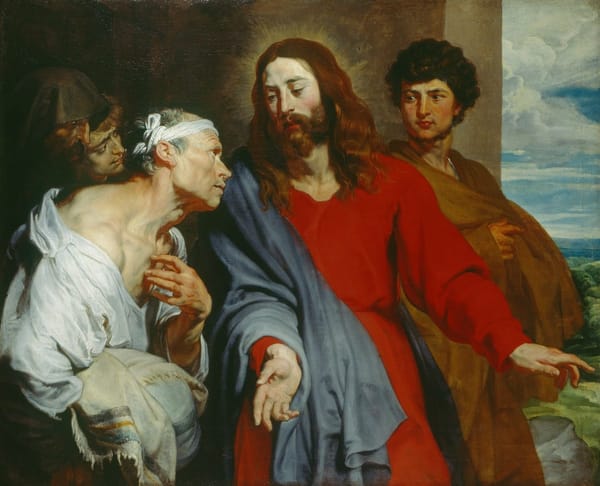
The Eighteenth Sunday after Pentecost
The paralytic carrying his bed is the subject of this day’s Gospel, and gives the eighteenth Sunday after Pentecost its title. This Sunday is inserted in the missal immediately after the Ember-days of autumn. We will not, like the liturgists of the Middle Ages,1 discuss the question of its having taken the place of the vacant Sunday, which formerly used always to follow the ordination of the sacred ministers,2 in the manner we have elsewhere described.3 Manuscript sacramentaries and lectionaries of very ancient date give it the name, which was so much in use, of Dominica vacat.4 Whatever may be the conclusion arrived at, there is one interesting point for consideration, viz., that in the Mass of this day the order of the lessons taken from St. Paul is broken. The Letter to the Ephesians, which has furnished the Epistles since the sixth Sunday after Pentecost, is to-day interrupted, and in its stead we have some verses from the first Epistle to the Corinthians, wherein the apostle gives thanks to God for the manifold gratuitous gifts granted, in Christ Jesus, to the Church. Now, the powers conferred by the imposition of the bishop’s hands on the ministers of the Church are the most marvellous gift that is known on earth, yea, in heaven itself. The other portions of the Mass, too, are, as we shall see further on, most appropriate to the prerogatives of the new priesthood. So that the liturgy of the present Sunday is particularly interesting when it immediately follows the Ember-days of September. But this coincidence is not of very frequent occurrence, at least as the liturgy now stands; nor can we dwell longer on these subjects without going too far into archæology, and exceeding our limits.
Mass
The Introits of the Sunday Masses since Pentecost have hitherto been taken from the Psalter. From Ps. xii. to Ps. cxviii. the Church, without ever changing the order of these sacred canticles, chose from each of them, as its own turn came, the verses most appropriate to the liturgy of each Sunday. But, dating from to-day, she is going to select her Introits elsewhere, with one exception, however, when she will again turn to this, the Book by excellence of divine praise. Her future opening anthems for the dominical liturgy to the end of the year will be taken from various other Books of the old Testament. For this eighteenth Sunday we have Jesus, son of Sirach, the inspired writer of Ecclesiasticus, asking God to ratify the fidelity of His prophets5 by the accomplishment of what they foretold. The present interpreters of the divine oracles are the pastors, whom the Church sends, in her own name, to preach the word of salvation and peace: let us, her children, pray with her that their words may never be void.
Introit
The surest way to obtain grace is to be ever humbly acknowledging to our God our deep conviction that, of ourselves, we cannot please His divine Majesty. The Church continues to give us, in her Collects, the most admirable expressions of such an avowal.
Collect
Epistle
1 Cap. i.Fratres, Gratias ago Deo meo semper pro vobis in gratia Dei, quæ data est vobis in Christo Jesu : quod in omnibus divites facti estis in illo, in omni verbo, et in omni scientia: sicut testimonium Christi confirmatum est in vobis : ita ut nihil vobis desit in ulla gratia, exspectantibus revelationem Domini nostri Jesu Christi, qui et confirmabit vos usque in finem sine crimine, in die adventus Domini nostri Jesu Christi.
1 Ch. i.Brethren: I give thanks to my God always for you, for the grace of God, that is given you in Christ Jesus; that in all things you are made rich in him, in all utterance, and in all knowledge, as the testimony of Christ was confirmed in you. So that nothing is wanting to you in any grace, waiting for the manifestation of our Lord Jesus Christ. Who also will confirm you unto the end without crime, in the day of the coming of our Lord Jesus Christ.
The other Collects, as on page 120.
The last coming of the Son of Man is no longer far off! The approach of that final event, which is to put the Church in full possession of her divine Spouse, redoubles her hopes; but the last judgment, which is also to pronounce the eternal perdition of so great a number of her children, mingles fear with her desire; and these two sentiments of hers will henceforth be continually brought forward in the holy liturgy.
It is evident that expectation has been, so to say, an essential characteristic of her existence. Separated from her Lord, she would have been sighing all day long in this vale of tears, had not the love which possesses her driven her to spend herself, unselfishly and unreservedly, for Him who is absolute Master of her whole heart. She, therefore, devotes herself to labour and suffering, to prayers and tears. But her devotedness, unlimited as it has been, has not made her hopes less ardent. A love without desires is not a virtue of the Church; she condemns it in her children as being an insult to the Spouse.
So just and, at the same time, so intense were, from the very first, these her aspirations that eternal Wisdom wished to spare His bride, by concealing from her the duration of her exile. The day and hour of His return is the one sole point upon which, when questioned by His apostles, Jesus refused to enlighten His Church.6 That secret constituted one of the designs of God's government of the world; but, besides that, it was also a proof of the compassion and affection of the Man-God; the trial would have been too cruel; and it was better to leave the Church under the impression, which after all was a true one, that the end was nigh in God’s sight, with whom a thousand years are as one day.7
This explains how it is that the apostles, the interpreters of the Church’s aspirations, are continually recurring to the subject of the near approach of our Lord’s coming. St. Paul has just been telling us, and that twice over in the same breath, that the Christian is he who waiteth for the manifestation of our Lord Jesus Christ, and for the day of His coming. In his Epistle to the Hebrews, he applies to the second coming the inflamed desires of the ancient prophets for the first, and says: ‘Yet a little, and a very little while, and He that is to come, will come, and will not delay.’8 The reason is that, under the new Covenant as under the old, the Man-God is called, on account of His final manifestation, which is always being looked for, He that is coming, He that is to come.9 The cry which is to close the world’s history is to be the announcement of His arrival: 'Behold! the Bridegroom is coming.’10
And St. Peter, too, says: 'Having the loins of your mind girt up, think of the glory of that day whereon the Lord Jesus is to be revealed! Hope for it, with a perfect hope!'11 The prince of the apostles foresaw the contemptuous way in which future false teachers would scoff at this long-expected, but always put-off, coming: ‘Where is His promise, or His coming? For, since the fathers slept, all things continue so, from the beginning of the creation!'12 Yes, he foresaw this, and forestalled their sarcasm, by answering it in the words which his brother Paul13 had previously used :14 ‘The Lord delayeth not His promise, as some imagine; but dealeth patiently, for your sake, not willing that any should perish, but that all should return to penance. But the day of the Lord shall come as a thief, in which the heavens shall pass away with great violence; and the elements shall be melted with heat; and the earth, and the works which are in it, shall be burnt up. Seeing, then, that all these things are to be dissolved, what manner of people ought you to be in holy conversation and godliness, looking for, and hastening unto, the coming of the day of the Lord, by which the heavens, being on fire, shall be dissolved, and the elements shall melt with the burning heat of fire? But we look for new heavens and a new earth according to His promises, in which justice dwelleth. Wherefore, dearly beloved, seeing that you look for these things, be diligent that ye may be found undefiled and unspotted to Him in peace . . . . Wherefore, brethren, knowing these things before, take heed lest, being led aside by the error of the unwise, you fall from your own steadfastness.'15
If, in those last days, the danger is to be so great that the very powers of heaven shall be moved,16 our Lord, as we are told in our Epistle, has providentially confirmed in us His testimony and our faith, by continual manifestations of His power. And, as if to verify that other word of the same Epistle, that He will thus confirm unto the end them that believe in Him, He redoubles His prodigies in these our times, as though they were precursors of the end. Miracles are forcing themselves on the world’s unwilling notice; and our modern facilities for propagating news are made to tell this glory of the Lord all over His earth! In the name of Jesus, in the name of one or other of His saints, but especially in the name of His Immaculate Mother, who is preparing the final triumph of the Church, the blind see, the lame walk, the deaf hear, every misery of both body and soul is suddenly made to yield. So incontestable, indeed, and so public, is the manifestation of supernatural power, that business-managers of all kinds, though they must, out of regard for incredulity, laugh at the facts, yet are most serious in turning the occasion to their profit. Such very material agencies as railway companies have been glad to accommodate the faithful thousands, and carry them as quickly as they could to the favoured sanctuaries, where the holy Mother of God has appeared. It is not in Catholic countries only that the divine power has made itself felt. Quite recently, in the very centre of Mohammedan infidelity, the city of the Sultans rejoiced at hearing of the marvels done by the Queen of heaven within its own walls. The water of the miraculous fountain has been carried even into the city of Mecca, where is the tomb of the founder of Islam, and into which, until but lately, it was death for any Christian to enter.
The infidel may say in his heart : 'There is no God!’17 If he hears not the divine testimony, it is because corruption, or pride, has more power over him than the light of reason, just as it had over the enemies of Jesus during His life upon earth. He is like to the asp of the Psalm,18 which maketh itself deaf; it stoppeth its ears, that it may never hear the voice of the divine Enchanter, who speaketh that He may save. His life is one piece of madness19 and folly;20 he has done his best to draw down vengeance upon himself.
Let us not be like him, but, with the apostle, let us thank God for the rich profusion of grace which He has so mercifully poured out upon us. Never were His gratuitous gifts more necessary than in these our miserable times. True, the Gospel does not now need to be promulgated; but the efforts of hell against it have become so violent that, in order to withstand them, there is need of a power from on high equal in some sense to that we read of as granted in the beginning of the Church. Let us beseech our Lord to bless us with men powerful in word and work. Let us, by the fervour of our fastings and prayers, obtain from His divine Majesty that the imposition of hands may produce, now more than ever, in them that are called to the priesthood, its full result: that it may make them rich in all things, and especially in all utterance, and in all knowledge. May these days, in which all principles are growing shadowy, find that the supernatural light is kept up, in full splendour and purity, by the zeal of the guides of Christ’s flock. May the compromises and flinchings of a generation, in which all truth is being etiolated and diminished, never lead our newly ordained priests, either themselves to shorten, or to permit anyone else to curtail, the measure of the perfect man,21 which was bestowed on them, in order that they might apply it to every Christian who is desirous of observing the Gospel! In spite of all threats, in spite of the noisy passions which are boisterous against any priest who dares to preach the truth, let their voice be what it should be—that is, an echo of the Word: let it vibrate with the holy firmness of the saints!
In the Gradual, the Church repeats the Introitverse, to celebrate once more the joy felt by the Christian people at hearing the glad tidings, that they are soon to go into the house of the Lord. That house is heaven, into which we are to enter on the last day, our Lord Jesus Christ leading the way. But the house is also the temple in which we are now assembled, and into which we are introduced by the representatives of that same Lord of ours, that is, by His priests.
Gradual
Gospel
Cap. ix.In illo tempore : Ascendens Jesus in naviculam, transfretavit, et venit in civitatem suam. Et ecce offerebant ei paralyticum jacentem in lecto. Et videns Jesus fìdem illorum, dixit paralytico : Confide, fili, remittuntur tibi peccata tua. Et ecce quidam de scribis dixerunt intra se : Hic blasphemat. Et cum vidisset Jesus cogitationes eorum, dixit : Ut quid cogitatis mala in cordibus vestris? Quid est facilius dicere : Dimittuntur tibi peccata tua : an dicere : Surge et ambula? Ut autem sciatis, quia filius hominis habet potestatem in terra dimittendi peccata, tunc ait paralytico : Surge, tolle le ctum tuum, et vade in domum tuam. Et surrexit, et abiit in doraum suam. Videntes autem turbæ timuerunt, et glorifica verunt Deum, qui dedit potestatem talem hominibus.
Ch. ix. At that time : Jesus entering into a boat, passed over the water and came into his own city. And behold they brought to him one sick of the palsy, lying on a bed. And Jesus seeing their faith, said to the man sick of the palsy: Be of good heart, son, thy sins are forgiven thee. And behold some of the scribes said within themselves; He blasphemeth. And Jesus seeing their thoughts, said; Why do you think evil in your hearts? Whether is it easier to say : Thy sins are forgiven thee; or to say : Arise and walk? But that you may know that the Son of man hath power on earth to forgive sins, (then said he to the man sick of the palsy,) Arise, take up thy bed, and go into thy house. And he arose and went into his house. And the multitude seeing it, feared and glorified God that gave such power to men.
In the thirteenth century, in many Churches of the west, the Gospel for to-day was that wherein our Lord speaks of the scribes and pharisees as seated on the chair of Moses.22 The Abbot Rupert, who gives us this detail in his book on the Divine Offices, shows how admirably this Gospel harmonized with the Offertory, which is the one we still have, and which alludes to Moses. ‘This Sunday’s Office,’ says he, ‘eloquently points out, to him who presides over the house of the Lord and has received charge of souls, the manner in which he should comport himself in the high rank, where the divine call has placed him. Let him not imitate those men, who unworthily sat on the chair of Moses; but let him follow the example of Moses himself, who, in the Offertory and its verses, presents the heads of the Church with such a model of perfection. Pastors of souls ought, on no account, to be ignorant of the reason why they are placed higher than other men: it is not so much that they may govern others, as that they may serve them.’23 Our Lord, speaking of the Jewish doctors, said: ‘All whatsoever they shall say to you, observe and do; but according to their works, do ye not: for they say, and do not.'24 Contrariwise to these unworthy guardians of the Law, they that are seated on the chair of doctrine ‘should teach, and act conformably to their teaching,' as the same Abbot Rupert adds. ‘Or, rather,' says he, ‘let them first do what it is their duty to do, that they may afterwards teach with authority; let them not seek after honours and titles, but make this their one object, to bear on themselves the sins of the people, and to merit to avert the wrath of God from those who are confided to their care. Such, we are told in the Offertory, is the example given them by Moses.'25 The Gospel which speaks of the scribes and pharisees who were seated on the chair of Moses has now been appointed for the Tuesday of the second week of Lent. But the one which is at present given for this Sunday equally directs our thoughts to the consideration of the superhuman powers of the priesthood, which are the common boon of regenerated humanity. The faithful, whose attention used formerly, on this Sunday, to be fixed on the right of teaching which is confided to the pastors of the Church, are now invited to meditate upon the prerogative which these same men have of forgiving sins and healing souls. Even if their conduct be in opposition to their teaching, it in nowise interferes with the authority of the sacred chair, from which, for the Church and in her name, they dispense the bread of doctrine to her children. Moreover, whatever unworthiness may happen to be in the soul of a priest, it does not in the least lessen the power of the keys which have been put into his hands to open heaven and to shut hell. For it is the Son of Man, Jesus, who, by the priest, be he a saint, or be he a sinner, rids of their sins His brethren and His creatures, whose miseries He has taken upon Himself, and whose crimes He has atoned for by His Blood.26
The miracle of the cure of the paralytic, which gave an occasion to Jesus of declaring His power of forgiving sins inasmuch as he was Son of Man, has always been especially dear to the Church. Besides the narration she gives us of it from St. Matthew in to-day’s Gospel, she again, on the Ember Friday of Whitsuntide, relates it in the words of St. Luke.27 The Catacomb frescoes, which have been preserved to the present day, equally attest the predilection for this subject, wherewith she inspired the Christian artists of the first centuries. From the very beginning of Christianity, heretics had risen up denying that the Church had the power, which her divine Head gave her, of remitting sin. Such false teaching would irretrievably condemn to spiritual death an immense number of Christians, who, unhappily, had fallen after their Baptism, but who, according to Catholic dogma, might be restored to grace by the sacrament of Penance. With what energy, then, would our mother the Church defend the remedy which gives life to her children! She uttered her anathemas upon, and drove from her communion, those pharisees of the new law, who, like their Jewish predecessors, refused to acknowledge the infinite mercy and universality of the great mystery of the Redemption.
Like to her divine Master, who had worked under the eyes of the scribes, His contradictors, the Church, too, in proof of her consoling doctrine, had worked an undeniable and visible miracle in the presence of the false teachers; and yet she had failed to convince them of the reality of the miracle of sanctification and grace invisibly wrought by her words of remission and pardon. The outward cure of the paralytic was both the image and the proof of the cure of his soul, which previously bad been in a state of moral paralysis; but he himself represented another sufferer, viz., the human race, which for ages had been a victim to the palsy of sin. Our Lord had already left the earth, when the faith of the apostles achieved this, their first prodigy, of bringing to the Church the world grown old in its infirmity. Finding that the human race was docile to the teaching of the divine messengers, and was already an imitator of their faith, the Church spoke as a mother, and said: Be of good heart, son! thy sins are forgiven thee! At once, to the astonishment of the philosophers and sceptics, and to the confusion of hell, the world rose up from its long and deep humiliation; and, to prove how thoroughly his strength had been restored to him, he was seen carrying on his shoulders, by the labour of penance and the mastery over his passions, the bed of his old exhaustion and feebleness, on which pride, lust, and covetousness had so long held him. From that time forward, complying with the word of Jesus, which was also said to him by the Church, he has been going on towards his house, which is heaven, where eternal joy awaits him! And the angels, beholding such a spectacle of conversion and holiness,28 are in amazement, and sing glory to God, who gave such power to men.
Let us also give thanks to Jesus, whose marvellous dower, which is the Blood He shed for His bride, suffices to satisfy, through all ages, the claims of eternal justice. It was at Easter time that we saw our Lord instituting, the great Sacrament, which thus in one instant restores the sinner to life and strength.29 But how doubly wonderful does its power seem, when we see it working in these times of effeminacy and of well-nigh universal ruin! Iniquity abounds; crimes are multiplied; and yet, the life-restoring pool, kept full by the sacred stream which flows from the open side of our crucified Lord, is ever absorbing and removing, as often as we permit it, and without leaving one single vestige of them, those mountains of sins, those hideous treasures of iniquity which had been amassed, during long years, by the united agency of the devil, the world, and man himself.
The Offertory speaks to us of the figurative altar, which was set up by Moses for the reception of the oblations of the figurative Law, which oblations, foreshadowed the great and only true sacrifice, at which we are now present. After the anthem which is still in use, we will append the verses which were anciently added. Moses is there represented as the type of those faithful prophets mentioned in the Introit; he is shown to us as the model of those true leaders of God’s people, who devote themselves in order to procure mercy and peace for those whom they guide.30 God sometimes seems to resist them, but He always suffers Himself to be overcome; and in return for their fidelity, He admits them into the most intimate manifestations of His light and His love. The first verse shows us the priest in his public life of intercession and devotedness for others; the second reveals to us his private life, of which prayer and contemplation are the main occupation. We shall not be surprised at the length of these verses—the singing of which would far exceed the time for offering the Host and chalice, such as is now the custom—if we remember how it was the ancient usage that the whole assembly of the faithful present at the holy Sacrifice took part in the oblation of the bread and wine needed for the liturgy. So likewise the Communion, which at present consists of only a few lines, was originally nothing but the antiphon to an entire psalm, which in the ancient antiphonaries was appointed for each day, when it was not the same as the Introit-psalm; the psalm was sung, repeating the antiphon after each verse, until all had communicated.
Offertory
Then Moses made an evening sacrifice.
℣. II. Moses prayed to the Lord and said: If I have found favour in thy sight, show me thyself openly, that I may see thee. And the Lord spake unto him, saying: For man shall not see me, and live; but be thou on the height of the rock, and my right hand shall protect thee, till I pass : whilst I pass I will take away my hand, and then shalt thou see my glory : but my face shall not be seen by thee; for I am God, showing wonderful things in the earth.
The sublime eloquence of the Secret is beyond all comment. Let us be thoroughly imbued with the high teaching here so admirably summed up in a few short words: let us come to understand that our life and conduct should have something divine about them, in response to the mysteries which are revealed to our understanding and incorporated into us by the venerable communication of this Sacrifice.
Secret
The other Secrets, as on page 130.
The Communion-anthem is addressed to the priests, and, at the same time, to us all: for if the priest offers the Victim, which is the holiest that can be, we should not think of accompanying him into the court of our God, without bringing up, that they may be united to the divine Host, other victims, that is ourselves. It is God’s injunction : Thou shalt not appear empty before me!31
Communion
Whilst giving thanks in the Postcommunion for the priceless gift of the sacred mysteries, let us beseech our God to perfect within us the grace of always receiving it worthily.
Postcommunion
The other Postcommunions, as on page 181.
Vespers
The psalms, capitulum, hymn, and versicle, as above, pages 71-81.
Antiphon of the Magnificat
- Berno Aug., cap. v., etc. ↩︎
- Microlog., cap. xxix. ↩︎
- Advent: Ember Saturday. ↩︎
- Thomasi Opp. Edit. Vezzosi, t. v., p. 148, 149, 309. ↩︎
- Ecclus. xxxvi. 18. ↩︎
- St. Matt. xxiv. 3, 36. ↩︎
- 2 St. Pet. iii. 8. ↩︎
- Hab. ii. 3; Heb. x. 37. ↩︎
- St. Matt. xi. 3; Apoc. i. 8. ↩︎
- St. Matt. xxv. 6. ↩︎
- 1 St. Pet. i. 5, 7, 13. ↩︎
- 2 St. Pet. iii. 3, 4. ↩︎
- Ibid. 15. ↩︎
- Rom. ii. 4. ↩︎
- 2 St. Pet. iii. 9-17. ↩︎
- St. Matt. xxiv. 29. ↩︎
- Ps. xiii. i. ↩︎
- Ps. lvii. 5, 6. ↩︎
- Ps. lvii. 5, 6. ↩︎
- Ps. xiii. 1. ↩︎
- Eph. iv. 13. ↩︎
- St. Matt. xxiii. 1-12. ↩︎
- Rup., Div. Off., xii. 18. ↩︎
- St. Matt. xxiii. 3. ↩︎
- Rup., ubi supra. ↩︎
- Heb. ii 10-18. ↩︎
- St. Luke v. 17-26. ↩︎
- St. Luke v. 26. ↩︎
- Wednesday of the fifth week after Easter. ↩︎
- Rup., ubi supra. ↩︎
- Exod. xxiii. 15. ↩︎
First Sunday of October: Feast of the Most Holy Rosary
|
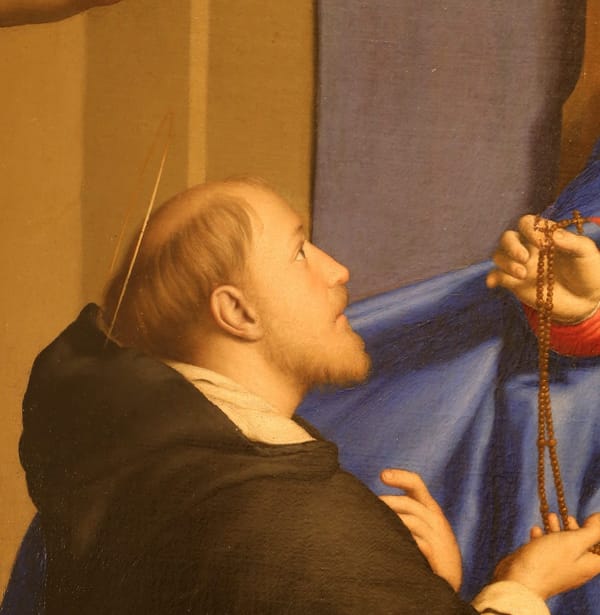
It is customary with men of the world to balance their accounts at the end of the year, and ascertain their profits. The Church is now preparing to do the same. We shall soon see her solemnly numbering her elect, taking an inventory of her holy relics, visiting the tombs of those who sleep in the Lord, and counting the sanctuaries, both new and old, that have been consecrated to her divine Spouse. But to-day’s reckoning is a more solemn one, the profits more considerable: she opens her balance-sheet with the gain accruing to our Lady from the mysteries which compose the cycle. Christmas, the cross, the triumph of Jesus, these produce the holiness of us all; but before and above all, the holiness of Mary. The diadem which the Church thus offers first to the august Sovereign of the world, is rightly composed of the triple crown of these sanctifying mysteries, the causes of her joy, of her sorrow, and of her glory. The joyful mysteries recall the Annunciation, the Visitation, the Birth of Jesus, Mary’s Purification, and the Finding of our Lord in the temple. The sorrowful mysteries bring before us the Agony of our blessed Lord, His being scourged, and crowned with thorns, the carrying of the cross, and the Crucifixion. While, in the glorious mysteries, we contemplate the Resurrection and Ascension of our Saviour, Pentecost, and the Assumption and Coronation of the Mother of God. Such is Mary’s rosary; a new and fruitful vine, which began to blossom at Gabriel’s salutation, and whose fragrant garlands form a link between earth and heaven.
In its present form, the rosary was made known to the world by St. Dominic at the time of the struggles with the Albigensians, that social war of such ill-omen for the Church. The rosary was then of more avail than armed forces against the power of satan; it is now the Church’s last resource. It would seem that, the ancient forms of social prayer being no longer relished by the people, the holy Spirit has willed by this easy and ready summary of the liturgy to maintain, in the isolated devotion of these unhappy times, the essential of that life of prayer, faith, and Christian virtue, which the public celebration of the Divine Office formerly kept up among the nations. Before the thirteenth century, popular piety was already familiar with what was called the psalter of the laity, that is, the angelical salutation repeated one hundred and fifty times; it was the distribution of these Hail Marys into decades, each devoted to the consideration of a particular mystery, that constituted the rosary. Such was the divine expedient, simple as the eternal Wisdom that conceived it, and far-reaching in its effects; for while it led wandering man to the Queen of Mercy, it obviated ignorance which is the food of heresy, and taught him to find once more ‘the paths consecrated by the Blood of the Man-God, and by the tears of His Mother.’1
Thus speaks the great Pontiff who, in the universal sorrow of these days, has again pointed out the means of salvation more than once experienced by our fathers. Leo XIII, in his encyclicals, has consecrated the present month to this devotion so dear to heaven; he has honoured our Lady in her litanies with a new title, Queen of the most holy rosary;2 and he has given the final development to the solemnity of this day, by raising it to the rank of a second class feast, and by enriching it with a proper Office explaining its permanent object.3 Besides all this, the feast is a memorial of glorious victories, which do honour to the Christian name.
Soliman II, the greatest of the Sultans, taking advantage of the confusion caused in the west by Luther, had filled the sixteenth century with terror by his exploits. He left to his son, Selim II, the prospect of being able at length to carry out the ambition of his race: to subjugate Rome and Vienna, the Pope and the emperor, to the power of the crescent. The Turkish fleet had already mastered the greater part of the Mediterranean, and was threatening Italy, when, on October 7, 1571, it came into action, in the Gulf of Lepanto, with the pontifical galleys supported by the fleets of Spain and Venice. It was Sunday; throughout the world the confraternities of the rosary were engaged in their work of intercession. Supernaturally enlightened, St. Pius V watched from the Vatican the battle undertaken by the leader he had chosen, Don John of Austria, against the three hundred vessels of Islam. The illustrious Pontiff, whose life’s work was now completed, did not survive to celebrate the anniversary of the triumph; but he perpetuated the memory of it by an annual commemoration of our Lady of Victory. His successor, Gregory XIII, altered this title to our Lady of the rosary, and appointed the first Sunday of October for the new feast, authorizing its celebration in those churches which possessed an altar under that invocation.
A century and a half later, this limited concession was made general. As Innocent XI, in memory of the deliverance of Vienna by Sobieski, had extended the feast of the most holy name of Mary to the whole Church; so, in 1716, Clement XI inscribed the feast of the rosary on the universal calendar, in gratitude for the victory gained by Prince Eugene at Peterwardein, on August 5, under the auspices of our Lady of the snow. This victory was followed by the raising of the siege of Corfu, and completed a year later by the taking of Belgrade.
Mass
The joys experienced on the other feasts of the Mother of God, are all gathered up and resumed in this one, for us, for the angels, and for our Lady herself. Like the angels, then, let us offer, together with Mary, the homage of our just delight to the Son of God, her Son, her King and ours.
Introit
The mysteries of the Son and of the Mother are our instruction and our hope. The Church prays in the Collect that they may also be our rule of life and our pledge of eternal happiness.
Collect
Then is made a commemoration of the occurring Sunday.
Epistle
Prov. cap. viii.Dominus possedit me in initio viarum suarum antequam quidquam faceret a principio. Ab æterno ordinata sum, et ex antiquis, antequam terra fieret, Nondum erant abyssi, et ego jam concepta eram. Nunc ergo, filii, audite me: Beati qui cnstodiunt vias meas. Audite disciplinam, et estote sapientes, et nolite abjicere eam. Beatus homo qui audit me, et qui vigilat ad fores meas quotidie, et observat ad postes ostii mei. Qui me invenerit, inveniet vitam, et hauriet salutem a Domino.
Prov. ch. viii.The Lord possessed me in the beginning of his ways, before he made anything from the beginning. I was set up from eternity, and of old before the earth was made. The depths were not as yet, and I was already conceived. Now therefore, ye children, hear me: Blessed are they that keep my ways. Hear instruction and be wise, and refuse it not. Blessed is the man that heareth mo, and that watcheth daily at my gates, and waiteth at the posts of my doors. He that shall find me, shall find life, and shall have salvation from the Lord.
Our Lady’s mysteries are before all time in God’s sight, like those of her divine Son; like these they will endure for all eternity; like them they rule the ages, which circle round the Word and Mary, preparing for both in the days of figures, perpetuating their presence by the incessant glorification of the most holy Trinity, in whose name all Christians are baptized. Now the rosary honours all this series of mysteries; to-day’s feast is a glance back upon the cycle as it draws to its close. From these mysteries, from this view of them, we must draw the conclusion formulated by our Lady herself in this passage from Proverbs, which the Church applies to her: ‘Now therefore, my children, consider my ways; imitate me, that you may find happiness.’ Blessed is he that watcheth at her gate! Let us pray to her, rosary in hand, considering her at the same time, meditating on her life and her greatness, and watching, were it but for a quarter of an hour, at the entrance to the palace of this incomparable Queen. The more faithful we are, the more assured will be our salvation and our progress in true life.
In the Gradual, let us congratulate the Queen of the holy rosary on her perfect life, all truth, and justice, and meekness, which won her the love of the supreme King. In the Alleluia verse, let us proclaim the nobility of her race, unequalled in the whole world.
Gradual
The Gospel is the same as on the feast of the most holy name of Mary (page 176). ‘At that time, the angel Gabriel was sent from God, into a city of Galilee, called Nazareth, to a Virgin espoused to a man whose name was Joseph, of the house of David; and the Virgin’s name was Mary. And the angel being come in, said to her: Hail, full of grace! the Lord is with thee; blessed art thou among women? Blessed art thou among women, repeated Elizabeth a few days later, and blessed is the fruit of thy womb. These two salutations, with the name of Mary added to the angel’s greeting and the name of Jesus to Elizabeth’s, constituted the Ave Maria in the time of St. Dominic, the promulgator of the rosary. The prayer, 'Holy Mary Mother of God’ which now so beautifully completes the formula of praise, received the sanction of the Church in the sixteenth century. No better Gospel could, then, have been chosen for to-day, for it gives the original text of the rosary, and describes the first of its mysteries.
All grace, all light, all life, are to be found in our Lady; by her holy rosary she, as we sing in the Offertory, has multiplied flowers and fruits in the garden of the Church. Every offering acceptable to God, comes from Mary, with and by Jesus.
Offertory
As the Secret tells us, the rosary, piously meditated, prepares us for the Sacrifice of the altar, that supereminent and august memorial of the mysteries which it imprints in the heart and mind of the Christian.
Secret
Then a commemoration of the Sunday.
The Preface as on September 8, substituting ‘in solemnitate, on the solemnity,’ for ‘in Nativitate, on the Nativity,’ of the blessed Virgin Mary.
After the sacred banquet, our soul must not remain barren. The fragrance of virtue’s flowers must embalm all that surrounds us, and prove to the Spouse that His visit has not been made in vain.
Communion
In the Postcommunion, the Church prays that our Lady may, by her intercession, second the effects of this Sacrifice, and-of the mysteries in which she played so great a part.
Postcommunion
Then is added the Postcommunion of the Sunday, and the Gospel of the same is read at the end of the Mass.
Vespers
A few days ago, the Church borrowed from the Servites of Mary her Office of the Seven Dolours; to-day she seeks her responsories, hymns, and antiphons from the noble family which claims the rosary as its birthright. The Christian world owes a new debt of gratitude to the sons of St. Dominic for enriching it with these beautiful liturgical formulæ. But as the Use of the Friars Preachers gives but one antiphon for the psalms in the Vespers of the saints, the following antiphons have been added for the Roman rite. The hymn, which so gracefully and yet concisely resumes the triple series of the mysteries, is the fourth of the entire Office: the first celebrates, at first Vespers, the joyful mysteries; the second, at Matins, the sorrowful; the third, at Lauds, the glorious. 'From these mysteries let us gather roses, and weave garlands for the Mother of fair love.’
Ps. Dixit Dominus, page 38.
Ps. Laudate pueri, page 41.
Ps.Lætatus sum, page 152.
Ps. Nisi Dominus, page 153.
Ps. Lauda Jerusalem, page 154.
Capitultum
Eccli. xxiv. xxxix.
Hymn
Te sauciam doloribus,
Te jugi amictam gloria,
O Virgo Mater pangimus.
Dum concipis, dum visitas,
Et edis, offers, invenis,
Mater beata, Filium.
In corde agonem, verbera,
Spinas, crucemque Filii
Perpessa, princeps martyrum.
In ignibus Paracliti,
In regni honore et lumine,
Regina fulgens gloria.
Ex his rosas mysteriis,
Et pulchri amoris inclytæ
Matri coronas nectite.
Qui natus es de Virgine,
Cum Patre et almo Spiritu,
In sempiterna sæcula.
thee wounded with the sword of sorrow,
thee girt with everlasting glory,
we sing, O Virgin Mother.
when thou conceivest; when thou visitest thy cousin;
when thou bringest forth thy Son, offerest him to God,
findest him in the temple, O happy Mother!
in thy inmost heart the agony, the scourging,
the thorns, and the cross of thy Son,
O first of martyrs!
in the triumphs of thy Son,
in the fires of the Paraclete,
in the honour and splendour of thy queenliness.
gather roses from these mysteries,
and wreathe therewith garlands
for the Mother of fair love.
born of the Virgin;
together with the Father and the holy Spirit,
through everlasting ages.
Antiphon of the Magnificat
The Prayer as on page 299.
Then is made a commemoration of the Sunday.
October 8: St. Bridget, Widow
‘Who, O Lord, has treated Thee thus?’ ‘They that despise Me and forget My love.’ This was the first revelation of the Son of God to Bridget of Sweden. Francis of Assisi, raising before the world the standard of the cross, had announced that Christ was about to recommence the dolorous way; not now in His own Person, but in the Church, who is flesh of His flesh. The truth of this declaration Bridget experienced from the very opening of that fatal fourteenth century, during which such innumerable disasters, the results of crime, fell at once upon the west.
Born in the year when Sciarra Colonna, a new Pilate’s servant, dared to strike the Vicar of Christ, Bridget’s childhood was contemporaneous with those sad falls, which caused the Church to be despised by her enemies. There were no saints in Christendom comparable to the great ones of old; in the preceding age the Latin races had exhausted their vitality in producing flowers; but where were the promised fruits? Ancient Europe had nought but affronts for the Word of God; this feast, this apparition of Jesus in cold Scandinavia, seems to point to His flight from the habitual centre of His predilection. Bridget was ten years old, when the Man of sorrows sought a resting-place in her heart: and at that very time, the death of Clement V and the election of John XXII in a foreign land, fixed the papacy in its seventy years’ exile.
Rome meanwhile, widowed of her Pontiff, appeared the most miserable of cities: ‘The ways of Sion mourn, because there are none that come to the solemn feast.’1 Sacked by her own sons, she was daily losing some remnant of her ancient glory; her public roads were scenes of bloodshed; solitude reigned amid the ruins of her crumbling basilicas; sheep grazed in St. Peter’s and the Lateran. From the seven hills anarchy had spread throughout Italy, transforming the towns into haunts of brigands, and the country parts into deserts. France was doomed to expiate, in the horrors of a hundred years' war, the captivity of the sovereign Pontiff.
Unfortunately, the captivity was loved; the court of Avignon did not mourn like the Hebrews by the rivers in Babylon; richer in gold than in virtues, it were well, had they not, for a long time, shaken the influence of the Holy See over the nations. The German empire and Louis of Bavaria could easily refuse obedience to the ward of the Valois; the Fratricelli accused the Pope of heresy; while, countenanced by the doctors of the law, Marsillus of Padua attacked the very principle of the papacy. Benedict XII discouraged by the troubles of Italy, abandoned his design of returning to Rome; and built upon the rock of Doms the famous castle, at once fortress and palace, which seemed to fix the residence of the Popes for ever on the banks of the Rhone. The misery of Rome, and the splendour of Avignon, reached their height under Clement VI who entered into a contract with Jane of Naples, Countess of Provence, securing to the Church the definitive possession of Avignon. At that time the papal court surpassed all others in luxury and worldliness. God in His justice visited the nations with the scourge of the black death; while in His mercy He sent warnings from heaven to Pope Clement:
Arise; make peace between the kings of France and England; and go into Italy to preach the year of salvation, and to visit the places watered by the blood of saints. Consider how, in the past, thou hast provoked My anger, doing thy own will and not thy duty; and I have held My peace. But now ray time is at hand. If thou wilt not obey, I shall require of thee an account of the unworthiness wherewith thou hast passed through all the degrees by which I permitted thee to be exalted in glory. Thou wilt be answerable for all the avarice and ambition that have been rife in the Church in thy days. Thou couldst have done much towards a reformation, but being carnal-minded thou wouldst not. Repair the past by zeal during the rest of thy life. Had not My patience preserved thee, thou wouldst have fallen lower than any of thy predecessors. Question thy conscience, and thou wilt see that I speak the truth.2
This severe message, dictated by the Son of God to the prophetess Bridget of Sweden, came from that northern land where sanctity seemed to have taken refuge during the past half century. Though incurring such reproaches, the Pope still had great faith, and he accordingly received with generous courtesy the messengers from the princess of Nericia. But, though he promulgated the celebrated Jubilee of the half-century, Clement VI allowed the holy year to pass away without going himself to prostrate at the tombs of the apostles, to which he convoked the entire world. The patience of God was at an end. The judgment of that soul was revealed to Bridget; she saw its terrible chastisement, which however was not eternal, and was tempered by hope.3
Hitherto wholly engaged with the supernatural interests of her own country, Bridget suddenly found her mission embrace the whole world. In vain, by her prayers to God, by her warnings to princes, had the saint striven to avert from Sweden the trials that were to end in the union of Calmar. Neither Magnus II nor his consort Blanche of Dampierre, took to heart the menaces of their noble relative: ‘I saw the sun and the moon shining together in the heavens, until both having given their power to the dragon, the sky grew pale, reptiles filled the earth, the sun sank into the abyss, and the moon disappeared, leaving no trace behind.’4
The criminal coldness of the south had been the occasion of grace for the north; but the latter in its turn did not profit by the time of its visitation: and Bridget quitted it for ever. She herself was a city of refuge to our Lord. Taking up her abode in Rome, she there, by her holiness, prepared the way for the return of Christ’s vicar. There for twenty years she, as it were, personified the eternal city, enduring all its bitter sufferings, knowing all its moral miseries, presenting its tears and prayers to our Lord; continually visiting the tombs of the apostles and martyrs throughout the peninsula; and at the same time never ceasing to transmit to Pontiffs and kings the messages dictated to her by God.
At length the horizon appeared to be brightening: while the just and inflexible Innocent VI reformed the papal court, Albornoz was restoring peace in Italy. In 1367 Bridget had the great joy of receiving in the Vatican the blessing of Urban V. Unhappily, in three short years Urban quitted the threshold of the apostles to return to his native land; but, as Bridget foretold, he re-entered Avignon only to die. He was succeeded by the nephew of Clement VI, Roger de Beaufort, under the name of Gregory XI, who was destined to put an end to the exile and break the chains of the Roman Pontiffs.
But Bridget’s hour had come. Another was to reap in joy what she had sown in tears; Catharine of Siena was to bring back to the holy city the vicar of our Lord. As to the valiant Scandinavian, who had never lost courage or faltered in faith through the failure of her missions, she was inspired by her divine Spouse to visit the holy places, the scenes of His Passion. It was on her return from this last pilgrimage, that, far from her native land, in that desolate Rome whose widowhood she had striven in vain to terminate, she was called to her heavenly reward. Her body was carried back to Scandinavia by her daughter St. Catharine of Sweden. It was laid in the yet unfinished monastery of Vadstena, mother-house of that projected Order of our Saviour, the foundations of which, like all the undertakings imposed by God upon Bridget, was not to be completed until after her death. Twenty-five years before, she had received almost simultaneously the command to found, and the command to quit, this holy retreat; as though the Lord would give her a glimpse of its blessed peace, only to crucify her the more in the very different path into which He immediately led her. Such is God’s severity towards His dear ones, and such His sovereign independence with regard to His gifts. In the same manner, He had allowed the saint, in her early years, to be attracted by the beautiful lily of virginity, and had then signified His will that the flower should not be hers. 'When I cry,’ said the prophet, in a captivity figurative of that whereof Bridget felt all the bitterness, ‘when I cry and entreat, He hath shut out my prayer. He hath shut up my ways with square stones, He hath turned my paths upside down.’5
Before reading the liturgical legend, let us call to mind that St. Bridget died on July 23, 1373; October 8 is the anniversary of the first Mass celebrated in her honour by Pope Boniface IX on the day following her canonization.6 Martin V confirmed the Acts of Boniface IX in her honour; and approved her Revelations, which had been violently attacked in the Councils of Constance and Basle, only to come forth with a higher recommendation to the piety of the faithful. Many Indulgences are attached to the rosary which bears the saint's name. These are now, by the favour of the apostolic See, frequently applied to ordinary rosaries; but it must be remembered that the true rosary of St. Bridget is composed of the Ave Maria recited sixty-three times, the Pater noster seven times, and the Credo seven times, in honour of the supposed number of our Lady’s years on earth, and of her joys and sorrows. It was also from a desire of honouring our Lady, that the saint vested in the abbess the superiority over the double monasteries in the Order of our Saviour.
O valiant woman! support of the Church in most unhappy times, mayst thou now be blest by all nations! When the earth, grown poor in virtue, no longer paid its debts to the Lord, thou wast the treasure discovered and brought from the uttermost coasts to supply for the indigence of many. Thou didst earn the good-will of heaven for the hitherto despised north. Then the holy Spirit was moved by the prayers of apostles and martyrs to lead thee to the land which their blood had not sufficed to render fruitful for the Spouse; thou didst appear as the merchant's ship bringing bread from afar to countries wasted and barren. At thy voice, Rome took heart again; after thy example, she expiated the faults which had wrought her ruin; thy prayers and hers won back to her the heart of her Spouse and of His vicar.
Thine own portion was one of suffering and labour. When, to the joy of all, thy work was consummated, thou hadst already quitted this world. Thou didst resemble the heroes of the old Testament, saluting from afar the promises that others were to see fulfilled, and acknowledging themselves to be strangers and pilgrims on the earth. Like them thou didst seek, not the fatherland thou hadst abandoned and whither thou couldst have returned, but the only true home which is heaven. Moreover God made it a glory to be called thy God.
From the eternal city where thine exile is at an end, preserve in us the fruit of thy example and teachings. Thy Order of our Saviour perpetuates them in the countries where it still exists though so much diminished; may it revive at Vadstena in its primitive splendour! By it and its rivals in holiness, bring hack Scandinavia to the faith, now so unhappily lost, of its apostle Anscharius, and of Eric and Olaf its martyr kings. Lastly, protect Home, whose interests were so specially confided to thee by our Lord; may she never again experience the terrible trial which cost thee a life-time of labour and suffering!
October 8 (the Same Day) [October 7]: Sts. Sergius, Bacchus, Marcellus and Apuleius, Martyrs
Among the martyrs annually commemorated on this day, the names of Marcellus and Apuleius carry back the mind to apostolic times. They had been disciples of Simon Magus, but were convinced of his lying deceit by the miracles of St. Peter, and shed their blood in testimony of their faith in the true God.
St. Sergius is regarded in the east as one of the most glorious witnesses to our Lord. He suffered in the tenth and last persecution, with his companion St. Bacchus, a soldier like himself of the Roman army in Syria. So illustrious became his sepulchre, that a city sprang up around it, which was called Sergiopolis, and became a metropolitan See. The west soon joined the east in honouring these holy martyrs, and a church was dedicated to them in Rome. Saint-Serge at Angers, founded by Clovis II, testifies to the veneration in which they were held by the Franks.
Prayer
| Previous October 7 (the Same Day): St. Justina, Virgin and Martyr | Next First Sunday of October: Feast of the Most Holy Rosary |