Daily reading
After Pentecost
Double · Movable from Easter · Temporal
October 15, 2028
From Dom Guéranger’s The Liturgical Year.

|
The Nineteenth Sunday after Pentecost
The divine Leader of God’s people is their salvation in all their distress. Did we not last Sunday see Him prove Himself such, and in a very telling way, by curing both body and soul of the poor paralytic, who was a figure of the whole human race? Let us hear His voice, in the Introit, with love and gratitude; let us promise Him the fidelity He asks of us; His Law, if we will but observe it, will preserve us from a relapse.
The anthem which follows is made up of several passages of holy Writ, without being exactly that of any one of them. The verse is taken from Psalm lxxvii.
Introit
Free both in mind and body by the omnipotent word of the Son of Man, the human race can devote itself, with all activity, to the service of God. Let us obtain from His divine Majesty, by uniting our prayer with that of the Church in her Collect, that the fatal paralysis, which was once so cruel a tyrant over our souls and faculties, may never return.
Collect
The other Collecte, as on page 120.
Epistle
Cap. iv.Fratres, Renovamini spiritu mentis vestræ, et induite novum hominem, qui secundum Deum creatus est in justitia, et sanctitate veritatis. Propter quod deponentep mendacium, loquimini veritatem unusquisque cum proximo suo : quoniam sumus invicem membra. Irascimini, et nolite peccare : sol non occidat super iracundiam vestram. Nolite locum dare diabolo : qui furabatur, jam non furetur : magis autem laboret, operando manibus suis, quod bonum est, ut habeat unde tribuat necessitatem patienti.
Ch. iv.Brethren : be renewed in the spirit of your mind; and put on the new man, who, according to God, is created in justice, and holiness of truth. Wherefore, putting away lying, speak ye the truth every man with his neighbour: for we are members one of another. Be angry and sin not. Let not the sun go down upon your anger. Give not place to the devil. He that stole, let him now steal no more; but rather let him labour, working with his hands the thing which is good, that he may have something to give to him that suffereth need.
The Epistle to the Ephesians, which was interrupted last Sunday in the manner we then described, is continued to-day by the Church. The apostle has already laid down the dogmatical principles of true holiness; he now deduces the moral consequences of those principles.
Let us call to mind how the holiness, which is in God, is His very truth—truth living and harmonious, which is no other than the admirable concert of the Three divine Persons, united in love. We have seen that holiness, as far as it exists in us men, is also union, by infinite love, with the eternal and living Truth. The Word took a Body unto Himself in order to manifest in the Flesh this sanctifying and perfect truth,1 of which He is the substantial expression;2 His Humanity, sanctified directly by the plenitude of the divine life and truth, which dwell within Him,3 became the model, as well as the means, the way, of all holiness to every creature.4 It was not sin alone, but it was, moreover, the finite nature of man that kept him at a distance from the divine life;5 but he finds in Christ Jesus, just as in God, the two elements of that life: truth and love. In Jesus, as the complement of His Incarnation, Wisdom aspires at uniting with herself all the members, also, of that human race, of which He is the Head,6 and the First-born;7 by Him the Holy Ghost, whose sacred fount He is,8 pours Himself out upon man, whereby to adapt him to his sublime vocation, and to consummate, in infinite love (which is Himself), that union of every creature with the divine Word. Thus it is that we verily partake of that life of God, whose existence and holiness are the knowledge and love of His own Word; thus it is that we are sanctified in truth9 by the participation of that very holiness wherewith God is holy by nature.
The Son of Man, being God, participates for us His brethren in the life of union in the truth which constitutes the holiness of the blessed Trinity. But He communicates that life, that truth, that deifying union, to none save those who have truly become His members, and who, in Him, reproduce between one another, by the operation of the Spirit of truth10 and love, that unity of which that sanctifying Spirit is the almighty bond in the Godhead.
‘May they all be one, as Thou, Father, in Me, and I in Thee,' said Jesus to His eternal Father, ‘that they also may be one in us. I have given unto them the glory (that is to say, the holiness) which Thou hast given unto Me, that they may be one, as we also are one; I in them, and Thou in Me, that they may be consummated (that is, be made perfect) in unity.'11 Here we have, and formulated by our Lord Himself, the simple but fruitful axiom, the foundation of Christian dogma and morals. By that sublime prayer, He explained what He had previously been saying: 'I sanctify Myself for them, that they, also, may be sanctified in truth.'12
Let us now understand the moral doctrine given us by St. Paul in our to-day's Epistle. What does he mean by that justice, and that holiness of truth, which is that of Christ,13 of the new man, whom everyone must put on, that aspires to the possession of the riches spoken of in the passages already read to us from this magnificent Epistle? Let us re-read the Epistle for the seventeenth Sunday, and we shall find that all the rules of Christian asceticism, as well as of the mystic life, are to St. Paul’s mind summed up in those words: Be careful to keep unity!14 It is the principle he lays down for all, both beginners and the perfect. It is the crowning of the sublimest vocations in the order of grace, as well as the foundation and reason of all God's commandments; so truly so, indeed, that, if we are commanded to abstain from lying, and to speak the truth to them that live with us, the motive is that we are members one of another.
There is a holy anger, of which the Psalmist speaks,15 and which is the outcome, on certain occasions, of zeal for the divine law and charity; but the movement of irritation excited in the soul must, even then, be speedily calmed down; to foster it would be to give place to the devil, to give him an opportunity of weakening, or even destroying, within us, by bitterness and hatred, the structure of holy unity.16
Before our conversion our neighbour, as well as God, was grieved by our sins; we cared little or nothing for injustice, provided it was not noticed; egotism was our law, and it was proof enough of the reign of satan over our souls. Now that the Spirit of holiness has expelled the unworthy usurper, the strongest evidence of His being our rightful master is that not only the rights of others are sacred in our estimation, but our toil and our labours are all undergone for the purpose of being serviceable to our neighbour. In a word, as the apostle continues a little farther on, we walk in love, because, as most dear children, we are followers of God.17
It is by this means alone, says St. Basil, that the Church manifests the many and great benefits bestowed on the world by the Incarnation. The Christian family, which, heretofore, was split up into a thousand separate fragments, is now made one, one in itself, and one in God; it is the repetition of what our Lord did, by assuming Flesh and making it one with Himself.18
Our Jesus has restored to our hands, which once were paralyzed for every supernatural work, the full freedom of their movements; let us, then, raise them up spiritually in prayer, giving glory to God by this our homage, which He graciously accepts as a fragrant sacrifice. The Church gives us this teaching in the Gradual, and by her own example as well.
Gradual
Gospel
Cap. xxii.In illo tempore; Loquebatur Jesus principibus sacerdotum, et pharisæis in parabolis, dicens : Simile factum est regnum cœlorum homini regi, qui fecit nuptias fìlio suo. Et misit servos suos vocare invitatos ad nuptias, et nolebant venire. Iterum misit alios servos, dicens : Dicite invitatis : Ecce prandium meum paravi; tauri mei, et altilia occisa sunt, et omnia parata; venite ad nuptias. Illi autem neglexerunt, et abierunt, alius in villam suam, alius vero ad negotiationem suam : reliqui vero tenuerunt servos ejus, et contumeliis affectos occiderunt. Rex autem cum audisset, iratus est : et missis exercitibus suis, perdidithomicidas illos, et civitatem illorum succendit. Tunc ait servis suis : Nuptiæ quidem paratæ sunt, sed qui invitati erant, non fuerunt digni. Ite ergo ad exitus viarum, et quoscumque inveneritis, vocate ad nuptias. Et egressi servi ejus in vias, congregaverunt omnes, quos invenerunt, malos et bonos : et impletæ sunt nuptiæ discumbentium. Intravit autem rex ut videret discumbentes, et vidit ibi hominem non vestitum veste nuptiali. Et ait illi: Amice, quomodo huc filtrasti, non habens vestem nuptialem? At ille obmutuit. Tunc dixit rex ministris : Ligatis manibuset pedibus ejus, mittite eum in tenebras exteriores : ibi erit fletus et stridor dentium. Multi enim sunt vocati, pauci vero electi.
Ch. xxii.At that time : Jesus spoke to the chief priests and the pharisees in parables, saying: The kingdom of heaven is likened to a king, who made a marriage for his son. And he sent his servants, to call them that were invited to the marriage: and they would not come. Again he sent other servants, saying: Tell them that were invited: Behold, I have prepared my dinner : my beeves and fatlings are killed, and all things are ready: come ye to the marriage. But they neglected, and went their ways, one to his farm, and another to his merchandise. And the rest laid hands on his servants, and having treated them contumeliously, put them to death. But when the king had heard of it, he was angry, and sending his armies, he destroyed those murderers, and burnt their city. Then he saith to his servants : The marriage indeed is ready : but they that were invited were not worthy. Go ye therefore into the highways; and as many as ye shall find, call to the marriage. And his servants going forth into the ways, gathered together all that they found, both bad and good : and the marriage was filled with guests. And the king went in to see the guests: and he saw there a man who had not on a wedding garment. And he saith to him: Friend, how eamest thou in hither not having on a wedding garment? But he was silent. Then the king said to the waiters : Bind his hands and his feet, and cast him into the exterior darkness; there shall be weeping and gnashing of teeth. For many are called, but few are chosen.
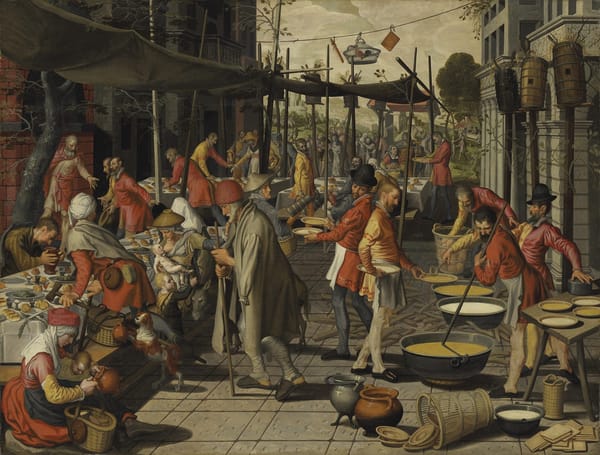
This Gospel has given to the present Sunday the name of the Sunday of the invited to the marriage. And yet, from the very opening of the dominical series, which began with the Descent of the Holy Ghost, the Church gave us the Gospel teaching which she offers to us, now a second time, for our consideration. On the second Sunday after Pentecost, she related to us, from St. Luke,19 the parable of the great supper, to which many were invited, and which St. Matthew, entering into fuller details, calls a marriage-feast.
Set thus before us, both at the beginning and at the close of the liturgical season over which the holy Spirit reigns supreme, this parable is, as it were, the interpreter of the whole portion of the year which it thus hems in : it is an additional revelation of the true aim of the Church. But how much has the light increased, since the first time we had these mystery-telling allegories! The certain man (homo quidam), who made a great supper, and invited many, has become the King, who makes a marriage for His Son, and, in this marriage, gives us an image of the kingdom of heaven. The world’s history, too, has been developing, as we gather from the terms respectively used by the two Evangelists. Those who were the first invited, and contented themselves with declining the kindness of the Master of the house, have grown in their impious ingratitude; laying hands on the messengers sent them by the loving kindness20 of the King, they treat them with contumely, and put them to death! We have seen the merited punishment inflicted on these deicides, by this Man, who was God Himself, the Father of Israel, now become King of the Gentiles : we have seen how He sent his armies to destroy them, and burn their city.21 And now at last, in spite of the refusal of the invited of Juda, in spite of the treacherous opposition put by them against the celebration of the nuptials of the Son of God, all things are ready for the marriage, and the banquet-hall is filled with guests.
Our heavenly King has confided, to the ministers of His love, the work of calling from every people the new guests. But now that His ambassadors, according to His command, have traversed the whole earth,22 bringing together all nations for this day of the joy of His heart,23 He Himself is coming in person, to see that nothing is wanting to the due preparation for the feast, and to give the signal for the eternal banquet of the divine nuptials. Now, for such a feast, and in such a place, if there be any deficiency, it can only be on the part of the guests. Let them, then, be careful not to draw down upon themselves, in this general and last examination, the displeasure of the great King, who has called them to an alliance with Himself. Though He has condescended to call them, notwithstanding their extreme poverty, from the public streets and highways, He has given them abundant time to lay aside their tatters; and knowing that they could not get ready of themselves, He has placed at their disposal, for the marriage-feast, the richest garments of His grace and virtues. Woe, then, to him who on the last day shall be found not having the wedding garment of charity! Such a want would admit of no excuse; and the King would justly punish it, by excluding the guilty man from the feast, as one that had insulted His Son.
Everything we have had on the preceding Sundays, has shown us how solicitous the Church ever is in preparing mankind for that wonderful marriage whose realization is the one object aimed at by the divine Word, in coming upon our earth. During her long exile, the bride of the Son of God has been a living model to her children; and, by her instructions, she has been unceasingly preparing them for the understanding of the great mystery of divine union. Three weeks ago,24 treating more directly than she had hitherto done on the great subject of her ambition as mother and bride, she reminded them of the great call. On the following Sunday, she gave them another lesson : she revealed to them the Bridegroom of the nuptials, to which they were invited, as the Man-God, the object of the twofold precept of love which embodies the whole Law. To-day, we have the teaching in all its perfection. It is condensed in the night Office, where we have St. Gregory explaining her whole teaching. The great doctor and the great Pope thus, in the name of the Church, explains our Gospel:
'The kingdom of heaven is the assembly of the just; for, the Lord says by a prophet: “Heaven is My throne";25 and Solomon says : “The soul of the just man is the throne of wisdom ”;26 and Paul calls Christ the Wisdom of God.27 If, therefore, heaven be the throne of God, we must evidently conclude that, as Wisdom is God, and the soul of the just man is the throne of Wisdom, this soul is a heaven . . . . The kingdom of heaven, then, is the assembly of the just . . . . If this kingdom is said to be like to a King, who made a marriage for his Son, your charity at once understands who is this King, who is the Father of a Son, King like Himself. It is He, of whom the psalmist says: “Give to the King Thy judgment, O God, and to the King’s Son Thy justice!”28 God the Father made the marriage of God His Son, when He wished that He, who had been God before all ages, should become Man towards the end of ages. But we must not, on that account, suppose that there are two persons in Jesus Christ, our God and our Saviour . . . . It is, perhaps, clearer and safer to say, that the King made a marriage for His Son, in that, by the mystery of the Incarnation, He united the Church to Him. The womb of the Virgin-Mother was the nuptial-chamber of that Bridegroom, of whom the psalmist says:29 He hath set His tabernacle in the sun : and He, as a Bridegroom, cometh out of His bride-chamber!'30
Notwithstanding her dignity of beloved bride of the Son of God, the Church is, none the less, subject to tribulations here below. The enemies of the Spouse, having ho longer any direct power to injure our Lord, turn all their rage against her. In these trials, endured as they are by the Church with love, Jesus sees a fresh trait of that resemblance which He wishes her to have to Himself; He, therefore, leaves her to suffer in this world, contenting Himself with ever upholding and saving her, as the Offertory says, in the midst of the evils which go on thickening around her.
Offertory
The august sacrifice, which is about to be offered, always obtains its effect, as far as the glory of the divine Majesty is concerned; but its virtue is applied to man in a greater or less degree, according to the dispositions of the creature, and depending on the divine mercy. Let us, in the Secret, beseech our heavenly Father, that we may experience abundantly the effects of the divine mysteries, which are so soon to be produced on our altar.
Secret
The other Secrets, as on page 130.
The Man-God, by His divine contact in the sacred banquet, has spiritually given vigour to our members; let us recall to mind that we must, henceforward, consecrate them to His service, and that our feet, now made sure, must run in the way of the divine commandments.
Communion
The Postcommunion, again, seems to be an allusion to the Gospel of the paralytic, which used formerly to be read on this Sunday. In it, we implore the assistance of the heavenly Physician, who sets man free from the palsy, which held him a prisoner; He also gives him the strength needed for fulfilling the law of God bravely and perseveringly.
Postcommunion
The other Postcommunions, as on page 181.
Vespers
The psalms, capitulum, hymn, and versicle, as above, pages 71-81.
Antiphon of the Magnificat
Oremus.
- St. John i. 14. ↩︎
- Heb. i. 3 ↩︎
- Col. ii. 3, 9, ↩︎
- St. John xiv. 6. ↩︎
- Eph. iv. 18. ↩︎
- Ibid. i. 10. ↩︎
- Col. i. 15-20. ↩︎
- Cf. St. John iv. 14; vii, 37, 39. ↩︎
- Ibid. xvii. 17. ↩︎
- Cf. St. John xv. 26. ↩︎
- Ibid. xvii. 21-23. ↩︎
- Ibid. 19. ↩︎
- Rom. xiii. 14. ↩︎
- Eph. iv. 3. ↩︎
- Ps. iv. 5. ↩︎
- S. Chrys., in ep. ad Eph. Hom., xiv. ↩︎
- Eph. v. 1, 2. ↩︎
- S. Basil, Const, mon., xviii ↩︎
- St. Luke xiv. 16-24. ↩︎
- See Time after Pentecost, vol. i., p. 358. ↩︎
- See Ninth Sunday after Pentecost. ↩︎
- Ps. xviii. 5. ↩︎
- Cant. iii. 11. ↩︎
- The Sixteenth Sunday after Pentecost. ↩︎
- Isa. lxvi. 1. ↩︎
- Wisd. vii. 27. ↩︎
- 1 Cor. i. 24. ↩︎
- Ps. lxxi. 2. ↩︎
- Ps. xviii. 6. ↩︎
- S. Greg., Hom, xxxviii. in Ev. ↩︎
October 15: St. Teresa, Virgin
'Although the Church triumphant in heaven, and the Church mourning here on earth, appear to be completely separated,' says Bossuet on this feast, ‘they are nevertheless united by a sacred bond. This bond is charity, which is found in this land of exile as well as in our heavenly country; which rejoices the triumphant saints, and animates those still militant; which, descending from heaven to earth, and from angels to men, causes earth to become a heaven, and men to become angels. For, O holy Jerusalem, happy Church of the first-born whose names are written in heaven, although the Church thy dear sister, who lives and combats here below, ventures not to compare herself with thee, she is not the less assured that a holy love unites her to thee. It is true that she is seeking, and thou possessest; that she labours, and thou art at rest; that she hopes, and thou rejoicest. But among all these differences which separate the two so far asunder, there is this at least in common: that what the blessed spirits love, the same we mortals love. Jesus is their life, Jesus is our life; and amid their songs of rapture, and our sighs of sorrow, everywhere are heard to resound these words of the sacred Psalmist: It is good for me to adhere to my God.’1
Of this sovereign good of the Church militant and triumphant, Teresa, in a time of decadence, was commissioned to remind the world, from the height of Carmel restored by her to its pristine beauty. After the cold night of the fourteenth and fifteenth centuries, the example of her life possessed a power of irresistible attraction, which survives in her writings, drawing predestined souls after her in the footsteps of the divine Spouse.
It was not, however, by unknown ways, that the holy Spirit led Teresa; neither did she, the humble Teresa, make any innovations. Long before, the apostle had declared that the Christian’s conversation is in heaven; and we saw, a few days ago, how the Areopagite formulated the teaching of the first century. After him we might mention St. Ambrose, St. Augustine, St. Gregory the Great, St. Gregory Nazianzen, and many other witnesses from all the churches. It has been said, and proved far more ably than we could prove it, that 'no state seems to have been more fully recognized by the fathers, than that of perfect union, which is achieved in the highest contemplation; and in reading their writings, we cannot help remarking the simplicity with which they treat of it; they seem to think it frequent, and simply look upon it as the full development of the Christian life.'2
In this, as in all else, scholasticism followed the fathers. It asserted the doctrine concerning these summits of Christian life, even at a time when the weakness of faith in the people scarcely over left full scope to divine charity, save in the obscurity of a few unknown cloisters, In its own peculiar form, the teaching of the School was unfortunately not accessible to all; and moreover the abnormal character of that troubled epoch affected even the mystics that still remained.
It was then that the virgin of Avila appeared in the Catholic kingdom. Wonderfully gifted by grace and by nature, she experienced the resistances of the latter, as well as the calls of God, and the purifying delays and progressive triumphs of love; the Holy Ghost, who intended her to be a mistress in the Church, led her, if one may so speak, by the classical way of the favours He reserves for the perfect. Having arrived at the mountain of God, she described the road by which she had come, without any pretension but to obey him who commanded her in the name of the Lord.3 With exquisite simplicity and unconsciousness of self, she related the works accomplished for her Spouse;4 made over to her daughters the lessons of her own experience;5 and described the many mansions of that castle of the human soul, in the centre of which, he that can reach it will find the holy Trinity residing as in an anticipated heaven.6 No more was needed: withdrawn from speculative abstractions and restored to its sublime simplicity, Christian mysticism again attracted every mind; light reawakened love; the virtues flourished in the Church; and the baneful effects of heresy and its pretended reform were counteracted.
Doubtless Teresa invited no one to attempt, as presumptuously as vainly, to force an entrance into the uncommon paths. But if passive and infused union depends entirely upon God’s good pleasure, the union of effective and active conformity to the divine will, without which the other would be an illusion, may be attained with the help of ordinary grace, by every man of good will. Those who possess it, ‘have obtained,’ says the saint, ‘what it was lawful for them to wish for. This is the union I have all my life desired, and have always asked of our Lord; it is also the easiest to understand, and the most secure.’7
She added however: ‘Beware of that excessive reserve, which certain persons have, and which they take for humility. If the king deigned to grant you a favour, would it be humility to meet him with a refusal? And when the sovereign Lord of heaven and earth deigns to honour my soul with His visit, and comes to load me with graces, and to rejoice with me; should I prove myself humble if I would not answer Him, nor keep Him company, nor accept His gifts, but fled from His presence and left Him all alone? A strange sort of humility is that! Look upon Jesus Christ as a Father, a Brother, a Master, or a Spouse; and treat Him in one or other of these ways; He Himself will teach you which is the one that best pleases Him and that it behoves you to choose. And then, be not so simple as to make no use of it.’8
But it is said on all sides: ‘This way is beset with snares: such a soul was lost in it; such an one went astray; and another, who ceased not to pray, could not escape a fall . . . See the inconceivable blindness of the world. It has no anxiety about those thousands of unfortunate creatures who, entirely strangers to the path of prayer, live in the most horrible excess; but if it happens, by a misfortune deplorable no doubt but very rare, that the tempter’s artifices seduce a soul that prays, they take advantage of this to inspire others with the greatest terror, and to deter them from the holy practices of virtue. Is he not the victim of a most fatal error, who believes it necessary to abstain from doing good in order to avoid doing evil? You must rise above all these fears. Endeavour to keep your conscience always pure; strengthen yourself in humility; tread under foot all earthly things; be inflexible in the faith of our mother the holy Church; and doubt not, after that, that you are on the right road.'9 It is too true that ‘when a soul finds not in herself that vigorous faith, and her transports of devotion do not strengthen her attachment to holy Church, she is in a way full of perils. The Spirit of God never inspires anything that is not conformable to holy Scripture; if there were the slightest divergence, that, of itself alone, would suffice to prove so evidently the action of the evil spirit, that, were the whole world to assure me it was the divine Spirit, I would never believe it.'10 But the soul may escape so great a danger by questioning those who can enlighten her. ‘Every Christian must, when he is able, seek out a learned guide, and the more learned the better. Such a help is still more necessary to persons given to prayer; and in the highest states they have most need of it. I have always felt drawn to men eminent for doctrine. Some, I grant, may not have experimental knowledge of spiritual ways; but if they have not an aversion for them, they do not ignore them; and by the assistance of holy Scripture, of which they make a constant study, they always recognize the true signs of the good Spirit. The spirit of darkness has a strange dread of humble and virtuous science; he knows it will find him out, and thus his stratagems will turn to his own loss . . . . I, an ignorant and useless creature, bless Thee, O Lord, for these faithful servants of Thine, who give us light.11 I have no no more knowledge than virtue; I write by snatches, and even then with difficulty; this prevents me from spinning, and I live in a poor house where I have no lack of occupations. The mere fact of being a woman and one so imperfect, is sufficient to make me lay down the pen.’12
As thou wilt, O Teresa: deliver thy soul; pass beyond that, and with Magdalene, at the recollection of what thou callest thine infidelities, water with thy tears the feet of our Lord, recognize thyself in St. Augustine’s confessions!13 Yes; in those former relations with the world, although approved by obedience; in those conversations, which were honourable and virtuous: it was a fault in thee, who wast called to something higher, to withhold from God so many hours which He was inwardly urging thee to reserve for Him alone. And who knows whither thy soul might have been led, hadst thou continued longer thus to wound thy Spouse? But we, whose tepidity can see nothing in thy ‘great sins’ but what would be perfection in many of us,14 have a right to appreciate, as the Church does, both thy life and thy writings; and to pray with her, on this joyful day of thy feast, that we may be nourished with thy heavenly doctrine and kindled with thy love of God.15
According to the word of the divine Canticle, in order to introduce Teresa into His most precious stores the Spouse had first to set charity in order in her soul. Having, therefore, claimed His just and sovereign rights, He at once restored her to her neighbour, more devoted and more loving than before. The Seraph’s dart did not wither or deform her heart. At the highest summit of perfection she was destined to attain, in the very year of her blessed death, she wrote: ‘If you love me much, I love you equally, I assure you; and I like you to tell me the same. Oh! how true it is, that our nature inclines us to wish for return of love! It cannot be wrong, since our Lord Himself exacts a return from us. It is an advantage to resemble Him in something, were it only in this.’16 And elsewhere, speaking of her endless journeys in the service of her divine Spouse, she says: ‘It cost me the greatest pain when I had to part from my daughters and sisters. They are detached from everything else in the world, but God has not given them to be detached from me; He has perhaps done this for my greater trial, for neither am I detached from them.’17
Grace never depreciates nature, which, like itself, is the Creator’s work. It consecrates it, makes it healthy, fortifies it, harmonizes it, causes the full development of its faculties to become the first and most tangible homage, publicly offered by regenerated man to Christ his Redeemer. Let any one read that literary master-piece, the Book of the Foundations, or the innumerable letters written by the seraphic mother amid the devouring activity of her life; there he will see whether the heroism of faith and of all virtues, whether sanctity in its highest mystical expression, was ever prejudicial—we will not say to Teresa’s constancy, devotedness, or energy—but to that intelligence, which nothing could disconcert, swift, lively, and pleasant; to that even character, which shed its peaceful serenity on all around; to the delicate solicitude, the moderation, the exquisite tact, the amiable manners, the practical good sense, of this contemplative, whose pierced heart beat only by miracle, and whose motto was: ‘To suffer or to die.’
To the benefactor of a projected foundation she wrote: ‘Do not think, sir, that you will have to give only what you expect; I warn you of it. It is nothing to give money; that does not cost us much. But when we find ourselves on the point of being stoned, you, and your son-in-law, and as many of us as have to do with this affair (as it nearly happened to us at the foundation of St. Joseph’s at Avila), Oh! then will be the good time!’18 It was on occasion of this same foundation at Toledo, which was in fact very stormy, that the saint said: ‘Teresa and three ducats are nothing; but God, Teresa, and three ducats, there you have everything.’
Teresa had to experience more than mere human privations: there came a time when God Himself seemed to fail her. Like Philip Benizi before her, and after her Joseph Calasanctius and Alphonsus Liguori, she saw herself, her daughters, and her sons, condemned and rejected in the name and by the authority of the Vicar of Christ. It was one of those occasions, long before prophesied, when it is given to the beast to make war with the saints and to overcome them.19 We have not space to relate all the sad circumstances;20 and why should we do so P The old enemy had then one manner of acting, which he repeated in the sixteenth, seventeenth, and eighteenth centuries, and will always repeat. In like manner, God has but one aim in permitting the evil, viz. to lead His chosen ones to that lofty summit of crucifying union, where He, who willed to be the first to taste the bitter dregs of the chalice, could say more truly and more painfully than any other: 'My God, My God, why hast Thou forsaken Me?’21
The Church thus abridges the life of the reformer of Carmel.
The Beloved, who revealed Himself to thee, O Teresa, at death, thou hadst already found in the sufferings of this life. If anything could bring thee back to earth, it would be the desire of suffering yet more.23 ‘I am not surprised,' says Bossuet speaking in thy honour on thy feast, ‘that Jesus willed to die: He owed that sacrifice to His Father. But why was it necessary that He should spend His days, and finally close them, in the midst of such great pains? It is because, being the Man of sorrows, as the prophet calls Him, He would live only to endure; or, to express it more forcibly by a beautiful word of Tertullian’s: He wished to be satiated, before dying, with the luxury of suffering: Saginari voluptate patientiædiscessurus volebat.24 What a strange expression! One would think, according to this father, that the whole life of our Saviour was a banquet, where all the dishes consisted of torments. A strange banquet in the eyes of men, but one which Jesus found to His teste! His death was sufficient for our salvation; but death was not enough to satisfy His wonderful appetite for suffering for us. It was needful to add the scourges, and that blood-stained crown that pierced His head, and all the cruel apparatus of terrible tortures; and wherefore? Living only to endure, He wished to be satiated, before dying, with the luxury of suffering for us. In so far that upon His cross, seeing in the eternal decrees that there was nothing more for Him to suffer, “Ah!” said He, “it is done, all is consummated; let Us go forth, for there is nothing more to do in this world;” and immediately He gave up His soul to His Father.’25
If such is the mind of Jesus our Saviour, must it not also be that of His bride, Teresa of Jesus? 'She too wished to suffer or to die; and her love could not endure that any other cause should retard her death, save that which deferred the death of our Saviour.’26 Let us warm our hearts at the sight of this great example. ‘If we are true Christians, we must desire to be ever with Jesus Christ. Now, where are we to find this loving Saviour of our souls? In what place may we embrace Him? He is found in two places: in His glory and in His sufferings; on His throne and on His cross. We must, then, in order to be with Him, either embrace Him on His throne, which death enables us to do; or else share in His cross, and this we do by suffering; hence we must either suffer or die, if we would never be separated from our Lord. Let us suffer then, O Christians; let us suffer what it pleases God to send us: afflictions, sicknesses, the miseries of poverty, injuries, calumnies; let us try to carry, with steadfast courage, that portion of His cross, with which He is pleased to honour us.'27
O thou, whom the Church proposes to her children as a mistress and mother in the paths of the spiritual life, teach us this strong and true Christianity. Perfection, doubtless, cannot be acquired in a day; and thou didst say: ‘We should be much to be pitied, if we could not seek and find God till we were dead to the world. God deliver us from those extremely spiritual people, who, without examination or discretion, would refer everything to perfect contemplation!'28 But God deliver us also from those mistaken devotions, which thou didst call puerile and foolish, and which were so repugnant to the uprightness and dignity of thy generous soul!29 Thou desiredst no other prayer, than that which would make thee grow in virtue. Convince us of the great principle in these matters, that 'the prayer best made and most pleasing to God, is that which leaves behind it the best results, proved by works; and not those sweetnesses which end in nothing but our own satisfaction.'30 He alone will be saved, who has kept the commandments and fulfilled the law; and heaven, thy heaven O Teresa, is the reward of the virtues thou didst practise, not of the revelations and ecstasies wherewith thou wast favoured.31
From the blessed abode where thy love feeds upon infinite happiness, as it was nourished on earth by sufferings, obtain that thy native Spain may carefully cherish, in these days of decadence, her beautiful title of the Catholic kingdom. Remember the part taken by France in determining thee to undertake the reform of Carmel.32 May thy sons be blessed with increase in members, in merit, and in holiness! In all the lands where the Holy Ghost has multiplied thy daughters, may their hallowed homes recall those ‘first dove-cotes of the blessed Virgin, where the Spouse delighted to show forth the miracles of His grace.’33 To the triumph of the faith, and the support of its defenders, thou didst direct their prayers and fasts;34 what an immense field now lies open to their zeal! With them and with thee, we ask of God ‘two things: first, that among so many men and so many religious, some may be found having the necessary qualities for usefully serving the cause of the Church, on the understanding that one perfect man can render more services than a great many who are not perfect. Secondly, that in the conflict our Lord may uphold them with His hand, enabling them to escape all dangers, and to close their ears to the songs of sirens . . . O God, have pity on so many perishing souls; stay the course of so many evils which afflict Christendom; and, without further delay, cause Thy light to shine in the midst of this darkness!’35
- Bossuet, Panegyric on St. Teresa. ↩︎
- Spiritual Life and Prayer according to holy Scripture and monastic tradition, ch. xix. (Translation by the Benedictines of Stanbrook). ↩︎
- Life of the saint written by herself. ↩︎
- Book of the Foundations. ↩︎
- The Way of Perfection. ↩︎
- The Interior Castle. ↩︎
- Interior Castle, 5th mansion. ↩︎
- Way of Perfection, ch. xxix. ↩︎
- Way of Perfection, ch. xxii. ↩︎
- Life, ch. xxv. ↩︎
- Life, ch. xiii. ↩︎
- Ibid. ch. x. ↩︎
- Ibid. ix. ↩︎
- Bolland. in Theres. 133. ↩︎
- Collect of the day. ↩︎
- To Mary of St. Joseph, prioress of Seville, Nov. 8, 1581. ↩︎
- Foundations, ch. xxvii. ↩︎
- To Alphonso Ramirez, Feb. 19, 1569. ↩︎
- Apoc. xiii. 7. ↩︎
- See the saint’s letters: to the prior of the Charterhouse at Seville, Jan. 1579; etc. ↩︎
- St. Matt. xxvii. 46. ↩︎
- In order to effect this correction, Gregory XIII had ordered that ten days of the year 1582 should be suppressed, and that the morrow of October 4 should be called the 15th of that month. It was during that historic night, between the 4th and 15th, that St. Teresa died. ↩︎
- Apparition to Father Gratian. ↩︎
- Tertull. De patientia, 3. ↩︎
- Bossuet, Panegyric on St. Teresa. ↩︎
- Ibid. ↩︎
- Bossuet, Panegyric on St. Teresa. ↩︎
- To the Bishop of Avila, March 1577, one of the saint’s most graceful letters. ↩︎
- Life, xiii. ↩︎
- To Father Gratian, Oct. 23, 1577. ↩︎
- Apparition to the Prioress of Veas. ↩︎
- Way of Perfection, i. ↩︎
- Foundations, iv. ↩︎
- Way of Perfection, i. 3. ↩︎
- Ibid. ↩︎
| Previous October 14: St. Callixtus I, Pope and Martyr | Next October 15: St. Teresa, Virgin |