Daily reading
After Pentecost
Double · Temporal
November 19, 2028
From Dom Guéranger’s The Liturgical Year.

|
The Sixth Resumed Sunday after Epiphany
Introit
Collect
The other Collects, as on page 120.
Epistle
1 Cap. i.Fratres, Gratias agimus Deo semper pro omnibus vobis, memoriam vestri facientes in orationibus nostris sine intermissione, memores operis fidei vestra, et laboris et charitatis, et sustinentiæ spei Domini nostri Jesu Christi, ante Deum et Patrem nostrum : scientes, fratres, dilecti a Deo, electionem vestram : quia Evangelium nostrum non fuit ad vos in sermone tantum, sed et in virtute, et in Spiritu sancto, et in plenitudine multa, sicut scitis quales fuerimus in vobis propter vos. Et vos imitatores nostri facti estis, et Domini, excipientes verbum in tribulatione multa, cum gaudio Spiritus sancti : ita ut facti sitis forma omnibus credentibus in Macedonia, et in Achaia. A vobis enim diffamatus est sermo Domini, non solum in Macedonia, et in Achaia, sed et in omni loco fìdes vestra, quæ est ad Deum, profecta est, ita ut non sit nobis necesse quidquam loqui. Ipsi enim de nobis annuntiant qualem introitum habuerimus ad vos : et quomodo conversi estis ad Deum a simulacris, servire Deo vivo, et vero, et exspectare Filium ejus de cœlis (quem suscitavit ex mortuis) Jesum, qui eripuit nos ab ira ventura.
1 Ch. i.Brethren : We give thanks to God always for you all: making a remembrance of you in our prayers without ceasing: being mindful of the work of your faith, and labour and charity, and of the enduring of the hope of our Lord Jesus Christ, before God and our Father; knowing, brethren beloved of God, your election. For, our Gospel hath not been to you in word only, but in power also, and in the Holy Ghost, and in much fullness, as you know what manner of men we have been among you for your sakes. And you became followers of us, and of the Lord, receiving the word in much tribulation, with joy of the Holy Ghost: so that you were made a pattern to all that believe in Macedonia and in Achaia. For from you was spread abroad the word of the Lord, not only in Macedonia and in Achaia, but also in every place your faith, which is towards God, is gone forth, so that we need not to speak anything. For they themselves relate of us, what manner of entering in we had unto you : and how you turned to God from idols, to serve the living and true God, and to wait for his Son from heaven (whom he raised up from the dead) Jesus, who hath delivered us from the wrath to come.
Gradual
Gospel
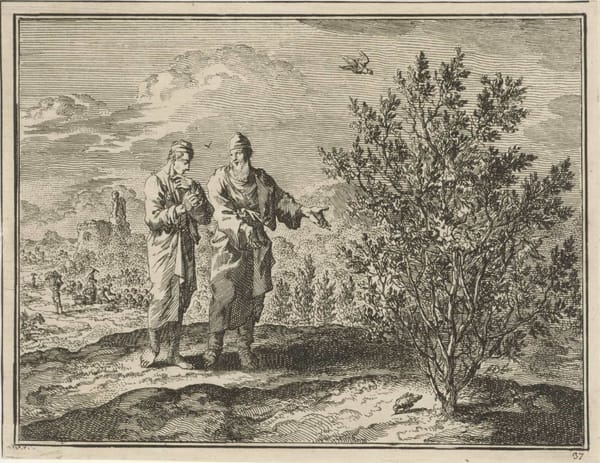
Cap. xiii.In illo tempore: Dixit Jesus turbis parabolam hanc : Simile est regnum cœlorum grano sinapis, quod accipiens homo seminavit in agro suo : quod minimum quidem est omnibus seminibus : cum autem creverit, majus est omnibus oleribus, et fit arbor, ita ut volucres cœli veniant, et habitent in ramis ejus. Aliam parabolam locutus est eis: Simile est regnum cœlorum fermento, quod acceptum mulier abscondit in farinæ satis tribus, donec fermentatum est totum. Hæc omnia locutus est Jesus in parabolis ad turbas et sine parabolis non loquebatur eis : ut impleretur quod dictum erat per prophetam, dicentem: Aperiam in parabolis os meum, eructabo abscondita a constitutione mundi.
Ch. xiii.At that time : Jesus spoke to the multitude this parable : The kingdom of heaven is like to a grain of mustard-seed, which a man took and sowed in his field. Which is the least indeed of all seeds; but, when it is grown up, it is greater than all herbs, and becometh a tree, so that the birds of the air come and dwell in the branches thereof. Another parable he spoke to them : The kingdom of heaven is like to leaven, which a woman took and hid in three measures of meal, until the whole was leavened. All these things Jesus spoke in parables to the multitudes, and without parables he did not speak to them : that it might be fulfilled which was spoken by the prophet, saying : I will open my mouth in parables; I will utter things hidden from the foundation of the world.
Offertory
Secret
The other Secrets, as on page 130.
Communion
Postcommunion
The other Postcommunions, as on page 131.
Vespers
The psalms, capitulum, hymn, and versicle, as above, pages 71-81.
Antiphon of the Magnificat
November 19: St. Elizabeth of Hungary, Duchess of Thuringia
ALTHOUGH the blessed in heaven shine each with his own peculiar glory, God is pleased to group them in families, as he groups the stars in the material firmament. It is grace that presides over the arrangement of these constellations in the heaven of the Saints; but sometimes it seems as if God wished to remind us that he is the sole Author of both grace and nature ; and inviting them, in spite of the fall, to honour him unitedly in his elect, he causes sanctity to become a glorious heirloom, handed down from generation to generation in the same family on earth. Among these races, none can compare with that royal line which, beginning in ancient Pannonia, spread its branches over the world in the most flourishing days of Christendom : Rich in virtue and studying beautifulness,1 as Scripture says, it brought peace into all the royal houses of Europe, with which it was allied; and the many names it has inscribed in the golden book of the blessed, perpetuate its glory.
Among these illustrious names, and surrounded by them as a diamond set in a circle of pearls, the greatest, in the esteem of the Church and of the people, is that of the amiable Saint, who was ripe for heaven at the age of twenty-four years, and who ascended on this day into the company of Stephen, Emeric, and Ladislas. Elizabeth was not inferior to them in manly virtues; but the simplicity of her loving soul added to the heroism of her race a sweetness, whose fragrance drew after her along the path of sanctity her daughter Gertrude of Thuringia, and her relatives Hedwige of Silesia, Agnes of Bohemia, Margaret of Hungary, Cunigund of Poland, and Elizabeth of Portugal.
All the poetry of those chivalrous times appears in the beautiful pages of contemporaneous writers, as they describe to us the innocent child, transplanted like a tender flower from the court of Hungary to that of Thuringia; and her life of devotedness there, with a bridegroom worthy to witness the ecstasies of her lofty but ingenuous piety, and to defend her heroic virtue against her slanderers. To the stewards who complained that during the absence of Duke Lewis she had, in spite of their remonstrances, exhausted the revenues upon the poor, he replied: “I desire that my Elizabeth be at liberty to act as she wishes, provided she leaves me Warteburg and Naumburg.” Our Lord opened the landgrave's eyes to see transformed into beautiful roses the provisions Elizabeth was carrying to the poor. Jesus crucified appeared in the leper she had taken into her own apartments that she might the better tend him. If it happened that illustrious visitors arrived unexpectedly, and the duchess having bestowed all her jewels in alms was unable to adorn herself becomingly to do them honour, the Angels so well supplied the deficiency that, according to the German chroniclers of the time, it seemed to the astonished guests that the Queen of France herself could not have appeared more strikingly beautiful or more richly attired.
Elizabeth indeed was never wanting to any of the obligations or requirements of her position as a wife and as a sovereign princess. As graciously simple in her virtues as she was affable to all, she could not understand the gloomy moroseness which some affected in their prayers and austerities. “They look as if they wanted to frighten our Lord,” she would say, “whereas he loves the cheerful giver.”2
The time soon came, when she herself had to give generously without counting the cost. First there was the cruel separation from her husband, Duke Lewis, on his departure for the crusade; then the heart-rending scene, when his death was announced to her, just as she was about to give birth to her fourth child; and thirdly the atrocious act of Henry Raspon, the landgrave's unworthy brother, who, thinking this a good opportunity for seizing the deceased's estates, drove out his widow and children, and forbade anyone to give them hospitality. Then in the very land where every misery had been succoured by her charity, Elizabeth was reduced to the necessity of begging, and not without many rebuffs, a little bread for her poor children, and of seeking shelter with them in a pig-sty.
On the return of the knights who had accompanied Duke Lewis to the Holy Land, justice was at length done to our Saint. But Elizabeth, who had become the passionate lover of holy poverty, chose to remain among the poor. She was the first professed Tertiary of the Seraphic Order; and the mantle sent by St. Francis to his very dear daughter, became her only treasure. The path of perfect self-renunciation soon brought her to the threshold of heaven. She who, twenty years before, had been carried to her betrothed in a silver cradle, and robed in silk and gold, now took her flight to God from a wretched hovel, her only garment being a patched gown. The minstrels, whose gay competitions had signalized the year of her birth, were no longer there; but the Angels were heard singing, as they bore her up to heaven : The kingdom of this world have I despised, for the love of Jesus Christ my Lord, whom I have seen, whom I have loved, in whom I have believed, whom I have tenderly loved.
Four years later, Elizabeth, now declared a Saint by the Vicar of Christ, beheld all the nations of the holy Empire, with the emperor himself at their head, hastening to Marburg, where she lay at rest in the midst of the poor whose life she had imitated. Her holy body was committed to the care of the Teutonic Knights, who in return for the honour, made Marburg one of the headquarters of their Order, and raised to her name the first Gothic church in Germany. Numerous miracles long attracted the Christian world to the spot.
And now, though still standing, though still beautiful in its mourning, St. Elizabeth's at Marburg knows its glorious titular only by name. And at Warteburg, where the dear Saint went through the sweetest episodes of her life as a child and as a bride, the great memorial now shown to the traveller is the pulpit of an excommunicated monk, and the ink-stain with which, in a fit of folly or drunkenness, he had soiled the wall, as he afterwards endeavoured with his pen to profane and sully everything in the Church of God.
It is time to read the liturgical history of the feast.
The following Hymn in honour of St. Elizabeth was sung in Germany in the fourteenth century.
Hymn
Decantat Ecclesiae;
Nam congaudet laetabunda
Sion mater filiae
Ascendenti de profunda
Convalle miseriae.
In annis infantiae
Vir accepti desponsatam
Indolis eximiae,
Semper tamen inspiratum
Voto continentiae.
Ratum hoc conjugium,
Vero docet argumento
Quod patrum coelestium
Vitae sanctae succremento
Attigit consortium.
Non extinxit spiritum,
Sed implevit fide rata
Nec reliquit irritum
Quod a Deo mens parata
Gerebat propositum.
Pauperum nutritia
Fastu mundi non elata
Nec parentum gloria,
In se carne trucidata
Crucifixit vitia.
Hostis innocentiae,
Potum lacte perforavit
Clavo poenitentiae,
Et sic sese liberavit
Virtus patientiae.
Munda mundum exuit,
Christum mente jam induta
Saccum carni consuit,
Et in tempus hoc statuta
Sic lampas emicuit.
Redimens divitias
De thesauro pietatis
Fudit auri copias,
Et multorum egestatis
Supplevit inopias.
Quaerents alimoniam,
Et vilescens ipsa sibi
Sprevit ignominiam,
Sciens soli, Christe, tibi
Recte dari gloriam.
Tibi nunc et jugiter,
Qui certantes in agone
Adjuvas fideliter,
Et mercedem das coronae
Vindenti viriliter.
sings a hymn to God;
Sion is in gladness,
rejoicing with her daughter
who ascends from
the valley of misery.
she is affianced
while yet a babe;
her husband finds her
adorned with every gift
and enamoured of purity.
by fidelity, fecundity, and the grace of the Sacrament;
Elizabeth's increasing holiness
proves that she is being led
to the company
of her fathers in heaven.
to the law of the flesh,
her spirit was not quenched;
faithful to her sacred engagements,
she obeyed the inspirations
her willing heart received from God.
and blessed feeder of the poor;
neither by worldly glory
nor by her kingly origin was she elated,
but she crucified the vices
in her mortified flesh.
asked her for water, as Sisara asked Jahel;
she deceived him with milk,
and transpiercing him
with the nail of penance,
she delivered herself by her virtue of patience.
she abandoned the world, unsullied by its contact;
and having already put on Christ interiorly,
she now clothed her body with sack-cloth,
and, even in the time of her mortality,
shone as a bright lamp.
at the price of poverty,
she poured out the golden
treasures of her piety,
and supplied the needs
of innumerable poor.
she earned her daily bread;
and, vile in her own eyes
she made light of shame,
knowing that to thee alone,
O Christ, honour is due.
both now and forever;
for thou faithfully assistest
them that fight the good fight,
and rewardest the valiant
victor with a crown.
What a lesson thou leavest to the earth, as thou mountest up to heaven, O blessed Elizabeth! We ask with the Church, for ourselves and for all our brethren in the faith: may thy glorious prayers obtain from the God of mercy that our hearts may open to the light of thy life's teaching, so that despising worldly prosperity we, may rejoice in heavenly consolations.3 The Gospel read in thy honour today tells us that the kingdom of heaven is like to a hidden treasure, and to a precious pearl; the wise and prudent man sells all he has, to obtain the treasure or the pearl.4 Thou didst well understand this good traffic, as the Epistle calls it,5 and it became the good fortune of all around thee : of thy happy subjects, who received from thee succour and assistance for both soul and body, of thy noble husband, who found an honourable place among those princes who knew how to exchange a perishable diadem for an eternal crown; in a word, of all who belonged to thee. Thou wast their boast; and several among them followed in thy footsteps along the heavenward path of self-renunciation. How is it that others, in an age of destruction, could abjure their title of children of Saints, and draw the people after them to deal so wantonly with the sweetest memorials and the noblest traditions? May our Lord restore to his Church and to thee the country where thou didst experience his love; may thy supplications, united with ours, revive the ancient faith in those branches of thy stock which are no longer nourished with that life-giving sap; and may the glorious trunk continue, in its faithful branches, to give saints to the world.
November 19 (the Same Day): St. Pontian, Martyr
Commemoration Of Saint Pontian, Martyr
The Church honours today a holy Pope of the persecution times, by name Pontian. Transported by order of the emperor Maximin to an island in the Mediterranean, he there suffered most cruel treatment, which earned him the crown of martyrdom. His second successor, St. Fabian, translated his body to the cemetery of Callixtus.
| Previous November 18: Dedication of the Basilicas of Sts. Peter and Paul, Apostles | Next November 19: St. Elizabeth of Hungary, Duchess of Thuringia |