Daily reading
December 14 · Sanctoral
December 14, 2028
From Dom Guéranger’s The Liturgical Year.
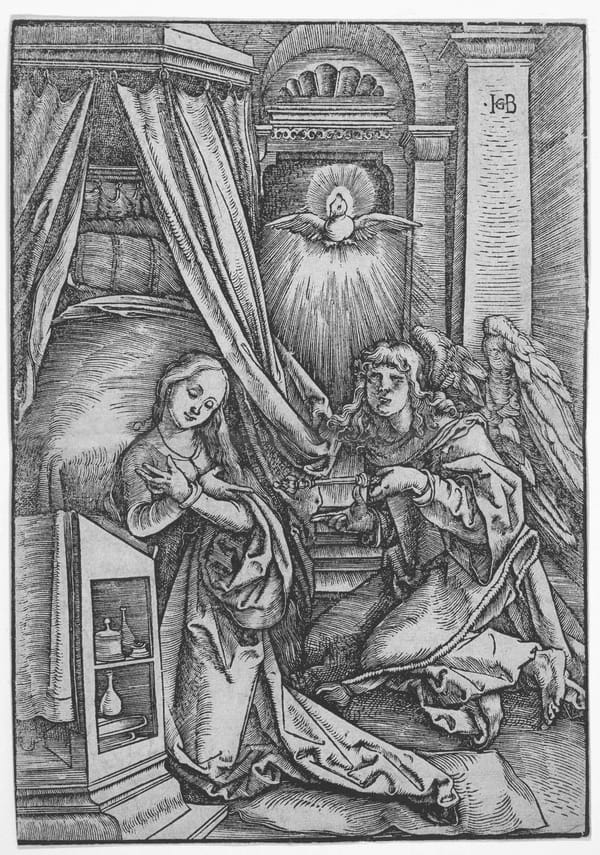
December 14: The Seventh Day within the Octave of the Immaculate Conception
Let us consider how our blessed Lady, having arrived at the house of her holy cousin Elizabeth, rendered her every possible service with the greatest love, favoured her with her sweet and holy conversations, assisted at the glorious birth of St. John the Baptist, and at length returned home to her humble dwelling in Nazareth. But, that we may the better enter into these divine mysteries, let us again listen to the seraphic St. Bonaventure.
When, therefore, her time was expired, Elizabeth gave birth to a son, whom our Lady took up, and with all diligence did what was required. The babe looked into Mary’s face like one that knew her; and as she gave him unto his mother, he turned his head towards Mary, for he fain would be in her arms again. Mary, on her part, delighted in nursing this holy babe, and fondled him, and kissed him with great joy. Consider the honour that is here given unto John. Never had child such arms as these to carry him. Many other privileges are related as being granted unto him; but for this present, I must needs pass them by.
Now, on the eighth day, the child was circumcised, and was called John. Then was the mouth of Zachary opened, and he prophesied, saying: “Blessed be the Lord God of Israel!” Thus were made, in that house, the two most beautiful canticles, namely, the Magnificat and the Benedictus. Meanwhile our Lady, going aside lest she should be seen by those that had come together for the ceremony, listened attentively to the canticle of Zachary, which prophesied of her Son, and most prudently pondered in her heart upon all these things. At length, when the time came for her to return home, she bade Elizabeth and Zachary farewell, and, giving John her blessing, she returned unto Nazareth. Recall to thy mind, in this her second journey, all that was told thee of her poverty. She returned to her house, where she would find neither bread, nor wine, nor those things which were needed. She had no property, nor money. She had been, now these three months, living with persons who were very rich; but now she returns unto her poor cottage, and has to procure her livelihood by the labour of her hands. Do thou sympathize with her, and learn to love poverty.
Sequence in Honour of Our Blessed Lady
(Taken from the ancient Roman-French Missals)
Cœli jubar, mundi rosa,
Cœlibatus lilium.
Ave, gemma pretiosa,
Super solem speciosa,
Virginale gaudium.
Spes reorum, O Maria,
Redemptoris Mater pia,
Redemptorum gloria.
Finis lethi, vitæ via;
Tibi triplex hierarchia
Digna dat præconia.
Virga Jesse florida,
Stella maris lucida,
Sidus veræ lucis.
Fructum vitæ proferens,
Et ad portum transferens
Salutis, quod ducis.
Florens hortus, ægris gratus,
Puritatis fons signatus,
Dans fluenta gratiæ.
Thronus veri Salomonis,
Quem præclaris cœli donis
Ornavit Rex gloriæ.
O regina pietatis,
Et totius sanctitatis
Flumen indeficiens.
In te salva confidentes,
Salutari sitientes
Potu nos reficiens.
Ad te flentes suspiramus,
Rege mentes, invocamus,
Evæ proles misera.
Statum nostræ paupertatis,
Vultu tuæ bonitatis,
Clementer considera.
Cella fragrans aromatum,
Apotheca charismatum
Salutaris.
Tuam nobis fragrantiam
Spirans, infunde gratiam
Qua ditaris.
Dulcis Jesu Mater bona,
Mundi salus, et Matrona
Supernorum civium,
Pacem confer sempiternam,
Et ad lucem nos supernam
Transfer post exsilium.
Amen.
brightness of the heavens, rose of the world,
lily of purity.
Hail, precious gem!
more beauteous than the sun,
and joy of pure souls.
Thou art the sinner’s hope, O Mary!
thou art the holy Mother of our Redeemer,
and the consolation of us whom he redeemed.
Thou didst stay the reign of death,
thou didst commence the reign of life.
To thee, O Mary, the triple hierarchy sing their praises.
Hail! flowery stem of Jesse,
bright star of the sea,
source that broughtest to us him that is our true light.
Thou bearest the fruit of life,
and he whom thou leadest
will not miss the port of salvation.
O flowery garden, so sweet to the sick!
O sealed fount of purity,
that gavest us Jesus, the author of grace.
Thou throne of the true Solomon,
enriched by the King of glory
with the best of heaven’s gifts.
O merciful Queen!
thou art the rich unfailing
stream of all sanctity.
Have pity on us who trust in thee,
and refresh our thirsty souls
with thy efficacious prayers.
Hear our sighs, O Mary!
and suffer us not,
poor children of Eve, to go astray.
Look with thy eye of love
on our many wants:
compassionate our poverty.
Vessel of every fragrance,
and Mother and treasury
of divine grace.
Breathe thy fragrance
into our souls,
and obtain for us the riches of grace.
Beautiful Mother of our sweet Jesus!
the world received its Saviour through thee,
and the heavenly citizens call thee Queen.
Obtain for us that peace which has no end,
and, after this our exile,
that light which is divine.
Prayer for the Time of Advent
(The Mozarabic breviary, Friday of the second week of Advent, Capitula)
Thursday of the Second Week of Advent
Cap. xix.Onus Ægypti. Ecce Dominus ascendet super nubem levem: et ingredietur Ægyptum: et commovebuntur simulacra Ægypti a facie ejus, et cor Ægypti tabescet in medio ejus: et concurrere faciam Ægyptios adversus Ægyptios, et pugnabit vir contra fratrem suum, et vir contra amicum suum, civitas adversus civitatem, regnum adversus regnum.
Ch. xix.The burden of Egypt. Behold the Lord will ascend upon a light cloud: and will enter into Egypt: and the idols of Egypt shall be moved at his presence, and the heart of Egypt shall melt in the midst thereof: and I will set the Egyptians to fight against the Egyptians, and they shall fight brother against brother, and friend against friend, city against city, kingdom against kingdom.
The Egypt which the Lord is here represented as visiting, and whose idols and empire He will overthrow, is the city of satan, which is to be destroyed, and to give place to the city of God. But how peaceful is the divine Conqueror’s entrance into His conquest! it is on a cloud, a light cloud, that He comes, as on His triumphal chariot. How many mysteries in these few words! ‘There are three clouds,’ says Peter of Blois; 'the first the obscurity of the prophets; the second, the depth of the divine decrees; the third, the prodigy of a Virgin Mother.’1 First, as to the obscurity of the prophets, it is essential to every prophecy that it be thus veiled, to the end that man’s free will may not be interfered with; but under this cloud the Lord comes at last, and when the day comes for the prophecy to be accomplished, all things are clear enough. Thus was it with the first coming; so will it be with the second. Then, as to the decrees of God; as they are ordinarily made manifest by second, that is by created, causes only, it almost always happens that the extreme simplicity of the means employed by the divine Wisdom takes men by surprise. Never was this so observable as in the grand event of the Incarnation. Men would naturally expect that, in restoring a fallen world, a power equal, at least, to that which first created it would be displayed; and all they are told about the portent is: ‘You will find the Child wrapped in swaddling clothes, and laid in a manger’! O almighty power of God, how dazzling is Thy light through this cloud! how strong art Thou in this apparent weakness!
But there is the third cloud; it is the Virgin Mary; a light cloud, ‘for,’ says St. Jerome, ‘neither concupiscence, nor the burden of earthly marriage, weighs upon her a cloud, too, laden with a refreshing Dew, since it holds the Just One, who is to be rained down upon us, that our seething passions may be quenched, and the soil of our spiritual life made fertile. How sweet is the majesty of our divine King, when seen thus through this beautiful cloud! O incomparable Virgin! the whole Church of God recognizes thee in that mysterious cloud which the prophet Elias,2 from the summit of Mount Carmel, saw rising up from the sea, little, at first, like a man’s foot, but sending at last such a plentiful rain that all Israel was refreshed by its abundance. Delay not, we pray thee; give us that heavenly and divine Dew which thou possessest within thee. Our sins have made the heavens as brass, and we are parched; thou alone of creatures art just and pure! Beseech our Lord, who has set up His throne of mercy in thee, to come speedily and destroy our enemies and bring us peace.
Hymn for Advent
(The Mozarabic breviary, first Sunday of Advent)
Mundum salvare veniens,
Formam assumpsit corporis
Nostræ similitudinis.
Virginis intrat uterum,
Nasciturus in corpore,
Mortis vincla disrumpere.
Videbunt lumen fulgoris,
Cum Salvator advenerit
Redimere quos condidit.
Cecinerunt oracula,
Nunc veniet in gloria,
Nostra ut curet vulnera.
Simul in Dei Filio,
Parati eum suscipere
Adventus sui gloria.
coming to save the world,
assumed to himself a body
like unto ours.
enters the Virgin’s womb,
that he may be born in the flesh,
and break the bonds of death.
but they shall see the brightest light,
when the Saviout shall come
to redeem his creatures.
oracles of the prophets anciently sang,
shall now come in glory
to cure our wounds.
and in the Son of God,
and be ready to receive him
in his glorious coming.
Prayer from the Ambrosian Breviary
(Sixth Sunday of Advent, Preface)
| Previous Wednesday of the Second Week of Advent | Next Thursday of the Second Week of Advent |