Daily reading
Temporal
January 7, 2029
From Dom Guéranger’s The Liturgical Year.
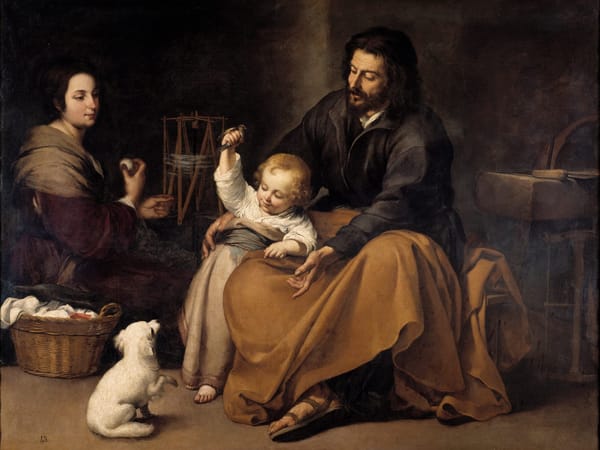
Sunday within the Octave of the Epiphany (or, the Feast of the Holy Family)
THIS Sunday has been chosen by the Church for the celebration of the Feast of the Holy Family; the liturgy of the day, as expressed in the Gospel, harmonizes well with the mystery of the new Feast, for it already carries us forward to the childhood of our Emmanuel and gives us those wonderful words which, after the example of his Blessed Mother, we must ever ponder within our hearts: ‘And he went down with them and came to Nazareth and was subject to them.’
The Feast of the Holy Family is of recent origin. In 1663 Barbara d'Hillehoust founded at Montreal the Association of the Holy Family; this devotion soon spread and in 1893 Leo XIII expressed his approval of a feast under this title and himself composed part of the Office. The Feast was welcomed by succeeding Pontiffs as an efficacious means for bringing home to the Christian people the example of the Holy Family at Nazareth, and by the restoration of the true spirit of family life, stemming, in some measure, the evils of present-day society. These motives led Benedict XV to insert the Feast in the universal Calendar, and from 1921 it has been fixed for this present Sunday.
Mass
The Introit recalls the joy that must have filled the cave of Bethlehem on that Christmas night; let us again rejoice with Mary and Joseph and sing the praises of the resting-place of the Lord of Hosts.
Introit
The Church prays in the Collect that the home life of every Christian family may be sanctified and perfected by the example of that of the Holy Family; this is her unceasing wish for her children.
Collect
Commemoration is made of the Sunday within the Octave:
Then of the Epiphany:
Epistle
Cap. III.Fratres, induite vos, sicut electi Dei, sancti, et dilecti, viscera misericordiæ, benignitatem, humilitatem, modestiam, patientiam, supportantes invicem, et donantes vobismetipsis, si quis adversus aliquem habet querelam: sicut et Dominus donavit vobis, ita et vos. Super omnia autem hæc, caritatem habete, quod est vinculum perfectionis: et pax Christi exsultet in cordibus vestris, in qua et vocati estis in uno corpore; et grati estote. Verbum Christi habitet in vobis abundanter, in omni sapientia, docentes, et commonentes vosmetipsos, psalmis, hymnis, et canticis spiritualibus, in gratia cantantes in cordibus vestris Deo. Omne quodcumque facitis, in verbo aut in opere, omnia in nomine Domini nostri Jesu Christi, gratias agentes Deo et Patri per Jesum Christum Dominum nostrum.
Ch. III.Brethren, put ye on therefore as the elect of God. holy, and beloved, the bowels of mercy, benignity, humility, modesty, patience; bearing with one another, and forgiving one another, if any have a complaint against another; even as the Lord hath forgiven you, so you also. But above all these things have charity, which is the bond of perfection; and let the peace of Christ rejoice in your hearts, wherein also you are called in one body; and be ye thankful. Let the word of Christ dwell in you abundantly in all wisdom, teaching and admonishing one another in psalms, hymns, and spiritual canticles, singing in grace in your hearts to God. All whatsoever you do in word, or in work, all things do ye in the name of the Lord Jesus Christ, giving thanks to God and the Father, through Jesus Christ our Lord.
If we would attain to charity, the bond of perfection which unites all Christians together in the one great family of God, we must pay heed to those virtues which the Epistle puts before us. We must be full of mercy, benignity, humility, modesty and patience; we must bear with one another and forgive one another, after the example of the Incarnate Word. Then the peace of Christ will dwell not only in our hearts, but in those around us, and our homes will truly become like that of Nazareth, where Mary and Joseph were ever singing in grace to the Lord God.
In the Gradual Holy Church again celebrates the praises of the House of the Lord; she proclaims the blessedness of those that obtain lasting fellowship in the heavenly home above; yet in the Alleluia verse she recalls the lowliness of the earthly home of our Emmanuel which made him truly a hidden King.
Gradual (Ps. xxiii)
Alleluia, alleluia. ℣. Isa. 45. Vere tu es Rex absconditus. Deus Isræl Salvator. Alleluia.
Alleluia, alleluia. ℣. Isa. 45. Verily thou art a hidden King, the God of Israel, the Saviour. Alleluia.
Gospel
Cap. II.Cum factus esset Jesus annorum duodecim, ascendentibus illis Jerosolymam secundum consuetudinem diei festi, consummatisque diebus, cum redirent, remansit puer Jesus in Jerusalem, et non cognoveruntparentes ejus. Existimantes autem ilium esse in comitatu, venerunt iter diei, et requirebant eum inter cognatos et notos. Et non invenientes, regressi sunt in Jerusalem, requirentes eum. Et factum est, post triduum invenerunt illum in tempio sedentem in medio doctorum, audientem illos, et interrogantem eos. Stupebant autem omnes, qui eum audiebant, super prudentia et responsis ejus. Et videntes admirati sunt. Et dixit mater ejus ad ilium: Fili, quid fecisti nobis sic? ecce pater tuus et ego dolentes quærebamus te. Et ait ad illos: Quid est quod me quærebatis? Nesciebatis quia in his quæ Patris mei sunt, oportet me esse? Et ipsi non intellexerunt verbum, quod locutus est ad eos. Et descendit cum eis, et venit Nazareth: et erat subditus illis. Et mater ejus conservabat omnia verba hæc in corde suo. Et Jesus proficiebat sapientià, et ætate, et gratia apud Deum et homines.
Ch. II.When Jesus was twelve years old, they went up to Jerusalem, according to the custom of the feast; and having fulfilled the days, when they returned, the Child Jesus remained in Jerusalem, and his parents knew it not. And thinking that he was in the company, they came a day’s journey, and sought him among their kinsfolk and acquaintance. And not finding him, they returned into Jerusalem, seeking him. And it came to pass, that after three days they found him in the temple, sitting in the midst of the doctors, hearing them, and asking them questions. And all that heard him were astonished at his wisdom and his answers. And seeing him, they wondered. And his Mother said to him: Son, why hast thou done so to us? Behold thy father and I have sought thee sorrowing. And he said to them: How is it that you sought me? Did you not know that I must be about my Father’s business? And they understood not the word that he spoke unto them. And he went down with them, and came to Nazareth, and was subject to them. And his Mother kept all these words in her heart. And Jesus advanced in wisdom, and age, and grace with God and men.
Thus, O Jesus! didst thou come down from heaven to teach us. The tender age of Childhood, which thou didst take upon thyself, is no hindrance to the ardour of thy desire that we should know the one only God, who made all things, and thee, his Son, whom he sent to us. When laid in the Crib, thou didst instruct the Shepherds by a mere look; when swathed in thy humble swaddling-clothes, and subjected to the voluntary silence thou hadst imposed on thyself, thou didst reveal to the Magi the light they sought in following the star. When twelve years old, thou explainest to the Doctors of Israel the Scriptures which bear testimony to thee. Thou gradually dispellest the shadows of the Law by thy presence and thy words. In order to fulfil the commands of thy heavenly Father, thou dost not hesitate to occasion sorrow to the heart of thy Mother, by thus going in quest of souls that need enlightening. Thy love of man will pierce that tender Heart of Mary with a still sharper sword, when she shall behold thee hanging on the Cross, and expiring in the midst of crudest pain. Blessed be thou, sweet Jesus, in these first Mysteries of thine Infancy, wherein thou already showest thyself devoted to us, and leavest the company of thy Blessed Mother for that of sinful men, who will one day conspire thy Death.
The Offertory takes us in thought to the Feast of the Purification; let us again offer ourselves to the Lord.
Offertory (Luke ii)
In the Secret the Church again prays that she may be strengthened in peace and grace; these gifts have been purchased for us by our Lord himself; it is through the Holy Mass that we can be more strongly established in them.
Secret
Commemoration of the Sunday
Commemoration of the Epiphany
The Preface is as on the Epiphany, p. 126.
The Communion recalls the subject of to-day's Gospel; let us never cease to meditate on the divine humility shown us in these words.
Communion (Luke ii)
If we have kept before our eyes the example of the holy Family, we may humbly trust that at the hour of our death we shall be helped and consoled and be found worthy to have fellowship with Christ in the eternal dwellings. Such is the last prayer of the Church, and may it be one we love to repeat and dwell on.
Postcommunion
Commemoration of the Sunday
Commemoration of the Epiphany
Vespers
Antiphons
The Psalms are from the Common of the Blessed Virgin Mary, and will be found on the Feast of the Purification, p. 488.
Little Chapter
(Luke ii)
Hymn
Et summa spes mortalium, Jesu,
O cui domestica
Arrisit orto caritas.
O sola quæ casto potes
Fovere Jesum pectore,
Cum lacte donans oscula.
Delecte custos Virginis,
Dulci patris quem nomine
Divina proies invocat.
Nati in salutem gentium,
Audite nos qui supplices
Vestras ad aras sistimus.
Rebus nitorem detrahit,
Nos hic manentes intimo
Ex corde vota fundimus.
Virtutis omnis gratia,
Hanc detur in domesticis
Referre posse moribus.
Qui natus es de Virgine,
Cum Patre, et almo Spiritu,
In sempiterna sæcula.
Sole hope of them that dwell on earth,
The purest love that ever graced
A home, did smile upon thy birth.
Was ever yet so rich in grace?
Didst nourish Christ upon thy knee
And fold him in a sweet embrace?
The Virgin with thy gentle might,
The Infant Jesus smiled on thee
And called thee father as by right.
Were born of David’s noble line,
O hear the humble prayers of all
To-day, who gather round your shrine.
And earth is veiled in shadows gray;
Yet hearts a-fire with joy and love
Still bid us linger on to pray.
Which held the earthly Trinity,
Be shed abroad upon the world
And bless the Christian family.
Immortal glory be to thee;
Praise to the Father infinite
And Holy Ghost eternally.
At the Magnificat
Collect as at Mass, p. 139.
Commemoration of the Epiphany
or—
The Collect as on p. 139.
Commemoration of the Sunday
The Collect as on p. 139.
MASS OF THE SUNDAY WITHIN THE OCTAVE OF THE EPIPHANY
(In some Churches, the Feast of the Holy Family is not observed on this day; the Mass will then be of the Sunday.)
It is the Kingship of the divine Infant that the Church again proclaims in the opening Canticle of the Mass for the Sunday within the Octave of the Epiphany. She sings the praises of her Emmanuel's Throne, and takes her part with the Angels who hymn the glory of Jesus' eternal Empire. Let us do the same, and adore the King of Ages, in his Epiphany.
Introit
The Collect is given on p. 139.
Epistle
Cap. XII.Fratres, obsecro vos per misericordiam Dei, ut exhibeatis corpora vestra hostiamviventem, sanctam, Deo placentem, rationabile obsequium vestrum. Et nolite conformari huic sæculo, sed reformamini in novitate sensus vestii: ut probetis quse sit voluntas Dei bona, et beneplacens, et perfecta. Dico enim per gratiam quæ data est mihi, omnibus qui sunt inter vos: Non plus sapere quam oportet sapere, sed sapere ad sobrietatem: et unicuique sicut Deus divisit mensuram fidei. Sicut enim in uno corpore multa membra habemus, omnia autem membra non eumdem actum habent: ita multi unum corpus sumus in Christo, singuli autem alter alterius membra: in Christo Jesu Domino nostro.
Ch. XII.Brethren, I beseech you, by the mercy of God, that you present your bodies a living sacrifice, holy, pleasing unto God, your reasonable service. And be not conformed to this world, but be reformed in the newness of your mind: that you may prove what is the good, and the acceptable, and the perfect will of God. For I say, by the grace that is given me, to all that are among you, not to be more wise than it behoveth to be wise, but to be wise unto sobriety, and according as God hath divided unto every one the measure of faith. For as in one body we have many members, but all the members have not the same office: so we, being many, are one body in Christ, and every one members of one another, in Jesus Christ our Lord.
The Apostle invites us to make our offering to the new-born King, after the example of the Magi; but the offering which this Lord of all things asks of us is not anything material or lifeless. He that is Life gives his whole self to us; let us, in return, present him our hearts, that is, a living sacrifice, holy, pleasing unto God; whose service may be reasonable, that is, whose obedience to the divine will may be accompanied by a formal intention of offering itself to its Creator. Here again, let us imitate the Magi, who went back another way into their own country—let us not adopt the ideas of this world, for the world is the covert enemy of our beloved King. Let us reform our worldly prudence according to the divine wisdom of Him, who may well be our guide, seeing he is the Eternal Wisdom of the Father. Let us understand, that no man can be wise without Faith, which reveals to us that we must all be united by love, so as to form one body in Christ, partaking of his life, his wisdom, his light, and his kingly character.
In the chant which follows the Epistle, the Church returns to her praise of the ineffable wonders of a God with us: Justice and righteousness have come down from heaven, to take up their abode on our mountains and hills.
Gradual
Alleluia, alleluia. ℣. Jubilate Deo omnis terra: servite Domino in lætitia. Alleluia.
Alleluia, alleluia. ℣. Sing joyfully to the Lord, ail the earth: serve ye the Lord with gladness. Alleluia.
The Gospel is the one for the Feast of the Holy Family, p. 141.
During the Offertory, the Church resumes her canticles of joy; the presence of the Divine Infant fills her with joy.
Offertory
The Secret is given on p. 143.
Whilst distributing the Bread of Life come down from heaven, the Church repeats the words addressed by Mary to her Son: Why hast thou done so to us? I and thy father have sought thee. The Good Shepherd, who feeds his Sheep with his own Flesh, replies, that he must needs do the will of his Father who is in heaven. He is come to be our Life, our light, and our food: he, therefore, leaves everything in order to give himself to us. But, whilst the Doctors in the Temple only saw and heard him, we, in this Living Bread, possess him and are united with him in sweetest union.
Communion
The Postcommunion is given on p. 144.
January 7: The Second Day within the Octave of the Epiphany
A SOLEMNITY of such importance as the Epiphany could not be without an Octave. The only Octaves during the year that are superior to this of the Epiphany, are those of Easter and Pentecost. It has a privilege which the Octave of Christmas has not; for no Feast can be kept during the Octave of the Epiphany, unless it be that of a principal Patron; whereas Feasts of double and semi-double rite are admitted during the Christmas Octave. It would even seem, judging from the ancient Sacramentaries, that anciently the two days immediately following the Epiphany were Days of Obligation, as were the Monday and Tuesday of Easter and Whitsuntide. The names of the Stational Churches are given, where the Clergy and Faithful of Rome assembled on these two days.
In order that we may the more fully enter into the spirit of the Church during this glorious Octave, we will contemplate, each day, the Mystery of the Vocation of the Magi, and we will enter, together with them, into the holy Cave of Bethlehem, there to offer our gifts to the Divine Infant, to whom the star has led the Wise Men.
These Magi are the harbingers of the conversion of all nations to the Lord their God; they are the Fathers of the Gentiles in the faith of the Redeemer that is come; they are the Patriarchs of the human race regenerated. They arrive at Bethlehem, according to the tradition of the Church, three in number; and this tradition is handed down by St Leo, by St Maximus of Turin, by St Cesarius of Arles, and by the Christian paintings in the Catacombs of Rome, which paintings belong to the period of the Persecutions.
Thus is continued in the Magi the Mystery prefigured by the three just men at the very commencement of the world: Abel, who, by his death, was the figure of Christ; Seth, who was the father of the children of God, as distinct from the family of Cain; and Enos, who had the honour of regulating the ceremonies and solemnity to be observed in man's worship of his Creator.
The Magi also continued, in their own person, that other Mystery of the three new parents of the human family, after the Deluge, and from whom all races have sprung: Sem, Cham, and Japheth, the Sons of Noe.
And, thirdly, we behold in the Magi that third Mystery of the three fathers of God's chosen people: Abraham, the Father of believers; Isaac, another figure of Christ immolated; and Jacob, who was strong against God,1 and was the father of the twelve Patriarchs of Israel.
All these were but the receivers of the Promise, although the hope of mankind, both according to nature and grace, rested on them; they, as the Apostle says of them, saluted the accomplishment of that Promise afar off.2 The nations did not follow them, by serving the true God; nay, the greater the light that shone on Israel, the greater seemed the blindness of the Gentile world. The three Magi, on the contrary, come to Bethlehem, and they are followed by countless generations. In them the figure becomes the grand reality, thanks to the mercy of our Lord, who having come to find what was lost, vouchsafed to stretch out his arms to the whole human race, for the whole was lost.
These happy Magi were also invested with regal power, as we shall see further on; as such, they were prefigured by those three faithful Kings who were the glory of the throne of Juda, the earnest maintainers among the chosen people of the traditions regarding the future Deliverer, and the strenuous opponents of idolatry: David, the sublime type of the Messias; Ezechias, whose courageous zeal destroyed the idols; and Josias, who reestablished the Law of the Lord, which the people had forgotten.
And if we would have another type of these holy pilgrims, who come from a far distant country of the Gentiles to adore the King of Peace, and offer him their rich presents, the sacred Scripture puts before us the Queen of Saba, also a Gentile, who hearing of the fame of the wisdom of Solomon, whose name means the Peaceful, visits Jerusalem, taking with her the most magnificent gifts—camels laden with gold, spices, and precious stones—and venerates, under one of the sublimest of his types, the kingly character of the Messias.
Thus, O Jesus! during the long and dark night, in which the justice of thy Father left this sinful world, did the gleams of grace appear in the heavens, portending the rising of that Sun of thine own Justice, which would dissipate the shadows of death, and establish the reign of Light and Day. But now all these shadows have passed away; we no longer need the imperfect light of types: it is thyself we now possess; and though we wear not royal crowns upon our heads, like the Magi and the Queen of Saba, yet thou receivest us with love. The very first to be invited to thy Crib, there to receive thy teachings, were simple Shepherds. Every member of the human family is called to form part of thy court. Having become a Child, thou hast opened the treasures of thine infinite wisdom to all men. What gratitude do we not owe for this gift of the light of Faith, without which we should know nothing, even whilst flattering ourselves that we know all things! How narrow and uncertain and deceitful is human science, compared with that which has its source in thee! May we ever prize this immense gift of Faith, this Light, O Jesus! which thou makest to shine upon us, after having softened it under the veil of thy humble Infancy. Preserve us from pride, which darkens the soul’s vision and dries up the heart. Confide us to the keeping of thy Blessed Mother; and may our love attach us for ever to thee, and her maternal eye ever watch over us lest we should leave thee, O thou the God of our hearts!
Let us now listen to the Hymns and Prayers of the several Churches in praise of the Mysteries of the glorious Epiphany. We will begin with this of Prudentius, in which he celebrates that never-setting Star, of which the other was but a figure.
Hymn
Oculos in altum tollite:
Illic licebit visere
Signum perennis gloriæ.
Hæc stella, quæ solis rotam
Vincit decore ac lumine,
Venisse terris nuntiat
Cum carne terrestri Deum.
Non illa servit noctibus,
Secuta lunam menstruam:
Sed solam cœlum possidens
Cursum dierum temperat.
Arctoa quamvis sidera
In se retortis motibus
Obire nolint; attamen
Plerumque sub nimbis latent.
Hoc sidus æternum manet:
Hæc stella numquam mergitur:
Nec nubis occursu abdita
Obumbrat obductam facem.
Tristis cometa intercidat,
Et si quod astrum
Sirio Fervet vapore, jam
Dei Sub luce destructum cadet.
raise up your eyes aloft:
there shall you see
the sign of his eternal glory.
This Star, which surpasseth
the sun’s disc in beauty and light,
announces that God has come
upon the earth clothed in human flesh.
It is not a Star that is made to serve the night,
following the monthly changes of the moon;
but it seems to preside over the heavens
and mark the course of the day.
’Tis true, that Polar Stars
are lights that never set;
yet are they often hid
beneath the clouds.
But this Star is never dimmed;
this Star is never extinguished;
nor does a coming cloud
o'ershadow her blaze of light.
Let comet, the harbinger of ill,
and meteors formed by Dogstar’s vaporous heat,
now fade away
before this God’s own light.
We take the three following solemn Prayers from the Gregorian Sacramentary.
Prayers
Omnipotens et sempiterne Deus, fidelium splendor animarum, qui hanc solemnitatem electionis gentium primitiis consecrasti; imple mundum gloria tua, et subditis tibi populis per luminis tui appare claritatem.
Concede nobis, omnipotens Deus, ut Salutare tuum nova cœlorum luce mirabile, quod ad salutem mundi hodierna festivitate processit, nostris semper innovandis cordibus oriatur. Per Christum Dominum nostrum. Amen.
Almighty and eternal God, the light of faithful souls, who hast consecrated this solemnity by the first-fruits of the vocation of the Gentiles; fill this world with thy glory, and manifest thyself to thy devoted people by the brightness of thy light.
Grant unto us, O Almighty God, that the Saviour sent by thee, who was made known by a new light in the heavens, and comes down for the salvation of the world on this day’s solemnity, may arise in our hearts and give them a perpetual renovation. Through Christ our Lord. Amen.
The following Sequence is found in the ancient Roman-French Missals.
Sequence
Qua prolem Dei vere Magi adorant:
Immensam Chaldæi cujus Persæque venerantur potentiam.
Quem cuncti Prophetæ cecinere venturum, gentes ad salvandas:
Cujus Majestas ita est inclinata, ut assumeret servi formam.
Ante sæcula qui Deus, et tempora, homo factus est in Maria:
Balaam de quo vaticinans: Exhibit et Jacob rutilans, inquit, stella,
Et confringet ducum agmina regionis Moab, maxima potentia.
Huic Magi munera deferunt præclara: aurum, simul thus et myrrham.
Thure Deum prsedicant, auro Regem magnum, hominem mortalem myrrha.
In somnis hos monet Angelus, ne redeant ad regem commotum propter regna;
Pavebat etenim nimium Regem natum, verens amittere regni jura.
Magi, stella sibi micante prævia, pergunt alacres itinera, patriam quæ eos ducebat ad propriam, liquentes Herodis mandata.
Qui percussus corde nimium præ ira, extemplo mandat eludia magica non linqui taliter impunita, sed mox privari eos vita.
Omnis nunc caterva tinnulum jungat laudibus organi pneuma,
Mystice offerens Regi regum Christo munera, pretiosa,
Poscens ut per orbem regna omnia protegat in sæcula sempiterna. Amen.
Wherein the Magi adore the true Son of God.
The Chaldeans and Persians offer homage to his infinite power.
All the Prophets had foretold that he would come to save the nations.
His Majesty so far humbled itself, as to assume the form of a servant.
He that was God before all ages and time, was made Man in Mary's womb.
Balaam thus prophesied concerning him: There shall go forth a bright star from Jacob,
And with exceeding power he shall break the armies of the chiefs of Moab.
The Magi bring him rich presents, gold, and frankincense, and myrrh.
By the frankincense they confess him to be God; by the gold, the great King; by the myrrh, a mortal Man.
An Angel warns them in their sleep, that they return not to King Herod, who feared to lose his kingdom.
For he was exceedingly troubled at the birth of the new King, and trembled lest he should be deprived of his throne.
The Magi, guided by a Star that went before them, set out on their journey with joy. The Star guided them to their own country, and Herod's commands were not heeded.
This prince, struck to the heart with exceeding wrath, straightway commands that the disobedience of the Magi be chastised, and that they be speedily put to death.
Now, therefore, let this assembly sing its songs of praise accompanied by the organ's shrill sounding notes.
And offer to Christ, the King of kings, its precious mystic gifts,
Beseeching him that he protect all the kingdoms of the universe for ever and ever. Amen.
St Ephrem gives us the following beautiful Hymn upon the Nativity of our Lord.
Hymn
The Greek Church gives us, in honour of the Virgin-Mother, this beautiful song of Saint Joseph the Hymnographer.
Virgo casta post partum permansisti, O sanctissima: Deum enim Verbum genuisti similem nobis factum sine peccato.
Sana vulnera cordis mei, o puella, et motus animæ meæ recta ac felici tramite dirige, o Virgo, ad Dei voluntatem faciendam.
Salve, o unica Genitrix illius qui carnem emendicavit. Salve collapsi mundi erectio, o immaculatissima: salve, mœroris dissolutio; salve, salus fidelium; salve, throne Dei altissime.
Mente revolventes divineloqui Prophetæ mysterii tui profunditatem, o Virgo, prophetice prænunciaverunt illud divino Spiritu illustrati. Nos vero cum illorum vaticinia opere completa nunc læti intueamur, credimus.
O Puella omnibus miraculis admirabilior; illum genuisti qui est ante omnia sæcula, nobis similem factum propter summam misericordiam suam, ut salvos faceret eos qui canunt: Benedictus es Deus Patrum nostrorum.
Divinis verbis tuis hominum generationes inhærentes, beatam te dicunt, o semper beatissima, suaviter concinentes: Benedicite omnia opera Dominum.
O Virgo bonorum amatrix, bonam effice animam meam, peccati malitia depravatam: tu enim bonum Deum ac Dominum peperisti.
Horrescunt Cherubim atque universa cœlestis natura ob reverentiam venerandæ Prolis tuæ incomprehensibilis, o immaculatissima, quæ similis facta est nobis propterineffabilem misericordiam suam, et secundum carnem baptizata est, cujus divinam Apparitionem nunc omnes exsultantes celebramus.
Thou, O most holy Mary! didst remain a pure Virgin after thy delivery; for thou didst give birth to God the Word, made like unto us in all save sin.
Heal the wounds of my heart, O Virgin! and direct the movements of my soul in a bright and happy path, so that I may fulfil God’s will.
Hail, incomparable Mother of Him who deigned to take our flesh! Hail. O most Immaculate Mary, that didst bring the fallen world its resurrection! Hail, thou dispeller of sorrow! Hail, thou that givest the faithful their Saviour! Hail, most high throne of God!
The divinely-speaking Prophets, revolving in their minds the depth of thy mystery, O Virgin! prophetically foretold it, for they were enlightened by the divine Spirit. We that now joyfully behold their prophecies fulfilled, we believe.
O Virgin! thou that art more admirable than all miracles! thou didst give birth to Him who was before all ages, and who was made like unto us through his great mercy, for he came that he might save them that sing: Blessed art thou, the God of our Fathers!
All generations of men, keeping to thy most sacred words, call thee Blessed, O most Blessed Mother! and sweetly sing in choral hymns: All ye works of the Lord, bless the Lord!
O Virgin, that lovest holy souls! make mine holy, for it is depraved by the evil of sin: make it good, for thou hast given birth to the good God and Lord,
The Cherubim and the whole heavenly kingdom tremble in reverence before the incomprehensible majesty of thy Son, O most Immaculate Mother! He was made like unto us, through his ineffable mercy, and was baptized according to the flesh: and now do we all exultingly celebrate his divine Apparition.
| Previous January 6: The Epiphany of Our Lord | Next January 7: The Second Day within the Octave of the Epiphany |