Daily reading
Simple · February 3 · Sanctoral
February 3, 2029
From Dom Guéranger’s The Liturgical Year.
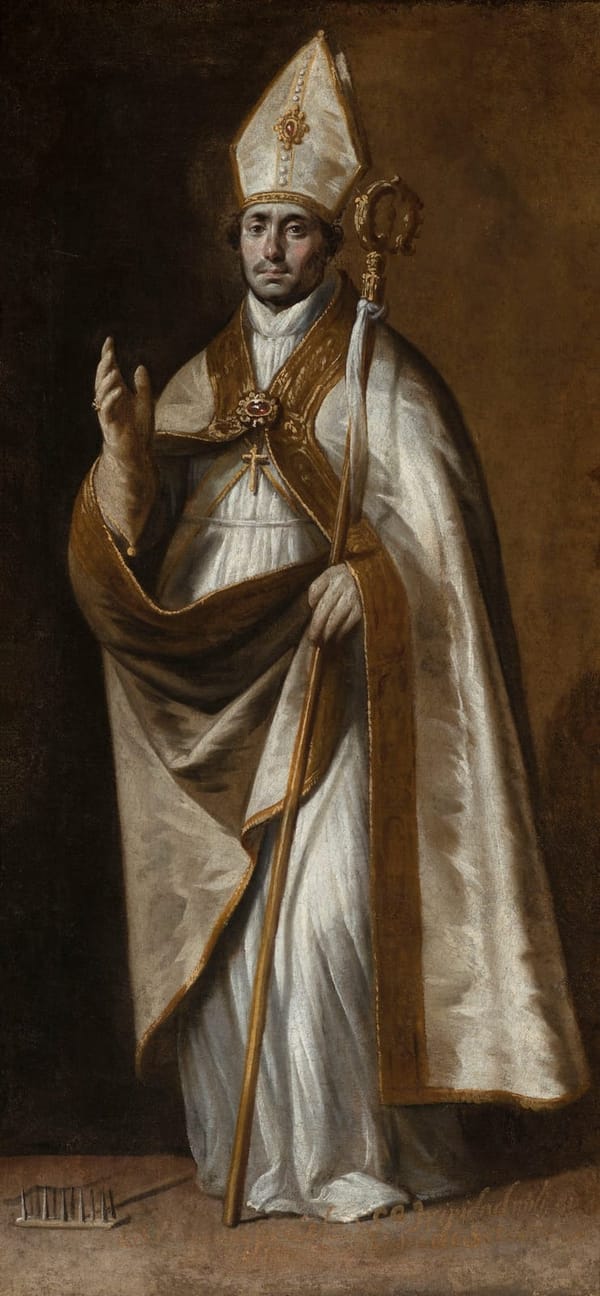
February 3: St. Blaise, Bishop and Martyr
Now that the Church has closed the joyous period of her forty days of Christmas, and is putting us through a course of meditations on subjects which are to excite a spirit of penance within us, each of the saints’ feasts must produce an impression, which shall be in accordance with that spirit. From this day till Easter, we will study the saints, as they come to us, in this special light: how much they laboured and suffered during their pilgrimage of life, and what was the plan they took for conquering the world and the flesh. ‘They went,’ says the psalmist, ‘and wept, casting their seeds: but coming they shall come with joyfulness, carrying their sheaves.’* It shall be the same with us; and at the end of our lenten labours, our risen Jesus will hail us as His living, regenerated children.
The calendar of this portion of the year abounds with martyrs; and, at the very outset, we meet with one of the most celebrated of these glorious champions of Christ. The scene of his pastoral virtues and of his martyrdom was Sebaste, a city of Armenia, the same that will give us forty martyred soldiers on a single day. The devotion to St. Blase is, even to this day, most fervently kept up in the east, especially in Armenia. The western Churches Boon began to love and honour his memory, and so universally, that we might call him one of the most popular of our saints. His feast, however, with us is only a simple, and the Church of Rome has given only one lesson on his life.
Accept, O glorious martyr, the praise which we, too, offer thee in union with that given thee by the whole Church. In return for this homage of our veneration, look down upon the Christian people, who are now preparing to enter on the season of penance, and to be converted to the Lord their God by holy compunction and tears. We ask it of thee by thine own combat: assist us in the one for which we are preparing. When duty required thee to undergo tortures and death, it found thee ready and brave; our duty is expiation by penance, and thy prayers must get us courage. Our enemies are not more cruel than thine, but they are more treacherous, and if we spare them we are lost. Obtain for us that heavenly assistance, which enabled thee to conquer. We are children of the martyrs; God forbid we should be degenerate! Pray, too, O holy pontiff, for the country thou didst water with thy blood. Armenia lost the faith for which thou didst lay down thy life. Intercede for her, that she may be restored to the Church, and let her conversion bring consolation to the few that have remained orthodox and faithful.
* Ps. cxxv. 6, 7. ↩︎
Saturday of Septuagesima Week
The sentence pronounced by the Almighty upon our first parents was to fall upon their children to the end of time. We have been considering, during this week of Septuagesima, the penalties of the great sin; but the severest and most humiliating of them all remains to be told. It is the transmission to the whole human race of original sin. It is true that the merits of the promised Redeemer will be applied to each individual man, in the manner established by God at various periods of time: still, this spiritual regeneration, whilst cleansing us from the leprosy which covered us, and restoring us to the dignity of children of God, will not remove every scar of the old wound. It will save us from eternal death, and restore us to life; but, as long as our pilgrimage lasts, we shall be weak and sickly. Thus it is that ignorance makes us short-sighted in those great truths, which should engross all our thoughts; and this fills us with illusions, which, by an unhappy inclination of our will, we cling to and love. Concupiscence is ever striving to make our soul a slave to the body; and in order to escape this tyranny, our life has to be one continual struggle. An unruly love for independence is unceasingly making us desire to be our own masters, and forget that we were born to obey. We find pleasure in sin, whereas virtue rewards us with nothing, in this life, save the consciousness of our having done our duty.
Knowing all this, we are filled with admiration and love when we think of thee, O Mary! thou purest of God’s creatures. Thou art our sister in nature; thou art a daughter of Eve; but thou wast conceived without sin, and art therefore the honour of the human race. Thou art of the same flesh and blood as ourselves; and yet thou art immaculate. The divine decree, which condemned us to inherit the disgrace of original sin, could not include thy most pure conception; and the serpent felt, as thy foot crushed his haughty head, that thou hadst never been under his power. In thee, O Mary! we find our nature such as it was when our God first created it. Hail, then, spotless Mirror of justice!
O Mary! beautiful in thine unsullied holiness, pray for us who are weighed down by the consequences of that sin of our first parents, which God would not suffer to approach thee. Thou art the implacable enemy of the serpent; watch over us, lest his sting inflict death on our souls. We were conceived in sin, and born in sorrow; pray for us, that we may so live as to merit blessing. We are condemned to toil, to suffering, and to death; intercede for us, that our atonement may find acceptance with our Lord. We are exposed to the treachery of our evil inclinations; we are in love with this present life; we forget eternity; we are ever striving to deceive our own hearts: how could we escape hell, were the grace of thy divine Son not unceasingly offered to us, enabling us to triumph over all our enemies? Thou, O Immaculate Mother of Jesus, art the Mother of divine grace! Pray for us, that we, who glory in being thy kindred by nature, may be daily more and more enriched with this priceless gift.
Let us salute the blessed Mother of God in the words of the following sequence, taken from the ancient missal of Cluny. Catholic piety has consecrated to Mary the Saturday of each week.
Sequence
Modulemur licet rei,
Poscentes remedia.
Spes mirandæ speciei,
Quæ vernat in gloria.
Spes Solaris, sola laris
Terreni fiducia.
Passus rectos et directos,
Da pacis suffragia.
Fulgens dux in pelago,
Tu præclara.
Stella nitens celebris,
Deo cara.
Residens, hæc mellica
Admitte cantica, Virgo pia.
Trementi pro scelere
Des ausus, Tu plausus, Veri vena.
Mundi medicina,
Munda scelus nostrum,
Piissima.
Nos ad vitam mina,
Placans Deum,
Tu benignissima.
Patria parens, Virgo pia,
Nos in umbræ mortis via
Sedentes illumina!
Tui Nati tuti cruce,
Mereamur cœli luce
Per te frui, Domina.
sing a hymn in praise of the Mother of God;
let us sing our prayer for help.
that beautiful Mother,
whose glory is bright as spring!
and warms our earthly home
with the sunny beam of hope.
direct us, steer us,
get us the calm of peace.
guiding us, as does the friendly star which leads
the shipwrecked into port.
thou art the shining well-known star,
so dear to God.
receive, O Virgin Mother,
these our sweet canticles.
do thou, fount of truth,
give courage and applause.
thou art the solace of the world;
may thy loving prayers
cleanse us from our guilt.
but intercede for us to God,
most merciful Queen!
and so lead us unto life.
Mother of thy Creator!
Virgin ever merciful! enlighten us
that are sitting in the shades of death.
and protected by the cross of thy Son,
we may, through thy intercession,
be brought to the enjoyment of light eternal.
| Previous Friday of Septuagesima Week | Next Saturday of Septuagesima Week |