Daily reading
Septuagesima
Double · February 5 · Sanctoral
February 5, 2029
From Dom Guéranger’s The Liturgical Year.
A Double leads the weekday.Rubric
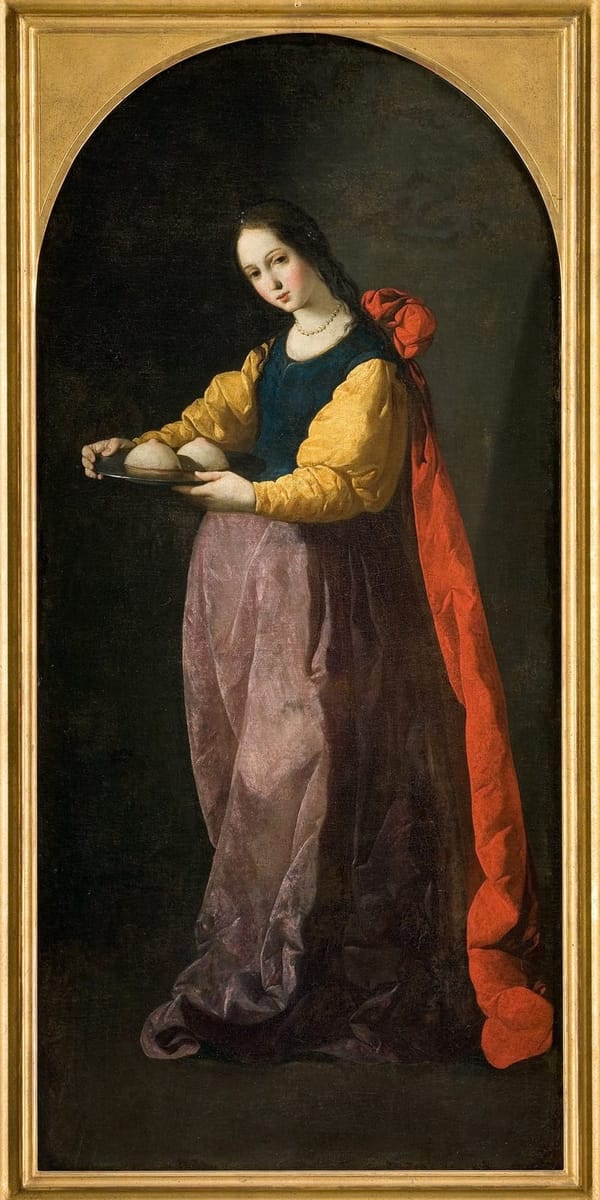 |
February 5: St. Agatha, Virgin and Martyr
Since the commencement of the ecclesiastical year, we have kept the feasts of two out of the four illustrious virgins whose names are daily honoured in the holy Sacrifice of the Lamb: the third comes to-day, lighting up the heaven of the Church with her bright soft rays. Lucy first, then Agnes, and now the gracious visit of Agatha. The fourth, Cecily, the immortal Cecily, is to be one of that magnificent constellation which gives such splendour to the closing of the year. To-day, then, let us keep a feast in honour of Agatha, the virgin daughter of that same fair Sicily which can boast of her Lucy. We must not allow the holy sadness of our present season to take aught from the devotion we owe to our saint. The joy wherewith we celebrate her merits will lead us to study her virtues. She will repay us by her prayers; she will encourage us to persevere in the path which is to bring us to the God she so nobly loved and served, and with whom she is now for ever united.
Let us begin by reading what the Church tells us of the virtues and combats of this glorious bride of Christ.
The ancient books of the liturgy abound with verses in honour of St. Agatha; but most of them are so poor in sentiment that we pass them over. The following beautiful hymn is the composition of Pope St. Damasus.
Hymn
Virginis emicat eximiæ:
Christus eam sibi qua sociat,
Et diadema duplex decorat.
Sed magia actibus atque fide,
Terrea prospera nil reputans,
Jussa Dei sibi corde ligans.
Exposuit sua membra flagris,
Pectore quam fuerit valido
Torta mamilla docet patulo.
Pastor ovem Petrus hanc recreat:
Inde gavisa magisque flagrans,
Cuncta flagella cucurrit ovans.
Hujus et ipsa meretur opem;
Quos fidei titulus decorat,
His Venerem magis ipsa premat.
Pro miseris supplica Domino,
Sio tua festa coli faciat,
Te celebrantibus ut faveat.
Spirituique proinde sacro,
Qui Deus unus et omnipotens
Hanc nostri faciat memorem.
of the glorious martyr and virgin Agatha,
when Christ took her to himself,
and a double crown wreathed her brow.
her grandest riches were her deeds and her faith.
Earthly prosperity was nothing in her eyes,
but her whole heart was on the precepts of her God.
she flinched not as they lashed her limbs:
and her wounded breast
reveals a dauntless heart.
where the pastor Peter heals his bleeding lamb;
and thence once more she runs to suffer,
gladder and braver at every wound.
was saved by Agatha’s prayer.
The same can check, in Christian hearts,
the threatening fire of lust.
intercede with him for us miserable sinners,
that he grant us so to spend thy feast,
that our celebration may draw down his grace.
and the Holy Ghost.
May the one almighty God
grant that this his saint be mindful of us.
How lovely are thy palms, O Agatha! But how long and cruel was thy combat for them! The day was thine; thy faith and thy virginity triumphed, but the battle-field streamed with thy blood, and thy glorious wounds bear testimony to the angels how stern was the courage of thy fidelity to Jesus thy Spouse. When thine enemies left thee, it was to Him thou didst look up; and then thy soul flew to its rest, in the bosom of thy King and God. The whole Church keeps feast to-day, praising her Lord in thee, great martyr and virgin! She knows the love thou bearest her, and how, amidst the joys of heaven, her interests and her wants are the object of thy prayers. Thou art our sister; be, too, our mother, by interceding for us. Centuries have passed away since that day, whereon thy soul quitted the body thou hadst sanctified by purity and suffering; but the great battle between the spirit and the flesh is still waging here on earth, and will do so to the end of time. Assist us in the struggle; keep up within our hearts the holy fire, which the world and our passions are ever seeking to quench.
It is now the season when every Christian should renew his whole being by repentance and compunction. We know the power of thy prayer; let it procure us these gifts: the fear of God, which keeps down the workings of corrupt nature; the spirit of penance, which repairs the injuries caused by our sins; and a solid love for our dear Lord, which sweetens the yoke, and ensures perseverance. More than once a whole people has witnessed how a relic of thine, thy veil, has checked the stream of lava which rolled down the sides of Etna; we are threatened with a torrent of vice, which will drive the world back to pagan corruption, unless divine mercy stay its wild fury; and prayers such as thine can obtain it for us. Delay not, O Agatha! each day gives strength to the danger. Not a nation but is now infected with the poison of a literature that is infidel and immoral; by thy prayers keep the poisonous cup from them that have not tasted, neutralize its power in them that have drunk its venom of death. Oh! spare us the shame of seeing our Europe the slave of sensuality, and the dupe of hell.
Monday of Sexagesima Week
All flesh had corrupted its way upon the earth.1 The terrible lesson, then, which men had received, by being driven out of paradise in the person of our first parents, had been without effect. Neither the certainty of death, when they would have to stand before the divine Judge, nor the humiliations which attend man’s first coming into this world, nor the pains and fatigues and trials which beset the whole path of life, had subdued men’s hearts, or brought them into submission to that sovereign Master whose hand lay thus heavy upon them. They had the divine promise that a Saviour should be given to them, and that this Redeemer (who was to be the Son of her that was to crush the serpent’s head), would not only bring them salvation, but would moreover reinstate them in all the happiness and honours they had lost. But even this was not enough to make them rise above the base passions of corrupt nature. The example of Adam’s nine hundred years’ penance, and the admonitions he could so feelingly give who had received such proofs of God’s love and anger, began to lose their influence upon his children; and when he at last descended into the grave, his posterity grew more and more heedless of what they owed to their Creator. The long life, which had been granted to man in this the first age of the world, was made but a fresh means of offending Him who gave it. When, finally, the sons of Seth took to themselves wives of the family of Cain, the human race reached the height of wickedness, rebelled against the Lord, and made their own passions their god.
Yet, all this while, they had had granted to them the power of resisting the evil propensities of their hearts. God had offered them His grace, whereby they were enabled to conquer pride and concupiscence. The merits of the Redeemer to come were even then present to divine justice, and the Lamb, slain, as St. John tells us, from the beginning of the world,2 applied the merits of His Blood to this as to every generation which existed before the great Sacrifice was really immolated. Each individual of the human family might have been just, as Noah was, and, like him, have found favour with the Most High; but the thought of their heart was bent upon evil, and not upon good, and the earth became peopled with enemies of God. Then it was that it repented God that He had made man,3 as the sacred Scripture forcibly expresses it. He decreed that man’s life on earth should be shortened, in order that the thought of death might be ever before us. He, moreover, resolved to destroy, by a universal deluge, the whole of this perverse generation, saving only one family. The world would thus be renewed, and man would learn from this awful chastisement to serve and love this his sovereign Lord and God.
We find the following liturgical formula in the Mozarabic missal. Nothing could be more appropriate to the season of Septuagesima.
Missa
(Dominica ante carnes tollendas.)
| Previous February 4: St. Andrew Corsini, Bishop and Confessor | Next Monday of Sexagesima Week |