Daily reading
Septuagesima
Double · February 12 · Sanctoral
February 12, 2029
From Dom Guéranger’s The Liturgical Year.
A Double leads the weekday.Rubric
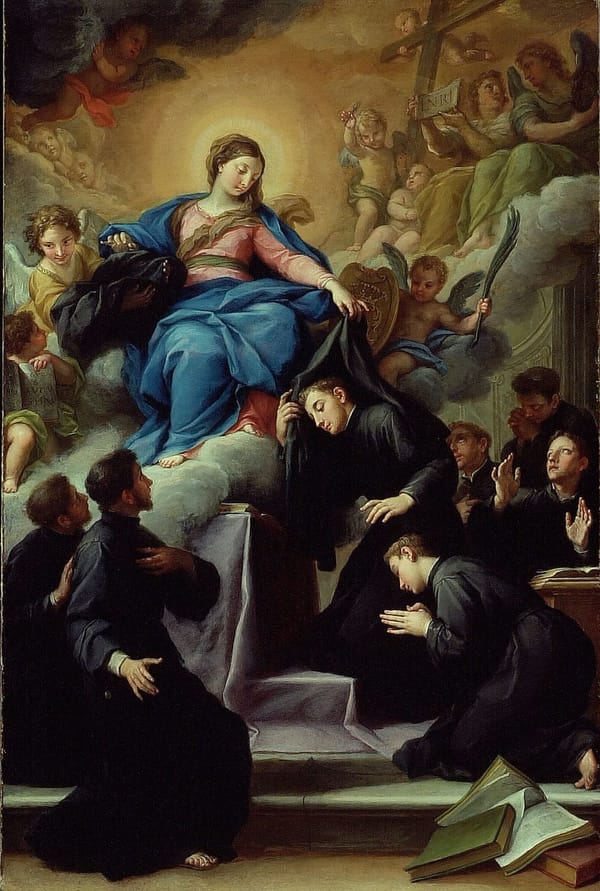 |
February 12: The Seven Holy Founders of the Order of Servites, Confessors
Clouds are gathering over Holy Church. We are reminded on every side of the approach of those days when our Emmanuel will show Himself to us in the pitiable state to which our sins have brought Him. Bethlehem is so soon followed by Calvary. We shall find the Mother of divine grace at the foot of the Cross as we found her at Ephrata. She brought forth her firstborn in joy, but now in tears she is to bring forth those brothers of His whose birth cost her so much. We have shared her joy, and we shall not refuse to weep and suffer with her.
Let us take for our models the saints whom the Church honours to-day. They passed their lives in the contemplation of our Lady’s sorrows, and the Order which they founded has the special mission to spread this devotion. St. Francis of Assisi raised the standard of the Cross anew in a world grown cold. The work of redemption seemed to be taken up afresh, and, as on the great Friday Jesus would not manifest Himself without Mary, the Servites completed the work of the Founder of the Friars Minor. Men regained confidence as they meditated on the Passion of the Son and the Compassion of the Mother.
The two feasts consecrated to the Dolours of our Lady will teach us in due course what place her compassion had in the economy of the Redemption. The Queen of heaven herself showed her predilection for the Order which made itself her apostle, in the striking outpouring of holiness which marked its origin. The simultaneous blooming of seven lilies, gathered on earth to-day by the angels, was a sight new even to heaven. Peter of Verona had a vision of them when they were implanting themselves on Monte Senario; and the future martyr saw the blessed Virgin smile as she gazed on that mountain where countless other flowers sprang up to perfume holy Church. Florence, the city of flowers, had never before given such blooms to God. Hell multiplied its attacks against the noble city, but could not prevail against Mary within its walls. We shall be reminded of these things by the feasts of St. Juliana Falconieri and St. Philip Benizi, which were established before the one we are keeping to-day. Let us unite our gratitude to that which the Church feels for the Religious family of the Servites. The world owes to them the grace of a new development in the knowledge and love of the Mother of God, who became our Mother at the price of unparalleled sufferings.
The lessons read by the Church on this day speak of the merits of our Saints and the favours with which our Lady rewarded their fidelity. February 11, the day first chosen as their common feast, is not the anniversary of the death of any one of them, but the day on which, in the year 1304, after passing through many vicissitudes, their Order obtained the definitive approbation of the Church.
You made the sorrows of Mary your own, and now she shares her eternal joys with you. The vine with its miraculously ripening grapes, which prefigured your fruitfulness in a frozen world, still yields a sweet odour in this land of exile, and the faithful still appreciate its fruit. Philip and Juliana have long been honoured as branches of this blessed vine, and to-day we pay our homage to the sevenfold root from which they sprang. You rejoiced in the obscurity which covered the life upon earth of the Queen of saints herself, but to-day the glory of Mary pierces all clouds, and no shadow can withdraw the servants from the radiance which surrounds the Mistress. May your glory be increased by the favours you bestow upon men! Teach an aged world to seek warmth at the fire whence you draw a love strong enough to triumph over the world and sacrifice self for God.
O Heart of Mary, pierced by the sword of sorrow, furnace of love which throughout all eternity feeds the fires of the very Seraphim, be our model, our refuge, and our consolation until the dawn of that blissful day which is to be the end of our exile in this vale of tears.
Monday of Quinquagesima Week
The life of a faithful Christian, like that of the patriarch Abraham, is neither more nor less than a courageous journeying onwards to the place destined for him by his Creator. He must put aside everything that could impede his progress, nor must he look back. This is, undoubtedly, hard doctrine; but if we reflect, for a moment, on the dangers which surround fallen man during his earthly pilgrimage, and on what our own sad experience has taught us, we shall not think it hard or strange, that our Saviour has made the renouncing and denying of ourselves an essential condition of our salvation. But, independently of this, is it not far better to put our life under God’s guidance, than to keep it in our own? Are we so wise or so strong, as to be able to guide ourselves? We may resist as we please, but God is our sovereign Lord and Master; and by giving us free-will, whereby we may either resist His will or follow it, He has not abdicated His own infinite rights to His creatures’ obedience. Our refusal to obey would not make Him less our Master.
Had Abraham, after receiving the divine call, chosen to remain in Chaldea, and refused to break up the home which God had bade him leave, God would then have selected some other man to be the patriarch of His chosen people, and father of that very family, which was to have the Messias as one of its children. This substitution of one for another in the order of grace is frequently forced upon divine justice; but what a terrible punishment it is for him that caused the substitution! When a soul refuses salvation, heaven does not therefore lose one of its elect: God, finding that He is despised by the one He called, offers the grace to another, until His call is followed.
The Christian life consists in this untiring, unreserved obedience to God. The first effect of this spirit of submission is, that it takes the soul from the region of sin and death, wherein she was wasting away her existence; it takes her from the dark Chaldea, and places her in the promised land of light. Lest she should faint on her way. along the narrow path, and fall a victim to the dangers which never leave her because they are within herself, God asks her for sacrifices, and these brace her. Here, again, we have Abraham for our model. God loves him, and promises him the richest of blessings; He gives him a son, as pledge of the promise; and then, shortly after, tests the holy patriarch's devotedness, by commanding him to slay with his own hand this dear child, on whom he has been told to build his hopes!
Man’s path on earth is sacrifice. We cannot go out from evil except by the way of self-resistance, nor keep our footing on good ground but by constant combating. Let us imitate Abraham: fix our eyes steadfastly on the eternal hills, and consider this world as a mere passing dwelling, a tent, put up for a few days. Our Jesus has said to us: ‘I came not to send peace, but the sword; for I came to separate.'1 Separation, then, and trials are sure to be sent us; but we are equally sure that they are for our good, since they are sent us by Him who so loved us, that He became one of ourselves. But this same Jesus has also said: ‘Where thy treasure is, there too is thy heart.’2 Christians! can our treasure be in this wretched world? No it must be in that fair land above. There, then, must we be, in desire and affection.
These are the thoughts the Church would have us meditate upon during these days, which immediately precede the forty of Lent. They will help to purify our hearts and make them long to be with their God. The noise of the world’s sins and scandals reaches our ears: let us pray, that the kingdom of God may come to us and to those poor sinners; for God’s infinite mercy can change them, if He will, into children of Abraham. Not a day passes but He so changes many a sinner. He has, perhaps, shown that miracle of His mercy to us, and those words of the apostle may be applied to us: 'You, who some time were afar off, are now made nigh (to God) by the Blood of Christ.'3
Let us pray for ourselves and for all sinners, in these beautiful words of the Mozarabic breviary.
Prayer
| Previous February 11: Our Lady of Lourdes | Next Monday of Quinquagesima Week |