Daily reading
Lent
Double · March 7 · Sanctoral
March 7, 2029
From Dom Guéranger’s The Liturgical Year.
A Double leads the weekday.Rubric
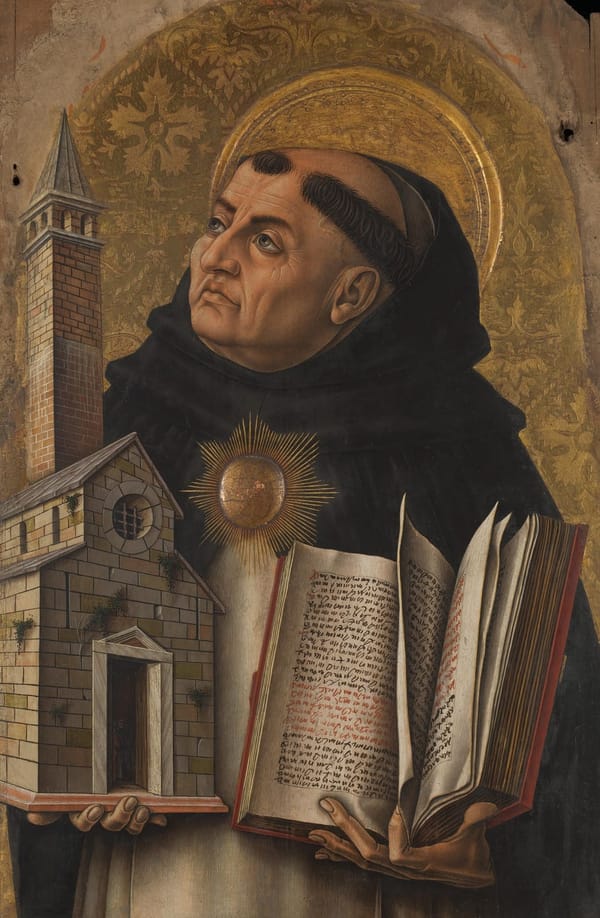 |
March 7: St. Thomas of Aquin, Doctor of the Church
The saint we are to honour to-day is one of the sublimest and most lucid interpreters of divine truth. He rose up in the Church many centuries after the apostolic age, nay, long after the four great Latin doctors, Ambrose, Augustine, Jerome, and Gregory. The Church, the ever young and joyful mother, is justly proud of her Thomas, and has honoured him with the splendid title of the angelical doctor, on account of the extraordinary gift of understanding wherewith God had blessed him; just as his contemporary and friend, St. Bonaventure, has been called the seraphic doctor, on account of the wonderful unction which abounds in the writings of this worthy disciple of St. Francis. Thomas of Aquin is an honour to mankind, for perhaps there never existed a man whose intellect surpassed his. He is one of the brightest ornaments of the Church, for not one of her doctors has equalled him in the clearness and precision wherewith he has explained her doctrines. He received the thanks of Christ Himself, for having well written of Him and His mysteries. How welcome ought this feast of such a saint to be to us during this season of the year, when our main study is our return and conversion to God! What greater blessing could we have than to come to the knowledge of God? Has not our ignorance of God, of His claims, and of His perfections, been the greatest misery of our past lives? Here we have a saint whose prayers are most efficacious in procuring for us that knowledge, which is unspotted, and converteth souls, and giveth wisdom to little ones, and gladdeneth the heart, and enlighteneth the eyes.1 Happy we if this spiritual wisdom be granted us! We shall then see the vanity of everything that is not eternal, the righteousness of the divine commandments, the malice of Bin, and the infinite goodness wherewith God treats us when we repent.
Let us learn from the Church the claims of the angelical doctor to our admiration and confidence.
The Dominican Order, of which St. Thomas is one of the greatest ornaments, has inserted the three following hymns in its liturgy of his feast:
Hymn
Laudans turba fidelium,
Errorum pulso nubilo
Per novi solis radium.
Fudit thesauros gratiæ:
Donis pienus ex æthere
Morum et sapientiæ.
Verbi coruscant faculæ,
Scripturæ sacræ Numinis,
Et veritatis regulæ.
Clarus vitæ munditia,
Splendens miris prodigiis,
Dat toti mundo gaudia.
Simulque sancto Flamini,
Qui sancti Thomæ merito
Nos cœli jungat agmini.
and give praise to God,
who has made a new sun to shine in our world,
and disperse the clouds of error.
that Thomas shed his treasures of heavenly light.
Heaven had enriched him
with gifts of virtue and wisdom:
we have derived a brighter knowledge of the Word,
the understanding of the divine Scriptures
and the rules of truth.
the light of his spotless life,
and the splendour of his miracles,
have filled the universe with joy.
and to the Holy Ghost.
And may our God, by the intercession and merits of his saint,
admit us into the choir of the blessed in heaven.
Hymn
Claram ducens originem,
Subit ætatis teneræ
Prædicatorum Ordinem.
Splendens in cœtu nubium,
Plusquam doctores cæteri
Purgans dogma Gentilium.
In lucem pandit abdita,
Dum supra sensus hominum
Obscura facit cognita.
Quadripartite pervius;
Fit Gedeonis gladius,
Tuba, lagena, radius.
Simulque sancto Flamini,
Qui sancti Thomæ merito,
Nos cœli jungat agmini.
Thomas, while in the bloom
of youth, embraced
the Order of Preachers.
brightly does he shine amidst the luminaries of earth,
and, more than any doctor of the Church,
refutes the doctrines of the Gentiles.
and brings to light the hidden gems of truth,
for he teaches us what the mind of man
had else never understood.
like to that four-branched river of paradise.
He made him to be her Gedeon’s sword,
her trumpet, her vase, her torch.
and to the Holy Ghost.
And may our God, by the intercession and merits of his saint,
admit us into the choir of the blessed in heaven.
Hymn
Thomæ felicem exitum,
Qui pervenit ad gaudia
Per Verbi vitæ meritum.
Thecam thesauri gratiæ,
Cum Christus Thomam efficit
Hæredem regni gloriæ.
Et funeris integritas,
Mira fragrans suavitas,
Ægris collata sanitas.
Terræ, ponto, et superis;
Nos juvet suis precibus,
Deo commendet meritis.
Simulque sancto Flamini,
Qui sancti Thomæ merito
Nos cœli jungat agmini.
the happy death of thy Thomas deserves a hymn of praise.
By the merits of him that is the Word of life,
he is now in endless joy.
of grace was welcomed as a guest.
It was there that he received from Christ
the inheritance of eternal glory.
he has loft us his glorious relics
which breathe forth a heavenly fragrance,
and work cures for the suffering sick.
earth, and sea, and heaven, all may give him praise.
May his prayers and merits
intercede for us with God.
and to the Holy Ghost.
And may our God, by the intercession and merits of his saint,
admit us into the choir of the blessed in heaven.
How shall we worthily praise thee, most holy Doctor! How shall we thank thee for what thou hast taught us? The rays of the divine Sun of justice beamed strongly upon thee, and thou hast reflected them upon us. When we picture thee contemplating truth, we think of those words of our Lord: 'Blessed are the clean of heart, for they shall see God.’2 Thy victory over the concupiscence of the flesh merited for thee the highest spiritual delights; and our Redeemer chose thee, because of the purity of thy angelic soul, to compose for His Church the Office whereby she should celebrate the divine Sacrament of His love. Learning did not impair thy humility. Prayer was ever thy guide in thy search after truth; and there was but one reward for which, after all thy labours, thou wast ambitious, the possession of God.
Thy life, alas! was short. The very masterpiece of thy angelical writings was left unfinished. But thou hast not lost thy power of working for the Church. Aid her in her combats against error. She holds thy teachings in the highest estimation, because she feels that none of her saints has ever known so well as thou, the secrets and mysteries of her divine Spouse. Now, perhaps more than in any other age, truths are decayed among the children of men;3 strengthen us in our faith, procure us light. Check the conceit of those shallow self-constituted philosophers, who dare to sit in judgment on the actions and decisions of the Church, and to force their contemptible theories upon a generation that is too ill-instructed to detect their fallacies. The atmosphere around us is gloomy with ignorance; loose principles, and truths spoilt by cowardly compromise, are the fashion of our times; pray for us; bring us back to that bold and simple acceptance of truth, which gives life to the intellect and joy to the heart.
Pray, too, for the grand Order which loves thee so devoutly, and honours thee as one of the most illustrious of its many glorious children. Draw down upon the family of thy patriarch St. Dominic the choicest blessings, for it is one of the most powerful auxiliaries of God’s Church.
We are on the eve of the holy season of Lent, preparing for the great work of earnest conversion of our lives. Thy prayers must gain for us the knowledge both of the God we have offended by our sins, and of the wretched state of a soul that is at enmity with its Maker. Knowing this, we shall hate our sins; we shall desire to purify our souls in the Blood of the spotless Lamb; we shall generously atone for our faults by works of penance
Wednesday of the Third Week of Lent
The Station, at Rome, is in the church oi Saint Xystus on the Appian Road. It now goes under the name of Saint Xystus the Old, in order to distinguish it from another church that is dedicated to the same holy Pope and Martyr.
Collect
Epistle
Cap. xx.Hæc dicit Dominus Deus: Honora patrem tuum, et matrem tuam, ut sis longævus super terram, quam Dominus Deus tuus dabit tibi. Non occides. Non moechaberis. Non furtum facies. Non loqueris contra proximum tuum falsum testimonium. Non concupisces domum proximi tui, nec desiderable uxorem ejus, non servum, non ancillam, non bovem, non asinum, nec omnia quæ illius , sunt. Cunctus autem populus videbat veces, et lampades, et sonitum buccmæ, montem que fumantem et perterriti, ao pa vore concussi steterunt procul, dicentes Moysi: Loquere tu nobis, et audiemus: non loquatur nobis Dominus, ne forte moriamur. Et ait Moyses ad populum: Nolite timere: ut enim probaret vos venit Deus; et ut terror illius esset in vobis, et non peccaretis. Stetitque populus de longe. Moyses autem accessit ad caliginem, in qua erat Deus. Dixit præterea Dominus ad Moysen: Hæc dices filiia Israël: Vos vidistis quod de oælo locutus sim vobis. Non facietis deos argenteos, nec deos aureos facietis vobis. Altare de terra facietis mibi, et offeretis super eo holocausta et pacifica vestra, oves vestras, et boves, in omni loco in quo memoriam fuerit nominis men
Ch. xx.Thus saith the Lord God: Honour thy father and thy mother, that thou mayst be long-lived upon the land which the Lord thy God will give thee. Thou shalt not kill. Thou shalt not commit adultery. Thou shalt not steal. Thou shalt not bear false witness against thy neighbour. Thou shalt not covet thy neighbour’s house, neither shalt thou desire his wife, nor his servant, nor his handmaid, nor his ox, nor his ass, nor any thing that is his. And all the people saw the voices and the flames, and the sound of the trumpet, and the mount smoking: and being terrified and struck with fear, they stood afar off, saying to Moses: Speak thou to us, and we will hear; let not the Lord speak to us, lest we die. And Moses said to the people: Fear not; for God is come to prove you, and that the dread of him might be in you, and you should not sin. And the people stood afar off. But Moses went to the dark cloud wherein God was. And the Lord said to Moses: Thus shalt thou say to the children of Israel: You have seen that I have spoken to you from heaven. You shall not make gods of silver, nor shall you make to yourselves gods of gold. You shall make an altar of earth unto me, and you shall offer upon it your holocausts and peace-offerings, your sheep and oxen, in every place where the memory of my name shall be.
The Church reminds us to-day of the divine commandments which relate to our duties towards our neighbour, beginning with that which enjoins respect to parents. Now that the faithful are intent on the great work of the conversion and amendment of their lives, it is well that they should be reminded that their duties towards their fellow-men are prescribed by God Himself. Hence, it is God whom we offended, when we sinned against our neighbour. God first tells us what He Himself has a right to receive from our hands. He bids us adore and serve Him; He forbids the worship of idols; He enjoins the observance of the Sabbath, and prescribes sacrifices and ceremonies: but, at the same time, He commands us to love our neighbours as ourselves, and assures us that He will be their avenger when we have wronged them, unless we repair the injury. The voice of Jehovah on Sinai is not less commanding when it proclaims what our duties are to our neighbour, than when it tells us our obligations to our Creator. Thus enlightened as to the origin of our duties, we shall have a clearer view of the state of our conscience, and of the atonement required of us by divine justice. But if the old Law, that was written on tablets of stone, thus urges upon us the precept of the love of our neighbour; how much more will the new Law, that was signed with the Blood of Jesus when dying upon the cross for His ungrateful brethren, insist on our observance of fraternal charity! These are the two Laws, on which we shall be judged; let us, therefore, carefully observe what they command on this head, that thus we may prove ourselves to be Christians, according to those words of our Saviour: ‘By this shall all men know that you are My disciples, if you have love one for another.’*
Gospel
Cap. xv.In illo tempore: Accesserunt ad Jesum ab Jerosolymis scribæ et pharisæi, dicentes: Quare discipuli tui transgrediuntur traditionem seniorum? non enim lavant manus su.as cum panem manducant. Ipse autem respondens, ait illis: Quare et vos transgredimini mandatum Dei propter traditionem vestram? Nam Deus dixit: Honora patrem et matrem. Et: Qui maledixerit patri vel matri, morte moriatur. Vos autem dicitis: Quicumque dixerit patri vel matri: Munus quodcumque est ex me tibi proderit: et non honorificabit patrem suum aut matrem suam: et irritum fecistis mandatum Dei, propter traditionem vestram. Hypocritæ, bene prophetavit de vobis Isaias, dicens: Populus hic labiis me honorat: cor autem eorum longe est a me. Sine causa autem colunt me, docentes doctrinas et mandata hominum. Et convocatis ad se turbis, dixit eis: Audite, et intelligite. Non quod iritrat in os, coinquinat hominem: sed quod procedit ex ore, hoc coinquinat hominem. Tune accedentes discipuli ejus, dixerunt ei: Seis quia pharisæi, audito verbo hoc, scandalizati sunt? At lile respondens, ait: Omnis plantatio quam non plantavit Pater meus cælestis, eradicabitur. Sinite illos: cæci sunt, et duces cæcorum. Cæcus autem si cæco ducatum præstet, ambo in foveam cadunt. Respondens autem Petrus, dixit ei: Edissere nobis parabola istam. At ille dixit: Adhuc et vos sine intellectu estis? Non intelligitis quia omne quod in os intrat, in ventrem vadit, et in secessum emittitur? Quæ autem procedunt de ore, de corde exeunt, et ea coinquinant hominem: de corde enim exeunt cogitationes malæ, homicidia, adulteria, fornicationes, furta, falsa testimonia, blasphemiæ. Hæc sunt quæ coinquinant hominem. Non lotis autem manibus manducare, non coinquinat hominem.
Ch. xv.At that time: The scribes and pharisees came from Jerusalem to Jesus, saying: Why do thy disciples transgress the tradition of the ancients? for they wash not their hands when they eat bread. But he answering, said to them: Why do you also transgress the commandment of God for your tradition? For God said: Honour thy father and mother; and: He that shall curse father or mother, let him die the death. But you say: Whosoever shall say to father or mother, The gift whatsoever proceedeth from me, shall profit thee. And he shall not honour his father or his mother; and you have made void the commandment of God for your tradition. Hypocrites, well hath Isaias prophesied of you, saying: This people honoureth me with their lips, but their heart is far from me. And in vain do they worship me, teaching doctrines and commandments of men. And having called together the multitudes unto him, he said to them: Hear ye and understand. Not that which goeth into the mouth defileth a man; but what cometh out of the mouth, this defileth a man. Then came his disciples, and said to him: Dost thou know that the pharisees, when they heard this word, were scandalized? But he answering, said: Every plant which my heavenly Father hath not planted, shall be rooted up. Let them alone; they are blind, and leaders of the blind. And if the blind lead the blind, both fall into the pit. And Peter answering, said to him: Expound to us this parable. But he said: Are you also yet without understanding? Do you not understand that whatsoever entereth into the mouth, goeth into the belly, and is cast out into the privy? But the things which proceed out of the mouth, come forth from the heart, and those things defile a man. For from the heart come forth evil thoughts, murders, adulteries, fornications, thefts, false testimonies, blasphemies. These are the things that defile a man. But to eat with unwashed hands doth not defile a man.
The Law that was given by God to Moses enjoined a great number of exterior practices and ceremonies; and they that were faithful among the Jews, zealously and carefully fulfilled them. Jesus Himself, though He was the divine Law-Giver, most humbly complied with them. But the pharisees had added their own superstitious traditions to these divine laws and ordinances, and made religion consist in the observance of these fanciful inventions. Our Saviour here tells the people not to be imposed upon by such teaching, and instructs them as to what is the real meaning of the external practices of the Law. The pharisees prescribed a great many ablutions or washings to be observed during the course of the day. They would have it, that they who eat without having washed their hands (and indeed the whole body some time during the day), were defiled, and that the food they thus partook of was unclean, because, as they said, they themselves had become defiled by having come near or touched objects which were specified by their whims. According to the Law of God, these objects were perfectly innocent; but according to the law of the pharisees, almost everything was contagious, and the only escape was endless washings! Jesus would have the Jews throw off this humiliating and arbitrary yoke, and reproaches the pharisees for having corrupted and made void the Law of Moses.
He tells them that there is no creature which is intrinsically, and of its own nature, unclean; and that a man’s conscience cannot be defiled by the mere fact of his eating certain kinds of food. Evil thoughts, and evil deeds, these, says our Saviour, are the things that defile a man. Some heretics have interpreted these words as being an implicit condemnation of the exterior practices ordained by the Church, and more especially of abstinence. To such reasöners and teachers we may justly apply what our Saviour said to the pharisees: They are blind and leaders of the blind. From this, that the sins into which a man falls by his use of material things are sins only on account of the malice of the will, which is spiritual, it does not follow that therefore man may, without any sin, make use of material things, when God or His Church forbids their use. God forbade our first parents, under pain of death, to eat the fruit of a certain tree; they ate it, and sin was the result of their eating. Was the fruit unclean of its own nature? No; it was a creature of God as well as the other fruits of Eden; but our first parents sinned by eating it, because their doing so was an act of disobedience. Again, when God gave His Law on Mount Sinai, He forbade the Hebrews to eat the flesh of certain animals; if they ate it, they were guilty of sin, not because this sort of food was intrinsically evil or cursed, but because they that partook of it disobeyed the Lord. The commandments of the Church regarding fasting and abstinence are of a similar nature. It is that we may secure to ourselves the blessing of Christian penance— in other words, it is for our spiritual interest—that the Church bids us abstain and fast at certain times. If we violate her law, it is not the food we take that defiles us, but the resisting a sacred power, which our Saviour, in yesterday's Gospel, told us we are to obey under the heavy penalty which He expressed in those words: He that will not hear the Church, shall be counted as a heathen and publican.
Let us take for to-day one of the solemn supplications offered to God by the Gothic Church of Spain during Lent.
Supplication
(Breviar. Mozarah. Ad Sextam in IV. fer. V. hebdomadœ)
* St. John xiii. 35 ↩︎
| Previous March 6: Sts. Felicitas and Perpetua, Martyrs | Next Wednesday of the Third Week of Lent |