Daily reading
Lent
Double · March 12 · Sanctoral
March 12, 2029
From Dom Guéranger’s The Liturgical Year.
A Double leads the weekday.Rubric
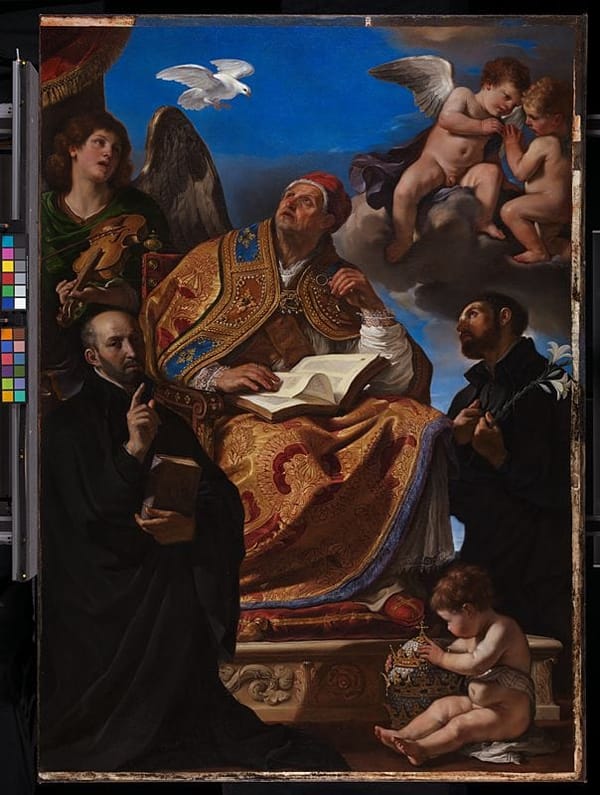 |
March 12: St. Gregory the Great, Pope and Doctor of the Church
Among all the pastors whom our Lord Jesus Christ has placed, as His vicegerents, over the universal Church, there is not one whose merits and renown have surpassed those of the holy Pope, whose feast we keep to-day. His name is Gregory, which signifies watchfulness; his surname is ‘the Great,’ and he was in possession of that title, when God sent the Seventh Gregory, the glorious Hildebrand, to govern His Church.
In recounting the glories of this illustrious Pontiff, it is but natural we should begin with his zeal for the services of the Church. The Roman liturgy, which owes to him some of its finest hymns, may be considered as his work, at least in this sense, that it is he who collected together and classified the prayers and rites drawn up by his predecessors, and reduced them to the form in which we now have them. He collected also the ancient chants of the Church, and arranged them in accordance with the rules and requirements of the divine Service. Hence it is, that our sacred music, which gives such solemnity to the liturgy, and inspires the soul with respect and devotion during the celebration of the great mysteries of our faith, is known as the Gregorian chant.
He is, then, the apostle of the liturgy, and this alone would have immortalized his name; but we must look for far greater things from such a Pontiff as Gregory. His name was added to the three, who had hitherto been honoured as the great Doctors of the Latin Church. These three are Ambrose, Augustine, and Jerome; who else could be the fourth but Gregory? The Church found in his writings such evidence of his having been guided by the Holy Ghost, such a knowledge of the sacred Scriptures, such a clear appreciation of the mysteries of faith, and such unction and authority in his teachings, that she gladly welcomed him as a new guide for her children.
Such was the respect wherewith everything he wrote was treated, that his very letters were preserved as so many precious treasures. This immense correspondence shows us that there was not a country, scarcely even a city, of the Christian world, on which the Pontiff had not his watchful eye steadily fixed; that there was not a question, however local or personal, which, if it interested religion, did not excite his zeal and arbitration as the Bishop of the universal Church. If certain writers of modern times had but taken the pains to glance at these letters, written by a Pope of the sixth century, they would never have asserted, as they have, that the prerogatives of the Roman Pontiff are based on documents fabricated, as they say, two hundred years after the death of Gregory.
Throned on the apostolic See, our saint proved himself to be a rightful heir of the apostles, not only as the representative and depositary of their authority, but as a fellow-sharer in their mission of calling nations to the true faith. To whom does England owe her having been, for so many ages, ‘the island of saints’? To Gregory, who, touched with compassion for those Angli, of whom, as he playfully said, he would fain make Angeli, sent to their island the monk Augustine with forty companions, all of them, as was Gregory himself, children of St. Benedict. The faith had been sown in this land as early as the second century, but it had been trodden down by the invasion of an infidel race. This time the seed fructified, and so rapidly that Gregory lived to see a plentiful harvest. It is beautiful to hear the aged Pontiff speaking with enthusiasm about the results of his English mission. He thus speaks in the twenty-seventh Book of his Morals: ‘Lo! the language of Britain, which could once mutter naught save barbarous sounds, has long since begun to sing, in the divine praises, the Hebrew Alleluia! Lo! that swelling sea is now calm, and saints walk on its waves. The tide of barbarians, which the sword of earthly princes could not keep back, is now hemmed in at the simple bidding of God’s priests.’*
During the fourteen years that this holy Pope held the place of Peter, he was the object of the admiration of the Christian world, both in the east and in the west. His profound learning, his talent for administration, his position, all tended to make him beloved and respected. But who could describe the virtue of his great soul? That contempt for the world and its riches, which led him to seek obscurity in the cloister; that humility, which made him flee the honours of the papacy, and hide himself in a cave, where, at length, he was miraculously discovered, and God Himself put into his hands the keys of heaven, which he was evidently worthy to hold, because he feared the responsibility; that zeal for the whole flock, of which he considered himself not the master, but the servant, so much so indeed that he assumed the title, which the Popes have ever since retained, of ‘servant of the servants of God’ that charity which took care of the poor throughout the whole world; that ceaseless solicitude, which provided for every calamity, whether public or private; that unruffled sweetness of manner, which he showed to all around him, in spite of the bodily sufferings which never left him during the whole period of his laborious pontificate; that firmness in defending the deposit of the faith, and crushing error wheresoever it showed itself; in a word, that vigilance with regard to discipline, which made itself felt for long ages after in the whole Church? All these services and glorious examples of virtue have endeared our saint to the whole world, and will cause his name to be blessed by all future generations, even to the end of time.
Let us now read the abridged life of our saint, as given us in the liturgy.
To these admirable lessons we subjoin a selection of antiphons and responsories, which are taken from an Office approved of by the holy See, for this feast of so great a saint.
Antiphons and Responsories*
St. Peter Damian, whose feast we kept a few days back, composed the following hymn in honour of our apostle:
Nunc angelorum eocius,
Ut tunc, Gregori, gentibus
Succurre jam credentibus.
Omnemque mundi gloriam
Spernis, ut inops inopem
Jesum sequaris principem.
Dum stipem petit angelus;
Tu munus jam post geminum,
Præbes et vas argenteum.
Suæ præfert Ecclesiæ:
Sic Petri gradum percipis,
Cujus et normam sequeris.
Lux et decus Ecclesiæ,
Non sinas in periculis,
Quos tot mandatis instruis.
Tua distillant labia,
Fragrantum vim aromatum
Tuum vincit eloquium.
Mire solvis ænigmata,
Theorica mysteria
Te docet ipsa Veritas.
Vicem simul et gloriam,
Nos solve culpæ nexibus,
Redde polorum sedibus.
Sit decus Unigenito,
Sit utriusque pariti
Majestas summa Flamini.
and now art a companion of the angels!
protect now, as of old, the nations
that believe in Christ.
and all the glory of the world,
that so thou, being poor,
mayst follow the Lord Jesus, who was poor.
in the garb of one that was shipwrecked, and asks an alms;
thou first makest him a double gift,
and then thou givest him a silver vase.
for thou didst imitate the virtues,
and now thou hast
the honours, of Peter.
Light and ornament of the Church!
Thou hast so richly instructed us,
assist us in our dangers.
that brings sweetness to the heart.
Thy words are more fragrant
than the richest perfume.
the obscure figures of sacred Writ.
The divine mysteries are taught thee
by him that is the very Truth.
the office and the glory of the apostles,
pray for us, that we may be loosed from the bonds of sin,
and obtain the thrones prepared for us above.
and to his only-begotten Son,
and to the Spirit of them
both be praise and highest kingship.
Father of the Christian people! Vicar of the charity, as well as of the authority, of Christ! O Gregory, vigilant Pastor! the Church, which thou hast so faithfully loved and served, turns to thee with confidence. Thou canst not forget the flock, which keeps up such an affectionate remembrance of thee; hear the prayer she offers thee on this thy solemnity. Protect and guide the Pontiff, who now holds the place of Peter, as thou didst; enlighten and encourage him in the difficulties wherewith he is beset. Bless the hierarchy of the pastors, which has received from thee such magnificent teachings and such admirable examples. Assist it to maintain inviolate the sacred trust of faith; bless the eSorts it is now making for the restoration of ecclesiastical discipline, without which all is disorder and confusion. God chose thee as the regulator of the divine service, the holy liturgy; foster, by thy blessing, the zeal which is now rising up among us for those holy traditions of prayer, which have been so neglected; teach us the long-forgotten secret, that the best way of praying is to use the prayers of the Church. Unite all Churches in obedience to the apostolic See, which is the ground and pillar of faith, and the fountain of spiritual authority.
But there is one country which was most dear to thee—our own native land. O apostle of England! look down with aSection on this island, which has now rebelled from Rome, and has become the resort of countless false religions. But now, after three centuries of apostasy from the true faith, the hand of God’s mercy is pressing her to conversion. She is thine own child in Christ Jesus: wilt thou not aid her to return to Him? Wilt thou not guide her, by thy prayers, to come forth out of the darkness, which still so thickly clouds her, and follow the light which heaven holds out to her? Oh! if England were once more Catholic, who can tell the good she would do? For what country is there that can do grander things for the propagation of the faith? Pray for her, then; she may regain her glorious title of Isle of Saints, for she has thee for her apostle!
These are the days of salvation; pray for the faithful, who have entered on their career of penance. Obtain for them compunction of heart, love of prayer, and an appreciation of the liturgy and its mysteries. The solemn ami devout homilies which thou didst address, at this season, to the people of Rome, are still read to ns; may they sink into our hearts and fill them with fear of God’s justice, and hope in His mercy, for His justice and mercy change not to suit the time. We are weak and timid, and this makes us count as harsh the laws of the Church which oblige us to fasting and abstinence; get us brave hearts, brave with the spirit of mortification. Thy holy life is an example to us, and thy writings are our instruction; what we still want is to be made true penitents, and this thy intercession must do for us: that so we may return, with the joy of a purified conscience, to the divine Alleluia, which thou hast taught us to sing on earth, and which we hope to chant together with thee in heaven.
* We may be permitted to express a hope, that the day is not far distant, when the Proper Offices, approved of by the holy See, will be adopted in England, for those saints in whom England has a special interest. Proper hymns, &c., have been composed and approved for St. Augustine of Canterbury and St. Anselm. [TRANSULATOR.]
* Moral, in Job. Lib. xxvii. Cap. xi. ↩︎
Monday of the Fourth Week of Lent
The Station is in the venerable church of the Four Crowned (brothers); their names are, Severus, Severianus, Carpophorus, and Victorious; they suffered martyrdom under the persecution of Diocletian. Their bodies, as also the head of the great martyr St. Sebastian, are among the relics of this church.
Collect
Præsta, quæsumus, omnipotens Deus: ut observations sacras annua devotione recolentes, et corpore tibi placeamua et mente. Per Christum Dominum nostrum. Amen.
Grant, we beseech thee, O almighty God, that we, who annually celebrate this holy fast, may be well pleasing to thee, both in body and mind. Through Christ our Lord. Amen.
Epistle
3. Cap. iii.
St. Paul explained to us, in yesterday’s Epistle, the antagonism that there is between the Synagogue and the Church; he showed us how Sara’s son, who was the father’s favourite, was persecuted by the son of Agar. The two women, who appear before Solomon, are another figure of the same truth. The child whom they both claim is the Gentile people, which has been brought to the knowledge of the true God. The Synagogue, typified by the woman who has caused death to her child, has misled the people confided to her care; and now unjustly claims one that does not belong to her. And whereas it is not from any motherly affection, but only from pride, that she puts forward such a claim, it matters little to her what becomes of the child, provided only he be not given to the true mother, the Church. Solomon, the king of peace, who is one of the Scriptural types of Christ, adjudges the child to her that has given him birth, and nourished him; and the pretensions of the false mother are rejected. Let us, then, love our mother, the holy Church, the bride of Jesus. It is she that has made us children of God by Baptism. She has fed us with the Bread of life; she has given us the holy Spirit; and, when we had the misfortune to relapse into death by sin, she, by the divine power given to her, has restored us to life. A filial love for the Church is the sign of the elect; obedience to her commandments is the mark of a soul in which God has set His kingdom.
Gospel
Cap. ii.In illo tempore: Prope erat Pascha Judaeorum, et ascendit Jesus Jerosolymam: et invenit in templo vendentes boves, et oves, et columbas, et nummularios sedentes. Et cum fecisset quasi flagellum de funiculis, omnes ejecit de templo, oves quoque, et boves, et nummulariorum effudit aes, et mensas subvertit. Et his, qui columbas vendebant, dixit: Auferte ista hine, et nolite facere domum Patris mei, domum negotiationis. Recordati sunt vero discipuli ejus quia scriptum est: Zelus domus tuae comedit me. Responderunt ergo Judæi, et dixerunt ei: Quod signum ostendis nobis quia hæc facis? Respondit Jesus, et dixit eis: Solvite templum hoc, et in tribus diebus excitabo illud. Dixerunt ergo Judæi: Quadraginta et sex annis ædificatum est templum hoc, et tu in tribus diebus excitabis illud? Ille autem dicebat de templo corporis sui. Cum ergo resurrexisset a mortuis, recordati sunt discipuli ejus, quia hoc dicebat, et crediderunt Scripturæ, et sermoni quem dixit Jesus. Cum autem esset Jerosolymis in Pascha in die festo, multi crediderunt in nomine ejus, videntes signa ejus, quæ faciebat. Ipse autem Jesus non credebat semetipsum eis, eo quod ipse nosset omnes, et quia opus ei non erat ut quis testimonium perhiberet de homine, ipse enim sciebat quid esset in homine.
Ch. ii.At that time the Pasch of the Jews was at hand, and Jesus went up to Jerusalem And he found in the temple them that sold oxen, and sheep, and doves, and the changers of money sitting. And when he had made as it were a scourge of little cords, he drove them all out of the temple, the sheep also and the oxen; and the money of the changers he poured out, and the tables he overthrew. And to them that sold doves he said: Take these things hence, and make not the house of my Father a house of traffic. And his disciples remembered that it was written: The zeal of thy house hath eaten me up. The Jews therefore answered, and said to him: What sign dost thou shew unto us, seeing thou dost these things? Jesus answered and said to them: Destroy this temple, and in three days I will raise it up. The Jews then said: Six and forty years was this temple in building, and wilt thou raise it up in three days? But he spoke of the temple of his body. When therefore he was risen again fromthe dead, hic disciples remembered that he had said this, and they believed the Scripture, and the word that Jesus had said. Now when he was at Jerusalem, at the Pasch, upon the festival day, many believed in his name, seeing his signs which he did. But Jesus did not trust himself to them, for that he knew all men, and because he needed not that any should give testimony of man, for he knew what was in man.
We read in the Gospel of the first Tuesday of Lent, that Jesus drove from the temple them that were making it a place of traffic. He twice showed this zeal for His Father’s house. The passage we have just read from St. John refers to the first time. Both occasions are brought before us during this season of Lent, because this conduct of our Saviour shows us with what severity He will treat a soul that harbours sin within her. Our souls are the temple of God, created and sanctified by God to the end that He might dwell there. He would have nothing to be in them, which is unworthy of their destination. This is the season for self-examination; and if we have found that any passions are profaning the sanctuary of out souls, let us dismiss them; let us beseech our Lord to drive them out by the scourge of His justice, for we, perhaps, might be too lenient with these sacrilegious intruders. The day of pardon is close at hand; let us make ourselves worthy to receive it. There is an expression in our Gospel which deserves a special notice. The evangelist is speaking of those Jews who were more sincere than the rest, and believed in Jesus, because of the miracles He wrought; he says: Jesus did not trust Himself to them, because He knew all men. So that there may be persons who believe in and acknowledge Jesus, yet whose hearts are not changed! Oh the hardness of man’s heart! Oh cruel anxiety for God’s priests! Sinners and worldlings are now crowding round the confessional; they have faith, and they confess their sins: and the Church has no confidence in their repentance! She knows that, a very short time after the feast of Easter, they will have relapsed into the same state in which they were on the day when she marked their foreheads with ashes. These souls are divided between God and the world; and she trembles as she thinks on the danger they are about to incur by receiving holy Communion without the preparation of a true conversion. Yet, on the other hand, she remembers how it is written that the bruised reed is not to be broken, nor the smoking flax to be extinguished.* Let us pray for these souls, whose state is so full of doubt and danger. Let us, also, pray for the priests of the Church, that they may receive from God abundant rays of that light, whereby Jesus knew what was in man.
Let us pray for the conversion of sinners, using the beautiful Preface given us by the Roman pontifical, and formerly recited during the reconciliation of the public penitents.
Preface
* Is. xlii. 3. ↩︎
| Previous The Fourth Sunday of Lent | Next Monday of the Fourth Week of Lent |