Daily reading
Holy Week
Double of the I Class · Movable from Easter · Temporal
March 25, 2029
From Dom Guéranger’s The Liturgical Year.

|
Palm Sunday
Including descriptions of the following:
- Blessing of Palms
- The Procession
- Mass of Palm Sunday
- The Passion and Gospel according to St. Matthew
- Vespers of Palm Sunday
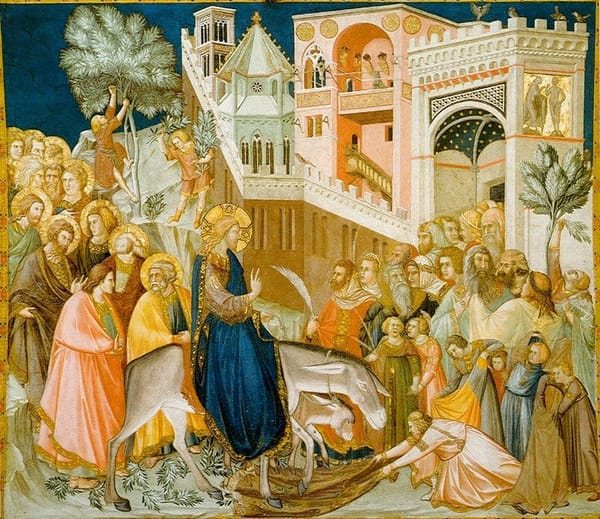
Early in the morning of this day, Jesus sets out for Jerusalem, leaving Mary His Mother, and the two sisters Martha and Mary Magdalene, and Lazarus, at Bethania. The Mother of sorrows trembles at seeing her Son thus expose Himself to danger, for His enemies are bent upon His destruction; but it is not death, it is triumph, that Jesus is to receive to-day in Jerusalem. The Messias, before being nailed to the cross, is to be proclaimed King by the people of the great city; the little children are to make her streets echo with their Hosannas to the Son of David; and this in presence of the soldiers of Rome’s emperor, and of the high priests and pharisees: the first standing under the banner of their eagles; the second, dumb with rage.
The prophet Zachary had foretold this triumph which the Son of Man was to receive a few days before His Passion, and which had been prepared for Him from all eternity, ‘Rejoice greatly, O daughter of Sion! Shout for joy, O daughter of Jerusalem! Behold thy King will come to thee; the Just and the Saviour. He is poor, and riding upon an ass, and upon a colt, the foal of an ass.’1 Jesus, knowing that the hour has come for the fulfilment of this prophecy, singles out two from the rest of His disciples, and bids them lead to Him an ass and her colt, which they would find not far off. He has reached Bethphage, on Mount Olivet. The two disciples lose no time in executing the order given them by their divine Master; and the ass and the colt are soon brought to the place where He stands.
The holy fathers have explained to us the mystery of these two animals. The ass represents the Jewish people, which had been long under the yoke of the Law; the colt, upon which, as the evangelist says, no man yet hath sat,2 is a figure of the Gentile world, which no one had ever yet brought into subjection. The future of these two peoples is to be decided a few days hence: the Jews will be rejected, for having refused to acknowledge Jesus as the Messias; the Gentiles will take their place, to be adopted as God’s people, and become docile and faithful.
The disciples spread their garments upon the colt; and our Saviour, that the prophetic figure might be fulfilled, sits upon him,3 and advances towards Jerusalem. As soon as it is known that Jesus is near the city, the holy Spirit works in the hearts of those Jews, who have come from all parts to celebrate the feast of the Passover. They go out to meet our Lord, holding palm branches in their hands, and loudly proclaiming Him to be King.4 They that have accompanied Jesus from Bethania, join the enthusiastic crowd. Whilst some spread their garments on the way, others cut down boughs from the palm-trees, and strew them along the road. Hosanna is the triumphant cry, proclaiming to the whole city that Jesus, the Son of David, has made His entrance as her King.
Thus did God, in His power over men’s hearts, procure a triumph for His Son, and in the very city which, a few days later, was to clamour for His Blood. This day was one of glory to our Jesus, and the holy Church would have us renew, each year, the memory of this triumph of the Man-God. Shortly after the birth of our Emmanuel, we saw the Magi coming from the extreme east, and looking in Jerusalem for the King of the Jews, to whom they intended offering their gifts and their adorations: but it is Jerusalem herself that now goes forth to meet this King. Each of these events is an acknowledgment of the kingship of Jesus; the first, from the Gentiles; the second, from the Jews. Both were to pay Him this regal homage, before He suffered His Passion. The inscription to be put upon the cross, by Pilate’s order, will express the kingly character of the Crucified: Jesus of Nazareth, King of the Jews. Pilate, the Roman governor, the pagan, the base coward, has been unwittingly the fulfiller of a prophecy; and when the enemies of Jesus insist on the inscription being altered, Pilate will not deign to give them any answer but this: ‘What I have written, I have written.’ To-day, it is the Jews themselves that proclaim Jesus to be their King: they will soon be dispersed, in punishment for their revolt against the Son of David; but Jesus is King, and will be so for ever. Thus were literally verified the words spoken by the Archangel to Mary, when he announced to her the glories of the Child that was to be born of her: ‘The Lord God shall give unto Him the throne of David, His father; and He shall reign in the house of Jacob for ever.’5 Jesus begins His reign upon the earth this very day; and though the first Israel is soon to disclaim His rule, a new Israel, formed from the faithful few of the old, shall rise up in every nation of the earth, and become the kingdom of Christ, a kingdom such as no mere earthly monarch ever coveted in his wildest fancies of ambition.
This is the glorious mystery which ushers in the great week, the week of dolours. Holy Church would have us give this momentary consolation to our heart, and hail our Jesus as our King. She has so arranged the service of to-day, that it should express both joy and sorrow; joy, by uniting herself with the loyal hosannas of the city of David; and sorrow, by compassionating the Passion of her divine Spouse. The whole function is divided into three parts, which we will now proceed to explain.
The first is the blessing of the palms; and we may have an idea of its importance from the solemnity used by the Church in this sacred rite. One would suppose that the holy Sacrifice has begun, and is going to be offered up in honour of Jesus, entry into Jerusalem. Introit, Collect, Epistle, Gradual, Gospel, even a Preface, are said, as though we were, as usual, preparing for the immolation of the spotless Lamb; but, after the triple Sanctus! Sanctus! Sanctus! the Church suspends these sacrificial formulas, and turns to the blessing of the palms. The prayers she uses for this blessing are eloquent and full of instruction; and, together with the sprinkling with holy water and the incensation, impart a virtue to these branches, which elevates them to the supernatural order, and makes them means for the sanctification of our souls and the protection of our persons and dwellings. The faithful should hold these palms in their hands during the procession, and during the reading of the Passion at Mass, and keep them in their homes as an outward expression of their faith, and as a pledge of God’s watchful love.
It is scarcely necessary to tell our reader that the palms or olive branches, thus blessed, are carried in memory of those wherewith the people of Jerusalem strewed the road, as our Saviour made His triumphant entry; but a word on the antiquity of our ceremony will not be superfluous. It began very early in the east. It is probable that, as far as Jerusalem itself is concerned, the custom was established immediately after the ages of persecution. St. Cyril, who was bishop of that city in the fourth century, tells us that the palm-tree, from which the people cut the branches when they went out to meet our Saviour, was still to be seen in the vale of Cedron.6 Such a circumstance would naturally suggest an annual commemoration of the great event. In the following century, we find this ceremony established, not only in the churches of the east, but also in the monasteries of Egypt and Syria. At the beginning of Lent, many of the holy monks obtained permission from their abbots to retire into the desert, that they might spend the sacred season in strict seclusion; but they were obliged to return to their monasteries for Palm Sunday, as we learn from the life of Saint Euthymius, written by his disciple Cyril.7 In the west, the introduction of this ceremony was more gradual; the first trace we find of it is in the sacramentary of St. Gregory, that is, at the end of the sixth, or the beginning of the seventh, century. When the faith had penetrated into the north, it was not possible to have palms or olive branches; they were supplied by branches from other trees. The beautiful prayers used in the blessing, and based on the mysteries expressed by the palm and olive trees, are still employed in the blessing of our willow, box, or other branches; and rightly, for these represent the symbolical ones which nature has denied us.
The second of to-day’s ceremonies is the procession, which comes immediately after the blessing of the palms. It represents our Saviour’s journey to Jerusalem, and His entry into the city. To make it the more expressive, the branches that have just been blessed are held in the hand during it. With the Jews, to hold a branch in one’s hand was a sign of joy. The divine law had sanctioned this practice, as we read in the following passage from Leviticus, where God commands His people to keep the feast of tabernacles: 'And you shall take to you, on the first day, the fruits of the fairest tree, and branches of palm-trees, and boughs of thick trees, and willows of the brook, and you shall rejoice before the Lord your God.'8 It was, therefore, to testify their delight at seeing Jesus enter within their walls, that the inhabitants, even the little children, of Jerusalem, went forth to meet Him with palms in their hands. Let us, also, go before our King, singing our hosannas to Him as the conqueror of death, and the liberator of His people.
During the middle ages, it was the custom, in many churches, to carry the book of the holy Gospels in this procession. The Gospel contains the words of Jesus Christ, and was considered to represent Him. The procession halted at an appointed place, or station: the deacon then opened the sacred volume, and sang from it the passage which describes our Lord’s entry into Jerusalem. This done, the cross which, up to this moment, was veiled, was uncovered; each of the clergy advanced towards it, venerated it, and placed at its foot a small portion of the palm he held in his hand. The procession then returned, preceded by the cross, which was left unveiled until all had re-entered the church. In England and Normandy, as far back as the eleventh century, there was practised a holy ceremony which represented, even more vividly than the one we have just been describing, the scene that was witnessed on this day at Jerusalem: the blessed Sacrament was carried in procession. The heresy of Berengarius, against the real presence of Jesus in the Eucharist, had been broached about that time; and the tribute of triumphant joy here shown to the sacred Host was a distant preparation for the feast and procession which were to be instituted at a later period.
A touching ceremony was also practised in Jerusalem during to-day’s procession, and, like those just mentioned, was intended to commemorate the event related by the Gospel. The whole community of the Franciscans (to whose keeping the holy places are entrusted) went in the morning to Bethphage. There, the father guardian of the holy Land, being vested in pontifical robes, mounted upon an ass, on which garments were laid. Accompanied by the friars and the Catholics of Jerusalem, all holding palms in their hands, he entered the city, and alighted at the church of the holy sepulchre where Mass was celebrated with all possible solemnity.
This beautiful ceremony, which dated from the period of the Latin kingdom in Jerusalem, has been forbidden, for now almost two hundred years, by the Turkish authorities of the city.
We have mentioned these different usages, as we have done others on similar occasions, in order to aid the faithful to the better understanding of the several mysteries of the liturgy. In the present instance, they will learn that, in to-day’s procession, the Church wishes us to honour Jesus Christ as though He were really among us, and were receiving the humble tribute of our loyalty. Let us lovingly go forth to meet this our King, our Saviour, who comes to visit the daughter of Sion, as the prophet has just told us. He is in our midst; it is to Him that we pay honour with our palms: let us give Him our hearts too. He comes that He may be our King; let us welcome Him as such, and fervently cry out to Him: ‘Hosanna to the Son of David!'
At the close of the procession a ceremony takes place, which is full of the sublimest symbolism. On returning to the church, the doors are found to be shut. The triumphant procession is stopped; but the songs of joy are continued. A hymn in honour of Christ our King is sung with its joyous chorus; and at length the subdeacon strikes the door with the staff of the cross; the door opens, and the people, preceded by the clergy, enter the church, proclaiming the praise of Him, who is our resurrection and our life.
This ceremony is intended to represent the entry of Jesus into that Jerusalem of which the earthly one was but the figure—the Jerusalem of heaven, which has been opened for us by our Saviour. The sin of our first parents had shut it against us; but Jesus, the King of glory, opened its gates by His cross, to which every resistance yields. Let us, then, continue to follow in the footsteps of the Son of David, for He is also the Son of God, and He invites us to share His kingdom with Him. Thus, by the procession, which is commemorative of what happened on this day, the Church raises up our thoughts to the glorious mystery of the Ascension, whereby heaven was made the close of Jesus’ mission on earth. Alas! the interval between these two triumphs of our Redeemer are not all days of joy; and no sooner is our procession over, than the Church, who had laid aside for a moment the weight of her grief, falls back into sorrow and mourning.
The third part of to-day’s service is the offering of the holy Sacrifice. The portions that are sung by the choir are expressive of the deepest desolation; and the history of our Lord’s Passion, which is now to be read by anticipation, gives to the rest of the day that character of sacred gloom, which we all know so well. For the last five or six centuries, the Church has adopted a special chant for this narrative of the holy Gospel. The historian, or the evangelist, relates the events in a tone that is at once grave and pathetic; the words of our Saviour are sung to a solemn yet sweet melody, which strikingly contrasts with the high dominant of the several other interlocutors and the Jewish populace. During the singing of the Passion, the faithful should hold their palms in their hands, and, by this emblem of triumph, protest against the insults offered to Jesus by His enemies. As we listen to each humiliation and suffering, all of which were endured out of love for us, let us offer Him our palm as to our dearest Lord and King. When should we be more adoring, than when He is most suffering?
These are the leading features of this great day. According to our usual plan, we will add to the prayers and lessons any instructions that seem to be needed.
This Sunday, besides its liturgical and popular appellation of Palm Sunday, has had several other names. Thus it was called Hosanna Sunday, in allusion to the acclamation wherewith the Jews greeted Jesus on His entry into Jerusalem. Our forefathers used also to call it Pascha Floridum, because the feast of the Pasch (or Easter), which is but eight days off, is to-day in bud, so to speak, and the faithful could begin from this Sunday to fulfil the precept of Easter Communion. It was in allusion to this name, that the Spaniards, having on the Palm Sunday of 1513, discovered the peninsula on the Gulf of Mexico, called it Florida. We also find the name of Capitilavium given to this Sunday, because, during those times when it was the custom to defer till Holy Saturday the baptism of infants born during the preceding months (where such a delay entailed no danger), the parents used, on this day, to wash the heads of these children, out of respect to the holy chrism wherewith they were to be anointed. Later on, this Sunday was, at least in some churches, called the Pasch of the competents, that is, of the catechumens, who were admitted to Baptism; they assembled to-day in the church, and received a special instruction on the symbol, which had been given to them in the previous scrutiny. In the Gothic Church of Spain, the symbol was not given till to-day. The Greeks call this Sunday Baïphoros, that is, Palmbearing.
THE BLESSING OF THE PALMS
It begins with the chanting of the following antiphon, which serves as an Introit.
Antiphon
Recording of the antiphon:
https://www.youtube.com/watch?v=S5sfnrALK0g
The priest then sums up, in the following prayer, the petitions of the faithful. This is what he asks for his people: that after this short life is over, they may come to that eternal kingdom, which has been prepared for them by the Death and Resurrection of Jesus.
After this prayer, the subdeacon chants a passage from the Book of Exodus, which relates how the people of God, after they had gone forth from Egypt, pitched their tents at Elim, beneath the shade of seventy palm-trees, where also were twelve fountains. While here, they were told by Moses that God was about to send them manna from heaven, and that, on the very next morning, their hunger would be appeased. These were figures of what is now given to the Christian people. The faithful, by a sincere conversion, have separated themselves from the Egypt of a sinful world. They are offering the palms of their loyalty and love to Jesus, their King. The fountains typify the Baptism, which, a few days hence, is to be administered to our catechumens. These fountains are twelve in number; the twelve articles of the symbol of our faith were preached to the world by the twelve apostles. And finally, on the morning of Easter day, Jesus, the Bread of life, the heavenly Manna, will arise from the tomb, and manifest His glory to us.
Cap. xv.In diebus illis: Venerunt filii Israel in Elim, ubi erant duodecim fontes aquarum, et Septuaginta palmæ: et castrametati sunt juxta aquas. Profectique sunt de Elim: et venit omnis multitudo filiorum Israel in desertum Sin, quod est inter Elim et Sinai: quintodecimo die mensis secundi, postquam egressi sunt de terra Ægypti. Et murmuravit omnis congregatio filiorum Israel contra Moysen et Aaron in solitudine. Dixeruntque filii Israel ad eos: Utinam mortui essemus per manum Domini in terra Ægypti, quando sedebamus super ollas carnium: et comedebamus panem in saturitate. Cur induxistis nos in desertum istud, ut occideretis omnem multitudinem fame? Dixit autem Dominus ad Moysen: Ecce ego pluam vobis panes de cœlo. Egrediatur populus, et colligat quæ sufficiunt per singulos dies: ut tentem eum, utrum ambulet in lege mea, an non. Die autem sexto parent quod inferant: et sit duplum, quam colligere solebant per singulos dies. Dixeruntque Moyses et Aaron ad omnes filios Israel: Vespere scietis, quod Dominus eduxerit vos de terra Ægypti: et mane videbitis gloriam Domini.
Ch. xv.In those days, the children of Israel came into Elim, where there were twelve fountains of water, and seventy palm-trees; and they encamped by the waters. And they set forward from Elim; and all the multitude of the children of Israel came into the desert of Sin, which is between Elim and Sinai, the fifteenth day of the second month after they came out of the land of Egypt. And all the congregation of the children of Israel murmured against Moses and Aaron in the wilderness. And the children of Israel said to them: Would to God we had died by the hand of the Lord in the land of Egypt, when we sat over the flesh pots, and ate bread to the full. Why have you brought us into this desert, that you might destroy all the multitude with famine? And the Lord said to Moses: Behold I will rain bread from heaven for you; let the people go forth, and gather what is sufficient for every day, that I may prove them whether they will walk in my law, or no. But the sixth day let them provide for to bring in, and let it be double to that they were wont to gather every day. And Moses and Aaron said to the children of Israel: In the evening you shall know that the Lord hath brought you forth out of the land of Egypt: and in the morning you shall see the glory of the Lord.
After this lesson, the choir sings one of the two following responsories, which commemorate the Passion of our Lord.
Responsory
Recording of the responsory:
https://www.youtube.com/watch?v=LLoLVshD3qc
The deacon then chants, from the Gospel of Saint Matthew, the history of Jesus’ triumphant entry into Jerusalem. The palms of the new Testament entwine with those of the old, in honour of the Man-God, who is the connecting link of both.
Gospel
Cap. xxi.In illo tempore: Cum appropinquasset Jesus Jerosolymis et venisset Bethphage, ad montem Oliveti; tunc misit duos discipulos, dicens eis: Ite in castellum, quod contra vos est: et statini invenietis asinam alligatam et pullum cum ea: solvite, et adducite mihi. Et si quis vobis aliquid dixerit, dicite quia Dominus his opus habet: et confestim dimittet eos. Hoc autem totum factum est, ut adimpleretur quod dictum est per prophetam dicentem: Dicite filiæ Sion: Ecce Rex tuus venit tibi mansuetus, sedens super asinam, et pullum filiura subjugalis. Euntes autem discipuli, fecerunt sicut præcepit illis Jesus. Et adduxerunt asinam, et pullum: et imposuerunt super eos vestimenta sua, et eum desuper sedere fecerunt. Plurima autem turba straverunt vestimenta sua in via. Alii autem cædebant ramos de arboribus, et sternebant in via. Turbæ autem quæ præcedebant, et quæ sequebantur, clamabant, dicentes: Hosanna filio David! benedictus qui venit in nomine Domini!
Ch. xxi.At that time: When Jesus drew nigh to Jerusalem, and was come to Bethphage, unto mount Olivet, he sent two disciples, saying to them: Go ye into the village that is over against you, and immediately you shall find an ass tied and a colt with her; loose them and bring them to me. And if any man shall say anything to you, say ye, that the Lord hath need of them; and forthwith he will let them go. Now all this was done that it might be fulfilled which was spoken by the prophet, saying: Tell ye the daughter of Sion: Behold, thy King cometh to thee, meek, and sitting upon an ass, and a colt, the foal of her that is used to the yoke. And the disciples going, did as Jesus commanded them: and they brought the ass and the colt, and laid their garments upon them, and made him sit thereon. And a very great multitude spread their garments in the way, and others cut boughs from the trees, and strewed them in the way; and the multitudes that went before and that followed, cried, saying: Hosanna to the Son of David! Blessed is he that cometh in the name of the Lord!
And now the mystery-speaking palms are to receive the Church’s blessing. The priest begins by two scriptural allusions: the first is to Noah, who received an olive-branch, when the waters of the deluge had subsided; the second is to Moses, whose people, after quitting Egypt, encamped under the seventy palm-trees. Then in the solemn tone of the Preface, he calls upon all creatures to give praise to the adorable name of Jesus, for whom we are preparing the homage of our devoted love. Let us respond to the invitation, and sing with all our hearts: Holy! Holy! Holy!—Hosanna in excelsis!
Pleni sunt coeli et terra gloria tua.
Hosanna in excelsis.
Benedictus qui venit in nomine Domini.
Hosanna in excelsis.
Heaven and earth are full of thy glory.
Hosanna in the highest!
Blessed is he that cometh in the name of the Lord.
Hosanna in the highest!
The prayers which now follow, explain the mystery of the palms, and draw down the blessing of God both upon them and upon the faithful who receive and keep them with proper dispositions.
The priest completes the blessing of the palms by sprinkling them with holy water and thurifying them with incense. After which, he adds the following prayer.
After this prayer, the priest distributes the palms to the faithful.9 During the distribution, the choir reminds us, by the two following antiphons, of the enthusiasm of the little children of Jerusalem, who, with their palms in their hands, sang their loud: Hosanna to the Son of David!
Antiphon
Recording of the antiphon:
https://www.youtube.com/watch?v=a16POhiuP8c
Antiphon
Recording of the antiphon:
https://www.youtube.com/watch?v=XKw_52x9dj8
As soon as the distribution is over, the priest concludes this first part of the service by the following prayer.
THE PROCESSION
The priest having blessed the incense—which, according to the custom of the Church, always heads a procession and sheds its perfume along the path that is to be taken—the deacon turns towards the people, and gives the signal for departure, with these words:
The choir answers:
The procession then advances, the clergy and people holding the palms in their hands. The choir chants the following antiphons, in honour of Jesus, the King of Israel.
Antiphon
Recording of the antiphon:
https://www.youtube.com/watch?v=WHNz7NE__tg
Antiphon
Recording of the antiphon:
https://www.youtube.com/watch?v=6JVZpN273ps
Antiphon
Recording of the antiphon:
https://www.youtube.com/watch?v=41GyvDYbFqU
Antiphon
Recording of the antiphon:
https://www.youtube.com/watch?v=F8Ee5Q1IWZE
Antiphon
Recording of the antiphon:
https://www.youtube.com/watch?v=DxIFVMTYeM4
Antiphon
The procession is now on its return to the church: but it cannot enter, for the doors are shut. We have already explained the meaning of this part of the ceremony. Immediately there are heard voices within the holy place; they are singing the praises of Christ, our King and Saviour. These cantors represent the holy angels in heaven, who are greeting the entry of Jesus into the eternal Jerusalem. Outside the church, there stands the choir, re-echoing the hymn of triumph; but it is man celebrating the entry of the Son of David into the earthly Jerusalem. The two choirs are thus kept separated from each other, until at length the victorious cross throws open the door, which represents the gate of heaven, and unites the Church militant with the Church triumphant. The hymn which is sung during this ceremony, was composed by Theodulf bishop of Orleans, when prisoner at Angers, by order of Louis the Good. The Church of Rome, by using the first six stanzas of this short poem, has immortalized it throughout the world.
The cantors within the church begin the first stanza, which is repeated by the choir without, not only after this, but also after each of the following five stanzas.
Hymn
Cui puerile decus prompsit Hosanna pium.
to whom the innocent children sang their fervent Hosanna.
Nomine qui in Domini, rex benedicte, venis.℟. Gloria, laus.
Et mortalis homo, et cuncta creata simul.℟. Gloria, laus.
Cum prece, voto, hymnis, adsumus ecce tibi.℟. Gloria, laus.
Nos tibi regnanti pangimus ecce melos.℟. Gloria, laus.
Rex bone, rex clemens, cui bona cuncta placent.℟. Gloria, laus.
Blessed art thou our King! that comest in the name of the Lord.℟. Glory, praise, &c.
and men on earth, and all created things praise thee.℟. Glory, praise, &c.
behold, we, too, present ourselves before thee, with our prayers, desires, and hymns.℟. Glory, praise, &c.
we sing our hymn to thee seated on thy throne.℟. Glory, praise, &c.
O dear and merciful King! to whom all is pleasing that is good.℟. Glory, praise, &c.
Recording of the Hymn:
https://www.youtube.com/watch?v=xtm0Jy1OFHM
As soon as the choir has sung its response to the last stanza, the subdeacon knocks with the cross at the door, which is immediately opened. In some places, it is the celebrant himself who performs this ceremony, and while doing it he recites the words of Psalm xxiii, in which David celebrates the entrance of our Redeemer into heaven on the day of His Ascension.
The procession then enters the church, singing the following responsory:
Responsory
Recording of the antiphon:
https://www.youtube.com/watch?v=BgLZrFHUHLY
Mass
The Station at Rome is in the basilica of St. John Lateran, the mother and mistress of all Churches. The papal function, however, now takes place at St. Peter’s; but the usual indulgences are still granted to those who visit the archbasilica.
The Mass of this Sunday retains no vestige of the joy, which characterized the ceremony of the palms. The Introit is taken from Psalm xxi, in which the royal prophet expresses the anguish of soul suffered by Jesus on the cross.
Introit
Ps. Deus, Deus meus, respice in me, quare me dereliquisti? Longe a salute mea verba delictorum meorum.
Domine, ne longe.
Ps. O God, my God, look upon me: why hast thou forsaken me? It is the cry of my sins that keeps salvation far from me.
O Lord, keep not, &c.
Recording of the Introit:
https://www.youtube.com/watch?v=MmM5BWlvFtg
In the Collect the Church prays that we may have grace to imitate the patience and humility of our Saviour. Jesus suffers and humbles Himself for us; it is but just that we should work out our salvation by following His example, that we should suffer, and be humble.
Collect
Epistle
Cap. ii.Fratres: Hoc enim sentite in vobis, quod et in Christo Jesu. Qui cum in forma Dei esset, non rapinam arbitratus est, esse se æqualem Deo: sed semetipsum exinanivit, formam servi accipiens, in similitudinem hominum factus, et habitu inventus ut homo. Humiliavit semetipsum, factus obediens usque ad mortem, mortem autem crucis. Propter quod et Deus exaltavit illum: et donavit illi nomen, quod est super omne nomen: ut in nomine Jesu (here, all kneel,) omne genu flectatur, cœlestium, terrestrium, et infernorum: et omnis lingua confiteatur, quia Dominus Jesus Christus in gloria est Dei Patris.
Ch. ii.Brethren: For let this mind be in you, which was also in Christ Jesus: who being in the form of God, thought it not robbery to be equal with God, but emptied himself, taking the form of a servant, being made in the likeness of men, and in habit found as a man. He humbled himself, becoming obedient unto death, even to the death of the cross. For which cause God also hath exalted him and hath given him a name which is above all names; that in the name of Jesus (here, all kneel,) every knee should bow, of those that are in heaven, on earth, and under the earth. And that every tongue should confess that the Lord Jesus Christ is in the glory of God the Father.
In obedience to the wishes of the Church, we have knelt down at those words of the apostle, where he says that every knee should bow at the holy name of Jesus. If there be one time of the year rather than another, when the Son of God has a right to our fervent adorations, it is this week, when we see Him insulted in His Passion. Not only should His sufferings excite us to tender compassion; we should also keenly resent the insults that are heaped upon our Jesus, the God of infinite majesty. Let us strive, by our humble homage, to make Him amends for the indignities He suffered in atonement for our pride. Let us unite with the holy angels, who, witnessing what He has gone through for the love of man, prostrate themselves, in profoundest adoration, at the sight of His humiliations.
In the Gradual, the Church makes use of the words of the royal prophet, who foretells the future glories of the Victim that dies on Calvary; but he also confesses that the success permitted to the enemies of Jesus had well nigh shaken his confidence.
Gradual
Recording of the antiphon:
https://www.youtube.com/watch?v=L_vhJ-IvDJI
The Tract consists of several verses taken from Psalm xxi, the first words of which were spoken by our Redeemer on the cross. So clear and explicit are the words of this psalm, that it might almost be called a history, as well as a prophecy, of the Passion.
Tract
Recording of the Tract:
https://www.youtube.com/watch?v=LnXYQkbB4mc
It is now time that we should hear the history of our Saviour’s Passion: but, in order that we may show both heaven and earth that we are not scandalized, as were the disciples, at the sight of His apparent weakness and the triumph of His enemies, we hold in our hands the palms, wherewith we have been proclaiming Him as our King.
The Church reads, on four different days of this week, the four evangelists’ narration of the Passion. She begins with that of St. Matthew, who was the first to write the Gospel. To express the sorrow which fills the hearts of the faithful, the acolytes do not carry the lights, nor is the book incensed. Omitting the customary salutation, the deacon, who is to take the part of the evangelist, at once begins the mournful history of our Lord’s sufferings and death.
The Passion and Gospel
Cum autem Jesus esset in Bethania, in domo Simonis leprosi, accessit ad eum mulier habens alabastrum unguenti pretiosi: et effudit super caput ipsius recumbentis. Videntes autem discipuli, indignati sunt, dicentes: ut quid perditio hæc? Potuit enim istud venundari multo, et dari pauperibus. Sciens autem Jesus, ait illis: Quid molesti estis huic mulieri? Opus enim bonum operata est in me. Nam semper pauperes habetis vobiscum: me autem non semper habetis. Mittens enim hæc unguentum hoc in corpus meum, ad sepeliendum me fecit. Amen dico vobis, ubicumque prædicatum fuerit hoc Evangelium in toto mundo, dicetur et quod hæc fecit in memoriam ejus.
Here the deacon pauses, and honours the Death of our Lord and Saviour by a solemn act of adoration. All the faithful kneel down, and remain for some time in that position. In many places, it is the custom to prostrate, and kiss the ground. The deacon then resumes his narration.
That the Mass of this Sunday may not be deprived of that essential rite which we call the Gospel, the deacon reserves a portion of the narrative; and going to the altar, he asks the priest to bless the incense. Which done, the deacon, himself also having received the priest’s blessing, goes to the place appointed for chanting the Gospel; but the acolytes do not carry their lights. After having thurified the book, he thus closes the history of the Passion.
Recording of St. Matthew Passion (Bach):
https://www.youtube.com/watch?v=ZwVW1ttVhuQ
The Offertory is again a prophecy of David. It foretells the state of abandonment to which our Saviour was to be reduced in the midst of all His sufferings, and the cruelty of His enemies, who would feed Him with gall and vinegar. Thus is He treated who is preparing to give us His Body for our food, and His Blood for our drink.
Offertory
Recording of the antiphon (Gregorian chant):
https://www.youtube.com/watch?v=YCBceN5Wtb0
Recording of the antiphon (Palestrina):
https://www.youtube.com/watch?v=oiEA8lCfM34
The Secret asks of God that He would impart to His servants the twofold fruit of Jesus’ Passion: grace in this life, and glory in the next.
Secret
In the Communion-anthem, the Church, after receiving into herself the life of Christ by the chalice of salvation, calls to our minds that other chalice which Jesus was to drink in order that He might gift us with immortality.
Communion
Recording of the antiphon:
https://www.youtube.com/watch?v=RmDey4MX3rA
The Church concludes the prayers of the Sacrifice she has just been offering, by asking the remission of sin for all her children, that they may see fulfilled that longing of their souls—a share in the glorious Resurrection of Jesus.
Postcommunion
Vespers
The psalms and antiphons are given on page 81.
Capitulum (Phil. ii.)
For the hymn and versicle, see page 89.
Antiphon of the Magnificat
Recording of the antiphon:
https://www.youtube.com/watch?v=u1H-cp3r3xg
Let us now go over in our minds the other events which happened to our divine Lord on this day of His solemn entry into Jerusalem. St. Luke tells us that it was on His approach to the city, that Jesus wept over it, and spoke these touching words: ‘If thou also hadst known, and that in this thy day, the things that are to thy peace! But now they are hidden from thine eyes. For the days shall come upon thee, and thine enemies shall cast a trench about thee, and compass thee round, and straiten thee on every side, and beat thee flat to the ground, and thy children who are in thee; and they shall not leave in thee a stone upon a stone; because thou hast not known the time of thy visitation.’10
A few days ago, we were reading in the holy Gospel how Jesus wept over the tomb of Lazarus; to-day He sheds tears over Jerusalem. At Bethania His weeping was caused by the sight of bodily death, the consequence and punishment of sin; but this death is not irremediable: Jesus is the resurrection and the life, and he that believeth in Him shall live.11 Whereas, the state of the unfaithful Jerusalem is a figure of the death of the soul, and from this there is no resurrection, unless the soul, while time is given to her, return to the Author of life. Hence it is, that the tears shed by Jesus over Jerusalem are so bitter. Amidst the acclamations which greet His entry into the city of David, His heart is sad; for He sees that many of her inhabitants will not profit of the time of her visitation. Let us console the Heart of our Jesus, and be to Him a faithful Jerusalem.
The sacred historian tells us that Jesus, immediately upon His entrance into the city, went to the temple, and cast out all them that sold and bought there.12 This was the second time that He had shown His authority in His Father’s house, and no one had dared to resist Him. The chief priests and pharisees found fault with Him, and accused Him to His face, of causing confusion by His entry into the city; but our Lord confounded them by the reply He made. It is thus that in after ages, when it has pleased God to glorify His Son and the Church of His Son, the enemies of both have given vent to their rage; they protested against the triumph, but they could not stop it. But when God, in the unsearchable ways of His wisdom, allowed persecution and trial to follow these periods of triumph, then did these bitter enemies redouble their efforts to induce the very people, that had cried Hosanna to the Son of David, to clamour for His being delivered up and crucified. They succeeded in fomenting persecution, but not in destroying the kingdom of Christ and His Church. The kingdom seemed, at times, to be interrupted in its progress; but the time for another triumph came. Thus will it be to the end; and then, after all these changes from glory to humiliation, and from humiliation to glory, the kingdom of Jesus and of His bride will gain the last and eternal triumph over this world, which would not know the time of its visitation.
We learn from St. Matthew13 that our Saviour spent the remainder of this day at Bethania. His blessed Mother and the house of Lazarus were comforted by His return. There was not a single offer of hospitality made to Him in Jerusalem, at least there is no mention in the Gospel of any such offer. We cannot help making the reflection, as we meditate upon this event of our Lord’s life:—an enthusiastic reception is given to Him in the morning, He is proclaimed by the people as their King; but when the evening of that day comes on, there is not one of all those thousands to offer Him food or lodging. In the Carmelite monasteries of St. Teresa’s reform, there is a custom, which has been suggested by this thought, and is intended as a reparation for this ingratitude shown to our Redeemer. A table is placed in the middle of the refectory; and after the community have finished their dinner, the food which was placed upon that table is distributed among the poor, and Jesus is honoured in them.
We give, as a conclusion to this day, a selection from the hymn used by the Greek Church on Palm Sunday. It was written by the celebrated hymnographer, Cosmas of Jerusalem.
Hymn (In Dominica Palmarum)
clamant: Benedictus qui venit in nomine Domini Salvatoris nostri.
that cry to him: Blessed is he that cometh in the name of the Lord our Saviour!
- Zach. ix. 9. ↩︎
- St. Mark xi. 2. ↩︎
- Ibid. 7, and St. Luke xix. 35. ↩︎
- St. Luke xix. 38. ↩︎
- St. Luke i. 32. ↩︎
- Cateches. x. versus fin. ↩︎
- Act. Ss. Jan. 20. ↩︎
- Lev. xxiii. 40. ↩︎
- In receiving the palm, the faithful should kiss first the palm itself, and then the priest's hand. ↩︎
- St. Matt. xxi.17. ↩︎
- St. John xi. 25. ↩︎
- St. Matt. xxi. 12. ↩︎
- St. Matt. xxi. 17. ↩︎
March 25: The Annunciation of the Ever Blessed Virgin
|
Including:
Feast of the Annunciation during Lent
This is a great day, not only to man, but even to God Himself; for it is the anniversary of the most solemn event that time has ever witnessed. On this day, the divine Word, by whom the Father created the world, was made flesh in the womb of a virgin, and dwelt among us.1 We must spend it in joy. Whilst we adore the Son of God who humbled Himself by thus becoming Man, let us give thanks to the Father, who so loved the world, as to give His only-begotten Son;2 let us give thanks to the Holy Ghost, whose almighty power achieves the great mystery. We are in the very midst of Lent, and yet the ineffable joys of Christmas are upon us: our Emmanuel is conceived on this day, and, nine months hence, will be born in Bethlehem, and the angels will invite us to come and honour the sweet Babe.
During Septuagesima week, we meditated upon the fall of our first parents, and the triple sentence pronounced by God against the serpent, the woman, and Adam. Our hearts were filled with fear as we reflected on the divine malediction, the effects of which are to be felt by all generations, even to the end of the world. But in the midst of the anathemas then pronounced against us, a promise was made us by our God; it was a promise of salvation, and it enkindled hope within us. In pronouncing sentence against the serpent, God said that his head should one day be crushed, and that, too, by a woman.
The time has come for the fulfilment of this promise. The world has been in expectation for four thousand years; and the hope of its deliverance has been kept up, in spite of all its crimes. During this time, God has made use of miracles, prophecies, and types, as a renewal of the engagement He has entered into with mankind. The blood of the Messias has passed from Adam to Noe; from Sem to Abraham, Isaac and Jacob; from David and Solomon to Joachim; and now it flows in the veins of Mary, Joachim’s daughter. Mary is the woman by whom is to be taken from our race the curse that lies upon it. God has decreed that she should be Immaculate; and has thereby set an irreconcilable enmity between her and the serpent. She, a daughter of Eve, is to repair all the injury done by her mother’s fall; she is to raise up her sex from the degradation into which it has been cast; she is to co-operate, directly and really, in the victory which the Son of God is about to gain over His and our enemy.
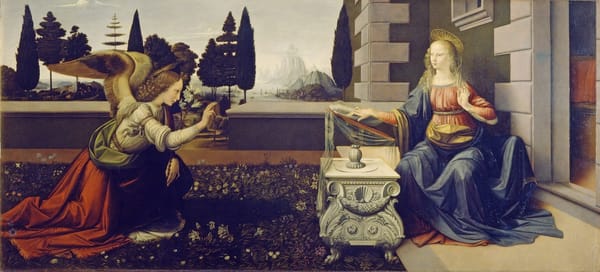
A tradition, which has come down from the apostolic ages, tells us that the great mystery of the Incarnation was achieved on the twenty-fifth day of March.3 It was at the hour of midnight, when the most holy Virgin was alone and absorbed in prayer, that the Archangel Gabriel appeared before her, and asked her, in the name of the blessed Trinity, to consent to become the Mother of God. Let us assist, in spirit, at this wonderful interview between the angel and the Virgin: and, at the same time, let us think of that other interview which took place between Eve and the serpent. A holy bishop and marytr of the second century, Saint Irenæus, who had received the tradition from the very disciples of the apostles, shows us that Nazareth is the counterpart of Eden.4
In the garden of delights there is a virgin and an angel; and a conversation takes place·between them. At Nazareth a virgin is also addressed by an angel, and she answers him; but the angel of the earthly paradise is a spirit of darkness, and he of Nazareth is a spirit of light. In both instances it is the angel that has the first word. ‘Why,’ said the serpent to Eve, ‘hath God commanded you, that you should not eat of every tree of paradise?’ His question implies impatience and a solicitation to evil; he has contempt for the frail creature to whom he addresses it, but he hates the image of God which is upon her.
See, on the other hand, the angel of light; see with what composure and peacefulness he approaches the Virgin of Nazareth, the new Eve; and how respectfully he bows himself down before her: ‘Hail, full of grace! The Lord is with thee! Blessed art thou among women! Such language is evidently of heaven: none but an angel could speak thus to Mary.
Eve imprudently listens to the tempter’s words; she answers him; she enters into conversation with one that dares to ask her to question the justice of God’s commands. Her curiosity urges her on. She has no mistrust in the serpent; this leads her to mistrust her Creator.
Mary hears what Gabriel has spoken to her; but this most prudent Virgin is silent. She is surprised at the praise given her by the angel. The purest and humblest of virgins has a dread of flattery; and the heavenly messenger receives no reply from her, until he has fully explained his mission by these words: ‘Fear not, Mary, for thou hast found grace with God. Behold, thou shalt conceive in thy womb, and shalt bring forth a Son: and thou shalt call His name Jesus. He shall be great, and shall be called the Son of the Most High, and the Lord God shall give unto Him the throne of David His father: and He shall reign in the house of Jacob for ever, and of His kingdom there shall be no end.’
What magnificent promises are these, which are made to her in the name of God! What higher glory could she, a daughter of Juda, desire, knowing, as she does, that the fortunate Mother of the Messias is to be the object of the greatest veneration? And yet it tempts her not. She has for ever consecrated her virginity to God, in order that she may be the more closely united to Him by love. The grandest possible privilege, if it is to be on the condition of violating this sacred vow, would be less than nothing in her estimation. She thus answers the angel: ‘How shall this be done? because I know not man.’
The first Eve evinces no such prudence or disinterestedness. No sooner has the wicked spirit assured her that she may break the commandment of her divine Benefactor and not die; that the fruit of her disobedience will be a wonderful knowledge, which will put her on an equality with God Himself: than she immediately yields; she is conquered. Her self-love has made her at once forget both duty and gratitude: she is delighted at the thought of being freed from the twofold tie which binds her to her Creator.
Such is the woman that caused our perdition. But how different is she that was to save us! The former cares not for her posterity; she looks but to her own interests: the latter forgets herself to think only of her God, and of the claims He has to her service. The angel, charmed with this sublime fidelity, thus answers the question put to him by Mary, and reveals to her the designs of God: ‘The Holy Ghost shall come upon thee, and the power of the Most High shall overshadow thee. And therefore also the Holy which shall be born of thee shall be called the Son of God. And behold thy cousin Elizabeth, she also hath conceived a son in her old age; and this is the sixth month with her that is called barren; because no word shall be impossible with God.’ This said, he is silent, and reverently awaits the answer of the Virgin of Nazareth.
Let us look once more at the virgin of Eden. Scarcely has the wicked spirit finished speaking than Eve casts a longing look at the forbidden fruit: she is impatient to enjoy the independence it is to bring her. She rashly stretches forth her hand; she plucks the fruit; she eats it, and death takes possession of her: death of the soul, for sin extinguishes the light of life; and death of the body, which, being separated from the source of immortality, becomes an object of shame and horror, and finally crumbles into dust.
But let us turn away our eyes from this sad spectacle, and fix them on Nazareth. Mary has heard the angel’s explanation of the mystery; the will of heaven is made known to her, and how grand an honour it is to bring upon her! She, the humble maid of Nazareth, is to have the ineffable happiness of becoming the Mother of God, and yet the treasure of her virginity is to be left to her! Mary bows down before this sovereign will, and says to the heavenly messenger: ‘Behold the handmaid of the Lord: be it done to me according to thy word.’
Thus, as the great St. Irenæus and so many of the holy fathers remark, the obedience of the second Eve repaired the disobedience of the first: for no sooner does the Virgin of Nazareth speak her fiat, ‘be it done,’ than the eternal Son of God (who, according to the divine decree, awaited this word) is present, by the operation of the Holy Ghost, in the chaste womb of Mary, and there He begins His human life. A Virgin is a Mother, and Mother of God; and it is this Virgin’s consenting to the divine will that has made her conceive by the power of the Holy Ghost. This sublime mystery puts between the eternal Word and a mere woman the relations of Son and Mother; it gives to the almighty God a means whereby He may, in a manner worthy of His majesty, triumph over satan, who hitherto seemed to have prevailed against the divine plan.
Never was there a more entire or humiliating defeat than that which this day befel satan. The frail creature, over whom he had so easily triumphed at the beginning of the world, now rises and crushes his proud head. Eve conquers in Mary. God would not choose man for the instrument of His vengeance; the humiliation of satan would not have been great enough; and therefore she who was the first prey oi hell, the first victim of the tempter, is selected to give battle to the enemy. The result of so glorious a triumph is that Mary is to be superior not only to the rebel angels, but to the whole human race, yea, to all the angels of heaven. Seated on her exalted throne, she, the Mother of God, is to be the Queen of all creation. Satan, in the depths of the abyss, will eternally bewail his having dared to direct his first attack against the woman, for God has now so gloriously avenged her; and in heaven, the very Cherubim and Seraphim reverently look up to Mary, and deem themselves honoured when she smiles upon them, or employs them in the execution of any of her wishes, for she is the Mother of their God.
Therefore is it that we, the children of Adam, who have been snatched by Mary’s obedience from the power of hell, solemnize this day of the Annunciation. Well may we say of Mary those words of Debbora, when she sang her song of victory over the enemies of God’s people: ‘The valiant men ceased, and rested in Israel, until Debbora arose, a mother arose in Israel. The Lord chose new wars, and He Himself overthrew the gates of the enemies.’5 Let us also refer to the holy Mother of Jesus these words of Judith, who by her victory over the enemy was another type of Mary: ‘Praise ye the Lord our God, who hath not forsaken them that hope in Him. And by me, His handmaid, He hath fulfilled His mercy, which He promised to the house of Israel; and He hath killed the enemy of His people by my hand this night . . . . The almighty Lord hath struck him, and hath delivered him into the hands of a woman, and hath slain him.’6
First Vespers
When the Annunciation falls on any other day than Monday, the first Vespers of this feast are sung before midday, according to the rule prescribed for fast-days of Lent: but when it falls on a Monday, this Office is celebrated at the ordinary time of Vespers, and only & commemoration is made of the Sunday by the Magnificat antiphon and the prayer.
The Office of first Vespers is always the commencement of a feast. The antiphons of the Vespers, at which we are going to assist, are taken from the Gospel of St. Luke, where the evangelist reveals to us the sublime interview between the angel and the Virgin. The psalms are those which tradition has consecrated to the celebration of Mary’s glories. We have elsewhere7 shown how each of the five refers to the Mother of God.
Psalm 109
Donec ponam inimicos tuos: * scabellum pedum tuorum.
Virgam virtutis tuæ emittet Dominus ex Sion: * dominare in medio inimicorum tuorum.
Tecum principium in die virtutis tuæ in splendoribus sanctorum: * ex utero ante luciferum genui te.
Juravit Dominus, et non pœnitebit eum: * Tu es Sacerdos in æternum secundum ordinem Melchisedech.
Dominus a dextris tuis: * confregit in die iræ suæ reges.
Judicabit in nationibus, implebit ruinas: * conquassabit capita in terra multorum.
De torrente in via bibet: * propterea exaltabit caput.
Until, on the day of thy last earning, I make thy enemies thy footstool.
O Christ! the Lord thy Father, will send forth the sceptre of thy power out of Sion: from thence rule thou in the midst of thy enemies.
With thee is the principality in the day of thy strength, in the brightness of the Saints: For the Father hath said to thee: From the womb, before the day-star, I begot thee.
The Lord hath sworn, and he will not repent: he hath said, speaking of thee, the God-Man: Thou art a Priest for ever, according to the order of Melchisedech.
Therefore, O Father, the Lord, thy Son, is at thy right hand: he hath broken kings in the day of his wrath.
He shall also judge among nations: he shall fill the ruins of the world: he shall crush the heads in the land of many.
He cometh now in humility: he shall drink, in the way, of the torrent of sufferings: therefore, shall he lift up the head.
Ant. Ave, Maria, gratia plena, Dominus tecum: nenedicta tu in mulieribus.
Ant. Hail, Mary, full of grace, the Lord is with thee: blessed art thou among women.
Psalm 112
Sit nomen Domini benedictum: * ex hoc nunc et usque in sæculum.
A solis ortu usque ad occasum: * laudabile nomen Domini.
Excelsus super omnes gentes Dominus: * et super cælos gloria ejus.
Quis sicut Dominus Deus noster qui in altis habitat: * et humilia respicit in cœlo et in terra?
Suscitans a terra inopem: * et de stercore erigens pauperem.
Ut collocet eum cum principibus: * cum principibus populi sui.
Qui habitare facit sterilem in domo: * matrem filiorum lætantem.
Blessed be the name of the Lord: from henceforth, now and for ever.
From the rising of the sun unto the going down of the same, the name of the Lord is worthy of praise.
The Lord is high above all nations: and his glory above the heavens.
Who is as the Lord our God, who dwelleth on high: and looketh down on the ow things in heaven and in earth, nay, who cometh down amidst us?
Raising up the needy from the earth: and lifting up the poor out of the dunghill.
That he may place him with princes: with the princes of his people.
Who maketh a barren woman to dwell in a house, the joyful mother of children.
Ant. Ne timeas, Maria; invenisti gratiam apud Dominum: ecce concipies, et paries filium.
Ant. Fear not, Mary; thou hast found grace with God: behold thou shalt conceive, and shalt bring forth a Son.
Psalm 121
Stantes erant pedes nostri: * in atriis tuis, Jerusalem.
Jerusalem quæ ædificatur at civitas: * cujus participate ejus in idipsum.
Illuc enim ascenderunt tribus, tribus Domini: * testimonium Israël ad confiten dum nomini Domini.
Quia illic sederunt sedes in judicio: * sedes super domum David.
Rogate quæ ad pacem sunt Jerusalem: * et abundantia diligentibus te.
Fiat pax in virtute tua: * et abundantia in turribus tuis.
Propter fratres meos et proximos meos: * loque bar pacem de te.
Propter domum Domini Dei nostri: * quæsivi bona tibi.
Our feet were standing in thy courts, O Jerusalem! Our heart loves and confides in thees O Mary.
Mary is like to Jerusalem, that is built as a city; which is compact together.
For thither did the tribes go up, the tribes of the Lord: the testimony of Israel, to praise the name of the Lord.
Because seats sat there in judgment; seats upon the house of David, and Mary is of a kingly race.
Pray ye, through Mary, for the things that are for the peace of Jerusalem: and may abundance be on them that love thee, O Church of our God!
The voice of Mary: Let peace be in thy strength, O thou new Sion! and abundance in thy towers.
I, a daughter of Israel, for the sake of my brethren and of my neighbours, spoke peace of thee.
Because of the house of the Lord our God, I have sought good things for thee.
Ant. Dabit ei Dominus sedem David patris ejus, et regnabit in aeternum.
Ant. And the Lord shall give unto him the throne of David his father, and he shall reign for ever.
Psalm 126
Nisi Dominus custodierit civitatem: * frustra vigilat qui custodit eam.
Vanum est vobis ante luoem surgere: * eurgite postquam sederitis, qui manducatis panem doloris.
Cum dederit dilectis suis somnum: * ecce hæreditas Domini filii, merces, fructus ventris.
Sicut sagittae in manu potentis: * ita filii excussorum.
Beatus vir, qui implevit desiderium suum ex ipsis: * non confundetur cum loquetur inimicis suis in porta.
Unless the Lord keep the city, he watcheth in vain that keepeth it.
It is vain for you to rise before light; rise ye after you have sit ten, you that eat of the bread of sorrow.
When he shall give sleep to his beloved: behold the inheritance of the Lord are children; the reward, the fruit of the womb.
As arrows in the hand of the mighty, so the children of them that have been shaken.
Blessed is the man that hath filled his desire with them; he shall not be confounded when he shall speak to his enemies in the gate.
Ant. Ecce ancilla Domini: fiat mihi secundum verbum tuum.
Ant. Behold the handmaid of the Lord: be it done to me according to thy word.
Psalm 147
Quoniam confortavit seras portarum tuarum: * benedixit filiis tuis in te.
Qui posuit fines tuos pacem: * et adipe frumenti satiat te.
Qui emittit eloquium suum terræ: * velociter currit sermo ejus.
Qui dat nivem sicut lanam: * nebulam sicut cinerem spargit.
Mittit crystallum suam sicut buccellas: * ante faciem frigoris ejus quis sustinebit?
Emittet verbum suum, et liquefaciet ea: * flabit spiritus ejus, et fluent aquæ.
Qui annuntiat verbum suum Jacob: * justitias, et judicia sua Israël.
Non fecit taliter omni nationi: * et judicia sua non manifestavit eis.
Because he hath strengthened against sin the bolts of thy gates: he hath blessed thy children within thee.
Who hath placed peace in thy borders, and filleth thee with the fat of com, toith Jesus, who is the Bread of life.
Who sendeth forth, by thee, his Word to the earth: his word runneth swiftly.
Who giveth snow like wool; scattereth mists like ashes.
He sendeth his crystal like morsels; who shall stand before the face of his cold?
He shall send forth his Word by Mary, and shall melt them: his Spirit shall breathe, and the waters shall run.
Who declareth his word to Jacob: his justices and his judgments to Israel.
He hath not done in like manner to every nation: and his judgments he hath not made manifest to them.
Capitulum (Is . vii.)
Hymn8
Dei Mater alma,
Atque semper Virgo,
Felix cœli porta.
Gabrielis ore,
Funda nos in pace,
Mutans Evæ nomen.
Profer lumen cæcis,
Mala nostra pelle,
Bona cuneta posee.
Sumat per te preces,
Qui pro nobis natus,
Tulit esse tuus.
Inter omnes mitis,
Nos culpis solutos
Mites fac et castos.
Iter para tutum;
Ut videntes Jesum,
Semper collætemur.
Summo Christo decus,
Spiritui sancto,
Tribus honor unus.
Blessed Mother of God,
yet ever a Virgin!
O happy gate of heaven!
from Gabriel’s lips,
confirm us in peace,
and so let Eva be changed into an Ave of blessing for us.
bring light to the blind,
drive from us our evils,
and ask all good things for us.
and offer our prayers to him,
who would be born of thee,
when born for us.
and meekest of the meek,
obtain us the forgiveness of our sins,
and make us meek and chaste.
and a safe pilgrimage;
that we may be united with thee
in the blissful vision of Jesus.
and to the Lord Jesus,
and to the Holy Ghost:
to the Three one self-same praise.
Antiphon of the Magnificat
Mass
The Church has taken most of the chants of today’s Mass from the forty-fourth Psalm, wherein the royal prophet celebrates the mystery of the Incarnation. In the Introit, she greets Mary as the Queen of the human race, to whom every creature should pay respectful homage. It is her virginity that fitted Mary to become the Mother of God. This virtue will be imitated in the Church, and each generation will produce thousands of holy virgins, who will walk in the footsteps of her who is their Mother and their model.
Introit
In the Collect, the Church glories in her faith in the divine maternity; she puts it forward as a claim to Mary’s interceding for her with God, who is her Son. This dogma of Mary’s being the Mother of God is founded on the mystery of the Incarnation, which is the basis of our faith, and which was accomplished on this twenty-fifth of March.
Collect
To this is added the Collect for the feria of Lent.
Epistle
Cap. vii.In diebus illis: Locutus est Dominus ad Achaz, dicens: Pete tibi signum a Domino Deo tuo, in profundum infemi, sive in excelsum supra. Et dixit Achaz: Non petam, et non tentabo Dominum. Et dixit: Audite ergo domua David: Numquid parum vobis est, molestos esse hominibus, quia molesti estis et Deo meo? Propter hoc dabit Dominus ipse vobis signum. Ecce Virgo concipiet, et pariet filium: et vocabitur nomen ejus Emmanuel. Butyrum et mel comedet, ut sciat reprobare malum et eligere bonum.
Ch. vii.In those days: the Lord spoke unto Achaz, saying: Ask thee a sign of the Lord thy God, either unto the depth of hell, or unto the height above. And Achaz said: I will not ask, and I will not tempt the Lord. And he (Isaias) said: Hear ye therefore, O house of David: Is it a small thing for you to be grievous to men, that you are grievous to my God also? Therefore the Lord himself shall give you a sign. Behold a Virgin shall conceive and bear a son, and his name shall be called Emmanuel. He shall eat butter and honey, that he may know to refuse the evil and to choose the good.
The prophet is speaking to a wicked king, who refused to accept a miraculous proof of God’s merciful protection over Jerusalem; and he makes this an opportunity for announcing to Juda the great portent which we are celebrating to-day: A Virgin shall conceive, and hear a Son. And when was it, that God fulfilled the prophecy? It was in an age, when mankind seemed to have reached the highest pitch of wickedness, and when idolatry and immorality reigned throughout the whole world. The fulness of time came, and the tradition, which had found its way into every country, that a Virgin should bring forth a Son, was exciting much interest. This is the day on which the mystery was accomplished; let us adore the power of God, and the fidelity wherewith He fulfils His promises. The Author of the laws of nature suspends them; He acts independently of them: virginity and maternity are united in one and the same creature, for the Child that is to be born is God. A Virgin could not bring forth other than God Himself: the Son of Mary is therefore called Emmanuel, that is, God with us.
Let us adore this God, the Creator of all things visible and invisible, who thus humbles Himself. Henceforth, He will have every tongue confess, not only His Divinity, but also His human Nature, which He has assumed in order that He might redeem us. From this day forward He is truly the Son of Man. He will remain nine months in His Mother’s womb, as other children. Like them, He will, after His birth, be fed on milk and honey. He will sanctify all stages of human life, from infancy to perfect manhood, for He is the New Man, who has come down from heaven that He might restore the old. Without losing aught of His Divinity, He shares in our weak finite being, that He may make us partakers of the divine nature.9
In the Gradual, the Church unites with David in praising the beauty of the Emmanuel, His kingdom and His strength; for He comes in humility, that He may rise again in glory; He comes to give battle that He may conquer and triumph.
Gradual
The Church continues the same canticle in the Tract, but it is in praise of Mary, the Virgin and Mother. The Holy Ghost loves her for her incomparable beauty; it is on this day that He overshadows her and she conceives the Word. Where is there a glory like that of Mary, who is an object of complacency to the three Persons of the Trinity? God could create nothing more exalted than the Mother of God. David foretells how this, his daughter, was to receive homage from the great ones of the earth, and how she was to be surrounded by holy virgins, who would follow her as their Queen and model. This day is also the triumph of her virginity, for it is raised to the dignity of divine maternity! Her triumph frees her sex from slavery, and renders it capable of everything that is honourable and great.
Tract
Gospel
Cap. i.In illo tempore: Missus est angelus Gabriel a Deo in civitatem Galilææ, cui nomen Nazareth, ad virginem desponsatam viro, cui nomen erat Joseph, de domo David: et nomen virginis, Maria. Et ingressus angelus ad eam, dixit: Ave, gratia plena; Dominus tecum: benedicta tu in mulieribus. Quæ cum audisset, turbata est in sermone ejus: et cogitabat qualis esset ista salutatio. Et ait angelus ei: Ne timeas, Maria: invenisti enim gratiam aqud Deum. Ecce concipies in utero, et paries filium: et vocabis nomen ejus Jesum. Hic erit magnus: et Filius Altissimi vocabitur. Et dabit illi Dominus Deus sedem David patris ejus: et regnabit in domo Jacob in æternum; et regni ejus non erit finis. Dixit autem Maria ad angelum: Quomodo fiet istud? quoniam virum non cognosco. Et respondens angelus, dixit ei: Spiritus sanctus superveniet in te; et virtue Altissimi obumbrabit tibi. Ideoque et quod nascetur ex te sanctum, vocabitur Filius Dei. Et ecceElisabeth cognata tua: et ipsa concepit filium in senectute sua. Et hic mensis sertufl est illi, quse vocatur sterilis; quia non erit impossibile apud Deum omne verbum. Dixit autem Maria: Ecce ancilla Domini: fiat mihi secundum verbum tuum.
Ch. i.At that time: the angel Gabriel was sent from God into a city of Galilee, called Nazareth, to a Virgin espoused to a man whose name was Joseph, of the house of David; and the Virgin’s name was Mary. And the angel being come in, said unto her: Hail, full of grace, the Lord is with thee: blessed art thou among women. Who having heard, was troubled at his saying, and thought with herself what manner of salutation this should be. And the angel said to her: Fear not, Mary, for thou hast found grace with God. Behold thou shalt conceive in thy womb, and shalt bring forth a son, and thou shalt call his name Jesus. He shall be great, and shall be called the Son of the Most High, and the Lord God shall give unto him the throne of David his father: and he shall reign in the house of Jacob for ever, and of his kingdom there shall be no end. And Mary said to the angel: How shall this be done, because I know not man? And the angel answering, said to her: The Holy Ghost shall come upon thee, and the power of the Most High shall overshadow thee. And therefore also the Holy which shall be born of thee, shall be called the Son of God. And behold thy cousin Elizabeth she also hath conceived a son in her old age; and this is the sixth month with her that is called barren: because no word shall be impossible with God. And Mary said: Behold the handmaid of the Lord, be it done to me according to thy word.
By these last words of thine, O Mary! our happiness is secured. Thou consentest to the desire of heaven, and thy consent brings us our Saviour. O Virgin-Mother! Blessed among women! we unite our thanks with the homage that is paid thee by the angels. By thee is our ruin repaired; in thee is our nature restored; for thou hast wrought the victory of man over satan! St. Bernard, in one of his homilies on this Gospel, thus speaks: ‘Rejoice, O thou our father Adam! but thou, O mother Eve, still more rejoice! You were our parents, but you were also our destroyers; and, what is worse, you had wrought our destruction before you gave us birth. Both of you must be consoled in such a daughter as this: but thou, O Eve, who wast the first cause of our misfortune, and whose humiliation has descended upon all women, thou hast a special reason to rejoice in Mary. For the time has now come, when the humiliation is taken away; neither can man any longer complain against the woman, as of old, when he foolishly sought to excuse himself, and cruelly put all the blame on her, saying: “The woman, whom Thou gavest me, gave me of the tree, and I did eat.” Go, Eve, to Mary; go, mother, to thy daughter; let thy daughter take thy part, and free thee from thy disgrace, and reconcile thee to her father: for, if man fell by a woman, he is raised up by a woman.
‘What is this thou sayest, Adam? “The woman, whom Thou gavest me, gave me of the tree, and I did eat?” These are wicked words; far from effacing thy fault, they aggravate it. But divine Wisdom conquered thy wickedness, by finding in the treasury of His own inexhaustible mercy a motive for pardon, which He had in vain sought to elicit by questioning thee. In place of the woman, of whom thou complainest, He gives thee another: Eve was foolish, Mary is wise; Eve was proud, Mary is humble; Eve gave thee of the tree of death, Mary will give thee of the Tree of life; Eve offered thee a bitter and poisoned fruit, Mary will give thee the sweet Fruit she herself is to bring forth, the Fruit of everlasting life. Change, then, thy wicked excuse into an act of thanksgiving, and say: “ The Woman, whom Thou hast given me, O Lord, hath given me of the Tree of life, and I have eaten thereof; and it is sweeter than honey to my mouth, for by it Thou hast given me life.” ’10
In the Offertory, the Church addresses Mary in the words spoken to her by the Archangel, to which she also adds those used by Elizabeth, when she saluted the Mother of her God.
Offertory
In the Secret, the Church renews her profession of faith in the mystery of the Incarnation; she confesses the reality of the two Natures, divine and human, in Jesus Christ, the Son of God, and Son of Mary.
Secret
To this is added the Secret for the feria of Lent.
The greatness of the solemnity obliges the Church to substitute, for the lenten Preface, the one she uses on our Lady’s feasts.
Preface
The Communion-anthem repeats the prophetic words of the Epistle. It is a Virgin that has conceived and brought forth Him, who, being God and Man, is also the living Bread that came down from heaven, whereby God is with us, and in us.
Communion
In the Postcommunion, the Church gratefully recalls to mind all the mysteries which God has achieved for our salvation, and which are the consequences of the one we honour to-day. After the Incarnation, which unites the Son of God to our human nature, we have had the Passion of this our divine Redeemer; and His Passion was followed by His Resurrection, whereby He triumphed over our enemy death.
Postcommunion
To this is added the Postcommunion of the feria of Lent.
Second Vespers
The antiphons, psalms, hymn, and versicle, are the same as in the first Vespers, pages 449-455.
The Magnificat antiphon alone is changed, and is as follows:
Antiphon of the Magnificat
Let us now bring together the different liturgies, and hear them celebrate the great mystery of this glad feast. First of all, let us listen to the Church of Rome, who, in her Office of Matins, thus proclaims the praises of Mary, the Mother of God:
Hymn
Colunt, adorant, prædicant,
Trinam regentem machinam,
Claustrum Mariæ bajulat.
Deserviunt per tempora,
Perfusa cceli gratia,
Gestant puellæ viscera.
Cujus, supernus artifex
Mundum pugillo contincns,
Ventris sub area clausus est.
Fœcunda eancto Spiritu,
Desideratus gentibus
Cujus per alvum fusus est.
Qui natus es de Virgine;
Cum Patre et almo Spiritu,
In sempiterna sæcula.
worship, adore, and praise;
he, the King of the triple kingdom,
is carried in Mary’s womb.
with heavenly grace, bears him,
whom the moon, and sun, and all creatures
serve in the order marked for them.
He, the sovereign Creator,
who holds the world in the palm of his hand,
is enclosed in the tabernacle of her womb.
proclaims her blessed;
the holy Spirit makes her fruitful;
and the Desired of nations is born of her.
that wast born of the Virgin!
and to the Father, and to the Spirit of love,
for everlasting ages.
Many of the Latin Churches, in the middle ages, used to recite, in the Mass of the Annunciation, the following sequence, which is thought to have been composed by Peter Abailard.
Sequence
Non quemvis Angelum,
Sed Fortitudinem
Suum Archangelum,
Amator hominis.
Pro nobis nuntium,
Naturae faciat
Ut præjudicium
In partu Virginis.
Natus Rex gloriæ:
Regnet et imperet,
Et zyma scoriæ
Tollat de medio.
Terat fastigia:
Colla sublimium
Calcet vi propria,
Potens in prælio.
Mundanum principem:
Secumque faciat
Matrem participem
Patris imperii.
Hæc dona dissere:
Revela veteris
Velamen litteræ
Virtute nuncii.
Dic: Ave, cominus,
Dic: Plena gratia,
Dic: Tecum Dominus,
Et dic: Ne timeas.
Dei depositum,
In quo perficiae
Casta propoeitum,
Et votum teneas.
Puella nuntium:
Credit et concipit,
Et parit Filium,
Sed admirabilem.
Humani generis:
Deum et hominem,
Et Patrem posteris,
In pace stabilem.
Nos reddat stabiles,
Ne nos labilitas
Humana labiles
Secum praecipitet.
Concessa venia,
Per matrem gratiæ
Obtenta gratia,
In nobis habitet.
Peccati veniam:
Reatue deleat,
Donet et patriam
In arce siderum.
sends to the Virgin
no less an angel than him
who is called God's Strength,
the Archangel Gabriel.
be speedily at his work;
may he stay the rights
and laws of nature
in the Virgin’s delivery.
when born, triumph over nature;
may he reign and command;
may he take away from the midst of men
all leaven and rust.
proud heads;
may this God, mighty in war,
trample in his power
on the necks of the haughty.
the prince of this world;
and make his Mother
share with him the empire
which his Father has given him.
announce these gifts;
lift up, by the virtue
of thy Annunciation,
the veil of the ancient Scripture.
say, when thou art in her presence, ‘Hail!’
Say: ‘O full of grace!’
Say: ‘The Lord is with thee!’
And then: ‘Fear not!’
the divine deposit;
by him fulfil
thy chaste purpose,
and keep thy vow.
the announcement;
she believes and conceives,
and brings forth a Son,
but he is the Admirable.
of mankind,
God and Man,
Father of the world to come,
the Prince of peace.
render us firm,
lest human frailty
should make us stumble
into the abyss.
of pardon, granting us pardon
and grace, obtained by
the Mother of grace,
dwell within us.
us pardon of our sins,
wipe away all our guilt,
and give us the country
in the starry heaven.
The Ambrosian liturgy gives us this fine Preface, which is used in its celebration of to-day’s mystery.
Preface
The Mozarabic liturgy (which, as we have already observed, keeps the feast of the Annunciation on December 18) has several admirable prayers touching this mystery: we select the following:—
Prayer
The Greek liturgy, with its wonted abundance, celebrates the glory of Mary in the Incarnation of the Word. We give the following hymn, which comes in the Office of the vigil of the Annunciation. In our opinion, it is finer than the one on the feast itself.
Hymn (Die XXIV. Martii)
O Emmanuel, God with us! who, as Thy Church says in her hymn, ‘being to take upon Thee to deliver man, didst not disdain the Virgin’s womb,’ the whole human race gives thanks to Thee on this day, for Thy merciful coming. O eternal Word of the Father! it was not enough for Thee to have drawn man out of nothing by Thy power; Thine exhaustless love would follow him even to the abyss of misery into which he had fallen. By sin man had forfeited the dignity Thou hadst given him: that he might regain it, Thou didst come in person and assume his nature, so to raise him up again to Thyself. In Thee, from this day forward unto all eternity, God is made man, and man is made God. Thy Incarnation is the fulfilment of the promises made in the canticle; Thou unitest Thyself to human nature, and it is in the virginal womb of a daughtei of David that Thou celebratest these ineffable espousals. O incomprehensible humiliation! O ineffable glory! The humiliation is for the Son of God, the glory is for the Son of man. Thus hast Thou loved us, O divine Word, thus hast Thou removed from us the degradation of our fall! The rebel angels fell, and Thou didst leave them in the abyss; we fell, and Thou hadst mercy on us. A single look of Thy pity would have sufficed to save us; but it would not satisfy Thy love: therefore d dst Thou descend into this world of sin, take upon Thyself the form of a slave,11 and lead a life of humiliation and suffering. O Word made Flesh, who comest not to judge, but to save,12 we adore Thee, we praise Thee, we love Thee. Make us worthy of all that Thy love has led Thee to do for us.
We salute thee, O Mary, full of grace, on this day whereon thou didst receive thy sublime dignity of Mother of God. Thy incomparable purity drew down upon thee the love of the great Creator, and thy humility drew Him into thy womb; His presence within thee increased the holiness of thy spirit and the purity of thy body. What must have been thy happiness in knowing that this Son of God was living by thy life, and was taking from thine own substance the new being, which His love for us induced Him to assume! Between thee and Him is formed that ineffable union which is granted to none else but to thee: He is thy Creator, and thou art His Mother; He is thy Son, and thou art His creature. Every knee bows down before Him, O Mary! for He is the great God of heaven and earth; but every creature reveres thee, also, for thou hast carried Him in thy womb, thou hast fed Him at thy breast; thou alone canst say to Him, as does His heavenly Father: ‘Thou art my Son!’ O Mother of Jesus! thou art the greatest of God’s works: receive the humble homage of mankind, for thou art most dear to us, seeing that thou art of the same flesh and blood as ourselves.
Thou art a daughter of Eve, but without her sin. By thy obedience to the divine decrees, thou savest thy mother and her race; thou restorest Adam and his children to the innocence they had lost. Jesus, whom thou bearest in thy womb, is our pledge that all these blessings are to be ours; and it is by thee that He comes to us. Without Jesus, we should abide in death; without thee, we should not have had Him to redeem us. It is from thy virginal womb that He receives the precious Blood which is to be our ransom, that Blood whose purity He protected in thy Immaculate Conception, and which becomes the Blood of God by the union, that is consummated in thee, of the divine with the human Nature.
To-day, O Mary! is fulfilled in thee the promise made by God after Adam's sin, that He would put enmity between the woman and the serpent. Up to this time, the human race had not the courage to resist the enemy; it was subservient to him, and everywhere were altars raised up in his honour; but, on this day, his head is crushed beneath thy foot. Thy humility, thy purity, thy obedience, have conquered him; his tyranny is checked. By thee we areelivered from his sway; and nothing but our own perversity and ingratitude could again give him the mastery. Let not this be, O Mary! Come to our assistance. During this season of repentance, we humbly acknowledge that we have abused the grace of God; we beseech thee, on this the feast of thy Annunciation, intercede for us with Him, who, on this day, became thy Son. Holy Mother of God! by the salutation addressed to thee by the angel Gabriel, by thy virginal fear, by thy fidelity to God, by thy prudent humility, by thy consent, obtain for us conversion of heart, and sincere repentance; prepare us for the great mysteries we are about to celebrate. These mysteries are so full of sorrow to thy maternal heart; and yet thou wouldst have us rejoice on this day, as we think on the ineffable happiness which filled thy soul at the solemn moment when the Holy Ghost overshadowed thee, and the Son of God became thine. Yes, blessed Mother of Jesus! we will spend the whole of this day near thee, in thy humble dwelling at Nazareth. Nine months hence, we will follow thee to Bethlehem, and there, in company with the shepherds and the angels, we will prostrate ourselves in adoration before the Infant-God, our Saviour: we will join our voices with those of the heavenly host, and we will thus express our gladness: ‘Glory be to God in the highest, and peace on earth to men of good will!’
Feast of the Annunciation during Paschaltide
IT very frequently happens that March 25 falls between Palm Sunday and Low Sunday: on these occasions, the feast of our Lady’s Annunciation, being out of keeping both with the dolorous mysteries of Holy Week and with the splendour of the Resurrection, is deferred to the Monday following Low Sunday. For the convenience of the faithful, we have here repeated the Vespers and Mass of this great feast. As to the instructions we gave upon the mystery of the Annunciation, our readers must refer to our volume on Lent.
First Vespers
The Office of First Vespers is always the commencement of a feast. The Antiphons of the Vespers at which we are going to assist are taken from the Gospel of St Luke, where the Evangelist reveals to us the sublime interview between the angel and the Virgin. The Psalms are those which tradition has consecrated to the celebration of Mary’s glories. We have elsewhere13 shown how each of the five refers to the Mother of God.
Psalm 109
Donec ponam inimicos tuos: * scabellum pedum tuorum.
Virgam virtutis tuæ emittet Dominus ex Sion: * dominare in medio inimicorum tuorum.
Tecum principium in die virtutis tuæ in splendoribus sanctorum: * ex utero ante luciferum genui te.
Juravit Dominus, et non pœnitebit eum: * Tu es Sacerdos in æternum secundum ordinem Melchisedech.
Dominus a dextris tuis: * confregit in die iræ suæ reges.
Judicabit in nationibus, implebit ruinas: * conquassabit capita in terra multorum.
De torrente in via bibet: * propterea exaltabit caput.
Until, on the day of thy last earning, I make thy enemies thy footstool.
O Christ! the Lord thy Father, will send forth the sceptre of thy power out of Sion: from thence rule thou in the midst of thy enemies.
With thee is the principality in the day of thy strength, in the brightness of the Saints: For the Father hath said to thee: From the womb, before the day-star, I begot thee.
The Lord hath sworn, and he will not repent: he hath said, speaking of thee, the God-Man: Thou art a Priest for ever, according to the order of Melchisedech.
Therefore, O Father, the Lord, thy Son, is at thy right hand: he hath broken kings in the day of his wrath.
He shall also judge among nations: he shall fill the ruins of the world: he shall crush the heads in the land of many.
He cometh now in humility: he shall drink, in the way, of the torrent of sufferings: therefore, shall he lift up the head.
Ant. Ave, Maria, gratia plena, Dominus tecum: nenedicta tu in mulieribus.
Ant. Hail, Mary, full of grace, the Lord is with thee: blessed art thou among women.
Psalm 112
Sit nomen Domini benedictum: * ex hoc nunc et usque in sæculum.
A solis ortu usque ad occasum: * laudabile nomen Domini.
Excelsus super omnes gentes Dominus: * et super cælos gloria ejus.
Quis sicut Dominus Deus noster qui in altis habitat: * et humilia respicit in cœlo et in terra?
Suscitans a terra inopem: * et de stercore erigens pauperem.
Ut collocet eum cum principibus: * cum principibus populi sui.
Qui habitare facit sterilem in domo: * matrem filiorum lætantem.
Blessed be the name of the Lord: from henceforth, now and for ever.
From the rising of the sun unto the going down of the same, the name of the Lord is worthy of praise.
The Lord is high above all nations: and his glory above the heavens.
Who is as the Lord our God, who dwelleth on high: and looketh down on the ow things in heaven and in earth, nay, who cometh down amidst us?
Raising up the needy from the earth: and lifting up the poor out of the dunghill.
That he may place him with princes: with the princes of his people.
Who maketh a barren woman to dwell in a house, the joyful mother of children.
Ant. Ne timeas, Maria; invenisti gratiam apud Dominum: ecce concipies, et paries filium.
Ant. Fear not, Mary; thou hast found grace with God: behold thou shalt conceive, and shalt bring forth a Son.
Psalm 121
Stantes erant pedes nostri: * in atriis tuis, Jerusalem.
Jerusalem quæ ædificatur at civitas: * cujus participate ejus in idipsum.
Illuc enim ascenderunt tribus, tribus Domini: * testimonium Israël ad confiten dum nomini Domini.
Quia illic sederunt sedes in judicio: * sedes super domum David.
Rogate quæ ad pacem sunt Jerusalem: * et abundantia diligentibus te.
Fiat pax in virtute tua: * et abundantia in turribus tuis.
Propter fratres meos et proximos meos: * loque bar pacem de te.
Propter domum Domini Dei nostri: * quæsivi bona tibi.
Our feet were standing in thy courts, O Jerusalem! Our heart loves and confides in thees O Mary.
Mary is like to Jerusalem, that is built as a city; which is compact together.
For thither did the tribes go up, the tribes of the Lord: the testimony of Israel, to praise the name of the Lord.
Because seats sat there in judgment; seats upon the house of David, and Mary is of a kingly race.
Pray ye, through Mary, for the things that are for the peace of Jerusalem: and may abundance be on them that love thee, O Church of our God!
The voice of Mary: Let peace be in thy strength, O thou new Sion! and abundance in thy towers.
I, a daughter of Israel, for the sake of my brethren and of my neighbours, spoke peace of thee.
Because of the house of the Lord our God, I have sought good things for thee.
Ant. Dabit ei Dominus sedem David patris ejus, et regnabit in aeternum.
Ant. And the Lord shall give unto him the throne of David his father, and he shall reign for ever.
Psalm 126
Nisi Dominus custodierit civitatem: * frustra vigilat qui custodit eam.
Vanum est vobis ante luoem surgere: * eurgite postquam sederitis, qui manducatis panem doloris.
Cum dederit dilectis suis somnum: * ecce hæreditas Domini filii, merces, fructus ventris.
Sicut sagittae in manu potentis: * ita filii excussorum.
Beatus vir, qui implevit desiderium suum ex ipsis: * non confundetur cum loquetur inimicis suis in porta.
Unless the Lord keep the city, he watcheth in vain that keepeth it.
It is vain for you to rise before light; rise ye after you have sit ten, you that eat of the bread of sorrow.
When he shall give sleep to his beloved: behold the inheritance of the Lord are children; the reward, the fruit of the womb.
As arrows in the hand of the mighty, so the children of them that have been shaken.
Blessed is the man that hath filled his desire with them; he shall not be confounded when he shall speak to his enemies in the gate.
Ant. Ecce ancilla Domini: fiat mihi secundum verbum tuum.
Ant. Behold the handmaid of the Lord: be it done to me according to thy word.
Psalm 147
Quoniam confortavit seras portarum tuarum: * benedixit filiis tuis in te.
Qui posuit fines tuos pacem: * et adipe frumenti satiat te.
Qui emittit eloquium suum terræ: * velociter currit sermo ejus.
Qui dat nivem sicut lanam: * nebulam sicut cinerem spargit.
Mittit crystallum suam siout buccellas: * ante faciem frigoris ejus quis sustinebit?
Emittet verbum suum, et liquefaciet ea: * flabit spiritus ejus, et fluent aquæ.
Qui annuntiat verbum suum Jacob: * justitias, et judicia sua Israël.
Non fecit taliter omni nationi: * et judicia sua non manifestavit eis.
Because he hath strengthened against sin the bolts of thy gates: he hath blessed thy children within thee.
Who hath placed peace in thy borders, and filleth thee with the fat of com, toith Jesus, who is the Bread of life.
Who sendeth forth, by thee, his Word to the earth: his word runneth swiftly.
Who giveth snow like wool; scattereth mists like ashes.
He sendeth his crystal like morsels; who shall stand before the face of his cold?
He shall send forth his Word by Mary, and shall melt them: his Spirit shall breathe, and the waters shall run.
Who declareth his word to Jacob: his justices and his judgments to Israel.
He hath not done in like manner to every nation: and his judgments he hath not made manifest to them.
Capitulum (Isa. vii.)
Hymn14
Dei Mater alma,
Atque semper Virgo,
Felix cœli porta.
Gabrielis ore,
Funda nos in pace,
Mutans Evæ nomen.
Profer lumen cæcis,
Mala nostra pelle,
Bona cuneta posee.
Sumat per te preces,
Qui pro nobis natus,
Tulit esse tuus.
Inter omnes mitis,
Nos culpis solutos
Mites fac et castos.
Iter para tutum;
Ut videntes Jesum,
Semper collætemur.
Summo Christo decus,
Spiritui sancto,
Tribus honor unus.
Blessed Mother of God,
yet ever a Virgin!
O happy gate of heaven!
from Gabriel’s lips,
confirm us in peace,
and so let Eva be changed into an Ave of blessing for us.
bring light to the blind,
drive from us our evils,
and ask all good things for us.
and offer our prayers to him,
who would be born of thee,
when born for us.
and meekest of the meek,
obtain us the forgiveness of our sins,
and make us meek and chaste.
and a safe pilgrimage;
that we may be united with thee
in the blissful vision of Jesus.
and to the Lord Jesus,
and to the Holy Ghost:
to the Three one self-same praise.
Then is made a commemoration of Low Sunday, as on p. 307.
Mass
The Church has taken most of the chants of to-day’s Mass from the forty-fourth Psalm, wherein the royal prophet celebrates the mystery of the Incarnation. In the Introit, she greets Mary as the Queen of the human race, to whom every creature should pay respectful homage. It was her virginity that fitted Mary to become the Mother of God. This virtue will be imitated in the Church, and each generation will produce thousands of holy virgins, who will walk in the footsteps of her that is their Mother and their model.
Introit
Ps. Eructavit cor meum verbum bonum: dico ego opera mea Regi. ℣. Gloria Patri. Vultum tuum.
Ps. My heart hath uttered a good word: I speak my works to the King. ℣. Glory, etc. All the rich.
In the Collect, the Church glories in her faith in the divine maternity; she puts it forward as a claim to Mary’s interceding for her with God, who is her Son. This dogma of Mary’s being the Mother of God is founded on the mystery of the Incarnation, which is the basis of our faith.
Collect
Epistle
Cap. vii.In diebus illis: Locutus est Dominus ad Achaz dicens: Pete tibi signum a Domino Deo tuo, in profundum inferni sive in excelsum supra. Et dixit Achaz: Non petam, et non tentabo Dominum. Et dixit: Audite ergo domus David: Numquid parum vobis est, molestos esse hominibus, quia molestiestis et Deo meo? Propter hoc dabit Dominus ipse vobis signum. Ecce virgo concipiet, et pariet filium: et vocabitur nomen ejus Emmanuel. Butyrum et mel comedet, ut sciat reprobare malum et eligere bonum.
Ch. vii.In those days: The Lord spoke unto Achaz, saying: Ask thee a sign of the Lord thy God, either unto the depth of hell, or unto the height above. And Achaz said: I will not ask, and I will not tempt the Lord. And he (Isaias) said: Hear ye, therefore, O house of David: Is it a small thing for you to be grievous to men, that you are grievous to my God, also? Therefore the Lord himself shall give you a sign. Behold a virgin shall conceive and bear a son, and his name shall be called Emmanuel. He shall eat butter and honey, that he may know to refuse the evil, and to choose the good.
The prophet is speaking to a wicked king, who refused to accept a miraculous proof of God's merciful protection over Jerusalem; and he makes this an opportunity for announcing to Juda the great portent which we are celebrating to-day: A virgin shall conceive and bear a son. And when was it that God fulfilled the prophecy? It was in an age when mankind seemed to have reached the highest pitch of wickedness, and when idolatry and immorality reigned throughout the whole world. 'The fulness of time came,' and the tradition, which had found its way into every country, that a virgin should bring forth a son, was exciting much interest. To-day we are celebrating the sublime mystery; let us adore the power of God, and the fidelity wherewith he fulfils his promises. The author of the laws of nature suspends them; he acts independently of them: virginity and maternity are united in one and the same creature, for the Child that is to be bom is God. A virgin could not bring forth other than God himself: the Son of Mary is, therefore, called Emmanuel, that is, God with us.
Let us adore this God, the Creator of all things visible and invisible, who thus humbles himself. Henceforth, he will have every tongue confess, not only his divinity, but also his human nature, which he has assumed in order that he might redeem us. From this day forward, he is truly the Son of Man. He will remain nine months in his Mother's womb, as other children. Like them, he will, after his birth, be fed on milk and honey. He will sanctify all stages of human life, from infancy to perfect manhood, for he is the New Man, who has come down from heaven that he might restore the old. Without losing aught of his divinity, he shares in our weak finite being, that he may make us ‘partakers of the divine nature.’15
The first Alleluia Versicle repeats the angel's salutation to Mary. Let us, with Gabriel, bow down before this holy Virgin, the masterpiece of nature and grace, predestined from all eternity to be the Mother of God.
The second Versicle celebrates in sublime and enthusiastic words, the effects of the divine mystery of the Incarnation—peace between God and man re-established in the virginal womb of Mary, wherein the divine and human nature are united in the Person of the Child, whom she conceives the very instant she consents to the will of the Most High.
Gospel
Cap. i.In illo tempore: Missus est angelus Gabriel a Deo in civitatem Galilææ, cui nomen Nazareth, ad virginem desponsatam viro cui nomen erat Joseph, de domo David: et nomen virginis Maria. Et ingressus angelus ad eam, dixit: Ave, gratia plena; Dominus tecum: benedicta tu in mulieribus. Quæ cum audisset, turbata est in sermone ejus: et cogitabat qualis esset ista salutatio. Et ait angelus ei: Ne timeas, Maria: invenisti enim gratiam apud Deum. Ecce concipies in utero, et paries filium: et vocabis nomen ejus Jesum. Hic erit magnus: et Filius Altissimi vocabitur. Et dabit illi Dominus Deus sedem David patris ejus: et regnabit in domoJacob in æternam; et regni ejus non erit finis. Dixit autem Maria ad angelum: Quomodo fiet istud? quoniam virum non cognosco. Et respondens angelus, dixit ei: Spiritus Sanctus superveniet in te; et virtus Altissimi obumbrabit tibi. Ideoque et quod nascetur ex te sanctum, vocabitur Filius Dei. Et ecce Elisabeth cognata tua: et ipsa concepit filium in senectute sua. Et hic mensis sextus est illi, quæ vocatur sterilis; quia non erit impossibile apud Deum omne verbum. Dixit autem Maria: Ecce ancilla Domini: fiat mihi secundum verbum tuum.
Ch. i.At that time: The angel Gabriel was sent from God into a city of Galilee, called Nazareth, to a virgin espoused to a man whose name was Joseph, of the house of David; and the virgin's name was Mary. And the angel being come in, said unto her: Hail, Mary, full of grace, the Lord is with thee: blessed art thou among women. Who having heard, was troubled at his saying, and thought with herself what manner of salutation this should be. And the angel said to her: Fear not, Mary, for thou hast found grace with God. Behold thou shalt conceive in thy womb, and shalt bring forth a son, and thou shalt call his name Jesus. He shall be great, and shall be called the Son of the Most High, and the Lord God shall give unto him the throne of David his father: and he shall reign in the house of Jacob for ever, and of his kingdom there shall be no end. And Mary said to the angel: How shall this be done, because I know not man? And the angel answering, said to her: The Holy Ghost shall come upon thee, and the power of the Most High shall overshadow thee. And therefore also the Holy which shall be born of thee shall be called the Son of God. And behold, thy cousin Elizabeth, she also hath conceived a son in her old age; and this is the sixth month with her that is called barren: because no word shall be impossible with God. And Mary said: Behold the handmaid of the Lord; be it done to me according to thy word.
By these last words of thine, O Mary! our happiness is secured. Thou consentest to the desire of heaven, and thy consent brings us our Saviour. O Virgin-Mother! Blessed among women! we unite our thanks with the homage that is paid thee by the angels. By thee is our ruin repaired; in thee is our nature restored; for thou hast wrought the victory of man over Satan! St Bernard, in one of his homilies on this Gospel, thus speaks: 'Rejoice, O thou our father Adam! but thou, O mother Eve, still more rejoice! You were our parents, but you were also our destroyers; and what is worse, you had wrought our destruction before you gave us birth. Both of you must be consoled in such a daughter as this: but thou, O Eve, who wast the first cause of our misfortune, and whose humiliation has descended upon all women, thou hast a special reason to rejoice in Mary. For the time is now come when the humiliation is taken away, neither can man any longer complain against the woman, as of old, when he foolishly sought to excuse himself, and cruelly put all the blame on her, saying: “The woman whom thou gavest me, gave me of the tree, and I did eat.” Go, Eve, to Mary; go, mother, to thy daughter; let thy daughter take thy part, and free thee from thy disgrace, and reconcile thee to her father: for if man fell by a woman, he is raised up by a woman.
'What is this thou sayest, Adam? “The woman whom thou gavest me, gave me of the tree, and I did eat?" These are wicked words; far from effacing thy fault, they aggravate it. But divine Wisdom conquered thy wickedness, by finding in the treasury of his own inexhaustible mercy a motive for pardon, which he had in vain sought to elicit by questioning thee. In place of the woman of whom thou complainest, he gives thee another: Eve was foolish, Mary is wise; Eve was proud, Mary is humble; Eve gave thee of the tree of death, Mary will give thee of the tree of life; Eve offered thee a bitter and poisoned fruit, Mary will give thee the sweet fruit she herself is to bring forth, the fruit of everlasting life. Change, then, thy wicked excuse into an act of thanksgiving, and say: “The woman, whom thou hast given me, O Lord, hath given me of the tree of life, and I have eaten thereof; and it is sweeter than honey to my mouth, for by it thou hast given me life.”‘16
In the Offertory, the Church addresses Mary in the words spoken to her by the archangel, to which she also adds those used by Elizabeth, when she saluted the Mother of her God.
Offertory
In the Secret, the Church renews her profession of faith in the mystery of the Incarnation; she confesses the reality of the two natures, divine and human, in Jesus Christ, the Son of God and Son of Mary.
Secret
The greatness of the solemnity obliges the Church to substitute for the Paschal Preface, the one she uses on our Lady's feasts.
Preface
The Communion Anthem repeats the prophetic words of the Epistle. It is a virgin that has conceived and brought forth him who, being God and man, is also the living Bread that came down from heaven, whereby God is with us, and in us.
Communion
In the Postcommunion the Church gratefully recalls to mind all the mysteries which God has achieved for our salvation, and which were the consequences of the one of to-day. After the Incarnation, which unites the Son of God to our human nature, we have had the Passion of this our divine Redeemer; and his Passion was followed by his Resurrection, whereby he triumphed over our enemy, death.
Postcommunion
Second Vespers
The Antiphons, Psalms, Hymn, and Versicle are the same as in the First Vespers, pp. 310-315.
The Magnificat Antiphon is alone changed, and is as follows:
Antiphon of the Magnificat
- St. John i. 14. ↩︎
- Ibid. iii. 16. ↩︎
- St. Augustine, De Trinitate, Lib. iv. cap. v. ↩︎
- Adv. hæreses. Lib. v. cap. xix. ↩︎
- Judges v. 7, 8. ↩︎
- Judith xiii. 17, 18; xvi. 7. ↩︎
- See our volume for Advent, in the Vespers for December 8. ↩︎
- In monastic churches it is preceded by this responsory:—,℟. breve. Angelus Domini * Nuntiavit Mariæ. Angelus. ℣. Et concepit de Spiritu sancto. * Nuntiavit. Gloria Patri. Angelus, ↩︎
- 2 St. Peter i. 4. ↩︎
- St. Bernard. Homil. II. super Missus est. ↩︎
- Phil, ii, 7. ↩︎
- St. John xii. 47. ↩︎
- See our volume for Advent, in the Vespers for December 8. ↩︎
- In monastic churches it is preceded by this Responsory: ℟. breve. Angelus Domini nuntiavit Mariæ. * Alleluia, alleluia. Angelus ℣. Et concepit de Spiritu Sancto. * Alleluia. Gloria Patri. Angelus. ↩︎
- 2 St Pet. i 4. ↩︎
- St Bernard, Homil. ii super Missus est. ↩︎
| Previous March 24: St. Gabriel, the Archangel | Next March 25: The Annunciation of the Ever Blessed Virgin |