Daily reading
Paschal Time
Double · April 11 · Sanctoral
April 11, 2029
From Dom Guéranger’s The Liturgical Year.
A Double leads the weekday.Rubric
 |
April 11: St. Leo the Great, Pope and Doctor of the Church
ONE of the grandest Saints in the Church’s Calendar is brought before us to-day. Leo, the Pontiff and Doctor, rises on the Paschal horizon, and calls for our admiration and love. As his name implies, he is the Lion of Holy Church; thus representing, in his own person, one of the most glorious of our Lord’s titles. There have been thirteen Popes who have had this name, and five of the number are enrolled in the catalogue of Saints; but not one of them has so honoured the name as he whose feast we keep to-day: hence he is called ‘Leo the Great.’
He deserved the appellation by what he did for maintaining the faith regarding the sublime mystery of the Incarnation. The Church had triumphed over the heresies that had attacked the dogma of the Trinity, when the gates of hell sought to prevail against the dogma of God having been made Man. Nestorius, a bishop of Constantinople, impiously taught that there were two distinct Persons in Christ the Person of the Divine Word, and the Person of Man. The Council of Ephesus condemned this doctrine, which, by denying the unity of Person in Christ, destroyed the true notion of the Redemption. A new heresy, the very opposite of that of Nestorianism, but equally subversive of Christianity, soon followed. The monk Eutyches maintained that in the Incarnation the human nature was absorbed by the Divine. The error was propagated with frightful rapidity. There was needed a clear and authoritative exposition of the great dogma, which is the foundation of all our hopes. Leo arose, and, from the Apostolic Chair, on which the Holy Ghost had placed him, proclaimed with matchless eloquence and precision the formula of the ancient faith—ancient indeed, and ever the same, yet ever acquiring greater and fresher brightness. A cry of admiration was raised at the General Council of Chalcedon, which had been convened for the purpose of condemning the errors of Eutyches. ' Peter,' exclaimed the Fathers, ‘Peter has spoken by the mouth of Leo!’ As we shall see further on, the Eastern Church has kept up the enthusiasm thus excited by the magnificent teachings given by Leo to the whole world.
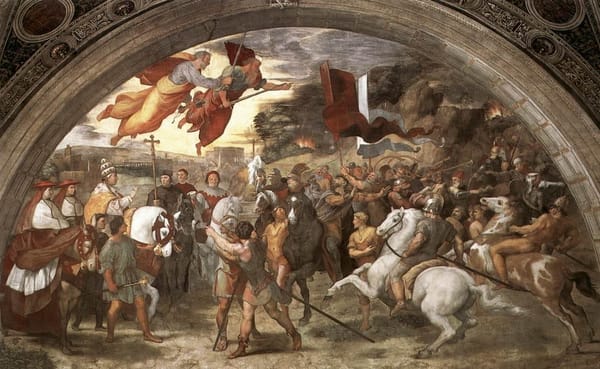
The barbarian hordes were invading the West; the Empire was little more than a ruin: and Attila, ‘the Scourge of God,’ was marching on towards Rome. Leo's majestic bearing repelled the invasion, as his word had checked the ravages of heresy. The haughty king of the Huns, before whose armies the strongest citadels had fallen, granted an audience to the Pontiff on the banks of the Mincio, and promised to spare Rome. The calm and dignity of Leo—who thus unarmed confronted the most formidable enemy of the Empire, and exposed his life for his flock—awed the barbarian, who afterwards told his people that, during the interview, he saw a venerable person standing in an attitude of defence, by the side of Rome’s intercessor: it was the Apostle St Peter. Attila not only admired, he feared the Pontiff. It was truly a sublime spectacle, and one that was full of meaning—a priest, with no arms save those of his character and virtues, forcing a king, such as Attila, to do homage to a devotedness which he could ill understand, and recognize by submission the influence of a power which had heaven on its side. Leo, singlehanded and at once, did what it took the whole of Europe several ages to accomplish in later times.
That the aureole of Leo’s glory might be complete, the Holy Ghost gifted him with an eloquence which, on account of its majesty and richness, might deservedly be called papal. The Latin language had at that time lost its ancient vigour; but we frequently come across passages in the writings of our Saint which remind us of the golden age.
In exposing the dogmas of our holy faith, he uses a style so dignified and so impregnated with the savour of sacred antiquity, that it seems made for the subject. He has several admirable sermons on the Resurrection; and speaking of the present season of the liturgical year, he says: ‘The days that intervened between our Lord's Resurrection and Ascension were not days on which nothing was done: on the contrary, great were the sacraments then confirmed, and great were the mysteries that were revealed.'1
Let us now read the sketch of the Saint’s life given by the Church in the Matins of the feast.
The Greek Church, in her Memea, has an office in honour of St Leo: we take from it the following stanzas. As they were composed before the Schism, they show us that the ancient Church of Constantinople believed the supremacy of the Roman Pontiff, and that it is not the Latins that have changed the faith. The Greeks keep the Feast of St Leo on February 18.
Hymn (Die XVIII Februarii)
Glory be to thee, O Jesus, Lion of the Tribe of Juda! that hast raised up in thy Church a Lion to defend her in those dark times, when holy Faith was most exposed to danger. Thou didst charge Peter to confirm his brethren2 and we have seen Leo, in whom Peter lived, fulfil his office with sovereign authority. We have heard the acclamation of the holy Council, which, in admiration at the heavenly teachings of Leo, proclaimed the signal favour thou didst confer on thy flock, when thou badest Peter feed both sheep and lambs.
O holy Pontiff Leo! thou worthily didst represent Peter in his Chair, whence thy apostolic teaching ceased not to flow, ever beautiful in its truth and majesty. The Church of thine own day honoured thee as the great teacher of faith; and the Church of every succeeding age has recognized thee as one of the most learned Doctors and preachers of the divine word. From thy throne in heaven, where now thou reignest, pour forth upon us the understanding of the great mystery, which thou wast called on to defend. Under thy inspired pen, this mystery grows clear; we see how sublimely it harmonizes with all other mysteries; and faith delights at gaining so close a view of the divine object of its belief. Oh! strengthen this faith within us. The Incarnate Word is blasphemed in our own times; avenge his glory, by sending us men of thy zeal and learning.
Thou didst triumph over barbarian invaders: Attila acknowledged the influence of thy sanctity and eloquence, by withdrawing his troops from the Christian land they infested. In these our days, there have risen up new barbarians—civilized barbarians, who would persuade us that religion should be eliminated from education. and that the State, in its laws and institutions, should simply ignore our Lord Jesus Christ, the King to whom all power has been given, not only in heaven but on earth also.3 Oh! help us by thy powerful intercession, for our danger is very great. Many are seduced, and have fallen into apostasy, whilst flattering themselves that they are still Christians. Pray that the light that is left within us may not be extinguished, and that the public scandals which now exist may be brought to an end. Attila was but a pagan; our modem statesmen and governments are, or at least call themselves, Christians: have pity cn them, and gain for them light to see the precipice to which they are hurrying society.
These days of Paschal Time remind thee, O holy Pontiff! of the Easters thou didst once spend here on earth, when, surrounded by the neophytes, thou gavest them the nourishment of thy magnificent discourses: pray for the faithful, who have this Easter risen to a new life with Christ. What they most need is a fuller and better knowledge of this their Saviour, in order that they may cling more closely to him, and persevere in his holy service. Thy prayers must obtain for them this knowledge; by thy prayers thou must teach them what he is both in his Divine and Human Nature: that as God he is their Last End, and their Judge after death; as Man, their Brother, their Redeemer, their Model. Bless, O Leo! and help the Pontiff who is now thy successor on the Chair of Peter. Show now thy love for that Rome whose sacred and eternal destinies were so frequently the subject of thy glowing and heavenly eloquence.
Wednesday of the Second Week after Easter
WE are not to suppose that because the sacred Humanity of our Risen Jesus is resplendent with glory and majesty, it is therefore less accessible to mortals. His kindness and condescension are the same as before; nay, he seems to have become more affectionate than ever, and more desirous to be with the children of men. Surely we have not forgotten what happened during the joyous octave of the Pascli! His affectionate greeting to the holy Women, when on their way to the sepulchre; his appearing to Magdalen under the form of a gardener; his conversation with the two disciples of Emmaus, and the means he took to make them recognize him; his showing himself, on the Sunday evening, to the Ten, greeting them with his Peace be to you, allowing them to touch him, and even condescending to eat with them; his amiably bidding Thomas, on the eighth day, convince himself of the reality of the Resurrection by feeling the Wounds; his meeting his disciples at the Lake of Genesareth, blessing their fishing, and providing them with a repast on the bank—all this is proof of the tender love and intimacy wherewith our Saviour treated his creatures during the forty days after his Resurrection.
As to his visits to his blessed Mother, we shall have another occasion for speaking of them; to-day we will consider him in the midst of his disciples. So frequently is he with them, that St Luke calls it an appearing to them for forty days.1 The apostolic college is reduced to eleven; for the place of the traitor Judas is not to be filled up till after our Lord’s Ascension, immediately before the descent of the Holy Ghost. How beautiful in their simplicity are these future messengers of the Good Tidings to mankind!2 A short while ago they were weak and hesitating in their faith; they forgot all they had seen and heard; they fled from their Master in the hour of trial. As he had foretold it to them, they were scandalized at his humiliations and death. The news of his Resurrection made little impression upon them; they even disbelieved it. And yet they found him so affectionate, so gentle in his reproaches, that they soon resumed the confidence and intimacy they had had with him during his mortal life. Peter, who had been the most unfaithful, as well as the most presumptuous, of all, has now regained his position of the most honoured of the Apostles, and, in a few days hence, is to receive a special proof of Jesus’ having forgotten his past disloyalty. He and his fellow Apostles can think of nothing now but Jesus. When he is with them they feast on the beauty and glory of his appearance. His words are dearer to them than ever, for they understand them better, now that they have been enlightened by the mysteries of the Passion and Resurrection. They eagerly listen to all that he says, and he says more than formerly, because he is so soon to leave them. They know that the day will soon come when they will no longer be able to hear his voice; they, therefore, treasure up his words as though they were his last will, and how could they better fit themselves for the mission he has entrusted to them? It is true they do not, as yet, fully enter into all the mysteries they are to preach to the world—they could not even remember so many sublime things—but Jesus tells them that he will soon send upon them the Holy Ghost, who will not only give them courage, but will also bless them with spiritual understanding, and will enable them to remember all that he, Jesus, has taught them.3
Nor must we forget the holy women, those faithful companions of Jesus, who followed him up to Calvary, and were the first to be rewarded with the joys of the Resurrection. Their divine Master could not overlook them now: he praises their devotedness, he encourages them; he takes every opportunity of repaying them. Heretofore, as the Gospel tells us,4 they provided him with food; now that he needs no earthly nourishment he feasts them with his dear presence; they see him, they hear his words; the very thought that he is soon to be taken from them makes these happy days doubly precious to them. They are the venerable mothers of the Christian people; they are our illustrious ancestors in the Faith; and on the day of the descent of the Holy Ghost, we shall find them with the Apostles in the Cenacle receiving the Tongues of Fire. Woman is to be represented on that glorious occasion, when the Church is to be made manifest before the world; the women of Calvary and the sepulchre are chosen for this office, and right well do they deserve to share in the bright joys of Pentecost.
Let us recite the following sequence in honour of our dear Jesus, who passes these forty days with his Apostles and the holy women. It was composed by Adam of St Victor:
Sequence
Lux succedit tenebris,
Morti resurrectio;
Lætis cedant tristia,
Cum sit major gloria
Quam prima confusio;
Umbram fugat veritas,
Vetustatem novitas,
Luctum consolatio.
Quod praeit in capite,
Membra sperent singula.
Pascha novum Christus est,
Qui pro nobis passus est,
Agnus, sine macula.
Prædam Christus eruit.
Quod Samson praecinuit.
Dum leonem lacerat.
David, fortis viribus,
A leonis unguibus
Et ab ursi faucibus
Gregem patris liberat.
Samson, Christum figuravit,
Cujus mors victoria.
Samson dictus Sol eorum:
Christus lux est electorum Quos illustrat gratia.
Botrus fluit in dilectae penetrai Ecclesiae.
Musto gaudent debriari
Gentium primitiae.
In regales transit usus:
Saccus fit soccus gratiæ,
Caro victrix miseriae.
Dei regnum perdiderunt;
Sed non deletur penitus
Cain, in signum positus.
Lapis iste nunc electus,
In trophæum stat erectus et in caput anguli.
Novam creat creaturam,
Tenens in se ligaturam
Capiti gloria,
Membrisque concordia!
Light follows darkness,
and resurrection death.
Sorrow gives place to joy,
for our glory is greater than
was our former shame.
Truth dispels the shadow;
the new what was old;
and consolation mourning.
Let the members hope to have
what now their Head enjoys.
Our new Pasch is Christ
—the spotless Lamb
that was slain for us.
from the enemy that surrounded us.
It is the victory prefigured by Samson,
when he tore the lion to pieces;
and by the powerful David,
when he rescued his father’s flock
from the lion’s grasp
and the bear's jaw.
he was a type of Christ, whose death was a victory.
Samson signifies their Sun:
so is Christ the Light of his elect,
for he makes his grace shine upon them.
the vine-stream flows into the store-house of the beloved Church.
and the first-fruits of the Gentiles
drink their fill and are glad.
is made a robe for kings:
that garment is the Flesh that triumphed over suffering,
and became an ornament of grace.
because they put the King to death;
they are not utterly destroyed,
for, like Cain, they are set as a sign.
is now the chosen one,
set up as a trophy, and made the chief corner-stone.
he creates us new creatures;
he unites in himself the two peoples (Jew and Gentile).
to our head!
and to the members peace!
| Previous Tuesday of the Second Week after Easter | Next Wednesday of the Second Week after Easter |