Daily reading
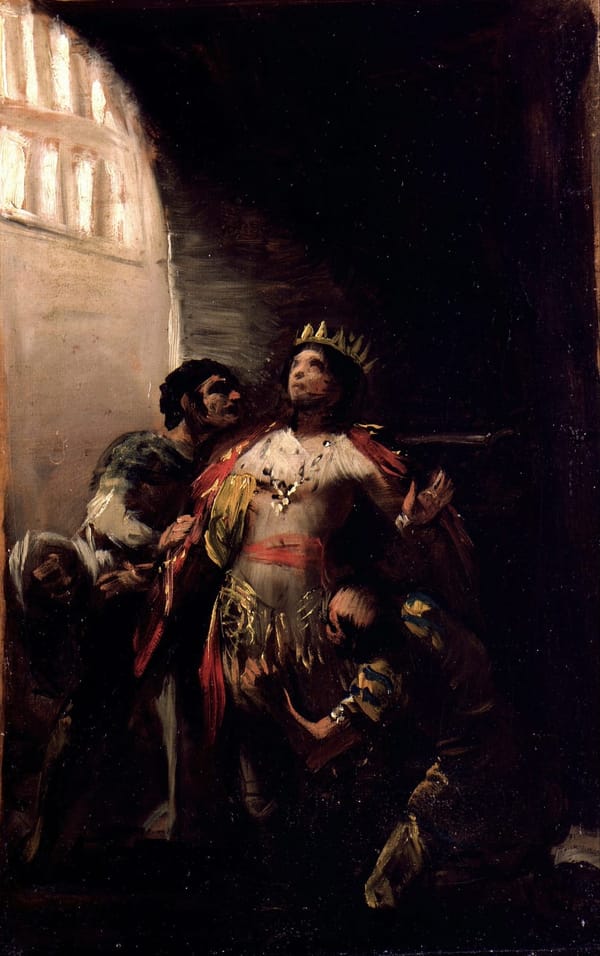
April 13: St. Hermenegild, Martyr
IT is through a martyr's palm-branch that we must to-day see the Paschal Mystery. Hermenegild, a young Visigoth prince, is put to death by his heretical father, because he courageously refused to receive his Easter Communion from an Arian bishop. The martyr knew that the Eucharist is the sacred symbol of Catholic unity; and that we are not allowed to approach the Holy Table in company with those who are not in the true Church. A sacrilegious consecration gives heretics the real possession of the divine Mystery, if the priestly character be in him who dares to offer sacrifice to the God whom he blasphemes; but the Catholic, who knows that he may not so much as pray with heretics, shudders at the sight of the profanation, and would rather die than share by his presence in insulting our Redeemer in that very Sacrifice and Sacrament which were instituted that we might all be made one in God.
The blood of the martyr produced its fruit: Spain threw off the chains of heresy that had enslaved her, and a Council, held at Toledo, completed the work of conversion begun by Hermenegild's sacrifice. There are very few instances recorded in history of a whole nation rising up as one man to abjure heresy; but Spain did it, for she seems to be a country on which heaven lavishes exceptional blessings. Shortly after this she was put through the ordeal of the Saracen invasion; she triumphed here again by the bravery of her children; and ever since then, her faith has been so staunch and so pure as to merit for her the proud title of The Catholic Kingdom.
St Gregory the Great, a contemporary of St Hermenegild, has transmitted to us the following account of the martyrdom. The Church has inserted it in her Lessons of today's Matins.
Pope Urban VIII composed the two following hymns for the feast of the holy martyr: we unite them under one conclusion.
Hymn
Hermenegilde jubar, gloria Martyrum,
Christi quos amor almis
Cœli cœtibus inserit.
Deo Servans obsequium! quo potius tibi
Nil proponis, et arces
Cautus noxia, quæ placent.
Surgentis vitii, non dubios agens
Per vestigia gressus
Quo veri via dirigit!
Non vitæ caperis divitis otio,
Gemmarumve nitore,
Regnandive cupidine.
Nec terret perimens carnificis furor:
Nam mansura caducis
Præfers gaudia cœlitum.
Clemens, atque preces, dum canimus tua
Quæsitam nece palmam,
Pronis auribus excipe.
Et natum celebrent ora precantium,
Divinumque supremis
Flamen laudibus efferant.
Hermenegild, as one of its glories:
so, too, do the martyrs,
whose love of Christ has numbered them among the blessed of heaven.
He was dear to thee above all things else;
and as to the dangerous pleasures of this world,
thou wisely didst reject them.
which excite and foster vice,
and march onwards, with unfaltering step,
whither the path of truth leads.
The luxuries of a life of ease and wealth,
the glitter of diamonds, the prospect of a throne
—they could not allure thee.
nor by the executioner's merciless rage;
for the everlasting joys of heaven
were dearer to thee than those of time.
from thy heavenly throne,
and graciously receive the prayers we present to thee
whilst celebrating the palm made thine by martyrdom.
Let the faithful assembled here in prayer, glorify the Son;
let them sing forth endless praise
to the Holy Ghost.
We offer thee, O brave witness to the truth of our holy faith! our admiration and gratitude. Thy courageous death was proof of the love thou hadst for Christ; and thy contempt of earthly honours teaches us to despise them. Though thou wert heir to a throne, a prison was thy abode here below. It was thence that thou didst ascend to heaven, wearing on thy brow the laurels of martyrdom, a crown far brighter than that which was offered thee on condition of thy apostatizing from the faith. Pray now for us: the Church asks it of thee, by inserting thy name in the Calendar of her Saints. The Pasch was the day of thy triumph; obtain for us that this may be a true Pasch to us, a real resurrection. which may lead us to the heaven above, where we may enjoy with thee the sight of our Risen Jesus. Intercede for us, that we may be firm in the faith, obedient to the teachings of holy Church, and enemies of every error and innovation. Protect Spain, thy fatherland, which owes to thy martyrdom long centuries of loyalty to the true faith. Pray for her, that she may ever continue to merit her glorious title of Catholic Kingdom.
Friday of the Second Week after Easter
LET us to-day turn to another subject. Let us think of that unfortunate Jerusalem, which, a few days since, re-echoed with the blasphemous cry: Away with him! Away with him! Crucify him! Is the city impressed by the great events that have taken place in her midst? Is the report still afloat of the sepulchre’s being found empty? Have Jesus’ enemies succeeded in tranquillizing the public mind by their lying scheme? They have summoned the soldiers who were set to guard the tomb, and have bribed them to say that they neglected their duty, that they fell asleep, and that the disciples came in the meanwhile, and stole away their Master’s corpse. As to the punishment due to this infraction of military discipline, the soldiers are told that they need be under no apprehension, inasmuch as they are assured that every excuse shall be made to the governor in case of need.1
Such is the final effort made by the Synagogue to make the world forget the name of Jesus of Nazareth! She would convince men that he was a mere contemptible impostor, who deserved his ignominious death, and will now be execrated for the posthumous attempt at a Resurrection! And yet, in a few years hence, the name of Jesus will be known and loved far beyond the walls of Jerusalem or the territory of Judea—it will be held in blessing in the furthermost parts of the earth. Let a hundred years pass, and the adorers of this Jesus will be found in every country. After three centuries paganism will own itself beaten; the idols will roll in the dust; the majesty of the Cæsars will humble itself before the Cross. And thou, O blind and obstinate Jew! wilt have it that he whom thou didst blaspheme and crucify is not risen, although he be now the King of the earth—the loved Monarch of a boundless empire! Read thy heaven-given prophecies, which thou hast handed down to us. Do they not tell thee that the Messias is to be despised—reputed with the wicked,2 and treated as one of them? But do they not likewise tell thee that his sepulchre shall he glorious?3 With all other men the grave puts an end to their name and their glory; whereas with Jesus his sepulchre is the trophy of his victory; we proclaim him to be the Messias, the King of ages, the Son of God, because by his own death he conquered death.
But Jerusalem is carnal-minded; and the humble Nazarene has not flattered her pride. His miracles were undeniable; the wisdom and authority of his words surpassed everything that had ever been heard; his goodness and compassion even exceed the miseries he is come to allay—but Israel has seen nothing, heard nothing, understood nothing; and now he remembers nothing. Alas! his fate is sealed, and it is himself that has sealed it. Five centuries before this, Daniel had thus prophesied: The people that shall deny him (Christ) shall not he his.4 Let them, therefore, that would escape the most terrible chastisement ever sent upon man, lose no time in recognizing the risen Jesus as the Messias.
A heavy atmosphere broods over the deicide city. Her people have said: Let his Blood he upon us and upon our children!—so indeed it is: it hangs like a storm-cloud of vengeance over Jerusalem, and, forty years hence, will send forth its thunderbolts of slaughter, fire, destruction, and a desolation which shall continue even to the end.5 Impostors will rise up, giving themselves out as the Messias. Jerusalem knows that the time for the fulfilment of the prophecies is come; and hence the credulity of her people in siding with these pretenders. Seditions are the consequence of this fanaticism. At length Rome is obliged to interfere. She sends her legions; and having drowned the rebellion with a deluge of blood, she banishes Israel from his country, making him a Cain-like wanderer on the face of the earth.
Why do not these unhappy Jews acknowledge, as the Messias, this Jesus whom they have crucified? Why still expect a fulfilment which has been so evidently accomplished? Why pass by, with sullen unrepentance, this empty sepulchre which is ever protesting against them? Have they not clamoured for the shedding of innocent Blood? They have but to confess this crime—this fruit of their pride—and they will be pardoned. But if they persist in defending what they have done, there is no hope for them—their chastisement will be blindness of heart, they will walk on in darkness even to the abyss, and hell will be their eternity. Bethphage and Mount Olivet are still echoing with the cry of Hosanna to the Son of David! O Israel! thou hast yet time! repeat this acclamation of thy loyalty! The hours are passing swiftly by; the solemnity of Pentecost will soon be upon us. On that day the law of the Son of David is to be promulgated, and the law of Moses will be abrogated, for its work is done and its figures are turned into realities. On that day thou wilt feel two peoples within thy womb6 one, weak in number, but destined to conquer all nations by leading them to the true God, will humbly and lovingly acknowledge for their King this Crucified and Risen Son of David; the other, proud and haughty, will obstinately blaspheme its Messias, and will become, by its ingratitude, the type of voluntary hardness of heart. It denies, even to this day, the Resurrection of its victim; but the chastisement which is to lie upon it to the end of time proves that he who punishes is God—the God of truth, whose anathemas are infallible.
Let us honour the Resurrection of our divine Messias by offering him this Easter sequence of the ancient Missal of St Gall.
Sequence
Atque pulchritudo
In cruce victoriam,
Est mortis principatus,
Est peccati veteris
Chirographum,
Immolatur victima
Pro ovili,
De Edom qui venerat,
Et de Bosra.
Serpentini vulneris
Sanat morsum.
Reconciliatur mundus:
Per lignum nunc redemptus,
Per lignum in Adam venditus.
Sociatur matutinis,
Factura novissima,
Restaurans cœli dispendia.
Vitam mundi portans
Atque pretium,
Tu vectis es botri
Nati in vineis
Engaddi.
Inimicitias solvens
Iis qui erant prope
Dans pacem,
Et his qui a longe.
Mundum attrahis,
Amplexando tuis
Hinc inde brachiis.
Ima perforans,
Vinctos, quos absolvis,
Ad summa erigis.
Hac dierum summa constructum,
Quam tetragrammaton
Adam græce colligit,
In te dissolvendum obtulit
Sed, ut mundum
Salvet quadrifidum,
Reaedificat post triduum.
Cruce tollens crimina mundi,
Da, ut in augmento
Charitatis, fidei, spei,
Crucis sacrosanctae valeamus,
Cum sanctis omnibus,
Dimensiones comprehendere,
Carnem macerantes,
Crucis almae bajulos
Tua trahas post vestigia.
Ibi ad tribunal, judex, tuum
Simus sanctae
Crucis per signaculum,
Quia regnavit a ligno Deus.
praise magnify
on the Cross.
the empire of death;
the handwriting
of the sin that was of old;
the Paschal Lamb
for the flock;
by him that came from Edom
and Bosra.
that cures the sting
of the serpent’s wound.
brought back into God's favour;
it was, in Adam, sold by a tree,
and by a tree is now redeemed.
the last made of creatures
is associated with the morning stars,
and repairs heaven’s losses.
that bearest the Life
and Ransom of the world
—thou art the staff,
bearing upon thee the cluster of grapes
from the vineyards of Engaddi.
who taketh enmities away,
and giveth peace
to them that are afar off,
and to them that are nigh.
thou drawest the whole world
to thyself, and, with thy two arms,
embracest all mankind.
thou penetratest into the depths below,
and raisest to heaven
the captives thou loosest.
—which had been built in the number of days
expressed by the four Greek letters composing Adam’s name
—he offered it that it might be destroyed;
but he raised it up again
in three days,
that he might save
the four quarters of the world.
that by the Cross takest away the sins of the world!
grant, that by our growth
in faith, hope, and charity,
we may be able to comprehend,
with all the Saints,
the measure of the Holy Cross;
and mortifying our flesh,
we may carry the dear Cross,
and be drawn by thee to walk in thy footsteps.
grant, O divine Judge,
that, by the sign of the holy Cross,
we may be so, when standing before thy tribunal,
‘That the Lord hath reigned from the Wood.’
| Previous Thursday of the Second Week after Easter | Next Friday of the Second Week after Easter |