Daily reading
Paschal Time
Double · April 21 · Sanctoral
April 21, 2029
From Dom Guéranger’s The Liturgical Year.
A Double leads the weekday.Rubric
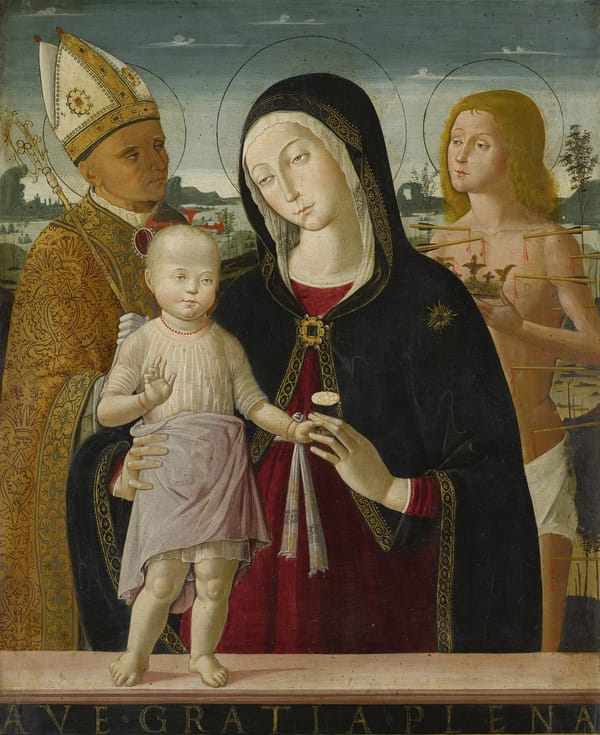 |
April 21: St. Anselm, Bishop, and Doctor of the Church
A MONK, a Bishop, a Doctor of the Church—such was the Saint whose feast comes to gladden us on this twenty-first day of April. He was a martyr, also, at least in desire, and we may add, in merit too—for he did enough to earn the glorious palm. When we think of Anselm, we picture to ourselves a man in whom are combined the humility and meekness of the cloister with the zeal and courage of the episcopal dignity; a man who was both a sage and a saint; a man whom it was impossible not to love and respect.
He left his native country of Piedmont for the Monastery of Bec in France, where he became a Benedictine monk. Being elected Superior, he realized in himself the type of an Abbot, as drawn by St Benedict in his Rule: ‘He that is made Abbot,’ says the holy Patriarch, ‘should study to give help rather than to give commands,’1 We read that the love entertained for Anselm by his brethren was beyond description. His whole time was devoted to them, either in giving them spiritual direction, or in communicating to them his own sublime knowledge of the sacred sciences. After governing them for several years, he was taken from them, and compelled to accept the dignity of Archbishop of Canterbury. He was a worthy successor of Augustine, Dunstan, Elphege, and Lanfranc; and by his own noble example of courage, he prepared the way for the glorious martyr Thomas, who succeeded him in less than a century.
As bishop, his whole life was spent in fighting for the liberty of the Church. Though gentle as a lamb by nature, he was all energy for this great cause. He used to say: ‘Christ would not have his Spouse be a slave; there is nothing in this world that God loves more than the liberty of his Church.’ There was a time when the Son of God allowed himself to be fettered with bonds in order that he might loosen us from the chains of our sins; but now that he has risen in triumph from the dead, he wills that his Spouse should be, like himself, free. She cannot otherwise exercise the ministry of salvation confided to her by her divine Lord; and yet there is scarcely a single hundred years of her existence in which she has not had to fight for this holy liberty. The rulers of this earth, with very few exceptions, have ever been jealous of her influence, and have sought to lessen it by every possible means. In our own times there are numbers of her children who do not even know that she has any rights or privileges; they would be at a loss to understand you, if you told them that she is the Spouse of Christ, and therefore a queen; they think it quite enough for her, if she enjoy the same amount of freedom and toleration as the sects she condemns; and they cannot see how, under such conditions as these, the Church is not the kingdom he wished her to be, but a mere slave. St Anselm would have abominated all such theories as these; so does every true Catholic. He is not driven into disloyalty to the Church by the high-sounding words, progress and modern society; he knows that there is nothing on earth equal to the Church; and when he sees the world convulsed by revolutions, he knows that all comes from the Church having been deprived of her rights. One of these is that she should not only be recognized, in the secret of our conscience, as the one only true Church, but that, as such, she should be publicly confessed and outwardly defended against every opposition or error. Jesus, her divine Founder, promised to give her all nations as her inheritance; he kept his promise, and she was once the Queen and Mother of them all. But nowadays, a new principle has been asserted, to the effect that the Church and all sects must be on an equal footing as far as the protection of the State goes. The principle has been received with acclamation, and hailed as a mighty progress achieved by modern enlightenment: even Catholics, whose previous services to religion had endeared them to our hearts and gained our confidence, have become warm defenders of the impious theory.
Trying as were the times when St Anselm governed the See of Canterbury, they were spared the humiliation of producing and ratifying such doctrine as this. The tyrannical interference of the Norman kings was an evil far less injurious than the modern system, which is subversive of the very idea of a Church. Open persecution would be a boon, compared to the fashionable error of which we are speaking. A winter torrent brings desolation in its track: but in the summer, when the flood is over, nature brings back her verdure and flowers. The errors which now prevail are like a great sea that gradually sweeps over the whole earth: and when the Church can find no spot whereon to rest, she will take her flight to heaven, and men must expect the speedy coming of the judge.
Anselm was not only the zealous and heroic defender of the rights and privileges of the Church; he was also a light to men by his learning. The contemplation of revealed truths was his delight. He studied them in their bearings one upon the other, and his writings occupy a distinguished place in the treatises of Catholic Theology. God had blessed him with extraordinary talent. Amidst all the troubles and anxieties and occupations of his various duties, he found time for study. Even when passing from place to place, as an exile, he was intent on the meditation of the mysteries of religion, thus preparing those sublime reflections which he has left us on the articles of our Faith.
The Church gives us, in her Liturgy, the following sketch of our Saint’s life:
We take the following Responsories and Antiphons from an office approved by the Holy See:
℣. Afflictions await me; but I fear none of them, so that I may consummate my course.* And your joy shall soon be changed into mourning, alleluia.℟. When the Fathers were assembled in Council, Urban, the Pope, cried out: Where art thou, Father and Master Anselm, Archbishop of the English? Come up here to us; fight for thine own and our Mother, and help us, alleluia.℣. Blessed be thy wisdom, and blessed the word of thy mouth!* Come up here to us; fight for thine own and our Mother, and help us, alleluia.
The following hymn is from the same Office:
Hymn
Laurea doctor redimitus astat:
Festus Anselmo chorus æmuletur
Dicere carmen.
Sæculi florem pereuntis horret;
Atque Lanfranci documenta quærens,
Intrat eremum.
Fertur immotæ fidei volatu:
Dogmatum puros latices an ullus
Altius hausit?
Te voves charæ soboli: benignis
Debiles portas humeris, alacres
Prævius hortans.
Quid times luctam? properant triumphi;
Exteras gentes, generosus exsul,
Lumine reples.
Parta, cui Christus nihil ante ponit,
Urget Anselmum: studio quis aequo
Vindicat ipsam?.
Pontifex summus tibi fert honores;
Te fides poscit: siluere Patres:
Dogma tuere.
Sis ad æternam Triadem, precamur,
Cuncta cui dignas resonent per orbem
Sæcula laudes.
a true monk, a doctor with his laurel wreath upon him.
Let our festive choir sing
fervently a hymn in his praise.
so wise, indeed, that he trampled on the flower of this perishable world,
and fled to solitude,
that he might receive instruction from Lanfranc.
he entered into the mysteries of the Word.
Did any mortal drink more fully
than he of the limpid fount of Truth?
thou didst tenderly care for thy flock.
Thou didst carry the weak upon thy shoulders
and encourage the fervent by thine own example.
O fear not the combat! Triumph shall be thine.
When he sends thee into exile, thou wilt shine,
as a generous light, upon lands beyond the sea.
which he won for us by redeeming us,
excited Anselm’s zeal.
Never had it a braver defender than he.
The Supreme Pontiff showed thee great honour,
when, in the presence of the Fathers, he said to thee:
‘Fight for the faith! Defend our dogmas!’
be mindful of the holy flock!
Intercede for us to the Blessed Three,
to whom be worthy praise from all for ever.
O holy Pontiff Anselm! beloved of God and men! the Church, whose cause thou didst so zealously defend on earth, celebrates, this day, thy praise, and honours thee as one of her dearest Saints. Thy meekness, condescension and charity gave thee a resemblance to Jesus, the Good Shepherd. Like him, thou couldst truly say: I know my sheep, and my sheep know me.2 Thou didst watch over them day and night, lest the wolf should come and find them unprotected. Far from fleeing at his approach, thou didst go forth to meet him, and nothing could induce thee to yield to his sacrilegious tyranny. Heroic champion of the Church's liberty! protect it in these our days, when there is not a country left where it is not insulted or ignored. Raise up in every place pastors with a spirit of holy independence such as thou hadst; that thus the faithful may take courage and that every Christian may boldly and proudly confess that he himself is a member of the Church, and that the interests of our spiritual mother are far more deserving of our solicitude than those of the whole world besides.
God had gifted thee, O Anselm, with that Christian philosophy which bows down to the teachings of faith, and which, being thus purified by humility, is elevated to the intelligence of the sublimest truths. The Church, in acknowledgement of the benefits she derived from thy learning, has conferred upon thee the title of Doctor, which for a long time was confined to those great men who lived in the early Christian Ages, and whose writings are the reflex of the preaching of the Apostles. Thy teaching has been deemed worthy of being numbered with that of the ancient Fathers, for it came from the same divine Spirit, and was the result of prayer rather than of study. Obtain for us, O holy Doctor, that ‘our faith,' like thine, ‘may seek understanding,'Nowadays, there are many who blaspheme what they know not;3 but there are many also who know little or nothing of what they believe. Hence arise a deplorable confusion of ideas, compromises are made between truth and error, and the only true doctrines are despised, scouted, or at least undefended. Pray to our heavenly Father, O Anselm, that he would bless the world with holy and learned men, who may teach the path of truth, and dispel the mists of error; that thus the children of the Church may not be led astray.
Look down with affection, O holy Pontiff, on the venerable Order, which, when God called thee from the vanities of the world, received thee, made thee one of her children, gave thy soul its life, and thy mind the light of wisdom. She claims thy protection. Thou art a son of the great Patriarch Benedict: forget not thy brethren. Bless them in France, where thou didst first embrace the Monastic Life; bless them in England, where thou wast Primate, and yet still the humble monk. Pray for the two countries, for both are dear to thee. Faith is weak in one; and heresy reigns supreme in the other. Beseech our Lord to show his mercy to both: he is all-powerful, and he turns not a deaf ear to the prayers of his Saints. If, in his justice, he have decreed not to restore to these two countries their ancient Catholic constitution, pray that, at least, the number of souls saved may be great, that conversions may be frequent, and that the labourers sent at the eleventh hour to the vineyard may emulate the zeal of them that were first called!
Saturday of the Third Week after Easter
THE Saturday brings us back to Mary. Let us again contemplate her prerogatives; and yet, whilst so doing, let us still keep our thoughts on holy Church, which has been the subject of our meditations during this week. Let us, to-day, consider the relations existing between Mary and the Church: they will make us the better understand these two mothers of mankind.
Before taking possession of the Church, which was to be proclaimed before all nations on the day of Pentecost, the Man-God made a worthy prelude to this kingly possession by uniting himself with her, who is so deservedly styled the mother and representative of the human race. This was Mary. Of the family of David, Abraham and Sem; immaculate, from the first moment of her existence, as were our first parents when they came from their Creator's hands; and destined for the grandest honour which could be conferred on a mere creature; Mary was, during her sojourn here on earth, the inheritance and co-operatrix of the Incarnate Word: she was the Mother of all the living.1 She, in her single person, was what the Church, collectively, has been from the day of its foundation. Her office of Mother of God surpasses all her other glories; still, we must not overlook, but on the contrary admire and love them.
Mary was the first creature that fully corresponded with the intentions which induced the Son of God to come down from heaven. He found in her the most lively faith, the firmest hope, and the most fervent love. Never had human nature, perfected by grace, offered to God an object so worthy of his acceptance. Before celebrating his union with the human race, as its Shepherd, Jesus was the Shepherd of this single sheep, whose merits and dignity surpass those of the rest of mankind, even supposing it to have been always and in all things faithful to its God.
Mary, therefore, represented the Christian Church before it existed in itself. The Son of God found in her not only a Mother, but the faithful worshipper of his Divinity from the first moment of his Incarnation. We saw on Holy Saturday how Mary’s faith withstood the test of Calvary and the tomb, and how this faith, which never faltered, kept alive on the earth the light which was never to be quenched, and which was soon to be confided to the collective Church, whose mission was to win over all nations to the divine Shepherd.
It was not Jesus’ will that his Blessed Mother should exercise a visible and outward postulate, save in a limited degree. Besides, he was not to leave her here till the end of time. But, just in the same way as, from the day of his Ascension, he made his Church co-operate with him in all that he does for his elect, so likewise did he will, during his mortal life, that Mary should have her share in all the works done by him for our salvation. She, whose formal consent had been required before the Eternal Word took flesh in her womb, was present, as we have already seen, at the foot of the Cross, in order that she, as a creature, might offer him, who offered himself as God, our Redeemer. The Mother’s sacrifice blended with that of the Son, and this raised her up to a degree of merit which the human mind could never calculate. Thus it is, though in a less perfect manner, the Church unites herself, in unity of oblation, with her divine Spouse, in the sacrifice of the Altar. It was to be on the day of Pentecost that the Church’s maternity would be proclaimed to the world; Mary was invested with the office of Mother of men, as Jesus was hanging upon his Cross. When his Side was opened with the spear, that the Church, born from the Water and Blood of Redemption, might come forth, Mary was there to receive into her arms this future mother, whom she had hitherto so fully represented.
In a few days we shall behold Mary in the Cenacle; the Holy Ghost will enrich her with new gifts, and we shall have to study her mission in the early Church. Let us close the considerations we have been making to-day by drawing a parallel between our two Mothers, who, though one is so far above the other in dignity, are nevertheless closely united to each other.
Our heavenly Mother, who is also the Mother of Jesus, is ever assisting our earthly Mother, the Church, with heavenly aid. Mary exercises over her, in each of her existences—Militant, Suffering or Triumphant—an influence of power and love. She procures to the Church the victories she wins; she enables her to go through the tribulations and trials which beset her path. The children of one are children of the other; both have a share in giving us spiritual birth—one, the 'Mother of divine grace,1 by her all-powerful prayers; the other, by the word of God and holy baptism. If when we depart this life, our admission to the beatific vision is to be retarded on account of our sins, and our souls are to descend to the abode of Purgatory, the suffrages of our earthly Mother will follow us, and alleviate or shorten our sufferings; but our heavenly Mother will do still more for us during that period of expiation, so awful and yet so just. In heaven the elect are rejoiced at the sight of the Church Triumphant, though she be still Militant on earth; and who can describe the joy these happy children must feel at seeing the glory of the Mother that begot them in Christ? but with how much gladder ecstasy must not these same citizens of heaven gaze upon Mary, that other Mother of theirs, who was their Star on the stormy sea of life, who never ceased to watch over them with most loving care, who procured them countless aids to salvation, and who, when they entered heaven, received them into those same maternal arms which heretofore carried the divine Fruit of her womb—that First-Born,2 whose brothers and joint-heirs we are called to be!
As long as we dwell in this vale of tears, which is now being turned into a paradise by the presence of our Risen Jesus, let us sometimes think of Mary's joys. Last Saturday we borrowed a hymn from the ancient Churches of Germany, in order to celebrate her Seven Joys; let, us do the same to-day.
Sequence
Sponsa Christi singularis,
Jocundata nimium
Per salutis nuntium:
Casta Mater et fœcunda,
Et suprema gaudia
Nostro cordi nuntia.
Quæ tam mire fœcundata
Genuisti filium,
Velut sidus radium;
Partu semper fœcundari.
Atque corde steriles
Fac clementer fertiles.
Cujus novum filium
Magi cum muneribus
Placant flexis genibus;
Nos illorum munera
Deo ferre tribue
Semper et assidue.
Jam in templo præsentatus
Simeonis manibus
Tollitur cum laudibus:
Ut et illum nos geramus
Puris semper cordibus
Et sinceris mentibus.
Laetabaris nimio,
Resurgente filio
Mortis ab imperio:
Pia, nos resurgere,
Sursum tolle variis
Cor oppressum vitiis.
Conspexisti visibus
Ire tuum filium
Ad paternum solium:
Hujus vitæ terminum,
Valeamus libere
Sine metu cernere.
Quam post vitæ terminum
Dulcis Jesu dextera
Vexit super sidera:
Sublevamen sceleris,
Et post hanc miseriam
Duc ad veram patriam.
dearest Spouse of Christ!
for the angel of our salvation
announced to thee an exceeding great joy.
O Virgin Mother!
and speak to our heart
of the joys that never end.
in that thou didst conceive of the Holy Ghost,
and bring forth thy Child,
as the star emits its ray.
in works of salvation.
Take these barren hearts of ours,
and by thy merciful prayers make them fertile.
at the adoration and gifts
paid by the Magi
to thy new-born Babe.
pray that we may ever imitate them,
and give to God
what their gifts signified.
at the praises spoken by Simeon,
when, at thy presenting Jesus in the Temple,
he took the Child in his arms.
that we may serve thy Son
with purity
and earnestness of heart.
all thy soul’s power
be glad at thy Son's rising
from the grasp of death.
that we may rise from our sins,
and have our hearts set free
from the pressure of its many vices.
the happiness to see thy Son
ascend into heaven,
where he is seated on his Father’s throne.
of the world
we may without fear
welcome his return.
who after thy life’s course was run,
wast raised up
by thy sweet Jesus above the stars.
may be raised from our sins,
and after this miserable life
be led to our true country.
| Previous Friday of the Third Week after Easter | Next Saturday of the Third Week after Easter |