Daily reading
Paschal Time
Double · April 24 · Sanctoral
April 24, 2029
From Dom Guéranger’s The Liturgical Year.
A Double leads the weekday.Rubric
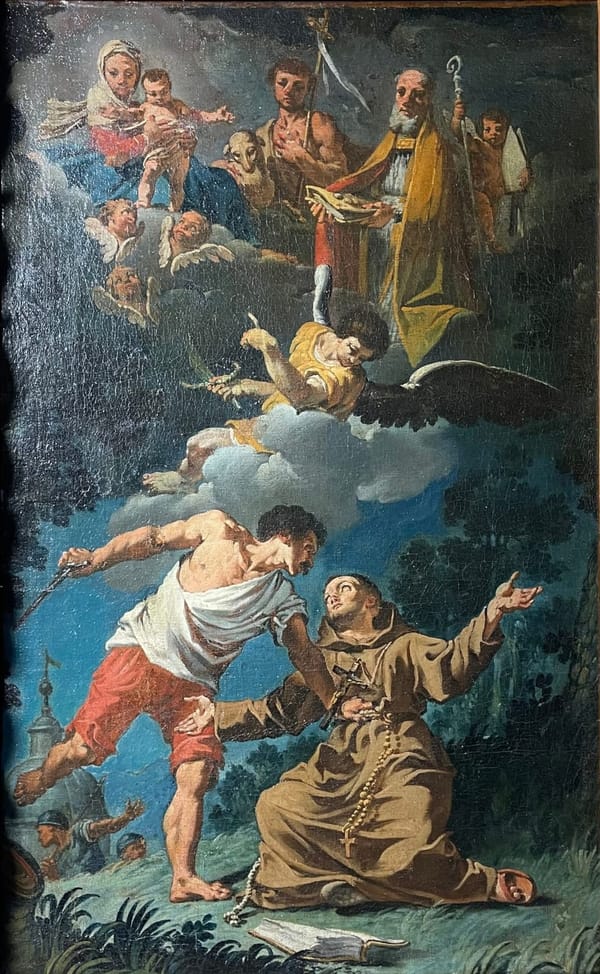 |
April 24: St. Fidelis of Sigmaringen, Martyr
OUR Risen Lord would have around him a bright phalanx of martyrs. Its privileged members belong to the different centuries of the Church’s existence. Its ranks open today to give welcome to a brave combatant, who won his palm, not in a contest with paganism, as those did whose feasts we have thus far kept, but in defending his mother, the Church, against her own rebellious children. They were heretics that slew this day’s martyr, and the century that was honoured with his triumph was the seventeenth.
Fidelis was worthy of his beautiful name. Neither difficulty nor menace could make him fail in his duty. During his whole life, he had but the glory and service of his divine Lord in view: and when the time came for him to face the fatal danger, he did so, calmly but fearlessly, as behoved a disciple of that Jesus who went forth to meet his enemies. Honour, then, be to-day to the brave son of St Francis! truly he is worthy of his seraphic Patriarch, who confronted the Saracens, and was a martyr in desire!
Protestantism was established and rooted by the shedding of torrents of blood; and yet Protestants count it as a great crime that, here and there, the children of the true Church made an armed resistance against them. The heresy of the sixteenth century was the cruel and untiring persecutor of men, whose only crime was their adhesion to the old faith—the faith that had civilized the world. The so-called Reformation proclaimed liberty in matters of religion, and massacred Catholics who exercised this liberty, and prayed and believed as their ancestors had done for long ages before Luther and Calvin were bom. A Catholic who gives heretics credit for sincerity when they talk about religious toleration, proves that he knows nothing of either the past or the present. There is a fatal instinct in error, which leads it to hate the Truth; and the true Church, by its unchangeableness, is a perpetual reproach to them that refuse to be her children. Heresy starts with an attempt to annihilate them that remain faithful; when it has grown tired of open persecution it vents its spleen in insults and calumnies; and when these do not produce the desired effect, hypocrisy comes in with its assurances of friendly forbearance. The history of Protestant Europe, during the last three centuries, confirms these statements; it also justifies us in honouring those courageous servants of God who, during that same period, have died for the ancient faith.
Let us now respectfully listen to the account given us, in the Liturgy, of the life and martyrdom of St Fidelis; we shall find that the Church has not grown degenerate in her Saints.
How truly couldst thou, O Fidelis! say with the Apostle: I have finished my course!1 Yea, thy death was even more beautiful than thy life, holy as that was. How admirable the calmness wherewith thou didst receive death! how grand the joy wherewith thou didst welcome the blows of thine enemies—thine, because they were those of the Church! Thy dying prayer, like Stephen's, was for them; for the Catholic, while he hates heresy, must love the heretics who put him to death. Pray, O holy martyr, for the children of the Church. Obtain for them an appreciation of the value of faith, and of the favour God bestowed on them when he made them members of the true Church. May they be on their guard against the many false doctrines which are now current through the world. May they not be shaken by the scandals which abound in this age of effeminacy and pride. It is faith that is to bring us to our Risen Jesus: and he urges it upon us by the words he addressed to Thomas: Blessed are they that have not seen and have believed!2 Of this number we wish to be: and therefore is it that we cling to the Church, the sovereign mistress of faith. We wish to believe her, and not human reason, which has neither the power to fathom the word of God, nor the right to sit in judgement over it. Jesus has willed that this holy faith should come down to us bearing on itself the strengthening testimony of the martyrs; and each age has had its martyrs. Glory to thee, O Fidelis, who didst win thy palm by combating the errors of the pretended Reformation! Take a martyr’s revenge, and pray without ceasing to our Jesus, that he would bring all heretics back to the faith and to union with the Church. They are our brethren by baptism; pray for them, that they may return to the Fold, and that we may one day celebrate with them the true Paschal banquet, wherein the Lamb of God gives himself to be our food, not figuratively, as in the Old Law, but really and truly, as fits the New Covenant.
Tuesday of the Fourth Week after Easter
WE are bound to believe the word of God: but this word is accompanied with every proof of its really coming from God. When Jesus told men that he was the Son of God, he gave ample proof of his being such: in the same manner, he insists on our believing what he reveals, but he gives us a guarantee of its being the truth. What is this guarantee? Miracles. Miracles are the testimony which God bears to himself. A miracle rouses man’s attention, for he knows that it is by God’s will alone that the laws of nature can be suspended. If God employ a miracle to make his will known, he has a right to find man obedient. The Israelites were convinced that it was God who was leading them, for the sea opened a passage to them, immediately that Moses stretched forth his hand over its waters.
Now Jesus, the author and finisher of faith did not demand our belief in the truths he revealed to us until he had proved the divinity of his mission by miracles. The works which I do, said he, give testimony of me. And again: If you will not believe me, believe my works. And what are these works? When St John the Baptist sent some of his disciples to Jesus, that they might ask him if he were the promised Messias, Jesus gave them this answer: Go and relate to John what you have heard and seen. The blind see, the lame walk, the lepers are made clean, the deaf hear, the dead rise again, the poor have the Gospel preached unto them.
Such is the motive of our faith. Jesus requires of us that we receive his word, as being that of the Son of God—for he has proved himself to be so by the works he has wrought. Truly may we exclaim with the Psalmist: Thy testimonies, O Lord, are become exceedingly credible! Whom shall we believe, if we refuse to believe him? And what must be the guilt of them who refuse to believe! Let us hearken to our Jesus speaking of those proud men who, though they had witnessed his miracles, rejected his teaching: If, says he, I had not done among them the works that no other man hath done, they would not have sin. It is their incredulity that led them astray; but their incredulity showed itself when, after witnessing such miracles as the raising Lazarus to life, they refused to acknowledge the divinity of him who bore testimony to himself by such works as these.
But our Risen Jesus is soon to ascend into Heaven; the miracles he wrought will be things of long past; are we, henceforth, to have no testimony for his word, which is the object of our Faith? Let us not fear. Do we forget that historical documents, when genuine, bring the same conviction to our minds, with regard to past events, as though we ourselves had been witnesses of those events? Is it not a law of the human mind—is it not a basis of certainty—that we yield assent to the testimony of our fellow-men, as often as we have evidence that they are neither deceived themselves, nor wish to deceive us? The miracles wrought by Jesus will be handed down to the end of time, supported by guarantees of authenticity which no facts of history could possibly have. If the authority of history is what all acknowledge it to be, then is he a fool who doubts the miracles which we are told were worked by our Saviour. Though we have not been eye-witnesses of them, yet such is our certainty of their having been done, that our faith is as strong and as docile as though we had assisted at the admirable scenes described in the Gospel.
Our Lord had sufficiently provided for our yielding our Faith to his word, by letting us know that he had confirmed his teaching by his miracles. But he would do more. He gives his disciples the power to do what he himself had done, and this in order that our faith might be strengthened by these supernatural evidences. It was on one of the forty days spent with his Apostles before his Ascension, that he spoke these words to them: Go ye into the whole world, and preach the Gospel to every creature. He that believeth and is baptized shall be saved; but he that believeth not shall be condemned. We have already stated the basis on which this faith was to rest—the miracles of the God-Man who demands our faith. But there were to be other miracles superadded to his own. Let us continue the text just quoted: And these signs shall follow them that believe: in my name they shall cast out devils; they shall speak with new tongues; they shall take up serpents; and if they shall drink any deadly thing it shall not hurt them; they shall lay their hands upon the sick, and they shall recover. Here, then, we find the power of working miracles given to Jesus’ disciples. He bids them go and preach his word to men, and men must yield their faith; he therefore gives his disciples a power over nature which will prove them to be the ambassadors of the Most High. Their word is not their own; it is that of God. They are the ministers of the Incarnate God, and we must believe their teaching. By believing them, we are, in reality, believing him who sends them, and who, to make us sure of their rightful authority, gives them the credentials which he himself deigned to show to men, when he spoke with his own lips.
Neither is this all. If we carefully weigh his words, we shall see that he does not intend the gift of miracles to cease with his first disciples. It is true that history proves how faithfully Jesus fulfilled his promise, and that, when the Apostles went forth commanding the world to believe what they preached, they gave testimony of their divine mission by countless miracles; but our Risen Lord promised more than this. He said not:’These are the signs which shall follow my Apostles;' but: These are the signs which shall follow them that believe. By these words he perpetuated in his Church the gift of miracles; he made it one of her chief characteristics, and one of the grounds of our faith. Before his Passion, he had gone so far as to say: He that believeth in me, the works that I do, he also shall do, and greater than these shall he do. It is now that he graces her with this prerogative: so that, dating from that hour, we must not be surprised at finding that his saints perform miracles greater even, at times, than his own. He promised that it should be so, and he has kept his word; thus showing us how desirous he is that faith (which is one of the main objects of a miracle) should be fostered and made vigorous in his Church. Far, then, be from every loyal child of the Church that fear, that uneasy feeling, yea, that indifference which some people evince when they hear or read of a miracle. The only thing we should ask is—are the witnesses trustworthy? If so, a true Catholic should receive the account with joy and gratitude; he should give thanks to our Jesus who thus mercifully fulfils his promise, and keeps such a watchful eye over the preservation of faith.
Let us adore him in that miracle of miracles, his Resurrection. Let us enter into the sentiments of the following fine sequence; it dates from the ninth century, and is from the rich treasury of Saint Gall.
Sequence
Voce modulemur supplici,
Et devotis melodiis
Coelesti Domino
Jubilemus Messiæ:
Qui seipsum exinanivit,
Ut nos perditos
Liberaret homines.
Carne gloriam Deitatis occulens
Pannis tegitur in præsepi,
Miserans praecepti transgressorem,
Pulsum patria
Paradisi nudulum.
Joseph, Mariae, Simeoni, subditur, circumciditur,
Et legali hostia mundatur, ut peccator,
Nostra qui solet relaxare crimina.
Servi subit manus baptizandus,
Et perfert fraudes tentatoris,
Fugit persequentum lapides.
Famem patitur,
Dormit et tristatur,
Ac lavat discipulis pedes Deus homo, summus humilis.
Sed tamen
Inter haec objecta corporis ejus Deitas
Nequaquam quivit latere, signis variis,
Et doctrinis prodita.
Aquam nuptiis
Dat saporis vinei.
Claro lumine vestivit.
Tactu fugat placido.
Membraque curat debilia.
Et saturavit quinque de panibus quina millia.
Stagnum peragrat fluctuans,
Ceu siccum littus, ventos sedat.
Linguam reserat constrictam,
Reclusit aures privatas vocibus; febres depulit.
Post haec mira miracula taliaque,
Sponte sua comprehenditur,
Et damnatur, et se crucifigi non despexit,
Sed sol ejus mortem non aspexit.
Illuxit dies,
Quam fecit Dominus,
Mortem devastans,
Primo Mariae,
Dehinc Apostolis;
Cor aperiens,
Ut clausa de ipso reserarent.
Favent igitur resurgenti Christo cuncta gaudiis.
Flores, segetes redivivo fructu vernant,
Et volucres gelu tristi terso dulce jubilant.
Lucent clarius sol, et luna
Morte Christi turbida.
Tellus herbida
Resurgenti plaudit Christo,
Quæ tremula ejus morte se casuram minitat.
Ergo die ista exsultemus
Qua nobis viam vitæ
Resurgens patefecit Jesus.
Astra, solum, mare jocundentur,
Et cuncti gratulentur in cœlis
Spiritales chori Trinitati.
sing the praises of our Saviour;
let us joyously offer our devout melodies
to the God of heaven,
our Messias;
who emptied himself,
that he might deliver us men
from the perdition whereinto we had fallen.
He hides under a human body the glory of his Divinity;
he is wrapped in swaddling clothes, and laid in a manger;
for he has pity on man who transgressed the commandment
and was driven naked
from the land of Paradise.
He is subject to Joseph, Mary, and Simeon; he is circumcized;
and he that is wont to forgive us our sins, deigns to be ransomed,
as a sinner, by the offering prescribed in the Law.
He bows down beneath the hand of his servant, and is baptized by him;
he permits the tempter to lay snares for him;
he has to fly from his enemies, who seek to stone him.
He suffers hunger,
sleep, and sadness:
he, God and yet Man, most High and yet humble, washes his disciples’ feet.
But notwithstanding
these outward humiliations, his divinity could not be hid;
it was made evident
by his miracles and teaching.
He gives water the savour of wine
at the marriage feast.
the light of day.
He drives hideous leprosy away
by his gentle touch:
he cures them that are maimed.
and with five loaves feeds five thousand men.
He walks upon the waters
as though they were dry land; he calms the winds.
He makes the dumb to speak,
and the deaf to hear; he drives fever away.
After these and other such wonderful miracles,
he allows himself to be taken by his enemies,
and condemned; he refuses not to suffer crucifixion;
but the sun refuses to witness his Death.
Then comes the day
which the Lord hath made:
it destroys death.
to Mary first,
and then to the Apostles.
opening their hearts
that they might understand what was there written concerning him.
All creatures keep a feast of joy at the Resurrection of Jesus.
Flowers spring up, meadows are again clothed in their rich verdure,
and birds, now that gloomy winter is past, carol in sweet jubilation.
The sun and moon,
which mourned at Jesus’ death, are brighter now than ever.
The earth, that shook at his death,
and seemed ready to fall to ruin,
now puts on her richest green to greet her Risen God.
Let us, therefore, be glad on this day,
whereon our Jesus, by his Resurrection,
opened to us the way of Life.
Let stars, and earth, and sea rejoice:
let all the choirs of the blessed in heaven
give praise to the Trinity.
| Previous Monday of the Fourth Week after Easter | Next Tuesday of the Fourth Week after Easter |