Daily reading
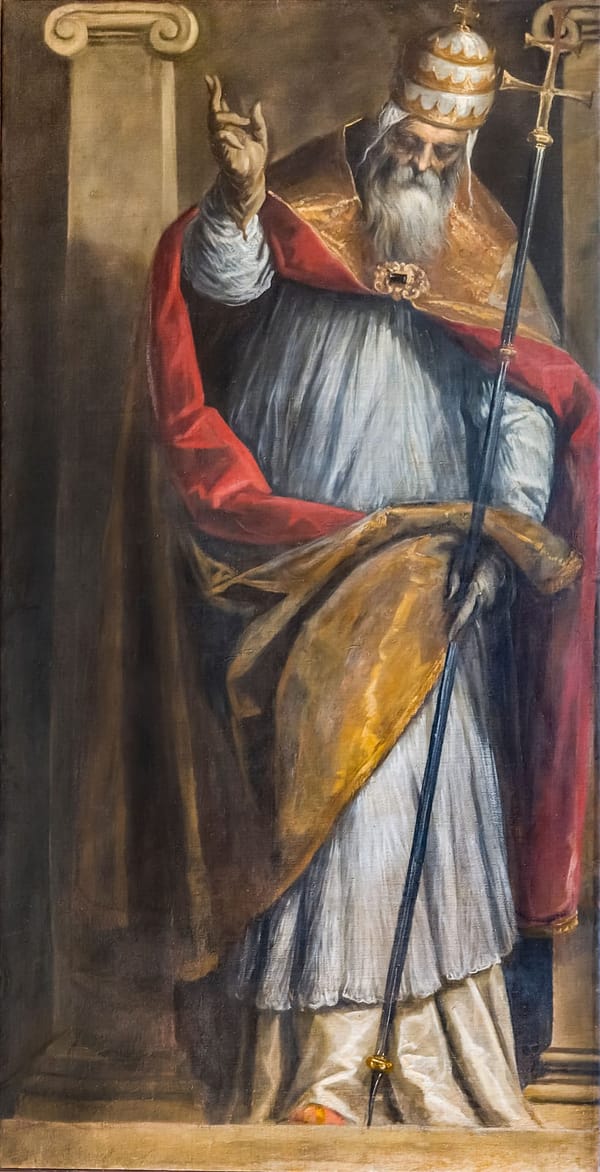
April 26: Sts. Cletus and Marcellinus, Popes and Martyrs
TWO bright stars appear this day on the ecclesiastical cycle, proclaiming the glory of our Jesus, the Conqueror of death. Again they are two pontiffs, and martyr pontiffs. Cletus leads us to the very commencement of the Church, for he was a disciple of Peter, and his second successor in the See of Rome. Marcellinus was a witness of the great persecution under Diocletian; he governed the Church on the eve of her triumph. Let us honour these two fathers of Christendom, who laid down their lives in its defence; and let us offer their merits to Jesus, who supported them by his grace, and cheered them with the hope that one day they would share in his Resurrection.
The following is the account given of St Cletus by the Liturgy:
The Life of St Marcellinus is thus given in the Breviary:
Pray for us, O holy Pontiffs, and look with fatherly love upon the Church on earth, which was so violently persecuted in your times, and at the present day is far from enjoying peace. The worship of idols is revived; and though they be not of stone or metal, yet they that adore them are as determined to propagate their worship as were the pagans of former days to make all men idolaters. The gods and goddesses now in favour are called Liberty, Progress, and Modern Civilization. Every measure is resorted to, in order to impose these new divinities upon the world; they that refuse to adore them are persecuted; governments are secularized, that is, unchristianized; the education of youth is made independent of all moral teaching; the religious element is rejected from social life as an intrusion: and all this is done with such a show of reasonableness that thousands of well-minded Christians are led to be its advocates, timid perhaps and partial, but still its advocates. Preserve us, O holy martyrs! from being the dupes of this artful impiety. It was not in vain that our Jesus suffered death, and rose again from the grave. Surely after this he deserves to be what he is—King of the whole earth, under whose power are all creatures. It is in order to obey him that we wish no other liberty save that which he has based upon the Gospel; no other progress save that which follows the path he has marked out; no other civilization save that which results from the fulfilment of the duties to our fellow-men, which he has established. It is he that created human nature, and gave it its laws; it is he that redeemed it, and restored to it its lost rights. Him alone, then, do we adore. O holy martyrs! pray that we may never become the dupes or slaves of the theories of human pride, even if they that frame or uphold them should have power to make us suffer or die for our resistance.
Thursday of the Fourth Week after Easter
THE Apostles have received their mission. The Sovereign Master has bade them divide among themselves the nations of the earth, and preach everywhere the Gospel—that is, the Good Tidings—the tidings of man's Redemption wrought by the Son of God, who was made flesh, was crucified, and arose again from the dead. But what is to be the grand support of these humble Jews, who have been suddenly transformed into conquerors, and have to win the whole world to Christ? Their support is the solemn promise made to them by Jesus, when, after saying: Go, teach all nations! he adds: Lo! I am with you all days, even to the consummation of the world! Hereby he promises never to leave them, and ever to direct and guide them. They shall see him no more in this life; and yet he assures them that he will be ever in their midst.
But these men, with whom Christ thus promises that he will abide for ever, and preserve them from every fall and from every error in the teaching of his doctrine—these Apostles are not immortal. We shall find them, one after the other, laying down their lives for the faith and so leaving this world. Are we, then, condemned to uncertainty and darkness, like men who have been abandoned by the light? Is it possible, that the appearance of our Emmanuel upon the earth has been but like that of a meteor, which we sometimes behold in the night, emitting a lurid light, and then suddenly disappearing, leaving us in greater darkness than before? No: the words of our Risen Jesus forbid us to fear such a calamity. He did not say to his Apostles:’Lo! I am with you even to the end of your lives;' but Lo! I am with you all days, even to the consummation of the world. So that those to whom he addressed himself were to live to the end of the world! What means this, but that the Apostles were to have successors, in whom their rights were to be perpetuated? successors whom Jesus would ever assist by his presence and uphold by his power. The work founded by a God, out of his love for man, and at the price of his own precious Blood, must surely be imperishable! Jesus, by his presence amidst his Apostles, preserved their teaching from all error; by his presence he will also, and for ever, guide the teaching of their successors.
O precious and necessary gift of Infallibility in the Church! Gift, without which the mission of the Son of God would have been a failure! Gift whereby faith, that essential element of man’s salvation, is preserved upon the earth! Yes, we have the promise; and the effects of this promise are evident even to them that are not of the Church. Where is there an unprejudiced man, who would not recognize the hand of God in the perpetuity of the Catholic Symbol of Faith, whereas everything else on earth is for ever changing? Can we attribute to natural causes such a result as this—that a society, whose link is unity of belief, should live through so many ages, and yet lose nothing of the truth it possessed at its commencement, nor imbibe anything of the falseness of the world around it; that it should have been attacked by thousands of sects, and yet have triumphed over them all, survived them all, and be as pure in the faith now at this present day, as it was on the day when first formed by its divine Founder? Is it not an unheard-of prodigy, that hundreds of millions of men, differing from each other in country, character, and customs, yea, and frequently enemies to each other, should be united in one like submission to one same authority, which, with a single word, governs their reason in matters of faith?
How great is thy fidelity to thy promises, O Jesus! Who could help feeling that thou art in the midst of thy Church, mastering by thy presence the warring elements, and by irresistible yet sweet power, subjecting our pride and fickleness to thy dear yoke? And they are men, men like ourselves who rule and guide our faith! It is the Pope, the successor of St Peter, whose faith cannot fail,* and whose sovereign word is carried through the whole world, producing unity of mind and heart, dispelling doubt, and putting an end to disputation. It is the venerable body of the bishops united with their Head, and deriving from this union an invincible strength in the proclamation of the one same truth in the several countries of the universe. Oh yes; men are made infallible because Jesus is with and in them! In everything else they are men like ourselves; but the Chair on which they are throned is supported by the arm of God; it is the Chair of Truth upon the earth.
How grand is our faith! Miracles gave it birth; and this continued miracle, of which we have been speaking, and which disconcerts all the calculations of human wisdom, directs it, enlightens it, and upholds it. How stupendous are the wondrous works done by our Risen Jesus during these forty days! So far, he had been preparing his work; now he carries it into effect. May the divine Shepherd be ever praised for the care he takes of his Sheep! If he exacts their faith as the first pledge of their service, we must own that he has made the sacrifice not only meritorious by the submission of our reason, but most attractive to our heart.
Let us honour his glorious Resurrection by a new canticle—one from the ancient Missals of Germany.
Sequence
Voce modulemur supplici.
Omnis in hac die
Rerum natura jubilans,
Personet immensas
Filio Dei gratias.
Jam nostri concives,
Coelestis sanctuarii milites,
In vestra nos adunate gaudia.
Hymnite nunc superi,
Pariter resonate inferi,
Et omnis in Domino
Spiritus gratuletur ænesi;
Deus homo nascitur;
Et fragili carne,
Se deitas occulens,
Probra sustinuit patiens:
Virtutibus, signis ut
Deus emicuit;
Et corporis nostri necessitate fruens,
Verus terrigena claruit.
Ab hoste tentatus,
Non est agnitus neque divinitas patuit:
Ars artem delusit,
Donec veteris nodum piaculi secuit.
In ara crucis hostiam
Se pro nobis Christus obtulit Deo Patri,
Morte sua nostra mortificans crimina.
Jam victor Christus,
Barathro populato,
Mortis principe vinculato,
Ab inferis pompa regreditur nobili.
Hæc est dies quæ illuxit, post turbida
Regni Æthiopum tempora;
Christus in qua resurrexit
Ultra victurus,
Cum carne quam sumpsit de Maria virgine.
Qui ovem
Cum gaudio Patri quam perdiderat,
Humero revexit suo.
sing with suppliant voice our praise to Christ.
On this day let all nature,
in a transport of joy,
Sound forth one universal hymn of thanks
to the Son of God.
And you,
our fellow-citizens,
permit us to share in your joys.
Sing a hymn, ye that are highest!
Intone a loud canticle, ye that are lowest!
Yea, let every spirit be glad in the Lord,
and praise him!
For he, God,
became Man for man's salvation.
Hiding his divinity
with the veil of our frail flesh,
he patiently endured every insult;
But his power and miracles
revealed him as our God.
He subjected himself to all our human wants,
and was verily a wayfarer on our earth.
He was tempted by the enemy;
but he made not known his divinity.
Craft by craft was foiled,
till the hour came for him to cut the knot of Adam's sin.
For our sake, he offered himself to his Father
a victim upon the altar of the Cross: and by his Death,
he put our sins to death.
And now hell is ravaged
and the prince of death enchained,
and Christ returns from Limbo,
in all the pageant of his victory.
This is the day which has shone upon the world,
after the stormy times of the Ethiopian sway.
It is the day whereon,
with the flesh he assumed from the Virgin Mary,
Christ rose again, to live for evermore.
With joy, he carried on his shoulders,
to his Father,
the sheep that had been lost.
* St Luke xxii 32. ↩︎
| Previous Wednesday of the Fourth Week after Easter | Next Thursday of the Fourth Week after Easter |