Daily reading
Paschal Time
Double of the II Class · May 1 · Sanctoral
May 1, 2029
From Dom Guéranger’s The Liturgical Year.
A Double of the II Class leads the weekday.Rubric

|
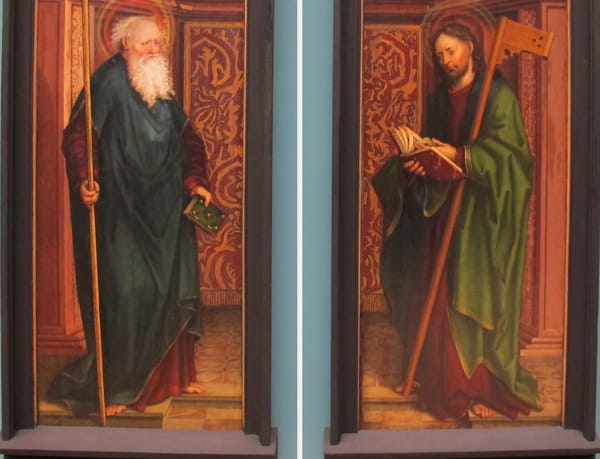
May 11 [May 1]: Sts. Philip and James the Less, Apostles
[This feast day, previously kept on May 1, was moved to May 11 when the feast of St. Joseph the Worker was established on May 1. The Solemnity of St. Joseph, which was replaced by St. Joseph the Work, was originally celebrated on the Third Sunday after Easter, as it was in the time of Dom Guéranger, whose article on that feast can be found here.-Ed.]
From Dom Guéranger's The Liturgical Year.
TWO of the favoured witnesses of our beloved Jesus' Resurrection come before us on this first day of May. Philip and James are here, bearing testimony to us that their Master is truly risen from the dead, that they have seen him, that they have touched him, that they have conversed with him,1 during these forty days. And, that we may have no doubt as to the truth of their testimony, they hold in their hands the instruments of the martyrdom they underwent for asserting that Jesus, after having suffered death, came to life again and rose from the grave. Philip is leaning upon the cross to which he was fastened, as Jesus had been; James is holding the club wherewith he was struck dead.
Philip preached the Gospel in the two Phrygias, and his martyrdom took place at Hierapolis. He was married when he was called by our Saviour; and we learn from writers of the second century that he had three daughters, remarkable for their great piety, one of whom lived at Ephesus, where she was justly revered as one of the glories of that early Church.
James is better known than Philip. He is called, in the sacred Scripture, Brother of the Lord,2 on account of the close relationship that existed between his own mother and the blessed Mother of Jesus. He claims our veneration during Paschal Time, inasmuch as he was favoured with a special visit from our Risen Lord, as we learn from St Paul.3 There can be no doubt but that he had done something to deserve this mark of Jesus’ predilection. St Jerome and St Epiphanius tell us that our Saviour, when ascending into heaven, recommended to St James’s care the Church of Jerusalem, and that he was accordingly appointed the first bishop of that city. The Christians of Jerusalem, in the fourth century, had possession of the chair on which St James used to sit when he assisted at the assemblies of the faithful. St Epiphanius also tells us that the holy Apostle used to wear a lamina of gold upon his forehead as the badge of his dignity. His garment was a tunic made of linen.
He was held in such high repute for virtue that the people of Jerusalem called him ' The Just and when the time of the siege came, instead of attributing the frightful punishment they then endured to the deicide they or their fathers had .committed, they would have it to be a consequence of the murder of James, who, when dying, prayed for his people. The admirable Epistle he has left us bears testimony to the gentleness and uprightness of his character. He there teaches us, with the eloquence of an inspired writer, that works must accompany our faith if we would be just with that justice which makes us like our Risen Lord.
The bodies of SS Philip and James repose in the Basilica of the Holy Apostles at Rome. These relics are counted as one of the richest treasures of the Holy City, and there is reason to believe that this first of May is the real anniversary of their translation. For a long period the Church of Rome kept special feasts in honour of four only of the Apostles: SS Peter and Paul, St John the Evangelist, and St Andrew (Peter’s brother): the rest were united in the solemnity of June 29, and a vestige of this is still to be found in the office of that day, as we shall see later on. The reception of the bodies of SS Philip and James, which were brought from the East somewhere about the sixth century, gave rise to the institution of to-day's feast; and this led gradually to the insertion into the Calendar of special feasts for the other Apostles and Evangelists.
Let us now read the brief account given of St Philip in the Liturgy.
The Breviary then gives the two following Lessons upon St James:
The Greek Church celebrates the memory of these two Apostles on distinct days, which are the anniversaries of their martyrdom. The following stanzas are from the hymn in honour of St Philip:
Hymn (Die XIV Novembris)
Let us now make a selection from the Menæa in honour of St James, whose memory is so affectionately cherished by the Eastern Churches:
Hymn (Die XXIII Octobris)
Holy Apostles! you saw our Risen Jesus in all his glory. He said to you on the evening of that great Sunday: Peace be to you! He appeared to you during the forty days following, that he might make you certain of his Resurrection. Great indeed must have been your joy at seeing once more that dear Master, who had admitted you into the number of his chosen Twelve; and his return made your love of him more than ever fervent. We address ourselves to you as our special patrons during this holy season, and most earnestly do we beseech you to teach us how to know and love the great mystery of our Lord’s Resurrection. May our hearts glow with Paschal joy, and may we never lose the new life that our Jesus has now given unto us.
Thou, O Philip! wast devoted to him, even from the first day of his calling thee. Scarcely hadst thou come to know him as the Messias, than thou didst announce the great tidings to thy friend Nathanael. Jesus treated thee with affectionate familiarity. When about to work the great miracle of the multiplication of the loaves, it was to thee that he addressed himself, and said to thee: Whence shall we buy bread, that these may eat?4 A few days before the Passion of thy divine Master, some of the Gentiles wished to see this great Prophet, of whom they had heard such wonderful things, and it was to thee that they applied. How fervently didst thou not ask him, at the Last Supper, to show thee the Father! Thy soul longed for the divine light; and when the rays of the Holy Ghost had inflamed thy spirit, nothing could daunt thy courage. As a reward of thy labours, Jesus gave thee to share with him the honours of the Cross. O holy Apostle! intercede for us, that we may imitate thy devotedness to Jesus; and that, when he deigns to send us the Cross, we may reverence and love it.
We also honour thy love of Jesus, O thou that art called the brother of the Lord, on whose venerable features was stamped the likeness of our Redeemer. If, like the rest of the Apostles, thou didst abandon him in his Passion, thy repentance was speedy and earnest, for thou wast the first, after Peter, to whom he appeared after his Resurrection. We affectionately congratulate thee, O James, for the honour thus conferred upon thee; do thou, in return, obtain for us that we may taste and see how sweet is our Risen Lord.5 Thy ambition was to give him every possible proof of thy gratitude; and the last testimony thou didst bear, in the faithless city, to the divinity of thy dear Master (when the Jews took thee to the top of the Temple) opened to thee, by martyrdom, the way that was to unite thee to him for eternity. Pray for us, O thou generous Apostle, that we also may confess his holy Name with the firmness which befits his disciples; and that we may ever be brave and loyal in proclaiming his rights as King over all creatures.
O holy Apostles! we beseech you to unite your prayers, and intercede for the Churches of the East, to which you preached the Gospel. Have compassion on Jerusalem, the dupe of schism and heresy; obtain her purification and her liberty; and rid her Holy Places of the sacrileges that have so long polluted them. Lead back the Christians of Asia Minor to union with the fold governed by the one supreme pastor. And lastly, pray for Rome, the city where your bodies repose, awaiting their glorious Resurrection. In return for the long hospitality she has given you, shield her with your protection; and permit not that the city of Peter, your venerable Head, should be deprived of its grandest glory—the presence of the Vicar of Christ.
Tuesday of the Fifth Week after Easter
THE third sacrament—the Holy Eucharist—is so intimately connected with our Redeemer's Passion that its institution could not be deferred till the Resurrection had taken place. On Maundy Thursday, we honoured the solemn act whereby our Jesus prepared for the morrow’s sacrifice, by instituting the mystery of his Body and Blood, which are really immolated in the Eucharistic Supper. The Apostles were not only admitted, as all future generations were to be, to partake of the divine Food, which giveth life to the world,1 but they moreover received power from Jesus, the Priest for ever,2 to do what he himself had just done. The great Mystery was inaugurated; the new priesthood was instituted: and now that Jesus is risen from the dead, he makes known to his Apostles the whole importance of the gift bestowed upon mankind at the Last Supper; he bids them begin the exercise of the sublime power conferred on them, as soon as the Holy Ghost, by descending upon the earth, shall give to the Church the signal for her using the prerogatives wherewith she has been endowed; and, finally, he teaches how they are to perform this special function of their Priesthood.
At the Last Supper, the Apostles were still carnal-minded men. They were taken up with the sad event that was about to happen, and overcome with grief at their divine Master telling them that that was the last Pasch he was to keep with them. They were not, therefore, in a fit state to appreciate what it was that Jesus had done for them, when he uttered those words: Take ye and eat; this is my Body. Drink ye all of this; for this is my Blood. Still less did they understand the greatness of the power they received, of doing what their Lord himself had just done in their presence. Now that Jesus is risen from the grave, he unfolds all these mysteries to them. The sacrament of the Eucharist was not instituted during these days, but it was made known, explained, and glorified by its divine institutor: and this circumstance gives a fresh lustre to the sacred season we are now going through.
Of all the sacraments, there is not one that can be compared in dignity to that of the Eucharist. The others give grace; this gives us the very Author of grace. The others are only sacraments; this is both a sacrament and a sacrifice. We will endeavour to explain it in all its magnificence, when we come to the bright feast of Corpus Christi. Let us for the present pay the tribute of our loving adoration to our Jesus, the Living Bread, that giveth life to the world.3 Let us acknowledge his immense love for his sheep. He seems to be on the point of leaving them that he may return to his Father, and yet his love retains him amongst them by means of this august mystery, wherein he is truly though invisibly present.
Be thou blessed, then, O Son of the Eternal Father! who, even in the days of the ancient covenant, didst assure us that thy delights are to be with the children of men.4 Thou provest it now by this wonderful sacrament, which reconciles thy two announcements, apparently so contradictory: thy leaving us, and thy abiding ever in our midst.
Be thou blessed for having provided for the nourishment of our souls as well as for that of our bodies. At Christmas we welcomed thy birth at Bethlehem, which signifies a House of Bread. Thou wast both the Saviour who was born for us, and the Food that came down from heaven to nourish our souls.
Be thou blessed, who, not satisfied with working the greatest of wonders at the Last Supper, by changing bread into thy Body and wine into thy Blood, hast also willed that this same miracle should be renewed, everywhere and to the end of time, for the support and consolation of our souls.
Be thou blessed in that thou hast put no limits to our longing after this Bread of Life. On the contrary, thou biddest us make it our daily Bread, and this in order that we may not faint in the way of this our exile.
Be thou blessed for the generosity wherewith, out of thy desire to communicate thyself unto us, thou hast exposed thyself to the blasphemies of heretics, to the sacrileges of bad Christians, and to the indifference of the tepid.
Be thou blessed, O divine Lamb, who enrichest the new Pasch by the shedding of thy Blood, and invitest the new Israel to a banquet where thy sacred Body is offered as nourishment to thy faithful; there do they receive life at its very source, and share in the ineffable joys of thy Resurrection.
Be thou blessed, O Jesus, for having instituted, in the Holy Eucharist, not only the greatest of the sacraments, but also a sacrifice which surpasses all others; a sacrifice whereby we are enabled to offer to the divine Majesty the only homage that is worthy of him, give him thanks in keeping with his favours to us, make him a superabundant atonement for our sins, and finally beg and obtain from him all the graces of which we stand in need.
Be thou blessed, O Emmanuel, who, having promised to give us this heavenly Food, didst fulfil thy promise on the eve of thy Passion, and gavest us this adorable sacrament as the testament of thy love. In the interval between thy Resurrection and Ascension, thou didst reveal to thine Apostles the excellency of thy gift, that so we might receive it with becoming faith.
We offer thee, dear Jesus, this homage of our faith. We confess that in this august Mystery the bread is changed into thy Body, and the wine into thy Blood: and we believe it, because thou hast said it, and because thou canst do all things.
In praise of our Paschal Lamb, who gives himself to us to be our nourishment, let us recite the following beautiful canticle, composed by Notker for the Church of Saint Gall.
Sequence
Esu potuque dignas,
Praebeant omnes se Christianae animae.
Ipse summus Pontifex.
Ejus illita sacrosancto cruore, tuta a clade Canopica,
In mari rubro sunt obruti.
Pedes tutentur adversus viperas;
Contra canes jugiter manu bajulent;
Quo de barathro victor rediit.
Ornatibus Christo consurgens, fideles admonet,
Cum eo victuros.
to partake of the Paschal Lamb,
by holy lives.
for their sakes, as an oblation to the Father.
of the Lamb; they are protected from the slaughter that fell upon Egypt,
were engulfed in the Red Sea.
let them protect their feet against vipers;
to defend themselves against dogs;
whereby he rose again victorious from the tomb.
rises together with Christ. She teaches us,
are to share in Jesus’ victory.
| Previous Monday of the Fifth Week after Easter | Next Tuesday of the Fifth Week after Easter |