Daily reading
Paschal Time
Double · May 5 · Sanctoral
May 5, 2029
From Dom Guéranger’s The Liturgical Year.
A Double leads the weekday.Rubric
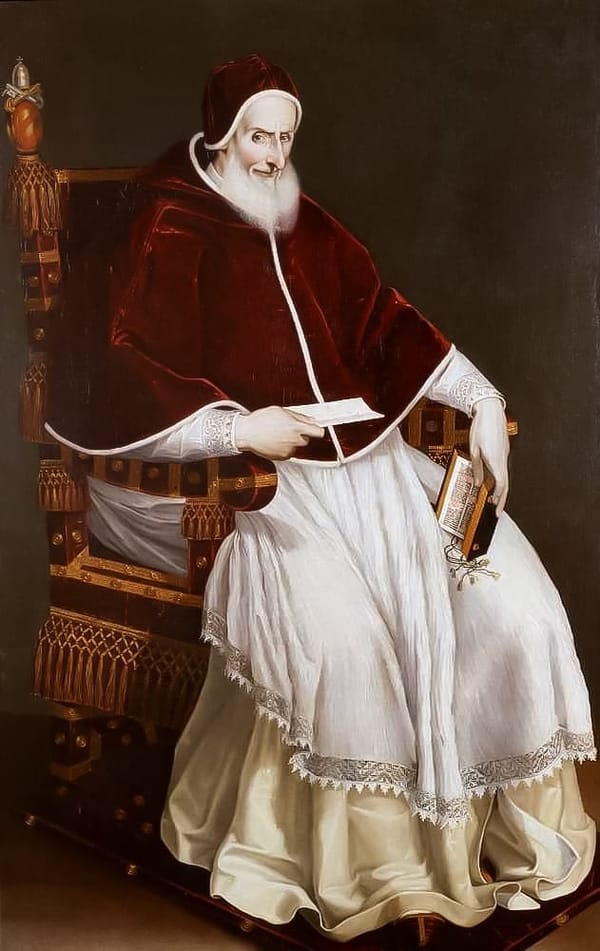 |
May 5: St. Pius V, Pope
WE have already met with the names of several Pontiffs on the Paschal Calendar. They form a brilliant constellation around our Risen Jesus, who, during the period between his Resurrection and Ascension, gave to Peter, their predecessor, the keys of the kingdom of heaven. Anicetus, Soter, Caius, Cletus and Marcellinus, held in their hands the palm of martyrdom: Leo was the only one who did not shed his blood in the cause of his divine Master. To-day there comes before us a holy Pope who governed the Church in these latter times; he is worthy to stand amidst the Easter group of Pontiffs. Like Leo, Pius V was zealous in combating heresy; like Leo, he saved his people from the barbarian yoke.
The whole life of Pius V was a combat. His pontificate fell during those troubled times when Protestantism was leading whole countries into apostasy. Italy was not a prey that could be taken by violence: artifice was therefore used, in order to undermine the Apostolic See and thus develop the whole Christian world in the darkness of heresy. Pius defended the Peninsula with untiring devotedness from the danger that threatened her. Even before he was raised to the Papal Throne he frequently exposed his life by his zeal in opposing the preaching of false doctrines. Like Peter the Martyr, he braved every danger and was the dread of the emissaries of heresy. When seated on the Chair of Peter, he kept the innovators in check by fear, roused the sovereigns of Italy to energy and by measures of moderate severity drove back beyond the Alps the torrent that would have swept Christianity from Europe had not the Southern States thus opposed it. From that time forward, Protestantism has never made any further progress: it has been wearing itself out by doctrinal anarchy. We repeat it: this heresy would have laid all Europe waste, had it not been for the vigilance of the pastor who animated the defenders of truth to resist it where it already existed, and who set himself as a wall of brass against its invasion in the country where he himself was the master.
Another enemy, taking advantage of the confusion caused in the West by Protestantism, organized an expedition against Europe. Italy was to be its first prey. The Ottoman fleet started from the Bosphorus. This again would have meant the ruin of Christendom but for the energy of the Roman Pontiff, our Saint. He gave the alarm, and called the Christian Princes to arms. Germany and France, tom by domestic factions that had been caused by heresy, turned a deaf ear to the call. Spain alone, together with Venice and the little Papal fleet, answered the summons of the Pontiff. The Cross and Crescent were soon face to face in the Gulf of Lepanto. The prayers of Pius V decided the victory in favour of the Christians, whose forces were much inferior to those of the Turks. We shall return to this important event when we come to the Feast of the Rosary in October. But we cannot omit to mention to-day the prediction uttered by the holy Pope, on the evening of the great day of October 7, 1571. The battle between the Christian and Turkish fleets lasted from six o'clock in the morning till late in the afternoon. Towards evening, the Pontiff suddenly looked up towards heaven, and gazed upon it in silence for a few seconds. Then turning to his attendants, he exclaimed: ' Let us give thanks to God! The Christians have gained the victory!' The news soon arrived at Rome; and thus, Europe once more owed her salvation to a Pope! The defeat at Lepanto was a blow from which the Ottoman Empire has never recovered: its fall dates from that glorious day.
The zeal of this holy Pope for the reformation of Christian morals, his establishment of the observance of the laws of discipline prescribed by the Council of Trent and his publication of the new Breviary and Missal have made his six years' pontificate to be one of the richest periods of the Church’s history. Protestants themselves have frequently expressed their admiration of this vigorous opponent of the so-called Reformation.
‘I am surprised,’ said Bacon, ‘that the Church of Rome has not yet canonized this great man.’ Pius V did not receive this honour till about a hundred and thirty years after his death; so impartial is the Church, when she has to adjudicate this highest of earthly honours even to her most revered Pastors!
Of the many miracles which attested the merits of this holy Pontiff, even during his life, we select the two following: As he was one day crossing the Vatican piazza, which is on the site of the ancient Circus of Nero, he was overcome with a sentiment of enthusiasm for the glory and courage of the martyrs who had suffered on that very spot in the first persecution. Stooping down, he took up a handful of dust from the hallowed ground which had been trodden by so many generations of the Christian people since the peace of Constantine. He put the dust into a cloth which the Ambassador of Poland, who was with him, held out to receive it. When the Ambassador opened the cloth, after returning to his house, he found it all saturated with blood, as fresh as though it had been that moment shed: the dust had disappeared. The faith of the Pontiff had evoked the blood of the martyrs, which thus gave testimony against the heretics that the Roman Church, in the sixteenth century, was identically the same as that for which those brave heroes and heroines laid down their lives in the days of Nero.
The heretics attempted more than once to destroy a life which baffled all their hopes of perverting the faith of Italy. By a base and sacrilegious stratagem, aided by treachery, they put a deadly poison on the feet of the crucifix which the Saint kept in his Oratory, and which he was frequently seen to kiss with great devotion. In the fervour of prayer, Pius was about to give this mark of love to the image of his crucified Master, when suddenly the feet of the crucifix detached themselves from the Cross and eluded the proffered kiss of the venerable old man. The Pontiff at once saw through the plot whereby his enemies would fain have turned the life-giving Tree into an instrument of death.
In order to encourage the faithful to follow the sacred Liturgy, we will select another interesting example from the life of this great Saint. When, lying on his bed of death, and just before breathing his last, he took a parting look at the Church on earth, which he was leaving for that of heaven, he wished to make a final prayer for the flock which he knew was surrounded by danger; he therefore recited, but with a voice that was scarcely audible, the following stanza of the Paschal hymn: ‘We beseech thee, O Creator of all things! that in these days of Paschal joy, thou defend thy people from every assault of death!’1
Let us now read the eulogy of this saintly Pope of modern times, as given in the divine Office:
St Pius is one of the leading glories of the Dominican Order. We find the following Responsories and Hymns in the Breviary of that Order:
Responsories
Hymn
Canora pangant organa:
Nimbosque pellant nubilos
Sacræ diei gaudia.
Fregit draconis impetum:
Piique sumpto nomine,
Hostem repressit impium.
Umbone firmo depulit:
Sectariorum spicula
Mucrone forti messuit.
Sacris stetit pro mcenibus,
Ut barbaros acinaces
Arceret a fidelibus.
Cura revexit sedula:
Et impiis erroribus
Objecit hic repagula.
Non vinxit in sudario
Necessitates publicas
Toto juvans ærario.
Manus habens tomatiles,
Pavit greges famelicos
Effusione munerum.
In hoc paschali gaudio,
Ab omni mortis impetu
Tuum defende populum.
give forth their glad sound in honour of blessed Pius!
Let the joys of this sacred day
dispel all stormy clouds.
and he conquered the devil in battle:
he took the name of Pius
and repressed the impious foe.
against the dangers that attacked the Church:
he was the strong sword
that mowed down the ranks of the heretics.
who stood for the defence of the Holy City,
that he might protect the faithful
from the scimitar of the Turks.
redisciplined morals;
and to impious errors
he opposed a barrier of restraint.
to hide his wealth in a napkin;
he threw open his whole treasury,
that he might relieve the necessities of his people.
with his hands ever pouring forth charity,
he fed and amply provided for his subjects
when suffering famine.
that in these days of Paschal joy
thou defend thy people
from every assault of death.
The following hymn is placed near the tomb of our Saint, in the Church of Saint Mary Major, for the use of those who visit his shrine:
Hymn
Cultus Dei contemnitur:
Ultrixque culpam persequens,
Jam poena terris imminet.
Cœlestium de sedibus
Præsentiorem vindicem,
Quam te, Pie, invocabimus?
Intensiore robore
Quam tu, superni numinis
Promovit in terris decus;
Avertit a cervicibus,
Quod christianis gentibus
Jugum parabant barbari.
Tu supplices nunc aspice:
Tu civium discordias
Compesce et iras hostium.
Terras revisat, ut
Deo Tuti queamus reddere
Mox lætiora cantica.
Uni Deo sit gloria,
Laus et potestas omnia
Per sæculorum sæcula.
for the worship of God is despised:
the chastisement that avenges guilt
is menacing our earth.
which of the heavenly citizens
can we better invoke
in our defence than thee, O Pius?
no mortal ever laboured
with such zealous vigour
to promote God's glory on earth as thou didst;
to free Christian lands from the yoke
which barbarians were seeking
to put upon them.
that thou art in heaven:
look upon us thy clients!
Restrain civil discord and repel our enemies.
that in calm security
we may sing our canticles to God
with a gladder heart.
one God, be glory,
praise and power, for ever
and ever.
Pontiff of the living God! thou wast, whilst on earth, the pillar of iron and wall of brass, spoken of by the prophet.2 Thine unflinching firmness preserved the flock entrusted to thee from the violence arid snares of its many enemies. Far from desponding at the sight of the dangers thou didst redouble thy courage just as men raise the embankments higher when they see the torrent swell. By thee was the spread of heresy checked; by thee was the Mussulman invasion repelled, and the haughty Crescent humbled. God honoured thee by choosing thee as the avenger of his glory and the deliverer of the Christian people: receive our thanks and the homage of our humble praise! By thee were repaired the injuries .done to the Church during a period of unusual trial. The true reform—the reform that is wrought by authority—was vigorously applied by thy strong and holy hand. To thee is due the restoration of the Divine Service by the publication of the books of holy Liturgy. And all these glorious deeds were done in the six short years of thy laborious pontificate!
Hear now the prayers addressed to thee by the Church Militant, whose destinies were once in thy hands. When dying, thou didst beseech our Risen Jesus to grant her protection against the dangers which were then threatening her: oh! see the state to which licentious error has now reduced almost the whole Christian world! The Church has nothing left to her wherewith to make head against her countless enemies, save the promises of her divine Founder; all visible support is withdrawn from her; she has been deprived of everything except the merit of suffering and the power of prayer. Unite, O holy Pontiff, thy prayers to hers, and show how unchanged is thy love of the flock of Christ. Protect in Rome the Chair of thy successor attacked by open violence and astute hypocrisy. Princes and peoples seem to have conspired against God and his Christ: disconcert the schemes of sacrilegious ambition, and the plots of impiety which would fain give the lie to the word of God. Avert, by thine intercession, the scourges which are threatening those nations that have become ungrateful to the Church and indifferent to the attempts made against her to whom they owe all they possess. Pray that the blind may see and the wicked be confounded. Pray that the True Faith may enlighten those numberless souls that call error truth and darkness light.
In the midst of this dark and menacing night, thine eyes, O holy Pontiff, discern them that are the faithful sheep of Christ: bless them, aid them, increase their number. Graft them on the venerable Tree which dieth not, that they may not be carried away by the storm. Obtain for them docility to the Faith and traditions of Holy Church; it is their only stay amidst the tide of error which is now threatening to deluge the whole world. Preserve to the Church the holy Order in which thou wast trained for the high mission destined for thee; maintain within her that race of men, powerful in work and word, zealous for the faith and sanctification of souls, of which we read in her Annals, and which has yielded saints such as thyself. And lastly, O Pius, remember that thou wast once the Father of the faithful: continue to be so, by thy powerful intercession, till the number of the elect be filled up!
- The Stanza recited by the dying Pontiff was, in the Breviary of his time, as follows: Quæsumus, Auctor omnium, In hoc Paschali gaudio, Ab omni mortis impetus Tuum defende populum. When the hymns were corrected under the pontificate of Urban the Eighth, this stanza was totally changed: Ut sis perenne mentibus, etc. [The Monastic Breviary has retained the original.—Tr.] ↩︎
- Jer. i 18. ↩︎
Saturday of the Fifth Week after Easter
ON this day, which is sacred to Mary, let us open the holy Gospel according to St John. There, in the second chapter, we find these words: There was a marriage in Cana of Galilee, and the Mother of Jesus was there.1 The sacred text goes on to say that Jesus also and his disciples were among the guests; but the Holy Spirit, who guided the Evangelist's hand, would have him first make mention of Mary. It was to teach us that this our blessed Mother extends her protection to those who enter upon the married life with worthy dispositions, that is, with such dispositions as to draw down upon themselves the blessing of her divine Son.
Marriage is a sacred state, for it was instituted by God. The first marriage was celebrated in the earthly Paradise between Adam and Eve, when yet they were innocent. It was God himself who dictated the conditions of marriage. Unity was to be its very basis; in other words, the wife was to have but one husband, the husband was to have but one wife. It was the type of a still more glorious unity, which was not to be revealed till a later period. The mystery of unity typified by marriage being part of the Christian revelation, we deem it a duty to put it before our readers by the following considerations.
The angels were all created at one and the same time: but the members of the human race were to be bom, each indeed from their respective parents, but yet so as that Adam and Eve were to be the common parents to whom all were to owe their origin. Such was our Creator’s design, and marriage was the means he selected for its fulfilment. An immense multitude of the angels having fallen, the places destined for them in heaven were to be filled up by the elect of earth; again, it was marriage that was to provide these citizens for heaven. Hence, God blessed marriage at the very commencement of the world, and with a blessing which was to be permanent, for, as the Church teaches us in the Liturgy,’it was not recalled, either by the punishment inflicted on original sin, or by the sentence which destroyed the world by the deluge.’2
Even before this second great chastisement came upon the earth, all flesh hud corrupted its way,3 and marriage had fallen from the elevated dignity given to it by the Creator. The end for which he instituted it was forgotten; it was debased into a mere sensual gratification; it lost the sacred unity, which was its glory. Polygamy and divorce destroyed its primitive character, and two frightful evils ensued: family ties were at an end, and woman’s position was degraded into that of a being which must minister to man’s passions. The lesson intended to be conveyed by the Deluge was soon lost sight of; the world again became depraved, so much so indeed, that when the Mosaic Law came with its reforms, it had not power to restore to marriage the dignity of its first institution.
To effect this, it was requisite that God himself should descend upon the earth. When the miseries of humanity had reached their height, the Word, the second Person of the blessed Trinity, assumed our human nature, and dwelt amongst us. He called himself the Bridegroom.4 The prophets and the Canticle of Canticles had foretold that he would take to himself a Spouse from among mortals. This Spouse is the Church—that is, the human race purified by baptism and enriched with supernatural gifts. As a dowry, he gave her his own precious Blood and merits; and then united her to himself for ever. This Spouse is One: he affectionately calls her his Only One.5 On her part, she has no other but him. Here we have revealed to us the divine type on which marriage was formed, which, as the Apostle teaches us, derives its holiness and dignity from its resemblance to the union existing between Christ and his Church.6 The two unions are for the same end, and bear a mutual relation to each other. Jesus loves his Church with the tenderest affection; but his Church is the issue of human marriage, for it is marriage that provides the Church with her children, and thus perpetuates her existence upon the earth. Let us not be surprised, therefore, that Jesus restored marriage to its primitive condition, and that he honours it as being his powerful aid in the accomplishment of his designs.
We have already seen, on the second Sunday after the Epiphany, how he selected the nuptial feast at Cana as the occasion of his working his first public miracle. By his accepting the invitation to assist, in company with his blessed Mother, at the marriage, it is evident that he wished to honour, by his divine presence, the sacred engagement which was to unite the two spouses; it is evident that he intended to renew, in their persons, the ancient blessing given in Paradise. Having, by his miracle at Cana, proved himself to be truly the Son of God, he began his public life and preaching. His object being to reform fallen man to the noble end for which he had been created, he frequently made marriage the subject of his instructions. He spoke of its being divinely instituted on the basis of unity. He authoritatively repeated the command given at its first institution: They shall be two in one flesh:7 two, and only two. Speaking of the indissolubility of the marriage tie, he told his hearers that no power on earth, not even the unfaithfulness, however criminal, of the husband or wife, could sever the bond. These were his words: What God hath joined together, let no man put asunder.8 Thus did he restore marriage to its normal state; thus did he abrogate the degrading liberty, or more correctly, the libertinism, of polygamy and divorce—those sad proofs of the hardness of man’s heart,9 and of the need he had of a Redeemer. Thus did the New Law bring back to marriage its primal blessing, and make it once more a holy state, which, so far from being an obstacle, is a means to virtue, and peoples both earth and heaven with the elect.
But our Risen Jesus would do more than repair the injuries brought upon marriage by human frailty. He raised to the dignity of a sacrament the solemn and irrevocable contract whereby a man and woman take each other for husband and wife. The moment that two Christians are thus irrevocably united, a sacramental grace descends upon them, and cements their union, which there and then becomes a sacred thing. The Apostle, speaking of Christian marriage, says: It is a great sacrament; but I speak in Christ, and in the Church.10 The meaning of these words is that marriage is the type of the union which exists between Christ and his Spouse the Church. There is one and the same object and end in the two unions—in that of Christ with the Church, and in that of the husband with his wife: this object, this end, is to people heaven with the elect. Hence it is that the Holy Ghost puts his divine seal upon both these unions.
But the grace of the seventh sacrament does more than cement the indissoluble union of husband and wife. It gives them every help they stand in need of for the fulfilment of their sacred mission. First of all, it infuses into their hearts a mutual love, which is strong as death, and which many waters cannot quench,11 so long as they make religion the ruling principle of their lives. This love is mingled with a sentiment of chaste respect, which serves as a check upon evil concupiscence. It is a love which time, far from impairing, makes purer and stauncher. It is a love calm like that which is found in heaven. When sacrifices are to be made, it makes them almost without an effort, and is intensified by the making. The sacramental grace also fits the husband and wife for the great duty of educating their children. It gives them an untiring devotedness for their welfare; an affectionate patience with their faults; a supernatural discernment for treating them according to their age and dispositions; a ceaseless remembrance of the fact that these dear ones were created for heaven; and, finally, a deep-rooted sentiment that they belong to God more truly than to the parents, through whom he gave them life.
Thus was the married state transformed by the grace of the sacrament of matrimony. The Christian Law restored to it the dignity of which the vile egotism of pagan passion had deprived it. After so long a period of degradation, mankind was again brought to the knowledge of what marriage really is—namely, love surrounded by sacrifice, and sacrifice prompted and aided by love. Truly a sacrament was needed for bringing about such a change as this! The change came, and admirable indeed it was. Two centuries had not elapsed since the promulgation of the Gospel, and paganism was still powerful; and yet we find a writer of those days giving the following description of a Christian husband and wife.’How shall I find words to describe the happiness of a marriage, whose tie is formed by the hands of the Church, which is confirmed by the sacred oblation, sealed by the blessing, proclaimed by the angels, and ratified by the heavenly Father? How wonderful a yoke is that which is taken up by two of the faithful united together in the same hope, in the same law, in the same duty! They have the same God for their Father, they serve the same Master, they are two in one flesh, they are one heart and soul. They pray together, they prostrate together, they fast together; they instruct each other, they exhort each other, they encourage each other. You see them together in the Church, and at the holy Table. They share in each other's trials, persecutions, and joys. There are no secrets between them; no such thing as shunning each other, or being wearied of each other's company. They have not to hide from each other, in order to visit the sick or the needy. Their alms excite no disputes; they approve of each other’s sacrifices; they interfere not with each other’s practices of piety. They have no need to make the sign of the Cross stealthily; neither are they afraid to give way, in each other’s presence, to feelings of love and gratitude for their God. They sing together the psalms and canticles: and if there be any rivalry between them, it is which of them shall best sing the praises of God. Oh! these are the marriages which gladden the eyes and ears of Christ. These are the marriages to which he imparts his blessing of peace. He has said, that he would be where two are united together; therefore, he is in such a house as the one we are describing; and the enemy of man is not there.’12
What a picture! and how great must be the sacrament which can bring about such results as this! Here is the secret of the world’s regeneration: it was our Lord Jesus Christ himself who created the beautiful existence of a Christian family, and implanted it on our earth. Long ages passed, and this was the type which, in spite of human frailty, was the only one acknowledged either by the conscience of individuals or by the public laws of nations. But the pagan element, which may be repressed, but which never dies, strove to regain what it had lost; and at length the time came when it succeeded in falsifying, in the majority of Christian countries, the notion of marriage. Faith teaches us, that this contract, now become a sacrament, comes under the jurisdiction of the Church, in what regards the bond, which constitutes its very essence: but the modem world looks on the Church as a power incompatible with the progress of liberty and enlightenment; and therefore the State takes the Church’s place, as often as it is deemed good for society! and marriage has been debased into a civil act. The immediate consequence of this has been, that the State can legalize divorce, and therefore paganize Society. The influence exercised over the world by the long predominance of the Christian spirit has not been entirely removed by this iniquitous secularization of marriage; still, from the principles laid down by our modem Governments we have this logical and practical result: that a marriage may be indissoluble and sacramental in the eyes of the Church, and null in the eyes of the civil power; and again, a marriage held to be legal by the State may be counted as invalid by the Church, and therefore not binding on the conscience. The rupture between Church and State is, therefore, consummated.
And yet that which Christ has appointed cannot be effaced by man. What Jesus has instituted is to last to the end of time. Therefore let Christians fear not: let them continue to receive from their mother, the Church, the doctrine of the sacraments; let them continue to look upon marriage as a divine institution, such as we have been describing it to be; and thus, they may save Society and re-Christianize it, or, if that cannot be, they will save their own and their children's souls.
The close of this week, and these reflections upon the divine sacrament of matrimony, lead us to think of thee, dear Mother of Jesus! The marriage feast at Cana, which was honoured by thy presence and blessing, is one of the great facts of the holy Gospel. Why, O thou purest of Virgins, who wouldst have refused the dignity of being Mother of God had it called for the sacrifice of the treasure already conferred on thee—why wast thou present at these nuptials, if not to teach a sublime lesson? This lesson is that holy and perfect continency is a state far superior to that of marriage. It is a lesson which exercises an immense influence upon the married life, inasmuch as it secures to it its Christian dignity and happiness. Who, then, could have been more appropriately chosen by God than thou, to bless a union which is so holy in itself, and instituted for so sublime an end? Shield it with thy protection now more than ever, for the world's laws have legislated for its ruin, and sensualism has destroyed in thousands of Christians the sense of right and wrong. There are exceptions: there are some who receive this sacrament with the holiest of dispositions: upon these, O Mary, lavish thy blessing. They are the inheritance of thy divine Son; they are the salt of the earth, to keep it from universal corruption; they are the pledge of a better future. They are thy children, sweet Mother! then watch over them, add to their number, that so the world may not perish.
To Mary, the Virgin of virgins, and Protectress of Christian Marriage: to Mary, who was the Spouse of the Eternal Word before she became his Mother by the Incarnation: let us, to-day, offer this beautiful sequence of the Catholic Germany of the Middle Ages; let us devoutly present it to her as the ring of her chaste nuptials.
Sequence
Desponsari habilis
Summo Regi, annulum,
Arrhabonis titulum, Suscipe, Maria.
Paranympho credula,
Concipis, quam Jaspidis
Color monstrat viridis plenam fide pia.
Numquam in te labilis
Fuit neque veritas,
Signat ut serenitas cœlica Sapphiri.
Sed sub divo pulchrius,
Pandit te eximio
Charitatis radio fervide igniri.
Monstrat et viriditas,
Mente cunctis purior
Es, et elegantior actu virtuali.
Ruber, niger, candidus,
Te designat limpide
Conversatam placide gestu virginali.
Indicat apertius,
Mortis Christi gladium
Sauciasse nimium spiritum Mariae.
Præ fulgore inclytus,
Flammeis scintillulis,
Claram te miraculis ac dono sophiæ.
Sed nitenti fulgido,
Humilis in animo,
Et benigna proximo rite comprobaris.
Cunctis gemmis gratior,
Asserit Topazius,
Cunctis quod limpidius Deum contemplaris.
Guttas jacit aureas
Chrysoprasus, nimii
Æstu desiderii refert te fervere.
Se conformat aetheri,
Sic fers opem anxiis,
Tuis quos auxiliis cernis indigere.
Deo et hominibus,
Prædilectam, roseus
Color et purpureus probat Amethysti.
Margarita cœlica
Es mercantum omnium;
Felix qui commercium consequitur Christi!
Venis albis cingitur.
Qui te vere humilem
Hinc et acceptabilem reseret Achates.
Mixtus fert, quod
Dominus Piis te virtutibus
Adornavit omnibus, quam optarunt vates.
Adamas, qui firmiter
Cunctis obstat ictibus,
In adversis omnibus fortem, patientem.
Te Crystallus frigida
Mente, carne virginem,
Nostræque originem spei existentem.
Ac timoris gratia
Ornant, ut egregius
Aperit Ligurius similis Electro.
Attrahit celerius:
Virgo pœnitentium
Chordas tangit mentium pietatis plectro.
Lucens nocte oculus,
Longe, late, largiter
Laudis tuae jugiter famam dilatari.
Ornata virtutibus,
Munda nos a vitiis,
Et de tuis nuptiis facias laetari.
Exsultat Arabia,
Ophir, Saba pariter,
Tharsis dat similiter aurum affluenter.
Sit gemmatus annulus,
Quem oblatum hodie
Per nos, sponsa gloriae suscipe clementer.
called to be the Spouse of the great King!
Receive, O Mary, this ring
as the expression of our loving congratulation.
the angel’s word and conceive
Jesus, the fresh Flower.
The green-coloured Jasper shows thy fervent faith.
was changeless and unwavering.
Its emblem is the Sapphire,
with its heavenly blue.
whose beauty doubles in the light of day,
signifies the burning flame of charity
that glowed within thy heart.
tells us that thou surpassest all creatures
in the purity of thy soul
and in the loveliness of thy holy deeds.
with its veins of red and black and white,
bespeaks thy innocent
and peaceful and modest bearing.
plainly tells us that thy soul, O Mary,
was wounded through and through
by the sword of the death of Christ.
with its sparkling golden rays,
denotes thy admirable miracles,
and the wisdom wherewith thou wast gifted.
Beryl reminds us
aptly of thy humility,
and of thy love of thy neighbour.
that richest and loveliest of gems,
tells us that no creature enjoyed so clearly as thou
the contemplation of our God.
What say its red golden drops,
but that thy soul burned
with exceeding love?
which adapts its colour to the air around it,
thou helpest them
that are in trouble and need thy aid.
with its ruddy and purple colour,
symbolizes thy being beloved
by God and Man.
after which all are in search.
Oh! happy they that find
the merchandise of Christ!
a large black stone with white veins,
speaks to us of thy humility, which
makes thee so dear to God.
tells us that God enriched
thee with every virtue,
O thou whom the prophets longed to behold!
which is proof against every blow,
loudly proclaims thy courage
and patience in all adversities.
makes us think of thee,
who wast a Virgin in mind and body,
and the commencement of our hope.
reminds us of the grace
of temperance and fear
that beautified thy soul.
attracts iron to itself;
so thou, O Virgin! touchest with the wand of devotion
the heart-strings of them that repent.
like a bright eye glistening in the gloom,
tells us that, far and wide,
thy praise is loudly and ever proclaimed.
O rich in every virtue!
cleanse us from vice,
and give us to rejoice in thy nuptials.
Saba and Tharsis,
yield an abundance
of gold.
this jewelled ring.
O glorious Spouse of Jesus!
deign to accept the offering we this day present unto thee.
| Previous Friday of the Fifth Week after Easter | Next Saturday of the Fifth Week after Easter |