Daily reading
Paschal Time
Double · Movable from Easter · Temporal
May 7, 2029
From Dom Guéranger’s The Liturgical Year.
 |
Rogation Days: Monday
It seems strange that there should be anything like mourning during Paschal Time: and yet these three days are days of penance. A moment’s reflection, however, will show us that the institution of the Rogation days is a most appropriate one. True, our Saviour told us, before His Passion, that ‘the children of the Bridegroom should not fast whilst the Bridegroom is with them’:1 but is not sadness in keeping with these the last hours of Jesus’ presence on earth? Were not His Mother and disciples oppressed with grief at the thought of their having so soon to lose Him, whose company had been to them a foretaste of heaven?
Let us see how the liturgical year came to have inserted in its calendar these three days, during which holy Church, though radiant with the joy of Easter, seems to go back to her lenten observances. The Holy Ghost, who guides hex in all things, willed that this completion of her paschal liturgy should owe its origin to a devotion peculiar to one of the most illustrious and venerable Churches of southern Gaul, the Church of Vienne.
The second half of the fifth century had but just commenced, when the country round Vienne, which had been recently conquered by the Burgundians, was visited with calamities of every kind. The people were struck with fear at these indications of God’s anger. St. Mamertus, who, at the time, was bishop of Vienne, prescribed three days' public expiation, during which the faithful were to devote themselves to penance, and walk in procession chanting appropriate psalms. The three days preceding the Ascension were the ones chosen. Unknown to himself, the holy bishop was thus instituting a practice, which was afterwards to form part of the liturgy of the universal Church.
The Churches of Gaul, as might naturally be expected, were the first to adopt the devotion. St. Alcimus Avitus, who was one of the earliest successors of St. Mamertus in the See of Vienne, informs us that the custom of keeping the Rogation days was, at that time, firmly established in his diocese.2 St. Cæsarius of Arles, who lived in the early part of the sixth century, speaks of them as being observed in countries afar off; by which he meant, at the very least, to designate all that portion of Gaul which was under the Visigoths.3 That the whole of Gaul soon adopted the custom, is evident from the canons drawn up at the first Council of Orleans, held in 511, which represented all the provinces that were in allegiance to Clovis. The regulations, made by the council regarding the Rogations, give us a great idea of the importance attached to their observance. Not only abstinence from flesh-meat, but even fasting, is made of obligation. Masters are also required to dispense their servants from work, in order that they may assist at the long functions which fill up almost the whole of these three days.4 In 567, the Council of Tours, likewise, imposed the precept of fasting during the Rogation days;5 and as to the obligation of resting from servile work, we find it recognized in the Capitularia of Charlemagne and Charles the Bald.
The main part of the Rogation rite originally consisted, (at least in Gaul,) in singing canticles of supplication while passing from place to place; and hence the word Procession. We learn from St. Cæsarius of Arles, that each day’s procession lasted six hours; and that when the clergy became tired, the women took up the chanting.6 The faithful of those days had not made the discovery, which was reserved for modem times, that one requisite for religious processions is that they be as short as possible.
The procession for the Rogation days was preceded by the faithful receiving the ashes upon their heads, as now at the beginning of Lent; they were then sprinkled with holy water, and the procession began. It was made up of the clergy and people of several of the smaller parishes, who were headed by the cross of the principal church, which conducted the whole ceremony. All walked bare-foot, singing the litany, psalms, and antiphons, until they reached the church appointed for the station, where the holy sacrifice was offered. They entered the churches that lay on their route, and sang an antiphon or responsory appropriate to each.
Such was the original ceremony of the Rogation days, and it was thus observed for a very long period. The monk of St. Gall’s who has left us so many interesting details regarding the life of Charlemagne, tells us that this holy emperor used to join the processions of these three days, and walk bare-footed from his palace to the stational church.7 We find St. Elizabeth of Hungary, in the thirteenth century, setting the like example: during the Rogation days, she used to mingle with the poorest women of the place, and walk bare-footed, wearing a dress of coarse stuff.8 St. Charles Borromeo, who restored in his diocese of Milan so many ancient practices of piety, was sure not to be indifferent about the Rogation days. He spared neither word nor example to reanimate this salutary devotion among his people. He ordered fasting to be observed during these three days; he fasted himself on bread and water. The procession, in which all the clergy of the city were obliged to join, and which began after the sprinkling of ashes, started from the cathedral at an early hour in the morning, and was not over till three or four o’clock in the afternoon. Thirteen churches were visited on the Monday; nine, on the Tuesday; and eleven, on the Wednesday. The saintly archbishop celebrated Mass and preached in one of these churches.9
If we compare the indifference shown by the Catholics of the present age for the Rogation days, with the devotion wherewith our ancestors kept them, we cannot but acknowledge that there is a great falling off in faith and piety. Knowing, as we do, the importance attached to these processions by the Church, we cannot help wondering how it is that there are so few among the faithful who assist at them. Our surprise increases when we find persons preferring their own private devotions to these public prayers of the Church, which, to say nothing of the result of good example, merit far greater graces than any exercises of our own fancying.
The whole western Church soon adopted the Rogation days. They were introduced into England at an early period; as likewise into Spain and Germany. Rome herself sanctioned them by herself observing them; this she did in the eighth century, during the pontificate of St. Leo III. She gave them the name of the Lesser Litanies, in contradistinction to the procession of April 25, which she calls the Greater Litanies. With regard to the fast which the Churches of Gaul observed during the Rogation days, Rome did not adopt that part of the institution. Fasting seemed to her to throw a gloom over the joyous forty days, which our risen Jesus grants to His disciples; she therefore enjoined only abstinence from flesh-meat during the Rogation days. The Church of Milan, which, as we have just seen, so strictly observes the Rogations, keeps them on the Monday, Tuesday and Wednesday after the Sunday within the Octave of the Ascension, that is to say, after the forty days devoted to the celebration of the Resurrection.
If, then, we would have a correct idea of the Rogation days, we must consider them as Rome does,—that is, as a holy institution which, without interrupting our paschal joy, tempers it. The purple vestments used during the procession and Mass do not signify that our Jesus has fled from us,10 but that the time for His departure is approaching. By prescribing abstinence for these three days, the Church would express how much she will feel the loss of her Spouse, who is so soon to be taken from her.
In England, as in many other countries, abstinence is no longer of obligation for the Rogation days. This should be an additional motive to induce the faithful to assist at the processions and litanies, and, by fervently uniting in the prayers of the Church, to make some compensation for the abolition of the law of abstinence. We need so much penance, and we do so little! If we are truly in earnest, we shall be most fervent in doing the little that is left us to do.
The object of the Rogation days is to appease the anger of God, and avert the chastisements which the sins of the world so justly deserve; moreover, to draw down the divine blessing on the fruits of the earth. The litany of the saints is sung during the procession, which is followed by a special Mass said in the stational church, or if there be no Station appointed, in the church whence the procession first started.
The litany of the saints is one of the most efficacious of prayers. The Church makes use of it on all solemn occasions, as a means of rendering God propitious through the intercession of the whole court of heaven. They who are prevented from assisting at the procession, should recite the litany in union with holy Church: they will thus share in the graces attached to the Rogation days; they will be joining in the supplications now being made throughout the entire world; they will be proving themselves to be Catholics.
We give the Mass of the Rogations, which is the same for all three days. It speaks to us, throughout, of the power and necessity of prayer. The Church uses the lenten colour, to express the expiatory character of the function she is celebrating: but she is evidently full of confidence; she trusts to the love of her risen Jesus, and that gives her hope of her prayers being granted.
For the convenience of the faithful we also insert the litany.
Litany of the Saints
Ps. Deus, auribus nostris audivimus: patres nostri annuntiaverunt nobis.℣. Gloria Patri. Exsurge.
Christe, eleison.
Kyrie, eleison.
Christe, audi nos.
Christe, exaudi nos.
Pater de cœlis, Deus, miserere nobis.
Fili, Redemptor mundi, Deus, miserere nobis.
Spiritus Sancte, Deus, miserere nobis.
Sancta Trinitas, unus Deus, miserere nobis.
Sancta Maria, Ora pro nobis.
Sancta Dei Genitrix, ora.
Sancta Virgo virginum, ora.
Sancte Michael, ora.
Sancte Gabriel, ora.
Sancte Raphael, ora.
Omnes sancti angeli et archangeli, orate.
Omnes sancti beatorum spirituum ordines, orate.
Sancte Joannes Baptista, ora.
Sancte Joseph, ora.
Omnes sancti patriarchæ et prophetæ, orate.
Sancte Petre, ora.
Sancte Paule, ora.
Sancte Andrea, ora.
Sancte Jacobe, ora.
Sancte Joannes, ora.
Sancte Thoma, ora.
Sancte Jacobe, ora.
Sancte Philippe, ora.
Sancte Bartholomæe, ora.
Sancte Matthæe, ora.
Sancte Simon, ora.
Sancte Thaddæe, ora.
Sancte Mathia, ora.
Sancte Barnaba, ora.
Sancte Luca, ora.
Sancte Maree, ora.
Omnes sancti apostoli et evangelistæ, orate.
Omnes sancti discipuli Domini, orate.
Omnes sancti Innocentes, orate.
Sancte Stephane, ora.
Sancte Laurenti, ora.
Sancte Vincenti, ora.
Sancti Fabiane et Sebastiane. orate.
Sancti Joannes et Paule, orate.
Sancti Cosma et Damiane, orate.
Sancti Gervasi et Protasi, orate.
Omnes sancti martyres, orate.
Sancte Sylvester, ora.
Sancte Gregori, ora.
Sancte Ambrosi, ora.
Sancte Augustine, ora.
Sancte Hieronyme, ora.
Sancte Martine, ora.
Sancte Nicolæ, ora.
Omnes sancti pontifices et confessores, orate.
Omnes sancti doctores, orate.
Sancte Antoni, ora.
Sancte Benedicte, ora.
Sancte Bernardo, ora.
Sancte Dominice, ora.
Sancte Francisce, ora.
Omnes sancti sacerdotes et levitæ, orate.
Omnes sancti monachi et eremitæ, orate,
Sancta Maria Magdalena, ora.
Sancta Agatha, ora.
Sancta Lucia, ora.
Sancta Agnes, ora.
Sancta Cæcilia, ora.
Sancta Catharina, ora.
Sancta Anastasia, ora.
Omnes sanctae virgines et viduae, orate.
Omnes sancti et sanctae Dei, Intercedite pro nobis.
Propitius esto, parce nobis, Domine.
Propitius esto, exaudi nos, Domine.
Ab omni malo, libera nos, Domine.
Ab omni peccato, libera nos, Domine.
Ab ira tua, libera.
A subitanea et improvisa morte, libera.
Ab insidiis diaboli, libera.
Ab ira, et odio, et omni mala voluntate, libera.
A spiritu fornicationis, libera.
A fulgure et tempestate, libera.
A flagello terræmotus, libera.
A peste, fame, et bello, libera.
A morte perpetua, libera.
Per mysterium sanctae Incarnationis tuæ, libera.
Per adventum tuum, libera.
Per nativitatem tuam, libera.
Per baptismum et sanctum jejunium tuum, libera.
Per crucem et passionem tuam, libera.
Per mortem et sepulturam tuam, libera.
Per sanctam Resurrectionem tuam, libera.
Per admirabilem Ascensionem tuam, libera.
Per adventum Spiritus sancti Paracliti, libera.
In die judicii, libera.
Peccatores, te rogamue, audi nos.
Ut nobis parcas, te rogamue, audi nos.
Ut nobis indulgeas, te rogamus.
Ut ad veram pœnitentiam nos perducere digneris, te rogamus.
Ut Ecclesiam tuam sanctam regere et conservare digneris, te rogamus.
Ut Domnum apostolicum, et omnes ecclesiasticos ordines, in sancta religione conservare digneris, te rogamus.
Ut inimicos sanctæ Ecclesiæ humillare digneris, te rogamus.
Ut regibue et principibus Christianis pacem et veram concordiam donare digneris, te rogamus.
Ut cuncto populo Christiano pacem et unitatem largiri digneris, te rogamus.
Ut nosmetipsos in tuo sancto servitio confortare et conservare digneris, te rogamus,
Ut mentes nostras ad cœlestia desideria erigas, te rogamus.
Ut omnibus benefactoribus nostris sempiterna bona retribuas, te rogamus.
Ut animas nostras, fratrum, propinquorum, et benefactorum nostrorum ab æterna damnatione eripias, te rogamus.
Ut fructus terræ dare et conservare digneris, te rogamus.
Ut omnibus fidelibus defunctis requiem æternam donare digneris, te rogamus.
Ut nos exaudire digneris, te rogamus.
Fili Dei, te rogamus.
Agnus Dei, qui tollis peccata mundi, parce nobis, Domine.
Agnus Dei, qui tollis peccata mundi, exaudi nos, Domine.
Agnus Dei, qui tollis peccata mundi, miserere nobis.
Christe, audi nos.
Christe, exaudi nos.
Kyrie, eleison.
Christe, eleison.
Kyrie, eleison.
Pater noster. (Secreto.)℣. Et ne nos inducas in tentationem.℟. Sed libera nos a malo.
Ps. We have heard, O God, with our ears: our fathers have told it unto us.℣. Glory, &c. Arise, &c.
Christ, have mercy on us.
Lord, have mercy on us.
Christ, hear us.
Christ, graciously hear us.
God the Father of heaven, have mercy on us.
God the Son, Redeemer of the world, have mercy on us.
God the Holy Ghost, have mercy on us.
Holy Trinity, one God, have mercy on us.
Holy Mary, pray for us.
Holy Mother of God, pray for us.
Holy Virgin of virgins, pray for us.
Saint Michael, pray for us
Saint Gabriel,
Saint Raphael,
All ye holy angels and archangels,
All ye holy orders of blessed spirits,
Saint John Baptist,
Saint Joseph,
All ye holy patriarchs and prophets,
Saint Peter,
Saint Paul,
Saint Andrew,
Saint James,
Saint John,
Saint Thomas,
Saint James,
Saint Philip,
Saint Bartholomew,
Saint Matthew,
Saint Simon,
Saint Thaddeus,
Saint Mathias,
Saint Barnaby,
Saint Luke,
Saint Mark,
All ye holy apostles and evangelists,
All ye holy disciples of our Lord,
All ye holy Innocents,
Saint Stephen,
Saint Laurence,
Saint Vincent,
Saints Fabian and Sebastian,
Saints John and Paul,
Saints Cosmas and Damian,
Saints Gervasius and Protasius,
All ye holy martyrs,
Saint Sylvester,
Saint Gregory,
Saint Ambrose,
Saint Augustine,
Saint Jerome,
Saint Martin,
Saint Nicholas,
All ye holy bishops and confessors,
All ye holy doctors,
Saint Antony,
Saint Benedict,
Saint Bernard,
Saint Dominic,
Saint Francis,
All ye holy priests and levites,
All ye holy monks and hermits.
Saint Mary Magdalene,
Saint Agatha,
Saint Lucy,
Saint Agnes,
Saint Cecily,
Saint Catharine,
Saint Anastasia,
All ye holy virgins and widows,
All ye men and women, saints of God, make intercession for us.
Be merciful to us, spare us O Lord,
Be merciful to us, graciously hear us, O Lord.
From all evil, deliver us, O Lord.
From all sin, deliver us, O Lord.
From thy wrath,
From sudden and unprovided death,
From the snares of the devil,
From anger, hatred, and all ill-will,
From the spirit of fornication,
From lightning and tempest,
From the scourge of earthquakes,
From plague, famine, and war,
From everlasting death,
Through the mystery of thy holy Incarnation,
Through thy coming,
Through thy nativity,
Through thy baptism and holy fasting,
Through thy cross and Passion,
Through thy death and burial,
Through thy holy Resurrection,
Through thy admirable Ascension,
Through the coming of the Holy Ghost the Comforter,
In the day of Judgment,
We sinners, beseech thee, hear us.
That thou spare us, we beseech thee, hear us.
That thou pardon us,
That thou vouchsafe to bring us to true penance,
That thou vouchsafe to govern and preserve thy holy Church,
That thou vouchsafe to preserve our apostolic Prelate, and all ecclesiastical orders, in holy religion,
That thou vouchsafe to humble the enemies of thy holy Church,
That thou vouchsafe to give peace and true concord to Christian kings and princes,
That thou vouchsafe to grant peace and unity to all Christian people,
That thou vouchsafe to strengthen and preserve us in thy holy service,
That thou render eternal good things to all our benefactors,
That thou deliver our souls, and those of our brethren, kinsfolk, and benefactors, from eternal damnation,
That thou vouchsafe to give and preserve the fruits of the earth,
That thou vouchsafe to give eternal rest to all the faithful departed,
That thou vouchsafe graciously to hear us,
Son of God, we beseech thee, hear us.
Lamb of God, who takest away the sins of the world, spare us, O Lord.
Lamb of God, who takest away the sins of the world, graciously hear us, O Lord.
Lamb of God, who takest away the sins of the world, have mercy on us.
Christ, hear us.
Christ, graciously hear us.
Lord, have mercy on us.
Christ, have mercy on us.
Lord, have mercy on us.
Our Father. (In secret.) ℣. And lead us not into temptation.℟. But deliver us from evil.
Psalm 69
Confundantur et revereantur: qui quærunt animam meam.
Avertantur retrorsum et erubescant: qui volunt mihi mala.
Avertantur statim erubescentes: qui dicunt mihi, Euge, euge.
Exsultent et lætentur in te omnes qui quærunt te: et dicant semper, Magnificetur Dominus, qui diligunt salutare tuum.
Ego vero egenus et pauper sum: Deus adjuva me.
Adjutor meus et liberator meus es tu: Domine, ne moreris.
Gloria Patri, et Filio, et Spiritui sancto.
Sicut erat in principio, et nunc, et semper: et in sæcula sæculorum. Amen. ℣. Salvos fac servos tuos.
Let them be confounded and ashamed that seek my soul.
Let them be turned backward, and blush for shame, that desire evils to me.
Let them be presently turned away blushing for shame, that say to me: ’Tis well, ’tis well.
Let all that seek thee rejoice and be glad in thee: and let such as love thy salvation, say always, The Lord be magnified.
But I am needy and poor: O God help me.
Thou art my helper and my deliverer: O Lord, make no delay.
Glory be to the Father, and to the Son, and to the Holy Ghost.
As it was in the beginning, is now, and ever shall be, world without end. Amen. ℣. Save thy servants.
illam, quam mundus dare non potest, pacem; ut et corda nostra mandatis tuis dedita, et hostium sublata formidine, tempora sint, tua protectione, tranquilla.
MASS OF THE ROGATION DAYS
The Introit, which is taken from the Psalms, tells us of the mercy of God, and how He graciously hears our prayer the moment we make it.
Introit
Ps. Diligam te, Domine, virtus mea: Dominus firmamentum meum et refugium meum, et liberator meus.℣. Gloria Patri. Exaudivit.
Ps. I will love thee, O Lord, my strength! The Lord is my rock, my refuge, and my deliverer.℣. Glory, &c. He hath, &c.
In the Collect, the Church represents the necessities of her children to almighty God. As a motive for His granting them His protection, she speaks of the confidence wherewith they ask it.
Collect
Then are added the other Collects, as in the Mass of the fifth Sunday after Easter, page 119.
Epistle
Cap. v.Charissimi, confitemini alterutrum peccata vestra, et orate pro invicem ut salvemini: multum enim valet deprecatio justi assidua. Elias homo erat similis nobis, passibilis: et oratione oravit ut non plueret super terram, et non pluit annos tres, et menses sex. Et rursum oravit: et cœlum dedit pluviam, et terra dedit fructum suum. Fratres mei, si quis ex vobis erraverit a veritate, et converterit quis eum: scire debet quoniam qui converti fecerit peccatorem ab errore viæ suæ, salvabit animam ejus a morte, et operiet multitudinem peccatorum.
Ch. v.Dearly beloved: Confess your sins one to another; and pray one for another, that you may be saved. For the continual prayer of a just man availeth much. Elias was a man passible like unto us: and with prayer he prayed that it might not rain upon the earth, and it rained not for three years and six months. And he prayed again, and the heaven gave rain, and the earth brought forth her fruit. My brethren, if any of you err from the truth, and one convert him; he must know, that he who caused a sinner to be converted from the error of his way, shall save his soul from death, and shall cover a multitude of sins.
Again it is the apostle St. James the Less, who speaks to us in to-day’s Epistle; and could any words be more appropriate? One of the motives for the institution of the Rogation days, is to obtain from God the blessing of weather favourable to the fruits of the earth; and St. James here adduces the example of Elias, to show us that prayer can stay or bring down the rain of heaven. Let us imitate the faith of this Prophet, and beg of our heavenly Father to give and preserve what we require for our nourishment. Another object of the Rogations, is to obtain the forgiveness of sin. If we pray with fervour for our brethren who are gone astray, we shall obtain for them the graces they stand in need of. We shall perhaps never know, during this life, those whom our prayer, united with the prayer of the Church, shall have converted from the error of their way; but the apostle assures us, that our charity will receive a rich reward,—the mercy of God upon ourselves.
In order the better to express mourning and communction in the Mass of the Rogation days, the Church not only uses purple vestments, she also retrenches somewhat of the joy of her canticles. She allows herself but one Alleluia-versicle; but it is full of hope in the goodness of her Lord.
Gospel
Cap. xi.In illo tempore: Dixit Jesus discipulis suis: Quis vestrum habebit amicum, et ibit ad ilium media nocte, et dicet illi: Amice, commoda mihi tres panes, quoniam amicus meus venit de via ad me, et non habeo quod ponam ante illum; et ille deintus respondensdicat; Noli mihi molestus esse, jam ostium clausum est, et pueri mei mecum sunt in cubili: non possum surgere, et dare tibi. Et si ille perseveraverit pulsans: dico vobis, et si non dabit illi surgens eo quod amicus ejus sit, propter improbitatem tamen ejus surget, et dabit illi quotquot habet necessarios. Et ego dico vobis: Petite, et dabitur vobis: quærite, et invenietis: pulsate, et aperietur vobis. Omnis enim qui petit, accipit: et qui quærit, invenit: et pulsanti aperietur. Quis autem ex vobis patrem petit panem, numquid lapidem dabit illi? Aut piscem: numquid pro pisce serpentem dabit illi? Aut si petierit ovum: numquid porriget illi scorpionem? Si ergo vos, cum sitis mali, nostis bona data dare filiis vestris: quanto magis Pater vester de cœlo dabit spiritum bonum petentibus se?
Ch. xi.At that time: Jesus said to his disciples: Which of you shall have a friend, and shall go to him at midnight, and shall say to him: Friend, lend me three loaves, because a friend of mine has come off his journey to me, and I have not what to set before him: and he from within should answer and say: Trouble me not, the door is now shut, and my children are with me in bed; I cannot rise and give thee. Yet if he shall continue knocking, I say to you, although he will not rise and give him, because he is his friend; yet because of his importunity he will rise, and give him as many as he needeth. And I say to you: Ask, and it shall be given you; seek, and you shall find; knock, and it shall be opened to you. For every one that asketh, receiveth; and he that seeketh, findeth; and to him that knocketh, it shall be opened. And which of you, if he ask his father bread, will he give him a stone? or a fish, will he for a fish give him a serpent? Or if he shall ask an egg, will he reach him a scorpion? If you then being evil, know how to give good gifts to your children, how much more will your Father from heaven give the good Spirit to them that ask him?
Could anything show us the all-powerfulness of prayer more clearly than do these words of our Gospel? By thus putting them before us, holy Church shows us the importance of the Rogation days, since it is during them that she shows us the efficacy of supplication, which triumphs over the refusal of God Himself. The reader, who has followed us thus far in our work, must have observed how the passages of holy Writ, selected by the liturgy, form a continued series of instruction, appropriate to each day. During these three days, we are labouring to appease the anger of heaven; could there be a more fitting occasion for our being told that God cannot resist persevering prayer? The Litanies we have been chanting in procession, are a model of this holy obstinacy, or, as our Gospel terms it, this importunity, of prayer. How often did we repeat the same words! Lord have mercy on ns!—Deliver us, O Lord!—We beseech thee, hear us! The divine Paschal Lamb, who is about to be offered on our altar, will mediate for us; a few moments hence He will unite His ever efficacious intercession with our poor prayers. With such a pledge as this, we shall leave the holy place, feeling sure that these prayers have not been made in vain. Let us, therefore, make a resolution to keep aloof no longer from the holy practices of the Church; let us always prefer praying with her, to praying by ourselves; she is the spouse of Jesus, she is our common mother, and she always wishes us to take part with her in the prayers she offers up. Besides, is it not for us that she makes these prayers?
The Offertory is taken from the Psalms. It gives praise to God, who, notwithstanding our being poor sinners, permits Himself to be overcome by our prayers, rises in our defence, and gives us all we stand in need of.
Offertory
The bonds of sin enchained us, and, of ourselves, we could not have returned to our Creator; but the Paschal Lamb has restored us our liberty; and as often as His Sacrifice is renewed upon the altar, our deliverance is achieved afresh. The Church expresses this in the Secret: her confidence rests on the divine Victim, which the Father has given us, and which she is now about to offer to Him.
Secret
Then are added the other Secrets, as given above in the Mass of the fifth Sunday after Easter, page 124.
The Communion-anthem is the repetition of the consoling words of our Saviour, as given us in the Gospel. It is He Himself who authorizes us to ask for whatsoever we please; we cannot ask too much. None of us would have dared to say: ‘Whosoever makes a petition to God, will have his petition granted’: but now that the Son of God has come from heaven to teach us this astounding truth, we should never tire of repeating it.
Communion
The Sacrifice of peace is consummated, and the Church gives free scope to her confidence by the words of thanksgiving expressed in the Postcommunion. The sacred gifts have brought us consolation; and our holy mother prays that consolation may prompt us to warmer love.
Postcommunion
To this are added the other Postcommunions, as given above, in the Mass of the fifth Sunday after Easter, page 126.
We subjoin a liturgical fragment, taken from the Rogation Mass of the ancient Gallican rite. This prayer was one of the supplications made on the first of these three days, and it bears with it the marks of its venerable antiquity.
Prayer (Post Nomina)
- St. Luke, v. 34. ↩︎
- Homil. de Rogationibus. ↩︎
- Serm. clxxii; amongst the Sermons of St. Augustine. ↩︎
- Canon xxvii. ↩︎
- Canon xvii. ↩︎
- Serm. clxxiv. Herbertus Turritanus. Miracul., lib. i. o. 21. ↩︎
- De rebus bellicis Caroli Magni, cap. xvi. ↩︎
- Surius: ad diem xix. Novembris. ↩︎
- Giussano: Life of St. Charles Borromeo. ↩︎
- Cant. viii. 14. ↩︎
May 7: St. Stanislaus, Bishop and Martyr
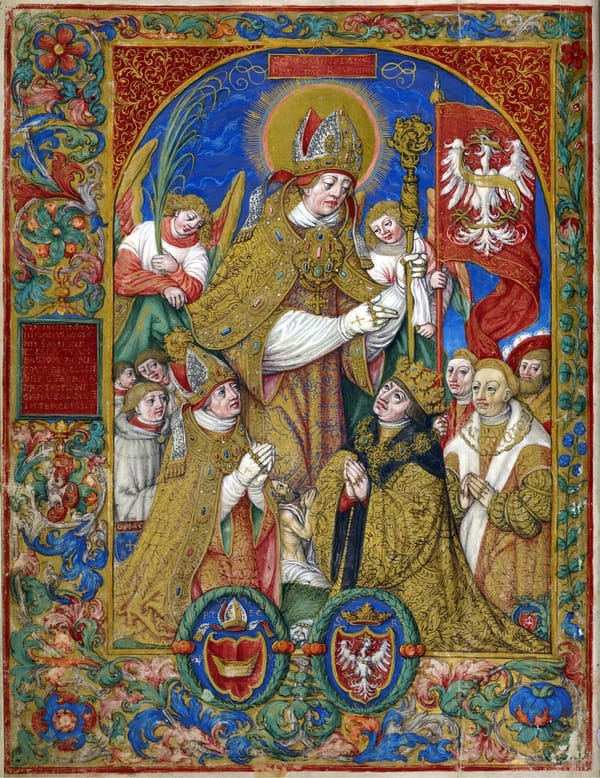 |
THE eleventh century, the century of contest between the priests of the Church and Barbarism, gives to-day another martyr to our Risen Jesus. It is Stanislaus, beloved by noble Poland as one of her chief protectors. He was slain at the altar by a Christian prince whom he had reproved for his crimes. The blood of the courageous Pontiff was mingled with that of our Redeemer in the same sacrifice. What an invincible energy there is in these lambs whom Jesus has sent amidst the wolves!1 They seem to be straightway changed into lions, as Jesus himself was at his Resurrection. There is not a century that has not had its martyrs: some for the faith, others for the unity of the Church, others for her liberty, others for justice, others for charity, and others, like our great Saint of to-day, for the maintenance of morals. The nineteenth century, too, has had its martyrs; scarcely a year elapses without our hearing of some who have been added to the bright list in the far East. At the commencement of the eighteenth century there was little probability of its providing such an abundant harvest of martyrdom as it did. Of one thing we are quite sure: whatever persecutions may arise in the future, the Spirit of fortitude will not be wanting to the champions of truth. Martyrdom is one of the Church's characteristics and it has never failed her. The Apostles who are very close to Jesus during these days preceding his Ascension drank the chalice which he drank; and only yesterday we were honouring the martyrdom of the favourite disciple—yes, even he had to tread the path prepared for all.
Holy Church tells us, in the account we now subjoin, how the saintly bishop of Cracow was offered the glorious chalice, and how courageously he accepted it.
Thou wast powerful in word and work, O Stanislaus! and our Lord rewarded thee with a martyr’s crown. From thy throne of glory, cast a look of pity upon us; obtain for us from God that gift of fortitude which was so prominent in thee, and which we so much need in order to surmount the obstacles which impede our progress. Our Risen Lord must have no cowards among his soldiers. He took by assault the kingdom into which he is about to enter; and he tells us plainly that if we would follow him thither, we must prepare to use violence.2 Brave soldier of the living God! obtain for us brave hearts. We need them for our combat—whether that be one of open violence for the faith or unity of the Church, or one which is to be fought with the invisible enemies of our salvation. Thou wast indeed a good shepherd, for the presence of the world neither made thee flee nor fear; ask our heavenly Father to send us shepherds like thee. Succour Holy Church, for she has to contend with enemies in every part of the world. Convert her persecutors, as thou didst convert Boleslaus; he was thy murderer, but thy martyrdom won mercy for him. Remember thy dear Poland, which honours thee with such fervent devotion. Be with her now that she has regained her rank among nations. During the severe triads which her sins drew down upon her, she maintained the sacred link of Catholic Faith and unity; she was patient and faithful; our Risen Jesus has had pity on her, and rewarded her patience and fidelity by granting her a share in his own Resurrection.
| Previous May 6: St. John before the Latin Gate | Next May 7: St. Stanislaus, Bishop and Martyr |