Daily reading
Semidouble · Movable from Easter · Temporal
May 15, 2029
From Dom Guéranger’s The Liturgical Year.
Tuesday within the Octave of the Ascension
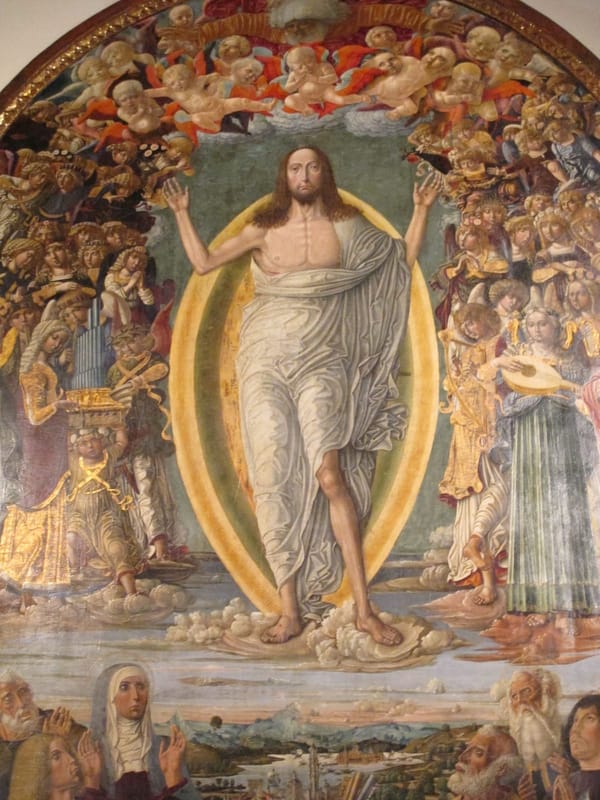
The Lord of glory has ascended into heaven, and, as the apostle says, He has gone thither as our forerunner;1 but how are we to follow Him to this abode of holiness, we whose path is beset with sin, we who are ever needing pardon rather than meriting anything like glory? This brings us to another consequence of the exhaustless mystery of the Ascension; let us give it our closest attention. Jesus has gone to heaven, not only that He may reign as King, but also that He may intercede for us as our High Priest, and, in this quality, obtain for us both the pardon of our sins and the graces we need for following Him to glory. He offered Himself on the cross as a victim of propitiation for our sins; His precious Blood was shed as our superabundant ransom; but the gate of heaven remained shut against us, until He threw it open by His own entrance into that sanctuary, where He was to exercise His eternal office of’Priest according to the order of Melchisedech.’2 By His Ascension into heaven, His priesthood of Calvary was transformed into a priesthood of glory. He entered with the veil of His once passible and mortal Flesh,3 within the veil of His Father’s presence, and there is He our Priest for ever.
How truly is He called Christ, that is,’the Anointed!’ for, no sooner was His divine Person united to the human Nature, than He received a twofold anointing: He was made both King and High Priest. We have already meditated upon His kingship; let us now contemplate His priesthood. He gave proofs of both during His life among us on earth; but it was only by His Ascension that their unclouded splendour was to be declared. Let us, then, follow our Emmanuel, and see Him as our High Priest.
The apostle thus describes the office of a high priest.’He is taken from among men, and is ordained for men in the things that appertain to God that he may offer up gifts and sacrifices for sins’:4 he is appointed their ambassador and mediator with God. Jesus received this office and ministry, and He is fulfilling it in heaven. But, that we may the better appreciate the grand mystery, let us study the figures given of it in the holy Scriptures, and developed by St. Paul in his sublime Epistle; they will give us a precise idea of the grandeur of our Jesus’ pontifical character.
Let us go in thought to the temple of Jerusalem. First of all there is the spacious uncovered court with its porticoes; in the centre stands the altar, whereon are slain the victims of the various sacrifices, and from the altar there radiate a number of conduits, through which flows the blood. We next come to a more sacred portion of the edifice; it is beyond the altar of holocausts, is covered in, and is resplendent with all the riches of the east. Let us respectfully enter, for the place is holy, and it was God Himself who gave to Moses the plan of the various fittings which adorn it with their mysterious and rich beauty: the altar of incense, with its morning and evening cloud of fragrance; the seven-branched candlestick, with its superb lilies and pomegranates; the table of the loaves of proposition, representing the offering made by man to Him who feeds him with the harvests of the earth. And yet it is not here, though the walls are wainscoted with the bright gold of Ophir, that is centred the great majesty of Jehovah. At the extreme end of the temple there is a veil of precious texture, richly embroidered with figures of the Cherubim, and reaching to the ground: it is there, beyond this veil, that the God of Abraham, Isaac, and Jacob, has fixed the abode of His presence; it is there, also, that rests the ark of the covenant, over which two golden Cherubim spread their wings. It is called the Holy of holies, and no one, under pain of death, may draw aside the veil, or look, or enter within the hallowed precinct, where the God of hosts deigns to dwell.
So then, man is banished from the place wherein God dwells; he is unworthy to enter into so holy a presence. He was created that he might see God and be eternally happy with that vision; but, because of sin, he is never to enjoy the sight of God. There is a veil between himself and Him who is his last end; neither can he ever remove that veil. Such is the severe lesson given to us by the symbolism of the ancient temple.
But there is a merciful promise, and it gives a gleam of hope. This veil shall one day be raised up, and man shall enter within: on one condition, however. Let us return to the figurative temple, and we shall learn what this condition is. As we have already noticed, none was allowed to enter the Holy of holies; there was but one exception, and that was in favour of the high priest, who might, once a year, penetrate beyond the veil. Yet even he had certain conditions to observe. If he entered without holding in his hands a vessel containing the blood of two victims, previously immolated by him for his own and the people’s sins, he was to be put to death; if, on the contrary, he faithfully complied with the divine ordinances, he would be protected by the blood he carried in his hands, and might make intercession for himself and all Israel.
How beautiful and impressive are these figures of the first covenant! but how much more so their fulfilment in our Jesus’ Ascension! Even during the period of His voluntary humiliations, He made His power felt in this sacred dwelling of God’s Majesty. His last breath on the cross rent the veil of the Holy of holies, hereby signifying to us that man was soon to recover the right he had lost by sin, the right of admission into God’s presence. We say soon; for Jesus had still to gain the victory over death, by His Resurrection; He had to spend forty days on earth, during which He, our High Priest, would organize the true priesthood that was to be exercised in His Church to the end of time, in union with the priesthood He Himself was to fulfil in heaven.
The fortieth day came, and found all things prepared: the witnesses of the Resurrection had proclaimed the victory of their master; the dogmas of faith had all been revealed; the Church had been formed; the sacraments had been instituted: it was time for our High Priest to enter into the Holy of holies, accompanied by the holy souls of limbo. Let us follow Him with the eye of our faith. As He approached, the veil, that had closed the entrance for four thousand years, was lifted up. Jesus enters. Has He not offered the preparatory sacrifice?—not the figurative sacrifice of the old law, hut the real one of His own Blood P And having reached the throne of the divine Majesty, there to intercede for us His people, He has but to show His eternal Father the wounds He received, and from which flowed the Blood that satisfied every claim of divine justice. He would retain these sacred stigmata of His sacrifice, in order that He might ever present them, as our High Priest, to the Father, and so disarm His anger.’My little children,’ says St. John in his first Epistle, ‘I write these things to you, that ye may not sin; but, if any man do sin, we have an advocate with the Father, Jesus Christ the just.’5 Thus, then, beyond the veil, Jesus treats of our interests with His Father; He gives the merits of His sacrifice their full efficacy; He is the eternal High Priest, whose advocacy is irresistible.
St. John, who was granted a sight of the interior of heaven, gives us a sublime description of this twofold character of our divine Head,—Victim and yet King, sacrificed and yet immortal. He shows us the throne of Jehovah, round which are seated the four-and-twenty ancients, the four symbolical living creatures, and then the seven spirits burning like lamps before it. But the prophet does not finish his description here. He bids us look at the right hand of Him who sits on the throne. There we perceive a Lamb standing and as it were slain: slain and yet standing, for He is radiant with glory and power.6 We should be at a loss to understand the vision, had we not our grand mystery of the Ascension to explain it; but now, all is clear. We recognize in the Lamb, portrayed by the apostle, our Jesus, the Word eternal, who, being consubstantial with the Father, is seated on the same throne with Him. Yet is He also the Lamb; for He assumed to Himself our flesh, in order that He might be sacrificed for us as a victim; and this character of victim is to be for ever upon Him. Oh! see Him there, in all His majesty as Son of God, standing in the attitude of infinite power, yet withal, He will not part with the semblance of the immolated. The sword of sacrifice has left five wounds upon Him, and He would keep them for eternity. Yes, it is identically the same meek Lamb of Calvary, and He is to be for ever consummating in glory the immolation He perfected on the cross.
Such are the stupendous realities seen by the angels within the veil;7 and when our turn comes to pass that veil, we also shall be enraptured with the sight. We are not to be left outside, as were the Jewish people when, once each year, their high priest entered into the Holy of holies. We have the teaching of the apostle:’The fore-runner, Jesus, our High Priest, has entered within the veil for us.’8 For us! Oh what music there is in these two words: for us! He has led the way; we are to follow! Even at the commencement, He would not go alone; He would have the countless legion of the souls of limbo to accompany Him: and ever since then, the procession into heaven has been one of unbroken magnificence. The apostle tells us that we, poor sinners as we are, are already saved by hope;9 and what is our hope, but that we are one day to enter into the Holy of holies? Then shall we blend our glad voices with those of the angels, the four-and- twenty ancients, the myriads of the blessed, in the eternal hymn:’To the Lamb that was slain, power, and divinity, and wisdom, and strength, and glory, and benediction, for ever and ever! Amen.’10
We offer our readers, to-day, the following sequence, composed by the pious Notker, in the ninth century, for the abbey of Saint Gall.
Sequence
Cunctis concedat esse Christianis,
Amatoribus suis.
Mediator nostrae naturae
Ac divinae.
Æthera novus homo
Transvolans.
Stipant, ad Patrem
Reversurum.
Cum lactanti adhuc
Stella tibi serviret
Et angeli?
Rem novam et dulcem
Dedisti, Domine,
Sperandi cœlestia.
Levando super sidereas metas,
Regum Domine.
Tuos replent apostolos,
Quis dedisti cernere
Te cœlos pergere.
In cœlis tibi occurrunt
Novem ordines,
Diu dispersum a lupis,
Gregem unum,
Bone Pastor,
Tu dignare custodire.
who love him, that this day may be
to them a happy one!
thou unitest in thyself the two natures
of God and Man.
thou the new Man,
didst ascend into heaven.
paid the homage of their service to thee,
when thou returnedst to thy Father;
when we remember how,
when thou wast a Babe at thy Mother’s breast,
a star united with the angels in serving thee?
gavest to the inhabitants of earth
a new and sweet sentiment:
the hope of heaven,
—which thou, O King of kings, hadst truly assumed,
—above the highest stars.
the hearts of thine apostles,
whom thou permittedst to see thee
mounting up to heaven!
did the nine choirs of angels go forth
to meet thee as thou enteredst heaven,
the sheep, thy one flock,
that had long been scattered by wolves!
Good shepherd!
vouchsafe to watch over this thy flock!
Prayer
Prayer
May 15: St. John Baptist de la Salle, Confessor
JOHN Baptist de la Salle, the teacher of the humble, takes his place to-day beside Leo the Great, Athanasius, and Gregory of Nazianzum. He has no fear. The victor of Paschal Time is the same Jesus who said during his mortal life: ‘Suffer the little children to come unto me,'1 and ‘unless you be converted and become as little children, you shall not enter into the kingdom of heaven,'2 that kingdom of heaven which, after entering into his glory, he manifests so fully upon earth. On the other hand, the Lion of Juda is never more terrible in his anger than when he beholds evil men conspiring to keep from him the little ones of whom he forms his court.3
The promise made in Holy Scripture that ' they that instruct many to justice shall shine as stars for all eternity'4 is addressed not only to the great doctors of the science of salvation, but also to the humblest Christian teacher, and the supreme Pontiff, when inscribing the name of the saint of to-day among those of the blessed, declared that the inspired words ' apply in an especial manner to those who, like him, have left all things and devoted themselves to the instruction of the baptized from earliest infancy in the teaching of the Gospel and the precepts which lead to life eternal.’5
John Baptist de la Salle was a true disciple of our blessed Lord, and entered so fully into the thought of his Master that no sacrifice was too great for him if only he might carry it out, and no suffering, humiliation, or persecution could hinder him from persevering in the accomplishment of his works of love. He suffered from misunderstanding and lack of support all through his life, but is he less great in heaven to-day on that account?
The following account of him is given in the Breviary:
O God, who hast raised up the holy Confessor John Baptist to promote the Christian education of the poor and to confirm the young in the way of truth, and, through him, hast gathered together a new family within thy Church: mercifully grant through his intercession and example that we may bum with zeal for thy glory in saving souls, and may share his crown in heaven. Through Christ our Lord.
Thus, O father of Christian schools, does Holy Church pray to-day in thy honour. She is as full of confidence as though the trials of thy mortal life had been sufficient to guard thy sons against similar sufferings; as serene as though the future of thy work were assured. And yet, might we not say that the culminating point of thy glorification on earth seems to have given the signal for the triumph of hell over thy labours? But the Church is strong in her experience of twenty centuries, and she fears no persecution. She knows that if the tree be planted by God, the hurricane will but strengthen its roots, and that a house built upon a rock can brave the wind and the floods. We too, like the Church, are full of hope, trusting in thy merits and thy intercession. Even if min seem complete, the divine Head of all who suffer persecution assures us that the tomb itself, though sealed by the powers of this world, cannot guarantee to Death the secure possession of his victim.
| Previous May 14: St. Boniface, Martyr | Next May 15: St. John Baptist de la Salle, Confessor |