lyp.network

Daily reading

Paschal Time

Double · Movable from Easter · Temporal

May 17, 2029

From Dom Guéranger’s The Liturgical Year.
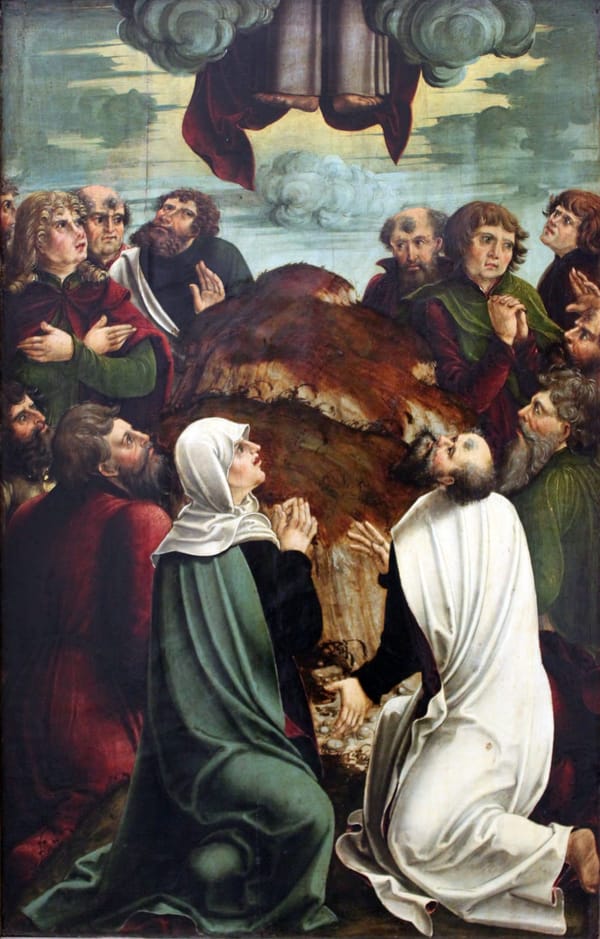
Mary and the apostles kneel on the mount as Christ’s feet disappear into the cloud
The Ascension of Christ, Mattheis Stöberl, c. 1510–15. Credits

Thursday within the Octave of the Ascension

O Rex gloriae, Domine virtutum, qui triumphator hodie super omnes cœlos ascendisti, ne derelinquas nos orphanos; sed mitte promissum Patris in nos, Spiritum veritatis, alleluia.
O King of glory, Lord of hosts, who didst this day ascend in triumph above all the heavens! leave us not orphans, but send upon us the Spirit of truth, promised by the Father, alleluia.

We have already seen how the Ascension of our Emmanuel won Him the empire over our understanding: it was the triumph of faith. The same mystery gave Him a second victory: the victory of love, which makes Him reign in our hearts. For eighteen hundred years, in whom have men believed, firmly and universally, except Jesus? In what have men agreed, except the dogmas of faith? What countless errors has this divine torch dispelled! What light has it given to the nations that received it! And in what darkness has it left those which rejected it after having once received it!

In like manner, no one has been loved as our Jesus has been, ever since the day of His Ascension; no one is so loved now or ever will be, as He. But that He might thus win our love He had to leave us, just as He had to do in order to secure our faith. Let us return to our text, that we may get deeper into the beautiful mystery.’It is expedient for you that I go!’1 Before the Ascension, the disciples were as inconstant in their love as they were in their faith. Jesus could not trust them. But no sooner had He left them, than they became warmly devoted to Him. Instead of complaining of their bereavement, they returned full of joy to Jerusalem. The thought of their master’s triumph made them forget their own loss, and they hastened, as He bade them, to the cenacle, where they were to be endued with power from on high. Watch these men during the subsequent years; examine what their conduct was from that time to the day of their death; count, if you can, their acts of devotedness in the arduous labour of preaching the Gospel; and say, if any other motive than love for their master could have enabled them to do what they did. With what cheerfulness did they drink His chalice!2 With what raptures did they hail His cross, when they saw it being prepared for themselves!

But let us not stop at these first witnesses; they had seen Jesus, and heard Him, and touched Him.3 Let us turn to those who came after them, and knew Him by faith only; let us see if the love, which burned in the hearts of the apostles, has been kept up by the Christians of the past eighteen centuries. First of all, there is the contest of martyrdom, which has never been altogether interrupted since the Gospel began to be preached. The opening campaign lasted three hundred years. What was it that induced so many millions to suffer, not only patiently but gladly, every torture that cruelty could devise? Was it not their ambition to testify how much they loved their Jesus? Let us not forget how these frightful ordeals were cheerfully gone through, not only by men hardened to suffering, but also by delicate women, by young girls, yea even by little children. Let us call to mind the sublime answers they gave to their persecutors, whereby they evinced their generous ardour to repay the death of Jesus by their own. The martyrs of our own times, in China, Japan, the Corea, and elsewhere, have repeated, without knowing it, the very same words to their judges and executioners as were addressed to the proconsuls of the third and fourth centuries by the martyrs of those days.

Yes, our divine King who has ascended into heaven, is loved as no other ever was or could be. Think of those millions of generous souls, who, that they might be exclusively His, have despised all earthly affections, and would know no other love than His. Every age,—even our own, in spite of all its miseries,—has produced souls of this stamp, and God alone knows how many.

Our Emmanuel has been, and to the end of time will ever be, loved on this earth. Have we not reason to say so, when we consider how many there have always been, even among the wealthiest ones of the world, who, in order that they might bear a resemblance to the Babe of Bethlehem, have given up everything they possessed? What an irresistible proof of the same truth we have in the countless sacrifices of self-love and pride, made with a view to imitate the obedience of the God-Man on earth! And what else but an ardent love of Jesus could have prompted those heroic acts of mortification and penance, whereby the sufferings of His Passion have been emulated, and, as the apostle says, filled up?4

But grand as all this is, it was not enough to satisfy man’s devoted love of His absent Lord. Jesus had said: ‘Whatsoever you do to the least of your brethren, you do it to Me.’5 Love is ever quick at catching the meaning of our Redeemer’s words. It took advantage of these, and saw in them another means for reaching Jesus,—reaching Him through the poor. And as the worst of poverties is the ignorance of divine truths, because it would make a man poor and miserable for eternity, therefore have there risen up in every age zealous apostles, who, bidding farewell to home and fatherland, have carried the light of the Gospel to them that sat in darkness and in the shadow of death. They heeded not the fatigues or the perils of such a mission: what cared they for all these things, if they could but make Jesus known and honoured and loved by one poor savage or Hindoo?

But what of those other poor ones, the sick, in whom Jesus suffers? Fear not: He is too much loved to be forgotten there. Once let the Church be free enough to develop her plans of charity, and there will be an institute of relief for every class of sufferers. The poor, the sick, all will be cared for and comforted. There will be vocations to charity, to meet every want; and women, too, urged by the love of their divine Lord, will deem it an honour to be the nurses and attendants of a suffering or dying Lazarus. The world itself is in admiration at their heroism; and though it knows not the divine principle which originates these charitable institutions, yet is it obliged to acknowledge the extraordinary good they effect.

But man’s observation can only reach the exterior; the interior is the far grander reality, and it is beyond his notice. What we have said so far is, therefore, but a very feeble description of the ardour wherewith our Lord Jesus Christ has been, and still is, loved on this earth. Let us picture to ourselves the millions of Christians who have lived since the first foundation of the Church. Many, it is true, have had the misfortune to be unfaithful to the object of their existence; but what an immense number have loved Jesus with all their heart and soul and strength!

Some have never flagged in their love; others have needed a conversion from vice or tepidity, returned to Him, and slept in the kiss of peace. Count, if you can, the virtuous actions, the heroic sacrifices, of those countless devoted servants of His, who are to be arrayed before Him in the valley of Josaphat. His memory alone can hold and tell the stupendous total of what has been done. This well-nigh infinite aggregate of holy deeds and thoughts, from the seraphic ardour of the greatest saint down to the cup of cold water given in the name of the Redeemer, what is it all but the ceaseless hymn of our earth to its beloved absent One, its never-forgotten Jesus? Who is the man, how dear soever his memory may be, for whom we would be devoted, or sacrifice our interests, or lay down our lives, especially if he had been ten or twenty ages gone from us? Who is that great Dead, the sound of whose name can make the hearts of men vibrate with love, in every country, and in every generation? It is Jesus, who died, who rose again, who ascended into heaven.

But we humbly confess, O Jesus, that it was necessary for us that Thou shouldst go from us, in order that our faith might soar up to Thee in heaven, and that our hearts, being thus enlightened, might burn with Thy love. Enjoy thine Ascension, O Thou King of angels and of men! We, in our exile, will feast on the fruits of the great mystery, waiting for it to be fulfilled in ourselves. Enlighten those poor blind infidels, whose pride will not permit them to recognize Thee, notwithstanding these most evident proofs. They continue in their errors concerning Thee, though they have such superabundant testimony of Thy Divinity in the faith and love Thou hast received in every age. The homage offered Thee by the universe, represented, as it has ever been, by the chief nations of the earth and by the most virtuous and learned men of each generation, is as nought in the eyes of these unbelievers. Who are they, to be compared with such a cloud of faithful witnesses? Have mercy on them, O Lord! save them from their pride; then will they unite with us in saying:’It was indeed expedient for this world to lose Thy visible presence, O Jesus! for never were Thy greatness, Thy power, and Thy Divinity, so recognized and loved, as when Thou didst depart from us. Glory, then, be to the mystery of Thine Ascension, whereby, as the psalmist prophesied, Thou receivedst gifts, that Thou mightest bestow them upon men!’6

We will take a hymn to-day from the Greek Church: it is the one she sings in honour of our Redeemer’s triumph, at her evening Office of Ascension day.

Hymn (In Assumptione Domini, ad magnum Vespertinum.)

Assumptus est in cœlos Dominus, ut mundo mitteret Paraclitum. Cœli præparaverunt thronum ejus, et nubes ascensum ejus. Mirantur angeli, supra seipsos hominem videntes. Pater suscipit quem habet in sinu coaeternum. Spiritus sanctus omnibus angelis suis imperat: Attollite portas, principes, vestras. Omnes gentes plaudite manibus, quia ascendit Christus ubi erat prius.
Domine, Assumptione tua obstupuerunt Cherubim, conspicientia te Deum in nubibus ascendentem, super ipsa sedentem; et glorificamus te, quoniam benigna est misericordia tua: Gloria tibi.
In montibus sanctis tuas videntes exaltationes, Christe, splendor gloriae Patris, fulgentem vultus tui speciem iterum atque iterum celebramus; tuas adoramus passiones, resurrectionem honoramus, inclytam glorificantes Assumptionem: miserere nobis.
Domine, quando te in nubibus elevatum viderunt apostoli, cum gemitibus la- crymarum tristitia repleti, Christe vitæ dator, lamentantes dicebant: Domine, utpote misericors, ne derelinquas nos orphanos, quos propter clementiam dilexisti servos tuos; sed mitte, sicut promisisti nobis, sanctissimum Spiritum tuum, illuminantem animas nostras.
Domine, dispensationis impleto mysterio, tuos assumens discipulos, in montem Olivarum tecum ducebas; et ecce firmamentum cœli intrasti. Qui propter me egenus sicut ego factus es, et illuc ascendisti unde non es separatus, sanctissimum tuum mitte Spiritum, illuminantem animas nostras.
A sinu paterno non separatus, dulcissime Jesu, et cum iis qui sunt in terra sicut homo conversatus, hodie a monte Olivarum assumptus es in gloria, et lapsam naturam nostram pro misericordia elevans, cum Patre sedere fecisti. Unde cœlestia incorporeorum agmina, prodigium stupentia, admiratione stabant attonita; et tremore comprehensa tuum erga homines amorem magnificabant. Cum quibus et nos in terra ex- istentes, tuam ad nos descensionem et a nobis Assumptionem glorificantes, rogamus dicentes: Qui discipulos et genitricem tuam Deiparam infinito gaudio in tua Assumptione replevisti, nos quoque electorum tuorum lætitia dignare, precibus eorum, propter magnam misericordiam tuam.
The Lord ascended into heaven, that he might send the Paraclete into this world. The heavens prepared his throne, and the clouds his Ascension. The angels are lost in wonder at seeing man exalted above them. The Father receives him who is in his own bosom, his co-eternal Son. The Holy Ghost speaks this bidding to all his angels: ‘Lift up your gates, O ye princes!’ Clap your hands, all ye people, for Christ hath ascended to the heaven where he has ever been.
The Cherubim were in amazement at thine Assumption, O Lord; they beheld thee ascending upon the clouds, thee their God, who sittest upon them. We glorify thee, for compassionate is thy mercy: Glory be to thee!
Seeing thy risings upon the holy mountains, O Christ, thou brightness of the Father’s glory! we tire not in praise of the brilliant beauty of thy Face. We adore thy Passion, we honour thy Resurrection, we glorify thy noble Assumption: have mercy on us!
When the apostles saw thee, O Lord, raised up to the clouds, they sighed, and wept, and were sad. Thus to thee, O Christ, thou giver of life, did they speak their sorrow: ‘Thou art merciful, O Lord! then leave not orphans us thy servants, whom, in thy goodness, thou hast loved; but send upon us, as thou hast promised, thy most holy Spirit, who will enlighten our souls.’
Having, O Lord, fulfilled the mystery of the dispensation, thou didst lead thy disciples to Mount Olivet; when, lo! thou ascendest into the firmament of heaven. O thou, that for my sake, wast made poor as I, and ascendest to the realm which thou hadst never left, send thy most holy Spirit to enlighten our souls!
Living as Man with them that were on earth, thou, sweetest Jesus! wast not separated from thy Father’s bosom. On this day, thou wast taken up in glory from Mount Olivet; and mercifully raising up our fallen nature thou placedst it on thy Father’s throne. The heavenly host of angels stood in astonished admiration at the sight of the prodigy; and, seized with awe, they celebrated in songs of praise thy love for man. Together with them, we also, who dwell on earth, do glorify thy coming down unto us and thine ascending up from us, and thus do we pray: O thou that, in thine Assumption, filledst the disciples and thy Mother with infinite joy; vouchsafe, through their prayers, and thine own great mercy, to give us a share in the joy of thine elect.

As a close to this glorious octave, we offer the eighth and last of the beautiful prayers given by the Mozarabic breviary in honour of our Lord’s Ascension.

Prayer

Christe Jesu, terribilis Deus noster, et rex noster, cujus in nativitate cum pastoribus angeli gloriam detulerunt; cui devicto mortis auctore, omnes gentes manibus cordibusque plauserunt; quem trophæa victricia reportantem ad æthera, apostolorum est fides prosecuta: fac nos redemptionis nostræ et Ascensionis tuae mysteria fidei jubilatione cantare; et cum principibus populi Deo Abraham fideli famulatu placere. Amen.
Christ Jesus! our God of dread majesty, and our King! at whose birth the angels and shepherds gave glory; at whose victory over the author of death all nations clapped their hands and were filled with joy; at whose ascending, with thy trophies, into heaven, the apostles were perfected in their faith: grant that we, also, with fervent faith, may sing our canticles of praise in honour of the mysteries of our Redemption and of thine Ascension; and that, with the princes of thy people, we may, by our faithful service, be well-pleasing to the God of Abraham. Amen.
  1. St. John, xvi. 7. ↩︎
  2. St. Matth. xx. 23. ↩︎
  3. 1 St. John, i. 1. ↩︎
  4. Coloss. i. 24. ↩︎
  5. St. Matth. xxv. 40. ↩︎
  6. Ps. lxvii. 19. ↩︎

May 17: St. Paschal Baylon, Confessor

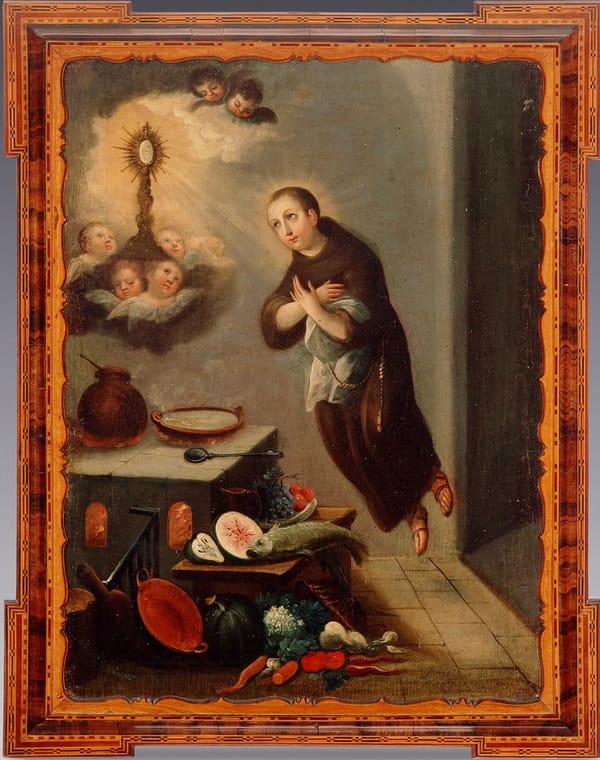
St Paschal Baylon in Franciscan habit
Saint Paschal Baylon, José Agustín Arrieta (1803–1874). Credits

THE Seraph of Assisi was sure to depute some of his children to pay their court to his Risen Master. The one he sends to-day is the humblest and most obscure of men; another will follow, three days hence, powerful in word and work, and holding a palm in his hands, as a most devoted preacher of the Gospel. Paschal Baylon was a simple peasant. He was a shepherd-boy; and it was in tending his flock that he found the Lord Jesus. He had a great love for contemplation. Forests and fields spoke to him of their great Creator; and, in order that he might be the more closely united with him, he resolved to seek him in the highest paths of perfection. He was ambitious to imitate the humble, poor and suffering life of the Man-God; the Franciscan Cloister offered him the opportunity of satisfying this desire and he flew to it. On that blessed soil, he grew to be one of heaven's choicest plants, and the whole earth has now heard the name of the humble lay-brother of a little convent in Spain. Holy Church brings him before us to-day enraptured in the contemplation of Jesus' Resurrection. He had trod the path of humiliation and the cross; it was but just that he should share in his Master's triumph. It was of him, and of such as he, that this divine Saviour spoke, when he said: Ye are they that have continued with me in my temptations; and I dispose to you, as my Father hath disposed to me, a kingdom; that ye may eat and drink at my table in my kingdom, and may sit upon thrones, judging the twelve tribes of Israel.1

The account given by the Liturgy of the angelic life of this illustrious son of St Francis is as follows:

Paschalis Baylon, pauperibus piisque parentibus in oppido Turris Formosæ Seguntinæ Dioecesis in Aragonia natus, a teneris annis plura dedit futurae sanctitatis indicia. Sortitus animam bonam, ac rerum coelestium apprime studiosam, pueritiam atque adolescentiam in gregis custodia transegit; quam ille vivendi rationem ideo praecipue diligebat, quod humilitati fovendae, ac innocentiae conservandae imprimis utilem atque opportunam judicaret. Erat in victu modicus, in oratione assiduus, tantaque apud coaevos et socios florebat auctoritate et gratia, ut eorum lites componens, errores corrigens, ignorantiam erudiens, ac desidiam excitans, velut omnium parens, et magister maximo studio coleretur ac amaretur: Beatus etiam tum a plerisque appellatus.
Qui vero in saeculo, terra nempe deserta et inaquosa, adeo feliciter adoleverat, flos convallium, plantatus in domo Domini, mirum ubique sparsit sanctitatis odorem. Igitur Paschalis arrepto vitæ severioris instituto, atque in ordine Minorum strictioris observantiae discalceatorum cooptatus, exsultavit ut gigas ad currendam viam suam, totumque se Domino excolendum tradens, dies noctesque cogitabat, qua se ratione magis ei magisque conformaret. Ita factum est brevi, ut eum tanquam seraphicæ perfectionis exemplar, ipsi quoque provectiores imitandum sibi proponerent. Ipse autem in humili servientium gradu constitutus, se velut omnium peripsema reputans, ardua quæque et abjecta domus ministeria veluti jure quodam peculiari sibi debita summa cum hilaritate suscipiebat et exercebat, humilitate ac patientia pari. Carnem spiritui quandoque reluctari nitentem jugi maceratione afflictavit, atque in servitutem redegit; spiritum vero assidua sui abnegatione ferventiorem in dies ad anteriora extendebat.
Deiparam Virginem, cujus clientelae se ab ineunte aetate dicaverat, tanquam matrem quotidianis colebat obsequiis, atque filiali exorabat fiducia. Porro erga sanctissimum Eucharistiae Sacramentum difficile dictu est quam ardenti teneretur devotionis affectu: quem defunctus etiam in cadavere retinere visus est, dum jacens in feretro, ad sacrae Hostiae elevationem bis oculos reseravit et clausit, magna omnium qui aderant admiratione. Ejusdem veritatem inter haereticos publice palamque professus, multa et gravia ob eam causam perpessus est; crebro etiam ad necem petitus, sed singulari Dei providentia impiorum manibus ereptus. Saepe inter orandum omnibus destituebatur sensibus, dulcique languebat amoris deliquio; quo tempore coelestem illam scientiam hausisse creditus est, qua homo rudis et illitteratus, de mysteriis Fidei difficillimis respondere, atque aliquot etiam libros conscribere potuit. Denique meritis plenus, eadem qua prœdixerat hora, feliciter migravit ad Dominum, anno salutis millesimo quingentesimo nonagesimo secundo, sexto decimo kalendas Junii, eodem quo natus fuerat, Festo Pentecostes recurrente, annum agens secundum supra quinquagesimum. Quibus, aliisque virtutibus insignem, ac miraculis tam in vita quam post mortem clarum, Paulus Quintus Pontifex Maximus illum Beatum appellavit: Alexander autem Octavus Sanctorum catalogo adscripsit. Tandem Leo decimus tertius peculiarem coetuum eucharisticorum, item societatum omnium a sanctissima Eucharistia, sive quæ hactenus institutae, sive quœ in posterum futurae sunt, Patronum caelestem declaravit et constituit.
Paschal Baylon was bom of poor and pious parents, at TorreHermosa, a small town of the diocese of Siguenza, in Aragon. Even from his infancy he gave many signs of future sanctity. He was endowed with a good disposition, and had a great love for the contemplation of heavenly things. He passed the years of boyhood and youth in tending flocks. He loved this kind of life more than any other, because it seemed to him the best for fostering humility and preserving innocence. He was temperate in his food, and assiduous in prayer. He had such influence over his acquaintance and companions, and was so dear to them, that he used to settle their disputes, correct their faults, instruct their ignorance and keep them out of idleness. He was honoured and loved by them as their father and master; and even then was often called the blessed Paschal.
Thus did this flower of the valley bloom in the world, that desert and parched land; but once planted in the house of the Lord, he shed everywhere around him a wondrous odour of sanctity. Having embraced the severest sort of life by entering the Order of the Discalced Friars Minor of strict observance, Paschal rejoiced as a giant to run his way. Devoting himself wholly to the service of his God, his one thought both day and night was how he could further imitate his divine Master. His brethren, even they that were most advanced, soon began to look upon him as a model of seraphic perfection. As for him, he put himself in the grade of the lay-brothers. Looking on himself as the off-scouring of all, he cheerfully took on himself with humility and patience the most tiring and menial work of the house, which work he used to say belonged to him by a special right. He mortified and subdued his flesh, which at times would strive to rebel against the spirit. He maintained the fervour of his spirit by assiduous self-denial, and daily stretched himself forward to the things that were more perfect.
He had consecrated himself from his earliest years to the Blessed Virgin; he honoured her as his Mother by daily devotions, and prayed to her with filial confidence. It would be difficult to describe the ardour of his devotion to the most holy Sacrament of the Eucharist. Even after his death, this devotion seemed to linger in his body; for when laid in his coffin, his eyes were seen to open and shut twice during the elevation of the sacred Host, to the astonishment of all that were present. He publicly and openly professed before heretics his faith in the dogma of the Real Presence, and had much to suffer on that account. His life was frequently attempted; but, by a special providence of God, he was rescued from the hands of the wicked men who sought to kill him. Frequently, when at prayer, he was rapt in ecstasy, and swooned away with the sweetness of love. It was on these occasions that he was supposed to receive the heavenly wisdom whereby he, though uneducated and illiterate, was enabled to give answers upon the profoundest mysteries of faith, and even write several books. Finally, rich in merit, he happily took his flight to heaven, at the hour which he had foretold, in the year of our Lord 1592, on the sixteenth of the Kalends of June (May 17), and on the Feast of Pentecost, the same on which he was born, being in his fifty-second year. These and other virtues procured him a great reputation, and as he was celebrated for miracles both before and after his death, he was beatified by Pope Paul the Fifth, and canonized by Alexander the Eighth. Lastly, Leo XIII declared and appointed him the special patron in heaven of Eucharistic conferences, and of all sodalities of the Holy Eucharist now existing or to be instituted in the future.

Heaven opened to receive thee, O Paschal! Even when here below, the fervour of thy contemplation often gave thee a foretaste of the delights of eternal bliss; but now every veil is drawn aside, and thou art face to face with him whom thou didst so ardently desire to possess. Thou hast no further need to unite thyself with him by humiliation and suffering; thou enjoyest his own glory, his own happiness, his own triumph, and he will have thee enjoy it for all eternity. Deign to cast an eye of pity on us, who have not thy eagerness to walk in our Redeemer’s footsteps, and who, as yet, have but the hope of being united to him for eternity. Gain for us courage. Gain for us that love which leads straight to Jesus, which surmounts every obstacle of flesh and blood, and gives to man an admirable resemblance to his divine Model. The pledge of this happy transformation has been given to us by our being permitted to partake of the Paschal Mystery; may it be perfected by our fidelity in keeping close to our divine conqueror and Lord! Though he leave us some time further in this vale of tears, his eye is ever upon us, he longs to see us persevere in our loyalty to him. Yet a little while, and we shall see him! Behold! says he, I come quickly; hold fast that which thou hast. Behold! I stand at the gate and knock. If any man shall hear my voice, and open to me the door, I will come in to him, and will sup with him, and he with me.2 Thus will the Pasch of time be changed into the Pasch of eternity. Pray for us, O Paschal, that like thee, we may hold fast that which, by the grace of our Risen Jesus, we already possess.

  1. St Luke xxii 28, 29, 30. ↩︎
  2. Apoc. iii 11, 20. ↩︎
Previous
May 16 (the Same Day): St. John Nepomucen, Martyr
Next
May 17: St. Paschal Baylon, Confessor