Daily reading
After Pentecost
Double · May 30 · Sanctoral
May 30, 2029
From Dom Guéranger’s The Liturgical Year.
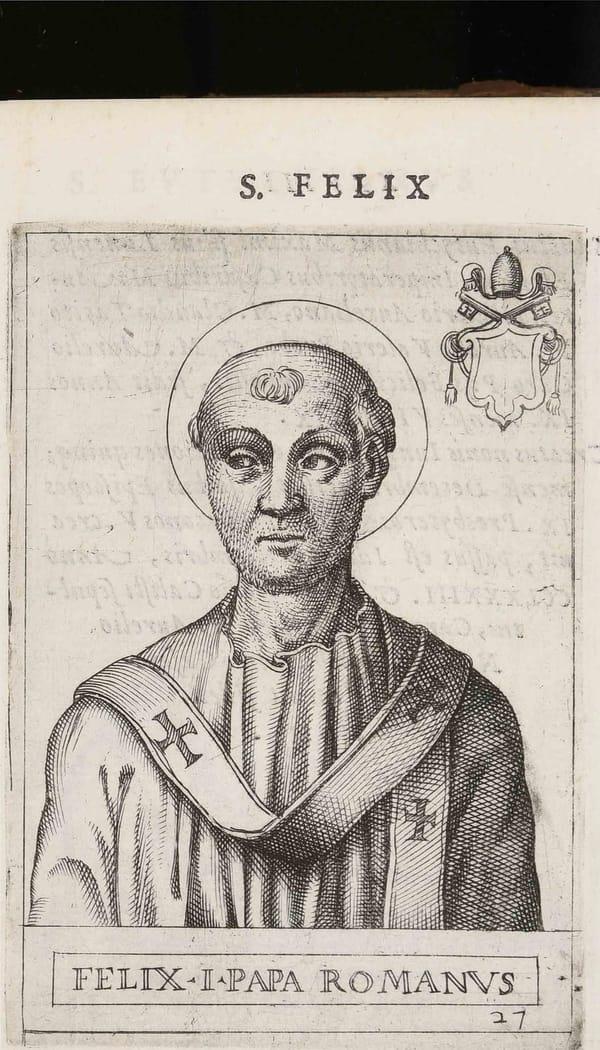 |
May 30: St. Felix I, Pope and Martyr
THE holy Popes of the primitive ages of the Church abound during these last days of our Paschal season. To-day we have Felix I, a martyr of the persecution under Aurelian, in the third century. His Acts have been lost, with the exception of this one detail: that he proclaimed a dogma of the Incarnation, with admirable precision, in a letter addressed to the Church of Alexandria, a passage of which was read with much applause at the two (Ecumenical Councils of Ephesus and Chalcedon.
We also learn from a law he passed for those troubled times of the Church, that this holy Pontiff was zealous in procuring for the martyrs the honour that is due to them. He decreed that the Holy Sacrifice should be offered up on their tombs. The Church still keeps this law in mind by requiring that all altars, whether fixed or portable, must have, amongst the relics that are placed in them, a portion of some belonging to the martyrs. We shall have to speak of this custom in a future volume.
The Liturgy gives us this short notice regarding the holy Pontiff:
Thou, O holy Pontiff, didst imitate thy divine Master in his death, for thou gavest thy life for thy sheep. Like him, too, thou art to rise from thy tomb, and thy happy soul shall be reunited to its body, which suffered death in testimony of the truth thou proclaimedst at Rome. Jesus is the first-born of the dead;* thou didst follow him in his Passion, thou shalt follow him in his Resurrection. Thy body was laid in those venerable vaults, which the piety of early Christians honoured with the appellation of Cemeteries—a word which signifies a place wherein to sleep. Thou, O Felix, wilt awaken on that great day whereon the Pasch is to receive its last and perfect fulfilment: pray that we also may then share with thee in that happy resurrection. Obtain for us that we may be faithful to the graces received in this year's Easter; and prepare us for the visit of the Holy Ghost, who is soon to descend upon us, that he may give stability to the work that has been achieved in our souls by our merciful Saviour.
* Apoc. i 5. ↩︎
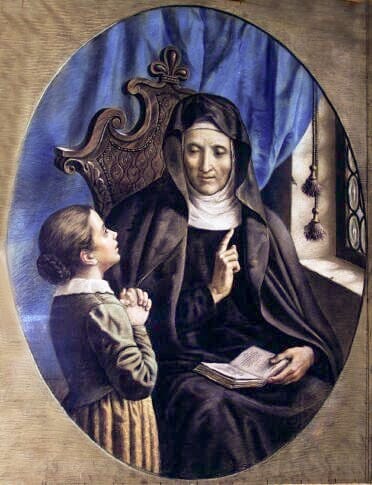
June 1 [May 31]: St. Angela de Merici, Virgin
 |
[This feast day, previously kept on May 31, was moved to June 1 when the feast of the Queenship of Mary was established on May 31.-Ed.]
From Dom Guéranger's The Liturgical Year.
THIS last day of May, which is honoured by the virginal triumph of Aurelia Petronilla, in the first age of the Church, is also fragrant with the lilies that wreathe the brow of Angela de Merici. The sixteenth century, which, a few days back, offered to our Risen Lord the seraphic Magdalen de Pazzi, now presents him with this second fruit of heroic sanctity. Angela realized the whole meaning of her beautiful name. She possessed the purity of the blessed spirits in a mortal body, and she imitated their celestial energy by the vigorous practice of every virtue. This heroine of grace trampled beneath her feet everything that could impede her heavenward march. Gifted at an early age with the highest contemplation, she bravely travelled to Palestine, there to venerate the footsteps of her divine Spouse Jesus. After this, she visited the New Jerusalem, Rome, and offered up her fervent prayers at the Confession of St Peter. She then returned to her life of seclusion, and founded a Religious Order which is, and will be to the end of time, one of the glories and aids of Holy Church.
The thought of the great St Ursula and her virginal legion made a deep impression on Angela’s soul, and she too would form to our Lord an army of valiant women. Ursula confronted the barbarian host; Angela would give battle to the world and to its seductions, which are so dangerous to young girls. God blessed her with victory. As a trophy of her combats, she can point to the countless generations of young people whom her Order has saved during the last three centuries, by giving them a solid Christian education.
The Liturgy thus speaks of the virtues and actions of St Angela:
Thou didst fight the battles of our Lord, O Angela, and thy holy labours merited for thee a glorious rest in the mansions of eternal bliss. An insatiable zeal for the honour of Jesus whom thou hadst chosen as thy Spouse, and an ardent charity for the creatures redeemed by his precious Blood were the characteristics of thy whole life. This love of thy neighbour made thee the mother of a countless progeny; for who can number the young children that have been educated, in sound doctrine and piety, by thy daughters? Thou didst powerfully contribute to the welfare of Christian society, by thus preparing so many for the duties of domestic life; and how many other Congregations, in imitation of thy Ursulines, have taken up the same admirable work, and have brought consolation to the Church, and happiness to the world? The sovereign Pontiff has ordered that thy feast should be kept throughout the whole Church. He declared, in issuing this decree, that he wished to put under thy maternal protection the young girls who are nowadays exposed to such fearful dangers by the enemies of Christ and his Church. They have formed the project of undermining the faith of women, that so their good influence may be destroyed in their families. Disconcert these impious plans, O Angela! Protect thy sex; nourish within it the sentiment of the dignity of Christian woman, and society may still be saved.
We turn to thee, O Spouse of Christ, and ask for fervour in the liturgical year, wherein we are made to follow in the path that was so dear to thee. Thy devotion in following the divine Mysteries which are successively brought before us, led thee to visit the Holy Land. Thou didst long to see Nazareth and Bethlehem, to traverse Galilee and Judea, to give thanks in the Cenacle, to weep on Calvary, and to adore the glorious Sepulchre. Deign to bless our feeble desires and efforts to tread in these same holy paths. We have still to follow thee to Mount Olivet, whence our Redeemer ascended into heaven; we have to return to the Cenacle, which the Holy Ghost is preparing to light up with his divine Fire. Obtain for us, O Angela, that we may follow thee to these hallowed spots, which made thee quit thy country and undertake a long and perilous pilgrimage. Oh! prepare our hearts for the sublime Mysteries which are to crown our Paschal season.
May 30 (the Same Day): St. Ferdinand III, King of Castile and Confessor
DURING the season consecrated to the mystery of our Emmanuel's Birth, we saw standing near his crib the blessed Emperor Charlemagne. Crowned with the imperial diadem, and with a sword in his fearless hand, he seemed to be watching over the Babe, whose first worshippers were shepherds. And now near the glorious Sepulchre, which was first visited by Magdalene and her companions, we perceive a king—Ferdinand the Victorious—wearing a crown, and keeping guard with his valiant sword, the terror of the Saracen.
Catholic Spain is personified in her Ferdinand. His mother Berengaria was sister to Blanche, the mother of St Louis of France. In order to form ‘the Catholic Kingdom,’ there was needed one of our Lord's Apostles, St James the Great; there was needed a formidable trial, the Saracen invasion, which deluged the Peninsula; there was needed a chivalrous resistance, which lasted eight hundred years, and by which Spain regained her glory and her freedom. St Ferdinand is the worthy representative of the brave heroes who drove out the Moors from their fatherland and made her what she is: but he had the virtues of a saint, as well as the courage of a soldier.
His life was one of exploits, and each was a victory. Cordova, the city of the Caliphs, was conquered by this warrior Saint. At once its Alhambra ceased to be a palace of Mahometan effeminacy and crime. Its splendid Mosque was consecrated to the divine service, and afterwards became the Cathedral of the City. The followers of Mahomet had robbed the Church of St James at Compostella of its bells, and had them brought in triumph to Cordova; Ferdinand ordered them to be carried thither again, on the backs of the Moors.
After a siege of sixteen months, Seville also fell into Ferdinand's hands. Its fortifications consisted of a double wall, with a hundred and sixty-six towers. The Christian army was weak in numbers; the Saracens fought with incredible courage, and had the advantages of position and tactics on their part: but the Crescent was to be eclipsed by the Cross. Ferdinand gave the Saracens a month to evacuate the city and territory. Three hundred thousand withdrew to Xeres, and a hundred thousand passed over into Africa. The brave Moorish General, when taking his last look at the city, wept, and said to his officers: ‘None but a Saint could, with such a small force, have made himself master of so strong and well-manned a place.’
We will not enumerate the other victories gained by our Saint. The Moors foresaw that the result would be their total expulsion from the Peninsula. But this was not all that Ferdinand proposed: he even intended to invade Africa, and thus crush the Mussulman power for ever. The noble project was prevented by his death, which took place in the fifty-third year of his age.
He always looked upon himself as the humble instrument of God’s designs, and zealously laboured to accomplish them. Though most austere towards himself, he was a father in his compassion for his people, and was one day heard to say: ‘I am more afraid of the curse of one poor woman, than of all the Saracen armies together.’ He richly endowed the churches which he built in Spain. His devotion to the holy Mother of God was most tender, and he used to call her his Lady: in return, Mary procured him victory in all his battles, and kept away all pestilence and famine from the country during his entire reign, which, as the contemporary chroniclers observe, was an evident miracle, considering the circumstances of the age and period. The life of our Saint was one of happiness and success, whereas the life of that other admirable king, St Louis of France, was one of almost uninterrupted misfortune; as though God would give to the world, in these two Saints, a model of courage in adversity, and an example of humility in prosperity. They form unitedly a complete picture of what human life is, regenerated as it has now been by our Jesus, in whom we adore both the humiliations of the Cross and the glories of the Resurrection. What happy times were those, when God chose kings whereby to teach mankind such sublime lessons!
One feels curious to know how such a man, such a king, as Ferdinand, would take death when it came upon him. When it came, he was in his fifty-fourth year. The time approached for his receiving the Holy Viaticum. As soon as the priest entered the room with the blessed Sacrament, the holy king got out of bed, prostrated himself in adoration, and, humbly putting a cord round his neck, received the Sacred Host. This done, and feeling that he was on the verge of eternity, he ordered his attendants to remove from him every sign of royalty, and called his sons round his bed. Addressing himself to the eldest, who was Alphonsus the Good, he entrusted him with the care of his brothers, and reminded him of the duties he owed to his subjects and soldiers; he then added these words: ‘My son, thou seest what armies, and possessions, and subjects thou hast, more than any other Christian king; make a proper use of these advantages; and as thou hast the power, be good and do good. Thou art now master of the country which the Moors took, in times past, from king Rodriguez. If thou keep the kingdom in the state wherein I now leave it to thee, thou wilt be, as I have been, a good king, which thou wilt not be, if thou allowest any portion of it to be lost.’
As his end drew nigh, the dying king was favoured with an apparition from heaven. He thanked God for granting him that consolation, and then asked for the blessed candle; but before taking it in his hand, he raised up his eyes to heaven, and said: 'Thou, O Lord, hast given me the kingdom, which I should not otherwise have had; thou hast given me more honour and power than I deserved; receive my thanks! I give thee back this kingdom, which I have increased as far as I was able; I also commend my soul into thy hands!' He then asked pardon of the bystanders, begging them to overlook any offence that he might have committed against them. The whole court was present, and, with tears, asked the Saint to forgive them.
The holy king then took the blessed candle into his hands, and raising it up towards heaven, said: ‘Lord Jesus Christ! my Redeemer! naked I came from my mother’s womb, and naked I return to the earth. Lord, receive my soul! and, through the merits of thy most holy Passion, deign to admit it among those of thy servants!’ Having said this, he gave back the candle, and asked the bishops and priests, who were present, to recite the Litanies; which being ended he bade them sing the Te Deum. When the hymn was finished, he bowed down his head, closed his eyes, and calmly expired.
Thus died those men, whose glorious works were the result of their faith, and who looked on themselves as only sent into this world that they might serve Christ and labour to propagate his kingdom. It was to them that Europe owed its highest glory; they made the Gospel its first law, and based its constitution on the Canons of the Church. It is now governed by a very different standard; it is paying dearly for the change, and is drifting rapidly to dissolution and ruin.
The following are the Lessons used in the Office of St Ferdinand:
By delivering thy people from the yoke of the infidel, thou, O Ferdinand, didst imitate our Risen Jesus, who rescued us from death and restored us to the life we had lost. Thy conquests were not like those of this world’s conquerors, who have no other aim than to satisfy their own and their people’s pride. Thy ambition was to deliver thy people from an oppression which had weighed heavily on them for long ages. Thy object was to save them from the danger of apostasy, which they incurred by being under the Moorish yoke. O Champion of Christ! it was for his dear sake that thou didst lay siege to the Saracen cities. His banner was thine; and thy first anxiety was to spread his kingdom. He, in return, blessed thee in all thy battles, and made thee ever victorious.
Thy mission, O Ferdinand, was to form for our God a nation, which has been honoured by Holy Church above all others with the glorious name of the 'Catholic Kingdom.’ Happy Spain, for by her perseverance and courage she broke the Mussulman yoke, that still weighs down the other countries which it made its prey! Happy Spain, for she repelled the invasion of Protestantism, and, by this, preserved the faith, which both saves souls and constitutes a nation’s strongest power! Pray for thy country, O saintly king! False doctrines and treacherous influences are now rife within her, and many of her children have been led astray. Never permit her to injure, by cowardly compromise, that holy faith which has hitherto been her grandest glory and safeguard. Frustrate the secret plots which are working to undermine her Catholicity. Keep up within her her old hatred of heresy, and maintain her in the rank she holds among Catholic nations. Unity in faith and worship may still save her from the abyss into which so many other countries have fallen. O holy king! save once more the land that God entrusted to thy keeping, and which thou didst restore to him with such humble gratitude, when thou wast about to change thine earthly for a heavenly crown. Thou art still her beloved protector; hasten, then, to her aid!
May 30 (the Same Day): St. Joan of Arc, Virgin
WHILE the angelic hosts acclaim the Incarnate Word as he takes possession of his eternal throne, a virgin at the head of the armies of earth re-echoes the praises of heaven. She was a child of the countryside, pious, gentle, and utterly ignorant, especially of the art of war, but Michael the soldier of God trained her with the aid of the Virgin Martyrs Catharine and Margaret, and suddenly, like a challenge thrown to modem naturalism in the broad daylight of history, she made her appearance, at the age of seventeen, as an incomparable warrior. Her victories, her personal influence and strategical genius equal those of the most famous captains of any times. But she surpasses them all in heroism, in her childlike simplicity, virginal purity, and faith in her Lord Jesus, the Son of St Mary, for whom she died—even greater at the stake at Rouen than in the days of her triumph. ‘De par le Roi du ciel’ (‘By order of the King of heaven’) was the motto on her banner. By order of the King of heaven, her sovereign liege, in whose royal service she is day by day, she calls upon cities to return, to their lawful obedience. By order of the King of heaven she intimates to the English that she has been sent to drive them out of France. ‘For,’ as she declared to the Dauphin's representative, 'the kingdom does not appertain to the Dauphin, but to my Lord. But it is the will of my Lord that the Dauphin should be made king and should hold the kingdom in commendam.’ ‘And who is thy Lord?’ asked Baudricourt. ‘My Lord is the King of heaven.’
To Charles she said: ‘I am called Joan the Maid, and through me does the King of heaven give you to understand that you shall be viceregent of the King of heaven who is king of France.' To the Duke of Burgundy, who was then in alliance with the enemy, she said: 'I tell you by order of the King of heaven, that all who make war on the said holy kingdom, make war on the King Jesus, the King of heaven and of all the earth.'
Joan came into the world on the feast of the glorious Epiphany, which manifested the divine Child to the world as the Lord of lords. It was during these days of his Ascension, when he takes his seat at the right hand of his Father, that she began her campaigns in 1428, achieved her greatest triumph in 1429, and closed her warlike career in 1430.
She died May 30, 1431, the eve of the Feast of Corpus Christi—a worthy consummation for a life like hers, a supreme consecration for her cause. As her soul rose from the flames to join Michael and his hosts and the Virgin Martyrs at the court of the immortal King of Ages, she left the Church on earth prostrate before Christ the King, the Ruler of the Nations, who, as it were, holds his royal assizes where he is glorified in the mystery of faith.
The following account of her life is given by the Church:
O King of Glory, who dost to-day ascend above the heights of heaven, thou didst drink of the torrent in the way and therefore dost thou now lift up thy head. Thy ancestor David prophesied it, thine Apostle proclaimed it. Thou didst humble thyself unto death, even the death of the cross, and therefore has God the Father exalted thee on this day, therefore does every knee bow at thy name, in heaven, on earth, and under the earth. It was becoming that the law of the Head should be the law also of all those who were to be called to share his glory. Before all the ages, in the great Counsel of which, as the Church sings on Christmas Day, thou wert the Angel, the conditions of definitive victory and eternal success were thus laid down.
The Gospel tells us that the hour would come for the disciples of Jesus to give testimony and that men would think to serve God by putting them to death. Joan, like Jesus, was questioned, judged and condemned with all the legal forms and imposing ceremonial of orthodoxy. But, O ye enemies of Joan and of France, ye thought yourselves her executioners, and ye were offering her in sacrifice. France was saved, for God accepted the virginal victim. Her passing mission became a permanent patronage, and the deliverer of her country on earth has become her immortal protectress in heaven.
Wednesday after Trinity Sunday
Including descriptions of:
- Wednesday after Trinity Sunday
- First Vespers of Corpus Christi
We have not, as yet, reached the feast of the divine Memorial; not until the morrow, shall we have it in all its splendour. But this evening, at first Vespers, the Church will begin her acclamations to the eternal Priest; and, although the sovereign Pontiffs have not ordained that a vigil, properly so called, shall precede the feast of Corpus Christi, yet have they granted indulgences1 to a voluntary fast practised on this its eve. Let us now resume the history of the Church’s worship of the great mystery.
We have already seen how the unity of the Church is based upon the Eucharist. Our Lord Jesus Christ, in that Sacrament, is the corner-stone, upon which rises, in the harmony of its several parts, the temple of living stones, built to the glory of God.2 Jesus is the High Priest, ordained for men, Himself being Man,3 that He may present to God the homage of His brethren, by offering, to His and their Father, a Sacrifice in the name of all. And although this homage of regenerate mankind—this Sacrifice which is the highest expression of that homage—owes its whole worth to the infinite dignity of Him who is the Head of the Church, yet the Sacrifice is completed only by the union of the members with the Head. The Head must have the body. The Church is, as the apostle tells us, the fullness, the completion, of Him who is filled in all;4 the Church perfects the Sacrifice, as being herself an integral portion of the Victim who is offered upon the altar. What is true of the Church, is true, likewise, of each one of us, who are members of Christ; and we are really His members, provided we be united, in the great Action of the Sacrifice, by that intimate union which makes one body of many members.
Herein consists the social influence of the Eucharist. The human family had been broken up by sin; it regains its lost unity by the Blood of the Lamb; and the original intention, which God had in creating the world, is fulfilled. After all other beings, the creature man came forth out of nothing. He was to give a voice of praise to the whole of creation; for his own twofold nature, material and spiritual, made him the compendium of all other creatures. When he was restored by redemption, he regained his position in the glorious choir of beings. The Eucharist, the thanksgiving, the praise by excellence, is the sweet produce of the human race. The Eucharist, that grand hymn of divine Wisdom sung to the King of ages, ascends from this earth of ours, blending two harmonies into one: the ineffable harmony of the eternal Canticle, that is, the Word in the Father’s bosom, and the harmony of the new canticle, which is repeated by the choir of creatures to the glory of their Creator.
The ages of faith lived on this grand truth; they thoroughly understood the priceless worth of the gift bestowed by the Man-God upon His Church. Appreciating the honour thence accruing to our earth, they felt themselves bound to respond to it, in the name of all creatures, by giving to the celebration of the sacred mystery everything that ritual could impart of grandeur and solemnity. The liturgy, for the Christians of those times, was exactly what is implied by the word: it was the public function, the social act by excellence; and, as such, it claimed every sort of external pomp; and the presence of the whole people round the altar was looked upon as a matter of course. As to the lawfulness of what are called private Masses, it would be easy to prove, by most authentic facts of history, that what the Catholic Church teaches regarding them, was her teaching from the very commencement; and yet, practically, and as a general rule, the richness of ceremonial, the enthusiasm of sacred chant, the magnificence of sacred rites, were, for a long period, regarded as inseparable from the offering up of the holy Sacrifice.
The solemnity of divine service, as celebrated in any Catholic cathedral on the grandest feast of the year, is but a feeble image of the magnificent forms of the ancient liturgies, such as we described them yesterday. The Church herself, whose desires for what is most perfect never vary, ever evinces a marked predilection for the remnants she has been able to keep up of her ancient forms of worship; but, as far as the generality of her people is concerned, there can be no doubt of the existence of a growing feeling of indifference for the external pomp wherewith the holy Sacrifice is so deservedly accompanied; whatever demonstrations of Christian piety still exist, are directed elsewhere. The cultus of the divine Presence in the Eucharist, as developed in these our own times, is certainly a blow to the heresy which denies that Presence; it is, too, a joy to every Catholic who loves God; but care must be taken lest a movement which is so profitable to individual souls and so redounding to the glory of the holy Sacrament, should be turned, by the craft of the enemy, against the Eucharist itself. Now, this might easily be the case, if, in consequence of such devotion being illregulated, the very primary object of the eucharistic dogma, which is Sacrifice, were permitted to lose its place either in the appreciation, or in the practical religion, of the faithful.
In the admirable connexion existing throughout the whole body of Christian revelation, there can be no such thing as one dogma becoming a danger to another. Every new truth, or every truth presented under a new aspect, is a progress in the Church, and an acquisition for her children. But the progress is only then a true one, when, in its application, the new truth, or its new aspect, is not treated with such prominence as to throw a more important truth into the shade. Surely no family would ever count that gain of new property to be a boon, which would jeopardise or lessen the rich patrimony which past ages had secured. The principle is a self-evident one; and must be borne in mind, when studying the different phases of the history of any human society, and especially when the history of the Church is in question. Although the holy Spirit, who is ever urging the Church to what is highest, is incessantly adorning her for the eternal nuptials and decking her brow with a gradual increase of light, yet is it but too often the case, that the human element of which she partakes through her members makes its weight tell upon the bride of Christ. When that happens, she redoubles her maternal solicitude for these her children; they are too delicate to live on the summits, and bear the bracing atmosphere to which their forefathers were accustomed. She herself continues her aspirations after what is most perfect, and approaches gradually nearer to heaven; but for the sake of her weakly children, she quits the mountain paths she loved to tread in better times, for those paths kept her closer to her divine Spouse; she comes lower down, she is content to lose something of her external charms, she stoops, that she may the better reach the children she has to save. This her condescension is admirable; but it certainly gives no right to the children, who live in these less healthy times, to think themselves better than their forefathers. Is a sick man better than the one who is in health, because the food, which is indispensable for keeping up the little strength he has, is given to him under new forms, and such as will suit his debilitated frame?
Because, in these our days, a certain increase of devotion towards the divine Host, who dwells in our tabernacles, has been observed in some souls, and the external demonstration of this devotion is under a new form, it has been asserted, that ‘no age ever equalled our own in the cultus of the most holy Sacrament!’ And because of this holy enthusiasm, the nineteenth century, which with its restless activity has opened out so many new methods of devotion, has been called by a certain writer ‘the great age of the Eucharist!' Would to God these assertions were correct! For it is quite true, and history is rich in bearing testimony to the fact, ‘that an age is more or less glorious, according to its devotion towards the adorable Eucharist.’ But it is no less true that, if the different centuries be compared with each other for devotion towards the Sacrament of love, which, at all times, ib the very life of the Church, there can be no doubt that that ought to be counted as the golden age, in which our Lord's intentions in instituting the divine mystery were the best understood and carried out, and not that wherein individual devotion was busiest.
Now, leaving aside, for the present, all principles connected with dogma, which will find their place more appropriately a few days later, we have history to bear witness to this fact, that, so long as the western nations kept up their faith and fervour, the Church, who is the faithful and sure interpreter of her Jesus' intentions, maintained the discipline observed in the worship practised towards the Eucharist during the early ages. After her twofold victory over the pagan persecutions and the obstinate dogmatism of the emperors of Byzantium, the Church, the noble depositary of the new Testament, was in possession of a freedom greater than she has had at any other period; her children, too, made it their perfection to follow her every wish. Thus free to act as she knew was best, and sure to be obeyed, she kept to the way of eucharistic worship which her martyrs had followed, and her doctors had so enthusiastically developed in their writings: that is, she took the energies of the new children she had received by the conversion of barbarian nations, and centred them in the Sacrifice, that is, in the holy fatigues of solemn Mass, and the Canonical Hours, which are but a natural irradiation of the Sacrifice.
Nothing in those times was more Catholic, nothing less individual and private, than the eucharistic worship thus based on the social character which pertains to the Sacrifice. It was the uppermost idea even in such of the faithful as, through sickness or other personal reasons, were obliged to communicate of the universal Victim separately from the rest of the people. It was the one leading thought which made them turn their hearts and their adorations towards the gilded dove, or the ivory tower, in which were preserved, under the mysterious integrity of the Sacrament, the precious remnants of the Sacrifice.
Faith in the real presence, a faith quite as animated and deep as any that can be witnessed in our own times, was the soul of the whole liturgy; it was the basis of the entire system of the Church’s rites and ceremonies, all of which are unmeaning if you take away the Catholic dogma of the Eucharist. This dogma was admitted by all the children of the Church as a principle beyond discussion; it was their dearest treasure; it was both foundation-stone and roofing of the house built amongst men by eternal Wisdom. To a superficial observer it might seem as though the faithful of those early ages were less intent upon it than we now are: but is it not always the case, that the rock which supports the edifice, and the timber which roofs it, call for less solicitude when the building is under no risk, either from the indifference of its inmates, or from the attacks of enemies outside?
The Church herself cannot grow decrepit; but it is a law in history, that, even within her fold, and in spite of the vitality she imparts to nations, no society ever maintains itself long at its highest pitch of perfection. Men are like stars in this, that their apogee marks the period of their decline; they seem to mount on high only that they may speedily descend: and, after the fullest vigour of age, we gradually approach the impotency of the old man. So it was to be with Christendom itself, with that grand confederation which had been established, by the Church, in the strong unity of unfeigned charity, and of faith unalloyed by error. The Crusades were, for a second time, rousing the world to holy enterprise; the preaching of St. Bernard was stirring mankind to zeal for the cause of God. The impulse was so immense, that it seemed as though the event marked the culminating point of Christ’s reign upon earth, and secured perpetuity to the power of the Church. And yet, that was the very period when old signs of decay returned, and with fresh intensity. The heroic Pontiff, St. Gregory VII., had stemmed the evil for a considerable time; but, at the period we speak of, a relapse set in, and advanced with its work of ravage, till it brought about the great revolt of the fifteenth century, and the general apostasy of nations.
The celebrated prophetess of the middle ages, Saint Hildegard, was then scanning, with her eagle eye, the miseries of her own day, and the still more sombre threatenings of the future. She that was used to write the messages of God to Pontiffs and kings, penned these words in a letter to Werner and his brother priests of Kircheim, who had written to Hildegard, and solicited her reply: ‘It was while lying for a long time on a bed of sickness, in the year of the Lord’s Incarnation one thousand one hundred and seventy, that I saw, wakeful both in body and mind, a most beautiful image, having a woman’s appearance: she was all perfect in her suavity, and most dear in the charms of her beauty, which was such, as that the human mind could in no wise comprehend it. Her stature was so great, that it reached from earth even up to heaven. Her face, too, beamed with exceeding brightness, and her eye was fixed on heaven. She was clad in a spotless garment, made of white silk. The mantle which covered her, was adorned with most precious stones, of emerald, sapphire, and likewise of beads and pearls. The shoes on her feet were of onyx. But her face was covered with dust, and her garment was rent on the right side, and her mantle had lost its elegant beauty, and her shoes were dimmed. And she with a loud and plaintive voice, cried out towards the high heavens: “Hearken, O heaven, that my face is defiled! And wail, O earth, that my garment is rent! And thou, O abyss, tremble, because my shoes are dimmed! Foxes have holes, and birds of the air nests;5 but I have not helper or comforter, nor staff whereon to lean, and whereby to have support. . . . They that should have adorned me in every way, have, in all these things, abandoned me. For it is they that besmear my face, by dragging the Body and Blood of my Spouse into the great uncleanness of the impurity of their living, and the great filth of their fornications and adulteries; and by buying and selling holy things, defiling them, as a child would be defiled were he put down in mire before swine. . . The wounds of Christ my Spouse are contaminated. . . . Princes and a headlong people will rush upon you, O priests! They will cast you forth, and put you to flight, and will take your riches away from you. . . They will say: Let us cast out from the Church these adulterers, and extortioners, and men that are full of all wickedness! And in doing this they will have it that they do a service unto God, because they say that it is by you that the Church is defiled. . . By God’s permission, many nations will begin to rage against you in their judgments, and many people will devise vain things concerning you, for they will count as nought your priestly office and your consecration. Kings of the earth will assist these in your overthrow, and they will thirst after the earthly things (you possess); and the princes in whose dominions you live, shall make a convention in this one plan, that they may drive you out of their territories, because you, by your most wicked deeds, have driven away the innocent Lamb from your midst.” And I heard a voice from heaven, saying: “This image is the Church!”’6
What a fearful description of the evils brought upon the Church in the twelfth century! What a prophecy of its far off results! These miseries were in keeping with the way in which the august mystery of the altar was treated. It has always been so. The disorders of the sanctuary necessarily brought about relaxation in the people. They grew wearied of receiving the heavenly food from hands that were, but too often, unworthy ones. The guests at the banquet of divine Wisdom became rare, so rare indeed that, in the year 1215 a General Council, the fourth of Lateran, passed the well-known law which obligee, under the severest penalties, the faithful of both sexes to receive Communion at least once in the year. The evil became so great, that the legislation of Councils and the genius of Innocent III, the last of the great Popes of the middle ages, would not have sufficed to arrest it, had not God given to His Church the two Saints, Dominio and Francis; they reclaimed the priesthood, and, for a time, brought back the people to the practice of Christian piety. But the ancient forms of the liturgy had perished during the interval of the crisis.
The oblation in common, which supposed that all communicated in the divine Victim, had given place to private foundations, and to honoraries or stipendium; in themselves, they were quite lawful, but they had been so considerably increased by the introduction of the mendicant Orders, that a change in the liturgy was the consequence. Private Masses, for special intentions, were multiplied, in order to satisfy obligations which had been contracted with individual donors; and, by a necessary consequence, the imposing rite of concelebration, maintained in Rome till the thirteenth century, entirely disappeared in the western Church. The Sacrifice of the Mass was no longer brought before the faithful with the majestic ceremonial which, in former times, had secured to it a preponderance over the whole religion and life of the Christian people. The holy Eucharist soon began to be given out of the time of Mass, and for reasons which were not always serious ones. More than one scholastic theologian encouraged the practice, if not with true learning, at least with sharp definitions and categorical divisions; so that Communion became, in the minds of some men, quite a distinct section in the institution of the Eucharist. This was the forerunner of what we so often find practised in our own times: Communions made isolatedly and furtively on principle, that is, in accordance with an ideal of spirituality, which has a dread of a crowd, and a repugnance to the excitement of the Church’s ceremonies!
The notion, then, of the Sacrifice, which includes the chief motive of the Presence of the Incarnate Word in the Eucharist, was no longer brought before the people with the emphatic pre-eminence of former ages. As a counter result of this, the truth of this Presence of our God under the eucharistic Species gained an ascendancy over the soul in a more exclusive, and therefore in a more impressive and direct, way. It was at this period that, out of a spirit of holy fear and from a feeling of respect—a feeling which can never be too great—several ancient usages began to be discontinued. Usages which had been established in order to express more fully the application of the Sacrifice, were now suppressed as exposing the sacred Species to involuntary irreverence. It is thus that the custom of giving the chalice to the laity, and communion to infants, fell into disuse.
An immense ritual change, then, was brought about. The Church accepted it, although she was aware of its being, in more than one point, a degeneracy as compared with former ages. The time had come, when the grand social forms of the liturgy, requiring as they did the strong union of Christian nations for their basis, would be but unrealities. The jealous mistrust of States against the Church—that is, against the power which was the sole bond of mutual union between the several nations—was ever on the increase, and only waited for an occasion to break out into open hostility. Diplomacy became a system of rupture between one country and another, whereas the Church had been the framer and maintainer of their union.
If the evil from within was thus great, still greater were the dangers to which the faithful were exposed by the onslaughts of heresy. And yet, it is precisely in such a time as this, that the superhuman prudence of the Church is most manifested. In defence of the faith, which is the essential element of her existence here below, she formed a rampart out of the very ruins caused by the liturgical revolution she had been compelled to accept; she sanctioned with her authority what was worthy of sanction, and thereby controlled the movement. She took advantage of the increase of devotion to the real Presence, which the movement had excited; she gave a fresh direction to her liturgy, by substituting a ceaseless expression of the dogma, for the less precise, though not less complete and far grander, forms of the earlier period. It was a reply to heresy, all the stronger because of its being more direct. We have already seen how, in consequence of the covert attacks of false doctrine, there was an evident reason felt in the thirteenth century for instituting a special feast in honour of the Eucharist, as the mystery of faith. That reason became sheer necessity at the approach, foreseen by God alone, of the bold triumph of the sacramentarian heresy. It was necessary to forestall the attack; and, by so doing, to render the coming assault less hurtful to the Christian world, and less injurious to our Lord present in the Sacrament of His love. The means for efficaciously realizing these two ends was the development of exterior devotion to the real Presence. The Church would thus proclaim her unshaken faith in the dogma, and the adorable Sacrament would receive, by the renewed fervour of faithful souls, a compensation for the indifference and insults of others.
Established throughout the world by the authority of the Roman Pontiffs, the feast of Corpus Christi was, therefore, both in itself and in its developments, as we were observing yesterday, the commencement of a new phase in the Catholic worship of the holy Eucharist. Once the feast was instituted, there followed processions, benediction, Forty-Hours, expositions, watchings in adoration; each of which was an additional affirmation of the Church’s belief in the real Presence; the piety of her children was re-enkindled; and the tribute of homage, which is so justly His due, was offered to our Lord under the sacramental Species.
O holy Church, our mother, thou bride of the Son of God, those times are past when thou couldst produce on this earth a likeness to the heavenly eruealem. Free to follow the inspirations of thy heart as bride, thou didst surround the great Sacrifice with the gorgeous ceremonial, which gave our ancestors an insight into the grandeurs of the mystery they saw thus celebrated. That royal magnificence of ritual would be too much for such times as these we live in. The nations of the earth have allowed themselves to be misled: for the glory they once enjoyed, when thou gavest them unity with each other through the unity of the sacred mysteries, is now exchanged for the dishonour and misery of alliance with the old enemy. Whilst thou, with nothing to fear, and strong in the consciousness of thy rights and thy influence for good, wast beautifying, in peace, the garden of thy Spouse; whilst thou wast rejoicing in the sweet fragrance of that garden, and in the fruits of the mystic vine: a strange noise was heard, the noise of ‘the chariots of Aminadab’, driven by the hands of thine own children turned traitors.7 It would have been but a just punishment, hadst thou then left this ungrateful earth, and gone to thy divine Spouse in heaven above. But, O loving 'Sulamitess', with all this increase of the evils of thine exile, thou gavest ear to the cries of them who willed to be ever thy faithful children; and thou remainedst for us, dear mother, that we might receive thy teachings, and thence derive light and life.
We know it: instead of the peaceful grandeurs which thou, beautiful queen, didst once display when thy sovereignty was undisputed; instead of choirs of exultation and triumph resounding in thy courts, we are to see thee, henceforth, as a warrior, and thy hymns are to be the songs of the camp; but how beautiful are thy steps8 in the armour of thy pilgrimage, O thou daughter of the King! Thou art terrible as an army set in array; but thou art, too, all sweet and comely, when, laying aside the robe of gold and all the richly varied clothing which decked thee standing at the right hand of the King’s throne, thou girdest thyself, like Him, with the sword, and piercest the hearts of His enemies with the arrows of thy truth and zeal.9
Turning our thoughts, for a moment, to the Greek Church, how different is the spectacle! She is motionless and sterile as a branch severed from the trunk. She retains, like so many withered leaves, the ancient forms of her liturgy, which has indeed an imposing unity, but it is the unity of schism. The very heresy, which here, in our own country, celebrates its unmeaning Supper in the cathedrals built by our forefathers, is it more out of place than the lifeless schism of the east, so scrupulously keeping up the ancient forms which are its condemnation, and making a parade of vestments which sit so awkwardly on rebels? What life can the members of such a Church derive from these dead forms of worship?
She alone is mother who knows how to meet the wants of her children, for her affection tells her not to give to delicate ones the food that suits the strong. She alone is the bride of the Lamb, who has the instinctive talent of making, in each period of time, the most of the treasure of her Spouse, the priceless Pearl He has committed to her care; and to this end she hesitates not to modify, if need be, her dearest practices, her most cherished schemes for good; yea, and changes the delights and grandeurs of her queenly supremacy for the hard work of battling with the enemy of her Lord.
We recognize thee, O bride of Christ, by this mark, that thou now lispest with us who are weak, thou who heretofore, didst sing so divinely with the strong; and that thou, who so long enjoyedst the peace and company of thy Spouse, art as ready and as powerful to meet and vanquish His enemies, now that they are filling His world. Thus struggling, thus labouring, and yet misunderstood and blamed by an ever-increasing number of ungrateful children, thou wilt not abandon them; thou remainest, that thou mayst carry to the last of the elect the sacred Host which is to unite him with the great Sacrifice. Affectionate and generous mother! we will follow thee in thy militant career; through the laborious passes of the steep road which leads thee to thy eternal rest; we will follow thee because thou bearest with thee the treasure of the world. The bolder the attacks of heresy, and the more insulting the neglect or blasphemies of ungrateful children, the louder shall be the profession of our faith, the humbler our adorations, the warmer and truer the demonstrations of our love towards the sacred Host.
FIRST VESPERS
OF THE FEAST OF CORPUS CHRISTI
We have, at last, reached the great feast which, since Monday, has kept our minds attentive. Our earth is preparing to acknowledge, by the homage of a solemn triumph, the presence of Christ, its Priest and King, in the sacred Host. Everywhere are the faithful busy preparing the triumph which is to be given to it to-morrow. These preparations are inspired by faith and love; and whilst they are progressing, the Church is ushering in the great feast by the celebration of first Vespers. Tuning her harp to the sublime antiphons of the angelic Doctor, St. Thomas, she proclaims, in a chant which is worthy of the words, that her Jesus is the eternal Priest according to the order of Melchisedech, and that the divine banquet He has prepared brings the children of the Church around the table of the Lord, like so many young olive plants.
The limits we have been obliged to observe in this work, would require us to exclude all those portions of the Office for the present feast, at which the faithful generally do not assist. But as this Office, which was composed by St. Thomas of Aquin, is one of exceptional beauty, we have resolved to give it in its entirety. The magnificence of these hymns, and psalms, and antiphons, and responsories—all of which are teeming with genuine Catholic spirit—will furnish the faithful with the best materials for contemplation, whereby to enlighten their minds and inflame their hearts during the whole octave. On each of the days of this week, they will be eager to adore that beautiful King of glory, who is going to hold His court in the midst of His people, with no other veil between Himself and them than the light cloud of the sacramental Species. During these happy hours, which love is ingenious enough to steal from one’s ordinary occupations, let the faithful prefer to take, wherewith to give utterance to their sentiments, the formulas which the Church herself uses when singing to her Spouse in the sacred banquet of His love. Not only will they there find the poetry, doctrine, and gracefulness of diction, which the bride ever has at her command when she addresses her beloved Jesus, but they will soon learn by experience that, like the divine food itself, those approved and sanctified formulas suit every soul; for these formulas of the Church adapt themselves to the several dispositions and degrees of spiritual advancement, and thus become, to each one of her children, the fittest and warmest expression of every want and desire.
The first Vespers of the feast of Corpus Christi are exactly the same as the second, with the single exception of the Magnificat antiphon. By this antiphon, O quam suavis, the Church declares to us, her children, how great is the sweetness of our Lord, and that it is manifested to us by the sweetness of the eucharistic Bread; but she also tells us who they are that taste this sweetness, and derive from it the fruits of salvation: they are the souls that are led to the divine banquet by the spiritual hunger of an humble and ardent desire. With such sentiments, let us, with the immaculate Mary, magnify the Lord, who exalteth the humble and putteth down the mighty, the proud. It is to the humblest of the daughters of Adam that we are indebted for the Bread of heaven: it was formed, in her chaste womb, by the Holy Ghost, as we shall explain further on; but let us, thus early, rejoice in the thought that the feast of Corpus Christi leads us to Mary, and bids us give her the tribute of our gratitude.
Antiphon of the Magnificat
Collect
The octave of Corpus Christi has the same privileges as that of the Epiphany. It admits of no feasts, except those of first class; and even on these a commemoration must be made of the octave at Mass, Lauds, and Vespers. Feasts of double and semidouble rite are merely commemorated. Our solemnity also tells upon all the hymns of the several feasts which may be kept during this octave; for, if the metre admit it, they conclude with the following doxology, which is the one used at Compline and the Little Hours of to-morrow’s Office:10
This continually repeated mention of virginal fecundity, during the feast in honour of the Eucharist, is an affectionate homage paid to the Virgin-Mother. The Church is mindful that the ‘first blasphemy against the dogma of the Sacrament of the altar, consisted in denying that the eucharistic Body of Christ was the one born of Mary.’11 Seeing, too, that the later heretics, who denied the real Presence, have constantly insulted the Mother of Jesus who resides in the holy Sacrament, the Church united them together in one and the same formula of confession and praise, when standing before the sacred Host. Those early and brave witnesses of the faith, Saints Ignatius and Irenæus, did the like; for, as St. Augustine says: 'Christ took flesh from Mary’s flesh; and it is that very flesh that He gave us to eat for our salvation; and we adore it as the foot-stool of His feet.’12
At this evening hour, when holy Church is proclaiming the adorable Sacrament, let us be imbued with these same sentiments, and offer our love to the sacred Host, which, in a few hours, is to be receiving our joyous adorations. We may, for this purpose, make use of the following formula, which has been such a favourite in so many of our Churches, ever since the fourteenth century. It used formerly to be sung, in Germany and France, during the Elevation, as an appropriate termination to the trisagion; for, as we find in the best manuscripts, this piece concluded with the same words as the Sanctus, namely, in excelsis. Liturgical compositions of this kind went under the name of tropes, and were much loved by the faithful of the middle ages; it is from them that our proses or sequences are derived.
Vere passum, immolatum in cruce pro homine,
Cujus latus perforatum fluxit aqua et sanguine:
Esto nobis prægustatum mortis in examine.
O Jesu dulcis!
O Jesu pie!
O Jesu, Fili Mariæ!
Which truly suffered, and was immolated on the cross, for man.
Whose side was pierced, and streamed with Water and Blood.
Be thou our foretaste (of heaven) when we are struggling with death!
O sweet Jesus!
O good Jesus!
O Jesus, Son of Mary!
- Two hundred days, for the fast, or for any other good work substituted for the same, at the discretion of the confessor. ↩︎
- Eph. ii. 21. ↩︎
- Heb. v. 1. ↩︎
- Eph. i. 22, 23. ↩︎
- St. Matt. viii. 20. ↩︎
- Ep. lii. ↩︎
- Cant. vi. 11, 12. ↩︎
- Ibid. vii. 1, 2. ↩︎
- Ps. xliv. 6. ↩︎
- In the monastic rite, it is as follows:
Gloria tibi Domine,
Qui natus es de Virgine,
Cum Patre et sancto Spiritu,
In sempiterna sæcula. Amen. ↩︎ - Mgr. Pie, Bishop of Poitiers. Homily given at Issoudun, Sept. 8, 1869. ↩︎
- Enarrat. in Psalm, xcviii. 9. ↩︎
| Previous Tuesday after Trinity Sunday | Next June 1 [May 31]: St. Angela de Merici, Virgin |