Daily reading
After Pentecost
Double · Movable from Easter · Temporal
June 5, 2029
From Dom Guéranger’s The Liturgical Year.
 |
Tuesday within the Octave of Corpus Christi
Wisdom prosecutes the fulfilment of the divine plan framed before all ages. His union, or, to use the scriptural expression, His marriage, with human nature in the womb of His Virgin Mother, has shown His love; and Jesus, the Son of Man, who never had any personality but the Word Himself, immolated on the cross in a daily-renewed Sacrifice, offers an infinite glory to the eternal Father. But the august Victim, who comes down upon earth at the word of the priest, does not return to heaven amidst some sacred flame, like that which used to consume the ancient holocausts. Immovable and passive as are the elements, whose substance has been changed into His by the marvellous power of the Sacrifice, Jesus remains at the altar under the appearance of bread and wine, for such they seem to be to the eyes and the other senses:—this is the blessed Sacrament, the outward sensible sign of a mysterious banquet.
'O Sacrament of Sacraments!1 O most divine and holy Sacrament! lifting up the veil of the symbolic mysteries which surround thee, show thyself to us in thy perfection, and fill our mental vision with thine incomparable and pure light!’2 Thus, in his inimitable style, speaks the interpreter of the divine hierarchies, the eagle of Athens, when, having explained the holy ceremonies of the Sacrifice, he soars aloft in the contemplation of the architypes, or principles, of the sacred rites, which he has just been describing. Let us follow, as far as may be, the sublime philosophy of our Christian Plato, who has given a sort of consecration to the language and formulas of pagan wisdom, by making them the receptacles and teachers of Christian dogma; and, like St. Paul, has made every height of science obey and subserve the mysteries of Christ.3
The priest, then, has just pronounced the words of Consecration, and the tremendous Mysteries are there on the altar: he shows them, veiled under the sacramental Species. The Host, after being concealed for a few moments, is held up before the adoring multitude; it was one, and now he divides it into several portions: he presents to all the faithful the one same Chalice; he mystically multiplies and distributes unity, and thus completes the Sacrifice. For the simple and hidden unity of the Word, by espousing to Himself the whole nature of man, came forth from the bosom of His Father into this visible, many-creatured world of the senses; and, conforming Himself to this multiplicity, without in any way changing His own oneness, uniting our lowliness with His own dignity, uniting our life with His own, uniting us as His members to Himself as our Head, He would have us all be one with Himself:4 so, the divine Sacrament, which in its own essence is one, and simple, and indivisible, lovingly multiplies itself under the exterior symbol of the Species; in order that, returning from the multiplicity of the receivers into the unity which is its own principle, it will bring into unity them that received it in holy dispositions.5 Eucharist or thanksgiving, is its most suitable name; for this Sacrament holds within it Him who is the object of all praise, and all the heavenly gifts He has bestowed upon us. It is the admirable sum-, mary of all the divine operations which God has achieved for man: it is the stay of our life; it gives back to our souls the divine image, and that upon the model of an architype which is eternal beauty; it leads us, by admirable ascensions, into a path which, naturally, we could never have entered; by it are repaired the ruins of the original fall; by it we cease to be poor; it takes our whole being, gives its whole self to us, and thereby makes us partakers of God Himself and of all His gifts.6
‘It is on this account.’ continues St, Denis, ‘that what is common to all the Sacraments, is attributed, by excellence, to this one; and hence it is, by a special name, called Communion and Synaxis. For albeit every Sacrament be such as gathereth our lives, divided asunder as they are in many ways, into that one state whereby we are joined to God, and by a godlike bringing together of things which stand apart, brings these our lives into communion and union with Him who is one; yet, to the reception of those sacred symbols, there is given consummation, by the divine and perfective gifts of this one Sacrament. For there is no function performed by the sacred minister, to which the most divine Eucharist does not succeed, bringing with it the completion of conjunction with the one God, and conferring on the receiver (of that previous Sacrament) the communion with God by the gift of the consummating Mysteries (of the Eucharist). So then, if the other Sacraments, not giving what they do not possess, remain, so to say, incomplete, not able to achieve perfect union between us and the one God; if their aim is to prepare the receiver to become partaker of the more excellent Mysteries of God; it is with all reason and justice that the wisdom of the hierarchs gave to this Sacrament the name of Communion or Synaxis, which is grounded on the truth of what it contains.’7
‘O Sacrament of love!’ cries out St. Augustine: ' O sign of unity! O bond of charity!’8 The unitive power of the Eucharist produces, as St. Denis so sublimely teaches, the union between God and His creature; but St. Augustine dwells on it as peacefully forming Christ’s mystical body; and so preparing it for the eternal Sacrifice, and for the universal and perfect communion in heaven. This is the leading idea, which inspires the holy bishop of Hippo with those magnificent passages, which we have already put, at least in part, before our readers. Though others of the holy fathers and doctors are very fine when treating of the Eucharist, we have kept to St. Augustine more closely than to the rest; and in so doing, we were but following the example set us by the Church herself, who finds her own teachings regarding the blessed Eucharist so faithfully expressed by his words, that, up to this Tuesday, she has taken him, in the beautiful homilies of her Matins during the octave, as her exclusive preacher.
He was telling us eight days ago—and he was but giving us the echo of all tradition—that the holy Eucharist is the centre and bond of the great Catholic communion, in this land of exile. On the very feast itself of Corpus Christi, he completes his teaching, when commenting the passage for the day’s Gospel; the Church took his commentary, making it the official explanation of her Gospel. The holy doctor then told us that the words of our Saviour, when announcing His intention to institute the Mystery of love, included not only the earth, but heaven itself; they signified the whole body of Christ’s Church: ‘I am the living bread, which came down from heaven. If any man eat of this bread, he shall live for ever; and the bread that I will give, is My Flesh for the life of the world; for My Flesh is meat indeed, and My Blood is drink indeed.’9 This meat, this drink, which He promises to give us, are truly and primarily His own veritable Flesh, and the very Blood which flows in His veins; it is the very Victim slain on the cross: but, as a consequence of this, it is also the Church, which is established upon His own real substance, and is immolated with Him as one same victim with Himself, in one and the same Sacrifice: ‘It is the holy Church,’ says St. Augustine, ‘the Church of all Christ’s members, the predestined, and the called, and the justified, and the glorified . . . . Seeing that men desire this, by the food and drink they take, that they may suffer neither hunger nor thirst—this result is gained by no other than this food and drink, which makes those who take it immortal and incorruptible: that is, the very fellowship of the saints, where there is peace, and full and perfect unity.’10 It is a banquet of ineffable sweetness and plenty, wherein each of the elect is a partaker of the whole body, and gives it, by the very fact of his own participation, increase and completeness.
This is the eternal Passover spoken of by our Redeemer, when He put an end to the figurative one by the reality, veiled though it was, of the Sacrament. 'I say unto you, that, from this time forward, I will not eat it again, till it be fulfilled (that is, completed) in the kingdom of God;11 I will not drink from henceforth of this fruit of the vine, until that day when I shall drink it with you new in the kingdom of My Father.’12 Oh! that day, that endless day, that day of light and vision whereof David sang! On that day, throwing aside all the veils that are now shrouding Him from our eyes, and Himself the first to be inebriated with love in that divine banquet, eternal Wisdom, with an embrace uniting both Head and members together, will give man to drink of the torrent of His own divine pleasures, and of that fount of life which He Himself has in the bosom of the Father.13 Christ, our Head, has long since ascended beyond the clouds; the Church, flowing with delights and leaning upon her Beloved, is continually going up after Him from this desert-land;14 one or another of His members, our brethren, is every moment going in, to complete the number of guests at the heavenly and eternal and new Passover; and as each one goes in, Jesus says: ‘This now is bone of My bones, and flesh of My flesh;’15 for all these are then united to Him as the bride to her Spouse, for they are but one body. It is the Eucharist which has produced this marvellous capability of perfect union between the members and their divine Head. This union will not be manifested till the day of glory: but it is here below, under the shadow and cloud of faith, that the Eucharist is thus transforming the elect into Christ, that is, into eternal union with Him, so as to make one body.
He that eateth My Flesh, and drinketh My Blood, abideth in Me, and I in him.16 ‘This, then, it is,’ says St. Augustine, ‘to eat that meat, and drink that drink: to abide in Christ, and have Him abiding in oneself.’17 ‘The sign that a man has eaten and drunk (of this Sacrament) is that he abides in Christ, and Christ in him; that he dwells in Christ, and Christ in him.18 This is the very nature of the eucharistic banquet, this banquet of mutual abiding; a banquet at which man cannot worthily eat of the Bread of life without becoming gradually more and more the bread of Christ, that one bread spoken of by the apostle,19 which is kneaded up by the Church in the holy Mysteries, that it may become one with the sacred Flesh of Christ, as St John Chrysostom so forcibly expresses it;20 and may give, as St. Augustine says, growth and strength in unity to the mystical body of Christ.21 ‘I am the wheat of Christ,’ said the holy martyr, Ignatius of Antioch; ‘may I be ground by the teeth of the wild beasts, that I may be found to be the pure bread of Christ, . . . to be offered in sacrifice to God.’22 This same thought of the great martyr of the early ages was taken up, and enlarged upon, in the eighth century, by the monk St. Beatus and his disciple Heterius: they are sending to Elipandus, Archbishop of Toledo, their reply to the Nestorians of Spain; and, in the first portion of it, they thus speak of the treatment the faithful receive from these heretics:23 ‘They are our persecutors: but, by persecuting us, they are but shaking the wheat out of the straw; when they torture us, they are but separating the dregs from the wine. We ought to go down on our knees, and pray for them that thus make us become the food of God. As wine, when it has come forth from the press, is put into the chalice, so it is with you: after those fastings, after those fatigues, and humiliations, and crushings, you have now come into the Lord’s cup, in Christ’s name. You are bread upon His table; you are wine in His goblet. We are all one and the same together; for there is but the one chalice in which we all are, because there is but the one Passion and Death of Christ, whereby we have all been redeemed. We all drink together, though we do not live together. A heretic seeks to separate; this is his effort, to tear asunder, not to piece.; to break, not to join. He separates the Word from the Flesh. He separates the Head from the body, by saying that the Head is by itself, and the body by itself. Unfortunate man! he knows not how Christ is the Head of the Church;24 and that the Church is conjoined to that Head; and that that is the whole Christ, Head and Body. Heretics are not food for the Lord; for it was not of them that He said: “My meat is, to do the will of Him that sent Me, that I may perfect His work”;25 and that work consists in making one bread out of many grains, that is, making one soul out of many souls, one in one charity, one faith, and one hope. For if the souls which He makes one by one faith were not the food of God, He would not have said of the countries white and ready for the harvest, though at that time not visible to the disciples: I have meat to eat which ye know not!’26
He hungered after this food, and oh! with what hunger! He longed, He thirsted, for that banquet of His last Supper, wherein He, the omnipotent guest, gives Himself as food to man, and would make the whole of humanity His own food. ‘As the fire devours the wood that is thrown into the furnace, so our Redeemer eats and assimilates to Himself, at this sacred table, the whole body of holy Church; He makes it His own, and thus it gains strength and grows.’27 So spoke William of Paris, at the beginning of the thirteenth century; and he was but repeating what St. Leo the Great and St. Augustine had taught, ages before, saying: ‘The participation of the Body and Blood of Christ has this as its chief work—to change us into Him,’28 ‘and in such wise, as that being made His body, and having become His members, we may be what we receive:29 (ut in id quod sumimus transeamus, ut simus quod accipimus.)’
Eternal Wisdom had all the children of men in view, when He assumed human flesh. If the unity which marks all the works of God seemed to require that He should unite Himself to one only in the same hypostasis or Person, that same law of unity was, so to say, a promoter of His loving design to make this Man-God the Head of a mystical body, in which each of the elect was to be united to Christ. The economy of the Incarnation is described to us by the holy fathers of the Church in this way—that the great mystery is not quite completed, until, by the Eucharist, the Head joins to Himself His members, and is united to the body which He is to animate and govern. ‘It is on this account,’ says Paschasius Radbert,30 ‘that He so rejoices at the Supper, and gives thanks to God, His Father, for that His desires are at last fulfilled. He desired, before He suffered,31 to eat the true Passover; in order that, when the hour came for Him to deliver Himself up as the price of our ransom, we might already be in Him as one body. And thus, we had to be crucified, and buried, and to rise again, together with Him.’32
The union between the Head and the members produced by the Eucharist is so close, that, taking the words of our Saviour, who compares it to the union existing between the Father and Himself,33 St. Hilary and St. Cyril of Alexandria adduce it as an argument, the one to defend the consubstantiality of the Word34 against the Arians; and the other to prove against the Nestorians the union, real and physical, and not merely one of influence or affection, which unites the Word and human nature in the Incarnation.35 One by nature with His Father, one, in Christ, with the flesh He assumed, eternal Wisdom makes us, through that flesh, one with Himself, in the Father.
But already by anticipation the Holy Ghost, that Bond eternal, had brought the elect into unity. He the divine indweller of the children of God, He the sanctifying, the indivisible Spirit, assembles the sons of Adam in the unity of His own spirit of grace. ‘As the power of Christ’s flesh makes one body36 of all nations,’ says St. Cyril,37 ‘so the holy Spirit makes all spirits one; and yet, hereby, neither spirits nor bodies are confounded; as the apostle said: One body and one spirit, one God and Father of all, who is above all, and in us all.’38 Still, in the marvellous union of creatures brought about, to the glory of the Father, by the Spirit of Father and Son, it is to the Son, as Incarnate Word, that is, as eternal Wisdom, who is taken with love for the children of men,39 that belongs this immense work of union, which so gloriously terminates in, which so stupendously leads up to, the divine espousals with human nature.
So it is too, with ourselves; we are just at the close of this Mystery of love, which we have been contemplating, though too briefly, in the most dear company of divine Wisdom; we are to spend the two days, still remaining of our octave, in considerations which are less exclusively on the dogma of the blessed Eucharist; and we now find ourselves returning to the thought which was our starting-point. God is love, as we were then saying; and love demands union; and union must make the united alike. This resemblance between God and man could not be realized save by man’s being raised to what St. Peter calls a participation of the divine nature;40 now, this is the special work of the Holy Ghost; and He effects it by grace, which is the result of His own personal indwelling41 in the soul He has sanctified. Like the unction of purest oil, He penetrates the inmost recesses, and the very substance, of that happy soul. It is thus He acted in Christ: He inundated, with His divine plenitude, the human nature assumed by the Word in the womb of the Virgin-Mother, when eternal Wisdom united Himself with that nature which, though inferior and created, was, from that moment, holy and perfect in the holy Spirit. He, the Spirit, acts proportionately in the same way with the Church: she is the holy city, and He prepares her for the feast of the nuptials of the Lamb; she is the bride of Christ, and He gives her to be clothed with robes all glittering and white, which are the virtues of the saints.42 When He has made her one by Baptism, and strengthened her in holiness by the second of the Sacraments, He has but to lead her to her Spouse, saying with her the come43 of the sacred Mysteries which are to complete His work, and unite together the bride and the Spouse. Thus the children of the bride, being made one body with Christ, are made partakers of her own nuptials with eternal Wisdom. If, then, we have all been baptized in the one only Spirit, it was, as the apostle teaches us, that we might all form that one body, in which Jews and Gentiles, bondsmen and free, are not individuals set off against each other by their personal differences; they are members of Christ, and have all been made to drink, in the one same holy Spirit,44 the divine Word, whose sacred Flesh is given to us in the mystery of salvation.
St. Peter, in his first Epistle, speaks of our taking the holy Eucharist as though it were, not only food, but milk for babes. He says, speaking to the early Christians, and, through them, to us also: ‘As newborn babes, desire ye the rational milk;’45 he means our Lord Jesus Christ, as is evident from the context. Clement of Alexandria thus quotes the passage: ‘As new-born babes, desire ye the Word!’ Yes, it is the Word, the milk of those who are converted and become little children,46 who are born again of the Holy Ghost;47 it prepares them for the solid food of the eternal feast, that is, for the Word unveiled. It is a delicious food, sweet as grace, strengthening as life, pure as is the light. It is that heavenly dew which fell from the bosom of the Father into the womb of the Virgin-Mother; and this same, the Word Incarnate, gives Himself to the Church, for she, too, is virgin and mother. Pure as a virgin, and affectionate as a mother, she invites her children to come, and she feeds them on this rational milk, this Word, this most beautiful One among the sons of men; she gives her little ones the Body of Christ, and strengthens them with the Word of the Father. Oh! let us run to this blessed mother, and drink of that Word, who turns all our evils away from us, making us forget, by correcting, them.48 The mother’s breast is everything to her child: life, joy, its whole world. With what eagerness it throws itself on its treasure, as St. John Chrysostom was saying in the Office of yesterday;49 with what ardour it kisses the fount of all its blessings! And yet, a mother’s milk is but an image of that which I am speaking of. That other ceases, when the first few months are gone; but the one I partake of is an exhaustless spring; it forms me into the perfect man, making me reach the age of the fullness of Christ.50
All these sublime teachings were like household words to the early Christians; and we cannot be surprised, therefore, that one of the favourite symbols of the holy Eucharist was milk. St. Perpetua relates51 that, on the evening before she and her companions were to suffer martyrdom, Pastor put a delicious milk into her mouth: the details she gives of that touching scene, show us that she is speaking of the blessed Sacrament. Among the paintings in the catacombs, we not unfrequently find this emblem, beautifully eloquent in its varied accompaniments. Sometimes it is a vase of milk, held in Pastor’s hand,52 or lying by his side;53 sometimes it is that same vase resting on a hillock, and the sheep are respectfully keeping guard over it;54 sometimes it is the Lamb of God, the Pastor of pastors, who is holding it hanging on His shepherd’s crook;55 but all this means and conveys the same mystery. In one of these paintings, however, the teaching is almost palpable:56 the precious vase of milk is placed on the back of the Lamb, who is holding the palm-branch of His triumph over death, though it cost Him His Blood; the vase is thus incorporated, so to say, with Him, and has a nimbus round it, as holding within it the divine Word, the food of the angels57 adapted, by the workings of love, to suit our human weakness.
For, as St. Augustine so admirably explains this doctrine, ‘Man does not live on one food, and angel on another: truth, divine Wisdom, is the one food of every intelligence.58 The Angels, the Powers, the heavenly spirits feed on it; they eat of it; they grow upon it, and yet the mysterious food lessens not.59 In the beginning was the Word, and the Word was with God, and the Word was God;60 take it, if you can; eat it; it is food. Perhaps you will say to me: “Oh! yes, it is verily food; but I—I am a babe; what I must have is milk; else I cannot reach that Word you tell me of.” Well! since it is milk you require, and yet there is no other food for you save this of heaven (the Word), He will pass through the flesh, that He may thus be brought within reach of your lips;61 for food does not become milk, except by its passing through flesh. It is thus a mother does. What the mother eats is what her child drinks; but the little one not being, as yet, strong enough to take the bread as it is, the mother eats it, and then gives it to her child under a form that very sweetly suits the babe.62 He does not receive the food such as it lay upon the table, but after it has passed through the flesh, and is thus made suitable to the child.63 Therefore was the Word made Flesh, and dwelt among us;64 and man hath eaten thus the bread of angels.65 Eternal Wisdom came down even to us, by the Flesh and Blood of Him that was our Saviour; He came as milk, which was full of all blessing to us.’66 Oh! truly, the bride may well say to the Spouse: ‘Thy breasts are better than wine.’67 He, beautiful Wisdom, has carried out His loving design. From the outset, right up to the attainment of His purpose, there have been numberless obstacles; but He has mastered them all, and with a power to which one thing alone can be compared—His matchless sweetness.68
The antiphonary of the celebrated monastery of Benchor, in Ireland, published by Muratori, and drawn up not later than the seventh century, gives us the following hymn, which is at once dignified and simple:
Hymn (Quando communicarent Sacerdotes)
Christi corpus sumite,
Sanctum bibentes
Quo redempti sanguinem.
Corpore et sanguine,
A quo refecti
Laudes dicamus Deo.
Christus Filius Deo
Mundum servavit
Per crucem et sanguinem.
Immolatus Dominus,
Ipse sacerdos
Exstitit et hostia.
Immolari hostias,
Qua adumbrantur
Divina mysteria.
Et Salvator omnium
Præclaram sanctis
Largitus est gratiam.
Pura mente creduli,
Sumant æternam
Salutis custodiam.
Rector quoque Dominus,
Vitam perennem
Largitur credentibus.
Dat esurientibus,
De fonte vivo
Præbet sitientibus.
Ipse Christus Dominus,
Venit venturus
Judicare homines.
take Christ’s Body,
and drink the sacred Blood,
whereby ye were redeemed.
we were saved;
by the same being fed,
let us sing our praises to God.
the giver of salvation,
saved the world to God his Father,
by his Cross and Blood.
who was slain for all,
was himself both
Priest and Victim.
that victims should be slain;
hereby were foreshadowed
our divine Mysteries.
and is the Saviour of all men,
has given to the just
a splendid favour.
approach with pure minds,
and receive the eternal
pledge of salvation.
who is keeper and ruler of the saints,
grants life everlasting
to them that believe.
he gives bread from heaven;
to the thirsty
he gives a drink from the living fount.
Alpha and Omega is coming,
who is to come
to judge mankind.
Our readers, after this charmingly simple appeal, which was so long heard in Erin, will be interested, too, by the following lyric antiphon, which was formerly used in the Church of Gaul. It was sung at the moment of Communion, on days of great solemnity, as an invitation calling the faithful to a participation in the Immortal Mystery.
- S. Dion. De Eccl. hier. c iii. 1. ↩︎
- Ibid. 3,§2. ↩︎
- 2 Cor. x. 5. ↩︎
- S. Dion. De eccl. hier. 12 § 13. ↩︎
- Ibid. § 3. ↩︎
- Ibid. § 7. ↩︎
- S. Dion. De Eccl. hier. § 1 ↩︎
- In Joan. Tract, xxvi. 13. ↩︎
- St. John vi. 51, 52, 56. ↩︎
- In Joan. Tract. xxvi. 15, 17. ↩︎
- St. Luke xxii. 16. ↩︎
- St. Matt. xxvi. 29. ↩︎
- Ps. xxxv. 8-10. ↩︎
- Cant. viii. 5. ↩︎
- Gen. ii. 23. ↩︎
- St. John vi. 57. ↩︎
- In Joan. Tract. xxv. 18. ↩︎
- Ibid. Tract. xxvii. 1. ↩︎
- 1 Cor. x. 17. ↩︎
- Horn. xlvi. in Joan. ↩︎
- Serm. 57, 137. ↩︎
- Ad Rom. ↩︎
- Ad Elipand. lib. i. 72. ↩︎
- 1 Cor. xi. 3; Eph. v. 23. ↩︎
- St. John iv. 34. ↩︎
- Ibid. 32. ↩︎
- De Sacram. Euch. c. 4. ↩︎
- St. Leo, Serm. 14, De Pass. ↩︎
- St. Aug. Serm. 57. ↩︎
- Ep. ad Frudeg. ↩︎
- St. Luke xxii. 15. ↩︎
- Rom. vi. ↩︎
- St. John xvii. 21. ↩︎
- De Trinit. lib. viii. ↩︎
- In Joan. lib. x. ↩︎
- Eph. iii. 6. ↩︎
- In Joan. ubi supra. ↩︎
- Eph. iv. 4, 6. ↩︎
- Prov. viii. 31. ↩︎
- 2 St. Pet. i. 4. ↩︎
- 1 Cor. iii. 16. ↩︎
- Apoc. xix. 7-9. ↩︎
- Ibid. xxii. 17. ↩︎
- 1 Cor. xii. 13. ↩︎
- 1 St. Pet ii. 2. ↩︎
- St. Matt. xviii. 3. ↩︎
- St. John iii. 5. ↩︎
- Freely from Clem. Alex. Pædag. i. 6. ↩︎
- Hom. 60, ad Pop. Antioch. ↩︎
- Eph. iv. 13. ↩︎
- Ruinart. Act. sinc. p. 87. ↩︎
- Via Appia. Db Rossi, i. tav. x. 16. ↩︎
- Via Nomentana, Bosio, 455. ↩︎
- Via Appia. De Rossi, i. tav. 12. ↩︎
- Via Ardeatina, Bosio, 249. ↩︎
- Via Lavicana, Bosio, 363. ↩︎
- Wisd. xvi. 20. ↩︎
- In Ps. cxxxiv. ↩︎
- In Ps. xxxiii. ↩︎
- St. John i. 1. ↩︎
- In Ps. cxix. ↩︎
- In Ps. xxxiii. ↩︎
- In Ps. xxx. ↩︎
- St. John. 14. ↩︎
- Ps. lxxvii. 25. ↩︎
- In Ps. xxx. et cxxxiv. Confess. vii. 18. ↩︎
- Cant. i. 1. ↩︎
- Wisd. viii. 1. ↩︎
June 5: St. Boniface, Apostle of Germany, Bishop and Martyr
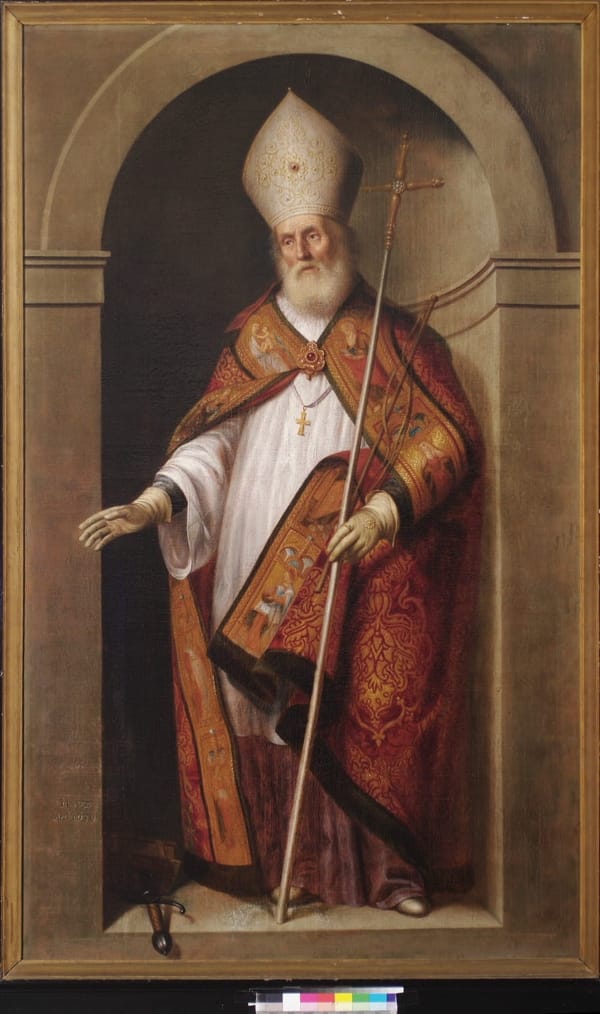 |
THE Son of Man, proclaimed King in the highest heavens on his triumphant Ascension day, leaves to his bride on earth the task of making his sovereign dominion recognized here below: this is her glory. Pentecost gives the signal for the Church's work of conquest; now does she awake, aroused by the breath of the Holy Ghost; replenished with this Spirit of love, she is all eagerness, as he is, to be possessed at once of the whole earth. We have already seen the Franks and the Anglo-Saxons pledging in her hands their oath of fealty to Christ, ‘to whom is given all power on earth and in heaven.’1 To-day we see how Winfrid realizes the fair name of Boniface, or well-doer, given him by Pope Gregory II. He presents himself before us, surrounded by the multitudes he has snatched at one blow from paganism and barbarism. Thanks to the Apostle of Germany, the hour is nigh when the Church may constitute in this world, apart from the spiritual dominion of souls, an empire more powerful than any that has ever been or is to be.
The eternal Father draws to his Son2 not men only but nations; these are his inheritance on earth no less than heaven is in eternity. The good pleasure that God takes in the Word made Flesh could never be content with merely seeing nations come, one here, another there, offering an isolated homage of recognition to Christ, as their Lord and Master. It was the whole world that was promised as his possession, without distinction of nations, without limits, save those of the earth itself:3 recognized or not, his power is universal. In the case of many, no doubt, the contempt or the ignorance of this regal claim of the Man-God is to last on throughout ages; for revolt, alas! is always possible to all. But it was the duty of the Church to exercise her influence over baptized nations, so as to gather them together in one public acknowledgement of the royalty of Christ, which is the source of every kingly power. At the Pontiff’s side there seemed to be a fitting place for a mailed chieftain of Christendom to be the lieutenant of Christ, who alone is Lord of lords and King of kings. Thus would be realized, in all its plenitude, the magnificent principality announced by the prophets for the Son of David.4
Such an institution was indeed worthy of the name it was to receive, that of the Holy Empire: in it we have the final result of our glorious Pentecost, the consummation of the testimony rendered by the Holy Ghost to Jesus, both as Pontiff and as King.5 In a few days, Leo III, the illustrious Pope called by the Holy Spirit to crown this his divine work, will proclaim, to the joy of the whole world, the establishment of this new empire beneath the sceptre-sway of the Man-God, in the person of Charlemagne, the representative of the King of kings. This marvellous work was not prepared all at once. Vast regions, destined to form the very nucleus of this future empire, for long centuries knew not so much as the very name of the Lord Jesus; or, at best, preserved but confused notions of truth, derived from some earlier evangelization that had been stifled in its birth by the turmoil of invasions—a mere mixture of Christian practices and idolatrous superstitions. At length we behold Boniface arise, endued with power from on high,6 the worthy precursor of St Leo III. Bom of those angelfaced Angles, by whom ancient Britain was transformed into the Island of Saints, he bums to carry into the heart of Germany, whence his ancestors had sprung, the light which first shone upon them in the land of their conquest.
Thirty years of monastic life, begun in childhood despite the tears and caresses of a tender father, had braced his soul. Prepared by this long period of retreat and silence, filled with divine science, and accompanied by the prayers of his cloistered brethren, he could now in all security set forth to follow the attraction of a divine call. But, first and foremost, Rome beholds him at the feet of the Sovereign Pontiff, submitting his plans and prospects to him who is the only source of all mission in the Church. Gregory II, in every way worthy of the great Popes that have borne that name, was at that time watching with apostolic vigilance over the Christian world, and preparing for the glorious sovereignty that awaited the Church in the coming eighth century. In the humble monk prostrate at his feet, the immortal Pontiff recognizes a powerful auxiliary sent to him by heaven; and so, armed with the apostolic benediction, Winfrid, now become Boniface, feels the powerful attraction of the Holy Spirit drawing him irresistibly to conquests of which ancient Rome had never dreamed.
Beyond the Rhine, farther than Roman legions ever penetrated, the Church now advances into this barbarous land, along pathways tracked for her by Boniface; overturning in her victorious march the last idols of the false gods, civilizing and sanctifying those savage hordes, the scourge of the old world. This Anglo-Saxon, a true son of St Benedict, gives to his work a stability that will defy the lapse of ages. Everywhere monasteries arise, taking root in the very soil, for God's sake; and, by force of example and beneficence, fixing around them its various nomad tribes. From the river banks, from the forest depths, instead of cries of war and of vengeance, is wafted the accent of prayer and of praise to the Most High. Sturm, the beloved disciple of St Boniface, presides over these peaceful colonies far superior to those of pagan Rome, planted though they were by her noblest veterans and manned by the best forces of her empire.
Here, too, where violence has hitherto reigned supreme, in these savage wilds, a novel kind of army is organized, formed of the gentle brides of Christ. The Spirit of Pentecost, like a mighty wind, has blown over the land of the Angles; and, even as in the cenacle holy women had a share in its influence, consecrated virgins, obedient to the heavenly impulse, have quitted the land of their birth, even the monastery that has sheltered them from childhood. Having for a while administered only at a distance to Winfrid's needs, and copied out for him the sacred books in letters of gold, they at length come to join the apostle. Fearlessly have they crossed the sea, and, guided by their divine Spouse, have come to share the labours undertaken for his glory. Lioba is at their head; she whose gentle majesty, whose heavenly aspect, uplifts the mind from earthly thoughts, and who by her knowledge of the scriptures, of the fathers, and of the sacred canons, is equal to any of the most celebrated doctors. But the Holy Ghost has still more richly gifted the soul of Lioba with humility and Christian heroism. Behold the chosen mother of the German nation! Germany's proud daughters, athirst for blood, who on their wedding-day disdained all other gift save a steed, a buckler, and a lance,7 are to learn from her the true qualities of the valiant woman. No more shall they be seen, intoxicated with slaughter, leading back to the field of battle their vanquished husbands; but the virtues of the wife and of the mother shall replace in them the fury of the camp; family life is to be founded on German soil, and through it the fatherland.
This was Boniface's intention when he called to his aid Lioba, Walburga, and their companions. Worn out with toil, but still more with the incessant wear and fret of petty jealousies (never spared to men of God by such as would cover their paltry complaints under the cloak of false zeal), our athlete of Christ was not ashamed to come to Lioba, his well-beloved daughter, humbly seeking from her that enlightened counsel and comfort which was never denied. Estimating at its true worth the share she had borne in his work, he was desirous that she should be laid to rest in the same tomb prepared for him in his abbey of Fulda.
But not yet was his labour ended, nor was the evening of life at hand. The spiritual welfare of his numberless converts must be secured, and at their head must be placed such as the Holy Ghost designated for the government of God's Church.8 By his means the hierarchy was constituted and developed; the land was covered with churches; and, beneath the rule of holy bishops chosen by God, these once wandering tribes now began to live a life to the glory of the most blessed Trinity, in a country but recently pagan, wherein Satan had hoped to perpetuate his own domination.
Nor was this our saint’s only work in Germany; in certain isolated parts, the seeds of Arianism and Manichæism had been silently taking root, by means of an intruded clergy, half pagan and half Christian in their rites; and these would inevitably prove a serious scandal to his recent converts that came within reach of their influence. Even as Christ, armed with a whip of cords, drove the buyers and sellers from the temple, so did Boniface, by vigorous measures, rid the land of these sectarian priests, who, with hands polluted by heathenish sacrifices to the vanquished deities of Valhalla, dared to offer also the spotless victim to the Most High.
The powerful action of Boniface, as the precursor of the Holy Empire, was not confined to preparing the German race alone for its share in so high a destiny. His beneficent influence was now to be exercised, at a most critical moment, upon France, the eldest daughter of the Church; for she was chosen, in the person of her princes, to be the first to bear the emblem of Christ’s universal kingship. The descendants of Clovis had preserved nought of his royal inheritance, save the vain title of a power that had now passed into the hands of a new family, a more vigorous branch of his stock. Charles Martel, the head of this race, measuring his strength with the Moors, had crushed their entire army near Poitiers: but, in the flush of victory, the hero of the day had wellnigh brought the Church of France to the brink of ruin, by distributing to his comrades in arms the episcopal sees and abbeys of the land. Unless a situation no less disastrous than would have been the triumph of Abderahman was to be accepted, these usurped croziers must at once be wrested from the hands of such strange titularies. To effect this, as much gentleness as firmness was needed, together with an ascendancy belonging only to virtue, if the hero of Poitiers and his noble race were to be gained over to respect the rights of holy Church. This victory, more glorious than had been the defeat of the Moors, was won by Boniface, a veritable triumph of unarmed holiness, as profitable to the vanquished as to the Church herself. Of this fierce warrior he was to make the worthy father of a second dynasty, the glory whereof should far surpass the brilliant hopes of the first race of the Frankish kings.
Boniface, now legate of Pope St Zachary as he had formerly been of Gregory III, fixed his episcopal see at Mainz, the better to keep within the fold both Germany the conquest of his earlier apostolate, and France more recently rescued by his labours. Like another Samuel, he himself, with his own hands, consecrated this new regal dynasty, by conferring the sacred unction on Pepin le Bref, son of Charles Martel. This was in the year 752. Another Charles, as yet a child, who was one day to inherit that throne thus firmly established, attracted the notice of the aged saint, and received his benediction; it was the future Charlemagne. But to the hand of a Sovereign Pontiff would be reserved the anointing of that royal brow; and a diadem more glorious still than that of a king of the Franks was one day to be his, exhibiting in his person the head of the new Roman Empire, the lieutenant of the King of kings.
The personal work of Boniface was now accomplished; like the old man Simeon, his eyes had seen the object of all his ambition, of his life-long toil, the salvation prepared by God for this new Israel. He too had now no desire left save that of departing in peace to our Lord; but could such an apostle enter into peace by any other gate than that of martyrdom? He understands this well: his hour has sounded: the old warrior has chosen his last battlefield. Friesland is still pagan: half a century ago, at the opening of his apostolic career, he had avoided this country, in order to escape the bishopric which St Willibrord, at that early date, was anxious to bestow upon him: but now that it has nought save death to offer him, he will enter this land. In a letter of sublime humility, prostrate at the feet of Pope Stephen III, he submits to the correction of the Apostolic See, the 'awkward mistakes,' as he terms them, and the many faults of his long life;9 to Lullus, his dearest son, he leaves the Church of Mainz; he recommends to the care of the Frankish king the several priests scattered all through Germany, the monks and virgins, who from distant homes have followed him hither. Then ordering to be placed amongst the few books which he is taking with him the winding sheet that is to enwrap his body, he designates the companions chosen by him for the journey, and sets out to win the martyr's palm.
Let us now read the liturgical record of this grand life.
Thou wast, O great apostle, the faithful servant of him who chose thee as the minister of his word and the propagator of his kingdom. When the Son of Man quitted earth to receive the delighted homage of the heavenly hosts in recognition of his kingship over them, he none the less remained King of this lower world which he has left but for a little while.10 He counted on his Church to guard his principality here below. Small indeed was the number of those who recognized him, on the day of his glorious Ascension, as their Master and Lord. But that faith deposited in those first chosen souls was a treasure which they, like skilful bankers, knew how to work with, and how to multiply by apostolic commerce. Transmitted from generation to generation, up to the day of the Lord's return, this precious capital was to go on yielding to the absent Lord more and more accumulated interest. Thus was it with thee, O Winfrid, in that age wherein thou didst bring into the Church that tribute of labour which she requires, though in very different proportion, from each of her sons. In her gratitude, for thy works which appeared to her well done and profitable above those of others, forestalling the Spouse himself, she would, even in this world, call thee by that new name11 whereby thou art known in heaven.
Indeed, when did riches, such as thou didst bring, come pouring at once into the hands of the bride? When did the Spouse appear to be so fully and truly head of the whole world, as in the eighth century, in which the Frankish princes, formed by thee to their noble destinies, constituted the temporal sovereignty of the Church, and gloried in being the lieutenants of Christ standing at the side of his Vicar on earth? To thee, O Boniface, is the Holy Empire indebted for its very existence. But for thee, France would have perished, debased by a simoniacal clergy, even before a Charlemagne had appeared; but for thee, Germany would have remained a prey to pagan barbarians, enemies of all civilization and progress. O thou that didst rescue both Germans and Franks, receive our grateful homage.
At the sight of thy works, and remembering the great popes and magnificent princes, whose glory is indeed derived from thee, our admiration equals our gratitude. But pardon us, dear saint, if the thought of those grand centuries of yore, so far removed, alas, from these our days, should mingle sadness with our joy. Viewed in the light of thy holy policy and its results, O glorious precursor of the confederation of Christian nations, how we must bewail the fatal errors of those princes and statesmen, so renowned in the seventeenth century, and so foolishly admired by a world whose ruin they were hastening! For, by the isolation of Catholic nations from one another, the ties that bound them to the Vicar of Christ became loosened: princes, forgetful of their true position as representatives of the divine King, made friends with heresy, in order to assert their independence of Rome, or to lower one another’s power. Therefore Christendom is no more. Upon its ruins, like a woful mimicry of the Holy Empire, Protestantism has raised its false evangelical empire, formed of nought but encroachments, and tracing its recognized origin to the apostasy of that felon knight Albert of Brandenburg.
The complicities that rendered such a thing possible have received their chastisement. May God’s justice be satisfied at last! O Boniface, cry out with us unto the God of armies for mercy. Raise up in the Church servants of Christ, powerful in word and work, as thou wast. Save France from anarchy; and restore to Germany a right appreciation of true greatness, together with the faith of her ancient days.
| Previous June 4: St. Francis Caracciolo, Confessor | Next June 5: St. Boniface, Apostle of Germany, Bishop and Martyr |