Daily reading
After Pentecost
Double · Movable from Easter · Temporal
August 12, 2029
From Dom Guéranger’s The Liturgical Year.

|
The Twelfth Sunday after Pentecost
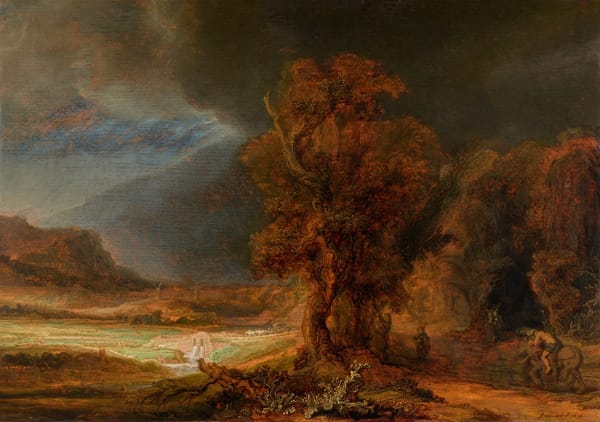
On this Sunday, which is their twelfth of Saint Matthew, the Greeks read in the Mass the episode of the young rich man who questions Jesus, given in the nineteenth chapter of the Saint’s Gospel. In the west, it is the Gospel of the Good Samaritan which gives its name to this twelfth Sunday after Pentecost.
The Introit begins with that beautiful verse of Psalm lxix. : 'Come to mine assistance, O God! O Lord, make haste to help me!’ Cassian, in his tenth Conference, has admirably drawn out the beauty of these words, and shows how they are appropriate for every circumstance of life, and how fully they respond to every sentiment of the Christian soul.1 Durandus applies this Introit to Job, because the lessons for the Divine Office, which are taken from that Book of Scripture, sometimes, though not often, coincide with this Sunday.2 Rupert looks on this Introit as the fitting prayer of the deaf and dumb man, whose cure was the subject of our reflexions this day last week. He says : 'The human race, in the person of our first parents, had become deaf to the commandments of God, and dumb in His praise; the first use he makes of his untied tongue, is to call upon the God who has healed him.'3 The same words are the Church’s first address, each morning, to her Creator, and her opening of each of the canonical hours, both day and night.
Introit
It frequently happens (and we have already explained the reason), that the Collect of the Masses for the Time after Pentecost contains an allusion to the Gospel of the foregoing Sunday. The one for to-day evidently does so. Eight days back, we were taught how man, who had rendered himself incapable of serving his Creator, finds by divine mercy, that his supernatural faculties are restored to him; and then, he gives forth the voice of praise, and that, too, rightly (loquebatur recte). The Church, taking up the idea here suggested, prays thus:
Collect
The other Collects, as on page 120.
Epistle
2 Cap. iii.
Fratres, Fiduciam talem habemus per Christum ad Deum : non quod sufficientes simus cogitare aliquid a nobis, quasi ex nobis : sed sufficientia nostra ex Deo est : qui et idoneos nos fecit ministros novi testamenti, non littera, sed spiritu : litter a enim occidit, spiritus autem vivificat. Quod si ministratio mortis litteris deformata in lapidibus, fuit in gloria, ita ut non possent intendere filii Israel in faciem Moysi, propter gloriam vultus ejus, quæ evacuatur : quomodo non magis ministratio spiritus erit in gloria? Nam si ministratio damnationis gloria est: multo magis abundat ministerium justitiæ in gloria.
2 Ch. iii.
The glorious promises mentioned in the concluding words of our Collect are described to us in the Epistle, which seems, at first sight, to be entirely in praise of the apostolic ministry; but the glory of the apostles is the glory of Him whom they announce; and this one glory, which is His, Christ, the Head, communicates to all His members, making it also their one glory. This divine glory flows, together with the divine life, from that sacred Head; and they both flow copiously through all the channels of holy Church.4 If they do not come to all Christians in the same proportions, such difference in no wise denotes that the glory and the life themselves are of a different kind for some from what they are for others. Each member of Christ's mystical Body is called upon to form his own degree of capacity for glory; not, of course, as the apostle says, that we are, of ourselves, sufficient even to think anything as of ourselves— but, what diversity there is in the way in which men turn to profit the divine capital allotted to each by grace!
Oh! if we did but know the gift of God!5 if we did but understand the supereminent dignity reserved, under the law of love, to every man of good will!6 Then, perhaps, our cowardice and sluggishness would, at last, go; then, perhaps, our souls would get fired with the noble ambition which turns men into saints. At all events, we should then come to realize that Christian humility, of which we were speaking on the last two Sundays, is not the vulgar grovelling of a low-minded man, but the glorious entrance upon the way which leads, by divine union, to the only true greatness. Are not those men inconsistent and senseless who, longing by the very law of their nature for glory, go seeking it in the phantoms of pride, and allow themselves to be diverted, by the baubles of vanity, from the pursuit of those real honours which eternal Wisdom7 had destined for them! And those grand honours were to have been heaped upon them, not only in their future heaven, but even here in their earthly habitation; and God and His saints were to have been admiring and applauding spectators!
In the name, then, of our dearest and truest interests, let us give ear to our apostle, and share his heavenly enthusiasm. We shall understand his exquisite teaching all the better, if we read the sequel to the few lines assigned for to-day’s Epistle. It is but fully carrying out the wishes of the Church, when her children, after or before assisting at her liturgical services, take the sacred Scriptures, and read for themselves the continuation of passages, which are necessarily abridged during the public celebrations. It were well, if they did this all through the year. What a fund of instruction they would thus acquire! To-day, however, there is an additional motive for the suggestion, inasmuch as this second Epistle to the Corinthians is brought before us for the first and only time during this season of the liturgy.
But let us examine what is this glory of the new Testament, which so fills the apostle with ecstasy, and, in his mind, almost entirely eclipses the splendour of the old. Splendour there undoubtedly was in the covenant of Sinai. Never had there been such a manifestation of God’s majesty, and omnipotence, and holiness, as on that day, when, gathering together, at the foot of the mount, the descendants of the twelve sons of Jacob, He mercifully renewed, with this immense family, the covenant formerly made with their fathers,8 and gave them His Law in the extraordinarily solemn manner described in the Book of Exodus. And yet, that Law, engraven as it was on stone by God’s own hand, was not, for all that, in the hearts of the receivers; neither did its holiness prevent, though it condemned, sin—sin which reigns in man’s heart.19 Moses, who carried the divine writing, came down from the mount, having the rays of God’s glory glittering on his face;10 but this glory was not to be shared in by the people of whom he was the head; it was for himself alone, as was likewise the privilege he had enjoyed of speaking with God face to face;11 it ceased with him, thus signifying, by its short duration, the character of that ministration, which was to cease on the coming of the Messiah, just as the night’s borrowed light vanishes when the day appears. And, as it were, the better to show that the time was not as yet come, when God would manifest His glory—the children of Israel were not able to gaze steadfastly on the face of Moses; so that, when he had to speak to the people, he had need to put on a veil. Though a mere borrowed light, the brightness of Moses’ face represented the glory of the future Covenant, whose splendour was to shine, not, of course, externally, but in the hearts of us all, by giving us 'the light of the knowledge of the glory of God, in the face of Christ Jesus.'12 Light, living and life-giving, which is none other than the divine Word,13 the Wisdom of the Father,14 and which the energy of the sacraments, seconded by contemplation and love, makes to pass from the Humanity of our divine Head to the very recesses of our souls.
We shall find our Sunday giving us a second reminder of Moses; but the true and enduring greatness of the Hebrew leader lies in what we have been stating. In the same way that Abraham was grander by the spiritual progeny which was the issue of his faith, than he was by the posterity that was his in the flesh—so the glory of Moses consisted not so much in his having been at the head of the ancient Israelites for forty long years, as in his having represented, in his own person, both the office of the Messiah King, and the prerogatives of the new people. The Gentile is set free from the law of fear and sin15 by the law of grace, which not only declares justice, but gives it; the Gentile, having been made a son of God,16 communes with Him in that liberty which comes of the Spirit of love.17 But, this privileged Gentile has no type which so perfectly represents him, in the first Covenant, as this the very lawgiver of Israel, this Moses who finds such favour with the Most High as to be admitted to behold His glory,18 and converse with Him with all the intimacy of friend to friend.19 Whereas God showed Himself to this His servant —as far, that is, as mortal man is capable of such sight20—and as He was seen by him without the intermediation of figures or images,21 so, when he approached thus to God, Moses took from his face the veil he wore at other times. The Jew persists, even to this very day, in keeping this veil between himself and Christ.22 The Christian, on the contrary, with the holy daring of which the apostle speaks,23 removes all intermediaries between God and himself, and draws aside the veil of all figures. ‘Beholding the glory of the Lord with face uncovered, we are transformed into the same image from glory to glory, as by the Spirit of the Lord,’24 for we become other christs, and are made like to God the Father, as is His Son Christ Jesus.
Thus is fulfilled the will of the almighty Father for the sanctification of the elect. God sees Himself reflected in these predestinated, who are become, in the beautiful light divine, conformable to the image of His Son.25 He could say of each one of them what He spoke at the Jordan and on Thabor: ‘This is my beloved son, in whom I am well pleased.’26 He makes them His true temple,27 verifying the word He spoke of old : ‘I will set my tabernacle in the midst of you: I will walk among you, and will be your God;28 I will bring thy seed from the east, and gather thee from the west; I will say to the north : “Give up!” and to the south: “Keep not back!” Bring my sons from afar, and my daughters from the ends of the earth!’29
Such are the promises, for whose realization we should, as the apostle says, be all earnestness in working out our sanctification, by cleansing ourselves from all defilement of the flesh and of the spirit, in the fear of God,30 and in His love. Such is that glory of the new Testament, that glory of the Church and of every Christian soul, which so immensely surpasses the glory of the old, and the brightness which lit up the face of Moses. As to our carrying this treasure in frail vessels, we must not, on that account, lose heart, but rather rejoice in this weakness, which makes God's power all the more evident; we must take our miseries, and even death itself, and turn them into profit, by giving the stronger manifestation of our Lord Jesus’ life in this our mortal flesh. What matters it to our faith and our hope, if our outward man is gradually falling to decay, when the inner is being renewed day by day? The light and transitory suffering of the present is producing within us an eternal weight of glory. Let us, then, fix our gaze, not on what is seen, but on what is unseen; the visible passes, the invisible is eternal.31
The human race, delivered from its long ages of dumbness, and blessed at the same time with God’s gifts, sings, in the Gradual, the hymn of its warmest gratitude.
Gradual
Gospel
Cap. x.In illo tempore : Dixit Jesus discipulis suis : Beati oculi, qui vident quæ vos videtis. Dico enim vobis, quod multi prophetæ, et reges voluerunt videre quæ vos videtis, et non viderunt : et audire quæ auditis, et non audierunt. Et ecce quidam legisperitus surrexit tentans illuni, et dicens: Magister, quid faciendo vitam æternam possidebo? At ille dixit ad eum : In lege quid scriptum est? quomodo legis? Ille respondens dixit : Diliges Domimim Deum tuum ex toto corde tuo, et ex tota anima tua, et ex omnibus viribus tuis, et ex omni mente tua : et proximum tuum sicut teipsum. Dixitque illi : Recte respondisti : hoc fac, et vives. Ille autem volens justificare seipsum, dixit ad Jesum: Et quis est meus proximus? Suscipiens autem Jesus, dixit: Homo quidam descendebat ab Jerusalem in Jericho, et incidit in latrones, qui etiam despoliaverunt eum : et plagis impositis abierunt, semivivo relicto. Accidit autem ut sacerdos quidam descenderet eadem via : et viso illo, præterivit. Similiter et Levita, cum esset secus locum, et videret eum, pertransiit. Samaritanus autem quidam iter faciens, venit secus eum : et videns eum, misericordia motus est. Et appropians, alligavit vulnera ejus, infundens oleum, et vinum : et imponens illum in jumentum suum, duxit in stabulum, et curam ejus egit. Et altera die protulit duos denarios, et dedit stabulario, et ait : Curam illius habe : et quodeumque supererogaveris, ego cum rediero, reddam tibi. Quia horum trium videtur tibi proximus fuisse illi, qui incidit in latrones? At ille dixit: Qui fecit misericordiam in ilium. Et ait illi Jesus: Vade, et tu fac similiter.
Ch. x.At that time : Jesus said to his disciples : Blessed are the eyes that see the things which you see. For I say to you, that many prophets and kings have desired to see the things that you see, and have not seen them : and to hear the things that you hear, and have not heard them. And behold, a certain lawyer stood up, tempting him, and saying: Master, what must I do to possess eternal life? But he said to him : What is written in the law? how readest thou? He answering said: Thou shalt love the Lord thy God with thy whole heart, and with thy whole soul, and with all thy strength, and with all thy mind : and thy neighbour as thyself. And he said to him : Thou hast answered right: this do and thou shalt live. But he willing to justify himself, said to Jesus : And who is my neighbour? And Jesus answering said: A certain man went down from Jerusalem to Jericho, and fell among robbers, who also stripped him, and having wounded him, went away, leaving him half dead. And it chanced that a certain priest went down the same way: and seeing him, passed by. In like manner also a levite, when he was near the place, and saw him, passed by. But a certain Samaritan, being on his journey, came near him; and seeing him, was moved with compassion. And going up to him, bound up his wounds, pouring in oil and wine; and setting him upon his own beast, brought him to an inn, and took care of him. And the next day, he took out two pence, and gave to the host, and said: Take care of him; and whatsoever thou shalt spend over and above, I at my return will repay thee. Which of these three in thy opinion was neighbour to him that fell among the robbers? But he said: He that showed mercy to him. And Jesus said to him: Go, and do thou in like manner.
The doctor and apostle of the Gentiles was speaking to us, in the Epistle, of the glory of the new Testament: Jesus, the Man-God, of whom Paul was but the servant, reveals to us, in the Gospel, the perfection of that Law, which He came to give to the world. And as though He would, in a certain way, unite His own divine teachings with those of His apostle, and justify that apostle’s enthusiasm, it is from the very depth of His own most holy soul, and in the Holy Ghost,32 that, having thanked His eternal Father for these great things, He cries out, turning to His disciples: Blessed are the eyes that see the things which ye see!
The same idea was expressed by the prince of the apostolic college, alluding to the unspeakable and glorious joy,33 which resulted from the new Alliance, wherein figures were to be replaced by realities. In his first Epistle to the elect of the holy Spirit,34 Peter speaks, in the same strain as his divine Master35 had done, of the unfulfilled aspirations of the saints of the old Testament,— those admirable men, whom St. Paul describes36 as being so grand in faith, as to be both heroic in combat and sublime in virtue. St. Peter then expresses, in inspired language, how the elect of the Church of expectation were continually looking forward to the grace of the time that was to come; how they were ever counting the years which were to intervene; how they were carefully searching (scrutinizing, as our Vulgate words it) the long ages, to find out when that happy time would be realized; although they were well aware, that the longed-for sight of the mysteries of salvation was never to be theirs, and that their mission was limited to prophesying those grandeurs to future generations.37
But, who are those kings spoken of in our Gospel, as uniting with the prophets in the desire to see the things we see? To say nothing of those holy ones who thought less of the throne they sat on, than of the divine Object of the world’s expectation,—may we not say, with the holy fathers,38 that those well deserved to be called kings, whom St. Paul describes as, by their faith, conquering kingdoms, vanquishing armies, stopping the mouths of lions, masters of the very elements, yea, what is more, masters of themselves? Heedless of the mockeries, as well as of the persecutions, of the world that was not worthy to possess such men, these champions of the faith were seen wandering in the deserts, sheltering in dens and caves, and yet happy in the love of One whom they knew they were not to see until long ages after their death.39
Do we, then, who are their descendants,—we for whom they were obliged to wait, in order to enjoy a share of those blessings which their sighs and vehement desires did so much to hasten,—appreciate the immense favour bestowed on us by our Lord? Our virtue scarcely bears comparison with that of the fathers of our faith; and nevertheless, by the descent of the holy Spirit of love, we have been more enlightened than ever were the prophets, for, by that holy Spirit, we have been put in possession of the mysteries which they only foretold. How is it, then, that we are so sadly slow to feel the obligation we are under of responding, by holiness of life,40 and by an ardent and generous love, to the liberality of that God, who has gratuitously called us from darkness to His admirable light?41 Having so great a cloud of witnesses over our heads, let us lay aside the burden of sin which impedes us, and run, by patience, in the fight proposed to us. Let us fix our eyes on Jesus, the author and finisher of faith, who, having joy set before Him, preferred to endure the cross, despising the shame, and now sitteth on the right hand of the throne of God.42 We know Him with greater certainty than we do the events which are happening under our eyes, for He Himself, by His holy Spirit, is ever within us, incorporating His mysteries into us.
The illumination of holy Baptism has produced within our souls that revelation of Christ Jesus which constitutes the basis of the Christian life, and on which the Man-God congratulated His disciples. It was of that revelation or knowledge that He spoke, rather than of the exterior sight of His human Nature, a sight which was common not only to His devoted followers, but to every enemy that chose to stare at Him. The apostle of the Gentiles makes this very clear, when, after the change produced in the disciples by the Holy Ghost’s coming upon them, he thus spoke : ‘If we once knew Christ according to the flesh, now we know Him so no longer.’43 It is literally in us, and no longer in the cities of Judea, that the kingdom of God is to be found.44 It is faith that shows us the Christ, who is dwelling in our hearts, that He may establish us in charity, and grow in us, by transforming us into Himself, and fill us with all the fullness of God.45 It is by fixing his eye on the divine image which silently lights up the soul that has been purified by Baptism that, as we were just now saying, the inner man is renewed from day to day, by incessant contemplation, and growing love, and persevering and, at last, perfect imitation, of his Creator and Saviour.46
How important it is, then, to let the supernatural light have such free scope and expansion within us, that not one of our acts or thoughts, not even the deepest recess of our hearts, may escape its sovereign influence and guidance! It is on this point, that the Holy Ghost works prodigies in faithful souls: the unrestrained development of His highest gifts, understanding and wisdom, gives such a predominance to the divine light, that the brightness of the sun’s rays pales before it. Breathing, in His omnipotent freedom, when and as He willeth, this holy Spirit does not always wait for the regular development of those gifts which He bestows upon all: the soul, drawn up to heights unreached by the ordinary paths of the Christian life, finds herself plunged in the deepest abyss of Wisdom;47 there she delightedly imbibes the rays which come to her from the eternal summits, and, in their tranquil and radiant simplicity which holds all in itself, she feels that she has the secret of all things. There are moments, when, raised up still higher,— above the region of the senses and the domain of human reasoning, or, as St. Denis the Areopagite words it, above all the intelligible,48—she is permitted to rest her wings on the summit, where dwells the uncreated light in its essence, and whence it streams down even to the furthest limits of creation, lending something of its divine splendour to every creature. Then it is, that mercifully acting on the soul, which cannot yet bear the direct infinite glory, the blessed Trinity shrouds her in that mysterious darkness, of which the saints speak as belonging to these highest degrees of mystical ascension. The darkness, beyond which is the very God of Majesty,49 is an obscurity which penetrates the soul with higher bliss than does light itself; it is a sacred night, whose silence is more eloquent than any sound that this earth could hear; it is a holy of holies, where adoration absorbs the soul; vision is not there, still less is science, and yet, it is in this sanctuary, that understanding and love, acting together in ineffable unison, take hold of the sublimest mysteries of theology.
It is quite true that such favours as these are imparted to but few; and no man can lay the slightest claim to them, be his virtue ever so great, or his fidelity ever so tried. Neither does perfection depend upon them. Faith, which guides the just man, is enough to make him estimate the life of the senses for what it really is,—miserable and grovelling. With the aid of ordinary grace, he easily lives in that intimate retirement of the soul, wherein he knows that the holy Trinity resides; he knows it, because he has it from the teaching of the Scripture.50 His heart is a kind of heaven, where his life is hidden in God, together with that Jesus upon whom are fixed all his thoughts:51 there he gives to his beloved Lord the only proof of love which is to be trusted, the only one that this Lord asks at our hands,—the keeping of the commandments.52 In spite of the ardent longings of his hope, he waits patiently and calmly for that final revelation of Christ, which, on the last day, will give him to appear together with Him in glory :53 for, as without seeing Him he believes in Him, so without seeing Him he knows that he loves Him.54 The ever-advancing growth in virtue, which men observe in such a man, is a more unmistakable proof of the power of faith, than can be those extraordinary manifestations of which we were just speaking, and in which the soul is so irresistibly subdued, that she has scarcely the power to refuse her love.
Hence, it is not without a reason and a connexion that the Gospel chosen for to-day passes at once, after the opening verses which we have been commenting, to the new promulgation of the great commandment, which includes the whole Law and the Prophets.55 Faith assures man that he may and must love the Lord his God with his whole heart, and with his whole soul, and his whole strength, and his whole mind, and his neighbour as himself. In the homily on the sacred text,56 the Church gives us the interpretation as far only as the question proposed by the Jewish lawyer: by this she insinuates that the latter portion of the Gospel, though by far the longer, is but the practical conclusion of the former, according to the saying of the apostle, that faith worketh by charity.57 The parable of the good Samaritan, though containing materials for the sublimest symbolic teaching, is spoken here in its literal sense by our Lord, for the one purpose of removing the restrictions put by the Jews on the great precept of love.
If all perfection be included in love,—if, without love, no virtue produces fruit for heaven,—it is important for us to remember, that love is not of the right kind unless it include our neighbour; and it is only after stating this particular, that St. Paul affirms that love fulfilleth the whole law,58 and that love is the plenitude of the law.59 Thus we find that the greater number of the precepts of the Decalogue concern our duties to our neighbour;60 and we are told, that the love we have for God is only then what it ought to be, when we love not only Him, but also what He loves, that is, when we love man whom He made to His own likeness.61 Hence, the apostle St. Paul does not explicitly distinguish, as the Gospel does, between the two precepts of love. He says:' All the law is fulfilled in one sentence: Thou shalt love thy neighbour as thyself.'62
Such being the importance of this love, it is necessary to have a clear understanding as to the meaning and extent of the word neighbour. In the mind of the Jews, it comprised only their own race; and in this they were following the custom of the pagan nations, to whom every stranger was an enemy. But, here in our Gospel, we have a representative of this Jewish diminished law63 eliciting, from Him who is the author of the law, an answer which declares the precept in all its fullness. This time, He does not make His voice heard amidst thunder and fire, as on Mount Sinaï. He, as Man living and conversing with men,64 reveals to them, and in the most intelligible way possible, the whole import of the eternal commandment which leads to life.65 In a parable (wherein, as many think, He is relating a fact which has really happened, and is known to those to whom He is addressing it), our Jesus describes how there was a man who went forth from the holy city, and how he fell in with a Samaritan, that is, with a stranger the most despised and the most disliked of all those whom an inhabitant of Jerusalem looked on as his enemies.66 And yet, the shrewd lawyer who questions Jesus, and, no doubt, all those who have been listening to the answer, are obliged to own that the neighbour, for the poor fellow who had fallen into the hands of robbers, was not so truly the priest, or the levite (though both of them were of his own race), as this stranger, this Samaritan, who forgets all national grudges as soon as he sees a suffering creature, and cannot look on him in any other light than as a fellow-man. Our Jesus made Himself thoroughly understood; and everyone present must have well learnt the lesson, that the greatest of all laws, the law of love, admits of no exception, either here or in heaven.
The Offertory is taken from the Book of Exodus, where Moses is described as striving with God, striving, that is, to induce Him to spare His people, after their crime of worshipping the golden calf. Moses was permitted to triumph, and God’s anger was appeased. It may sometimes happen that this Sunday falls close upon, or even on, the very day when the Church, in her Martyrology (September 4), makes a commemoration of the Jewish leader; and Honorius of Autun67 tells us, that this is the reason for such frequent mention being made in to-day’s liturgy of this glorious lawgiver of Israel.
Offertory
The Secret prays our Lord to accept graciously the offerings of the Sacrifice— offerings which are made for the purpose of winning pardon for us, and giving honour to His divine majesty.
Secret
The other Secrets, as on page 130.
As on last Sunday, so again to-day, the Communion-anthem evidently alludes to harvest-time and vintage. Bread, wine, and oil, are not only the supports of our material life; they are, also, the matter of the most august of our Sacraments. No moment is so suitable for speaking their praise as that of our having been made sharers in the sacred banquet.
Communion
The life imparted to us by the sacred mysteries, finds in them its perfection, and also its protection; for they are continually removing from us, gradually more and more, those remnants of the evil which had first brought death upon us. Such is the teaching expressed in the Postcommunion.
Postcommunion
The other Postcommunions, as on page 181.
Vespers
The psalms, capitulum, hymn, and versicle, as above, pages 71-81.
Antiphon of the Magnificat
- Cass., Collat., x. 10. ↩︎
- Dur., Rat., vi. 126. ↩︎
- Rup., De div. off., xii. 12. ↩︎
- Eph. iv. 15, 16. ↩︎
- St. John iv. 10. ↩︎
- St. Luke ii. 14. ↩︎
- Ecclus vi. 29-32. ↩︎
- Gen. xv. 18. ↩︎
- Rom. vii 12, 13. ↩︎
- Exod. xxxiv. 29-35. ↩︎
- Ibid. xxxiii. 11. ↩︎
- 2 Cor. iv. 6. ↩︎
- St. John i. 4-9. ↩︎
- Wisd. vii. 25, 26 ↩︎
- Rom. vii. 2. ↩︎
- Ibid. 15. ↩︎
- 2 Cor. iii. 17. ↩︎
- Exod xxxiii. 17-19. ↩︎
- Ibid. 11. ↩︎
- Ibid. 20. ↩︎
- Num. xii. 8. ↩︎
- 2 Cor. iii. 14. ↩︎
- Ibid. 12. ↩︎
- 2 Cor. iii. 18. ↩︎
- Rom. viii. 29. ↩︎
- St. Matt. iii. 17, xvii. 5. ↩︎
- 2 Cor. vi. 16. ↩︎
- Lev. xxvi. 12. ↩︎
- Isa. xliii. 5-7. ↩︎
- 2. Cor. vii. 1. ↩︎
- 2 Cor. iv. 7-18, etc. ↩︎
- St. Luke x. 21-23. ↩︎
- 1 St. Pet. i. 8. ↩︎
- Ibid. 1, 2. ↩︎
- St. Amb., in Luc., x. ↩︎
- Heb. xi. ↩︎
- 1 St. Pet. i. 10-12. ↩︎
- ℣. Beda, in Luc., iii. Homily for the day. ↩︎
- Heb. xi. 33-39. ↩︎
- 11 St. Pet. i. 13-16. ↩︎
- Ibid. ii. 9. ↩︎
- Heb. xii. 1, 2. ↩︎
- 2 Cor. v. 16. ↩︎
- St. Luke xvii. 21. ↩︎
- Eph. iii. 16-19. ↩︎
- Col. iii. 10. ↩︎
- St. Denis Areop., De div. nom., vii. 3. ↩︎
- De myst. theol., i. 1. ↩︎
- Ps. xvii. 12. ↩︎
- St. John xiv. 23. ↩︎
- Col. iii. 3. ↩︎
- St. John. xiv. 21. ↩︎
- Col. iii. 4. ↩︎
- 1 St. Pet. i. 8. ↩︎
- St. Matt. xxii. 36-40. ↩︎
- The Office of Matins. ↩︎
- Gal. v. 6. ↩︎
- Rom. xiii. 8. ↩︎
- Ibid. 10. ↩︎
- Ibid. 9 ↩︎
- 1 St. John iv. 20. ↩︎
- Gal. v. 14. ↩︎
- Ps. xi. 2. ↩︎
- Baruch iii. 38. ↩︎
- Ibid. iv. 1. ↩︎
- St. John iv. 9. ↩︎
- Gemm. anim., iv. 69. ↩︎
August 12: St. Clare, Virgin
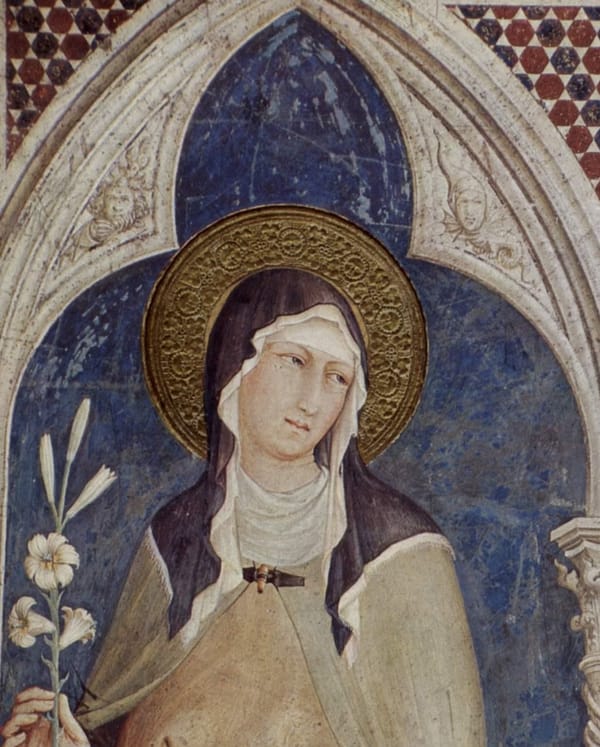 |
THE same year in which St. Dominic, before making any project with regard to his sons, founded the first establishment of the Sisters of his Order, the companion destined for him by heaven received his mission from the Crucifix in the church of St. Damian, in these words: ‘Go, Francis, repair My house, which is falling to ruin.' The new patriarch inaugurated his work, as Dominic had done, by preparing a dwelling for his future daughters, whose sacrifice might obtain every grace for the great Order he was about to found. The house of the Poor Ladies occupied the thoughts of the seraph of Assisi, even before St. Mary of the Portiuncula, the cradle of the Friars Minor. Thus, for a second time this month, Eternal Wisdom shows us that the fruit of salvation, though it may seem to proceed from the word and from action, springs first from silent contemplation.
Clare was to Francis the help like unto himself, who begot to the Lord that multitude of heroic virgins and illustrious penitents soon reckoned by the Order in all lands, coming from the humblest condition and from the steps of the throne. In the new chivalry of Christ, Poverty, the chosen Lady of St. Francis, was to be the queen also of her whom God had given him as a rival and a daughter. Following to the utmost limits the Man-God humbled and stripped of all things for us, she nevertheless felt that she and her sisters were already queens in the kingdom of heaven:1 ‘In the little nest of poverty,' she used lovingly to say, ‘what jewel could the bride esteem so much as conformity with a God possessing nothing, become a little One whom the poorest of mothers wrapt in humble swathing bands and laid in a narrow crib?’2 And she bravely defended against the highest authorities the privilege of absolute poverty, which the great Pope Innocent III feared to grant. Its definitive confirmation, obtained two days before the saint’s death, came as the long-desired reward of forty years of prayer and suffering for the Church of God.
This noble daughter of Assisi had justified the prophecy whereby, sixty years previously, her mother Hortulana had learnt that the child would enlighten the world; the choice of the name given her at her birth had been well inspired.3 'Oh! how powerful was the virgin’s light,’ said the Sovereign Pontiff in the bull of her canonization; ' how penetrating were her rays! She hid herself in the depth of the cloister, and her brightness transpiring filled the house of God.’4 From her poor solitude, which she never quitted, the very name of Clare seemed to carry grace and light everywhere, and made far-off cities yield fruit to God and to her father St. Francis.
Embracing the whole world where her virginal family was being multiplied, her motherly heart overflowed with affection for the daughters she had never seen. Let those who think that austerity embraced for God’s sake dries up the soul, read these lines from her correspondence with Blessed Agnes of Bohemia. Agnes, daughter of Ottocar I, had rejected the offer of an imperial marriage to take the religious habit, and was renewing at Prague the wonders of St. Damian’s.' O my mother and my daughter,’ said our saint, 'if I have not written to you as often as my soul and yours would wish, be not surprised: as your mother’s heart loved you, so do I cherish you; but messengers are scarce, and the roads full of danger. As an opportunity offers to-day, I am full of gladness, and I rejoice with you in the joy of the Holy Ghost. As the first Agnes united herself to the immaculate Lamb, so it is given to you, O fortunate one, to enjoy this union (the wonder of heaven) with Him the desire of whom ravishes every soul; whose goodness is all sweetness, whose vision is beatitude, who is the light of the eternal light, the mirror without spot! Look at yourself in this mirror, O queen! O bride! unceasingly by its reflection enhance your charms; without and within adorn yourself with virtues; clothe yourself as beseems the daughter and the spouse of the supreme King. O beloved, with your eyes on this mirror, what delight it will be given you to enjoy in the divine grace! . . . Remember, however, your poor Mother, and know that for my part your blessed memory is for ever graven on my heart.’5
Not only did the Franciscan family benefit by a charity which extended to all the worthy interests of this world. Assisi, delivered from the lieutenants of the excommunicated Frederick II and from the Saracen horde in his pay, understood how a holy woman is a safeguard to her earthly city. But our Lord loved especially to make the princes of Holy Church and the Vicar of Christ experience the humble power, the mysterious ascendancy, wherewith He had endowed His chosen one. St. Francis himself, the first of all, had, in one of those critical moments known to the saints, sought from her direction and light for his seraphic soul. From the ancients of Israel there came to this virgin, not yet thirty years old, such messages as this: ‘ To his very dear Sister in Jesus Christ, to his mother the Lady Clare, handmaid of Christ, Hugolin of Ostia, unworthy bishop and sinner. Ever since the hour when I had to deprive myself of your holy conversation, to snatch myself from that heavenly joy, such bitterness of heart causes my tears to flow, that if I did not find at the feet of Jesus the consolation which His love never refuses, my mind would fail and my soul would melt away. Where is the glorious joy of that Easter spent in your company and that of the other handmaids of Christ? . . . I knew that I was a sinner; but at the remembrance of your supereminent virtue, my misery overpowers me, and I believe myself unworthy ever to enjoy again that conversation of the saints, unless your tears and prayers obtain pardon for my sins. I put my soul, then, into your hands; to you I intrust my mind, that you may answer for me on the day of judgment. The Lord Pope will soon be going to Assisi; oh! that I may accompany him, and see you once more! Salute my sister Agnes (i.e., St. Clare’s own sister and first daughter in God); salute all your sisters in Christ.’6
The great Cardinal Hugolin, though more than eighty years of age, became soon after Gregory IX. During his fourteen years' pontificate, which was one of the most brilliant as well as most laborious of the thirteenth century, he was always soliciting Clare’s interest in the perils of the Church and the immense cares which threatened to crush his weakness. For, says the contemporaneous historian of our saint: ‘He knew very well what love can do, and that virgins have free access to the sacred court; for what could the King of heaven refuse to those to whom He has given Himself?’7
At length her exile, which had been prolonged twentyseven years after the death of Francis, was about to close. Her daughters beheld wings of fire over her head and covering her shoulders, indicating that she, too, had reached seraphic perfection. On hearing that a loss which so concerned the whole Church was imminent, the Pope, Innocent IV, came from Perugia with the Cardinals of his suite. He imposed a last trial on the saint’s humility, by commanding her to bless, in his presence, the bread which had been presented for the blessing of the Sovereign Pontiff;8 heaven approved the invitation of the Pontiff and the obedience of the saint, for no sooner had the virgin blessed the loaves than each was found to be marked with a cross.
A prediction that Clare was not to die without receiving a visit from the Lord surrounded by His disciples was now fulfilled. The Vicar of Jesus Christ presided at the solemn funeral rites paid by Assisi to her who was its second glory before God and men. When they were beginning the usual chants for the dead, Innocent would have had them substitute the Office for holy Virgins; but on being advised that such a canonization before the body was interred would be considered premature, the Pontiff allowed them to continue the accustomed chants. The insertion, however, of the virgin’s name in the catalogue of the saints was only deferred for two years.
The following lines are consecrated by the Church to her memory:
O Clare, the reflection of the Spouse which adorns the Church in this world no longer suffices thee; thou now beholdest the light with open face. The brightness of the Lord plays with delight in the pure crystal of thy soul, increasing the happiness of heaven, and giving joy this day to our valley of exile. Heavenly beacon, with thy gentle shining enlighten our darkness. May we, like thee, by purity of heart, by uprightness of thought, by simplicity of gaze, fix upon ourselves the divine ray, which flickers in a wavering soul, is dimmed by our waywardness, is interrupted or put out by a double life divided between God and the world.
Thy life, O virgin, was never thus divided. The most high poverty, which was thy mistress and guide, preserved thy mind from that bewitching of vanity which takes off the bloom of all true goods for us mortals. Detachment from all passing things kept thine eye fixed upon eternal realities; it opened thy soul to that seraphic ardour wherein thou didst emulate thy Father Francis. Like the Seraphim, whose gaze is ever fixed on God, thou hadst immense influence over the earth; and St. Damian’s, during thy lifetime, was a source of strength to the world.
Deign to continue giving us thine aid. Multiply thy daughters; keep them faithful in following their Mother’s example, so as to be a strong support to the Church. May the various branches of the Franciscan family be ever fostered by thy rays, and may all Religious Orders be enlightened by thy gentle brightness. Shine upon us all, O Clare, and show us the worth of this transitory life and of that which never ends.
- Regula Damianitarum, viii. ↩︎
- Regula ii; Vita S. Claræ, coæva ii. ↩︎
- Clara claris praclara mentis, magnæ in cœlo claritate gloriæ ac in terra splendore miraculorum sublimium, clare claret.—Bulla Canonizationis. ↩︎
- Bulla Canonizationis. ↩︎
- S. Claræ ad B. Agnetem, Epist. iv. ↩︎
- Wadding ad an. 1221. ↩︎
- Vita S. Claræ coæva iii. ↩︎
- Wadding ad an. 1253, though the fact is referred by others to the Pontificate of Gregory IX. ↩︎
| Previous August 11: Sts. Tiburtius and Susanna, Martyrs | Next August 12: St. Clare, Virgin |