Daily reading
After Pentecost
Double · Movable from Easter · Temporal
September 30, 2029
From Dom Guéranger’s The Liturgical Year.

|
The Nineteenth Sunday after Pentecost
The divine Leader of God’s people is their salvation in all their distress. Did we not last Sunday see Him prove Himself such, and in a very telling way, by curing both body and soul of the poor paralytic, who was a figure of the whole human race? Let us hear His voice, in the Introit, with love and gratitude; let us promise Him the fidelity He asks of us; His Law, if we will but observe it, will preserve us from a relapse.
The anthem which follows is made up of several passages of holy Writ, without being exactly that of any one of them. The verse is taken from Psalm lxxvii.
Introit
Free both in mind and body by the omnipotent word of the Son of Man, the human race can devote itself, with all activity, to the service of God. Let us obtain from His divine Majesty, by uniting our prayer with that of the Church in her Collect, that the fatal paralysis, which was once so cruel a tyrant over our souls and faculties, may never return.
Collect
The other Collecte, as on page 120.
Epistle
Cap. iv.Fratres, Renovamini spiritu mentis vestræ, et induite novum hominem, qui secundum Deum creatus est in justitia, et sanctitate veritatis. Propter quod deponentep mendacium, loquimini veritatem unusquisque cum proximo suo : quoniam sumus invicem membra. Irascimini, et nolite peccare : sol non occidat super iracundiam vestram. Nolite locum dare diabolo : qui furabatur, jam non furetur : magis autem laboret, operando manibus suis, quod bonum est, ut habeat unde tribuat necessitatem patienti.
Ch. iv.Brethren : be renewed in the spirit of your mind; and put on the new man, who, according to God, is created in justice, and holiness of truth. Wherefore, putting away lying, speak ye the truth every man with his neighbour: for we are members one of another. Be angry and sin not. Let not the sun go down upon your anger. Give not place to the devil. He that stole, let him now steal no more; but rather let him labour, working with his hands the thing which is good, that he may have something to give to him that suffereth need.
The Epistle to the Ephesians, which was interrupted last Sunday in the manner we then described, is continued to-day by the Church. The apostle has already laid down the dogmatical principles of true holiness; he now deduces the moral consequences of those principles.
Let us call to mind how the holiness, which is in God, is His very truth—truth living and harmonious, which is no other than the admirable concert of the Three divine Persons, united in love. We have seen that holiness, as far as it exists in us men, is also union, by infinite love, with the eternal and living Truth. The Word took a Body unto Himself in order to manifest in the Flesh this sanctifying and perfect truth,1 of which He is the substantial expression;2 His Humanity, sanctified directly by the plenitude of the divine life and truth, which dwell within Him,3 became the model, as well as the means, the way, of all holiness to every creature.4 It was not sin alone, but it was, moreover, the finite nature of man that kept him at a distance from the divine life;5 but he finds in Christ Jesus, just as in God, the two elements of that life: truth and love. In Jesus, as the complement of His Incarnation, Wisdom aspires at uniting with herself all the members, also, of that human race, of which He is the Head,6 and the First-born;7 by Him the Holy Ghost, whose sacred fount He is,8 pours Himself out upon man, whereby to adapt him to his sublime vocation, and to consummate, in infinite love (which is Himself), that union of every creature with the divine Word. Thus it is that we verily partake of that life of God, whose existence and holiness are the knowledge and love of His own Word; thus it is that we are sanctified in truth9 by the participation of that very holiness wherewith God is holy by nature.
The Son of Man, being God, participates for us His brethren in the life of union in the truth which constitutes the holiness of the blessed Trinity. But He communicates that life, that truth, that deifying union, to none save those who have truly become His members, and who, in Him, reproduce between one another, by the operation of the Spirit of truth10 and love, that unity of which that sanctifying Spirit is the almighty bond in the Godhead.
‘May they all be one, as Thou, Father, in Me, and I in Thee,' said Jesus to His eternal Father, ‘that they also may be one in us. I have given unto them the glory (that is to say, the holiness) which Thou hast given unto Me, that they may be one, as we also are one; I in them, and Thou in Me, that they may be consummated (that is, be made perfect) in unity.'11 Here we have, and formulated by our Lord Himself, the simple but fruitful axiom, the foundation of Christian dogma and morals. By that sublime prayer, He explained what He had previously been saying: 'I sanctify Myself for them, that they, also, may be sanctified in truth.'12
Let us now understand the moral doctrine given us by St. Paul in our to-day's Epistle. What does he mean by that justice, and that holiness of truth, which is that of Christ,13 of the new man, whom everyone must put on, that aspires to the possession of the riches spoken of in the passages already read to us from this magnificent Epistle? Let us re-read the Epistle for the seventeenth Sunday, and we shall find that all the rules of Christian asceticism, as well as of the mystic life, are to St. Paul’s mind summed up in those words: Be careful to keep unity!14 It is the principle he lays down for all, both beginners and the perfect. It is the crowning of the sublimest vocations in the order of grace, as well as the foundation and reason of all God's commandments; so truly so, indeed, that, if we are commanded to abstain from lying, and to speak the truth to them that live with us, the motive is that we are members one of another.
There is a holy anger, of which the Psalmist speaks,15 and which is the outcome, on certain occasions, of zeal for the divine law and charity; but the movement of irritation excited in the soul must, even then, be speedily calmed down; to foster it would be to give place to the devil, to give him an opportunity of weakening, or even destroying, within us, by bitterness and hatred, the structure of holy unity.16
Before our conversion our neighbour, as well as God, was grieved by our sins; we cared little or nothing for injustice, provided it was not noticed; egotism was our law, and it was proof enough of the reign of satan over our souls. Now that the Spirit of holiness has expelled the unworthy usurper, the strongest evidence of His being our rightful master is that not only the rights of others are sacred in our estimation, but our toil and our labours are all undergone for the purpose of being serviceable to our neighbour. In a word, as the apostle continues a little farther on, we walk in love, because, as most dear children, we are followers of God.17
It is by this means alone, says St. Basil, that the Church manifests the many and great benefits bestowed on the world by the Incarnation. The Christian family, which, heretofore, was split up into a thousand separate fragments, is now made one, one in itself, and one in God; it is the repetition of what our Lord did, by assuming Flesh and making it one with Himself.18
Our Jesus has restored to our hands, which once were paralyzed for every supernatural work, the full freedom of their movements; let us, then, raise them up spiritually in prayer, giving glory to God by this our homage, which He graciously accepts as a fragrant sacrifice. The Church gives us this teaching in the Gradual, and by her own example as well.
Gradual
Gospel
Cap. xxii.In illo tempore; Loquebatur Jesus principibus sacerdotum, et pharisæis in parabolis, dicens : Simile factum est regnum cœlorum homini regi, qui fecit nuptias fìlio suo. Et misit servos suos vocare invitatos ad nuptias, et nolebant venire. Iterum misit alios servos, dicens : Dicite invitatis : Ecce prandium meum paravi; tauri mei, et altilia occisa sunt, et omnia parata; venite ad nuptias. Illi autem neglexerunt, et abierunt, alius in villam suam, alius vero ad negotiationem suam : reliqui vero tenuerunt servos ejus, et contumeliis affectos occiderunt. Rex autem cum audisset, iratus est : et missis exercitibus suis, perdidithomicidas illos, et civitatem illorum succendit. Tunc ait servis suis : Nuptiæ quidem paratæ sunt, sed qui invitati erant, non fuerunt digni. Ite ergo ad exitus viarum, et quoscumque inveneritis, vocate ad nuptias. Et egressi servi ejus in vias, congregaverunt omnes, quos invenerunt, malos et bonos : et impletæ sunt nuptiæ discumbentium. Intravit autem rex ut videret discumbentes, et vidit ibi hominem non vestitum veste nuptiali. Et ait illi: Amice, quomodo huc filtrasti, non habens vestem nuptialem? At ille obmutuit. Tunc dixit rex ministris : Ligatis manibuset pedibus ejus, mittite eum in tenebras exteriores : ibi erit fletus et stridor dentium. Multi enim sunt vocati, pauci vero electi.
Ch. xxii.At that time : Jesus spoke to the chief priests and the pharisees in parables, saying: The kingdom of heaven is likened to a king, who made a marriage for his son. And he sent his servants, to call them that were invited to the marriage: and they would not come. Again he sent other servants, saying: Tell them that were invited: Behold, I have prepared my dinner : my beeves and fatlings are killed, and all things are ready: come ye to the marriage. But they neglected, and went their ways, one to his farm, and another to his merchandise. And the rest laid hands on his servants, and having treated them contumeliously, put them to death. But when the king had heard of it, he was angry, and sending his armies, he destroyed those murderers, and burnt their city. Then he saith to his servants : The marriage indeed is ready : but they that were invited were not worthy. Go ye therefore into the highways; and as many as ye shall find, call to the marriage. And his servants going forth into the ways, gathered together all that they found, both bad and good : and the marriage was filled with guests. And the king went in to see the guests: and he saw there a man who had not on a wedding garment. And he saith to him: Friend, how eamest thou in hither not having on a wedding garment? But he was silent. Then the king said to the waiters : Bind his hands and his feet, and cast him into the exterior darkness; there shall be weeping and gnashing of teeth. For many are called, but few are chosen.
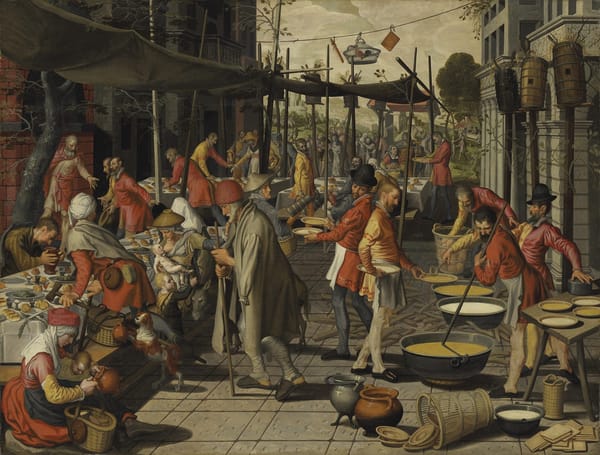
This Gospel has given to the present Sunday the name of the Sunday of the invited to the marriage. And yet, from the very opening of the dominical series, which began with the Descent of the Holy Ghost, the Church gave us the Gospel teaching which she offers to us, now a second time, for our consideration. On the second Sunday after Pentecost, she related to us, from St. Luke,19 the parable of the great supper, to which many were invited, and which St. Matthew, entering into fuller details, calls a marriage-feast.
Set thus before us, both at the beginning and at the close of the liturgical season over which the holy Spirit reigns supreme, this parable is, as it were, the interpreter of the whole portion of the year which it thus hems in : it is an additional revelation of the true aim of the Church. But how much has the light increased, since the first time we had these mystery-telling allegories! The certain man (homo quidam), who made a great supper, and invited many, has become the King, who makes a marriage for His Son, and, in this marriage, gives us an image of the kingdom of heaven. The world’s history, too, has been developing, as we gather from the terms respectively used by the two Evangelists. Those who were the first invited, and contented themselves with declining the kindness of the Master of the house, have grown in their impious ingratitude; laying hands on the messengers sent them by the loving kindness20 of the King, they treat them with contumely, and put them to death! We have seen the merited punishment inflicted on these deicides, by this Man, who was God Himself, the Father of Israel, now become King of the Gentiles : we have seen how He sent his armies to destroy them, and burn their city.21 And now at last, in spite of the refusal of the invited of Juda, in spite of the treacherous opposition put by them against the celebration of the nuptials of the Son of God, all things are ready for the marriage, and the banquet-hall is filled with guests.
Our heavenly King has confided, to the ministers of His love, the work of calling from every people the new guests. But now that His ambassadors, according to His command, have traversed the whole earth,22 bringing together all nations for this day of the joy of His heart,23 He Himself is coming in person, to see that nothing is wanting to the due preparation for the feast, and to give the signal for the eternal banquet of the divine nuptials. Now, for such a feast, and in such a place, if there be any deficiency, it can only be on the part of the guests. Let them, then, be careful not to draw down upon themselves, in this general and last examination, the displeasure of the great King, who has called them to an alliance with Himself. Though He has condescended to call them, notwithstanding their extreme poverty, from the public streets and highways, He has given them abundant time to lay aside their tatters; and knowing that they could not get ready of themselves, He has placed at their disposal, for the marriage-feast, the richest garments of His grace and virtues. Woe, then, to him who on the last day shall be found not having the wedding garment of charity! Such a want would admit of no excuse; and the King would justly punish it, by excluding the guilty man from the feast, as one that had insulted His Son.
Everything we have had on the preceding Sundays, has shown us how solicitous the Church ever is in preparing mankind for that wonderful marriage whose realization is the one object aimed at by the divine Word, in coming upon our earth. During her long exile, the bride of the Son of God has been a living model to her children; and, by her instructions, she has been unceasingly preparing them for the understanding of the great mystery of divine union. Three weeks ago,24 treating more directly than she had hitherto done on the great subject of her ambition as mother and bride, she reminded them of the great call. On the following Sunday, she gave them another lesson : she revealed to them the Bridegroom of the nuptials, to which they were invited, as the Man-God, the object of the twofold precept of love which embodies the whole Law. To-day, we have the teaching in all its perfection. It is condensed in the night Office, where we have St. Gregory explaining her whole teaching. The great doctor and the great Pope thus, in the name of the Church, explains our Gospel:
'The kingdom of heaven is the assembly of the just; for, the Lord says by a prophet: “Heaven is My throne";25 and Solomon says : “The soul of the just man is the throne of wisdom ”;26 and Paul calls Christ the Wisdom of God.27 If, therefore, heaven be the throne of God, we must evidently conclude that, as Wisdom is God, and the soul of the just man is the throne of Wisdom, this soul is a heaven . . . . The kingdom of heaven, then, is the assembly of the just . . . . If this kingdom is said to be like to a King, who made a marriage for his Son, your charity at once understands who is this King, who is the Father of a Son, King like Himself. It is He, of whom the psalmist says: “Give to the King Thy judgment, O God, and to the King’s Son Thy justice!”28 God the Father made the marriage of God His Son, when He wished that He, who had been God before all ages, should become Man towards the end of ages. But we must not, on that account, suppose that there are two persons in Jesus Christ, our God and our Saviour . . . . It is, perhaps, clearer and safer to say, that the King made a marriage for His Son, in that, by the mystery of the Incarnation, He united the Church to Him. The womb of the Virgin-Mother was the nuptial-chamber of that Bridegroom, of whom the psalmist says:29 He hath set His tabernacle in the sun : and He, as a Bridegroom, cometh out of His bride-chamber!'30
Notwithstanding her dignity of beloved bride of the Son of God, the Church is, none the less, subject to tribulations here below. The enemies of the Spouse, having ho longer any direct power to injure our Lord, turn all their rage against her. In these trials, endured as they are by the Church with love, Jesus sees a fresh trait of that resemblance which He wishes her to have to Himself; He, therefore, leaves her to suffer in this world, contenting Himself with ever upholding and saving her, as the Offertory says, in the midst of the evils which go on thickening around her.
Offertory
The august sacrifice, which is about to be offered, always obtains its effect, as far as the glory of the divine Majesty is concerned; but its virtue is applied to man in a greater or less degree, according to the dispositions of the creature, and depending on the divine mercy. Let us, in the Secret, beseech our heavenly Father, that we may experience abundantly the effects of the divine mysteries, which are so soon to be produced on our altar.
Secret
The other Secrets, as on page 130.
The Man-God, by His divine contact in the sacred banquet, has spiritually given vigour to our members; let us recall to mind that we must, henceforward, consecrate them to His service, and that our feet, now made sure, must run in the way of the divine commandments.
Communion
The Postcommunion, again, seems to be an allusion to the Gospel of the paralytic, which used formerly to be read on this Sunday. In it, we implore the assistance of the heavenly Physician, who sets man free from the palsy, which held him a prisoner; He also gives him the strength needed for fulfilling the law of God bravely and perseveringly.
Postcommunion
The other Postcommunions, as on page 181.
Vespers
The psalms, capitulum, hymn, and versicle, as above, pages 71-81.
Antiphon of the Magnificat
Oremus.
- St. John i. 14. ↩︎
- Heb. i. 3 ↩︎
- Col. ii. 3, 9, ↩︎
- St. John xiv. 6. ↩︎
- Eph. iv. 18. ↩︎
- Ibid. i. 10. ↩︎
- Col. i. 15-20. ↩︎
- Cf. St. John iv. 14; vii, 37, 39. ↩︎
- Ibid. xvii. 17. ↩︎
- Cf. St. John xv. 26. ↩︎
- Ibid. xvii. 21-23. ↩︎
- Ibid. 19. ↩︎
- Rom. xiii. 14. ↩︎
- Eph. iv. 3. ↩︎
- Ps. iv. 5. ↩︎
- S. Chrys., in ep. ad Eph. Hom., xiv. ↩︎
- Eph. v. 1, 2. ↩︎
- S. Basil, Const, mon., xviii ↩︎
- St. Luke xiv. 16-24. ↩︎
- See Time after Pentecost, vol. i., p. 358. ↩︎
- See Ninth Sunday after Pentecost. ↩︎
- Ps. xviii. 5. ↩︎
- Cant. iii. 11. ↩︎
- The Sixteenth Sunday after Pentecost. ↩︎
- Isa. lxvi. 1. ↩︎
- Wisd. vii. 27. ↩︎
- 1 Cor. i. 24. ↩︎
- Ps. lxxi. 2. ↩︎
- Ps. xviii. 6. ↩︎
- S. Greg., Hom, xxxviii. in Ev. ↩︎
September 30: St. Jerome, Priest, Confessor and Doctor of the Church
‘I know not Vitalis, I reject Meletius, I pass by Paulinus;1 he that cleaveth to the Chair of Peter, he is mine.’2 Thus, about the year 376, when the whole east was disturbed by the competitions for the episcopal See of Antioch, wrote an unknown monk to Pope St. Damasus. It was St. Jerome, a native of Dalmatia, who implored ‘light for his soul redeemed by the Blood of our Lord.’3
Far from Stridonium, his semi-barbarous native place, whose austerity and vigour he never lost; far from Rome, where the study of literature and philosophy had not had sufficient ascendency to withhold him from the seductions of pleasure; the fear of God’s judgments had led him into the desert of Chalcis. There, under a burning sky, in the company of wild beasts, he for four years tormented his body with fearful macerations; and then, as a yet more efficacious remedy, and certainly a more meritorious mortification for one passionately fond of classical beauties, he sacrificed his Ciceronian tastes to the study of the Hebrew language. Such an undertaking was far more laborious then than in our days of lexicons and grammars and scientific works of every description. Many a time was Jerome discouraged and almost in despair. But he had learnt the truth of the maxim he afterwards inculcated to others: ‘Love the science of the Scriptures, and you will not love the vices of the flesh.’4 So he took up his Hebrew alphabet again, and continued to spell those ‘hissing and panting syllables’5 until he had so mastered them as even to spoil his pronunciation of Latin.6 For the rest of his life, all the energy of his spirited nature was spent upon this labour.7
God amply repaid the homage thus rendered to His sacred word: Jerome hoped, to obtain by his toil the cure of his moral sickness; he moreover attained the lofty holiness that we now admire in him. Other heroes of the desert remain unknown: Jerome was one of those to whom it is said: ‘You are the salt of the earth; you are the light of the world’; and God willed that in due time this light should be set upon a candlestick that it might shine to all that are in the house.8
The once brilliant student returned to Rome an altered man; for his holiness, learning, and humility, he was declared by all to be worthy of the episcopal dignity.9 Pope Damasus, the virgin doctor of the virgin Church,10 commissioned him to answer, in his name, the consultations sent from east and west;11 and caused him to begin, by the revision of the Latin new Testament upon the original Greek text, those great scriptural works, which have immortalized his name and entitled him to the undying gratitude of the Christian world. Meanwhile Helvidius dared to call in question the perpetual virginity of the Mother of God: Jerome’s refutation revealed that talent for polemics, of which Jovinian, Vigilantius, Pelagius, and others, were also to feel the force. Mary rewarded him for thus avenging her honour, by bringing to him a number of holy souls, whom he was to lead in the paths of virtue, and instruct in the mysteries of holy Scripture.
Here was a phenomenon inexplicable to the infidel historian: at the very time when the Rome of the Cæsars was perishing, suddenly around this Dalmatian were gathered the fairest names of ancient Rome. They were thought to have died out, when the lower classes made themselves supreme; but at the critical moment, when Rome was to rise again purified from the flames kindled by the barbarians, they reappeared to claim their birthright and refound the city for its true eternal destiny. The combat was of a new kind; but they were at the head of the army that was to save the world. Four centuries earlier, the apostle had said there were not many wise, and powerful, and noble; Jerome declared that, in his day, they were numerous, ‘numerous among the monks.’12
The monastic army in the west was, at its origin, chiefly recruited from the patricians, whose character of ancient grandeur it ever afterwards retained; its ranks included noble virgins and widows; and sometimes husband and wife would enlist together. Marcella was the first to inaugurate the monastic life at Rome, in her palace on the Aventine. She obtained St. Jerome’s direction for her privileged community; but after his departure, she herself was consulted by all, as an oracle, on the difficulties of holy Scripture.13 She was joined in her retreat by Furia, Fabiola, and Paula, worthy descendants of Camillus, of the Fabii, and of the Scipios. But the old enemy could ill brook such losses to his power: Jerome must be forced to leave Rome.
A pretext was soon found for raising a storm. The Treatise on Virginity addressed to St. Paula’s daughter Eustochium, and written in Jerome’s fearless and pointed style, evoked the animosity of false monks, foolish virgins, and unworthy clerics.14 In vain did the prudent Marcella predict the tempest: Jerome would make bold to write what others dared to practise.15 But he had not reckoned on the death of Pope Damasus at that very juncture; an event for which the ignorant and the envious had been waiting, in order to give full vent to their stifled hatred.16 Driven away by the storm, the lover of justice returned to the desert; not this time to Chalcis, but to the peaceful Bethlehem, whither the sweet recollection of our Saviour’s infancy attracted the strong athlete. Paula and her daughter soon followed him, in order not to forgo the lessons they prized above all else in the world; their presence was a consolation to him in his exile, and an encouragement to continue his labours. All honour to these valiant women! To their fidelity, their thirst for knowledge, their pious importunities, the world is indebted for a priceless treasure, viz: the authentic translation17 of the sacred Books, which was necessitated by the imperfections of the old Italic Version and its numberless variations, as also by the fact that the Jews were accusing the Church of falsifying the Scripture.18
‘Paula and Eustochium, may the labours of my poor life be pleasing to you, useful to the Church, and worthy of posterity; as for contemporaries, I care but little for their judgment.’19 So said the holy solitary; yet he felt the envious attacks of his bitter enemies more keenly than he would own to himself. ‘Handmaids of Christ,’ he said, ‘shield me with the buckler of your prayers from those who malign me.’20 Every book he translated brought upon him fresh criticisms, and those not only from enemies. There were the timid, who were alarmed for the authority of the Septuagint, so sacred both to the Synagogue and to the Church;21 there were the possessors of precious manuscripts, written on purple vellum and adorned with splendid uncials, and with letters of silver and gold, all which would now lose their value. ‘Well, let them keep their precious metal, and leave us our poor papers,’22 cried Jerome exasperated. ‘And yet, it is you,’ he said to the fair inspirers of his works, ‘who force me to endure all this folly and all these injuries; to put an end to the evil, it were better you enjoined silence on me.’23 But neither the mother nor the daughter would hear of such a thing, and Jerome yielded to constraint. Finding that the text of his first revision of the Psalter upon the Greek Septuagint24 had become corrupted through careless transcriptions, they induced him to undertake a second.25 This version is inserted in our present Vulgate, together with his translation of the other Books of the old Testament from Hebrew or Chaldaic.26 In all these works the saint appealed to Paula and Eustochium as guarantees of his exactitude, and begged them to collate his translations word for word with the original.27
All his old friends in Rome took part in this learned intercourse. Jerome refused to none the light of his knowledge, and pleasantly excused himself for giving one half of the human race a preference over the other: 'Principia, ray daughter in Jesus Christ, I know that some find fault with me for writing to women; let me say, then, to these detractors: If men questioned me on the Scripture, they should receive my answers.’28
There was great joy in the monasteries at Bethlehem when news arrived that another Paula was born in Rome. Eustochium’s brother had married Læta, the Christian daughter of the pagan pontiff Albinus. They had vowed their child to God before her birth; and now they rejoiced to hear her lisp into the ear of the priest of Jupiter the Christian Alleluia. On hearing of her grandmother beyond the seas, and of her aunt consecrated to God, the little one would beg to go and join them. ‘Send her,’ wrote Jerome delightedly, ‘I will be her master and foster-father; I will carry her on my old shoulders; I will help her lisping lips to form her words; and I shall be prouder than Aristotle; for he indeed educated a king of Macedon, but I shall be preparing for Christ a handmaid, a bride, a queen predestined to a throne in heaven.’29 The child was, in fact, sent to Bethlehem, where she was destined to solace the last hours of the aged saint, and to assume, while yet very young, the responsibility of carrying on the work of her holy relatives.
But Jerome had still more to suffer, before leaving this world. The elder Paula was the first to be called away, singing: ‘I have chosen to be an abject in the house of my God, rather than to dwell in the tabernacles of sinners.’30 So great a langour then took possession of St. Jerome, that it seemed his end was approaching.31 Eustochium, though brokenhearted, repressed her tears, and implored him to live and fulfil his promises to her mother. He therefore aroused himself, finished his translations,32 and took up again his commentaries on the text. He had completed Isaias,33 and was engaged upon Ezechiel, when the most awful calamity of those times came upon the world: ‘Rome is fallen; the light of the earth is xtinguished; in that one city the whole universe has perished. What can we do, but hold our peace and think upon the dead?’
He had, however, to think about the living also, for numberless fugitives, destitute of all things, made their way to the holy places; and the uncompromising wrestler was all tenderness to these unfortunates. Loving the practice of the holy Scripture no less than its teaching, he spent his days in discharging the duties of hospitality. In spite of his failing sight, he gave the night hours to his dear studies, wherein he forgot the troubles of the day, and rejoiced to fulfil the desires of the spiritual daughter God had given him. The prefaces to his fourteen books on Ezechiel bear witness to the share taken by the virgin of Christ in this work undertaken despite the misfortunes of the times, his own infirmities, and his last controversies with heretics.34
Heresy seemed indeed to be profiting of the troubled state of the world, to rise up with renewed audacity. The Pelagians, supported by bishop John of Jerusalem, assembled one night with torches and swords, and set fire to the monastery of St. Jerome, and to that of the sacred virgins then governed by Eustochium. Manfully seconded by her niece Paula the younger, the saint rallied her terrified daughters, and they escaped together through the midst of the flames. But the anxiety of that terrible night was too much for her already exhausted strength. Jerome laid her to rest beside her mother, near the crib of the Infant God; and leaving his commentary on Jeremias unfinished, he prepared himself to die.
The following is the liturgical account of his life.
Thou completest, O illustrious saint, the brilliant constellation of doctors in the heavens of holy Church. The latest stars are now rising on the sacred cycle; the dawn of the eternal day is at hand; the Sun of justice will soon shine down upon the valley of judgment. O model of penance, teach us that holy fear, which restrains from sin, or repairs its ravages; guide us along the rugged path of expiation. Historian of great monks,35 thyself a monk and father of the solitaries attracted like thee to Bethlehem by the sweetness of the divine Infant, keep up the spirit of labour and prayer in the monastic Order, of which several families have adopted thy name. Scourge of heretics, attach us firmly to the Roman faith. Watchful guardian of Christ’s flock, protect us against wolves, and preserve us from hirelings. Avenger of Mary’s honour, obtain for our sinful world that the angelic virtue may flourish more and more.
O Jerome, thy special glory is a participation in the power of the Lamb to open the mysterious Book; the key of David was given to thee to unclose the many seals of holy Scripture and to show us Jesus concealed beneath the letter.36 The Church, therefore, sings thy praises to-day, and presents thee to her children as the official interpreter of the inspired writings which guide her to her eternal destiny Accept her homage and the gratitude of her sons. May our Lord, by thy intercession, renew in us the respect and love due to His divine word. May thy merits obtain for the world other holy doctors, and learned interpreters of the sacred Books. But let them bear in mind the spirit of reverence and prayer with which they must hear the voice of God in order to understand. God will have His word obeyed, not discussed; although, among the various interpretations of which that divine word is susceptible, it is lawful, under the guidance of the Church, to seek out the true one; and it is praise-worthy to he ever sounding the depths of beauty hidden in that august doctrine. Happy is he who follows thy footsteps in these holy studies! Thou didst say: 'To live in the midst of such treasures, to be wholly engrossed in them, to know and to seek nothing else, is it not to dwell already more in heaven than on earth? Let us learn in time that science which will endure for ever.’37
- Hieron. Epist. xv. al. lvii. ad Damas. ↩︎
- Epist. xvi. al. lviii. ↩︎
- Ibid. ↩︎
- Epist. cxxv. al. iv. ad Rusticum. ↩︎
- Ibid. ↩︎
- Epist. xxix. al. cxxx. ad Marcellam. ↩︎
- Epist. cviii. al. xxvii, ad Eustochium. ↩︎
- St. Matt. v. 13, 14, 15. ↩︎
- Hieron. Epist. xlv. al. xcix. Ad Asellam. ↩︎
- Epist. xlviii. al. 1. ad Pammachium. ↩︎
- Epist. cxxiii. al. xi. ad Agcruchiam. ↩︎
- Epist. lxvi. al. xxvi. ad Pammachium. ↩︎
- Epist. cxxvii. al. xvi. ad Princ. ↩︎
- Epist. xxii. ad Eustochium, de custodia virginitatis. ↩︎
- Epist. xxvii. al. cxx. ad Marcellam. ↩︎
- Præf. Versionis Didymi de Spirita Sancto; Epist. xlv. al. xcix. ad Ascllam. ↩︎
- Conc. Trid. Sess. iv. ↩︎
- Hier. Præf. in Isaiam, ad Paulam et Eustochium. ↩︎
- Præf. in Daniel. ↩︎
- Præf. in Reg. ↩︎
- Aug. ad Hieron. Epist. lvi al. lxxxvi. ↩︎
- Hier. Præf. in Job. ad easdem. ↩︎
- Præf, in Jerem. ↩︎
- Psalt. rom. ↩︎
- Psalt. gall. Hier. Præf, in Psalmos. ↩︎
- Except Baruch, Wisdom, Ecclesiasticus, Machabees, and a few fragments, retained from the old Italic. ↩︎
- Hier. Præf, in Esther. ↩︎
- Epist. lxv. al. cxl. ad Principi m. ↩︎
- Epist. cvii. al. vii. ad Lætam. ↩︎
- Ps. lxxxiii. 11. Hier. Epist. cviii. al. xxvii. ad Eustochium. ↩︎
- Epist. xcix. al. xxxi. ad Theophilum. ↩︎
- Præf. in Josue, Jud. et Ruth. ↩︎
- Comment, in Isaiam. ↩︎
- Comment, in Ezech, i, Prolog. ↩︎
- St. Paul the Hermit, St. Hilarion, St. Malchus. ↩︎
- Hier. Epist. liii. al. ciii. ad Paulinum. ↩︎
- Ibid. ↩︎
| Previous September 29: Dedication of St. Michael the Archangel | Next September 30: St. Jerome, Priest, Confessor and Doctor of the Church |