Daily reading
After Pentecost
Greater Double · Temporal
November 18, 2029
From Dom Guéranger’s The Liturgical Year.

|
The Sixth Resumed Sunday after Epiphany
Introit
Collect
The other Collects, as on page 120.
Epistle
1 Cap. i.Fratres, Gratias agimus Deo semper pro omnibus vobis, memoriam vestri facientes in orationibus nostris sine intermissione, memores operis fidei vestra, et laboris et charitatis, et sustinentiæ spei Domini nostri Jesu Christi, ante Deum et Patrem nostrum : scientes, fratres, dilecti a Deo, electionem vestram : quia Evangelium nostrum non fuit ad vos in sermone tantum, sed et in virtute, et in Spiritu sancto, et in plenitudine multa, sicut scitis quales fuerimus in vobis propter vos. Et vos imitatores nostri facti estis, et Domini, excipientes verbum in tribulatione multa, cum gaudio Spiritus sancti : ita ut facti sitis forma omnibus credentibus in Macedonia, et in Achaia. A vobis enim diffamatus est sermo Domini, non solum in Macedonia, et in Achaia, sed et in omni loco fìdes vestra, quæ est ad Deum, profecta est, ita ut non sit nobis necesse quidquam loqui. Ipsi enim de nobis annuntiant qualem introitum habuerimus ad vos : et quomodo conversi estis ad Deum a simulacris, servire Deo vivo, et vero, et exspectare Filium ejus de cœlis (quem suscitavit ex mortuis) Jesum, qui eripuit nos ab ira ventura.
1 Ch. i.Brethren : We give thanks to God always for you all: making a remembrance of you in our prayers without ceasing: being mindful of the work of your faith, and labour and charity, and of the enduring of the hope of our Lord Jesus Christ, before God and our Father; knowing, brethren beloved of God, your election. For, our Gospel hath not been to you in word only, but in power also, and in the Holy Ghost, and in much fullness, as you know what manner of men we have been among you for your sakes. And you became followers of us, and of the Lord, receiving the word in much tribulation, with joy of the Holy Ghost: so that you were made a pattern to all that believe in Macedonia and in Achaia. For from you was spread abroad the word of the Lord, not only in Macedonia and in Achaia, but also in every place your faith, which is towards God, is gone forth, so that we need not to speak anything. For they themselves relate of us, what manner of entering in we had unto you : and how you turned to God from idols, to serve the living and true God, and to wait for his Son from heaven (whom he raised up from the dead) Jesus, who hath delivered us from the wrath to come.
Gradual
Gospel
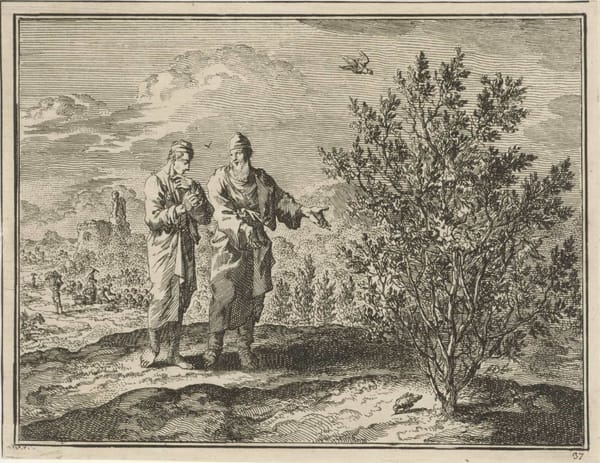
Cap. xiii.In illo tempore: Dixit Jesus turbis parabolam hanc : Simile est regnum cœlorum grano sinapis, quod accipiens homo seminavit in agro suo : quod minimum quidem est omnibus seminibus : cum autem creverit, majus est omnibus oleribus, et fit arbor, ita ut volucres cœli veniant, et habitent in ramis ejus. Aliam parabolam locutus est eis: Simile est regnum cœlorum fermento, quod acceptum mulier abscondit in farinæ satis tribus, donec fermentatum est totum. Hæc omnia locutus est Jesus in parabolis ad turbas et sine parabolis non loquebatur eis : ut impleretur quod dictum erat per prophetam, dicentem: Aperiam in parabolis os meum, eructabo abscondita a constitutione mundi.
Ch. xiii.At that time : Jesus spoke to the multitude this parable : The kingdom of heaven is like to a grain of mustard-seed, which a man took and sowed in his field. Which is the least indeed of all seeds; but, when it is grown up, it is greater than all herbs, and becometh a tree, so that the birds of the air come and dwell in the branches thereof. Another parable he spoke to them : The kingdom of heaven is like to leaven, which a woman took and hid in three measures of meal, until the whole was leavened. All these things Jesus spoke in parables to the multitudes, and without parables he did not speak to them : that it might be fulfilled which was spoken by the prophet, saying : I will open my mouth in parables; I will utter things hidden from the foundation of the world.
Offertory
Secret
The other Secrets, as on page 130.
Communion
Postcommunion
The other Postcommunions, as on page 131.
Vespers
The psalms, capitulum, hymn, and versicle, as above, pages 71-81.
Antiphon of the Magnificat
November 18: Dedication of the Basilicas of Sts. Peter and Paul, Apostles
This inscription stood in letters of gold over the triumphal arch in the ancient Vatican Basilica.1 Never did the Roman genius frame a more magnificent utterance in so few words; never did the greatness of Simon BarJona appear to such advantage on the seven hills. In 1506 the great arch, that had looked down upon twelve centuries of prostrate pilgrims, fell from old age, and the beautiful inscription perished. But Michael Angelo's lofty dome points out to the city and the world the spot where sleeps the Galilaean fisherman, the successor of the Caesars, the Vicar of Christ, the ruler of the destinies of Rome.
The second glory of the eternal City is the tomb of St. Paul on the Ostian Way. Unlike that of St. Peter, which lies deep down in the Vatican crypt, this tomb is raised to the level of the floor by massive masonry, on which rests the great sarcophagus. This circumstance was ascertained in 1841, when the papal altar was reconstructed. It was evidently to obviate the consequences of inundations from the Tiber, that the sarcophagus had thus been raised above the place where Lucina had first laid it.2 The pilgrim certainly finds nothing to blame in this arrangement, when, on looking through the small opening in the centre of the altar, his respectful glance falls upon the marble of the tomb, and he reads these imposing words traced in large characters of Constantine's period: PAULO APOSTOLO ET MARTYRI. To Paul Apostle and Martyr.3
Thus Christian Rome is protected on the North and South by these two citadels. Let us enter into the sentiments of our fathers, when they said of this privileged city: “Peter the door-keeper, sets his holy dwelling at the entrance: who can deny that this city is like heaven? At the other extremity, Paul from his temple guards the walls; Rome lies between the two: here then God dwelleth.”4
The present feast therefore deserves to be more than a local solemnity; its extension to the universal Church is a subject for the world's gratitude. Thanks to this feast, we can all make together in spirit today the pilgrimage ad limina Apostolorum,5 which our ancestors performed with such fatigue and danger, yet never thought they purchased too dearly its holy joys and blessings. “Heavenly mountains, glittering heights of the new Sion! There are the gates of our true country, the two lights of the immense world. There Paul's voice is heard like thunder; there Peter withholds or hurls the bolt. The former opens the hearts of men, the latter opens heaven. Peter is the foundation-stone, Paul the architect of the temple where stands the altar by which God is propitiated. Both together form a single fountain, which pours " out its healing and refreshing waters.”6
In the following Lessons the Roman Church gives us her traditions concerning the two basilicas whose dedication feast we are celebrating.
In honour of the holy Apostles we gladly borrow from the libraries of our Anglican brethren the following Sequence, sung four centuries ago by the venerable church of York.
Sequence
Apostolorum principis,
Piae laudis harmonia
Laetis resonet canticis.
Dignum lade venerari apostolum gentium;
Ut quos amor vita junxit,
Nec mors ipsa post disjunxit jungat et praeconium.
Romanae potentiae idolatria,
Jam fundata et firmata
Ibidem orbem gubernat Ecclesia.
Pauli tenet firmamentum dogmate Ecclesia;
Clavis huic potentiae,
Illi cessit scientiae juncta ad officia.
Gratulatur et rectore inter fluctus saeculi;
Pauli viget ex doctrina,
Vitae sumpta medicina grex fidelis populi.
Ille coelum aperit verbo vitae credulis,
Et quod unus praedicat
Alter verum comprobat crebris hoc miraculis.
Viam vitae nescientes ad salutem convocat;
Ambo praesunt convocatis,
Ambo certant desolatis, hostis ne prevaleat.
Consurgunt imperium,
Unus crucis, alter ensis
Perpessus supplicium.
Una die passi, sortem ad justorum transmeant;
Qui malorum noe exsortes
Sua prece et consortes beatorum faciant.
of the Prince of the Apostles,
let the harmony of our loving praise
resound in joyous canticles.
the Apostle of the Gentiles, worthy of equal praise;
that those whom love united in life,
and death itself did not sever, may together receive our homage.
that the idolatry of the Roman empire has been destroyed;
and in that same Rome the Church
has been founded and built up, and rules the world.
and strengthened by Paul's teaching;
one holds the key of authority,
the other that of knowledge, both for the same work.
the faithful people rejoice amid the billows of this world;
while they grow strong
and receive life-giving medicine from Paul's doctrine.
Peter opens heaven to believers in the word of life,
and what the one preaches
the other proves by many miracles.
ignorant of the way of life;
together they direct the called,
together they strive lest the enemy should prevail against them.
and incur the penalty,
one of the cross,
the other of the sword.
on the same day, and together pass to the reward of the just;
by their prayer may they deliver us from all evil,
and make us companions of the blessed.
Today let us call to mind and complete the instructions we received on the general feast of the Dedication of churches; and let us conclude with the following Sequence, worthy of the pen of Adam of St. Victor, to whom it was long attributed. It sets forth in all the figures once so well known, the great mystery of Christ's union with the human race, which is expressed in the consecration of Christian temples.
Sequence
Domini virtutum
et atria!
Tuta aedificia, quae non movent
Imo fovent vectus, flumen, pluvia!
Per concinna sacramenta
Umbrae praecurrentia!
Evam fundit, in manentis
Copulae primoria.
Noe servat, gubernata
Mundi per diluvium.
Anus Sara ridet laeta,
Nostrum lactans gaudium.
Et camelus adaquatur
Ex Rebeccae hydria.
Aptat sibi, ut per illas
Virgo fiat congrua,
A Jacob, dum devagatur
Nimis freta litterae.
Quibus Rachel videns fulta,
Pari nubit foedere.
Geminos parit ex Juda
Thamar diu vidua.
Dum se lavat, in fiscella
Reperitur scirpea.
Quo Israel satiatur,
Tinctus ejus sanguine;
Egyptios sub profunda
Obruens voragine.
Hic mandata legis dena,
Sed in arca foederis.
Hic Aaron indumenta
Quae praecedit poderis.
Bethsabee sublimatur,
Sedis consors regiae.
Vestis astat deauratae,
Sicut regum filiae.
Salomonis quam divina
Condit sapientis,
Myrrhae et thuris fumosa,
Virga pigmentaria.
Quae figura obumbravit,
Reseravit nobis die gratiae;
Et peallamus:
Adsunt enim nuptiae.
In tubis epulantium
Et finis per pealterium.
Una canunt melodia,
Sine fine dicentia: Alleluia!
and courts of the Lord
of hosts!
that wind and flood
and rain instead of shaking strengthen it.
aptly prefigured by the mysteries
of the time of shadows!
Eve comes forth from his side,
the first type of an eternal union.
preserves Noe, safely sailing
through the deluge that destroys the world.
laughs joyously to see herself a mother
suckling the child whose name signifies our joy.
drinks from Rebecca's pitcher,
and she waters his camels;
with ear-rings and bracelets,
that she may appear as beseems a virgin.
and trusting too much to the letter,
is supplanted by Jacob.
which are a strength to Rachel the clear-sighted,
and give her equal rights.
veils herself on the highway,
and gives twin sons to Juda.
is found by the maiden
as she is bathing.
the Israelites are fed therewith,
and are marked with its blood.
whose rushing waves
engulf the Egyptians.
here in the Ark of the Covenant
are the ten commandments of the Law.
here the garments of Aaron,
and first of them all the Pontiff's ephod.
is raised as bride
even to share the royal throne,
in robes of gold and all variety,
even as the daughters of princes.
whom Solomon instructs
with his divine wisdom;
breathing the fragrance of myrrh
and incense and every perfume.
foreshadowed thus in figures,
the day of grace has revealed to us;
with the Beloved and sing to him,
for it is the Nuptial-day.
by the clang of trumpets,
and closes with the psaltery.
with one same melody,
repeating without end: Alleluia!
- De Rossi, Inscript. Christ. T. II. 345. ↩︎
- See the Legend of St. Cornelius, Sept. 16th. ↩︎
- Dom Gueranger, Saint Cécile et la Société romaine aux deux premiers siècles, ch vi. ↩︎
- Janitor ante fores fixit sacraria Petrus: Quis neget has arces instar esse poli? Parte alia Pauli circumdant atria muros: Hos inter Roma est: hic sedet ergo Deus. Inscription on the gate of Rome which was called n the 6th century the gate of St. Peter. (de Rossi, Inscript. ii. 99.) ↩︎
- To the threshold of the Apostles, i. e. of their basilicas, where pilgrims used to prostrate before entering. ↩︎
- Venant. Fortunat. Miscellania, iii. 7. ↩︎
| Previous November 17: St. Gregory Thaumaturgus, Bishop and Confessor | Next November 18: Dedication of the Basilicas of Sts. Peter and Paul, Apostles |