Daily reading
After Pentecost
Double · Movable from Advent · Temporal
November 25, 2029
From Dom Guéranger’s The Liturgical Year.

|
The Twenty-Fourth Sunday after Pentecost
The number of the Sundays after Pentecost may exceed twenty-four, and go as far as twenty-eight, according as Easter is each year more or less near to the vernal equinox. But the Mass here given is always reserved for the last; and the intervening ones, be their number what it may, are taken from the Sundays after the Epiphany, which, in that case, were not used at the beginning of the year.1 This, however, does not apply to the Introit, Gradual, Offertory, and Communion, which, as we have already said, are repeated from the twenty-third Sunday.
We have seen how that Mass of the twenty-third Sunday was regarded, by our forefathers, as really the last of the cycle. Abbot Rupert has given us the profound meaning of its several parts. According to the teaching we have already pondered over,2 the reconciliation of Juda was shown us as being, in time, the term intended by God: the last notes of the sacred liturgy blended with the last scene of the world’s history, as seen and known by God. The end proposed by eternal Wisdom in the world’s creation, and mercifully continued, after the fall, by the mystery of Redemption, has now (we speak of the Church’s year and God’s workings) been fully carried out. This end was no other than that of divine union with human nature, making it one in the unity of one only body.3 Now that the two antagonistic people, Gentile and Jew, are brought together in the one same new Man in Christ Jesus their Head,4 the two Testaments, which so strongly marked the distinction between the ages of time, the one called the old, the other the new, fade away, and give place to the glory of the eternal Alliance.
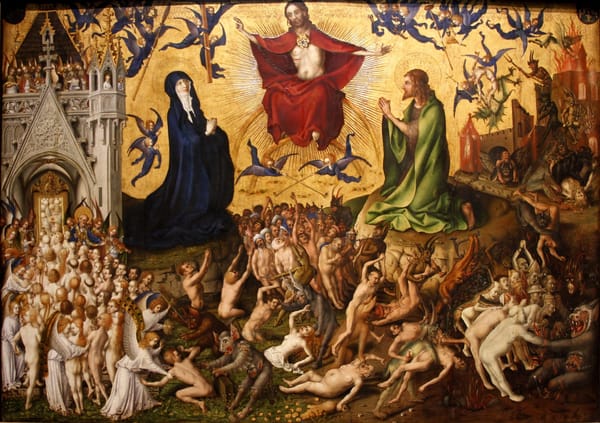
It was here, therefore, that mother Church formerly finished her liturgical year. She was delighted at what she had done during all the past months; that is, at having led her children, not only to have a thorough appreciation of the divine plan, which she had developed before them in her celebrations, but moreover, and more especially, to unite them themselves, by a veritable union, to their Jesus, by a real communion of views, and interests, and loves. On this account, she used not to revert again to the second coming of the God-Man and the last judgment, two great subjects which she had proposed for her children’s reflexions, at the commencement of the purgative life, that is, in her season of Advent. It is only a few centuries ago that, with a view of giving to her year a conclusion more defined and intelligible to the faithful of these comparatively recent times, she chose to conclude the cycle with the prophetic description of the dread coming of her Lord, which is to put an end to time, and to open eternity. From time immemorial, St. Luke had had the office of announcing, in Advent, the approach of the last judgment;5 the evangelist St Matthew was selected for this its second, and more detailed, description, on the last Sunday after Pentecost.
Mass
Introit
Ps. Benedixisti, Domine, terram tuam: avertisti captivitatem Jacob. Gloria Patri. Dicit Dominus.
Ps. Thou, O Lord, hast blessed thy land: thou hast brought back the captive children of Jacob. Glory, etc. The Lord.
The doing of good works, by the help of divine grace, prepares us to receive a still greater grace, for greater works in the future. In the Collect, let us unite with our mother, the Church, in praying for an efficacious influence of the divine Mover upon our wills.
Collect
The other Collects, as on page 120.
Epistle
Cap. i.Fratres, Non cessamus pro vobis orantes et postulantes, ut impleamini agnitione voluntatis Dei in omni sapientia, et intellectu spiritali : ut ambuletis digne Deo per omnia placentes: in omni opere bono fructificantes, et crescentes in scientia Dei : in omni virtute confortati secundum potentiam claritatis ejus, in omni patientia, et longanimitate cum gaudio, gratias agentes Deo Patri, qui dignos nos fecit in partem sortis sanctorum in lumine : qui eripuit nos de potestate tenebrarum, et transtulit in regnum Filii dilectionis suæ; in quo habemus redemptionem per sanguinem ejus, remissionem peccatorum.
Ch. i.Brethren: We cease not to pray for you, and to beg that you may be filled with the knowledge of his will, in all wisdom, and spiritual understanding: that you may walk worthy of God, in all things pleasing: being fruitful in every good work, and increasing in the knowledge of God: strengthened with all might, according to the power of his glory, in all patience and longsuffering with joy. Giving thanks to God the Father, who hath made us worthy to be partakers of the lot of the saints in light: who hath delivered us from the power of darkness, and hath translated us into the kingdom of the Son of his love, in whom we have redemption through his blood, the remission of sins.
Thanksgiving and prayer! There we have the epitome of our Epistle, and an eloquent conclusion of the apostle’s course of instructions: it is also both the summary and the conclusion of the year of the sacred liturgy. The Doctor of the Gentiles has been zealous, beyond measure, in his fulfilment of the task assigned to him by mother Church. Of a certainty, the fault is not his, if the souls he undertook to guide, on the morrow of the descent of the Spirit of love, have not all reached that summit of perfection, which he longed for us all to attain. Those who have gone bravely forward in the path which, a year since, was opened out to them by holy Church, now, by a happy experience, know that that path most surely leads them to the life of union, where divine charity reigns supreme. Who is there that, with anything like earnestness, has allowed his mind and heart to take an interest in the several liturgical seasons which have been brought before us, and been celebrated by the Church during the past twelve months, has not also felt an immense increase of light imparted to him? Now, light is that indispensable element, which delivers us from the power of darkness, and translates us, by the help of God, into the kingdom of the Son of His love. The work of redemption, which this His beloved Son came down upon earth to accomplish for His Father’s glory, could not do otherwise than make progress in those who have, with more or less fervour, entered into the spirit of His Church, during the whole year, that is, from the opening of Advent right up to these the closing days of the sacred cycle. All of us, then, whosoever we may be, should give thanks to this Father of lights,6who hath thus made us worthy to be partakers, somewhat at least, of the lot of the saints.
So, then, all of us, be the share of our participation what it may, must pray that the excellent gift,7 which has been put into our hearts, may fervently yield itself to the still richer development, which the coming new cycle is intended to produce within us.
The just man cannot possibly remain stationary in this world; he must either descend or ascend; and whatever may be the degree of perfection to which grace has led him, he must be ever going still higher as long as he is left in this life.8 The Colossians, to whom the apostle was writing, had fully received the Gospel; the word of truth which had been sown in them had produced abundant fruit in faith, hope, and love;9 and yet, instead of relenting on that account his solicitude in their regard, it is precisely for that reason10 that St. Paul, who had prayed for them up till then, ceases not to pray for them. So let us do: let us go on praying. Let us beg of God, that He will again, and always, fill us with His divine Wisdom, and with the Spirit of understanding. We need all that, in order to correspond with His merciful designs. If the new year of the Church, which is so soon to begin, finds us faithful and making fresh progress, we shall be repaid with new aspects of truth in the garden of the Spouse, and the fruits we shall produce there will be more plentiful, and far sweeter, than in any bygone year. Therefore, let us make up our minds to walk worthy of God, ‘with dilated hearts,’11 and bravely; for the eye of His approving love will be ever upon us, as we toil along. Oh, yes! let us run on in that uphill path, which will lead us to eternal repose in the beatific vision!
Gradual
Gospel
Cap. xxiv.In illo tempore : Dixit Jesus discipulis suis: Cum videritis abominationem desolationis, quæ dicta est a Daniele propheta, stantem in loco sancto, qui legit intelligat: tunc qui in Judæa sunt, fugiant ad montes: et qui in tecto, non descendat tollere aliquid de domo sua: et qui in agro, non revertatur tollere tunicam suam. Væautemprægnantibus, et nutrientibus in illis diebus. Orate autem ut non fìat fuga vestra in hieme, vel Sabbato. Erit enim tunc tribulatio magna, qualis non fuit ab initio mundi usque modo, neque fiet. Et nisi breviati fuissent dies illi, non fìeret salva omnis caro: sed propter electos breviabuntur dies illi. Tunc si quis vobis dixerit : Ecce hic est Christus, aut illic : nolite credere. Surgent enim pseudochristi, et pseudoprophetæ : et dabunt signa magna et prodigia, ita ut in errorem inducantur (si fieri potest) etiam electi. Ecce prædixi vobis. Si ergo dixerint vobis : Ecce in deserto est, nolite exire: Ecce in penetralibus, nolite credere. Sicut enim fulgur exit ab Oriente, et paret usque in Occidentem : ita erit et adventus Filii hominis. Ubicumque fuerit corpus, illic congregabuntur et aquilæ. Statim autem post tribulationem dierum illorum sol obscurabitur, et luna non dabit lumen suum, et stellæ cadent de cœlo, et virtutes cœlorum commovebuntur : et tunc parebit signum Filii hominis in cœlo: et tunc plangent omnes tribus terræ : et videbunt Filium hominis venientem in nubibus cœli cum virtute multa et majestate. Et mittet angelos suos cum tuba, et voce magna: et congregabunt electos ejus a quatuor ventis, a summis cœlorum usque ad terminos eorum. Ab arbore autem fici discite parabolam : cum jam ramus ejus tener fuerit, et folia nata, scitis quia prope est æstas; ita et vos, cum videritis hæc omnia, scitote quia prope est in januis. Amen dico vobis, quia non præteribit generatio hæc, donec omnia hæc fiant. Cœlum et terra transibunt, verba autem mea non præteribunt.
Ch. xxiv.At that time: Jesus said to his disciples: When you shall see the abomination of desolation, which was spoken of by Daniel the prophet, standing in the holy place: he that readeth, let him understand. Then they that are in Judea, let them flee to the mountains; and he that is on the house-top, let him not come down to take anything out of his house; and he that is in the field, let him not go back to take his coat. And wo to them that are with child, and that give suck in those days. But pray that your flight be not in the winter, or on the Sabbath. For there shall be then great tribulation, such as hath not been from the beginning of the world until now, neither shall be. And unless those days had been shortened, no flesh should be saved: but for the sake of the elect, those days shall be shortened. Then if any man shall say to you: Lo! here is Christ, or there: do not believe him. For there shall arise false Christs, and false prophets, and shall shew great signs and wonders, insomuch as to deceive, if possible, even the elect. Behold I have told it to you beforehand; if therefore they shall say to you : Behold he is in the desert, go ye not out: Behold he is in the closets, believe it not. For as lightning cometh out of the east, and appeareth even into the west; so shall also the coming of the Son of Man be. Wheresoever the body shall be there shall the eagles also be gathered together. And immediately after the tribulation of those days, the sun shall be darkened, and the moon shall not give her light, and the stars shall fall from heaven, and the powers of heaven shall be moved: and there shall appear the sign of the Son of Man in heaven: and then shall all tribes of the earth mourn: and they shall see the Son of Man coming in the clouds of heaven with much power and majesty. And he shall send his angels with a trumpet, and a great voice: and they shall gather together his elect from the four winds, from the farthest parts of the heavens to the utmost bounds of them. And from the fig-tree learn a parable: when the branch thereof is now tender and the leaves come forth, you know that summer is nigh. So you also, when you shall see all these things, know ye that it is nigh even at the doors. Amen, I say to you, that this generation shall not pass, till all these things be done. Heaven and earth shall pass, but my words shall not pass.
Several times during Advent we meditated on the circumstances which are to accompany the last coming of Christ our Lord; and in a few days the same great teachings will be again brought before us, filling our souls with a salutary fear. May we, then, be permitted, on this last Sunday of our liturgical year, to address ourselves in a prayer of desire and praise to our adorable Lord and King, the solemn hour of whose judgment is to be the consummation of His work, and the signal of His triumph.
O Jesus! who then art to come to deliver Thy Church, and avenge that God who has so long borne every sort of insult from His creature man, that day of Thy coming will indeed be terrible to the sinner! He will then understand how the Lord hath made all things for Himself—all, even the ungodly, who, on the evil day, are to show forth the divine justice.12 The whole world, fighting on His side against the wicked,13 shall then at last be avenged for that slavery of sin which had been forced upon it.14 Vainly will the wicked cry out to the rocks to fall upon them, and hide them from the face of Him that will then be seated on His throne;15 the abyss will refuse to engulf them; in obedience to Him who holds the keys of death and of hell,16 it will give forth, to a man, its wretched victims, and set them at the foot of the dread tribunal. O Jesus, how magnificent will Thy power then appear! The heavenly hosts will also be standing around Thee, forming Thy brilliant17 court, and assembling Thy elect from the four quarters of the earth.
For we also, Thy redeemed who have become Thy members by becoming the members of Thy beloved Church, we are to be there on that day, and our place (O ineffable mystery!) is to be the one Thou hast reserved for Thy bride; it is to be Thy own throne,18 where seated we shall judge the very angels.19 Even now, all those blessed of the Father,20 all those elect whose youth, like that of the eagle, has been so often renewed by receiving Thy precious Blood,21 have they not had their eyes fitted to gaze without being dazzled on the Sun of justice, when He shall appear in the heavens? The tediousness of their long exile has given such keenness to their hunger that nothing will have power to stay their flight, once the sacred prey of Thy divine Body shall be shown them! What hindrance could be strong enough to check the impetuosity of the love22 which will bring them all together to the banquet of the eternal Pasch? The trumpet of the Archangel, which will ring through the graves of the just, is to be a summons calling them, not to death, but to life; to the sight of the old enemy’s destruction;23 to a redemption which is to include their very bodies;24 to the unimpeded passover to the true Land of promise; in a word, to the Pasch, and this time real, and for all, and for ever. What will be the joy of that true day of the Lord!25 What joy for them that have, by faith, lived in Christ, and loved Him without seeing Him!26 Identifying themselves with Thee, O Jesus, notwithstanding the weakness of the flesh, they have continued here below Thy life of suffering and humiliation. What a triumph when, delivered for ever from sin, and vested in their immortal bodies, they shall be borne aloft before Thy face, that they may for ever be with Thee!27
But their chiefest joy on that great day will be to assist at the glorification of their most dear Lord, by the manifestation of the power which was given to Him over all flesh.28 Then, O Emmanuel! crushing the heads of kings, and making Thine enemies Thy footstool,29 Thou wilt be shown as the one Ruler of all nations.30 Then will heaven, and earth, and hell bow their knee31 before that Son of Man, who heretofore appeared on earth as a slave, and was judged, and condemned, and put to death between two thieves. Then, dear Jesus, Thou wilt judge the unjust judges, to whom, even in the midst of all the humiliations they put on Thee, Thou didst foretell this Thy coming on the clouds of heaven.32 And when, after the irrevocable sentence has been passed, the wicked shall go to everlasting torments, and the just to life eternal,33 Thy apostle tells us that, having conquered Thine enemies and been proclaimed undisputed King, Thou wilt consign to Thy eternal Father this Thy kingdom won over death; it will be the perfect homage of Thee, the Head, and of all Thy faithful members.34 God will thus be all in all. It will be the perfect accomplishment of that sublime prayer Thou taughtest mankind to make,35 which they daily offer up to the Father who is in heaven, saying to Him : 'Hallowed be Thy name! Thy kingdom come! Thy will be done on earth, as it is in heaven!' O blissfully peaceful day, when blasphemy is to cease, and when this poor earth of ours, cleansed by fire from the filth of sin, shall be turned into a new paradise! Where, then, is the Christian, who would not thrill with emotion at the thought of that last of all the days of time, which is to usher in beautiful eternity? Who would not despise the agonies of his own last hour, when he reflects that those sufferings have really only one meaning in them, that the Son of Man, as the Gospel words it, is nigh even at the very doors!
O sweet Jesus, detach us every year more and more from this world, whose fashion passeth away,36 with its vain toils, its false glories, and its lying pleasures. It was Thine own foretelling, that, as in the days of Noe and Sodom, men will go on with their feasting, and business, and amusements, without giving any more thought to Thy approaching coming than their forefathers heeded the threat of the Deluge, or of the fire, which came upon them and destroyed them.37 Let these men go on with their merry-making, and their sending gifts one to the other, as Thine Apocalypse expresses it, because, so they will have it, Christ and His Church are then to be worn-out ideas!38 Whilst they are tyrannizing over Thy holy city in a thousand varied ways, and persecuting her as no past period had ever done, they little think that all this is an announcement of the eternal nuptials, which are nigh at hand. All these trials are the fresh jewels, which the bride is to have given her before her beauty is complete; and the blood of her last martyrs is to incarnadine her already splendid robes with all the richness of royal crimson. As for us, we lend an ear to the echoes of our home above; and, from the throne of our God, we hear going forth the voice heard by Thy beloved prophet of Patmos: 'Give praise unto our God, all ye His servants, and ye that fear Him, little and great! Alleluia! For the Lord our God the almighty hath reigned! Let us be glad and rejoice, and give glory unto Him; for the marriage of the Lamb is come, and His wife hath prepared herself!'39 Yet a little while, till the number of our brethren be made up;40 and then, with the Spirit and the bride, we will say to Thee, in all the ardour of our souls that have long thirsted after Thee: ‘Come, Lord Jesus!41 Come, and perfect us in love, by eternal union, unto the glory of the Father, and of Thyself the Son, and of the Holy Ghost, for ever and ever!'
Offertory
In the Secret, let us ask of God that, at the approach of the last judgment, He would turn all hearts towards Himself, and vouchsafe to make our earthly desires give place to the desire for, and relish of, heavenly things.
Secret
The other Secrets, as on page 130.
Communion
May the divine Sacrament, as the Church prays in the Postcommunion, fully cure, by its virtue, whatsoever may remain faulty in our souls at this close of the year!
Postcommunion
The other Postcommunions, as on page 131.
Vespers
The psalms, capitulum, hymn and versicle, above, pages 71-81.
Antiphon of the Magnificat
- Farther on (vid. inf., pages 496-511) we have given these Sundays, which are the third, fourth, fifth, and sixth, after the Epiphany. When there are twenty-five Sundays after Pentecost, it is the sixth after the Epiphany, which is put after the twenty-third; if the number of Sundays be twenty-six, the fifth after the Epiphany becomes the twenty-fourth after Pentecost; if the number be twenty-seven, we go back to the fourth after the Epiphany, and the rest follow; if it be as high as twenty-eight, we begin with the third. ↩︎
- The thirteenth Sunday after Pentecost. ↩︎
- Eph. ii. 16. ↩︎
- Ibid. 15. ↩︎
- First Sunday of Advent. ↩︎
- St. Jas. i. 17. ↩︎
- Ibid. ↩︎
- Ps. lxxxiii. 6. ↩︎
- Col. i. 4-6. ↩︎
- Ibid. 9. ↩︎
- St. Benedict, The Holy Rule. ↩︎
- Prov. xvi 4. ↩︎
- Wisd. v. 21. ↩︎
- Rom. viii 21. ↩︎
- Apoc. vi. 16. ↩︎
- Ibid. i. 18. ↩︎
- Apoc. xix. 14. ↩︎
- Ibid. iii. 21. ↩︎
- 1 Cor. vi. 3. ↩︎
- St. Matt. xxv. 3. ↩︎
- Ps. cii. 5. ↩︎
- Cant. viii. 6. ↩︎
- 1 Cor. xv. 28. ↩︎
- Rom. viii. 23. ↩︎
- Ps. cxvii. 24. ↩︎
- 1 St. Pet. i. 8. ↩︎
- 1 Thess. iv. 6. ↩︎
- St. John xvii. 2. ↩︎
- Ps. cix. ↩︎
- Ps. ii. ↩︎
- Phil. ii. 10. ↩︎
- St. Matt. xxvi. 64. ↩︎
- Ibid. xxv. 46. ↩︎
- 1 Cor. xv. 24-28. ↩︎
- St. Matt. vi. 9. ↩︎
- 1 Cor. vii. 31. ↩︎
- St. Luke xvii. 26-30. ↩︎
- Apoc. ix. 10. ↩︎
- Apoc. xix. 5-7. ↩︎
- Ibid. vi. 11. ↩︎
- Ibid. xxii. 17. ↩︎
November 25: St. Catherine, Virgin and Martyr
GERTRUDE the Great, from her very infance, felt a special attraction towards the glorious virgin Catharine. As she was desirous of knowing how great were her merits, our Lord showed her St. Catharine seated on a throne so lofty and so magnificent, that it seemed her glory was sufficient to have filled the courts of heaven had she been its sole queen; while from her crown a marvellous brightness was reflected on her devout clients.1 It is well known how the Maid of Orleans, entrusted by St. Michael to the guidance of St. Catharine and St. Margaret, received aid and counsel from them during seven years; and how it was at Sainte-Catherine-de-Fierbois that she received her sword.
In the twelfth and thirteenth centuries the Crusaders of the West experienced the powerful assistance of the Alexandrian martyr; and on their return from the East they introduced her cultus, which soon became extremely popular. An Order of knighthood was founded to protect the pilgrims visiting her holy body on Mount Sinai. Her feast was raised to the rank of first class, and as observed was a holiday of obligation by many churches. She was honoured as patroness by Christian philosophers, scholars, orators, and attorneys. The senior advocate was called bastonier, because it was his privilege to carry her banner; while confraternities of young girls were formed under the invocation of St. Catharine, whose members vied with one another in their zeal for adorning her venerated image. She was classed among the helping saints, as being a wise counsellor; and was claimed patroness by various associations merely on account of their experience of her powerful intercession with our Lord. Her betrothal with the divine Child, and other scenes from her legend, furnished Christian rt with many beautiful inspirations.
The holy and learned Baronius regretted that even in his day the Acts of the great Oriental martyr were open to discussion on certain points, which were eagerly seized upon by the extreme critics of the succeeding centuries in order to lessen popular devotion towards her.2 There remains, however, this grlory to Christian honoured by pupils and masters and became the guiding spirit in the development of human though during the centuries illustrated by such brilliant suns of lerning as Albert the Great, Thomas of Aquin, and Bonaventure. “Blessed are the clean of heart, for they shall see God.”3 Methodius, a bishop and martyr of the third century, thus speaks in his “Banquet of Virgins”: “The virgin must have a very great love of sound doctrine; and she ought to hold an honourable place among the wise.”4
Let us now read the abridged Legend of St. Catharine in the book of holy Church.
Today’s feast has inspired many liturgical compositions in the West. We will limit our selections to a sequence from the Gradual of St. Victor’s, and a beautiful and touching responsory still used by the Friars Preachers.
Sequence
Nostro sonet Conditori,
Qui disponit omnia,
Per quem dimicat imbellis,
Per quem datur et puellis
De viris victoria;
Feminae non feminina
Stupuit ingenis,
Quum beat Catharina
Doctos vinceret doctrina,
Ferrum patientia.
Pulchrum dedit ornamentum
Morum privilegia,
Clara per progrenitores,
Claruit per sacros mores
Ampliori gratia.
Lectionis et laboris
Attrivere studia:
Nam perlegit disciplinas
Saeculares et divinas
In adolescentia.
Reputavit sicut lutum
Bona transitoria,
Et reduxit in contemptum
Patris opes et parentum
Larga patrimonia.
Virgo sapiens et prudens
Sponso pergit obvia,
Ut, adventus ejus hora,
Praeparata, sine mora
Intret ad convivia.
Cupiens pro Christo mori;
Cujus in praesentia
Quinquaginta sapientes
Mutos reddit et silentes
Virginis facundia.
Et rotarum triste plaustrum,
Famem et jejunia,
Et quaecumque flunt ei,
Sustinet amore Dei,
Eadem ad omnis.
Superat imperatorem
Feminae constantia:
Cruciatur imperator,
Quia cedit cruciator,
Nec valent supplicia.
Et, dum morte mors finitur,
Vitae subit gaudia.
Angelis mox fuit curae
Dare corpus sepulturae
Terra procul alia.
Quod informos multos sanat
Evidenti gratia.
Bonum nobis dat unguentum,
Si per suum interventum
Nosra sanet vitia.
De se praesens gaudia,
Et futura praebeat,
Quae dedit praesentis,
Et hic hobis gaudest,
Illi nos in gloria,
resound in praise of our Creator,
who disposes all things;
by whom they fight
who are unskilled in war,
by whose power maidens triumph over men.
stand amazed to see
in blessed Catharine
qualities that seem above her sex,
when she vanquishes learned men by her science
and the sword by her courage.
she adds the precious ornaments
of incomparable virtue;
and noble by birth,
she becomes more noble still
by grace and holy living.
yet she spares it
neither labour nor study;
and in early youth
she masters earthly science
and that which is of God.
she considers transitory
goods as mire,
contemning her
father's wealth
and her ample patrimony.
as a wise and prudent virgin,
she goes to meet the Spouse;
that, ready at the hour of his coming,
she may enter without delay
to the feast.
she is led before the emperor;
and in his presence,
by her eloquence,
puts fifty philosophers
to silence.
the horrors of the prison,
the cruel wheel,
hunger and want,
and all her other sufferings;
she remains unchanged through all.
a woman's constancy
triumphs over the emperor;
yea, the emperor himself is tormented,
seeing both executioner
and torments unavailing.
and by death ending death,
enters into the joys of life,
while Angels with all care
bury her body
in a far-off land.
by a visible grace
heals the sick;
good indeed is the unction she gives us,
if she heals our vices
by her prayers.
to see the joy she causes us;
may she who gives us present joys
give likewise those to come;
and may she now rejoice with us,
and we with her in glory.
Responsory
Gloria Patri, et Filio, et Spiritui Sancto.* Fragrat.
Glory be to the Father, and to the Son, and to the Holy Ghost.* A sweet frangrance.
O blessed Catharine, accept us as thy disciples. In thy person, philosophy, true to its beautiful name, leads us to Eternal Wisdom, truth leads to goodness, and science to Christ who is the way, the truth, and the life. “O curious inquirers, who delight in idle, fruitless speculation,” exclaims the most eloquent of thy panegyrists, “know that the brilliant light of science which enchants you, is not intended merely to please your eyes, but to guide your steps and rule your conduct. Vain minds, that make such pompous display of your learning in order to win men's praise, learn that this glorious talent has not been entrusted to you for your self-advancement, but for the triumph of the truth. And you, cowardly, sordid souls, who use science as a means of gaining earthly goods, consider seriously that so " divine a treasure is not meant to be traded within so unworthy a manner ; and that the only commerce it is concerned with, is of a higher and sublimer kind, viz: the redemption of souls.”5
Thus, O Catharine, thou didst employ thy science solely for the truth. Thou madest “the majesty of Jesus Christ so visible, that his presence dissipated all the errors of philosophy, and the truths it had usurped acknowledged him for their Master, or rather were gathered up in him as in their centre. Let us learn from this holy example to bear witness to the truth and to make it triumph over the world, employing all our light of knowledge in the fulfilment of this duty. O holy truth I owe thee the testimony of my words, of my life, of my blood: for the truth is God himself.”6
This, O magnanimous virgin, is the thought of holy Church, when she thus formulates her prayer for today: O God, who didst give the law to Moses on the summit of Mount Sinai, and didst wonderfully deposit in the same place the body of the blessed Virgin and Martyr Catharine by means of thy holy Angels; grant, we beseech thee, that by her merits and intercession, we may be enabled to arrive at the mountain, which is Christ, who liveth and reigneth with thee for ever and ever.7
| Previous November 24 (the Same Day): St. Chrysogonus, Martyr | Next November 25: St. Catherine, Virgin and Martyr |