Daily reading
Wednesday of the First Week of Advent
Cap. iii.Ecce enim dominator Dominus exercituum auferet a Jerusalem et a Juda validum et fortem, omne robur panis, et omne robur aquæ; fortem, et virum bellatorem, judicem, et prophetam, et ariolum, et senem: principem super quinquaginta, et honorabilem vultu, et consiliarium, et sapientem de architectis, et prudentem eloquii mystici. Et dabo pueros principes eorum; et effœminati dominabuntur eis. Ruit enim Jerusalem, et Judas concidit, quia lingua eorum et adinventiones eorum contra Dominum, ut provocarent oculos majestatis ejus. Agnitio vultus eorum respondit eis, et peccatum suum quasi Sodoma prædicaverunt, nec absconderunt. Væ animæ eorum, quoniam reddita sunt eis mala! Dicite justo quoniam bene, quoniam fructum adinventionum suarum comedet. Væ impio in malum! retributio enim manuum ejus fiet ei.
Ch. iii.For behold the sovereign the Lord of hosts shall take away from Jerusalem and from Juda the valiant and the strong, the whole strength of bread, and the whole strength of water; the strong man, and the man of war, the judge and the prophet, and the cunning man, and the ancient, the captain over fifty, and the honourable in countenance, and the counsellor, and the architect, and the skilful in eloquent speech. And I will give children to be their princes; and the effeminate shall rule over them. For Jerusalem is ruined, and Juda is fallen, because their tongue and their devices are against the Lord, to provoke the eyes of his majesty. The show of their countenance hath answered them, and they have proclaimed abroad their sin as Sodom, and they have not hid it. Woe to their souls, for evils are rendered to them! Say to the just man that it is well, for he shall eat the fruit of his doings. Woe to the wicked unto evil! for the reward of his hands shall be given him.
Jerusalem is tending to her destruction; therefore she is losing all power, and, with the rest, the power of understanding. She no longer knows whither she is going, and she sees not the abyss into which she is plunging. Such are all those men, who never give a thought to the coming of the sovereign Judge; they are men of whom Moses said in his canticle: ‘They are a nation without counsel and without wisdom. O that they would be wise and would understand, and would provide for their last end!’ The Son of God comes now in the swaddling-clothes of a weak Babe, in the humility of a servant, and, to speak with the prophets, as the dew which falls softly drop by drop; but it will not always be so. This earth also, which now is the scene of our sins and our hardheartedness, will perish before the face of the angry Judge; and if we have made it the one object of our love, to what shall we then cling? ‘A sudden death which has happened in your presence,’ says St. John Chrysostom, ‘or an earthquake, or the bare threat of some dire calamity, terrifies and prostrates you: what then shall it be when the whole earth shall sink beneath your feet; when you shall see all nature in disorder; when you shall hear the sound of the last trumpet; when the sovereign Master of the universe shall appear before you in the fulness of His majesty? Perchance you have seen criminals dragged to punishment: did they not seem to die twenty times before they reached the place of execution, and before the executioner could lay his hands on them, fear had crushed out life?’ Oh! the terror of that last day! How is it that men can expose themselves to such misery, when, to avoid it, they have but to open their hearts to Him, who is now coming to them in gentlest love, asking them to give Him a place in their souls, and promising to shelter them from the wrath to come, if they will but receive Him! O Jesus, who can withstand Thy anger at the last day? Now Thou art our Brother, our Friend, a little Child who is to be born for us: we will therefore make covenant with Thee; so that, loving Thee now in Thy first coming, we may not fear Thee in the second. When Thou comest in that second one, bid Thy angels approach us, and say to us those thrilling words: ‘It is well!’
Hymn of Advent
(Roman breviary, the Office of Matins)
E Patris æterni sinu,
Qui natus orbi subvenis,
Labente cursu temporis
Tuoque amore concrema,
Ut cor caduca deserens
Cœli voluptas impleat.
Damnabit igni noxios,
Et vox amica debitum
Vocabit ad cœlum pios,
Volvamur inter turbines;
Vultu Dei sed compotes
Cœli fruamur gaudiis.
Tibique, sancte Spiritus,
Sicut fuit sit jugiter
Sæclum per omne gloria.
of the bosom of the eternal Father,
yet born in the fleeting course of time,
thou bringest succour to the world.
and inflame them with thy love,
that, being detached from earthly things,
they may be filled with the joys of heaven.
shall condemn the wicked to the flames,
and lovingly call the good
to the heaven they have won,
into the dark pool of fire,
but, admitted to the vision of God,
may enjoy the bliss of heaven.
and to thee, O Holy Ghost,
may there ever be, as there ever hath been,
glory for ever and ever.
Prayer from the Mozarabic Missal
(In the Mass of the fourth Sunday of Advent, Illation)
December 5: St. Sabas, Abbot
|
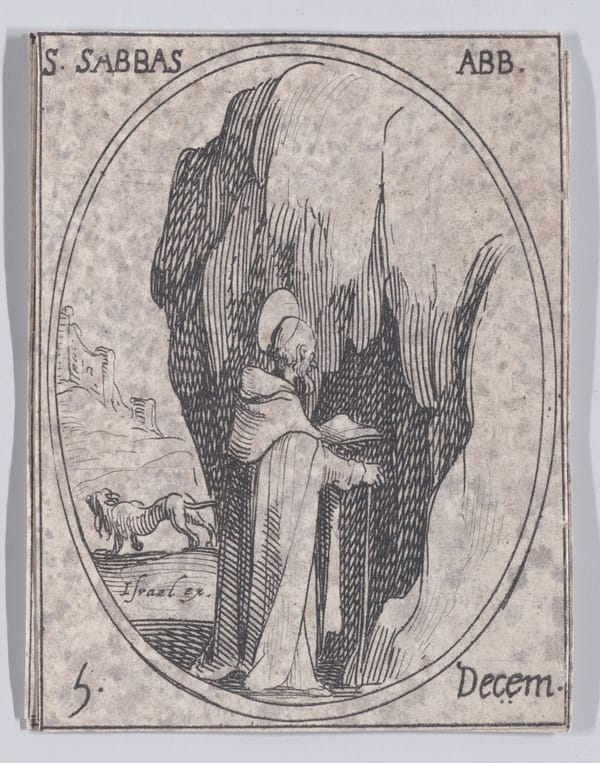
The Roman Church confines herself to-day to the Office of the feria: but to that she joins a commemoration of St. Sabas, abbot of the celebrated laura of Palestine which still exists under his name. This saint, who died in 533, is the only one of the monastic Order of whom the Church makes any mention in her liturgy during the whole period of Advent; we might even say that he is the only simple confessor whose name occurs in the calendar of this part of the year: for, as regards St. Francis Xavier, the glorious title of apostle of the Indies puts him in a distinct class of saints. Here, again, we should recognize divine Providence, which has selected for these days of preparation for Christmas, those saints whose characteristic virtues would make them our fittest models in this work of preparation. We have the feasts of apostles, pontiffs, doctors, virgins: Jesus, the Man-God, the King and Spouse of men, is preceded by this magnificent procession of the noblest of His servants: simple confession has but a single representative, the anchoret and cenobite Sabas, who, by his profession of the monastic life, is of that family of holy solitaries, which began with the prophet Elias under the old Testament, and continued up to the time of St. John the Precursor, who was one of its members, and will continue on, during the new Covenant, until the last coming of Jesus. Let us, then, honour this holy abbot, towards whom the Greek Church professes a filial veneration, and under whose invocation Rome has consecrated one of her churches. Let us beg his prayers by this Collect of the holy liturgy.
Collect
O Sabas, thou man of desires! in thy expectation of that Lord, who has bidden His servants watch until He come, thou didst withdraw into the desert, fearing lest the turmoil of this world might distract thy mind from its God. Have pity on us who are living in the world, and are so occupied in the affairs of that world, and yet who have received the commandment, which thou didst so take to heart, of keeping ourselves in readiness for the coming of our Saviour and our Judge. Pray for us, that when He comes we may be worthy to go out to meet Him. Kemember also the monastic state, of which thou art one of the brightest ornaments; raise it up again from its ruins; let its children be men of prayer and faith, as of old; let thy spirit be among them, and the Church thus regain, by thy intercession, all the glory which is reflected on her from the sublime perfection of this holy state.
Let us look again at the prophecy of Jacob. The holy patriarch not only foretells that the Messias will be the Expectation of nations; he adds that, when this promised Deliverer comes, the sceptre will have been taken away from Juda.1 This oracle is now fulfilled. The flag of Cæsar Augustus floats on the ramparts of Jerusalem. The temple is still untouched; the abomination of desolation stands not yet in the holy place; sacrifices are there still offered up to God; but then, the true temple of God, the Incarnate Word, has not yet been built; the Synagogue has not denied Him, who was her expectation; the Victim, that was to supersede all others, has not been immolated. Yet, Juda has no chief of her own race; Cæsar’s coin is current throughout all Palestine; and the day is not far off when the leaders of the Jewish people will own, in the presence of the Roman governor, that they have not the power to put any man to death.2 So that there is now no king upon the throne of David and Solomon, that throne which was to abide for ever. O Jesus! Son of David, and King of peace, now is the time when Thou must show Thyself and take possession of the sceptre which has been taken in battle from the hand of Juda, and put, for a time, into that of an emperor. Come! for Thou art King, and the psalmist, Thy ancestor, thus sang of Thee: 'Gird Thy sword upon Thy thigh, O Thou Most Mighty! With Thy comeliness and Thy beauty set out, proceed prosperously, and reign, because of truth and meekness and justice, and Thy right hand shall conduct Thee wonderfully. Thy arrows are sharp: under Thee shall people fall: Thy arrows shall go into the hearts of the King’s enemies. Thy throne is for ever and ever; the sceptre of Thy kingdom is a sceptre of uprightness. . . . God, Thy God, hath anointed Thee, O Christ! who takest thence Thy name, with the oil of gladness above Thy fellows, who have been honoured with the name of king.’3 When Thou hast come, O Messias! men will be no more as sheep going astray without a shepherd; there will be but one fold, in which Thou wilt reign by love and justice, for all power will be given unto Thee in heaven and on earth. When, in the hour of Thy Passion, Thy enemies shall ask Thee: ‘Art Thou King?’ Thou wilt answer them in all truth: ‘Verily, I am.’4 Come, dearest King, and reign over our hearts; come, and reign over this world, which is Thine because Thou didst create it, and will soon be Thine because Thou wilt have redeemed it. Reign, then, over this world, and delay not the manifestation of Thy royal power until the day of which it is written: 'He will break kings in the day of His wrath’;5 reign from this very hour, and let all people fall at Thy feet and adore Thee in one grand homage of love and obedience.
Sequence for the Time of Advent
(Composed in the eleventh century, and taken from the ancient Roman-French missals)
| Previous December 4 (the Same Day): Saint Barbara, Virgin and Martyr | Next December 5: St. Sabas, Abbot |