Daily reading
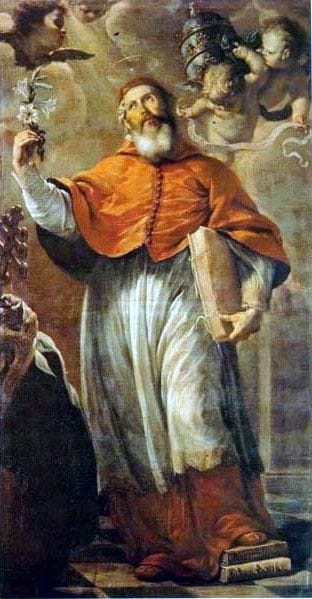
December 11: Saint Damasus, Pope and Confessor
This great Pontiff comes before us in the liturgical year, not to bring us tidings of peace as St. Melchiades did, but as one of the most illustrious defenders of the great mystery of the Incarnation. He defends the faith of the universal Church in the divinity of the Word, by condemning, as his predecessor Liberius had done, the acts and the authors of the celebrated Council of Rimini. With his sovereign authority, he bore witness to the teaching of the Church regarding the Humanity of Jesus Christ, and condemned the heretic Apollinaris, who taught that Jesus Christ had assumed only the flesh and not the soul of man. He commissioned St. Jerome to make a new translation of the new Testament from the Greek, for the use of the Church of Rome; here, again, giving a further proof of the faith and love which he bore to the Incarnate Word. Let us honour this great Pontiff, whom the Council of Chalcedon calls ‘the ornament and support of Rome by his piety.’ St. Jerome, too, who looked upon St. Damasus as his friend and patron, calls him ‘a man of the greatest worth; a man whose equal could not be found, well versed in the holy Scriptures, and a virgin doctor of the virgin Church.’ The legend of the breviary gives us a brief account of his life.
Prose
(Taken from the Cluny missal of 1523)
Holy Pontiff Damasus! during thy life on earth, thou wast the light, which guided the children of the Church; for thou didst teach them the mystery of the Incarnation, and didst guard them against those perfidious doctrines, wherewith hell ever strives to corrupt that glorious symbol of our faith, which tells us of God’s infinite mercy towards us, and of the sublime dignity of man thus mercifully redeemed. Seated on the Chair of Peter, thou didst confirm thy brethren, and thy faith failed not; for Jesus had prayed to His Father for thee. We rejoice at the infinite recompense with which this divine Prince of pastors has rewarded the unsullied purity of thy faith, O thou ‘virgin doctor of the virgin Church!’ Oh that we could have a ray of that light which now enables thee to see Jesus in His glory! Pray for us, that we may have light to see Him, and know Him, and love Him, under the humble guise in which He is so soon to appear to us. Obtain for us the science of the sacred Scriptures, in which thou wast so great a master; and docility to the teachings of the Bishop of Rome, to whom, in the person of St. Peter, Christ has said: ‘Launch out into the deep!’*
Obtain also for all Christians, O thou the successor of this prince of the apostles, that they be animated with those sentiments, which St. Jerome thus describes in one of his letters addressed to thee: ‘It is the Chair of Peter that I will consult, for from it do I derive that faith which is the food of my soul. I will search for this precious pearl, heeding not the vast expanse of sea and land which I must pass over. Where the body is, there shall the eagles be gathered together. It is now in the west that the Sun of justice rises. I ask the Victim of salvation from the priest, and from the shepherd the protection of the sheep. On that rock I know the Church is built. He that eats the Lamb in any house but this, is profane. He that is not in Noah’s ark, shall perish in the waters of the deluge. I know not Vitalis, I reject Meletius, I pass by Paulinus. He that gathers not with thee, Damasus, scatters; for he that is not of Christ, is of Antichrist.’
Let us contemplate our divine Saviour in the womb of His most holy Mother Mary. Let us, together with the holy angels, adore Him in this state of profound humiliation, to which His love for us has brought Him. See Him there offering Himself to His Father for the redemption of mankind, and commencing at once to fulfil the office of our Mediator, which He has taken upon Himself. What an excess of love is this of our Jesus, that He is not satisfied with having humbled Himself in assuming our nature,though that alone would have sufficed to redeem a million worlds! The eternal Son of God wills to remain, as other children, nine months in His Mother’s womb: after that, to be born in poverty, to live a life of labour and suffering, and to be obedient to death, even to the death of the cross. O Jesus! mayst Thou be praised and loved by all creatures for this Thy immense love of us! Thou hast come down from heaven the Victim that art to take the place of all those which were hitherto offered, but which could not efface man’s sin. At length, the earth possesses its Saviour, though as yet unseen. God will not curse the earth, which, though covered with crime, is rich in such a treasure as this. Still repose, O Jesus, in the chaste womb of Mary, that living ark which contains the true manna sent for the food of man. But the time is approaching for Thee to leave this loved sanctuary. The tender love which Thou hast received from Mary, must be changed for the malice wherewith men will treat Thee; yet it must needs be that Thou be born on the day which Thou Thyself hast decreed: it is the will of Thy eternal Father, it is the expectation of the world, it is the salvation of all who shall love Thee.
Prose in Honor of the Blessed Virgin
(Taken from the Cluny missal of 1523)
Prayer for the Time of Advent
(The Mozarabic breviary, Monday of the first week of Advent)
* St. Luke v. 4. ↩︎
Tuesday of the Second Week of Advent
Cap. xiv.Prope est ut veniat tempus ejus, et dies ejus non elongabuntur. Miserebitur enim Dominus Jacob, et eliget adhuc de Israel, et requiescere eos faciet super humum suam: adjungetur advena ad eos, et adhærebit domui Jacob. Et tenebunt eos populi, et adducent eos in locum suum: et possidebit eos domus Israel super terram Domini in servos et ancillas: et erunt capientes eos qui se ceperant, et subjicient exactores suos. Et erit in die illa, cum requiem dederit tibi Deus a labore tuo et a concussione tua, et a servitute dura, qua ante servisti: sumes parabolam istam contra regem Babylonis, et dices: Quomodo cessavit exactor, quievit tributum? Contrivit Dominus baculum impiorum, virgam dominantium, cædentem populos in indignatione, plaga insanabili, subjicientem in furore Gentes, persequentem crudeliter. Quomodo cecidisti de cœlo, Lucifer, qui mane oriebaris? corruisti in terrain, qui vulnerabas gentes: qui dicebas in corde tuo: In cœlum conscendam; super astra Dei exaltabo solium meum, sedebo in monte testamenti, in lateribus aquilonis: ascendam super altitudinem nubium, similis ero Altissimo. Verumtamen ad infernum detraheris in profundum laci.
Ch. xiv.Her time is near at hand, and her days shall not bo prolonged. For the Lord will have mercy on Jacob, and will yet choose out of Israel, and will make them rest upon their own ground: and the stranger shall bo joined with them, and shall adhere to the house of Jacob. And the peoplo shall take them, and bring them into their place: and the house of Israel shall possess them in the land of the Lord for servants and handmaids: and they shall make them captives that had taken them, and shall subdue their oppressors. And it shall come to pass in that day, that when God shall give thee rest from thy labour, and from thy vexation, and from the hard bondage, wherewith thou didst serve before, thou shalt take up this parable against the king of Babylon, and shalt say: How is the oppressor come to nothing? the tribute hath ceased? The Lord hath broken the staff of the wicked, the rod of the rulers, that struck the people in wrath with an incurable wound, that brought nations under in fury, that persecuted in a cruel manner. How art thou fallen from heaven, O Lucifer, who didst rise in the morning? how art thou fallen to the earth, that didst wound the nations? And thou saidst in thy heart: I will ascend into heaven, I will exalt my throne above the stars of God, I will sit in the mountain of the covenant, in the sides of the north: I will ascend above the height of the clouds, I will be like the Most High. But yet thou shalt be brought down to hell, into the depth of the pit.
Thy ruin, O Lucifer, is irreparable! Thou refusedst to humble thyself before God, and thou wast cast into hell. Thy pride then sought a compensation for this thy deep humiliation, and thou causedst the ruin of the human race, out of hatred for God and His creatures. Thou didst succeed in inspiring him, who was formed out of dust, with that same pride which had caused thine own destruction. By thee sin came into this world, and by sin death: the human race seemed now a victim which never could escape thy vengeance. Forced to give up thy hopes of a heavenly royalty, thou aimedst at reigning in hell and destroying the creatures of God as they came from His creating love. But again thou art foiled and conquered. Thy reign was in pride; pride alone could form thy court and give thee subjects; now, see how the sovereign Lord of all things uproots thy kingdom: He Himself comes to teach His creatures humility; and He teaches it, not by laws given with awful majesty, as once on Sinai, but by Himself meekly practising that heavenly humility, which alone can raise up them that had fallen by pride. Tremble, proud spirit, thy sceptre is to be broken!
In thy haughty wisdom, thou disdainest this humble and lowly Virgin of Nazareth, who holds within herself, in adoring silence, the mystery of thy ruin and our salvation. The Child whom she carries in her womb, and who is so soon to be born, has long since been the object of thy contempt. Know, then, that God does not disdain this unborn Child, for this Child is also God! And a single act of adoration and devotedness to His Father, which He is making in the womb of Mary, gives more glory to the Divinity than all thy pride could rob it of, even were thy pride to increase for eternity. Henceforth, men, taught by the lessons of a God the immense power of humility, will have recourse to it as their great remedy. Instead of exalting themselves, as thou didst, by a mad and guilty pride, they will humble themselves with love and pleasure: the lower they humble themselves, the higher will God raise them: the poorer they own themselves, the richer will He make them. It is the glorious Virgin that tells us this in her exquisite canticle. May she be ever blessed, Mother so gentle and sweet to her children, and so terrible to thee, Lucifer! that writhest beneath her as she crushes and conquers thee.
Prose for the Time of Advent
(Composed in the eleventh century, and taken from the ancient Roman-French missals)
Prayer from the Gallican Sacramentary
(Mass for Christmas Eve)
| Previous Monday of the Second Week of Advent | Next Tuesday of the Second Week of Advent |