Daily reading
December 12 · Sanctoral
December 12, 2029
From Dom Guéranger’s The Liturgical Year.
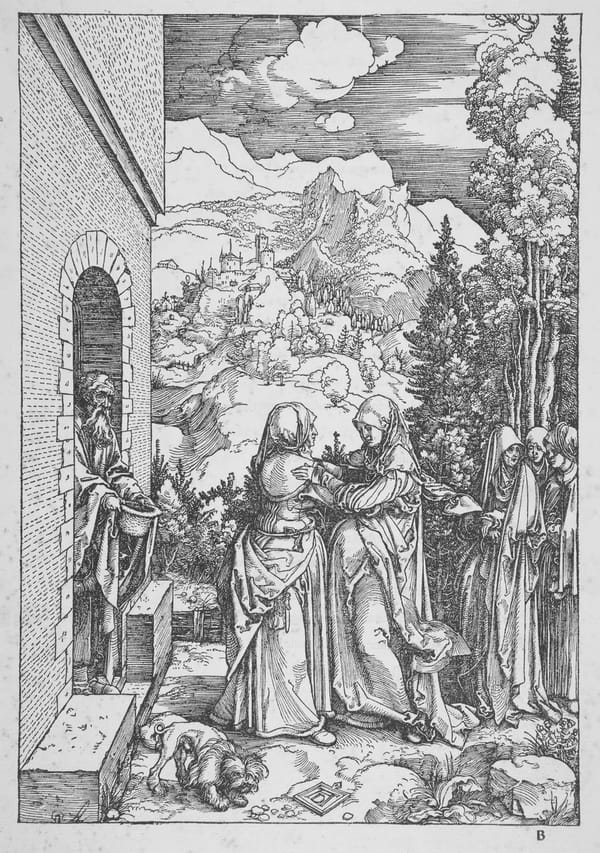
December 12: The Fifth Day within the Octave of the Immaculate Conception
Let us contemplate the sentiments of profound respect and maternal tenderness, which fill the soul of our blessed Lady, now that she has conceived Jesus in her chaste womb: He is her God, and yet He is her Son. Let us think upon this wonderful dignity bestowed upon a creature; and let us honour the Mother of our God. It is by this mystery that the prophecy of Isaias was fulfilled: ‘Behold, a Virgin shall conceive and bear a Son;’1 and that of Jeremias: ‘The Lord hath created a new thing upon the earth; a woman shall compass a Man.’2 The Gentiles themselves had received the tradition of these prophecies. Thus in the old pagan Carnutum (Chartres), there was an altar dedicated ‘To the Virgin that was to bring forth a Son and that of Jeremias: 'The Lord hath created a new thing upon the earth; a woman shall compass a Man.' 11 The Gentiles them- selves had received the tradition of these prophecies. Thus in the old pagan Oarnutum (Chartres), there was an altar dedicated ' To the Virgin that was to bring forth a Son and that of Jeremias: 'The Lord hath created a new thing upon the earth; a woman shall compass a Man.' 11 The Gentiles them- selves had received the tradition of these prophecies. Thus in the old pagan Oarnutum (Chartres), there was an altar dedicated ' To the Virgin that was to bring forth a Son (Virgini Parituræ)’; and whilst modern rationalism, with its ignorant scepticism, was affecting to throw a doubt on this fact of history, the researches of science were discovering that Carnutum was far from being the only city of the west which had such an altar.
But what human language could express the dignity of our Lady, who carries within her chaste womb Him that is the world’s salvation! If Moses, after a mere colloquy with God, returned to the Israelites with the rays of the majesty of Jehovah encircling his head, what an aureola of glory is due to Mary, who has within her, as in a living heaven, that very God Himself! The divine Wisdom tempers the effulgence of her glory that it be not visible to men; and this in order that the state of humility, which the Son of God has chosen as the one in which He would manifest Himself to the world, should not be removed at the very outset by the dazzling glory which would, otherwise, have been seen gleaming from His Mother.
The sentiments which filled the heart of Mary during these months of her ineffable union with the divine Word, may be thus expressed in the words of the bride in the sacred Canticle: ‘I sat under the shadow of Him whom I desired; and His fruit was sweet to my palate. I sleep, but my heart watches. My soul melted when He spoke. I to my Beloved and my Beloved to me, who feedeth among the lilies, till the day break, and the shadows retire.’3 And if there ever were a human heart, that was forced, by the overpowering vehemence of its love of God, to use these other words of the same Canticle, it was Mary’s: ‘O daughters of Jerusalem! stay me up with flowers, compass me about with fragrant fruits; for I languish with love.’4 ‘These sweet words,’ says the venerable Peter of Celles, ‘are those of the bride that dwelleth in the gardens, and is now near the time of her delivery. What so lovely in creation as this Virgin, who loves the Lord with such matchless love and is so exceedingly loved by this her Lord? It is she of whom the Scripture speaks, when it calls the bride the dearest hind. What, too, so lovely as that well-beloved Son of God, born of His beloved Father from all eternity, and now, at the end of time, as the apostle speaks, formed in the womb of His dearest Mother, and become to her, in the words of the same divine proverb, the sweetest fawn? Let us, therefore, cull our flowers, and offer them to both Child and Mother. But let me briefly tell you what are the flowers you must offer to our Lady. Christ says, speaking of His Humanity, “I am the flower of the field, and the lily of the valleys.” By Him, therefore, let us purify our souls and bodies, and so be able to approach our God in chastity. Next, preserve this flower of purity from all that would injure it; for flowers are tender things, and soon droop and fade. Let us wash our hands among the innocent, and, with a pure heart, and pure body, and cleansed lips, and chaste soul, let us gather in the paradise of our heavenly Father our fresh flowers for the new Nativity of our new King. With these flowers let us stay up this most saintly Mother, this Virgin of virgins, this Queen of queens, this Lady of ladies; that so we may deserve to receive the blessing of the Mother and of the divine Babe.’5
Virgo Mater gloriosa,
Mater Regis gloriæ.
Ave, fulgens margarita
Per quam venit mundi vita,
Christus sol justitiæ.
O oliva fructifera,
Tu pietatis viscera
Nulli claudis hominum.
Nos exsules laetificas,
Ut vitis, dum fructificas
Salvatorem Dominum.
Ave, Virgo Mater Dei,
Tu superni sol diei,
Et mundi noctis luna.
Succurre nobis miseris,
Mortalium spes unica.
Ave, decus virginale,
Templum Dei speciale! Per te fiat veniale
Omne quod committimus.
Tu nobis es singularis;
Tu nos ducas, stella maris;
Tu nos semper tuearis:
En ad te confugimus.
Ad te, pia, suspiramus,
Si non ducis, deviamus;
Ergo doce quid agamus;
Post hunc finem ut vivamus
Cum sanctis perenniter.
Jesu Christe, Fili Dei,
Tota salus nostræ spei;
Tuæ matris interventu,
Angelorum nos conventu
Fac gaudere jugiter.
glorious Virgin-Mother
of the King of glory!
Hail, fair pearl!
by whom came the life of the world,
Christ the Sun of justice.
O fruitful olive!
thou excludest no mortal
from thy tender compassion.
Thou givest gladness to us exiles,
for, like a fruitful vine,
thou yieldest thy fruit, Jesus our Lord.
Hail, Virgin Mother of God!
thou art the sun of the heavenly day!
thou art the moon of the world’s night!
Tenderest of Mothers!
help us poor mortals,
for God wills us to hope in thee above all creatures.
Hail, O purest Virgin!
God’s special temple! pray for us to him,
that he would forgive us all our sins.
Thou art unto us what no other creature is.
Guide us, O star of the sea!
Defend us always and in all places.
We fly to thee in our necessities.
Tender Mother! we pray thee guide us,
or we go astray.
Tell us what would thy Jesus have us do?
that so, after this life is ended,
we may live for ever with the saints.
O Jesus! Son of God,
our only Saviour, in whom rests all our hope!
grant by the intercession of thy Mother,
that we may be united
to the angels in eternal joy.
A Prayer for the Time of Advent
(The Mozarabic breviary, first Sunday of Advent)
Wednesday of the Second Week of Advent
Cap. xvi.Emitte Agnum Domine, dominatorem terræ, de petra deserti ad montem filiæ Sion. Et erit: sicut avis fugiens, et pulli de nido avolantes, sic erunt filiae Moab in transcensu Arnon. Ini consilium, coge concilium, pone quasi noctem umbram tuam in meridie: absconde fugientes, et vagos ne prodas. Habitabunt apud te profugi mei: Moab, esto latibulum eorum a facie vastatoris. Finitus est enim pulvis, consummatus est miser, defecit qui conculcabat terram. Et praeparabitur in misericordia solium, et sedebit super illud in veritate, in tabernaculo David, judicans et quaerens judicium, et velociter reddens quod justum est.
Ch. xvi.Send forth, O Lord, the Lamb, the ruler of the earth, from Petra of the desert to the mount of the daughter of Sion. And it shall come to pass, that as a bird fleeing away, and as young ones flying out of the nest, so shall the daughters of Moab be in the passage of Arnon. Take counsel, gather a council, make thy shadow as the night in the midday: hide them that flee, and betray not them that wander about. My fugitives shall dwell with thee: O Moab, be thou a covert to them from the face of the destroyer. For the dust is at an end, the wretch is consumed, he hath failed that trod the earth under foot. And a throne shall be prepared in mercy, and one shall sit upon it in truth in the tabernacle of David, judging and seeking judgement, and quickly rendering that which is just.
Send forth to us, O Lord, the Lamb: 'It is the Lamb,’ says Peter of Celles,' it is the Lamb we need, and not the Lion; the Lamb that knows no anger, and whose meekness is never ruffled; the Lamb that will give us His snow-white wool to warm our coldness, and cover our nakedness; the Lamb that will give us His flesh to eat, lest we faint with hunger on the way. Send Him full of wisdom, for in His divine prudence He will vanquish the spirit of pride; send full of strength, for it is written that the Lord is strong and mighty in battle; send Him full of meekness, for He is to come down as dew that falls on the fleece; send Him as a victim, for He is to be sold and immolated for our ransom; send Him the pardoner of sinners, for He is to come to call them, and not the just; send Him to receive power and divinity, for He is worthy to loose the seven seals of the sealed book, the unspeakable mystery of the Incarnation.’* Thou art King, then, O divine Lamb! Thou art even now, in thy Mother’s womb, the sovereign Ruler. This virginal womb is a throne of mercy whereon Thou art seated in humility, ready to avenge our rights and confound our cruel enemy. O most dear King! our eyes cannot yet behold Thee, but our hearts tell us Thou art near us. We know that it is for our sake that Thou hast put on this strange royalty. Suffer us to approach Thee, and offer Thee our homage and loyalty, even now that a cloud hides Thee from our sight. . A few days more, and Thou wilt be seated on another throne, Thy Mother’s arms, and then all the earth will see the salvation that is sent unto it.
Hymn taken from the Anthology of the Greeks
(December 20)
Prayer from the Mozarabic Missal
(Second Sunday of Advent)
* Third Sermon for Advent. ↩︎
| Previous Tuesday of the Second Week of Advent | Next Wednesday of the Second Week of Advent |