Daily reading
Advent
Semidouble · Movable from Advent · Temporal
December 16, 2029
From Dom Guéranger’s The Liturgical Year.

|
The Third Sunday of Advent
To-day, again, the Church is full of joy, and the joy is greater than it was. It is true that her Lord has not come; but she feels that He is nearer than before, and therefore she thinks it just to lessen somewhat the austerity of this penitential season by the innocent cheerfulness of her sacred rites. And first, this Sunday has had the name of Gaudete given to it, from the first word of the Introit; it also is honoured with those impressive exceptions which belong to the fourth Sunday of Lent, called Lœtare. The organ is played at the Mass; the vestments are rose-colour; the deacon resumes the dalmatic, and the subdeacon the tunic; and in cathedral churches the bishop assists with the precious mitre. How touching are all these usages, and how admirable this condescension of the Church, wherewith she so beautifully blends together the unalterable strictness of the dogmas of faith and the graceful poetry of the formulæ of her liturgy! Let us enter into her spirit, and be glad on this third Sunday of her Advent, because our Lord is now so near unto us. To-morrow we will resume our attitude of servants mourning for the absence of their Lord and waiting for Him; for every delay, however short, is painful and makes love sad.
The Station is kept in the basilica of St. Peter, at the Vatican. This august temple, which contains the tomb of the prince of the apostles, is the home and refuge of all the faithful of the world; it is but natural that it should be chosen to witness both the joy and the sadness of the Church.
The night Office commences with a new Invitatory. The voice of the Church no longer invites the faithful to come and adore in fear and trembling the King, our Lord„ who is to come. Her language assumes another character; her tone is one of gladness; and now, every day, until the vigil of Christmas, she begins her nocturns with these grand words:
Now let us take the book of the Prophet, and read with the Church:
Cap. xxvi.In die illa cantabitur canticum istud in terra Juda: Urbs fortitudinis nostræ Sion; Salvator ponetur in ea murus et antemurale. Aperite portas, et ingrediatur gens justa, custodiens veritatem. Vetus error abiit, servabis pacem; pacem, quia in te speravimus. Sperastis in Domino in saeculis æternis: in Domino Deo forti in perpetuum. Quia incurvabit habitantes in excelso, civitatem sublimem humiliabit. Humiliabit eam usque ad terram, detrahet eam usque ad pulverem. Conculcabit eam pes; pedes pauperis, gressus egenorum. Semita justi recta est, rectus callis justi ad ambulandum. Et in semita judiciorum tuorum, Domine, sustinuimus te: nomen tuum, et memoriale tuum in desiderio animæ. Anima mea desideravit te in nocte: sed et spiritu meo in præcordiis meis, de mane vigilabo ad te.
Ch. xxvi.In that day shall this canticle be sung in the land of Juda. Sion the city of our strength: a Saviour, a wall, and a bulwark shall be set therein. Open ye the gates and lot the just nation, that keepeth the truth, enter in. The old error is passed away, thou wilt keep peace: peace, because we have hoped in thee. You have hoped in the Lord for evermore: in the Lord God mighty for ever. For he shall bring down them that dwell on high, the high city he shall lay low. He shall bring it down even to the ground, he shall pull it down even to the dust. The foot shall tread it down; the feet of the poor, the steps of the needy. The way of the just is right, the path of the just is right to walk in. And in the way of thy judgements, O Lord, we have patiently waited for thee: thy name and thy remembrance are the desire of the soul. My soul hath desired thee in the night: yea, and with my spirit within me in the morning early I will watch to thee.
O holy Roman Church, city of our strength! behold us thy children assembled within thy walls, around the tomb of the fisherman, the prince of the apostles, whose sacred relics protect thee from their earthly shrine, and whose unchanging teaching enlightens thee from heaven. Yet, O city of strength: it is by the Saviour, who is coming, that thou art strong. He is thy wall, for it is He that encircles, with His tender mercy, all thy children; He is thy bulwark, for it is by Him that thou art invincible, and that all the powers of hell are powerless to prevail against thee. Open wide thy gates, that all nations may enter thee; for thou art mistress of holiness and the guardian of truth. May the old error, which sets itself against the faith, soon disappear, and peace reign over the whole fold! O holy Roman Church! thou hast for ever put thy trust in the Lord; and He, faithful to His promise, has humbled before thee the haughty ones that defied thee, and the proud cities that were against thee. Where now are the Cæsars, who boasted that they had drowned thee in thine own blood? where the emperors, who would ravish the inviolate virginity of thy faith? where the heretics, who, during the past centuries of thine existence, have assailed every article of thy teaching, and denied what they listed? where the ungrateful princes, who would fain make a slave of thee, who hadst made them what they were? where that empire of Mahomet, which has so many times raged against thee, for that thou, the defenceless State, didst arrest the pride of its conquests? where the reformers, who were bent on giving the world a Christianity, in which thou wast to have no part? where the more modern sophists, in whose philosophy thou wast set down as a system that had been tried, and was a failure, and is now a ruin? and those kings who are acting the tyrant over thee, and those people that will have liberty independently and at the risk of truth, where will they be in another hundred years? Gone and forgotten as the noisy anger of a torrent; whilst thou, O holy Church of Rome, built on the immovable rock, wilt be as calm, as young, as unwrinkled as ever. Thy path through all the ages of this world’s duration, will be right as that of the just man; thou wilt ever be the same unchanging Church, as thou hast been during the eighteen hundred years past, whilst everything else under the sun has been but change. Whence this thy stability, but from Him who is very truth and justice? Glory be to Him in thee! Each year, He visits thee; each year, He brings thee new gifts, wherewith thou mayst go happily through thy pilgrimage; and to the end of time, He will visit thee, and renew thee, not only with the power of that look wherewith Peter was renewed, but by filling thee with Himself, as He did the ever glorious Virgin, who is the object of thy most tender love, after that which thou bearest to Jesus Himself. We pray with thee, O Church, our mother, and here is our prayer: ‘Come, Lord Jesus! Thy name and Thy remembrance are the desire of our souls: they have desired Thee in the night, yea, and early in the morning have they watched for Thee.’
The Mass
The assembly of the faithful is attentive; the cantors intone the Gregorian melody, and the church echoes with these sweet words:
The Introit
Ps. O Lord thou hast blessed thy land: thou hast turned away the captivity of Jacob. ℣. Glory.
In the Collect, the Church asks for the grace of that divine visit, which dispels darkness and brings light. Darkness produces fear in the soul; whereas, light gives courage and joy to the heart.
Collect
The other Collects of the blessed Virgin, against the persecutors of the Church, and for the Pope, are the same as on the first Sunday in Advent, page 128.
Epistle
Cap. iv.Fratres, gaudete in Domino semper: iterum dico, gaudete. Modestia vestra nota sit omnibus hominibus: Dominus prope est. Nihil solliciti sitis; sed in omni oratione, et obsecratione, cum gratiarum actione, petitiones vestræ innotescant apud Deum. Et pax Dei, quae exsuperat omnem sensum, custodiat corda vestra, et intelligentias vestras, in Christo Jesu Domino nostro.
Ch. iv.Brethren, rejoice in the Lord always: again I say, rejoice. Let your modesty be known to all men: the Lord is nigh. Be nothing solicitous: but in everything, by prayer and supplication with thanksgiving, let your petitions be made known to God. And the peace of God, which surpasseth all understanding, keep your hearts and minds in Christ Jesus our Lord.
Nothing is more just than that we rejoice in the Lord. Both the prophet and the apostle excite us to desire the Saviour, both of them promise us peace. Therefore, let us not be solicitous: the Lord is nigh; nigh to His Church, and nigh to each of our souls. Who can be near so burning a fire, and yet be cold? Do we not feel that He is coming to us, in spite of all obstacles? He will let nothing be a barrier between Himself and us, neither His own infinite high majesty, nor our exceeding lowliness, nor our many sins. Yet a little while, and He will be with us. Let us go out to meet Him by these prayers and supplications, and thanksgiving which the apostle recommends to us. Let our zeal to unite ourselves with our holy mother the Church become more than ever fervent: now every day her prayers will increase in intense earnestness, and her longings after Him, who is her light and her love, will grow more ardent. First let us say together with her:
Gradual
Qui sedes, Domine, super Cherubim, excita potentiam tuam et veni.℣. Qui regis Israel, intende: Qui deducis velut ovem Joseph.Alleluia, alleluia.℣. Excita Domine potentiam tuam, et veni, ut salvos facias nos. Alleluia.
O Lord, who sittest on the Cherubim, exert thy power and come.℣. Thou who rulest Israel, hearken. Thou who leadest Joseph as a sheep.Alleluia, alleluia.℣. Exert, O Lord, thy power, and come to save us. Alleluia.
Gospel
Cap. i.In illo tempore: Miserunt Judæi ab Jerosolymis sacerdotes et levitas ad Joannem ut interrogarent eum: Tu quis es? Et confessus est, et non negavit, et confessus est: Quia non sum ego Christus. Et interrogaverunt eum: Quid ergo? Elias es tu? Et dixit: Non sum. Propheta es tu? Et respondit: Non. Dixerunt ergo ei: Quis es, ut responsum domus his qui miserunt nos? Quid dicis de te ipso? Ait: Ego vox clamantis in deserto: Dirigite viam Domini, sicut dixit Isaias propheta. Et qui missi fuerant erant ex Pharisæis. Et interrogaverunt eum, et dixerunt ei: Quid ergo baptizas, si tu non es Christus, neque Elias, neque propheta? Respondit eis Joannes, dicens: Ego baptizo in aqua: medius autem vestrum stetit, quem vos nescitis. Ipse est, qui post me venturus est, qui ante me factus est: cujus ego non sum dignus ut solvam ejus corrigiam calceamenti. Hæc in Bethania facta sunt trans Jordanem, ubi erat Joannes baptizans
Ch. i.At that time: the Jews sent from Jerusalem priests and levites to John, to ask him: Who art thou? And he confessed, and did not deny, and he confessed: I am not the Christ. And they asked him: What then? Art thou Elias? And he said: I am not. Art thou a prophet? And he answered: No. They said therefore unto him: Who art thou, that we may give an answer to them that sent us? What sayest thou of thyself? Ho said: I am the voice of one crying in the wilderness: Make straight the way of the Lord, as said the prophet Isaias. And they that were sent were of the Pharisees. And they asked him and said to him: Why then dost thou baptize, if thou be not Christ, nor Elias, nor a prophet? John answered them saying: I baptize with water; but there hath stood one in the midst of you, whom you know not. The same is he that shall come after me, who is preferred before me: the latchet of whose shoe I am not worthy to loose. These things were done in Bethania, beyond the Jordan, where John was baptizing.
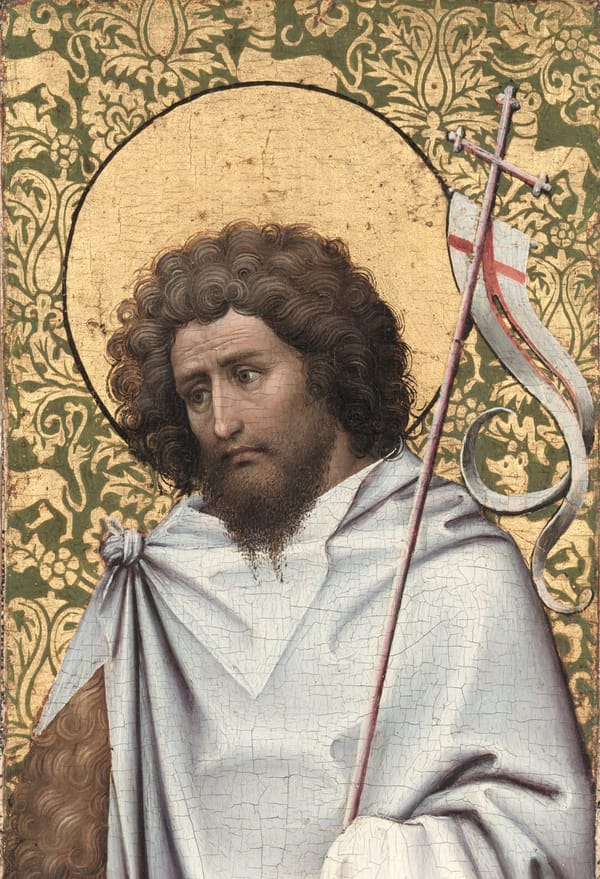
There hath stood One in the midst of you, whom you know not, says Saint John the Baptist to them that were sent by the Jews. So that our Lord may be near, He may even have come, and yet by some be not known! This Lamb of God is the holy Precursor’s consolation: he considers it a singular privilege to be but the voice, which cries out to men to prepare the way of the Redeemer. In this, St. John is the type of the Church, and of all such as seek Jesus. St. John is full of joy because the Saviour has come: but the men around him are as indifferent as though they neither expected nor wanted a Saviour. This is the third week of Advent; and are all hearts excited by the great tidings told them by the Church, that the Messias is near at hand? They that love Him not as their Saviour, do they fear Him as their Judge? Are the crooked ways being made straight, and the hills being brought low? Are Christians seriously engaged in removing from their hearts the love of riches and the love of sensual pleasures? There is no time to lose: the Lord is nigh! If these lines should come under the eye of any of those Christians who are in this state of sinful indifference, we would conjure them to shake off their lethargy, and render themselves worthy of the visit of the divine Infant: such a visit will bring them the greatest consolation here, and give them confidence hereafter, when our Lord will come to judge all mankind. Send Thy grace, O Jesus, still more plentifully into their hearts; 'compel them to go in,’ and permit not that it be said of the children of the Church, as St. John said of the Synagogue: There standeth in the midst of you One, whom you know not.
During the Offertory the faithful should unite in the prayer of the Church, and beg that the captivity in which our sins hold us may be brought to an end, and that the divine Deliverer may come.
Offertory
Secret
The other Secrets are given on page 132.
During the Communion, the Church chants the words of the prophet Isaias, which bid the heart of the sinner take courage. Fear not, Christian people! He that is coming is God; but He comes to save His creatures, and to give Himself to them.
Communion
The Church asks of God, in the following prayer, that the secret visit which she has just been receiving from her divine Spouse, may fit her for that solemn one which she is preparing to receive at the feast of Christmas.
Postcommunion
The other Postcommunions as on the first Sunday, page 134.
Vespers
Listen: recording
Capitulum
Phil. iv. 4.
The hymn Creator alme siderum, and the canticle Magnificat, are given on pages 107 and 109.
Antiphon of the Magnificat
But if the third Sunday of Advent fall on December 17, then, instead of the above, is said the first of the Great Antiphons (O Sapientia), which will be found, with the other six, in the proper of saints, from December 17 to 23 (page 484).
Prayer
December 16: Saint Eusebius, Bishop of Vercelli and Martyr
When asked to tell the names of the saints who were foremost in defending the dogma of the Incarnation, we think at once of the intrepid Eusebius of Vercelli, as one of the glorious number. The Catholic faith, which was so violently attacked in the fourth century by the Arian heresy, was maintained at that time by the labours and zeal of four sovereign Pontiffs: Sylvester, who confirmed the decrees of the Council of Nicæa: Julius, the supporter of St. Athanasius; Liberius, whose faith failed not, and who, when restored to his liberty, confounded the Arians; and lastly, Damasus, who destroyed the last hopes of the heretics. One of these four Pontiffs appears on our Advent calendar—Damasus, whose feast we kept but a few days since. The four Popes have for their fellow-combatants, in this battle for the Divinity of the Incarnate Word, four great bishops, of whom it may be said that the defence of the dogma of the Consubstantiality of the Son of God was what they lived for, and that to say anathema to them was to say anathema to Christ Himself; all four most powerful in word and work, lights of the Churches of the world, objects of the people’s love, and the dauntless witnesses of Jesus. The first and greatest of the four is the bishop of the second See of Christendom, St. Athanasius, the Patriarch of Alexandria: the second is St. Ambrose of Milan, whose feast we kept on the seventh of this month; the third is the glory of Gaul, St. Hilary, bishop of Poitiers; the fourth is the ornament of Italy, St. Eusebius, bishop of Vercelli, whom we have to honour to-day. Hilary will come to us during Christmastide, and will stand at the crib of the Word, whose Divinity he so bravely confesses; Athanasius will meet us at Easter, and help us to celebrate, in the triumphant Resurrection, Him whom he proclaimed as God in those dark times, when human wisdom hoped to destroy, by fifty years of peace, that Church which had survived the storm of three centuries of persecution. St. Eusebius’ place is Advent; and divine Providence has thus chosen him as one of the patrons of the faithful during this mystic season. His powerful prayers will help us to come devoutly to Bethlehem, and see in the Child, that is lying there, the eternal Word of God. So great were the sufferings which St. Eusebius had to undergo for the Divinity of Jesus, that the Church awards him the honours of a martyr, although he did not actually shed his blood. Let us now listen to the admirable account which the Church gives us of his life.
That Council was held the following year, at Milan; Eusebius was invited by Constantius to be present at it, which was what the legates of Liberius had desired and begged. So far was he from being duped by the synagogue of the malicious Arians to side with them against St. Athanasius, that he openly declared from the first that several of those present were known to him to be heretics, and he therefore proposed that they should subscribe to the Nicene Creed before proceeding any further. This the Arians, infuriated with anger, refused to do; whereupon, he not only refused to subscribe to what was drawn up against Athanasius, but he also, by a most ingenious device, succeeded in having the name of St. Denis the martyr blotted out from the decree, which the craft of the Arians had induced him to sign. Wherefore, they being exceedingly angry against Eusebius, loaded him with injuries, and had him sent into banishment. The holy man, on his side, shaking off the dust from his feet, caring little either for the threats of the emperor, or the sword which was held over him, submitted to banishment as to something which belonged to his episcopal office. Being sent to Scythopolis, he there endured hunger, thirst, blows, and sundry other punishments; he generously despised his life for the true faith, feared not death, and gave up his body to the executioners.
Valiant soldier of Jesus, Eusebius, martyr and pontiff, how much labour and suffering thou didst undergo for the Messias! And yet, they seemed to thee to be little in comparison with what is due to this eternal Word of the Father, who, out of His pure love, has made Himself the Servant of His own creatures, by becoming Man for them in the mystery of the Incarnation. We owe the same debt of gratitude to this divine Saviour. He is born in a stable for our sake, as He was for thine; pray, therefore, for us that we may be ever faithful to Him both in war and in peace; and that we may resist our temptations and evil inclinations with that same firmness, wherewith we would confess His name before tyrants and persecutors. Obtain for the bishops of our holy mother the Church such vigilance, that no false doctrines may surprise them, and such courage that no persecution may make them yield. May they be faithful imitators of the divine Pastor, who gives His life for His sheep; and may they ever feed the flock entrusted to them in the unity and charity of Jesus Christ.
Let us consider how our blessed Lady, having returned to Nazareth, is overwhelmed with joy to feel living within her Him, who gives being to every created thing, and whom she loves with all the intensity of the Mother of God. Joseph, the faithful guardian of her virginity, tenderly loves this his spouse, and blesses God for having entrusted such a treasure to his keeping. The angels crowd round this favoured house wherein dwell their sovereign Lord, and she whom He has chosen to be His Mother. Never was there happiness like that which fills this little dwelling; and yet, God has decreed to visit it with a heavy trial, in order that He may give an occasion to Mary to exercise heroic patience, and to Joseph an occasion of meriting by his exquisite prudence. Let us listen to the Meditation of St. Bonaventure, in which he thus ponders the Gospel narrative:
'But while our Lady and Joseph her spouse were thus dwelling together, the Infant Jesus grew within His Mother’s womb. Then Joseph, perceiving that Mary was with Child, was above all measure grieved. Here give, I pray thee, all thine attention, for thou hast many fair things to learn. If thou wouldst know wherefore it was that our Lord wished that His Mother should have a husband, whereas He always wished that she should be a Virgin, I answer thee that He so wished on three accounts: firstly, that she might not be disgraced when it was seen that she was a Mother: secondly, that she might have Joseph’s aid and company; and thirdly, that the birth of the Son of God might be concealed from the devil.
‘Now, Joseph did look many times on Mary, and grief and trouble of heart fell upon him, and his displeasure was seen in his face, and he turned his eyes away from her as one that was guilty of that which he perforce suspected. See how God permits His servants to be afflicted and sorely tried, that they may so receive their crown. Now Joseph was minded to put her away privately. In very truth may it be said of this holy man, that his praise is in the Gospel, for the Gospel says of him that he was a just man, that is, a man of great virtue. For albeit they say that no shame, nor suffering, nor insult can befall a man so grievous as that of his wife’s unfaithfulness; yet did Joseph restrain himself withal, and would not accuse Mary, but bore this great injury patiently. He sought not how to avenge himself, but, overcome with pity, and wishing to forgive, he was minded to put her away privately. But herein also had our Lady her share of tribulation, for she took notice of Joseph’s trouble, and it sorely grieved her. Yet did she humbly hold her peace, and hide the gift of God. Better did it seem unto her that evil should be thought of her than that she should reveal the divine mystery, and say aught of herself which would come nigh to boasting. Therefore did she beseech our Lord that Himself would right this matter, and make pass this grief from Joseph and herself. Here thou mayst learn what great tribulation and anxiety was theirs. But God came unto their assistance.
‘He therefore sent His angel, who spake unto Joseph in his sleep, and told him that his spouse had conceived of the Holy Ghost, and that he was to abide with her in all surety and joy. Whereupon, the tribulation ceased, and they were both exceedingly comforted. So likewise would it befall us if we would suffer patiently, for after a storm God brings a calm. Neither oughtest thou to doubt this, for God suffereth not His servants to be afflicted save for their good. After this, Joseph requested our Lady to narrate unto him what had happened; and she faithfully narrated all unto him. Whereupon Joseph remains with his blessed spouse, and lives with her in all contentment, and loves her above what words can say, and diligently provides her with whatsoever she needed. So also our Lady continues to remain confidently with Joseph, and they live right joyfully in their poverty.’
Prayer for the Time of Advent
(The Mozarabic breviary, Wednesday of the first week of Advent, Capitula)
| Previous Saturday of the Second Week of Advent | Next December 16: Saint Eusebius, Bishop of Vercelli and Martyr |