Daily reading
December 17 · Sanctoral
December 17, 2029
From Dom Guéranger’s The Liturgical Year.
December 17: The Commencement of the Great Antiphons
The Church enters to-day on the seven days which precede the Vigil of Christmas, and which are known in the liturgy under the name of the Greater Ferias. The ordinary of the Advent Office becomes more solemn; the antiphons of the psalms, both for Lauds and the Hours of the day, are proper, and allude expressly to the great coming. Every day, at Vespers, is sung a solemn antiphon, consisting of a fervent prayer to the Messias, whom it addresses by one of the titles given Him in the sacred Scriptures.
In the Roman Church, there are seven of these antiphons, one for each of the greater ferias. They are commonly called the O’s of Advent, because they all begin with that interjection. In other Churches, during the middle ages, two more were added to these seven; one to our blessed Lady, O Virgo virginum; and the other to the angel Gabriel, O Gabriel; or to St. Thomas the apostle, whose feast comes during the greater ferias; it began O Thoma Didyme.1 There were even Churches where twelve great antiphons were sung; that is, besides the nine we have just mentioned, O Rex Pacifice to our Lord, O mundi Domina, to our Lady, and O Hierusalem to the city of the people of God.
The canonical Hour of Vespers has been selected as the most appropriate time for this solemn supplication to our Saviour, because, as the Church sings in one of her hymns, it was in the evening of the world (vergente mundi vespere) that the Messias came amongst us. These antiphons are sung at the Magnificat, to show us that the Saviour whom we expect is to come to us by Mary. They are sung twice, once before and once after the canticle, as on double feasts, and this to show their great solemnity. In some Churches it was formerly the practice to sing them thrice; that is, before the canticle, before the Gloria Patri, and after the Sicut erat. Lastly, these admirable antiphons, which contain the whole pith of the Advent liturgy, are accompanied by a chant replete with melodious gravity, and by ceremonies of great expressiveness, though, in these latter, there is no uniform practice followed. Let us enter into the spirit of the Church; let us reflect on the great day which is coming; that thus we may take our share in these the last and most earnest solicitations of the Church imploring her Spouse to come, to which He at length yields.
First Antiphon
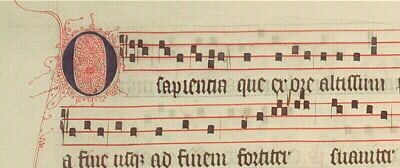
O uncreated Wisdom, who art so soon to make Thyself visible to Thy creatures, truly Thou disposest all things. It is by Thy permission that the emperor Augustus issues a decree ordering the enrolment of the whole world. Each citizen of the vast empire is to have his name enrolled in the city of his birth. This prince has no other object in this order, which sets the world in motion, but his own ambition. Men go to and fro by millions, and an unbroken procession traverses the immense Roman world; men think they are doing the bidding of man, and it is God whom they are obeying. This world-wide agitation has really but one object; it is, to bring to Bethlehem a man and woman who live at Nazareth in Galilee, in order that this woman, who is unknown to the world but dear to heaven, and who is at the close of the ninth month since she conceived her Child, may give birth to this Child in Bethlehem; for the Prophet has said of Him: ‘His going forth is from the beginning, from the days of eternity. And thou, O Bethlehem! art not the least among the thousand cities of Juda, for out of thee He shall come.’2 O divine Wisdom! how strong art Thou in thus reaching Thine ends by means which are infallible, though hidden; and yet, how sweet, offering no constraint to man’s free-will; and withal, how fatherly, in providing for our necessities! Thou choosest Bethlehem for Thy birth-place, because Bethlehem signifies the house of bread. In this, Thou teachest us that Thou art our Bread, the nourishment and support of our life. With God as our food, we cannot die. O Wisdom of the Father, living Bread that hast descended from heaven, come speedily into us, that thus we may approach to Thee and be enlightened3 by Thy light, and by that prudence which leads to salvation.
A Prayer for the Time of Advent
(The Mozarabic breviary, fourth Sunday of Advent, Oratio)
Monday of the Third Week of Advent
Cap. xxviii.Hæc dicit Dominus Deus: Ecce ego mittam in fundamentis Sion lapidem, lapidem probatum, angularem, pretiosum, in fundamento fundatum. Qui crediderit, non festinet. Et ponam in pondere judicium, et justitiam in mensura, et subvertet grando spem mendacii, et protectionem aquæ inundabunt. Et delebitur fœdus vestrum cum morte, et pactum vestrum cum inferno non stabit.
Ch. xxviii.Thus saith the Lord God: Behold I will lay a stone in the foundations of Sion, a tried stone, a corner-stone, a precious stone, founded in the foundation. He that believeth, let him not hasten. And I will set judgement in weight, and justice in measure; and hail shall overturn the hope of falsehood, and waters shall overflow its protection. And your league with death shall be abolished, and your covenant with hell shall not stand.
Heavenly Father! Thou art preparing to set in the foundations of Sion a corner-stone, that is tried and solid; and this stone, which is to give firmness to Sion Thy Church, is Thy Incarnate Son. It was prefigured, as Thy apostle assures us,1 by that rock of the desert, which yielded the abundant and saving stream that quenched the thirst of Thy people. But now Thou art about to give us the reality; it has already come down from heaven, and the hour is fast approaching when Thou wilt lay it in the foundations. O sacred Stone, which makest all one, and givest solidity to the whole structure! By Thee it will come to pass, that there shall be no longer Jew or Gentile, but all nations shall become one family. Men shall no more build on sand, nor set up houses which floods and storms may overturn. The Church shall rise up from the stone which God now sets, and, secure on the great foundation, her summit shall touch the clouds. With all his weakness, and all his fickleness, man will partake of Thy immutability, O divine Stone, if he will but lean on Thee. Woe to him that rejects Thee, for Thou hast said, and Thou art the eternal Truth: 'Whosoever shall fall upon that stone, shall be bruised; and upon whomsoever it shall fall, it will grind him to powder.’2 From this twofold evil, O Thou that art chief corner-stone, deliver us, and never permit us to be of the number of those blind men who rejected Thee. Give us grace ever to honour and love Thee as the cause of our strength, and the one sole origin of our solidity: and since Thou hast communicated this Thy quality of the rock to one of Thine apostles, and by him to his successors unto the end of the world, grant us ever to cling to this rock, the holy Roman Church, in union with which all the faithful on the face of the earth are preparing to celebrate the glorious solemnity of Thy coming, O precious and tried Stone! Thou art coming, that Thou mayst destroy the kingdom of falsehood, and break the league which mankind had made with death and hell.
Hymn for Advent
(In the Mozarabic breviary, first Sunday of Advent)
Rerum parenti proximas
Quas esse sentit gratias,
Laudesque promat maximas.
Perfecit olim tradita,
Cum nos redemit unicus
Factoris orbis Filius.
Tulit reatum criminum,
Sumensque nostrum pulverem,
Mortis peremit principem.
Sed sempiternus a Patre,
Duabus in substantiis,
Persona sola est Numinis.
Nitescat ut cultu novo
Renatus in nato Deo,
Factus novus vetus homo.
Ovans trophæo, gentium
Renata plebs per gratiam
Hæc festa præbet annua.
Votis feratur omnibus,
Quos sustinere convenit,
Tanti diei gloriam.
Orbemque terror presserit;
Succurrat hæc humillima
Susceptionis dignitas.
Ejusque soli Filio,
Cum Spiritu Paraclito,
In sempiterna sæcula.
laud the graces that are nigh,
and sing their highest praises
to their Creator.
who created this world, redeemed us,
he fulfilled the promises
which the heavensent prophets spoke in the ages past.
and shown himself to men,
took away the punishment due to their sins;
and assuming our nature, though but dust, he vanquished the prince of death.
but begotten eternally from the Father,
in the two substances there is but one Person,
that is the Person of the Word.
that our old man being changed into the new,
we may put on new beauty
by being regenerated in the new-born God.
in gladness and exultation
at the trophy won by the divine Nativity,
keep every year its feast.
be celebrated with devout solemnity by all,
who have so just a share
in the glory of this great day.
shall burst upon the world and fill it with fear,
this most humble expression
of our devout celebration of the first may give us confidence.
and to his only Son,
and to the holy Spirit,
be glory for ever and ever.
Prayer from the Ambrosian Missal
(In the Mass of the sixth Sunday of Advent, Preface).
| Previous December 16: Saint Eusebius, Bishop of Vercelli and Martyr | Next Monday of the Third Week of Advent |