lyp.network

Daily reading

December 22 · Sanctoral

December 22, 2029

From Dom Guéranger’s The Liturgical Year.

December 22: Sixth Antiphon
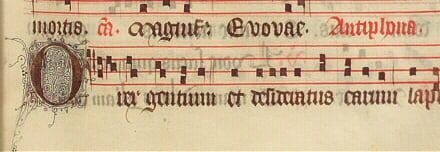
O Rex gentium, the chant in the Poissy Antiphonal, folios 31r and 31v
Poissy Antiphonal, c. 1335–1345, fol. 31r–31v. State Library Victoria.
O Rex gentium, et desideratus earum, lapisque angularis, qui facis utraque unum; veni, et salva hominem quem de limo formasti.
O King of nations, and their desired One, and the corner stone that makest both one; come and save man whom thou formedst out of slime.

O King of nations! Thou art approaching still nigher to Bethlehem, where Thou art to be born, The journey is almost over, and Thy august Mother, consoled and strengthened by the dear weight she bears, holds an unceasing converse with Thee on the way. She adores Thy divine Majesty; she gives thanks to Thy mercy; she rejoices that she has been chosen for the sublime ministry of being Mother to God. She longs for that happy moment when her eyes shall look upon Thee, and yet she fears it. For, how will she be able to render Thee those services which are due to Thy infinite greatness, she that thinks herself the last of creatures? How will she dare to raise Thee up in her arms, and press Thee to her heart, and feed Thee at her breasts? When she reflects that the hour is now near at hand, in which, being born of her, Thou wilt require all her care and tenderness, her heart sinks within her; for, what human heart could bear the intense vehemence of these two affections—the love of such a Mother for her Babe, and the love of such a creature for her God? But Thou supportest her, O Thou the Desired of nations! for Thou, too, longest for that happy birth, which is to give to the earth its Saviour, and to men that corner-stone, which will unite them all into one family. Dearest King! be Thou blessed for all these wonders of Thy power and goodness! Come speedily, we beseech Thee, come and save us, for we are dear to Thee, as creatures that have been formed by Thy divine hands. Yea, come, for Thy creation has grown degenerate; it is lost; death has taken possession of it: take Thou it again into Thy almighty hands, and give it a new creation; save it; for Thou hast not ceased to take pleasure in and love Thine own work.

The Great Antiphon in Honour of Christ.

O Rex pacifice, tu ante sæcula nate, per auream egredere portam, redemptos tuos visita, et eos illuc revoca, unde ruerunt per culpam.
O King of peace! that wast born before all ages, come by the golden gate; visit them whom thou hast redeemed, and lead them back to the place whence they fell by sin.

Saturday in Ember Week of Advent

Prope est jam Dominus; venite adoremus.
The Lord is now nigh: come, let us adore.

The lessons from the prophet Isaias are interrupted to-day also; and a homily on the Gospel of the Mass is read in their place. As this Gospel is repeated to-morrow, in the Mass of the fourth Sunday of Advent, we will, for the present, omit it, and be satisfied with mentioning the reason of the same Gospel being assigned to the two days.

The primitive custom, in the Roman Church, was to hold ordinations in the night between Saturday and Sunday, just as Baptism was administered to the catechumens in the night between Holy Saturday and Easter Sunday. The ceremony took place towards midnight, and Sunday morning was always far advanced before the termination; so that the Mass of ordination was considered as the Mass of Sunday itself. Later on, discipline relaxed, and these severe vigils were given up; the ordination Mass, like that of Holy Saturday, was anticipated; and, as the fourth Sunday of Advent and the second of Lent had not hitherto had a proper Gospel, since they had not had a proper Mass, it was settled, about the tenth or eleventh century, that the Gospel of the Mass of ordinations should be repeated in the special Mass of the two Sundays in question.

The Station is at St. Peter’s on account of the ordinations. This basilica was always one of the largest of the city of Rome, and was therefore the best suited for the great concourse of people.

Let us honour Mary upon this day of the week, which is consecrated to her; let us borrow a canticle from the oriental Church, ever profuse in its praise of the Mother of God.

Hymn Taken from the Anthology of the Greeks

(December 15)

Ut thronus purpuriformis Creatorem fers; ut animatus thalamus regem circumdas, Deo gratissima.
Virga virtutis germinasti Christum in quo stabilimur; te enim figurabat virga Aaron, olim germinans inculta; casta columba, semper Virgo.
Hymnificare modum superadmirabilem, et omnem sensum superantem extraordinariæ tuæ graviditatis nesciunt omnium hominum catervae; omnem enim mentem et cogitationem prætergreditur, ac intelligentias, omnium et verborum virtutem.
Miraculum inenarrabile conceptionis atque immemorandum gestationis tuæ prodigium videns Isaias, divina voce clamabat: Spiritus sanctus supervenit in te, Dei Mater! rubum to servans ut olim incombustum; et ideo cum angelo clamamus: Gaude, Dei tabernaculum.
As a royal throne, thou carriest the Creator; as a living couch, thou encirclest the King, O creature most dear to God:
Branch most vigorous, thou didst bud forth the Christ on whom we lean and are supported; for Aaron’s branch, which, of old, budded unplanted, was a type of thee, thou chaste dove, and ever a Virgin.
To sing the more than wonderful manner of thy extraordinary and incomprehensible maternity, is above the power of all the choirs of men: for no mind, no thought, no understanding, no words, can reach the mystery.
Isaias, seeing the unspeakable miracle, the ineffable miracle of thy maternity, spoke thus divinely: The holy Spirit hath come upon thee, O Mother of God! preserving thee, as heretofore he kept entire the burning bush: and, therefore, we cry out with the angel: Rejoice, O thou tabernacle of God!

Prayer from the Mozarabic Missal
(Fifth Sunday of Advent, Illatio)

Dignum et justum est nos tibi gratias agere, Domine sancte, Pater æterne, omnipotens Deus, per Jesum Christum Filium tuum Dominum nostrum. Ejus incarnatio salus facta est mundi, et passio exstitit redemptio hominis procreati. Ipse igitur nos, omnipotens Pater, quæsumus, perducat ad praemium, qui redemit de tenebris infernorum. Ipse carnem nostram a delictis emaculet, qui eam suscepit ex Virgine. Ipse nos læsos tuæ restituat majestati, qui nos tibi per sanguinem suum reconciliavit. Ipse nos secundi adventus examinatione justificet, qui in primo contulit donum gratiae suas. Ipse ad judicandum veniat mitis, qui olim apparuit humilis. Ipse in judicium ostendatur nobis mitissimus, qui dudum venit occultus.
It is meet and just that we give thee thanks, O holy Lord, eternal Father, almighty God, through Jesus Christ thy Son our Lord. His Incarnation was the salvation of the world, and his Passion the redemption of his creature man. Therefore we beseech thee, O almighty Father, may he lead us to heaven, who purchased us from dark hell. May he cleanse our flesh from its sins, who took to himself that flesh from the Virgin. May he again bring us from our treason to fidelity, who reconciled us to thee by his Blood. May he make and find us just in the judgement of his second coming, who conferred upon us the gift of his grace in the first. May he come to judge us in meekness, who heretofore came in humility to dwell with us. May he show himself in gentlest meekness when he judges us, who heretofore hid himself in deepest humility when he redeemed us.
Previous
Friday in Ember Week of Advent
Next
Saturday in Ember Week of Advent