This day

May 17, 2026

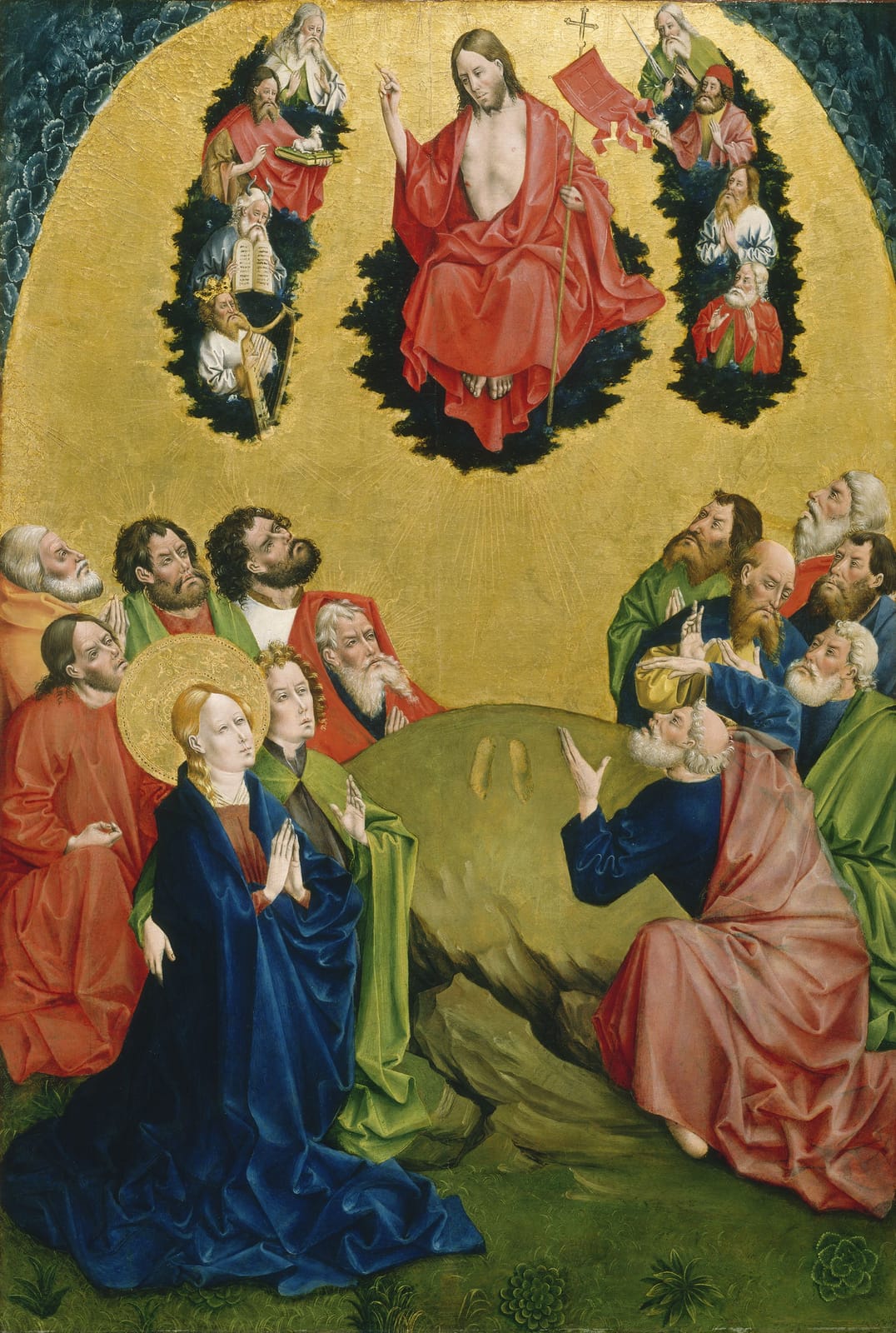
Christ in a red robe ascends in a mandorla while Mary and the apostles kneel on the mount
The Ascension, Johann Koerbecke (c. 1420–1491), 1456–57. Credits

Paschal Time

May 17, 2026

Sunday within the Octave of the Ascension

From Dom Guéranger’s The Liturgical Year.

O King of glory, Lord of hosts, who didst this day ascend in triumph above all the heavens! leave us not orphans, but send upon us the Spirit of truth, promised by the Father, alleluia.

Jesus has ascended into heaven. His Divinity had never been absent; hut, by the Ascension, His Humanity was also enthroned there, and crowned with the brightest diadem of glory. This is another phase of the mystery we are now solemnizing. Besides a triumph, the Ascension gave to the sacred Humanity a place on the very throne of the eternal Word, to whom it was united in unity of Person. From this throne, it is to receive the adoration of men and of angels. At the name of Jesus, Son of Man, and Son of God,—of Jesus who is seated at the right hand of the Father almighty,—'Every knee shall bend, in heaven, on earth and in hell.’

Give ear, O ye inhabitants of earth! This is the Man Jesus, who heretofore was a little Babe wrapped in swaddling clothes; who went through Judea and Galilee, not having where to lay His head; who was bound by the sacrilegious hands of his enemies, was scourged, crowned with thorns, nailed to a cross; who, whilst men thus trampled Him, as a worm, beneath their feet, submitted His will to that of His Father, accepted the chalice of suffering, and, that He might make amends to the divine glory, shed His Blood for the redemption of you sinners.

Chapter 1: The History of Paschal Time

From Dom Guéranger’s The Liturgical Year.

WE give the name of Paschal Time to the period between Easter Sunday and the Saturday following Whit Sunday. It is the most sacred portion of the liturgical year, and the one towards which the whole cycle converges. We shall easily understand how this is, if we reflect upon the greatness of Easter, which is called the feast of feasts, and the solemnity of solemnities, in the same manner, says St. Gregory, as the most sacred part of the Temple was called the Holy of holies; and the book of sacred scripture, wherein are described the espousals between Christ and the Church, is called the Canticle of Canticles. It is on this day that the mission of the Word Incarnate attains the object towards which it has hitherto been tending: man is raised up from his fall and regains what he had lost by Adam’s sin.

Christmas gave us a Man-God; three days have scarcely passed since we witnessed his infinitely precious Blood shed for our ransom; but now, on the day of Easter, our Jesus is no longer the victim of death: He is a conqueror, who destroys death, the child of sin, and proclaims life, that undying life which he has purchased for us.

Christ in a red robe ascends in a mandorla while Mary and the apostles kneel on the mount
Johann Koerbecke (c. 1420–1491), The Ascension, 1456–57. National Gallery of Art, Washington. CC0 (Wikimedia Commons). Credits

Email view of this day