Daily reading
Advent
Double · December 13 · Sanctoral
December 14, 2026
From Dom Guéranger’s The Liturgical Year.
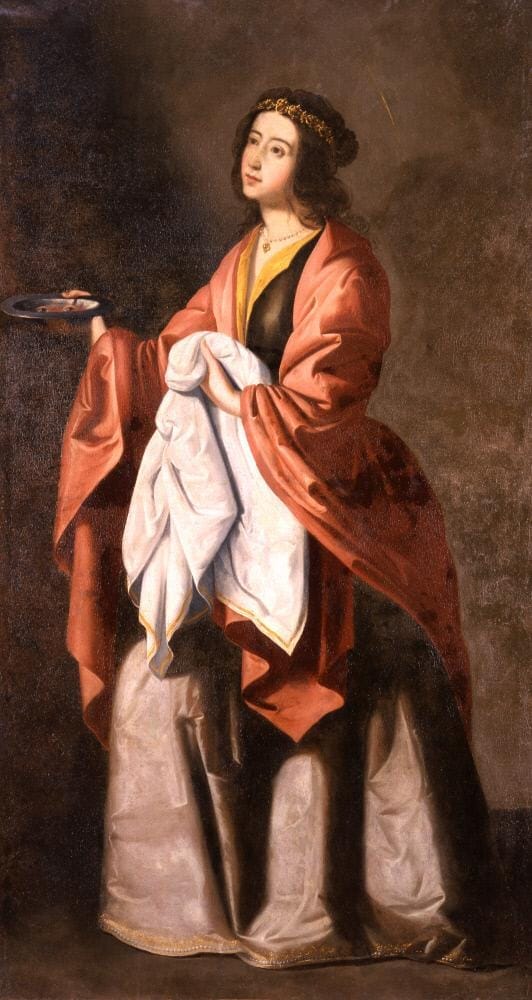 |
December 13: St. Lucy, Virgin and Martyr
We here give some of the antiphons which occur in the Office of the saint: they form a lyric poem of great beauty.
O virgin Lucy! why askest thou of me, what thyself canst straightway grant unto thy mother?
Because of thee, O virgin Lucy! the city of Syracuse shall be honoured by the Lord Jesus Christ.
Words of Lucy: I bless thee, the Father of my Lord Jesus Christ, because by thy Son the fire around me was quenched.
In thy patience thou didst possess thy soul, O Lucy, bride of Christ! thou didst hate the things that are in the world, and thou shinest among the angels. Thou didst conquer the enemy by thine own blood.
We present ourselves before thee, O virgin martyr, beseeching thee to obtain for us that we may recognize in His lowliness that same Jesus whom thou now seest in His glory. Take us under thy powerful patronage. Thy name signifies light; guide us through the dark night of this life. O fair light of virginity! enlighten us; evil concupiscence has wounded our eyes: pray for us, O thou bright light of virginity! that our blindness be healed, and that rising above created things, we may be able to see that true light, which shineth in darkness, but which darkness cannot comprehend. Pray for us, that our eye may be purified, and may see, in the Child who is to be born at Bethlehem, the new Man, the second Adam, the model on which the life of our regeneration must be formed. Pray too, O holy virgin, for the Church of Rome and for all those which adopt her form of the holy Sacrifice; for they daily pronounce at the altar of God thy sweet name; and the Lamb, who is present, loves to hear it. Heap thy choicest blessings on the fair Isle, which was thy native land, and where grew the palm of thy martyrdom. May thy intercession secure to her inhabitants firmness of faith, purity of morals, and temporal prosperity, and deliver them from the disorders which threaten her with destruction.
December 14: The Seventh Day within the Octave of the Immaculate Conception
Let us consider how our blessed Lady, having arrived at the house of her holy cousin Elizabeth, rendered her every possible service with the greatest love, favoured her with her sweet and holy conversations, assisted at the glorious birth of St. John the Baptist, and at length returned home to her humble dwelling in Nazareth. But, that we may the better enter into these divine mysteries, let us again listen to the seraphic St. Bonaventure.
When, therefore, her time was expired, Elizabeth gave birth to a son, whom our Lady took up, and with all diligence did what was required. The babe looked into Mary’s face like one that knew her; and as she gave him unto his mother, he turned his head towards Mary, for he fain would be in her arms again. Mary, on her part, delighted in nursing this holy babe, and fondled him, and kissed him with great joy. Consider the honour that is here given unto John. Never had child such arms as these to carry him. Many other privileges are related as being granted unto him; but for this present, I must needs pass them by.
Now, on the eighth day, the child was circumcised, and was called John. Then was the mouth of Zachary opened, and he prophesied, saying: “Blessed be the Lord God of Israel!” Thus were made, in that house, the two most beautiful canticles, namely, the Magnificat and the Benedictus. Meanwhile our Lady, going aside lest she should be seen by those that had come together for the ceremony, listened attentively to the canticle of Zachary, which prophesied of her Son, and most prudently pondered in her heart upon all these things. At length, when the time came for her to return home, she bade Elizabeth and Zachary farewell, and, giving John her blessing, she returned unto Nazareth. Recall to thy mind, in this her second journey, all that was told thee of her poverty. She returned to her house, where she would find neither bread, nor wine, nor those things which were needed. She had no property, nor money. She had been, now these three months, living with persons who were very rich; but now she returns unto her poor cottage, and has to procure her livelihood by the labour of her hands. Do thou sympathize with her, and learn to love poverty.
Sequence in Honour of Our Blessed Lady
(Taken from the ancient Roman-French Missals)
Cœli jubar, mundi rosa,
Cœlibatus lilium.
Ave, gemma pretiosa,
Super solem speciosa,
Virginale gaudium.
Spes reorum, O Maria,
Redemptoris Mater pia,
Redemptorum gloria.
Finis lethi, vitæ via;
Tibi triplex hierarchia
Digna dat præconia.
Virga Jesse florida,
Stella maris lucida,
Sidus veræ lucis.
Fructum vitæ proferens,
Et ad portum transferens
Salutis, quod ducis.
Florens hortus, ægris gratus,
Puritatis fons signatus,
Dans fluenta gratiæ.
Thronus veri Salomonis,
Quem præclaris cœli donis
Ornavit Rex gloriæ.
O regina pietatis,
Et totius sanctitatis
Flumen indeficiens.
In te salva confidentes,
Salutari sitientes
Potu nos reficiens.
Ad te flentes suspiramus,
Rege mentes, invocamus,
Evæ proles misera.
Statum nostræ paupertatis,
Vultu tuæ bonitatis,
Clementer considera.
Cella fragrans aromatum,
Apotheca charismatum
Salutaris.
Tuam nobis fragrantiam
Spirans, infunde gratiam
Qua ditaris.
Dulcis Jesu Mater bona,
Mundi salus, et Matrona
Supernorum civium,
Pacem confer sempiternam,
Et ad lucem nos supernam
Transfer post exsilium.
Amen.
brightness of the heavens, rose of the world,
lily of purity.
Hail, precious gem!
more beauteous than the sun,
and joy of pure souls.
Thou art the sinner’s hope, O Mary!
thou art the holy Mother of our Redeemer,
and the consolation of us whom he redeemed.
Thou didst stay the reign of death,
thou didst commence the reign of life.
To thee, O Mary, the triple hierarchy sing their praises.
Hail! flowery stem of Jesse,
bright star of the sea,
source that broughtest to us him that is our true light.
Thou bearest the fruit of life,
and he whom thou leadest
will not miss the port of salvation.
O flowery garden, so sweet to the sick!
O sealed fount of purity,
that gavest us Jesus, the author of grace.
Thou throne of the true Solomon,
enriched by the King of glory
with the best of heaven’s gifts.
O merciful Queen!
thou art the rich unfailing
stream of all sanctity.
Have pity on us who trust in thee,
and refresh our thirsty souls
with thy efficacious prayers.
Hear our sighs, O Mary!
and suffer us not,
poor children of Eve, to go astray.
Look with thy eye of love
on our many wants:
compassionate our poverty.
Vessel of every fragrance,
and Mother and treasury
of divine grace.
Breathe thy fragrance
into our souls,
and obtain for us the riches of grace.
Beautiful Mother of our sweet Jesus!
the world received its Saviour through thee,
and the heavenly citizens call thee Queen.
Obtain for us that peace which has no end,
and, after this our exile,
that light which is divine.
Prayer for the Time of Advent
(The Mozarabic breviary, Friday of the second week of Advent, Capitula)
Monday of the Third Week of Advent
Cap. xxviii.Hæc dicit Dominus Deus: Ecce ego mittam in fundamentis Sion lapidem, lapidem probatum, angularem, pretiosum, in fundamento fundatum. Qui crediderit, non festinet. Et ponam in pondere judicium, et justitiam in mensura, et subvertet grando spem mendacii, et protectionem aquæ inundabunt. Et delebitur fœdus vestrum cum morte, et pactum vestrum cum inferno non stabit.
Ch. xxviii.Thus saith the Lord God: Behold I will lay a stone in the foundations of Sion, a tried stone, a corner-stone, a precious stone, founded in the foundation. He that believeth, let him not hasten. And I will set judgement in weight, and justice in measure; and hail shall overturn the hope of falsehood, and waters shall overflow its protection. And your league with death shall be abolished, and your covenant with hell shall not stand.
Heavenly Father! Thou art preparing to set in the foundations of Sion a corner-stone, that is tried and solid; and this stone, which is to give firmness to Sion Thy Church, is Thy Incarnate Son. It was prefigured, as Thy apostle assures us,1 by that rock of the desert, which yielded the abundant and saving stream that quenched the thirst of Thy people. But now Thou art about to give us the reality; it has already come down from heaven, and the hour is fast approaching when Thou wilt lay it in the foundations. O sacred Stone, which makest all one, and givest solidity to the whole structure! By Thee it will come to pass, that there shall be no longer Jew or Gentile, but all nations shall become one family. Men shall no more build on sand, nor set up houses which floods and storms may overturn. The Church shall rise up from the stone which God now sets, and, secure on the great foundation, her summit shall touch the clouds. With all his weakness, and all his fickleness, man will partake of Thy immutability, O divine Stone, if he will but lean on Thee. Woe to him that rejects Thee, for Thou hast said, and Thou art the eternal Truth: 'Whosoever shall fall upon that stone, shall be bruised; and upon whomsoever it shall fall, it will grind him to powder.’2 From this twofold evil, O Thou that art chief corner-stone, deliver us, and never permit us to be of the number of those blind men who rejected Thee. Give us grace ever to honour and love Thee as the cause of our strength, and the one sole origin of our solidity: and since Thou hast communicated this Thy quality of the rock to one of Thine apostles, and by him to his successors unto the end of the world, grant us ever to cling to this rock, the holy Roman Church, in union with which all the faithful on the face of the earth are preparing to celebrate the glorious solemnity of Thy coming, O precious and tried Stone! Thou art coming, that Thou mayst destroy the kingdom of falsehood, and break the league which mankind had made with death and hell.
Hymn for Advent
(In the Mozarabic breviary, first Sunday of Advent)
Rerum parenti proximas
Quas esse sentit gratias,
Laudesque promat maximas.
Perfecit olim tradita,
Cum nos redemit unicus
Factoris orbis Filius.
Tulit reatum criminum,
Sumensque nostrum pulverem,
Mortis peremit principem.
Sed sempiternus a Patre,
Duabus in substantiis,
Persona sola est Numinis.
Nitescat ut cultu novo
Renatus in nato Deo,
Factus novus vetus homo.
Ovans trophæo, gentium
Renata plebs per gratiam
Hæc festa præbet annua.
Votis feratur omnibus,
Quos sustinere convenit,
Tanti diei gloriam.
Orbemque terror presserit;
Succurrat hæc humillima
Susceptionis dignitas.
Ejusque soli Filio,
Cum Spiritu Paraclito,
In sempiterna sæcula.
laud the graces that are nigh,
and sing their highest praises
to their Creator.
who created this world, redeemed us,
he fulfilled the promises
which the heavensent prophets spoke in the ages past.
and shown himself to men,
took away the punishment due to their sins;
and assuming our nature, though but dust, he vanquished the prince of death.
but begotten eternally from the Father,
in the two substances there is but one Person,
that is the Person of the Word.
that our old man being changed into the new,
we may put on new beauty
by being regenerated in the new-born God.
in gladness and exultation
at the trophy won by the divine Nativity,
keep every year its feast.
be celebrated with devout solemnity by all,
who have so just a share
in the glory of this great day.
shall burst upon the world and fill it with fear,
this most humble expression
of our devout celebration of the first may give us confidence.
and to his only Son,
and to the holy Spirit,
be glory for ever and ever.
Prayer from the Ambrosian Missal
(In the Mass of the sixth Sunday of Advent, Preface).
| Previous December 13 (the Same Day): St. Odilia, Virgin and Abbess | Next December 14: The Seventh Day within the Octave of the Immaculate Conception |