lyp.network

Daily reading

Septuagesima

Double · January 24 · Sanctoral

February 3, 2027

From Dom Guéranger’s The Liturgical Year.

St. Timothy transferred from Jan 24.Rubric
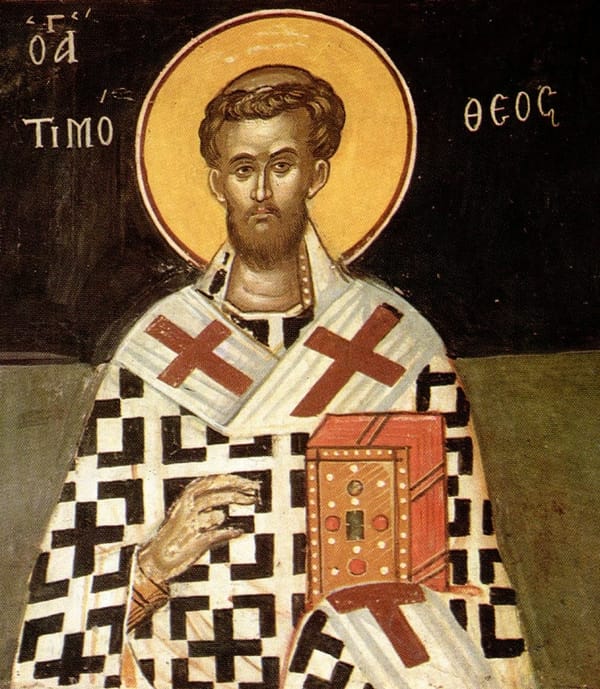
St Timothy as bishop blessing, holding Gospel book, gold halo
Fresco of St Timothy, Stavronikita Monastery, Mount Athos (Commons Agios Timotheos Stavronikita). Credits

January 24: St. Timothy, Bishop and Martyr

BEFORE giving thanks to God for the miraculous Conversion of the Apostle of the Gentiles, the Church assembles us together for the feast of his favourite disciple. Timothy—the indefatigable companion of St Paul—the friend to whom the great Apostle, a few days before shedding his blood for Christ, wrote his last Epistle—comes now to await his master's arrival at the Crib of the Emmanuel. He there meets John the Beloved Disciple, together with whom he bore the anxieties attendant on the government of the Church of Ephesus; Stephen too, and the other martyrs, welcome him, for he also bears a martyr's palm in his hand. He presents to the august Mother of the Divine Babe the respectful homage of the Church of Ephesus, which Mary had sanctified by her presence, and which shares with the Church of Jerusalem the honour of having had her as one of its number, who was not only, like the Apostles, the witness, but moreover, in her quality of Mother of God, the ineffable instrument of the salvation of mankind.

Let us now read, in the Office of the Church, the abridged account of the actions of this zealous disciple of the Apostles.

Timotheus, Lystris in Lycaonia natus ex patre Gentili et matre Judæa, Christianam colebat religionem, cum imca loca venit Paulus Apostolus. Qui fama commotus quæ de Timothei sanctitate percrebuerat, ipsum adhibuit socium suæ peregrinationis: sed propter Judæos, qui se ad Christum converterant, scientes Timothei patrem esse Gentilem, eum circumcidit. Cum igitur ambo Ephesum venissent, ibi ordinatus est Episcopus ab Apostolo, ut eam Ecclesiam gubernaret.
Ad quem Apostolus duas Epistolas scripsit, alteram Laodicea, alteram Roma: quibus in pastoralis officii cura confirmatus, cum sacrificium, quod uni Deo debetur, fieri dæmonum simulacris ferre non posset, populum Ephesinum Dianæ in ejus celebritate immolantem, abilla impietate removere conatus, lapidibus obrutus est; ac pene mortuus a Christianis ereptus, et in montem oppido vicinum delatus, nono kalendas Februarii obdormivit in Domino.
Timothy was born at Lystra in Lycaonia. His father was a Gentile, and his mother a Jewess. When the Apostle Paul came into those parts, Timothy was a follower of the Christian religion. The Apostle had heard much of his holy life, and was thereby induced to take him as the companion of his travels: but on account of the Jews, who had become converts to the faith of Christ, and were aware that the father of Timothy was a Gentile, he administered to him the rite of circumcision. As soon as they arrived at Ephesus, the Apostle ordained him Bishop of that Church.
The Apostle addressed two of his Epistles to him—one from Laodicea, the other from Rome—to instruct him how to discharge his pastoral office. He could not endure to see sacrifice, which is due to God alone, offered to the idols of devils; and finding that the people of Ephesus were offering victims to Diana on her festival, he strove to make them desist from their impious rites. But they, turning upon him, stoned him. The Christians could not deliver him from their hands till he was more dead than alive. They carried him to a mountain not far from the town, and there, on the ninth of the Kalends of February (January 24), he slept in the Lord.

The Greek Church celebrates the memory of St Timothy in her Menæa, from which we extract the following strophes.

Die XXII Januarii

Deisapiens Timothee, torrentem ingressus es deliciarum, et divinitus hausisti gnosim, ferventes imitatus amatores Christi, cujus nunc lætanter adiisti gloriam, contemplans Trinitatem splendidissimam et pacem placidissimam.
Deisapiens Timothee, frequentibus corporis debilitatibus et infirmitatibus corroboratus secundum mentem, erroris potentiam facile dissolvisti, Christi custoditus potestate, et prædicasti sublimiter divinissimum pacis nobis Evangelium.
Mundi fines tua nunc decantant miracula, Thaumaturge immortalis; miraculis etenim te Christus remunerans adornavit, propter ipsum tormenta perpessum, et pro morte tolerata immortali gloria et beatitudine donavit.
Effusa est, omnisancte, abundanter gratia e labiis tuis, et flumina dogmatum scaturire fecit Christi Ecclesiam irrigantia et centuplicem ferentia fructum, o Timothee, Christi præco, divine Apostole.
Mortificans tuæ membra carnis Verbo subjecisti; dans pejoris, beate Timothee, regimen meliori, passionibus dominatus es, et animam alleviasti, Pauli documentis harmonice ordinatus.
Fulgurans quasi sol Paulus te misit quasi radium splendidum terram abundantiori lumine illuminantem lucidissime, Theophantes Timothee, ad directionem nostram et confirmationem.
Currus Dei apparuisti, Timothee, portans divinum nomen, ante impios tyrannos, Deograte, non timens istorum crudelitatem; tu enim invincibilem Salvatoris fortitudinem induisti.
Coronam gloriosam recepisti, Timothee omnibeate, divina mente prædite, Apostole, et diadema regni præcinxisti, et astitisti ante thronum magistri tui, cum Paulo decoratus in æternis tabernaculis, beatissime.
O Timothy! full of godly wisdom! thou didst enter into the torrent of delights, and drink in of the mysterious knowledge, imitating the fervent lovers of Christ, into whose glory thou hast now joyfully gone, contemplating the infinitely resplendent Trinity, and most tranquil peace.
O Timothy! full of godly wisdom! thy frequent weaknesses and ailments of body gave thee strength of spirit; thou didst readily reduce to nought the power of error, for thou wast guarded by the power of Christ, and sublimely didst thou preach to us the most divine Gospel of peace.
The furthermost ends of the earth now sing thy miracles, immortal Thaumaturgus! for Christ rewarding thee, adorned thee with the gift of miracles, because thou didst suffer torments for his sake; and he gave thee, for the death thou didst endure, glory and blessedness everlasting.
Most holy Saint! grace flowed in plenty from thy lips, and made the streams of dogma water the Church of Christ, and yield fruit a hundredfold, O Timothy! thou herald of Christ! thou Apostle of God!
Mortifying thy flesh, thou didst subject it to the Word: and making what is superior govern that which is inferior, O blessed Timothy! thou didst master thy passions and unburden thy soul, and the harmony was established in thee which was taught by blessed Paul.
He, Paul, brilliant as the sun, sent thee forth as a shining ray, that thou mightest most brightly illumine the earth with a rich abundance of light, unto our direction and encouragement, O Timothy, thou revealer of God!
O Timothy I as a chariot of God, thou didst carry his divine name before impious tyrants, fearing not their cruelty, O thou beloved of God! for thou hadst clad thyself with the invincible strength of Jesus.
O most blessed Timothy! O divinely gifted mind! O Apostle! thou hast received a glorious crown; thy brow has been encircled with a heavenly crown; and thou hast stood before the throne of thy Master, beautiful in glory, together with Paul, in the eternal tabernacles, O most blessed one!

In thee, O holy Pontiff! we honour one of the disciples of the Apostles—one of the links which connect us immediately with Christ. Thou appearest to us all illumined by thy intercourse with Paul the great Doctor of the Gentiles. Another of his disciples, Dionysius the Areopagite, made thee the confidant of his sublime contemplations on the Divine Names; but now, bathed in light eternal, thou thyself art contemplating the Sun of Justice, in the beatific vision. Intercede for us, who enjoy but a glimpse of his beauty through the veil of his humiliations, that we may so love him, as to merit to see him one day in his glory. In order to lessen the pressure of the corruptible body, which weigheth down the soul,* thou didst subject thy outward man to so rigorous a penance that St Paul exhorted thee to moderate it: do thou assist us in our endeavours to reduce our flesh to obedience to the spirit. The Church reads without ceasing the counsels, which the Apostle gave to thee, and to all Pastors through thee, for the election and the conduct of the clergy: pray that the Church may be blessed with Bishops, Priests, and Deacons, endowed with all those qualifications which he requires from the dispensers of the mysteries of God. Lastly, we beseech thee, who didst ascend to heaven decked with the aureole of martyrdom, encourage us who are also soldiers of Christ, that we may throw aside our cowardice, and win that kingdom where he welcomes and crowns his elect for all eternity.


* Wisd. ix 15. ↩︎


February 3: St. Blaise, Bishop and Martyr

Now that the Church has closed the joyous period of her forty days of Christmas, and is putting us through a course of meditations on subjects which are to excite a spirit of penance within us, each of the saints’ feasts must produce an impression, which shall be in accordance with that spirit. From this day till Easter, we will study the saints, as they come to us, in this special light: how much they laboured and suffered during their pilgrimage of life, and what was the plan they took for conquering the world and the flesh. ‘They went,’ says the psalmist, ‘and wept, casting their seeds: but coming they shall come with joyfulness, carrying their sheaves.’* It shall be the same with us; and at the end of our lenten labours, our risen Jesus will hail us as His living, regenerated children.

The calendar of this portion of the year abounds with martyrs; and, at the very outset, we meet with one of the most celebrated of these glorious champions of Christ. The scene of his pastoral virtues and of his martyrdom was Sebaste, a city of Armenia, the same that will give us forty martyred soldiers on a single day. The devotion to St. Blase is, even to this day, most fervently kept up in the east, especially in Armenia. The western Churches Boon began to love and honour his memory, and so universally, that we might call him one of the most popular of our saints. His feast, however, with us is only a simple, and the Church of Rome has given only one lesson on his life.

Blasius, Sebaste in Armenia cum virtutum laude floreret, ejusdem civitatis episcopus eligitur. Qui quo tempore Diocletianus insatiabilem crudelitatem in Christianos exercebat, se in speluncam abdidit montis Argæi, ubi tamdiu latuit, dum ab Agricolai præsidis militibus venantibus deprehensus, et ad præsidem ductus, ejus jussu conjectus est in vincula. Quo in loco multos ægrotos sanavit, qui ad Blasium, ejus fama sanctitatis adducti, deferebantur. In illis puer fuit, qui, desperata a medicis salute, transversa spina fauci bus inhærente, animam agebat. Productus autem ad præsidem Blasius semel et iterum, cum nec blanditiis, nec mims adduci posset ut diis sacrificaret, primum virgis cæsus, deinde in equuleo ferreis pectinibus dilaniatus est: postremo, dempto capite, illustre fidei testimonium Christo Domino dedit, tertio Nonas Februarii.
Blase, whose signal virtues made him dear to the people of Sebaste in Armenia, was chosen bishop of that city. When the emperor Diocletian waged his cruel persecution against the Christians, the saint hid himself in a cave on Mount Argeus, and there he remained some time concealed, but was at length discovered by some soldiers of the governor Agricolaus, while they were hunting. They led him to the governor, who gave orders that he should be put into prison. During his imprisonment, many sick people, attracted by the reputation of his sanctity, came to him, and he healed them. Among these was a boy, whose life was despaired of by the physicians, on account of his having swallowed a bone, which could not be extracted from his throat. The saint was twice brought before the governor, but neither fair promises nor threats could induce him to offer sacrifice to the gods. Whereupon, he was first beaten with rods, and then his flesh was torn with iron hooks while he lay stretched on the rack. At length he was beheaded, and nobly gave testimony to the faith of Christ our Lord, on the third of the Nones of February (February 3).

Accept, O glorious martyr, the praise which we, too, offer thee in union with that given thee by the whole Church. In return for this homage of our veneration, look down upon the Christian people, who are now preparing to enter on the season of penance, and to be converted to the Lord their God by holy compunction and tears. We ask it of thee by thine own combat: assist us in the one for which we are preparing. When duty required thee to undergo tortures and death, it found thee ready and brave; our duty is expiation by penance, and thy prayers must get us courage. Our enemies are not more cruel than thine, but they are more treacherous, and if we spare them we are lost. Obtain for us that heavenly assistance, which enabled thee to conquer. We are children of the martyrs; God forbid we should be degenerate! Pray, too, O holy pontiff, for the country thou didst water with thy blood. Armenia lost the faith for which thou didst lay down thy life. Intercede for her, that she may be restored to the Church, and let her conversion bring consolation to the few that have remained orthodox and faithful.


* Ps. cxxv. 6, 7. ↩︎


Wednesday of Sexagesima Week

O God of infinite justice! we have sinned; we have abused the life Thou hast given us: and when we read, in Thy Scriptures, how Thine anger chastised the sinners of former days, we are forced to acknowledge, that we have deserved to be treated in like manner. We have the happiness to be Christians and children of Thy Church; the light of faith, and the power of Thy grace, have brought us once more into Thy friendship; but how can we forget that we were once Thy enemies? And are we so deeply rooted in virtue, that we can promise ourselves perseverance in it to the end? Pierce, O Lord! pierce my flesh with Thy fear.1 Man’s heart is hard, and unless it fear Thy sovereign Majesty, it may again offend Thee.

We are penetrated with fear, when we remember that Thou didst bury the world and destroy mankind by the waters of the deluge; for we learn by this, how Thy patience and long-suffering may be changed into inexorable anger. Thou art just, O Lord! and who shall presume to take scandal, or to murmur, when Thy wrath is enkindled against sinners?

We have defied Thy justice, we have braved Thine anger; for, though Thou hast told us that Thou wilt never more destroy sinners by a deluge of water, yet we know that Thou hast created, in Thy hatred for sin, a fire, which shall eternally prey on them that depart this life without being first reconciled with Thy offended Majesty.

O wonderful dignity of our human nature! We cannot be indifferent towards that infinite Being that created us: we must be His friends or His enemies! It could not have been otherwise. Ile gave us understanding and free-will: we know what is good and what is evil, and we must choose the one or the other: we cannot remain neutral. If we choose good, God turns towards us and loves us; if evil, we separate from Him, who is our sovereign Good. But, whereas He bears most tender mercy towards this frail creature whom He created out of pure love, and because He wills that all men should be saved, He waits with patience for the sinner to return to Him, and, in countless ways, draws his heart to repentance.

But woe to him that obeys not the divine call, when that call is the last! Then justice takes the place of mercy, and revelation tells us how fearful a thing it is to fall into the hands of the living God.2 Let us, then, flee from the wrath to come,3 by making our peace with the God we have offended. If we be already restored to grace, let us walk in His fear, until love shall have grown strong enough in our hearts to make us run the way of the commandments.4

The following prayer is from the Mozarabic breviary of the Gothic Church of Spain.

Oratio
(In capite jejunii.)

Averte faciem tuam a peccatis nostris, Domine, et omnes iniquitates nostras dele; remove ab oculis tuis malarum nostrarum facinus voluptatum, nostræque confessioni clementer tuum appone auditum. Miserere, quæsumus, rogantibus nobis, qui propitius respicis in adversis, et qui desperatis cor pœnitens tribuis ad confessionem gloriæ tuæ. Sed quia publicanus a longe stans et percutiens pectus suum, sola confessione purgatus est, similiter et nos peccatores exaudi; ut sicut illi meritospetitionis suæ fructus donasti, ita et nobis supplicantibus indignis servistuis veniam digneris impendere peccatis. Amen.
Turn away thy face from our sins, O Lord, and blot out all our iniquities. Take from thine eyes the guilt of our sinful pleasures, and mercifully incline thine ear to our confession. Have mercy, we beseech thee, upon us thy suppliants, O thou that lookest with pity on them that are in affliction, and givest to the disconsolate a penitent heart, that so they may praise thy name. The publican who stood afar off and struck his breast, found forgiveness by this alone, that he confessed his sin; do thou, in like manner, mercifully hear us sinners and as thou didst give to him the fruit his prayer deserved, so also vouchsafe to grant unto us, thy suppliant unworthy servants, the pardon of our sins. Amen.

  1. Ps. cxviii. 120. ↩︎
  2. Heb. x. 31. ↩︎
  3. St. Matt. iii. 7. ↩︎
  4. Ps. cxviii. 32. ↩︎
Previous
Tuesday of Sexagesima Week
Next
February 3: St. Blaise, Bishop and Martyr