This day

November 5, 2026

After Pentecost

November 5, 2026

November 5: Fifth Day within the Octave of All Saints

From Dom Guéranger’s The Liturgical Year.

And the Spirit and the Bride say: Come And he that heareth, let him say: Come! — Surely I come quickly: Amen. Come, Lord Jesus.

While we honour the Church triumphant with our chants, and succour the Church suffering with our prayers, let us also turn our thoughts to the Church militant, during these days when the closing cycle presents her to us as about to complete her work on earth. Now the Church is our model; but especially at the close of our pilgrimage ought we to make her attitude our own. The above-cited dialogue, which will terminate the world's history, shows clearly the sentiments wherewith the Holy Spirit inspires her in preparation for the final hour.

As the sufferings of the dying man break the last ties that bound him to the life of the senses; so the last social convulsions, however violently they may shake the Church, will eventually disengage her from the trammels of a world, which she will no longer be able to save from ruin. Free, therefore, to give herself up to her desires, which had been pent up for ages and kept under control by so many labours, she will have but one word to utter: Come!

This week's Sunday: The Twenty-Third Sunday after Pentecost

From Dom Guéranger’s The Liturgical Year.

When the number of the Sundays after Pentecost is only twenty-three, the Mass for to-day is taken from the twenty-fourth and last Sunday; and the Mass appointed for the twenty-third is said on the previous Saturday, or on the nearest day of the preceding week which is not impeded by a double or semi-double feast.

But, under all circumstances, the antiphonary ends to-day. The Introits, Graduals, Communions, and Postcommunions, which are given below, are to be repeated on each of the Sundays till Advent, which vary in number each year. Our readers will remember that, in the time of St. Gregory, Advent was longer than we now have it; and that, in those days, its weeks commenced in that part of the cycle which is now occupied by the last Sundays after Pentecost. This is one of the reasons for the lack of liturgical riches in the composition of the dominical Masses which follow the twenty-third.

Even on this one, the Church, without losing sight of the last day, used to lend a thought to the new season which was fast approaching, the season, that is, of preparation for the great feast of Christmas.

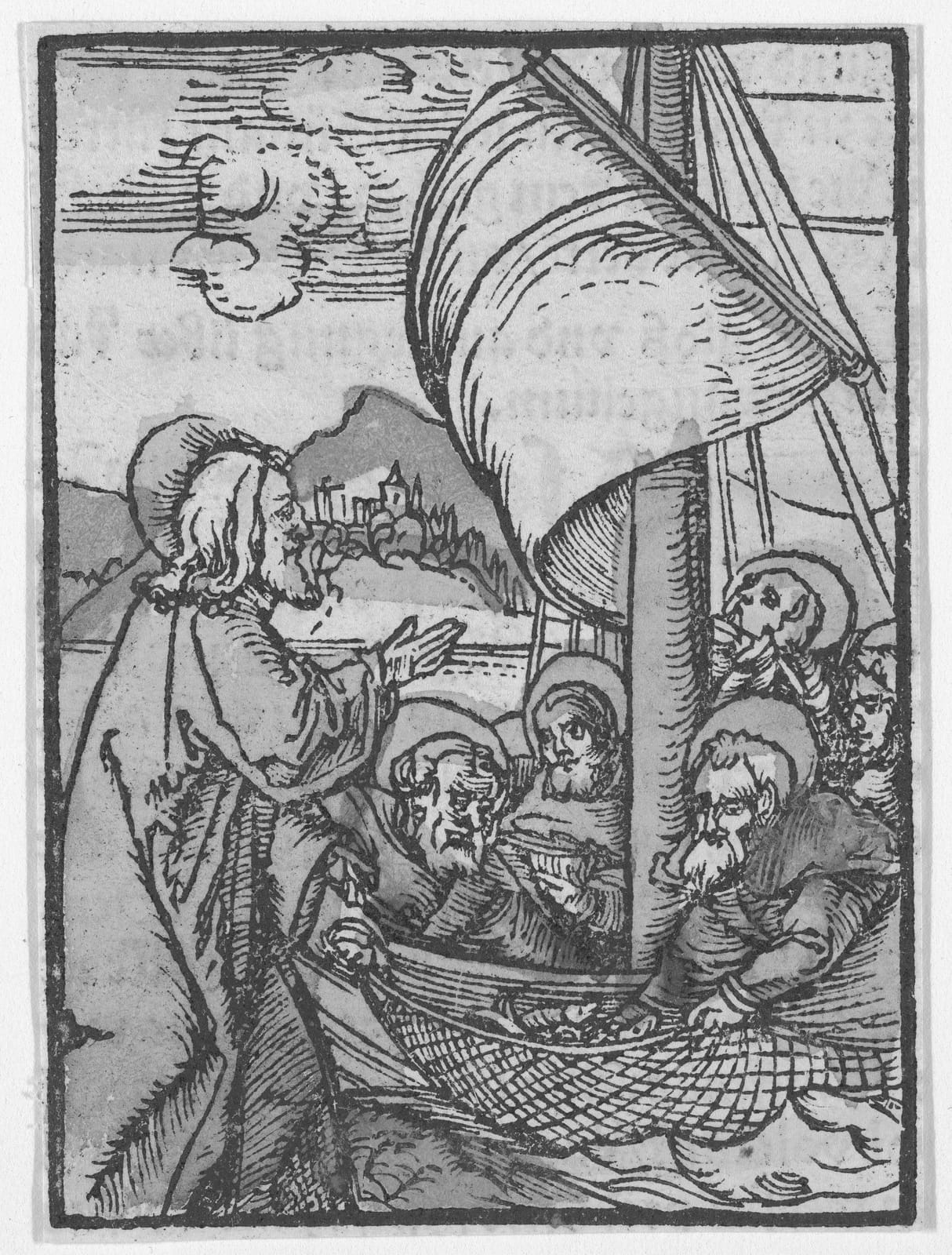
Peter hauling in a second draught of fishes
Hans Schäufelein (1480–1540), The Second Draught of Fishes by Saint Peter, from Das Plenarium, 1517. Credits

Email view of this day